Noise-Clustered Distant Supervision for Relation Extraction: A
Nonparametric Bayesian Perspective
Qing Zhang and Houfeng Wang
Key Laboratory of Computational Linguistics (Peking University) Ministry of Education, China {zqicl,wanghf}@pku.edu.cn
Abstract
For the task of relation extraction, dis-tant supervision is an efficient approach to generate labeled data by aligning knowl-edge base with free texts. The essence of it is a challenging incomplete multi-label classification problem with sparse and noisy features. To address the challenge, this work presents a novel nonparametric Bayesian formulation for the task. Ex-periment results show substantially higher top-precision improvements over the tradi-tional state-of-the-art approaches.
1 Introduction
To efficiently generate structured relation informa-tion from free texts, the research on distantly su-pervised Relation Extraction (RE) (Mintz et al., 2009;Riedel et al., 2013;Hoffmann et al.,2011) has been attracting much attention, because it can greatly reduce the manual annotation for training. It essentially based on the assumption that the re-lation between two entities in a Knowledge Base (KB), is also likely hold within a sentence that mentions the two entities in free texts. This as-sumption plays a crucial role in distant supervi-sion, which is quite effective in real applications.
However, the assumption of distant alignment can also lead to the noisy training corpus prob-lem (Fan et al., 2014), which is challenging for the task as follows: i) Noisy features. Not all relations existed in a KB keep the same mean-ing of that relation for the correspondmean-ing entities in a free text. For example, the second relation mention in Figure 1 does not explicitly describe any relation instance, so features extracted from this sentence can be noisy. Such analogous cases commonly exist in feature extraction. ii) Incom-plete labels. Similar to noisy features, the
gener-Figure 1: Aligned Example (Fan et al., 2014): the relation instances related to the entity pair hBarackObama, U.S.i in the KB, and its men-tions in the free text.
ated label can be incomplete due to the incomplete knowledge base (Ritter et al., 2013). For exam-ple, the fourth relation mention in Figure 1 should be labeled by the relation Senate-of. However, the corresponding relation instance (Senate-of(Barack Obama, U.S.)) is missing in the knowledge base. Such analogous cases are also common in real ap-plications. iii) Sparse features. Sophisticated features extracted from the mentions can result in a large number of sparse features (Riedel et al., 2013). The generalization ability of feature based prediction models will be badly hurt, when the fea-tures do not match between testing and training.
To tackle the problem, we develop a novel dis-tant supervision approach from a nonparametric Bayesian perspective (Blei et al., 2016), along with the previously most effective research line (Petroni et al.,2015) of using matrix completion (Fan et al.,2014) for relation extraction. Our goal is to design a noise-tolerant relation extraction model for distantly supervised corpus with noise and sparsity problems. Different from (Fan et al., 2014) as one state-of-the-art method in this line, we model noisy data corpus using adaptive vari-ance modeling approach (Chen et al.,2015), based on Dirichlet Process (Blei and Jordan, 2004) in-stead of a fixed way of controlling complex noise weighting. To the best of our knowledge, we are
the first to apply this technique on relation extrac-tion with distant supervision.
2 Approach
The essence of the task is a multi-label classifica-tion problem (Cabral et al.,2011) with noisy pat-terns (Han and Sun, 2014). One simple way, to solve the problem, is to learn separate classifiers for each of relation labels, usingnsamples withd features, by optimizingb∈R1×1andw∈Rd×1,
argminb,wl(ytrain,[1Xtrain]
b w
), (1)
where 1 is the all-one column vector; Xtrain ∈
Rn×d and ytrain ∈ Rn×1 are the
correspond-ing feature matrix and label vector respectively. However, label correlations are not considered in the above formulation. To jointly consider feature correlations and label correlations, (Cabral et al., 2011) formulated the multi-label classification as a matrix completion problem. As a powerful frame-work, it has been successfully applied to relation extraction task with distant supervision.
2.1 Previous Formulation
The work in (Fan et al., 2014) first adopted the mentioned framework, as a general joint learning and inference framework (Cabral et al.,2011), to learn noise-tolerant distant supervision for rela-tion extracrela-tion. It achieves the state-of-the-art per-formance. Suppose we have a training corpus, in-cluding n instances (entity pairs) including both training and test data, withd-dimensional features and trelation labels, which is built according to the basic alignment assumption. The task can be modeled with a sparse matrixZ ∈ Rn×(d+t),
de-fined as
Z =
Xtrain Ytrain
Xtest Ytest
, (2)
where each row in Z represents entity pair, and each column represents noisy textual feature inX or incomplete relation label inY. In such a way, relation extraction is transformed into a problem of completing the unknown labels inYtest for the
test dataXtest inZ. The rational of this
model-ing is that noisy features and incomplete labels are semantically correlated, which can be explained in an underlying low-rank structure (Riedel et al., 2013). Taking noise into consideration,Z is fur-ther defined as
Z =Z∗+E, (3)
whereZ∗ is the underlying low-rank matrix
Z∗ =
X∗
train Ytrain∗
X∗
test Ytest∗
, (4)
andEis the error (noise) matrix
E=
EXtrain EYtrain
EXtest 0
. (5)
This error (noise) modeling approach has been successfully applied to distantly supervised rela-tion extracrela-tion. However, it still has clear lim-itations. The noise model is limited to a single source without considering the intrinsic clustering structures of data. In addition, the true rank is usu-ally hard to determine, for adaptively modeling the correlations among features and labels.
2.2 Nonparametric Bayesian Modeling
The use of nonparametric Bayesian modeling has been widely adopted in Natural Language Pro-cessing (NLP) (Chen et al.,2014). Instead of im-posing assumptions that might be wrong, it “lets the data speak for itself”, without requiring opti-mizing parameters blindly by hands (Blei and Jor-dan,2004). To take advantage of these merits, we here adopt it for the task, with the following moti-vations:
Motivation 1: Adaptive Noise-Clustered At-tention. The goal is to find an adaptive cluster specific noise parameterization for the complex noisy corpus, without making overly strong as-sumptions about the noise distribution in real ap-plications.
Motivation 2: Adaptive Latent Feature Space Selection.The goal is to automatically find better dense representations of latent entity-pair, feature and label without pre-specifying the rank values by laboriously retraining models.
2.2.1 Nonparametric Bayesian Formulation
We develop a novel formulation for distantly su-pervised relation extraction, using a nonparamet-ric Bayesian approach, based on the Dinonparamet-richlet Pro-cess, which can been seen as an infinite Dirich-let distribution, with clustering effect for modeling categorical variables adaptively.
Noise component modeling. Instead of using a single fixed noise model, we redefineE= [εi,j]∈
Rn×(d+t) in Eq.(5). εi,j is modeled by a
p(εi,j) =
∞ X
k=1
θkN(εi,j|0, σk), (6)
where θk is the mixing proportion for the k-th
gaussian componentN(εi,j|0, σk)with mean zero
and varianceσk. Theθis obtained from the
stick-breaking process (Blei and Jordan, 2004), with P∞
k=1θk= 1,
θk=βk kY−1
l=1
(1−βl), (7)
whereβkare independent draws from the beta
dis-tribution β(1, α). As a result, the noise entries will cluster themselves intoKgroups without re-quiring a complicated model selection procedure. Since a mixture of Gaussians can approximate any continuous probability distribution (Zhao et al., 2014), this structural noise formulation can adapt much wider range of real noises than previous for-mulation (Fan et al.,2014) for relation extraction.
Low-rank component modeling. Different from (Fan et al., 2014), instead of directly min-imizing the rank of Z∗ in Eq.(3), we decom-pose Z∗ into two low-rank matrices U and V, from probabilistic perspective (Salakhutdinov and Mnih,2007). This modeling approach can lead to a more flexible way of estimating the optimal rank values for latent feature spaces. To determine the appropriate rank automatically, we adopt the Au-tomatic Relevance Determination (ARD) method (Babacan et al.,2012) by imposing a prior on each dimmension (column) of U and V. Specifically, we impose the Gaussian priors with variance λr
on ther-th columns ofU andV, i.e.,u.randv.r:
p(U|λ) =
R
Y
r=1
N(u.r|0, λrIU),
p(V|λ) =YR
r=1
N(v.r|0, λrIV),
λr ∼IG(a1, b1),
(8)
where IG is an Inverse Gamma distribution for modeling the varianceλr. Considering a column
as latent factor in U or V with a zero mean in the prior, a very small variance indicates that this column will shrink to zero. Thus, the irrelevant columns hurting the performance will be elimi-nated adaptively, without pre-specifying the rank values by retraining models laboriously as in the previous modeling (Fan et al.,2014) for the task.
Prediction component modeling. We can leverage the above presented low-rank component for U, V and noise component for εi,j, to build
Eq.(9) for prediction. Different from the state-of-the-art multi-label classification framework as adopted in (Fan et al., 2014), for simplicity, we design noise model for features and labels jointly,
p(yi,j) =N(yi,j|
ui.vj.T
| {z }
low−rank component
, |{z}εi,j noise component
), (9)
whereui.andvj.are defined in Eq.(8) as rows of
U andV respectively.
For each interaction between entity-pair and feature (or relation),εi,j as defined in Eq.(6) can
be injected into Eq.(9) (Chen et al.,2015) by εi,j =σzij,
σzij ∼IG(a0, b0),
zij =k∼Mult(θk),
(10)
whereθkis modeled in Eq.(7); Mult is a
Multino-mial distribution.
The mechanism of the introduced clustered noise component for relation extraction can be easily understood through considering its role in the Gaussian distribution. As shown in Eq.(9), εi,j is used to control the variance. Large
vari-ance value means low confidence, and the small value means high confidence, for fitting yi,j with
ui.vTj.. The variance parameterεi,j, generated by
noise component Eq.(7,10), serves as a confidence parameter for training instance. In the algebra view of likelihood, variance parameter is just the weight of training instance (i.e., the interaction be-tween ”entity pair and feature” or ”entity pair and label”), measuring the importance for its contribu-tion to the total likelihood. We can treat this mech-anism as an importance weighting mechmech-anism, for selecting noisy interactionsyijwith different
clus-tering structures adaptively.
In this mechanism, for eachyi,jin noisy corpus,
Dataset #training #testing %more than one label #features #relation labels
NYT’10 4,700 1,950 7.5% 244,903 51
[image:4.595.86.519.138.310.2]NYT’13 8,077 3,716 0% 1,957 51
Table 1: Statistics about the two widely used datasets.
(a) NYT’10 dataset (b) NYT’13 dataset
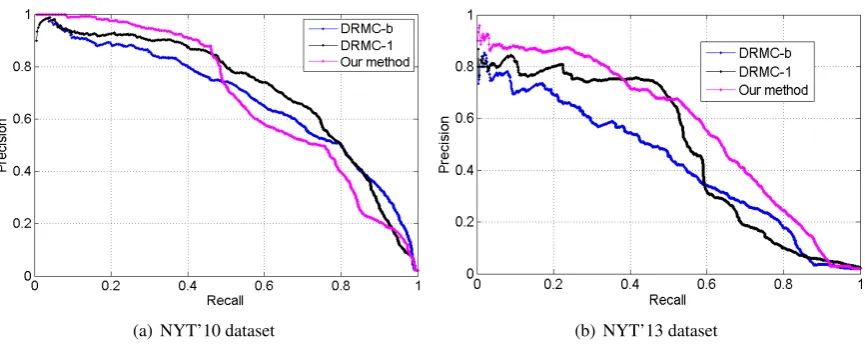
Figure 2: Precision-Recall curve on NYT’10 and NYT’13 datasets. DRMC-b(1) (Fan et al.,2014).
Models P R F1
Mintz 63.59% 61.20% 62.37% Hoffmann 67.18% 36.41% 47.23% Surdeanu 76.23% 53.18% 62.65% DRMC-b 61.03% 66.82% 63.79% DRMC-1 64.17% 71.74% 67.75%
Our 87.94% 46.00% 63.44% Table 2: Results at the highest F1 point in the Precision-Recall (P-R) curve on NYT’10 dataset. Mintz (Mintz et al.,2009); Hoffmann (Hoffmann et al., 2011); Surdeanu (Surdeanu et al., 2012); DRMC-b(1) (Fan et al.,2014);
Learning. To combine Eqs. (7)-(10), we can construct the full Bayesian model. The goal turns to infer the posterior of all involved variables:
p(U,V, λ, σ,z, β|Xobserved,Yobserved), (11)
where Xobserved,Yobserved are the observed
bi-nary features (fitting 1) and labels (fitting both 1 and 0). Variational inference is adopted as shown in (Chen et al.,2015).
Prediction. After learning1, we use the expec-tationE(P(yi,j))in Eq.(9) to complete the entries
inYtest. Finally, we can acquire Top-N predicted
relations via ranking the valuesE(P(yi,j)), given
entity pairi, for different relationsj.
1We implement the system for relation extraction, based
on the code at http://peixianc.me/amf codes.zip.
3 Experiments
We evaluate our method on two widely used datasets as shown in Table 1 with the same setting in (Fan et al.,2014).
Dataset. NYT’10, was developed by (Riedel et al.,2010).NYT’13, was also released by (Riedel et al., 2013), in which they only regarded the lexicalized dependency path between two entities as features. Both are automatically generated by aligning Freebase to New York Times corpus.
Parameter setting. For all the conducted ex-periments, the model hyperparameters are fixed without further tuning: a0 = b0 = 10−4, a1 =
b1 = 0.1andα= 1.
[image:4.595.78.286.351.449.2]Top-N
NFE-13 DRMC-b DRMC-1 Our
Top-100 62.9% 82.0% 80.0% 92.0%
Top-200 57.1% 77.0% 80.0% 88.2%
Top-500 37.2% 70.2% 77.0% 86.3%
[image:5.595.71.294.63.147.2]Average 52.4% 76.4% 79.0% 88.8%
Table 3: Precision of Top-N predicted instances on NYT’13 dataset. NFE-13 (Riedel et al.,2013); DRMC-b(1) (Fan et al.,2014).
Models P R F1
DRMC-b 47.70% 49.58% 48.62% DRMC-1 67.99% 50.42% 57.90%
Our 66.46% 53.30% 59.16%
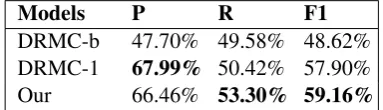
Table 4: Results at the highest F1 point in the Precision-Recall (P-R) curve on NYT’13 dataset. DRMC-b(1) (Fan et al.,2014).
Top-N predicted instances. Table 3 shows that our model achieves much significant improvements on that. Moreover, Table 4 shows that our method can achieve the best F1, compared with the baselines.
NYT’10 and NYT’13 have different perfor-mance records, which could be explained as fol-lows. From the dataset perspective, NYT’10 is a dataset with multi-label instances, which is more complex than NYT’13 only having single label in-stances. This is one reason of why the trends are quite different between them. More essentially, we further discuss the differences from the model mechanism perspective, to explain the reasons. In (Fan et al., 2014)’s work, it has no explicit noise modeling mechanism. The noise is modeled im-plicitly as the error of cost functions. From the probabilistic view, that error is sampled from sin-gle Gaussian with zero mean and fixed variance. In contrast, our method uses infinite Gaussian with automatically learnt variance. It may cause over-fitting for complex dataset with sparse features. In addition, we guess the reason is that in (Fan et al., 2014)’s work, they use two separate cost func-tions for features and labels, while in our work we use one unified noise component for both of them, which shows the promising precision performance in NYT’10 when recall is less than 0.4.
In addition, in our experiments, we found that early stopping is crucial for achieving good re-sults while model learning. This also verifies that the potential overfitting problem should be further considered while using the more flexible
nonpara-metric method for NLP task. 4 Related Work
Our work is closest to (Fan et al., 2014), since we focus on the same noisy corpus problem. Al-though from different perspectives, we study it along with the same line of using matrix factoriza-tion (Petroni et al.,2015) for relation extraction. In this line, (Riedel et al.,2013) initially considered the task as a matrix factorization problem. Their method consists of several models, such as PCA (Collins et al., 2001) and collaborative filtering (Koren,2008). However, the data noise brought by the assumption of distant supervision (Mintz et al., 2009), is not considered in the work. Another line addressing the problem uses deep neural networks (Zeng et al.,2015;Wang et al.,2015). The differ-ence is that it is a supervised learning approach, while our focused one is a joint learning approach with transductive style, in which both training and test data are exploited simultaneously. In addi-tion, (Han and Sun,2016) explored Markov logic technique to enrich supervision knowledge, which can incorporate indirect supervision globally. Our method could be further augmented by that idea, using additional logical constraint to reduce the uncertainty for the clustered noise modeling. 5 Conclusion
In this paper, building on recent advances from the nonparametric Bayesian literature, we reformulate the task of relation extraction with distant super-vision, based on the adaptive variance learning with intrinsic clustering structures. For the task, it can solve the sparsity problem via the learnt low-rank dense representations and can allow fit-ting noisy corpus through adaptive variance ad-justment. Meanwhile, it can avoid turning a large number of parameters. Experiments suggest sub-stantially higher top-precision than the competi-tors. In the future work, we plan to develop more sophisticated noise models for features and labels separately, and try to explore logical information, particularly in this context of nonparametric noise modeling, for further benefiting this task.
Acknowledgments
[image:5.595.85.277.206.261.2]References
S. Derin Babacan, Martin Luessi, Rafael Molina, and Aggelos K. Katsaggelos. 2012. Sparse bayesian
methods for low-rank matrix estimation. IEEE
Transactions on Signal Processing, 60(8):3964– 3977.
David M. Blei and Michael I. Jordan. 2004. Variational methods for the dirichlet process. InProceedings of the International Conference on Machine Learning, Banff, Alberta, Canada.
David M. Blei, Alp Kucukelbir, and Jon D. McAuliffe. 2016. Variational inference: A review for
statisti-cians. CoRR, abs/1601.00670.
Ricardo Silveira Cabral, Fernando De la Torre, Jo˜ao Paulo Costeira, and Alexandre Bernardino. 2011. Matrix completion for multi-label image
clas-sification. In Proceedings of Advances in Neural
Information Processing Systems, Granada, Spain., pages 190–198.
Miaohong Chen, Baobao Chang, and Wenzhe Pei. 2014. A joint model for unsupervised chinese word
segmentation. InProceedings of the Conference on
Empirical Methods in Natural Language Process-ing, Doha, Qatar, pages 854–863.
Peixian Chen, Naiyan Wang, Nevin L. Zhang, and Dit-Yan Yeung. 2015. Bayesian adaptive matrix factor-ization with automatic model selection. In Proceed-ings of IEEE Conference on Computer Vision and Pattern Recognition, MA, USA, pages 1284–1292. Michael Collins, Sanjoy Dasgupta, and Robert E.
Schapire. 2001. A generalization of principal com-ponents analysis to the exponential family. In ceedings of Advances in Neural Information Pro-cessing Systems, British Columbia, Canada, pages 617–624.
Miao Fan, Deli Zhao, Qiang Zhou, Zhiyuan Liu, Thomas Fang Zheng, and Edward Y. Chang. 2014. Distant supervision for relation extraction with ma-trix completion. InProceedings of the Annual Meet-ing of the Association for Computational LMeet-inguis- Linguis-tics, Baltimore, MD, USA, pages 839–849.
Xianpei Han and Le Sun. 2014. Semantic consistency: A local subspace based method for distant super-vised relation extraction. InProceedings of the An-nual Meeting of the Association for Computational Linguistics, Baltimore, MD, USA, pages 718–724. Xianpei Han and Le Sun. 2016. Global distant
super-vision for relation extraction. InProceedings of the AAAI Conference on Artificial Intelligence, Phoenix, Arizona, USA., pages 2950–2956.
Raphael Hoffmann, Congle Zhang, Xiao Ling, Luke S. Zettlemoyer, and Daniel S. Weld. 2011. Knowledge-based weak supervision for information extraction of overlapping relations. InProceedings of Annual Meeting of the Association for Computa-tional Linguistics , Oregon, USA, pages 541–550.
Yehuda Koren. 2008. Factorization meets the neigh-borhood: a multifaceted collaborative filtering
model. InProceedings of the International
Confer-ence on Knowledge Discovery and Data Mining, Las Vegas, Nevada, USA, pages 426–434.
Mike Mintz, Steven Bills, Rion Snow, and Daniel Ju-rafsky. 2009. Distant supervision for relation ex-traction without labeled data. InProceedings of the 47th Annual Meeting of the Association for Compu-tational Linguistics, Singapore, pages 1003–1011. Fabio Petroni, Luciano Del Corro, and Rainer Gemulla.
2015. CORE: context-aware open relation
extrac-tion with factorizaextrac-tion machines. In Proceedings
of the Conference on Empirical Methods in Natu-ral Language Processing, Lisbon, Portugal, pages 1763–1773.
Sebastian Riedel, Limin Yao, and Andrew McCallum. 2010. Modeling relations and their mentions
with-out labeled text. InProceedings of Machine
Learn-ing and Knowledge Discovery in Databases, Euro-pean Conference, Barcelona, Spain, pages 148–163. Sebastian Riedel, Limin Yao, Andrew McCallum, and Benjamin M. Marlin. 2013. Relation extraction with matrix factorization and universal schemas. In
Proceedings of Conference of the North American Chapter of the Association of Computational Lin-guistics, Atlanta, Georgia, USA, pages 74–84. Alan Ritter, Luke Zettlemoyer, Mausam, and Oren
Et-zioni. 2013. Modeling missing data in distant super-vision for information extraction.TACL, 1:367–378. Ruslan Salakhutdinov and Andriy Mnih. 2007. Proba-bilistic matrix factorization. In Proceedings of Ad-vances in Neural Information Processing Systems, British Columbia, Canada, pages 1257–1264. Mihai Surdeanu, Julie Tibshirani, Ramesh Nallapati,
and Christopher D. Manning. 2012. Multi-instance multi-label learning for relation extraction. In Pro-ceedings of the Conference on Empirical Methods in Natural Language Processing, Jeju Island, Korea, pages 455–465.
Zhen Wang, Baobao Chang, and Zhifang Sui. 2015. Distantly supervised neural network model for
rela-tion extracrela-tion. InProceedings of Chinese
Compu-tational Linguistics and Natural Language Process-ing, Guangzhou, China, pages 253–266.
Daojian Zeng, Kang Liu, Yubo Chen, and Jun Zhao. 2015. Distant supervision for relation extraction via
piecewise convolutional neural networks. In
Pro-ceedings of the Conference on Empirical Methods in Natural Language Processing, Lisbon, Portugal, pages 1753–1762.
Qian Zhao, Deyu Meng, Zongben Xu, Wangmeng Zuo, and Lei Zhang. 2014. Robust principal component
analysis with complex noise. In Proceedings of