Neural Morphological Analysis: Encoding-Decoding Canonical Segments
Katharina KannCenter for Information and Language Processing LMU Munich, Germany
Ryan Cotterell
Department of Computer Science Johns Hopkins University, USA
Hinrich Sch¨utze
Center for Information and Language Processing LMU Munich, Germany
Abstract
Canonical morphological segmentation aims to divide words into a sequence of stan-dardized segments. In this work, we propose a character-based neural encoder-decoder model for this task. Additionally, we extend our model to include morpheme-level and lexical information through a neural reranker. We set the new state of the art for the task improving previous results by up to 21% accuracy. Our experiments cover three languages: English, German and Indonesian.
1 Introduction
Morphological segmentation aims to divide words into morphemes, meaning-bearing sub-word units. Indeed, segmentations have found use in a diverse set of NLP applications, e.g., automatic speech recognition (Afify et al., 2006), keyword spot-ting (Narasimhan et al., 2014), machine transla-tion (Clifton and Sarkar, 2011) and parsing (Seeker and C¸etino˘glu, 2015). In the literature, most re-search has traditionally focused onsurface segmen-tation, whereby a word w is segmented into a se-quence of substrings whose concatenation is the en-tire word; see Ruokolainen et al. (2016) for a sur-vey. In contrast, we considercanonical segmenta-tion: w is divided into a sequence of standardized segments. To make the difference concrete, con-sider the following example: the surface segmen-tation of the complex English wordachievabilityis achiev+abil+ity, whereas its canonical
segmenta-tion isachieve+able+ity, i.e., we restore the
alter-ations made during word formation.
Canonical versions of morphological segmenta-tion have been introduced multiple times in the lit-erature (Kay, 1977; Naradowsky and Goldwater, 2009; Cotterell et al., 2016). Canonical segmen-tation has several represensegmen-tational advantages over surface segmentation, e.g., whether two words share a morpheme is no longer obfuscated by orthogra-phy. However, it also introduces a hard algorith-mic challenge: in addition to segmenting a word, we must reverse orthographic changes, e.g., map-pingachievability7→achieveableity.
Computationally, canonical segmentation can be seen as a sequence-to-sequence problem: we must map a word form to a canonicalized version with segmentation boundaries. Inspired by the re-cent success of neural encoder-decoder models (Sutskever et al., 2014) for sequence-to-sequence problems in NLP, we design a neural architecture for the task. However, a na¨ıve application of the encoder-decoder model ignores much of the linguis-tic structure of canonical segmentation—it cannot directly model the individual canonical segments, e.g., it cannot easily produce segment-level embed-dings. To solve this, we use a neural reranker on top of the encoder-decoder, allowing us to embed both characters and entire segments. The combined approach outperforms the state of the art by a wide margin (up to 21% accuracy) in three languages: En-glish, German and Indonesian.
2 Neural Canonical Segmentation
We begin by formally describing the canonical segmentation task. Given a discrete alphabet
Σ (e.g., the 26 letters of the English alphabet),
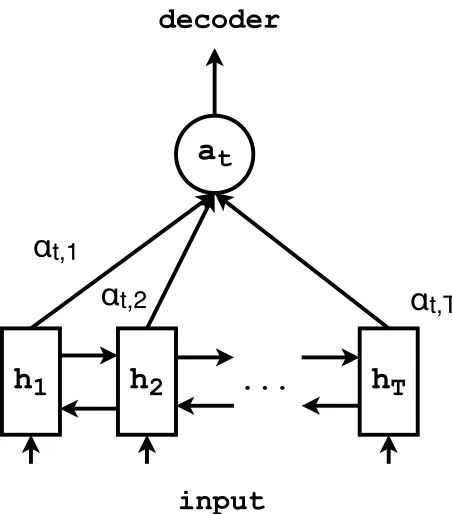
Figure 1:Detailed view of the attention mechanism of the neu-ral encoder-decoder.
our goal is to map a word w ∈ Σ∗ (e.g.,
w=achievability), to a canonical segmentationc ∈
Ω∗ (e.g., c=achieve+able+ity). We define Ω = Σ∪{+}, where+is a distinguished separation
sym-bol. Additionally, we will write the segmented form asc=σ1+σ2+. . .+σn, where each segmentσi ∈Σ∗ andnis the number of canonical segments.
We take a probabilistic approach and, thus, at-tempt to learn a distribution p(c| w). Our model consists of two parts. First, we apply an encoder-decoder recurrent neural network (RNN) (Bahdanau et al., 2014) to the sequence of characters of the input word to obtain candidate canonical segmen-tations. Second, we define a neural reranker that allows us to embed individual morphemes and chooses the final answer from within a set of can-didates generated by the encoder-decoder.
2.1 Neural Encoder-Decoder
Our encoder-decoder is based on Bahdanau et al. (2014)’s neural machine translation model.1 The en-coderis a bidirectional gated RNN (GRU) (Cho et al., 2014b). Given a word w ∈ Σ∗, the input to
1github.com/mila-udem/blocks-examples/tree/master/machine_
translation
the encoder is the sequence of characters ofw, rep-resented as one-hot vectors. The decoder defines a conditional probability distribution over c ∈ Ω∗
givenw:
pED(c|w) =
|c|
Y
t=1
p(ct|c1, . . . , ct−1, w)
=
|c|
Y
t=1
g(ct−1, st, at)
wheregis a nonlinear activation function, stis the state of the decoder attandatis a weighted sum of the|w|states of the encoder. The state of the encoder forwiis the concatenation of forward and backward hidden states−→hi and←h−iforwi. An overview of how the attention weight and the weighted sum at are included in the architecture can be seen in Figure 1. The attention weightsαt,i at each timesteptare computed based on the respective encoder state and the decoder statest. See Bahdanau et al. (2014) for further details.
2.2 Neural Reranker
The encoder-decoder, while effective, predicts each output character inΩ sequentially. It does not use
explicit representations for entire segments and is in-capable of incorporating simple lexical information, e.g., does this canonical segment occur as an inde-pendent word in the lexicon? Therefore, we extend our model with a reranker.
The reranker rescores canonical segmentations from a candidate set, which in our setting is sampled from pED. Let the sample set beSw = {k(i)}Ni=1
where k(i) ∼ p
ED(c | w). We define the neural
reranker as
pθ(c|w) =
expu>tanh(W vc) +τlogpED(c|w)
Zθ
where vc=Pni=1vσi (recall c = σ1+σ2+. . .+σn) and vσi is a one-hot morpheme embedding of σi with an additional binary dimension marking if σi occurs independently as a word in the language.2
The partition function is Zθ(w) and the parame-ters are θ = {u, W, τ}. The parameters W and u
2To determine if a canonical segment is in the lexicon, we
are projection and hidden layers, respectively, of a multi-layered perceptron andτ can be seen as a tem-perature parameter that anneals the encoder-decoder modelpED(Kirkpatrick, 1984). We define the
parti-tion funcparti-tion over the sample setSw:
Zθ =
X
k∈Sw
expu>tanh(W vk)+τlogpED(k|w)
.
The reranking model’s ability to embed mor-phemes is important for morphological segmenta-tion since we often have strong corpus-level signals. The reranker also takes into account the character-level information through the score of the encoder-decoder model. Due to this combination we expect stronger performance.
3 Related Work
Various approaches to morphological segmentation have been proposed in the literature. In the un-supervised realm, most work has been based on the principle of minimum description length (Cover and Thomas, 2012), e.g., LINGUISTICA(Goldsmith, 2001; Lee and Goldsmith, 2016) or MORFESSOR (Creutz and Lagus, 2002; Creutz et al., 2007; Poon et al., 2009). MORFESSORwas later extended to a semi-supervised version by Kohonen et al. (2010). Supervised approaches have also been considered. Most notably, Ruokolainen et al. (2013) developed a supervised approach for morphological segmen-tation based on conditional random fields (CRFs) which they later extended to work also in a semi-supervised way (Ruokolainen et al., 2014) using letter successor variety features (Hafer and Weiss, 1974). Similarly, Cotterell et al. (2015) improved performance with a semi-Markov CRF.
More recently, Wang et al. (2016) achieved state-of-the-art results on surface morphological segmen-tation using a window LSTM. Even though Wang et al. (2016) also employ a recurrent neural network, we distinguish our approach, in that we focus on canonicalmorphological segmentation, rather than surfacemorphological segmentation.
Naturally, our approach is also relevant to other applications of recurrent neural network transduc-tion models (Sutskever et al., 2014; Cho et al., 2014a). In addition to machine translation (Bah-danau et al., 2014), these models have been
success-fully applied to many areas of NLP, including pars-ing (Vinyals et al., 2015), morphological reinflec-tion (Kann and Sch¨utze, 2016) and automatic speech recognition (Graves and Schmidhuber, 2005; Graves et al., 2013).
4 Experiments
To enable comparison to earlier work, we use a dataset that was prepared by Cotterell et al. (2016) for canonical segmentation.3
4.1 Languages
The dataset we work on covers 3 languages: En-glish, German and Indonesian. English and German are West Germanic Languages, with the former be-ing an official languages in nearly 60 different states and the latter being mainly spoken in Western Eu-rope. Indonesian — or Bahasa Indonesia— is the official language of Indonesia.
Cotterell et al. (2016) report the best experimental results for Indonesian, followed by English and fi-nally German. The high error rate for German might be caused by it being rich in orthografic changes. In contrast, Indonesian morphology is comparatively simple.
4.2 Corpora
The data for the English language was extracted from segmentations derived from the CELEX database (Baayen et al., 1993). The German data was extracted from DerivBase (Zeller et al., 2013), which provides a collection of derived forms to-gether with the transformation rules, which were used to create the canonical segmentations. Finally, the data for Bahasa Indonesia was collected by us-ing the output of the MORPHINDanalyzer (Larasati et al., 2011), together with an open-source corpus of Indonesian. For each language we used the 10,000 forms that were selected at random by Cotterell et al. (2016) from a uniform distribution over types to form the corpus. Following them, we perform our experiments on 5 splits of the data into 8000 train-ing forms, 1000 development forms and 1000 test forms and report averages.
4.3 Training
We train an ensemble of five encoder-decoder mod-els. The encoder and decoder RNNs each have 100 hidden units. Embedding size is 300. We use ADADELTA(Zeiler, 2012) with a minibatch size of 20. We initialize all weights (encoder, decoder, em-beddings) to the identity matrix and the biases to zero (Le et al., 2015). All models are trained for 20 epochs. The hyperparameter values are taken from Kann and Sch¨utze (2016) and kept unchanged for the application to canonical segmentation described here.
To train the reranking model, we first gather the sample set Sw on the training data. We take 500 individual samples, but (as we often sample the same form multiple times) |Sw| ≈ 5. We op-timize the log-likelihood of the training data using ADADELTA. For generalization, we employL2
reg-ularization and we perform grid search to determine the coefficientλ ∈ {0.0,0.1,0.2,0.3,0.4,0.5}. To
decode the model, we again take 500 samples to populateSw and select the best segmentation. Baselines.Our first baseline is the joint transduction and segmentation model (JOINT) of Cotterell et al. (2016). It is the current state of the art on the datasets we use and the task of canonical segmentation in general. This model uses a jointly trained, separate transduction and segmentation component. Impor-tantly, the joint model of Cotterell et al. (2016) al-ready contains segment-level features. Thus, rerank-ing this baseline would not provide a similar boost.
Our second baseline is a weighted finite-state transducer (WFST) (Mohri et al., 2002) with a log-linear parameterization (Dreyer et al., 2008), again, taken from Cotterell et al. (2016). The WFST baseline is particularly relevant because, like our encoder-decoder, it formulates the problem directly as a string-to-string transduction.
Evaluation Metrics. We follow Cotterell et al. (2016) and use the following evaluation measures: error rate, edit distance and morpheme F1. Error
rate is defined as1minus the proportion of guesses
that are completely correct. Edit distance is the Lev-enshtein distance between guess and gold standard. For this, guess and gold are each represented as one string with a distinguished character denoting the segment boundaries. Morpheme F1 compares the
RR ED Joint WFST UB
error
en .19(.01).25(.01) 0.27(.02)0.63(.01) .06(.01)
de .20(.01).26(.02) 0.41(.03)0.74(.01) .04(.01)
id .05(.01).09(.01) 0.10(.01)0.71(.01) .02(.01)
edit
en .21(.02).47(.02) 0.98(.34)1.35(.01) .10(.02)
de .29(.02).51(.03) 1.01(.07)4.24(.20) .06(.01)
id .05(.00).12(.01) 0.15(.02)2.13(.01) .02(.01)
F1
en .82(.01).78(.01) 0.76(.02)0.53(.02) .96(.01)
de .87(.01).86(.01) 0.76(.02)0.59(.02) .98(.00)
[image:4.612.313.541.57.274.2]id .96(.01).93(.01) 0.80(.01)0.62(.02) .99(.00)
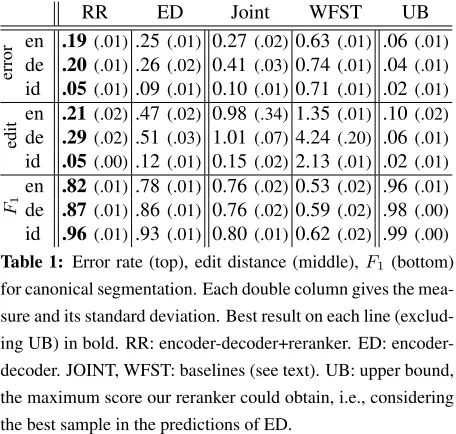
Table 1: Error rate (top), edit distance (middle),F1 (bottom)
for canonical segmentation. Each double column gives the mea-sure and its standard deviation. Best result on each line (exclud-ing UB) in bold. RR: decoder+reranker. ED: encoder-decoder. JOINT, WFST: baselines (see text). UB: upper bound, the maximum score our reranker could obtain, i.e., considering the best sample in the predictions of ED.
morphemes in guess and gold. Precision (resp. re-call) is the proportion of morphemes in guess (resp. gold) that occur in gold (resp. guess).
5 Results
The results of the canonical segmentation experi-ment in Table 1 show that both of our models im-prove over all baselines. The encoder-decoder alone has a .02 (English), .15 (German) and .01 (Indone-sion) lower error rate than the best baseline. The encoder-decoder improves most for the language for which the baselines did worst. This suggests that, for more complex languages, a neural network model might be a good choice.
The reranker achieves an additional improvement of .04 to .06. for the error rate. This is likely due to the additional information the reranker has access to: morpheme embeddings and existing words.
Important is also the upper bound we report. It shows the maximum performance the reranker could achieve, i.e., evaluates the best solution that appears in the set of candidate answers for the reranker. The right answer is contained in≥94% of samples. Note
appropri-ate model for the task. Due to the large gap between the performance of the encoder-decoder and the up-per bound, a better reranker could further increase performance. We will investigate ways to improve the reranker in future work.
Error analysis. We give for representative samples the error (E for the segmentation produced by our method) and the correct analysis (G for gold).
We first analyze cases in which the right an-swer does not appear at all in the samples drawn from the encoder-decoder. Those in-clude problems with umlauts in German (G: verfl¨uchtigen7→ ver+fl¨uchten+ig, E: verflucht+ig)
and orthographic changes at morpheme boundaries (G:cutter7→cut+er, E: cutter or cutt+er, sampled
with similar frequency). There are also errors that are due to problems with the annotation, e.g., the fol-lowing two gold segmentations are arguably incor-rect: tec7→detectiveandsyrerin7→syr+er+in(syris
neither a word nor an affix in German).
In other cases, the encoder-decoder does find the right solution (G), but gives a higher probability to an incorrect analysis (E). Examples are a wrong split into adjectives or nouns instead of verbs (G: f¨ugsamkeit7→f¨ugen+sam+keit, E: f¨ugsam+keit),
the other way around (G: z¨ahler7→zahl+er, E:
z¨ahlen+er), cases where the wrong morphemes
are chosen (G: precognition7→pre+cognition, E:
precognit+ion), difficult cases where letters have
to be inserted (G: redolence7→redolent+ence, E:
re+dolence) or words the model does not split
up, even though they should be (G: additive7→
addition+ive, E:additive).
Based on its access to lexical information and morpheme embeddings, the reranker is able to correct some of the errors made by the encoder-decoder. Samples are G: geschwisterp¨archen7→
geschwisterpaar+chen, E: geschwisterpar+chen
(geschwisterpaaris a word in German but geschwis-terpar is not) or G:zickig7→zicken+ig, E: zick+ig
(withzicken, but notzick, being a German word). Finally, we want to know if segments that appear in the test set without being present in the training set are a source of errors. In order to investigate that, we split the test samples into two groups: The first group contains the samples for which our sys-tem finds the right answer. The second one contains all other samples. We compare the percentage of
wrong samples right samples 27.33 (.02) 36.60 (.01)
Table 2: Percentage of segments in the solutions for the test data that do not appear in the training set - split by samples that our system does or does not get right. We use the German data and average over the 5 splits. Standard deviation in parenthesis.
samples that do not appear in the training data for both groups. We exemplarily use the German data and the results results are shown in Table 2. First, it can be seen that very roughly about a third of all segments does not appear in the training data. This is mainly due to unseen lemmas as their stems are naturally unknown to the system. However, the cor-rectly solved samples contain nearly10%more un-seen segments. As the average number of segments per word for wrong and right solutions —2.44and 2.11, respectively — does not differ by much, it seems unlikely that many errors are caused by un-known segments.
6 Conclusion and Future Work
We developed a model consisting of an encoder-decoder and a neural reranker for the task of canoni-cal morphologicanoni-cal segmentation. Our model com-bines character-level information with features on the morpheme level and external information about words. It defines a new state of the art, improv-ing over baseline models by up to .21 accuracy, 16 pointsF1 and .77 Levenshtein distance.
We found that ≥ 94% of correct segmentations
are in the sample set drawn from the encoder-decoder model, demonstrating the upper bound on the performance of our reranker is quite high; in fu-ture work, we hope to develop models to exploit this.
Acknowledgments
We gratefully acknowledge the financial support of Siemens for this research.
References
Mohamed Afify, Ruhi Sarikaya, Hong-Kwang Jeff Kuo, Laurent Besacier, and Yuqing Gao. 2006. On the use of morphological analysis for dialectal Arabic speech recognition. InProc. of INTERSPEECH.
Dzmitry Bahdanau, Kyunghyun Cho, and Yoshua Ben-gio. 2014. Neural machine translation by jointly learning to align and translate. arXiv preprint arXiv:1409.0473.
Kyunghyun Cho, Bart van Merri¨enboer, Dzmitry Bah-danau, and Yoshua Bengio. 2014a. On the proper-ties of neural machine translation: Encoder-decoder approaches. arXiv preprint arXiv:1409.1259.
Kyunghyun Cho, Bart Van Merri¨enboer, C¸alar G¨ulc¸ehre, Dzmitry Bahdanau, Fethi Bougares, Holger Schwenk, and Yoshua Bengio. 2014b. Learning phrase repre-sentations using RNN encoder–decoder for statistical machine translation. InProc. of EMNLP.
Ann Clifton and Anoop Sarkar. 2011. Combin-ing morpheme-based machine translation with post-processing morpheme prediction. InProc. of ACL. Ryan Cotterell, Thomas M¨uller, Alexander Fraser, and
Hinrich Sch¨utze. 2015. Labeled morphological seg-mentation with semi-markov models. In Proc. of CoNLL.
Ryan Cotterell, Tim Vieira, and Hinrich Sch¨utze. 2016. A joint model of orthography and morphological seg-mentation. InProc. of NAACL.
Thomas M Cover and Joy A Thomas. 2012. Elements of Information Theory. John Wiley & Sons.
Mathias Creutz and Krista Lagus. 2002. Unsupervised discovery of morphemes. In Proc. of the ACL-02 Workshop on Morphological and Phonological Learn-ing.
Mathias Creutz, Teemu Hirsim¨aki, Mikko Kurimo, Antti Puurula, Janne Pylkk¨onen, Vesa Siivola, Matti Var-jokallio, Ebru Arisoy, Murat Sarac¸lar, and Andreas Stolcke. 2007. Morph-based speech recognition and modeling of out-of-vocabulary words across lan-guages. ACM Transactions on Speech and Language Processing, 5(1):3:1–3:29.
Markus Dreyer, Jason R. Smith, and Jason Eisner. 2008. Latent-variable modeling of string transductions with finite-state methods. InProc. of EMNLP.
John Goldsmith. 2001. Unsupervised learning of the morphology of a natural language. Computational Linguistics, 27(2):153–198.
Alex Graves and J¨urgen Schmidhuber. 2005. Frame-wise phoneme classification with bidirectional lstm and other neural network architectures. Neural Net-works, 18(5):602–610.
Alan Graves, Abdel-rahman Mohamed, and Geoffrey Hinton. 2013. Speech recognition with deep recurrent neural networks. InProc of. ICASSP.
Margaret A. Hafer and Stephen F. Weiss. 1974. Word segmentation by letter successor varieties. Informa-tion storage and retrieval, 10(11):371–385.
Katharina Kann and Hinrich Sch¨utze. 2016. Single-model encoder-decoder with explicit morphological representation for reinflection. InProc. of ACL. Martin Kay. 1977. Morphological and syntactic analysis.
Linguistic Structures Processing, 5:131–234.
Scott Kirkpatrick. 1984. Optimization by simulated an-nealing: Quantitative studies. Journal of Statistical Physics, 34(5-6):975–986.
Oskar Kohonen, Sami Virpioja, and Krista Lagus. 2010. Semi-supervised learning of concatenative morphol-ogy. In Proc. of the 11th Meeting of the ACL Spe-cial Interest Group on Computational Morphology and Phonology.
Septina Dian Larasati, Vladislav Kuboˇn, and Daniel Ze-man. 2011. Indonesian morphology tool (morphind): Towards an indonesian corpus. In Proc. of SFCM. Springer.
Quoc V. Le, Navdeep Jaitly, and Geoffrey E. Hin-ton. 2015. A simple way to initialize recurrent networks of rectified linear units. arXiv preprint arXiv:1504.00941.
Jackson L. Lee and John A. Goldsmith. 2016. Linguis-tica 5: Unsupervised learning of linguistic structure. InProc. of NAACL.
Mehryar Mohri, Fernando Pereira, and Michael Ri-ley. 2002. Weighted finite-state transducers in speech recognition. Computer Speech & Language, 16(1):69–88.
Jason Naradowsky and Sharon Goldwater. 2009. Im-proving morphology induction by learning spelling rules. InProc. of IJCAI.
Karthik Narasimhan, Damianos Karakos, Richard Schwartz, Stavros Tsakalidis, and Regina Barzilay. 2014. Morphological segmentation for keyword spot-ting. InProc. of EMNLP.
Hoifung Poon, Colin Cherry, and Kristina Toutanova. 2009. Unsupervised morphological segmentation with log-linear models. InProc. of NAACL.
Teemu Ruokolainen, Oskar Kohonen, Sami Virpioja, and Mikko Kurimo. 2013. Supervised morphological seg-mentation in a low-resource learning setting using con-ditional random fields. InProc. of CoNLL.
Teemu Ruokolainen, Oskar Kohonen, Sami Virpioja, and mikko kurimo. 2014. Painless semi-supervised morphological segmentation using conditional random fields. InProc. of EACL.
Wolfgang Seeker and ¨Ozlem C¸etino˘glu. 2015. A graph-based lattice dependency parser for joint morphologi-cal segmentation and syntactic analysis.TACL, 3:359– 373.
Ilya Sutskever, Oriol Vinyals, and Quoc V. Le. 2014. Sequence to sequence learning with neural networks. InProc. of NIPS.
Oriol Vinyals, Łukasz Kaiser, Terry Koo, Slav Petrov, Ilya Sutskever, and Geoffrey Hinton. 2015. Grammar as a foreign language. InProc. of NIPS.
Linlin Wang, Zhu Cao, Yu Xia, and Gerard de Melo. 2016. Morphological segmentation with window LSTM neural networks. InProc. of AAAI.
Matthew D Zeiler. 2012. Adadelta: an adaptive learning rate method.arXiv preprint arXiv:1212.5701. Britta Zeller, Jan ˇSnajder, and Sebastian Pad´o. 2013.