Named Entity Recognition for Novel Types by Transfer Learning
Lizhen Qu1,2, Gabriela Ferraro1,2, Liyuan Zhou1, Weiwei Hou1,Timothy Baldwin1,3
1 DATA61, Australia
2 The Australian National University 3 The University of Melbourne
{lizhen.qu,gabriela.ferraro,joe.zhou}@data61.csiro.au [email protected],[email protected]
Abstract
In named entity recognition, we often don’t have a large in-domain training corpus or a knowledge base with adequate coverage to train a model directly. In this paper, we pro-pose a method where, given training data in a related domain with similar (but not identical) named entity (NE) types and a small amount of in-domain training data, we use transfer learn-ing to learn a domain-specific NE model. That is, the novelty in the task setup is that we as-sume not just domain mismatch, but also label mismatch.
1 Introduction
There are two main approaches to named entity recog-nition (NER): (i) build sequence labelling models such as conditional random fields (CRFs) (Lafferty et al., 2001) on a large manually-labelled training cor-pus (Finkel et al., 2005); and (ii) exploit knowledge bases to recognise mentions of entities in text (Rizzo and Troncy, 2012; Mendes et al., 2011). For many social media-based or security-related applications, however, we cannot assume that we will have ac-cess to either of these. An alternative is to have a small amount of in-domain training data and access to large-scale annotated data in a second domain, and perform transfer learning over both the features and label set. This is the problem setting in this paper.
NER of novel named entity (NE) types poses two key challenges. First is the issue of sourcing labelled training data. Handcrafted features play a key role in supervised NER models (Turian et al., 2010), but if we have only limited training amounts of training
data, we will be hampered in our ability to reliably learn feature weights. Second, the absence of target NE types in the source domain makes transfer diffi-cult, as we cannot directly apply a model trained over the source domain to the target domain. Alvarado et al. (2015) show that even if the NE label set is identical across domains, large discrepancies in the label distribution can lead to poor performance.
Despite these difficulties, it is possible to transfer knowledge between domains, as related NE types often share lexical and context features. For example, the expressionsgive lecturesandattend tutorials of-ten occur near mentions of NE typesPROFESSOR
andSTUDENT. If onlyPROFESSORis observed in the source domain but we can infer that the two classes are similar, we can leverage the training data to learn an NER model forSTUDENT. In practice, differences between NE classes are often more sub-tle than this, but if we can infer, for example, that the novel NE typeSTUDENTaligns with NE types
PERSONandUNIVERSITY, we can compose the context features ofPERSONandUNIVERSITYto induce a model forSTUDENT.
In this paper, we propose a transfer learning-based approach to NER in novel domains with label mis-match over a source domain. We first train an NER model on a large source domain training corpus, and then learn the correlation between the source and tar-get NE types. In the last step, we reuse the model parameters of the second step to initialise a linear-chain CRF and fine tune it to learn domain-specific patterns. We show that our methods achieve up to 160% improvement in F-score over a strong baseline, based on only 125 target-domain training sentences.
2 Related work
The main scenario where transfer learning has been applied to NER is domain adaptation (Arnold et al., 2008; Maynard et al., 2001; Chiticariu et al., 2010), where it is assumed that the label setY is the same for both the source and target corpora, and only the domain varies. In our case, however, both the domain and the label set differ across datasets.
Similar to our work, Kim et al. (2015) use transfer learning to deal with NER data sets with different label distributions. They use canonical correlation analysis (CCA) to induce label representations, and reduce the problem to one of domain adaptation. This supports two different label mappings: (i) to a coarse label set by clustering vector representations of the NE types, which are combined with mention-level predictions over the target domain to train a target domain model; and (ii) between labels based on the knearest neighbours of each label type, and from this transferring a pre-trained model from the source to the target domain. They showed their automatic label mapping strategies attain better results than a manual mapping, with the pre-training approach achieving the best results. Similar conclusions were reached by Yosinski et al. (2014), who investigated the transferability of features from a deep neural net-work trained over the ImageNet data set. Sutton and McCallum (2005) investigated how the target task affects the source task, and demonstrated that decod-ing for transfer is better than no transfer, and joint decoding is better than cascading decoding.
Another way of dealing with a lack of annotated NER data is to use distant supervision by exploiting knowledge bases to recognise mentions of entities (Ling and Weld, 2012; Dong et al., 2015; Yosef et al., 2013; Althobaiti et al., 2015; Yaghoobzadeh and Sch¨utze, 2015). Having a fine-grained entity typol-ogy has been shown to improve other tasks such as re-lation extraction (Ling and Weld, 2012) and question answering (Lee et al., 2007). Nevertheless, for many social media-based or security-related applications, we don’t have access to a high-coverage knowledge base, meaning distant supervision is not appropriate.
3 Transfer Learning for NER
Our proposed approachTransInitconsists of three steps: (1) we train a linear-chain CRF on a large
source-domain corpus; (2) we learn the correlation between source NE types and target NE types using a two-layer neural network; and (3) we leverage the neural network to train a CRF for target NE types.
Given a word sequence xof length L, an NER system assigns each wordxia labelyi ∈ Y, where
the label spaceYincludes all observed NE types and a special categoryOfor words without any NE type. Let(x,y)be a sequence of words and their labels. A linear-chain CRF takes the form:
1 Z
L Y
l=1
exp
Wff(yl,x) +Wgg(yl−1, yl)
, (1)
wheref(yl,x)is a feature function depending only
onx, and the feature functiong(yl−1, yl)captures
co-occurrence between adjunct labels. The feature functions are weighted by model parametersW, and
Zserves as the partition function for normalisation. The source domain model is a linear-chain CRF trained on a labelled source corpus. The co-occurrence of target domain labels is easy to learn due to the small number of parameters (|Y|2). Mostly
such information is domain specific so that it is un-likely that the co-occurrence of two source types can be matched to the co-occurrence of the two tar-get types. However the feature functions f(yl,x)
capture valuable information about the textual pat-terns associated with each source NE type. Without g(yl−1, yl), the linear-chain CRF is reduced to a
lo-gistic regression (LR) model:
σ(y∗,xi;Wf) =
exp(W.yf∗f(y∗i,xi))
P
y∈Yexp(Wf.yf(y,xi)) . (2)
In order to learn the correlation between source and target types, we formulate it as a predictive task by using the unnormalised probability of source types to predict the target types. Due to the simplifica-tion discussed above, we are able to extract a linear layer from the source domain, which takes the form
ai = Wsxi, whereWs denotes the parameters of f(yl,x) in the source domain model, and each ai
is the unnormalised probability for each source NE type. Takingaias input, we employ a multi-class LR
classifier to predict target types, which is essentially p(y0|a) = σ(y0,ai;Wt), wherey0 is the observed
We do not add any non-linear layers between these two linear layers because we otherwise end up with saturated activation functions. An activa-tion funcactiva-tion is saturated if its input values are its max/min values (Glorot and Bengio, 2010). Taking tanh(x) as an example, ∂tanh∂z(z) = 1−tanh2(z). Ifz is, for example, larger than 2, the correspond-ing derivative is smaller than 0.08. Assume that we have a three-layer neural network where zi
de-notes the input of layer i, tanh(z) is the middle layer, and L(zi−2) is the loss function. We then have ∂L(zi−2)
∂zi−2 = ∂z∂Li+1
∂tanh(zi−1)
∂zi−1 ∂z
i−1
∂zi−2. If thetanh layer is saturated, the gradient propagated to the lay-ers below will be small, and no learning based on back propagation will occur.
If no parameter update is required for the bottom linear layer, we will also not run into the issue of saturated activation functions. However, in our ex-periments, we find that parameter update is neces-sary for the bottom linear layer because of covariate shift (Sugiyama et al., 2007), which is caused by dis-crepancy in the distribution between the source and target domains. If the feature distribution differs be-tween domains, updating parameters is a straightfor-ward approach to adapt the model for new domains.
Although the two-layer neural network is capable of recognising target NE types, it has still two draw-backs. First, unlike a CRF, it doesn’t include a label transition matrix. Second, the two-layer neural net-work has limited capacity if the domain discrepancy is large. If we rewrite the two-layer architecture in a compact way, we obtain:
p(y0|x) =σ(y0,xi;WtWs). (3)
As the equation suggests, if we minimize the negative log likelihood, the loss function is not convex. Thus, we could land in a non-optimal local minimum using online learning. The pre-trained parameter matrix
Wsimposes a special constraint that the computed
scores for each target type are a weighted combina-tion of updated source type scores. If a target type shares nothing in common with source types, the pre-trainedWsdoes more harm than good.
In the last step, we initialise the model parameters of a linear-chain CRF forf(yl,x)using the model
parameters from the previous step. Based on the architecture of the NN model, we can collapse the
two linear transformations into one by:
Wf =WtWs, (4)
while initialising the other parameters of the CRF to zero. After this transformation, each initialised parameter vectorWf.yis a weighted linear
combina-tion of the updated parameter vectors of the source types. Compared to the second step, the loss func-tion we have now is convex because it is exactly a linear-chain CRF. Our previous steps have provided guided initialization of the parameters by incorpo-rating source domain knowledge. The model also has significantly more freedom to adapt itself to the target types. In other words, collapsing the two ma-trices simplifies the learning task and removes the constraints imposed by the pre-trainedWs.
Because the tokens of the classO are generally several orders of magnitude more frequent than the tokens of the NE types, and also because of covariate shift, we found that the predictions of the NN mod-els are biased towards the classO(i.e. a non-NE). As a result, the parameters of each NE type will al-ways include or be dominated by the parameters of
Oafter initialisation. To ameliorate this effect, we renormaliseWtbefore applying the transformation,
as in Equation (4). We do not include the parameters of the source classOwhen we initialise parameters of the NE types, while copying the parameters of the source classOto the target classO. In particular, let obe the index of source domain classO. For each parameter vectorWti∗of NE type, we setWiot = 0. For the parameter vector for the target classO, we set only the element corresponding to the weight be-tween source typeO and target class Oto 1, and other elements to 0.
18 54 125 268 553 1123 4543 18222 Training size
0.0 0.2 0.4 0.6 0.8 1.0
F1-Measure
BOW Embed LabelEmbed CCA TransInit
(a) Target:I2B2, Source:BBN
18 54 125 268 553 1123 4543 18222
Training size 0.0
0.2 0.4 0.6 0.8 1.0
F1-Measure
BOW Embed LabelEmbed CCA TransInit
(b) Target:I2B2, Source:CoNLL
18 54 125 268 553 1123 4543 18222
Training size 0.0
0.2 0.4 0.6 0.8 1.0
F1-Measure
BOW Embed LabelEmbed CCA TransInit
[image:4.612.76.550.58.198.2](c) Target:CADEC, Source:CoNLL
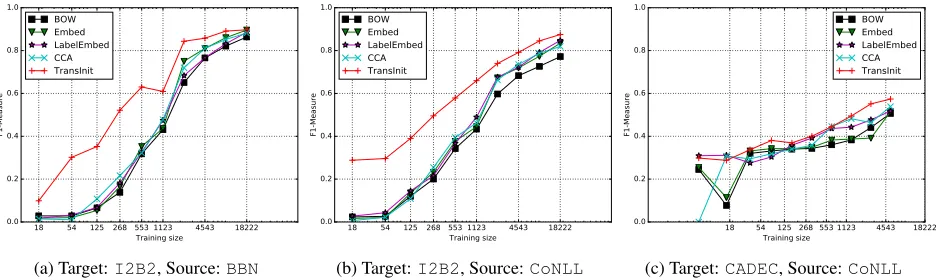
Figure 1: Macro-averaged F1 results across all novel classes on different source/target domain combinations
4 Experimental Setup 4.1 Datasets
We use CADEC (Karimi et al., 2015) and I2B2
(Ben Abacha and Zweigenbaum, 2011) as target cor-pora with the standard training and test splits. From each training set, we hold out 10% as the devel-opment set. As source corpora, we adopt CoNLL
(Tjong Kim Sang and De Meulder, 2003) andBBN
(Weischedel and Brunstein, 2005).
In order to test the impact of the target domain training data size on results, we split the training set ofCADECandI2B2into 10 partitions based on a log scale, and created 10 successively larger training sets by merging these partitions from smallest to largest (with the final merge resulting in the full training set). For all methods, we report the macro-averaged F1 over only the NE classes that are novel to the target domain.
4.2 Baselines
We compare our methods with the following two in-domain baselines, one cross-domain data-based method, and three cross-domain transfer-based benchmark methods.
BOW: an in-domain linear-chain CRF with hand-crafted features, from Qu et al. (2015).
Embed: an in-domain linear-chain CRF with hand-crafted features and pre-trained word embeddings, from Qu et al. (2015).
LabelEmbed: take the labels in the source and tar-get domains, and determine the alignment based on the similarity between the pre-trained embeddings for each label.
CCA: the method of Kim et al. (2015), where a one-to-one mapping is generated between source and target NE classes using CCA and k-NN (see Sec-tion 2).
TransDeepCRF: A three-layer deep CRF. The bot-tom layer is a linear layer initialised withWsfrom
the source domain-trained CRF. The middle layer is a hardtanhfunction (Collobert et al., 2011). The top layer is a linear-chain CRF with all parameters initialised to zero.
TwoLayerCRF: A two-layer CRF. The bottom layer is a linear layer initialised with Ws from
the source domain-trained CRF. The top layer is a linear-chain CRF with all parameters initialised to zero.
We compare our method with one variation, which is to freeze the parameters of the bottom linear layer and update only the parameters of the LR classifier while learning the correlation between the source and target types.
4.3 Experimental Results
Figure 1 shows the macro-averaged F1 of novel types between our methodTransInitand the three baselines on all target corpora. The evaluation re-sults onCADECwithBBNas the source corpus are not reported here becauseBBNcontains all types of
CADEC. From the figure we can see thatTransInit
outperforms all other methods with a wide margin onI2B2. WhenCoNLLis taken as the source cor-pus, despite not sharing any NE types withI2B2, several target types are subclasses of source types:
HOS-PITALw.r.t.ORGANIZATION.
In order to verify ifTransInitis able to capture semantic relatedness between source and target NE types, we inspected the parameter matrixWtof the
LR classifier in the step of learning type correlations. The corresponding elements inWtindeed receive
much higher values than the semantically-unrelated NE type pairs. When less than 300 target training sentences are used, these automatically discovered positive correlations directly lead to 10 times higher F1 scores for these types than the baselineEmbed, which does not have a transfer learning step. Since
TransInitis able to transfer the knowledge of multi-ple source types to related target types, this advantage leads to more than 10% improvement in terms of F1 score on these types compared withLabelEmbed, given merely 268 training sentences inI2B2. We also observe that, in case of few target training exam-ples,LabelEmbedis more robust thanCCAif the correlation of types can be inferred from their names.
We study the effects of transferring a large num-ber of source types to target types by using BBN, which has 64 types. Here, the novel types ofI2B2
w.r.t. BBN are DOCTOR, PATIENT,HOSPITAL,
PHONE, andID. For these types,TransInit success-fully recognisesPERSONas the most related type toDOCTOR, as well as CARDINAL as the most related type to ID. In contrast, CCA often fails to identify meaningful type alignments, especially for small training data sizes.
CADEC is definitely the most challenging task when trained on CoNLL, because there is no se-mantic connection between two of the target NE types (DRUGandDISEASE) and any of the source NE types. In this case, the baselineLabelEmbed
achieves competitive results with TransInit. This suggests that the class names reflect semantic corre-lations between source and target types, and there are not many shared textual patterns between any pair of source and target NE types in the respective datasets.
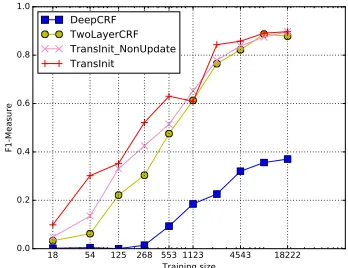
Even with a complex model such as a neural net-work, the transfer of knowledge from the source types to the target types is not an easy task. Figure 2 shows that with a three-layer neural network, the whole model performs poorly. This is due to the fact that the hardtanhlayer suffers from saturated function values. We inspected the values of the output hidden
18 54 125 268 553 1123 4543 18222 Training size
0.0 0.2 0.4 0.6 0.8 1.0
F1-Measure
[image:5.612.339.513.59.193.2]DeepCRF TwoLayerCRF TransInit_NonUpdate TransInit
Figure 2: Difficulty of Transfer. The source model is trained onBBN.
units computed byWsxon a random sample of
tar-get training examples before training on the tartar-get corpora. Most values are either highly positive or negative, which is challenging for online learning algorithms. This is due to the fact that these hid-den units are unnormalised probabilities produced by the source domain classifier. Therefore, remov-ing the hidden non-linear-layer layer leads to a dra-matic performance improvement. Moreover, Figure 2 also shows that further performance improvement is achieved by reducing the two-layer architecture into a linear chain CRF. And updating the hidden layers leads to up to 27% higher F1 scores than not updating them in the second step ofTransInit, which indicates that the neural networks need to update lower-level features to overcome the covariate shift problem.
5 Conclusion
We have proposed TransInit, a transfer learning-based method that supports the training of NER mod-els across datasets where there are mismatches in domain and also possibly the label set. Our method was shown to achieve up to 160% improvement in F1 over competitive baselines, based on a handful of in-domain training instances.
Acknowledgments
References
Maha Althobaiti, Udo Kruschwitz, and Massimo Poesio. 2015. Combining minimally-supervised methods for arabic named entity recognition. Transactions of the Association for Computational Linguistics, 3:243–255. Julio Cesar Salinas Alvarado, Karin Verspoor, and Timo-thy Baldwin. 2015. Domain adaption of named entity recognition to support credit risk assessment. In Aus-tralasian Language Technology Association Workshop 2015.
Andrew Arnold, Ramesh Nallapati, and W. William Co-hen. 2008. Exploiting feature hierarchy for transfer learning in named entity recognition. InProceedings of ACL-08: HLT, pages 245–253.
Asma Ben Abacha and Pierre Zweigenbaum. 2011. Med-ical entity recognition: A comparison of semantic and statistical methods. InProceedings of BioNLP 2011 Workshop, pages 56–64.
Laura Chiticariu, Rajasekar Krishnamurthy, Yunyao Li, Frederick Reiss, and Shivakumar Vaithyanathan. 2010. Domain adaptation of rule-based annotators for named-entity recognition tasks. InProceedings of the 2010 Conference on Empirical Methods in Natural Language Processing, pages 1002–1012.
Ronan Collobert, Jason Weston, L´eon Bottou, Michael Karlen, Koray Kavukcuoglu, and Pavel Kuksa. 2011. Natural language processing (almost) from scratch.
Journal of Machine Learning Research, 12:2493–2537. Li Dong, Furu Wei, Hong Tan, Sun, Ming Zhou, and
Ke Xu. 2015. A hybrid neural model for type classi-fication of entity mentions. InTwenty-Fourth Interna-tional Joint Conference on Artificial Intelligence (IJ-CAI), pages 1243–1249.
Jenny Rose Finkel, Trond Grenager, and Christopher Man-ning. 2005. Incorporating non-local information into information extraction systems by Gibbs sampling. In
Proceedings of the 43rd Annual Meeting on Association for Computational Linguistics, pages 363–370. Xavier Glorot and Yoshua Bengio. 2010. Understanding
the difficulty of training deep feedforward neural net-works. InProceedings of the Thirteenth International Conference on Artificial Intelligence and Statistics (AIS-TATS 2010), pages 249–256.
Sarvnaz Karimi, Alejandro Metke-Jimenez, Madonna Kemp, and Chen Wang. 2015. Cadec: A corpus of adverse drug event annotations.Journal of Biomedical Informatics, 55:73–81.
Young-Bum Kim, Karl Stratos, Ruhi Sarikaya, and Min-woo Jeong. 2015. New transfer learning techniques for disparate label sets. In Proceedings of the 53rd Annual Meeting of the Association for Computational Linguistics and the 7th International Joint Conference
on Natural Language Processing of the Asian Feder-ation of Natural Language Processing, (ACL 2015), pages 473–482.
John Lafferty, Andrew McCallum, and Fernando Pereira. 2001. Conditional random fields: Probabilistic models for segmenting and labeling sequence data. In Proceed-ings of the 18th International Conference on Machine Learning, pages 282–289.
Changki Lee, Yi-Gyu Hwang, and Myung-Gil Jang. 2007. Fine-grained named entity recognition and relation ex-traction for question answering. InProceedings of the 30th Annual International ACM SIGIR Conference on Research and Development in Information Retrieval, pages 799–800.
Xiao Ling and Daniel S. Weld. 2012. Fine-grained entity recognition. InProceedings of the 26th AAAI Confer-ence on Artificial IntelligConfer-ence.
Diana Maynard, Valentin Tablan, Cristian Ursu, Hamish Cunningham, and Yorick Wilks. 2001. Named en-tity recognition from diverse text types. In Recent Advances in Natural Language Processing 2001 Con-ference.
Pablo N Mendes, Max Jakob, Andr´es Garc´ıa-Silva, and Christian Bizer. 2011. DBpedia spotlight: shedding light on the web of documents. In Proceedings of the 7th International Conference on Semantic Systems, pages 1–8.
Lizhen Qu, Gabriela Ferraro, Liyuan Zhou, Weiwei Hou, Nathan Schneider, and Timothy Baldwin. 2015. Big data small data, in domain out-of domain, known word unknown word: The impact of word representations on sequence labelling tasks. InProceedings of the 19th Conference on Computational Natural Language Learning (CoNLL 2015), pages 83–93.
Giuseppe Rizzo and Rapha¨el Troncy. 2012. NERD: a framework for unifying named entity recognition and disambiguation extraction tools. InProceedings of the Demonstrations at the 13th Conference of the Euro-pean Chapter of the Association for Computational Linguistics, pages 73–76.
Masashi Sugiyama, Matthias Krauledat, and Klaus-Robert M¨uller. 2007. Covariate shift adaptation by importance weighted cross validation.Journal of Machine Learn-ing Research, 8:985–1005.
Charles Sutton and Andrew McCallum. 2005. Composi-tion of condiComposi-tional random fields for transfer learning. InProceedings of the Conference on Human Language Technology and Empirical Methods in Natural Lan-guage Processing, HLT ’05, pages 748–754.
Joseph Turian, Lev Ratinov, and Yoshua Bengio. 2010. Word representations: a simple and general method for semi-supervised learning. InProceedings of the 48th annual meeting of the association for computational linguistics, pages 384–394.
Ralph Weischedel and Ada Brunstein. 2005. BBN pro-noun coreference and entity type corpus. Linguistic Data Consortium.
Yadollah Yaghoobzadeh and Hinrich Sch¨utze. 2015. Corpus-level fine-grained entity typing using contextual information. InProceedings of the 2015 Conference on Empirical Methods in Natural Language Processing (EMNLP 2015), pages 715–725.
Mohamed Amir Yosef, Sandro Bauer, Johannes Hoffart, Marc Spaniol, and Gerhard Weikum. 2013. HYENA-live: Fine-grained online entity type classification from natural-language text. InProceedings of the 51st An-nual Meeting of the Association for Computational Lin-guistics: System Demonstrations, pages 133–138. Jason Yosinski, Jeff Clune, Yoshua Bengio, and Hod