In: Proceedings of CoNLL-2000 and LLL-2000, pages 55-60, Lisbon, Portugal, 2000.
Learning Distributed Linguistic Classes
S t e p h a n R a a i j m a k e r s
N e t h e r l a n d s O r g a n i s a t i o n for A p p l i e d Scientific Research ( T N O ) I n s t i t u t e for A p p l i e d Physics
Delft T h e N e t h e r l a n d s
raaijmakers@tpd, tno. nl
A b s t r a c t
Error-correcting o u t p u t codes (ECOC) have emerged in machine learning as a success- ful implementation of the idea of distributed classes. Monadic class symbols are replaced by bit strings, which are learned by an ensem- ble of binary-valued classifiers (dichotomizers). In this study, the idea of E C O C is applied to memory-based language learning with local (k- nearest neighbor) classifiers. Regression analy- sis of the experimental results reveals that, in order for ECOC to be successful for language learning, the use of the Modified Value Differ- ence Metric (MVDM) is an important factor, which is explained in terms of population den- sity of the class hyperspace.
1 I n t r o d u c t i o n
Supervised learning m e t h o d s applied to natu- ral language classification tasks commonly op- erate on high-level symbolic representations, with linguistic classes that are usually monadic, without internal structure (Daelemans et al., 1996; Cardie et al., 1999; Roth, 1998). This contrasts with the distributed class encoding commonly found in neural networks (Schmid, 1994). Error-correcting o u t p u t codes (ECOC) have been introduced to machine learning as a principled and successful approach to dis- tributed class encoding (Dietterich and Bakiri, 1995; Ricci and Aha, 1997; Berger, 1999). W i t h ECOC, monadic classes are replaced by code- words, i.e. binary-valued vectors. An ensem- ble of separate classifiers (dichotomizers) must be trained to learn the binary subclassifications for every instance in the training set. During classification, the bit predictions of the vari- ous dichotomizers are combined to produce a codeword prediction. T h e class codeword which has minimal H a m m i n g distance to the predicted
codeword determines the classification of the in- stance. Codewords are constructed such that their H a m m i n g distance is maximal. Extra bits are added to allow for error recovery, allowing the correct class to be determinable even if some bits are wrong. An error-correcting o u t p u t code for a k-class problem constitutes a matrix with k rows and 2 k - 1 - 1 columns. Rows are the code- words corresponding to classes, and columns are binary subclassifications or bit functions fi such that, for an instance e, and its codeword vector
C
fi(e) = ~-i(c) (1)
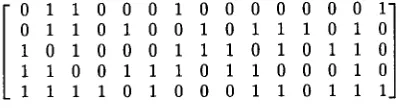
(~-i(v) the i-th coordinate of vector v). If the m i n i m u m H a m m i n g distance between ev- ery codeword is d, then the code has an error- correcting capability of [ - ~ J . Figure 1 shows the 5 x 15 E C O C matrix, for a 5-class problem. In this code, every codeword has a Hamming distance of at least 8 to the other codewords, so this code has an error-correcting capability of 3 bits. E C O C have two natural interpreta-
0 1 1 0 0 0 1 0 0 0 0 0 0 0 1 ]
0 1 1 0 1 0 0 1 0 1 1 1 0 1
~
1 0 1 0 0 0 1 1 1 0 1 0 1 1
[image:1.596.313.515.520.574.2]1 1 0 0 1 1 1 0 1 1 0 0 0 1
1 1 1 1 0 1 0 0 0 1 1 0 1 1
Figure
h ECOC for a five-class problem.
of the classifier. The received message must be decoded before it can be interpreted as a classi- fication. Adding redundancy to a signal before transmission is a well-known technique in digi- tal communication to allow for the recovery of errors due to noise in the channel, and this is the key to the success of ECOC. From a ma- chine learning perspective, an error-correcting output code uniquely partitions the instances in the training set into two disjoint subclasses, 0 or 1. This can be interpreted as learning a set of class boundaries. To illustrate this, consider the following binary code for a three-class prob- lem. (This actually is a one-of-c code with no error-correcting capability (the minimal Ham- ming distance between the codewords is 1). As such it is an error-correcting code with lowest error correction, but it serves to illustrate the point.)
fl f2 f3 C1 0 0 1
C2 0 1 0 (2)
C3 1 0 0
For every combination of classes (C1-C2, C1- C3, C2-C3), the Hamming distance between the codewords is 2. These horizontal relations have vertical repercussions as well: for every such pair, two bit functions disagree in the classes they select. For C1-C2, f2 selects C2 and f3 se- lects C1. For C1-C3, f l selects C3 and f3 selects C1. Finally, for C2-C3, f l selects C3 and f2 se- lects C2. So, every class is selected two times, and this implies that every class boundary asso- ciated with that class in the feature hyperspace is learned twice. In general (Kong and Diet- terich, 1995), if the minimal Hamming distance between the codewords of an (error-correcting) code is d, then every class boundary is learned d times. For the error-correcting code from above this implies an error correction of zero: only two votes support a class boundary, and no vote can be favored in case of a conflict. The decoding of the predicted bit string to a class symbol ap- pears to be a form of voting over class bound- aries (Kong and Dietterich, 1995), and is able to reduce both bias and variance of the classifier. 2 D i c h o t o m i z e r E n s e m b l e s
Dichotomizer ensembles must be diverse apart from accurate. Diversity is necessary in order to decorrelate the predictions of the various di- chotomizers. This is a consequence of the voting
mechanism underlying ECOC, where bit func- tions can only outvote other bit functions if they do not make similar predictions. Selecting dif- ferent features per dichotomizer was proposed for this purpose (Ricci and Aha, 1997). An- other possibility is to add limited non-locality to a local classifier, since classifiers that use global information such as class probabilities during classification, are much less vulnerable to cor- related predictions. The following ideas were tested empirically on a suite of natural language learning tasks.
• A careful feature selection approach, where every dichotomizer is trained to select (pos- sibly) different features.
• A careless feature selection approach, where every bit is predicted by a voting committee of dichotomizers, each of which randomly selects features (akin in spirit to the Multiple Feature Subsets approach for non-distributed classifiers (Bay, 1999). • A careless feature selection approach,
where blocks of two adjacent bits are pre- dicted by a voting committee of
quadro-
tomizers,
each of which randomly selects features. Learning blocks of two bits al- lows for bit codes that are twice as long (larger error-correction), but with half as many classifiers. Assuming a normal dis- tribution of errors and bit values in every 2 bits-block, there is a 25% chance that both bits in a 2-bit block are wrong. The other 75% chance of one bit wrong would pro- duce performance equal to voting per bit. Formally, this implies a switch from N two- class problems toN/2
four-class problems, where separate regions of the class land- scape are learned jointly.• Adding non-locality to 1-3 in the form of larger values for k.
• The use of the Modified Value Difference Metric, which alters the distribution of in- stances over the hyperspace of features, yielding different class boundaries.
3 M e m o r y - b a s e d l e a r n i n g
matching data to be classified with classified data stored in a knowledge base. This latter data set is called the training data, and its ele- ments are called
instances.
Every instance con- sists of a feature-value vector and a class label. Learning under the memory-based paradigm islazy,
and consists only of storing the training instances in a suitable data structure. The in- stance from the training set which resembles the most the item to be classified determines the classification of the latter. This instance is called the nearest neighbor, and models based on this approach to analogy are callednearest
neighbor models
(Duda and Hart, 1973). So- called k-nearest neighbor models select a winner from the k nearest neighbors, where k is a pa- rameter and winner selection is usually based on class frequency. Resemblance between instances is measured using distance metrics, which come in many sorts. T h e simplest distance metric is the overlap metric:k (3)
5(vi, vj) = 0
if vi = vj 5(vi, vj) = 1 ifvi ¢ vj
(~ri(I)
is the i-th projection of the feature vec- tor I.) Another distance metric is the Mod- ified Value Difference Metric (MVDM) (Cost and Salzberg, 1993). The MVDM defines sim- ilarity between two feature values in terms of posterior probabilities:5(vi, vj) =
~
I P(c I vi) - P(c Ivj) l
(4)cEClasses
When two values share more classes, they are more similar, as 5 decreases. Memory-based learning has fruitfully been applied to natu- ral language processing, yielding state-of-the- art performance on all levels of linguistic analy- sis, including grapheme-to-phoneme conversion (van den Bosch and Daelemans, 1993), PoS- tagging (Daelemans et al., 1996), and shallow parsing (Cardie et al., 1999). In this study, the following memory-based models are used, all available from the T I M B L package (Daele- mans et al., 1999). I B i - I G is a k-nearest dis- tance classifier which employs a
weighted
over- lap metric:~(I~, b ) = ~ wkS(~k(/~), ~ ( I j ) ) (5)
k
In stead of drawing winners from the k-nearest neighbors pool, IBi-IG selects from a pool of instances for k nearest distances. Features are separately weighted based on Quinlan's infor- mation gain ratio (Quinlan, 1993), which mea- sures the informativity of features for predicting class labels. This can be computed by subtract- ing the entropy of the knowledge of the feature values from the general entropy of the class la- bels. The first quantity is normalized with the a
priori
probabilities of the various feature values of feature F:H ( C ) -
Eveva es(F) P(v) ×
H(QF=v])
(6)
Here,
H(C)
is the class entropy, defined asH(C) = -
~
P(c) log
2P(c). (7)cEClass
H(C[F=v] )
is the class entropy computed over the subset of instances that have v as value forFi.
Normalization for features with many values is obtained by dividing the information gain for a feature by the entropy of its value set (called thesplit info
of feature Fi.H(C)--~veValues(Fi) P(v)xH(C[F=v]) Wi ---- split_in f o( Fi )
split - info(Fi) = -
~
P(v)
log 2P(v)
vE Values( Fi )
(s)
I G T R E E is a heuristic approximation of IB1- IG which has comparable accuracy, but is op- timized for speed. It is insensitive to k-values larger t h a n 1, and uses value-class cooccurrence information when exact matches fail.
4
Experiments
The effects of a distributed class representa- tion on generalization accuracy were measured using an experimental matrix based on 5 lin- guistic datasets, and 8 experimental condi- tions, addressing feature selection-based ECOC vs. voting-based ECOC, MVDM, values of k larger t h a n 1, and dichotomizer weight- ing. The following linguistic tasks were used.
D I M I N is a Dutch diminutive formation task de-
last three syllables of the noun. T h e STRESS task, also derived from the D u t c h Celex lexP cal database, assigns p r i m a r y stress on the ba- sis of phonemic values. MORPH assigns mor- phological boundaries (a.o. root morpheme, stress-changing affix, inflectional morpheme), based on English C E L E X data. T h e WSJ- NPVP task deals with N P - V P chunking of PoS- tagged Wall Street J o u r n a l material. GRAPHON, finally, is a g r a p h e m e - t o - p h o n e m e conversion task for English based on the English Celex lex- ical database. Numeric characteristics of the different tasks are listed in table 1. All tasks with the exception of GRAPHON h a p p e n e d to be five-class problems; for GRAPHON, a five- class subset was taken from the original training set, in order to keep c o m p u t a t i o n a l d e m a n d s manageable. T h e tasks were subjected to the
Data set Features Classes Instances
DIMIN 12 5 3,000
STRESS 12 5 3,000
MORPH 9 5 300,000
NPVP 8 5 200,000
GRAPHON 7 5 73,525
Table 1: Data sets.
8 different experimental situations of table 2. For feature selection-based ECOC, backward se- quential feature elimination was used (Raaij- makers, 1999), r e p e a t e d l y eliminating features in t u r n and evaluating each elimination step with 10-fold cross-validation. For dichotomizer weighting, error information of the dichotomiz- ers, d e t e r m i n e d from separate unweighted 10- fold cross-validation experiments on a separate training set, p r o d u c e d a weighted H a m m i n g dis- tance metric. Error-based weights were based on raising a small constant ~ in the interval [0, 1) to the power of the n u m b e r of errors m a d e by the dichotomizer (Cesa-Bianchi et al., 1996). R a n d o m feature selection drawing features with replacement created feature sets of b o t h differ- ent size and composition for every dichotomizer. 5 R e s u l t s
Table 3 lists the generalization accuracies for the control groups, and table 4 for the E C O C algorithms. All accuracy results are based on 10-fold cross-validation, with p < 0.05 using paired t-tests. T h e results show t h a t dis-
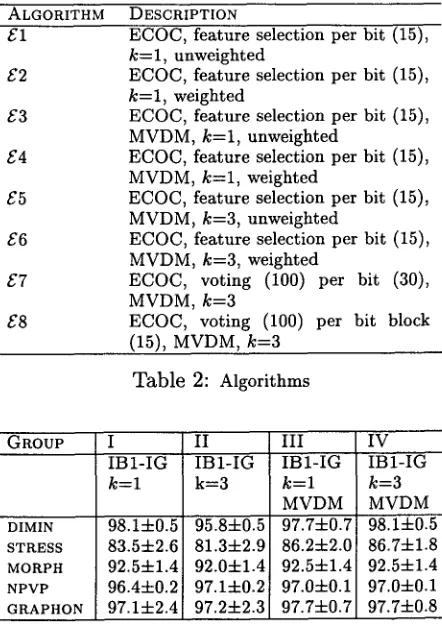
ALGORITHM DESCRIPTION
E1 £2 E3 E4 £5 £6 £7 $8
ECOC, feature selection per bit (15), k----l, unweighted
ECOC, feature selection per bit (15), k----l, weighted
ECOC, feature selection per bit (15), MVDM, k=l, unweighted
ECOC, feature selection per bit (15), MVDM, k=l, weighted
ECOC, feature selection per bit (15), MVDM, k----3, unweighted
ECOC, feature selection per bit (15), MVDM, k=3, weighted
ECOC, voting (100) per bit (30), MVDM, k=3
ECOC, voting (100) per bit block (15), MVDM, k=3
Table 2: Algorithms
GRouP I II III IV
IBi-IG IBi-IG IBi-IG IBi-IG'
k=l k=3 k=l k=3
MVDM MVDM 98.1±0.5
DIMIN STRESS MORPH NPVP GRAPHON
98.1±0.5 83.5±2.6 92.5±1.4 96.4±0.2 97.1±2.4
95.8±0.5 81.3±2.9 92.0±1.4 97.1±0.2 97.2±2.3
97.7±0.7 86.2±2.0 92.5±1.4 97.0±0.1 97.7±0.7
[image:4.596.316.537.87.400.2] [image:4.596.91.279.325.411.2]TASK £1 (I) g2(I) $3 (III) $4 (III) $5 (IV) $6 (IV) $7 (IV) g8 ($6) DIMIN 98.6=k0.4x/ 98.5=k0.4x/ 98.6:k0.6~/ 98.7::k0.6x/ 98.8::k0.5x/ 98.9::k0.4~/ 96.6:k0.9x 98.4=E0.4
STRESS 85.3::kl.Sx/ 86.3::k2.0X/ 88.2=hl.7x/ 88.8=t:1.7X/ 88.2:kl.7x/ 89.3::kl.9~/ 86.5=k2.3x 88.8::kl.7
MORPH 93.2:kl.6x/ 93.2=kl.5x/ 93.2=kl.3x/ 93.2=kl.3~/ 93.2=1=1.6~/ 93.2=kl.5~/ 93.0::kl.6x/ 93.4:t=1.5x/
NPVP t 96.8::k0.1~/ 96.9::k0.2x/ 96.8=E0.1 96.9:k0.1 96.8::k0.1 96.9=k0.1 96.8=h0.2x 96.8=t:0.2
GRAPHON 98.2=t=0.7 98.3=t=0.7 98.4:k0.6X/ 98.3=E0.5X/ 98.3::h0.6X/ 98.5::k0-5X/ 97.6=k0.7x 97.6:h0.8x
Table 4: Generalization accuracies for feature selection-based ECOC (x/ indicates significant improvement over control group (in round brackets) , and x deterioration at p < 0.05 using paired t-tests). A 1" indicates 25 voters for performance reasons.
control group II to the accuracy gain of ECOC (algorithm $6, compared to control group IV). The correlation between these two variables is very high (0.93, significant at p < 0.05), again indicative of a linear relation. From the per- spective of learning class boundaries, the strong effect of MVDM on ECOC accuracy can be un- derstood as follows. When the overlap metric is used, members of a training set belonging to the same class may be situated arbitrarily remote from each other in the feature hyperspace. For instance, consider the following two instances taken from DIMIN:
. . . d , A , k , j e
. . .
d,A,x,je
(Hyphens indicate absence of feature values.) These two instances encode the diminutive for- mation of Dutch d a k j e
(little roo]~
from dak(roo]~,
and d a g j e (lit.little day,
proverbially used) from dag(day).
Here, the values k and x, corresponding to the velar stop 'k' and the ve- lar fricative 'g', are minimally different from a phonetic perspective. Yet, these two instances have coordinates on the twelfth dimension of the feature hyperspace that have nothing to do with each other. The overlap treats the k - x value clash just like any other value clash. This phenomenon may lead to a situation where in- habitants of the same class are scattered over the feature hyperspace. In contrast, a value dif- ference metric like MVDM which attempts to group feature values on the basis of class cooc- currence information, might group k and x to- gether if they share enough classes. The effect of MVDM on the density of the feature hyper- space can be compared with the density ob- tained with the overlap metric as follows. First, plot a random numerical transform of a feature space. For expository reasons, it is adequateto restrict attention to a low-dimensional (e.g. two-dimensional) subset of the feature space, for a specific class C. Then, plot an MVDM trans- form of this feature space, where every coordi- nate (a, b) is transformed into
(P(Cla), P(C I
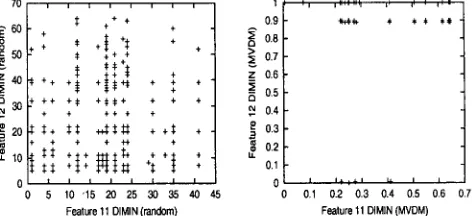
b)). This idea is applied to a subset of DIMIN, consisting of all instances classified as j e (one of the five diminutive suffixes for Dutch). The features for this subset were limited to the last two, consisting of the rhyme and coda of the last syllable of the word, clearly the most infor- mative features for this task. Figure 2 displays the two scatter plots. As can be seen, instances are widely scattered over the feature space for the numerical transform, whereas the MVDM- based transform forms many clusters and pro- duces much higher density. In a condensed fea-70
o•60
~ 3 0 ¢D
20
+ + ÷ +
% + + + t 4
t ++t +
+ + +% + # $ + + + +
+ + + + ÷ +
$÷ S t ~ $ ~ , ÷ t +
+ + + ~ ÷
$:$ + t + - t t - i - t ~ + + ± ÷
i i | I I I I I 5 10 '15 20 25 30 35 40 45
Feature 11 DIMIN (random)
'i
0.9
0.8
0.7
_z 0.6
~. 0.4
0.3
. 0.2
0.1
0
-~.@ + ¢ 4, ¢41.
[image:5.596.53.527.90.157.2] [image:5.596.297.533.441.549.2]0,1 0.2 0.3 0.4 0.5 0.6 0.7
Feature I | DIMIN (MVDM)
Figure 2: R a n d o m numerical transform of feature val- ues based on the overlap metric (left) vs. numerical transform of feature values based on MVDM (right), for a two-features-one-class subset of DIMIN.
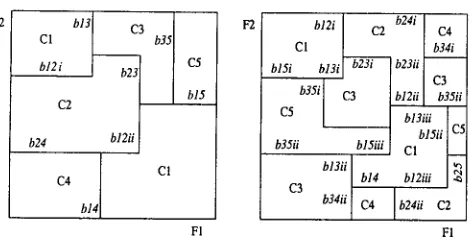
tional b u r d e n on the learning problems consti- t u t e d by the various bit functions.
C1 b 1 3 ~ 3 b35
hi2 i C5 b15
C2
b24 bl2ii I
C4 b14 CI
Fl
F2 bl2i I C2 b24i I C4
b35i C3 ~ _ ~
b3 ii C4 b24ii C2
FI
Figure 3: Condensed feature space (left) vs. scattered feature space (right).
6 C o n c l u s i o n s
T h e use of error-correcting o u t p u t codes (ECOC) for representing n a t u r a l language classes has been empirically validated for a suite of linguistic tasks. Results indicate t h a t E C O C can be useful for datasets with features with high class predictivity. These sets typically t e n d to benefit from the Modified Value Difference Metric, which creates a condensed hyperspace of features. This in t u r n leads to a lower num- ber of class boundaries to be learned per bit function, which simplifies the b i n a r y subclas- sification tasks. A voting algorithm for learn- ing blocks of bits proves as accurate as an ex- pensive feature-selecting algorithm. Future re- search will address further mechanisms of learn- ing complex regions of the class b o u n d a r y land- scape, as well as alternative error-correcting ap- proaches to classification.
A c k n o w l e d g e m e n t s
T h a n k s go to Francesco Ricci for assistance in generating the error-correcting codes used in this paper. David A h a and the m e m b e r s of the Induction of Linguistic Knowledge (ILK) Group of Tilburg University and Antwerp University are t h a n k e d for helpful c o m m e n t s and criticism. R e f e r e n c e s
H. Baayen, R. Piepenbrock, and H. van Rijn. 1993.
The CELEX database on CD-ROM. Linguistic Data Consortium. Philadelpha, PA.
S. Bay. 1999. Nearest neighbor classification from multiple feature subsets. Intelligent Data Analy- sis, 3(3):191-209.
A. Berger. 1999. Error-correcting output coding for text classification. Proceedings of IJCAI'99: Workshop on machine learning for information filtering.
C. Cardie, S. Mardis, and D. Pierce. 1999. Com- bining error-driven pruning and classification for partial parsing. Proceedings of the Sixteenth In- ternational Conference on Machine Learning, pp. 87-96.
N. Cesa-Bianchi, Y. Freund, D. Helmbold, and M. Warmuth. 1996. On-line prediction and con- version strategies. Machine Learning 27:71-110.
S. Cost and S. Salzberg. 1993. A weighted near- est neighbor algorithm for learning with symbolic features. Machine Learning,10:57-78.
W. Daelemans, J. Zavrel, P. Berck, and S. Gillis. 1996. Mbt: A memory-based part of speech tag- ger generator. Proceedings of the Fourth Work- shop on Very Large Corpora, ACL SIGDAT.
W. Daelemans, J. Zavrel, K. Van der Sloot, and A. Van den Bosch. 1999. Timbh Tilburg memory based learner, version 2.0, reference guide. ILK
Technical Report - I L K 99-01. Tilburg.
T. Dietterich and G. Bakiri. 1995. Solving multi- class learning problems via error-correcting out- put codes. Journal of Artificial Intelligence Re- search, 2:263-286.
R. Duda and P. Hart. 1973. Pattern classification and scene analysis. Wiley Press.
E. Kong and T. Dietterich. 1995. Error-correcting output coding corrects bias and variance. Pro- ceedings of the 12th International Conference on Machine Learning.
J.R. Quinlan. 1993. C4.5: Programs for Machine Learning. Morgan Kaufmann, San Mateo, Ca. S. Raaijmakers. 1999. Finding representations for
memory-based language learning. Proceedings of CoNLL-1999.
F. Ricci and D. Aha. 1997. Extending local learners with error-correcting output codes. Proceedings of the l~th Conference on Machine Learning.
D. Roth. 1998. A learning approach to shallow pars- ing. Proceedings EMNLP- WVLC'99.
H. Schmid. 1994. Part-of-speech tagging with neu- ral networks. Proceedings COLING-9~.
C. Shannon. 1948. A mathematical theory of com- munication. Bell System Technical Journal,27:7, pp. 379-423, 27:10, pp. 623-656.
[image:6.596.67.303.112.234.2]