An Incremental Model for Coreference Resolution with Restrictive
Antecedent Accessibility
Manfred Klenner
Institute of Computational Linguistics University of Zurich
Don Tuggener
Institute of Computational Linguistics University of Zurich
Abstract
We introduce an incremental model for coref-erence resolution that competed in the CoNLL 2011 shared task (open regular). We decided to participate with ourbaselinemodel, since it worked well with two other datasets. The ben-efits of an incremental over a mention-pair ar-chitecture are: a drastic reduction of the num-ber of candidate pairs, a means to overcome the problem of underspecified items in pair-wise classification and the natural integration of global constraints such as transitivity. We do not apply machine learning, instead the system uses an empirically derived salience measure based on the dependency labels of the true mentions. Our experiments seem to indi-cate that such a system already is on par with machine learning approaches.
1 Introduction
With notable exceptions (Luo et al., 2004; Yang et al., 2004; Daume III and Marcu, 2005; Culotta et al., 2007; Klenner, 2007; Rahman and Ng, 2009; Klenner and Ailloud, 2009; Cai and Strube, 2010; Raghunathan et al., 2010) supervised approaches to coreference resolution are often realized by pairwise classification of anaphor-antecedent candidates. A popular and often reimplemented approach is pre-sented in (Soon et al., 2001). As recently discussed in (Ng, 2010), the so called mention-pair model suf-fers from several design flaws which originate from the locally confined perspective of the model:
• Generation of (transitively) redundant pairs, as the formation of coreference sets (coreference clustering) is done after pairwise classification
• Thereby generation of skewed training sets which lead to classifiers biased towards nega-tive classification
• No means to enforce global constraints such as transitivity
• Underspecification of antecedent candidates
These problems can be remedied by an incremen-tal entity-mention model, where candidate pairs are evaluated on the basis of the emerging coreference sets. A clustering phase on top of the pairwise clas-sifier no longer is needed and the number of candi-date pairs is reduced, since from each coreference set (be it large or small) only one mention (the most representative one) needs to be compared to a new anaphor candidate. We form a ’virtual prototype’ that collects information from all the members of each coreference set in order to maximize ’repre-sentativeness’. Constraints such as transitivity and morphological agreement can be assured by just a single comparison. If an anaphor candidate is com-patible with the virtual prototype, then it is by defini-tion compatible with all members of the coreference set.
We designed our system to work purely with a simple, yet empirically derived salience measure. It turned out that it outperformed (for German and En-glish, using CEAF, B-cubed and Blanc) the systems from the 2010’s SemEval shared task1 on ’corefer-ence resolution in multiple languages’. Only with the more and more questioned (Luo, 2005; Cai and
1
We have carried out a post task evaluation with the data provided on the SemEval web page.
Strube, 2010) MUC measure our system performed worse (at least for English). Our system uses real preprocessing (i.e. a dependency parser (Schneider, 2008)) and extracts markables (nouns, named enti-ties and pronouns) from the chunks and based on POS tags delivered by the preprocessing pipeline. Since we are using a parser, we automatically take part in theopen regular session. Please note that the dependency labels are the only additional informa-tion being used by our system.
2 Our Incremental Model
Fig. 1 shows the basic algorithm. Let I be the chronologically ordered list of markables, C be the set of coreference sets (i.e. the coreference partition) and B a buffer, where markables are stored, if they are not found to be anaphoric (but might be valid antecedents, still). Furthermore mi is the current
markable and ⊕means concatenation of a list and a single item. The algorithm proceeds as follows: a set of antecedent candidates is determined for each markablemi(steps 1 to 7) from the coreference sets
and the buffer. A valid candidaterj orbk must be
compatible withmi. The definition of compatibility
depends on the POS tags of the anaphor-antecedent pair (in order to be coreferent, e.g. two pronouns must agree in person, number and gender etc.).
In order to reduce underspecification,mi is
com-pared to a virtual prototype of each coreference set. The virtual prototype bears information accumu-lated from all elements of the coreference set. For instance, assume a candidate pair ’she .. Clinton’. Since the gender of ’Clinton’ is unspecified, the pair might or might not be a good candidate. But if there is a coreference set already including ’Clinton’, let’s say: {’Hilary Clinton’, her, she}then we know the gender from the other members and are more save in our decision. The virtual prototype here would be something like: singular, feminine, human.
From the set of candidates, Cand, the most salient
antei ∈ Cand is selected (step 10) and the
coref-erence partition is augmented (step 11). If antei
comes from a coreference set, mi is added to that
set. Otherwise (anteiis from the buffer), a new set is
formed,{antei, mi}, and added to the set of
coref-erence sets.
2.1 Restricted Accessibility of Antecedent Candidates
As already discussed, access to coreference sets is restricted to the virtual prototype - the concrete members are invisible. This reduces the number of considered pairs (from the cardinality of a set to 1).
Moreover, we also restrict the access to buffer el-ements: if an antecedent candidate,rj, from a
coref-erence set exists, then elements from the buffer,bk,
are only licensed if they are more recent thanrj. If
both appear in the same sentence, the buffer element must be more salient in order to get licensed.
2.2 Filtering based on Anaphora Type
There is a number of conditions not shown in the basic algorithm from Fig. 1 that define compatibil-ity of antecedent and anaphor candidates based on POS tags. Reflexive pronouns must be bound in the subclause they occur, more specifically to the sub-ject governed by the same verb. Personal and pos-sessive pronouns are licensed to bind to morphologi-cally compatible antecedent candidates (named enti-ties, nouns2and pronouns) within a window of three sentences.
We use the information given by CoNLL input data to identify ’speaker’ and the person adressed by ’you’. ’I’ refers to one of the coreference sets whose speaker is the person who, according to the CoNLL data, is the producer of the sentence. ’You’ refers to the producer of the last sentence not being pro-duced by the current ’speaker’. If one didn’t have access to these data, it would be impossible to cor-rectly identify the reference of ’I’, since turn taking is not indicated in the pure textual data.
As we do not use machine learning, we only apply string matching techniques to match nom-inal NPs and leave out bridging anaphora (i.e. anaphoric nouns that are connected to their an-tecedents through a semantic relation such as hy-ponymy and cannot be identified by string matching therefore). Named entities must either match com-pletely or the antecedent must be longer than one token and all tokens of the anaphor must be con-tained in the antecedent (to capture relations such
2
1 for i=1 to length(I) 2 for j=1 to length(C)
3 rj := virtual prototype of coreference setCj
4 Cand := Cand⊕rj if compatible(rj, mi)
5 for k= length(B) to 1
6 bk:= the k-th licensed buffer element
7 Cand := Cand⊕bkif compatible(bk, mi)
8 if Cand ={}then B := B⊕mi
9 if Cand 6={}then
10 antei := most salient element of Cand
11 C := augment(C,antei,mi)
Figure 1: Incremental Model: Base Algorithm
as ’Hillary Clinton ... Clinton’). Demonstrative NPs are mapped to nominal NPs by matching their heads. Definite NPs match with noun chunks that are longer than one token3 and must be contained completely without the determiner (e.g. ’Recent events ... the events’). From the candidates that pass these filters the most salient one is selected as antecedent. If two or more candidates with equal salience are available, the closest one is chosen.
2.3 Binding Theory as a Filter
There is another principle that help reduce the num-ber of candidates even further: binding theory. We know that ’He’ and ’him’ cannot be coreferent in the sentence ’He gave him the book’. Thus, the pair ’He’-’him’ need not be considered at all. Actually, there are subtle restrictions to be captured here. We have not implemented a full-blown binding theory on top of our dependency parser, yet. Instead, we approximated binding restrictions by subclause de-tection. ’He’ and ’him’ in the example above are in the same subclause (the main clause) and are, thus, exclusive. This is true for nouns and personal pro-nouns, only. Possesive and reflexive pronouns are allowed to be bound in the same subclause.
2.4 An Empirically-based Salience Measure
Since we look for a simple and fast salience measure and do not apply machine learning in our baseline system, our measure is solely based on the gram-matical functions (given by the dependency labels) of the true mentions. Grammatical functions have
3
If we do not apply this restriction too many false positives are produced.
played a major role in calculating salience, espe-cially in rule based system such as (Hobbs, 1976; Lappin and Leass, 1994; Mitkov et al., 2002; Sid-dharthan, 2003). Instead of manually specifying the weights for the dependency labels like (Lappin and Leass, 1994), we derived them empirically from the coreference CoNLL 2011 gold standard (train-ing data). The salience of a dependency label, D, is estimated by the number of true mentions in the gold standard that bear D (i.e. are connected to their heads with D), divided by the total number of true mentions. The salience of the labelsubject is thus calculated by:
N umber of true mentions bearing subject T otal number of true mentions
For a given dependency label, this fraction indicates how strong is the label a clue for bearing an an-tecedent. This way, we get a hierarchical order-ing of the dependency labels (subject > object >
pobject > ...) according to which antecedents are ranked. Clearly, future work will have to establish a more elaborate calculation of salience. To our surprise, however, this salience measure performed quite well, at least together with our incremental ar-chiteture.
3 Evaluation
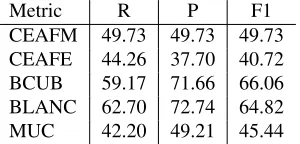
The results of our evaluation over the CoNLL 2011 shared task development set are given in Fig. 2 (de-velopment set) and 3 (official results on the test set). The official overall score of our system in the open regular setting is 51.77.
rea-Metric R P F1 CEAFM 49.73 49.73 49.73 CEAFE 44.26 37.70 40.72 BCUB 59.17 71.66 66.06 BLANC 62.70 72.74 64.82 MUC 42.20 49.21 45.44
Figure 2: CoNLL 2011 Development Set Results
Metric R P F1
CEAFM 50.03 50.03 50.03 CEAFE 41.28 39.70 40.48 BCUB 61.70 68.61 64.97 BLANC 66.05 73.90 69.05 MUC 49.04 50.71 49.86
Figure 3: CoNLL 2011 Test Set Results
sons for that. First and foremost, the scorer requires chunk extensions to match perfectly. That is, even if the head of an antecedent is found, this does not count if the chunk extension of that noun phrase was not correctly identified. Since chunks do not play a major role in depencendy parsing, our approxima-tion might be faulty4. Another shortcomming are nominal anaphora that can not be identified by string matching (e.g. Obama ... The president). Our sim-ple salience-based approach does not cope at all with this type of anaphora.
4 Related Work
(Ng, 2010) discusses the entity-mention model which operates on emerging coreference sets to cre-ate features describing the relation of an anaphor candidate and established coreference sets. (Luo et al., 2004) implemented such a model but it per-formed worse than the mention-pair model. (Yang et al., 2004) presented an incremental model which used some coreference set specific features, namely introducing the number of mentions in a set as a feature besides checking for morphological compat-ibility with all mentions in a set. They also report that the set size feature only marginally improves or in some combinations even worsens system perfor-mance. (Daume III and Marcu, 2005) introduced a wide range of set specific features, capturing set
4
Especially Asiatic names pose problems to our parser, quite often the extensions could not get correctly fixed.
count, size and distribution amongst others, in a joint model for the ACE data.
All the above mentioned systems use an incre-mental model to generate features describing the emerging coreference sets and the anaphor candi-date. In contrast, we use an incremental architecture to control pair generation in order to prevent gener-ation of either redundant or irrelevant pairs.
5 Conclusions
We have introduced an incremental model for coref-erence resolution based on an empirically derived salience measure that is meant as a simple and very fast baseline system. We do not use machine learning, nor do we resolve more complex nominal anaphora such as ’Obama ... The president’ (but we handle those that can be resolved by simple pattern matching, e.g. Hilary Clinton .. Clinton). Given these restrictions, our system performed well.
The central idea of our approach is that the evolv-ing coreference sets should restrict the access to an-tecedent candidates in a twofold way: by use of vir-tual prototypes that accumulate the properties of all members of a coreference set (e.g. wrt. animacy), but also by restricting reachable buffer elements (i.e. yet unattached markables).
The benefits of our incremental model are:
• due to the restricted access to antecedent candi-dates, the number of generated candidate pairs can be reduced drastically5
• no coreference clustering phase is needed
• the problem of underspecification that exists for any pair-wise model can be compensated by a virtual prototype that accumulates the proper-ties of the elements of a coreference set
These benefits are independent of the underly-ing classification scheme, be it a simple salience-based one or a more advanced machine learning one. The work presented here thus would like to opt for further research based on incremental architectures. Web demos for English and German are available6.
5We observed a reduction over 75% in some experiments when moving from a mention-pair to an incremental entity-mention model.
6
[image:4.612.113.256.174.247.2]References
Jie Cai and Michael Strube. 2010. Evaluation metrics for end-to-end coreference resolution systems. In Pro-ceedings of the SIGdial 2010 Conference: The 11th Annual Meeting of the Special Interest Group on Dis-course and Dialogue.
Aron Culotta, Michael Wick, and Andrew McCallum. 2007. First-order probabilistic models for coreference resolution. In Human Language Technologies 2007: The Conference of the North American Chapter of the Association for Computational Linguistics; Proceed-ings of the Main Conference, pages 81–88, Rochester, New York, April. Association for Computational Lin-guistics.
Hal Daume III and Daniel Marcu. 2005. A large-scale exploration of effective global features for a joint en-tity detection and tracking model. InHLT ’05: Pro-ceedings of the conference on Human Language Tech-nology and Empirical Methods in Natural Language Processing, pages 97–104, Morristown, NJ, USA. As-sociation for Computational Linguistics.
Jerry R. Hobbs. 1976. Pronoun resolution. Technical Report 76-1, Research Report, Department of Com-puter Sciences, City College, City University of New York.
Manfred Klenner and Etienne Ailloud. 2009. Opti-mization in Coreference Resolution Is Not Needed: A Nearly-Optimal Zero-One ILP Algorithm with Inten-sional Constraints. InProc. of the EACL.
Manfred Klenner. 2007. Enforcing consistency on coref-erence sets. In In Recent Advances in Natural Lan-guage Processing (RANLP), pages 323–328.
Shalom Lappin and Herbert J Leass. 1994. An algorithm for pronominal anaphora resolution. Computational Linguistics, 20:535–561.
Xiaoqiang Luo, Abe Ittycheriah, Hongyan Jing, Nanda Kambhatla, and Salim Roukos. 2004. A mention-synchronous coreference resolution algorithm based on the bell tree. In Proceedings of the 42nd Annual Meeting on Association for Computational Linguis-tics.
Xiaoqiang Luo. 2005. On coreference resolution perfor-mance metrics. InHLT ’05: Proceedings of the con-ference on Human Language Technology and Empir-ical Methods in Natural Language Processing, pages 25–32, Morristown, NJ, USA. Association for Com-putational Linguistics.
Ruslan Mitkov, Richard Evans, and Constantin Orasan. 2002. A new, fully automatic version of mitkov’s knowledge-poor pronoun resolution method. In CI-CLing ’02: Proceedings of the Third International Conference on Computational Linguistics and
Intel-ligent Text Processing, pages 168–186, London, UK. Springer-Verlag.
Vincent Ng. 2010. Supervised noun phrase coreference research: The first fifteen years. InProceedings of the 48th Annual Meeting of the Association for Computa-tional Linguistics.
Karthik Raghunathan, Heeyoung Lee, Sudarshan Ran-garajan, Nathanael Chambers, Mihai Surdeanu, Dan Jurafsky, and Christopher Manning. 2010. A multi-pass sieve for coreference resolution. InProceedings of the 2010 Conference on Empirical Methods in Nat-ural Language Processing, EMNLP ’10, pages 492– 501, Stroudsburg, PA, USA. Association for Compu-tational Linguistics.
Altaf Rahman and Vincent Ng. 2009. Supervised mod-els for coreference resolution. InProceedings of the 2009 Conference on Empirical Methods in Natural Language Processing: Volume 2 - Volume 2, EMNLP ’09, pages 968–977, Stroudsburg, PA, USA. Associa-tion for ComputaAssocia-tional Linguistics.
Gerold Schneider. 2008. Hybrid Long-Distance Func-tional Dependency Parsing. Doctoral Thesis, Institute of Computational Linguistics, Univ. of Zurich. Advaith Siddharthan. 2003. Resolving pronouns
ro-bustly: Plumbing the depths of shallowness. In Pro-ceedings of the Workshop on Computational Treat-ments of Anaphora, 11th Conference of the European Chapter of the Association for Computational Linguis-tics (EACL 2003).
Wee M. Soon, Hwee T. Ng, and Daniel. 2001. A ma-chine learning approach to coreference resolution of noun phrases. Computational Linguistics, 27(4):521– 544, December.