Exploring the Interdependencies
among Communication,
Knowledgeability and Performance of
Multi-agent Systems
Punam Bedi, Vibha Gaur, Member, IAENG
Abstract— The advent of ubiquitous computing has revolutionized distributed Multi-agent systems (MAS). Consequently, there are many software projects focusing on MASs. However, its successful application is subject to the adoption of effective agents’ communication that would be needed to share expertise for achieving goals of MAS. Communication among agents and agents’ cognitive capabilities influences MAS quality. The main quality factors that are affected by communication among agents are knowledgeability and performance and vice-versa. Knowledgeability can be realized by maximizing the amount and specification of knowledge in knowledgebase that affects the quality of decisions to achieve the goals, while performance can be interpreted as a means to maximize the utility of MAS in terms of throughput, resource utilization and response time. Fuzzy Cognitive Maps are useful tool for simulating and analyzing dynamic systems. This paper presents an application of FCM to analyze the interdependencies of four major features of MAS namely agent base, communication effort, performance and knowledgeability that would assist the analyst in modeling MAS to meet the desired objectives.
Index Terms— Communication, Fuzzy Cognitive Maps (FCMs), knowledgeability, Multi-agent Systems (MASs)
I. INTRODUCTION
Advances in network and distributed systems have led to emergence of Multi-agent systems (MASs). An MAS is one that consists of a number of agents, which interact with one another, typically by
Manuscript received March 8, 2007.
Punam Bedi is Head of Department of Computer Science, University of Delhi, Delhi, India. (email: [email protected])
Vibha Gaur is with Department of Computer Science, University of Delhi, India. (Tel: 44--07805551503; e-mail: [email protected])
exchanging messages to successfully carry out tasks that have been delegated to them. An MAS can be described by three main elements namely a set of agents, interfaces among agents and characteristics of MAS [7] while, software agent is a computer program that is situated in some environment, and is capable of autonomous action to meet its design objectives. Agents may have different capabilities and specialized knowledge in a similar manner to pediatricians, neurologists and cardiologists. Alternatively, they may have different sources of information, resources and responsibilities. In these situations, communication among agents is of special importance when a group of agents interact with each other to solve a problem that is beyond the capability and knowledge of each individual. Efficiency, performance and overall quality of MAS depend mainly on how the agents communicate with each other [14].
Researchers have studied agents’ communication from various perspectives whereas communication may exclusively include cooperation, coordination and competition [4]. Far presents agents’ interactions in competitive and uncertain environments [14] while Durfee [15] has addressed the issues related with scaling up of the coordination strategies. Malyankar and Findler [6] describe an experiment to validate a methodology for formulating models of coordination in intelligent agent societies. Fortino and Russo [16] have proposed a model that enables multi-coordination between distributed and mobile software agents by allowing agents to choose among a variety of different coordination spaces and patterns which best fit their dynamic communication and synchronization needs.
among agents are knowledgeability and performance of MAS. Our objective in this paper is to explore the relationship among agents’ communication, knowledgeability and performance of MAS. The organization of this paper is as follows: Section 2 presents MAS quality in a brief and in Section 3, preliminaries of Fuzzy Cognitive Maps have been presented. Section 4 simulates relationship among agents’ communication, and MAS quality features: knowledgeability and performance using FCM and section 5 concludes the paper.
II. MAS QUALITY: KNOWLEDGEABILITY AND PERFORMANCE
Quality in software system is defined as the degree to which a system, a component or process conforms to specified requirement [13] or fitness for use. ISO Standard 8402 defines quality as; “The totality of features and characteristics of a product or service that bears on its ability to satisfy stated or implied needs”.
In other work, we have presented a Multi-dimensional model of MAS quality [19]. The two main factors of MAS quality that are affected by communication among agents from both the customers’ and developers’ point of view are knowledgeability and performance of MAS.
Knowledgeability is an integral part of the MAS paradigm. It is defined as the ability of MAS to represent knowledge about external world, reasoning with it and sharing it [4]. MAS must be knowledgeable in its area of expertise and knowledge in MAS can be realized by problem solving, cognitive capabilities of agents and effective communication among them to share the knowledge [3] [9] [14].
MAS performance includes many parameters: optimization of computer resources usage, managing dynamics of population size (number of agents), the number of tasks completed by agents [18] and the number of concurrent tasks/goals agents are carrying out, throughput, response time [8].
Based on the above discussion, we view knowledgeability and performance of MAS as follows:
• Knowledgeability: It is degree to which MAS acquires the knowledge from its environment, peer agents and its users and reasons about its goals.
• Performance: It characterizes the MAS in terms of throughput, response time and resource utilization. The response time is the length of time between a user agent requesting a task and return of the result.
The communication among agents involves computation cost and communication overhead [15] that affects the performance of MAS.
Communication overhead [17] is the time required to send a task, and is assumed to be proportional to the distance between the communicating agents and ranges between 10 to 120 msec, while computation cost involves time to reason for an optimized partner to achieve the goals. An effective communication strategy would need to reduce these overheads without sacrificing the quality of MAS.
Following section describes FCM that has been used in section 4.
III. FUZZY COGNITIVE MAPS
Fuzzy Cognitive Maps (FCMs) are a useful modeling tool for simulating and analyzing dynamic systems. They can represent knowledge that describes different aspects in behavior of dynamic and complex systems. FCMs link casual concepts, values, goals, and trends in a fuzzy feedback dynamic system and integrate the accumulated experience and knowledge on the operation of the system using human experts. FCMs have been used for simulating processes, forecasting and decision making and adopted in many distinct areas such as modeling of virtual worlds [2], modeling software development projects [10] [11] etc.
An FCM is an interconnected network of concepts that represent beliefs, sources or characteristics relevant to a modeled domain of system and are connected by edges ei,j that indicate the influence of one concept on others. Fig.1 illustrates a graphical illustration of FCM consisting of 5 concepts.
The value Ai of a concept represents its physical value that results from the transformation of the real value of the system, in the interval [0,1]. Interconnections ei,j are characterized by weights Wi, j in the interval [-1, 1] that express type and strength of the influence.
At each simulation step, the value Ai of a concept is computed by the following formula [12]: N
Ai(k+1) = ƒ (Ai(k) + Σ Aj(k)∗ Wj, i ) j≠i
j=i
ƒ= 1/ (1+ e -λx)
λ is a parameter that determines its steepness. In this paper, the value of λ = 5 has been used.
IV.
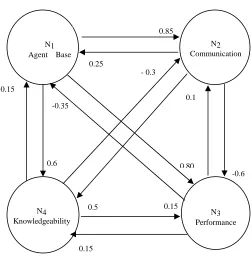
FCM MODELAgents’ communication is one of the main characteristics of MAS in which software agents usually interact with a purpose of achieving their goals; to share expertise; to work in parallel or sequence on common problems; to be developed and implemented modularly; to be fault tolerant through redundancy; to represent multiple viewpoints and the knowledge of multiple experts; to be reusable [5] and to meet global constraints. In this paper we aim to study the relationship between the local knowledge of agents and global quality of MAS namely knowledgeability and performance that requires communication among agents. A FCM model has been proposed to simulate relationship among agents’ communication, and MAS quality features: knowledgeability and performance, which is shown in Figure 2.
The model consists of four concepts and their interdependencies in the form of weights, which are as follows:
• Agent Base (N1): the degree of exploitation of cognitive capabilities of individual agents involved in a Multi-agent application and interfaces among them.
• Communication (N2): communication effort, which reflects the effort connected with sharing of knowledge, reasoning and decision making to achieve goals of MAS.
• Performance (N3): It reflects the gain in utility of MAS in terms of throughput, response time and resource utilization.
• Knowledgeability (N4): It can be interpreted as the exhaustiveness of knowledgebase that drastically affects the reasoning and decision making to accomplish the goals of MAS The casual relationships between nodes, which is represented by directed edges, can be interpreted as follows:
Increase in agents’ cognitive capabilities has positive effect on the knowledgeability of MAS (+0.6 directed edge between N1 and N4). However it forces higher level of communication among agents (+0.85 directed edge between N1 and N2), which is essential to meet dependencies between agents and share the expertise, resources or information and hence to synchronize the global knowledge of MAS. Communication among agents has negative impact on performance of MAS as communication involves computational and communication cost and thus adversely affects the performance of MAS. (-0.6 directed edge between N2 and N3). But communication affects positively on sharing of knowledge among agents and thus the knowledgeability of MAS. (0.5 directed edge between N2 and N4).
The increase in knowledgeability further positively affects the performance of MAS, as it enables MAS to solve problems that are beyond the capability and knowledge of each individual agent. Information discovered by one agent can be of sufficient use to another agent and now they can solve the problem twice as fast and hence affecting the performance of MAS. (0.75 directed edge between N4 and N3), that in consequence, can cause increase in communication among agents (0.1 directed edge between N3 and N2). Increase in communication among agents can require more agents to control the coordination (0.25 directed edge between N2 and N1), which further positively impact the performance of MAS (0.8 directed edge between N1 and N3).
However, higher value of knowledgeability
and performance demand dropping off the cognitive capabilities of agents and hence lesser agents in agent base (-0.15 directed edge between N4 and N1; -0.35 directed edge between N3 and N1). Increase in knowledgeability has a negative effect on communication (-0.3 directed edge between N4 and N2) that in consequence improves the performance.
Then, these relationships were expressed in fuzzy terms, i.e. weak, strong and very strong by taking into consideration the common perception of their strength. Finally, these terms were replaced by numerical values.
Simulation
The developed FCM model was simulated. Each state vector consists of four numbers, which correspond to conceptual nodes as follows: agent base (N1), communication (N2), performance (N3) and knowledgeability (N4).
The starting vector C0 = (0.5, 0, 0, 0) represent a situation when agent base concept is active and set at value 0.5, and other concepts are inactive. This state can be interpreted as beginning state of multi-agent application execution where individual multi-agents are assigned their goals.
As the simulation continues, agents communicate to achieve their individual and global goals of MAS. The successive values of nodes show the trends, which occur with the progressive time. By analyzing states of nodes in consequent system states, relationship between the nodes can be learned and analyzed.
Rounding to three significant digits, during the simulation, the following states are achieved:
Co= (0.50, 0.893, 0.881, 0.818) C1=(0.2615, 0.792, 0.483, 0.988) C2=(0.355, 0.468, 0.357, 0.958) C4=(0.319, 0.562, 0.676, 0.924) C5=(0.236, 0.576, 0.57, 0.946) C6=(0.271, 0.467, 0.481, 0.929) C7=(0.278, 0.5, 0.594, 0.912) C8=(0.25, 0.527, 0.573, 0.926) C9=(0.261, 0.49, 0.528, 0.924)
Where Ci is the ith state of the system. The model steadily reaches the equilibrium, which is state C49=(0.5, 0.5, 0.5, 0.5).
Analysis of the Simulation
In order to understand the achieved results, values of all nodes are presented in Figure 3.
Individual Behavior Analysis
Agent base: Initially (stage C0) large number of agents is required to achieve goals and attain momentum in MAS activities. As life of MAS grows, less number of agents is vital to achieve desired goals and number of agents settles to a low value than initial count (Stage C19); after initial fluctuations in the number of agents.
Communication: As large number of agents are required at initial stage C0 and it results in higher values of communication, that helps MAS to build its knowledge base. As the knowledge base of MAS grows; less communication effort is requisite to achieve desired goals. And in simulation the value of communication decreases continuously after initial fluctuations.
0 0.2 0.4 0.6 0.8 1 1.2
1 2 3 4 5 6 7 8 9 10 11 12 13 14 15 16 17 18 19 20
State Number
value of N
odes
Agent Base Communication
[image:4.612.47.299.80.337.2]Performance Knowledgeability
Figure 3: Results of the simulation
[image:4.612.315.519.502.650.2]-0.6
Fig. 2.FCM describing influence of communication on quality of MAS
0.6 N1 Agent Base
N2 Communication
N3 Performance N4
Knowledgeability
0.15 -0.15
-0.25
N2 Communication
0.25
0.85
0.80
0.5 -0.35
0.1 - 0.3
Performance: The large number of agents in initial stages leads to high performance, but as communication increases between agents, it decreases performance of MAS. Performance of MAS decreases steadily after initial higher values. Knowledge: More number of agents in agent base and higher value of communication results in higher value of knowledge base, and knowledge of MAS remain more or less steady at higher values. It decreases very marginally with life of MAS. Model suggests that knowledge once gained is not lost in near future.
Overall Behavior Analysis
FCM allows the different contributions of quality features through weights on edges that are specific to application considered and thus making overall analysis of agents’ coordination easy to understand and ascertain.
The first state (C1) shows that the performance is high despite of high communication as the communication is supporting MAS to build its knowledge base that affects the performance of MAS positively
The next states show that as the communication among software agents decreases, value of performance increases. But higher value of communication improves the knowledgeability of MAS. As knowledgeability attains higher values, communication decreases, as agents need not to communicate any more that results in higher performance of MAS.
The simulation tends to move towards an equilibrium state at state C49, with more fluctuations at initial stages of graph in the values of different concepts.
This suggests analysts or designer of MAS application to wait for some time before making decisions on ideal number of agents in application, acceptable level of communication, performance and knowledge.
Related work
There have been very few papers in the literature that discuss the software agents’ communication issues affecting the quality of MAS. This is why; we have concentrated to large degree on two issues:
Demonstrating the effect of communication among agents on MAS quality; mainly on performance and knowledgeability of MAS,
Demonstrating how the quality of MAS affects the communication efforts and the individual knowledge of agents in agent base.
There are indeed some similar issues that examine the relationship between computational time and the number of tasks and agents [8]. They report that as the numbers of tasks and agents both exceeds after a certain level, the system’s performance degradation begins to grow exponentially with load. Sugawara et al. [17] has investigated how learning parameters for local strategies to select partner agents committed a specific tasks influence on overall performance of MAS and proposed that collaboration can improve total performance of MAS.
Scheutz and Schermerhorn [1] have studied cycles to completion and overhead vis-à-vis with number of different cooperative agents. They have suggested as number of agents of any type increases, the cycles to completion decreases but communication overhead increases; and if the number of agents is kept to a certain level, the communication overhead does not drastically effects system performance, and cycles to completion reduces with increase in number of agents.
Our model suggests that the relationship between agent base, communication overhead, knowledgeability and performance is not a linear relationship, but the values of these concepts fluctuate before attaining an equilibrium state. This means, it is not possible to easily control the knowledgeability and performance of MAS by just escalating the size of agent base. The analysis shows that the MAS analyst must wait some time before taking any judgments based on performance to accommodate the communication between the agents.
This study would assist the designers and researchers, in modeling the communication among agents, in envisioning agent societies and also facilitate in analyzing the impact of societal characteristics on performance of multi-agent projects.
V. CONCLUSIONS
Fuzzy cognitive maps are suitable and useful for systems that can’t be described easily by mathematical formulas. Building and simulation of models for such systems can be facilitated on the basis of knowledge about mutual relationships between factors that describe the system.
affects positively to the knowledgeability and adversely to the performance of MAS.
The benefits of carrying out such investigations becomes increasingly important as MASs mature, and this paper has shown that different MAS communication models need to be investigated in order to guarantee the quality of service to users as MAS become available.
The further study in this area would be to increase the scope and to incorporate more concepts of MAS quality; and analyze how all of them are interrelated and how a desired level of quality can be achieved. Future study would also include the environmental factors that have their effect on various factors of MAS quality.
REFERENCES
[1] M. Scheutz and P. Schermerhorn, Many is more, but not too many: dimensions of cooperation of agents with and without predictive capabilities, IEEE/WIC International Conference on Intelligent Agent technology, 2003, pp.378- 384. [2] J. Dickerson and B. Kosko, Fuzzy Virtual Worlds, Artificial Intelligence Experts, Vol. 7, 1994, pp.25-31.
[3] B.H. Far, Modeling and Implementation of Software Agents Decision Making, Proceedings of the Third IEEE International Conference on Cognitive Informatics (ICCI’04), IEEE. Alta., Canada , 2004, pp. 258-267.
[4] B. H. Far and R. S. Wahono, Cognitive-Decision-Making Issues for Software Agents, Brain and Mind, 4, 2003, pp. 239-252.
[5] M. N. Huhns, L. M. Stephens, Multiagent Systems and Societies of Agents, Ed. By Gerhard Weiss. Multiagent Systems: A Modern Approach to Distributed Artificial Intelligence. MIT press. 1999, ch.1.
[6] R. M. Malyankar, N.V. Findler, A Methodology for Modeling Coordination in Intelligent Agent societies, Computational, Mathematical and Organization Theory, 4(4), 1998, pp. 317-345.
[7] R. Neruda, Cooperation of Computational Intelligent Agents, International Symposium on Collaborative Technologies and Systems (CTS'06), Las Vegas, Nevada, USA, 2006, pp. 256-263.
[8] H. S. Nwana, L. Lee, D. T. Ndumu, P. D. Wilde, The stability, scalability and performance of multi-agent systems, BT Technol J., 16(3), 1998, pp. 94-103.
[9] B.H. Far and R.S. Wahono, (2003), Software Agents: Quality, Complexity and Uncertainty Issues, Proceedings of the First IEEE International Conference on Cognitive Informatics, 2002, pp.122-131.
[10] W. Statch, L. Kurgan, Modeling Software Development Projects Using Fuzzy Cognitive Maps, Proceedings of IEEE International conference on Fuzzy Systems, Nevada, USA, 2005, pp. 618-624.
[11] W. Statch, L. Kurgan, W. Pedrycz, M. Reformat, Parallel Fuzzy Cognitive Maps as a Tool for Modeling software Development Projects, NAFIP ’04, Alta., Canada, 1, 2004, pp. 28-33.
[12] E. I. Papageorgiou, C. D. Stylios, P. P. Groumpos, The Challenges of using Unsupervised Learning Algorithms for Fuzzy Cognitive Maps, Proceedings of IEEE conference on Neural Networks, 3, 2004, pp. 2425-2430.
[13] C. David, W. Sharma and S.Ravi, S., Toward a Diagnostics Instrument for Assessing the Quality of Expert
Systems, ACM SIGBDP Conference on Trends and Directions in Expert Systems, Orlando, Florida, United States, 1992, pp. 72-87.
[14] B.H. Far, A collective view and Methodologies for Software Agents’, Canadian Conference on Electrical and Computer Engineering, Alta., Canada, 3, 2004, pp. 1249-1252. [15] E. H. Durfee, Scaling Up Agent Coordination Strategies, Computer, IEEE, 34(7), 2001, pp. 39-46.
[16] Fortino G., Russo W., Multi-coordination of mobile agents: a model and a component-based architecture, Proceedings of the 2005 ACM symposium on Applied Computing, Santa Fe, New Mexico, 2005, 443-450.
[17] T. Sugawara, K. Fukuda, T. Hirotsu, S. Sato, S. Kurihara, MAS performance by adaptive nonadaptive agent selection, Proceedings of the International Conference on Intelligent Agent Technology (IAT’06), 2006, pp. 555-559. [18] F. Andriamasinoro, R. Courdier, E. Piquet, Enhancing a multi-agent system's performance from implementation to simulation analysis, Proceedings of Ist International Symposium on Cluster Computing and the Grid, 2001, page 464.