Technical Committee
LAN Emulation Client
Management Specification
Version 2.0
AF-LANE-0093.000
October, 1998
© 1998 by The ATM Forum. The ATM Forum hereby grants its members the limited right to reproduce in whole,
but not in part, this specification for its members' internal use only, and not for further distribution. This right
shall not be, and is not, transferable. All other rights reserved. Except as expressly stated in this notice, no part of
this document may be reproduced or transmitted in any form or by any means, or stored in any information storage
and retrieval system, without the prior written permission of The ATM Forum.
The information in this publication is believed to be accurate as of its publication date. Such information is subject
to change without notice and The ATM Forum is not responsible for any errors. The ATM Forum does not assume
any responsibility to update or correct any information in this publication. Notwithstanding anything to the
contrary, neither The ATM Forum nor the publisher make any representation or warranty, expressed or implied,
concerning the completeness, accuracy, or applicability of any information contained in this publication. No
liability of any kind shall be assumed by The ATM Forum or the publisher as a result of reliance upon any
information contained in this publication.
The receipt or any use of this document or its contents does not in any way create by implication or otherwise:
•
Any express or implied license or right to or under any ATM Forum member company's patent, copyright,
trademark or trade secret rights which are or may be associated with the ideas, techniques, concepts or
expressions contained herein; nor
•
Any warranty or representation that any ATM Forum member companies will announce any product(s) and/or
service(s) related thereto, or if such announcements are made, that such announced product(s) and/or service(s)
embody any or all of the ideas, technologies, or concepts contained herein; nor
•
Any form of relationship between any ATM Forum member companies and the recipient or user of this
document.
Implementation or use of specific ATM standards or recommendations and ATM Forum specifications will be
voluntary, and no company shall agree or be obliged to implement them by virtue of participation in The ATM
Forum.
The ATM Forum is a non-profit international organization accelerating industry cooperation on ATM technology.
The ATM Forum does not, expressly or otherwise, endorse or promote any specific products or services.
NOTE: The user's attention is called to the possibility that implementation of the ATM interoperability
specification contained herein may require use of an invention covered by patent rights held by ATM Forum
Member companies or others. By publication of this ATM interoperability specification, no position is taken by
The ATM Forum with respect to validity of any patent claims or of any patent rights related thereto or the ability to
obtain the license to use such rights. ATM Forum Member companies agree to grant licenses under the relevant
patents they own on reasonable and nondiscriminatory terms and conditions to applicants desiring to obtain such a
license. For additional information contact:
The ATM Forum
Worldwide Headquarters
2570 West El Camino Real, Suite 304
Mountain View, CA 94040-1313
Tel: +1-650-949-6700
Acknowledgement
The contributions adopted by the ATM Forum and the assistance of the editing group of the LAN
Emulation Sub-Working group were essential to the completion of this specification and its
predecessor.
In particular, the editor would like to recognize the following members who made significant
contributions to this effort:
Andy Bierman
Bill Ellington
Norm Finn
Andre Fredette
John D. Keene
Jon Lawrence
Faye Ly
Keith McCloghrie
Jason Perreault
Andrew Smith
Matt Squire
Andrew Tylee
The assistance by these members and all who participated in the LAN Emulation Sub-Working
Group is appreciated. Special thanks to everyone who hosted and attended the special editing
meeting for the first version of the LEC MIB.
Contents
1. Introduction...1
1.1 Terminology...1
1.2 References...2
2. Management Functions...3
2.1 Configuration Management...3
2.2 Performance Management...3
2.2.1 Observing the behavior of an ATM emulated LAN...3
2.2.2 Levels of performance management...4
2.3 Fault Management...5
2.4 Security Management...5
2.5 Accounting Management...5
3. Management Framework...6
3.1 SNMP...6
3.2 RFCs...6
3.3 Requirements for LAN Emulation Hosts...7
3.3.1 Requirements for SNMP...7
3.3.2 Requirements for Other Network Management Protocols...7
3.3.3 Conclusion...7
4. MIB-II and RFC 1573 Support...8
4.1 Emulated Network Interfaces and the Interfaces table...8
4.2 Interpretations of Interface tables for ATM emulated LANs...10
4.3 AToM MIB support and the Interfaces Stack Table...15
4.4 Maximum Data Frame Sizes...16
5.1 MAC Addresses...17
5.2 ATM Addresses...19
6. LAN Emulation Client MIB Description...20
6.1 Motivation...20
6.2 MIB Organization...20
6.3 MIB Groups...21
6.3.1 Configuration Group...21
6.3.2 Status Group...23
6.3.3 Statistics Group...25
6.3.4 Server Connections Group...25
6.3.5 ATM Addresses Group...25
6.3.6 Registered MAC Addresses Group...26
6.3.7 Registered Route Descriptors Group...26
6.3.8 LE_ARP Cache Group - MAC Addresses...26
6.3.9 LE_ARP Cache Group - Route Descriptors...27
6.3.10 Index Mapping Group...27
6.3.11 Multicast Forward VCC Group...27
6.3.12 Proxy LE_ARP Response Group – MAC Addresses...28
6.3.13 Proxy LE_ARP Response Group – Route Descriptors...28
6.3.14 TLV Group...29
6.4 Interaction with ifAdminStatus...29
6.5 Limitations...30
1. Introduction
One of the most promising networking technologies is ATM. ATM offers high performance, the
ability to carry many types of services (data, voice, video), and the ability to carry traffic over both
the LAN and the WAN.
LAN Emulation provides a means of running existing applications and protocols over ATM. The
LAN Emulation specification defines four types of components:
•
LAN Emulation Clients - which use emulated LANs to send and receive data.
•
LAN Emulation Servers - which perform control coordination functions, and assist clients in
doing address resolution.
•
Broadcast and Unknown Servers - which emulate the multicast functions of a shared-media
LAN.
•
LAN Emulation Configuration Servers - which provide auto-configuration services.
Network management is concerned with the ability to remotely monitor and control networks and
networked devices.
This document defines network management for LAN Emulation Clients.
1.1 Terminology
The following acronyms and terminology are used throughout this document.
AAL
ATM Adaptation Layer
ATM
Asynchronous Transfer Mode
BUS
Broadcast and Unknown Server
ELAN
Emulated Local Area Network
LAN
Local Area Network
LANE
LAN Emulation
LE
LAN Emulation
LE_ARP
LAN Emulation Address Resolution Protocol
LEC
LAN Emulation Client
LECID
LAN Emulation Client Identifier
LECS
LAN Emulation Configuration Server
LES
LAN Emulation Server
LUNI
LAN Emulation User-Network Interface
RD
Route Descriptor
RFC
Request For Comment (Document Series)
UNI
User-Network Interface
VCC
Virtual Channel Connection
VCI
Virtual Channel Identifier
VPI
Virtual Path Identifier
1.2 References
•
The ATM Forum, LAN Emulation Over ATM Specification, Version 1.0.
•
The ATM Forum, LAN Emulation Over ATM Version 2 — LUNI Specification.
•
RFC 1213, McCloghrie and Rose, Management Information Base for Network Management
of TCP/IP-based internets: MIB-II.
•
RFC 1493, Decker, Langille, Rijsinghani, and McCloghrie, Definitions of Managed Objects
for Bridges.
•
RFC 1573, McCloghrie and Kastenholtz, Evolution of the Interfaces Group of MIB-II.
•
RFC 1695, Ahmed and Tesink, Definitions of Managed Objects for ATM Management.
2. Management Functions
Network management can be divided into the areas of configuration, performance, fault,
security, and accounting management.
2.1 Configuration Management
Configuration management is concerned with setting up network elements for normal operation,
finding out their current operational parameters, and keeping track of inventories and network
topologies.
This network management specification addresses several common tasks, including
•
Identifying all of the LAN Emulation Clients currently set up at a managed device.
•
Creating and destroying LAN Emulation Clients, for hosts which support this. (This is like
adding network interface cards to a machine, or removing them from a machine.)
•
Forcing LAN Emulation Clients to join or leave emulated LANs. (This is like attaching a
machine to a traditional LAN, or detaching it from a traditional LAN. Making a client leave an
emulated LAN does not destroy the client, but simply returns it to an Initial State, where its
configuration can be examined and altered.)
•
Examining and changing Initial State Parameters.
•
Identifying Configuration, Control, and Multicast VCCs.
It does not address identification of Data Direct VCCs, configuration of LAN Emulation PVCs, or
identification of the ATM addresses at each end of a VCC. These are expected to be handled via
extensions to other MIBs.
Other areas which affect LEC management are at least partially outside of the scope of the LUNI.
They include configuration of LAN Emulation Configuration Servers, fault management at the
LAN Emulation Server, and full auto-discovery of emulated LAN topology.
2.2 Performance Management
Performance management is concerned with the quality of service that a system delivers to its
users, and the efficiency with which it delivers that service.
2.2.1 Observing the behavior of an ATM emulated LAN
One important component of performance management is the ability to observe the behavior of a
network. Several factors make ATM emulated LANs harder to observe than traditional ones.
•
Traffic is spread out over many virtual circuits, instead of being concentrated in one physical
•
These virtual circuits may be set up and torn down frequently, presenting a moving target to
would-be observers.
•
The performance of each virtual circuit may be affected by factors outside the control of the
ATM emulated LAN hosts. In particular, these include which switches are congested, and
what actions those switches take in response to congestion (cell loss, flow control, etc.).
•
In addition to data traffic, there may be a fair amount of LAN Emulation control traffic. It is
desirable to monitor this control traffic separately.
•
It is an explicit non-goal for ATM Forum LAN Emulation to support promiscuous listeners
(hosts who want to listen to all unicast traffic). Thus, managers can't simply attach protocol
analyzers to an emulated LAN to find out what is happening.
Given this, the only ways for a network management station to monitor the amount of traffic
going to a specific host are
1. To enlist the help of LAN Emulation Clients (LECs) in collecting this information.
2. To collect and aggregate performance statistics about individual virtual circuits.
3. To collect performance statistics at the ATM port level, using the AToM MIB.
4. To eavesdrop on communication between two LAN Emulation hosts. A major disadvantage
of this is that the network manager must decide which paths to monitor in advance.
This specification requires LAN Emulation Clients to carry out basic traffic measurements, and to
make them available through SNMP MIBs, as described in the following text.
2.2.2 Levels of performance management
There are several potential levels of performance management, including
•
Performance management of the MAC layer, where we view an emulated LAN as providing a
connectionless packet delivery service.
•
Performance management of LUNI traffic, especially LE_ARPs.
•
Performance management of individual virtual circuits within an emulated LAN.
•
Performance management of the ATM switch network over which an emulated LAN runs.
This specification focuses on the first two levels. While performance management of the switch
network is important, it is beyond the proper scope of the LUNI. Furthermore, we recognize the
philosophy that
"The SNMP explicitly minimizes the number and complexity of management functions realized
by the management agent itself." - RFC 1157
"This memo strongly recommends that connection-oriented sub-layers not have a conceptual row
in the ifTable for each virtual circuit. This avoids the proliferation of conceptual rows, especially
those which have considerable redundant information." - RFC 1573
In particular, this specification does not require clients to implement elaborate protocol analysis
functionality, or to maintain separate traffic counters for each virtual circuit. Vendors may, of
course, choose to implement such features in addition to those specified herein.
2.3 Fault Management
Fault management is concerned with the prevention, detection, and correction of problems in an
emulated LAN that are caused by the failure of network elements.
At the LAN Emulation Client level,
•
The MIB-II object 'ifOperStatus' indicates whether the emulated interface is up or down.
•
The RFC 1573 object 'ifLinkUpDownTrapEnable' provides an optional way to enable and
disable 'linkUp'/'linkDown' traps. (Because this object's MIN-ACCESS is 'read-only', and
its default value is 'disabled', an implementation is not required to implement these traps for
the LAN Emulation Client layer.)
•
The LEC MIB object 'lecInterfaceState' provides additional information on the state of the
LAN Emulation Client.
•
The LEC MIB objects 'lecLastFailureRespCode' and 'lecLastFailureState' provide information
on the last Configure failure or Join failure.
At the virtual circuit level, operational status, administrative status, and AAL5 error statistics are
available for Configuration, Control, and Multicast VCCs, via the LEC MIB Server VCC table
and the AToM MIB.
2.4 Security Management
Security management is outside the scope of this document.
2.5 Accounting Management
3. Management Framework
This chapter defines the network management framework for LAN Emulation Clients.
3.1 SNMP
LAN Emulation Client management is defined using SNMP MIBs. SNMP is an Internet-standard
network management framework whose basic concepts are as follows:
"A network management system contains: several (potentially many) nodes, each with a
processing entity, termed an agent, which has access to management instrumentation; at least one
management station; and, a management protocol, used to convey management information
between the agents and management stations. Operations of the protocol are carried out under an
administrative framework which defines both authentication and authorization policies.
Network management stations execute management applications which monitor and control
network elements. Network elements are devices such as hosts, routers, terminal servers, etc.,
which are monitored and controlled through access to their management information.
Management information is viewed as a collection of managed objects, residing in a virtual
information store, termed the Management Information Base (MIB). Collections of related objects
are defined in MIB modules. These modules are written using a subset of OSI's Abstract Syntax
Notation One (ASN.1)." - RFC 1442 (SMI for SNMPv2)
Currently, there are two versions of the SNMP framework. This specification uses SNMPv2 as
the basis for defining a LAN Emulation Client MIB, and refers to other MIBs whose published
definitions use SNMPv2 conventions. However, this specification does not mandate the use of
SNMPv2, as opposed to SNMPv1. RFC 1452 describes how SNMPv1 and SNMPv2 coexist,
and The Simple Times reports that automatic translations can be obtained by mailing SNMPv2
MIBs to
[email protected]
.
3.2 RFCs
RFC ("Request for Comment") documents are a standard way of proposing new protocols and
MIBs in the Internet community. Some of the most relevant RFCs, for our purposes, are
•
RFC 1213, which defines MIB-II, the core set of managed objects for the Internet suite of
protocols.
•
RFCs 1441 through 1452, which define SNMPv2. These RFCs total more than 400 pages.
The Simple Times volume 2, number 3 contains a useful road map.
•
RFCs 1902 through 1902, which update the SNMPv2 specification. For the purposes of this
document, the security/complexity debate reflected in RFCs 1901 and 1910 is irrelevant.
•
RFC 1573, which defines the evolution of the Interfaces group of MIB-II.
3.3 Requirements for LAN Emulation Hosts
All LAN Emulation Clients SHOULD be network-manageable, either via the SNMP network
management protocol or via some other network management protocol.
3.3.1 Requirements for SNMP
SNMP agents that support LAN Emulation Clients MUST implement:
•
The Systems and Interfaces groups of STD 17, RFC 1213 - MIB II.
•
RFC 1695 - Definitions of Managed Objects for ATM Management, according to the
conformance statements defined in that RFC. This RFC is better known as the AToM MIB.
•
The LAN Emulation Client MIB defined in this specification
1.
These are in addition to any other MIB objects that a particular host may be required to support.
For instance, an ATM-to-Ethernet bridge should also support the Bridge MIB.
Optionally, an agent may support
•
RFC 1573 - Evolution of the Interfaces Group of MIB-II.
In this event, the specifications in RFC 1573 supersede those in MIB-II (for example, an agent
which implements RFC 1573 does not need to support 'ifInNUcastPkts' or 'ifOutNUcastPkts').
3.3.2 Requirements for Other Network Management Protocols
Although the use of SNMP is recommended, it is not strictly required. LAN Emulation Client
management for other protocols SHOULD be based on the MIBs listed above - especially MIB-II,
RFC 1573 and the LAN Emulation Client MIB.
3.3.3 Conclusion
We now define these requirements in more detail, starting with MIB-II and RFC 1573.
1
A SNMP agent which only supports LANE 1.0 clients may choose to conform with Version 1.0 of this document
instead. However, note that several of the changes made here and in the LEC MIB addendum benefit LANE 1.0
clients.
4. MIB-II and RFC 1573 Support
All SNMP agents which support LAN Emulation Clients must implement MIB-II, and are also
encouraged to implement RFC 1573. This chapter explains why, and defines interpretations of
MIB-II / RFC 1573 as they apply to LAN Emulation Clients.
4.1 Emulated Network Interfaces and the Interfaces table
The goal of LAN Emulation is to present the illusion that one or more ATM ports can be treated as
one or more 802.* LAN ports
2. Real LAN ports have entries in the MIB-II Interfaces table and
the RFC 1573 Interface Extensions table. To preserve a consistent management framework, it is
highly desirable for each emulated port to have entries in these tables as well.
Each SNMP agent that supports LAN Emulation Clients must support such entries. Thus, the
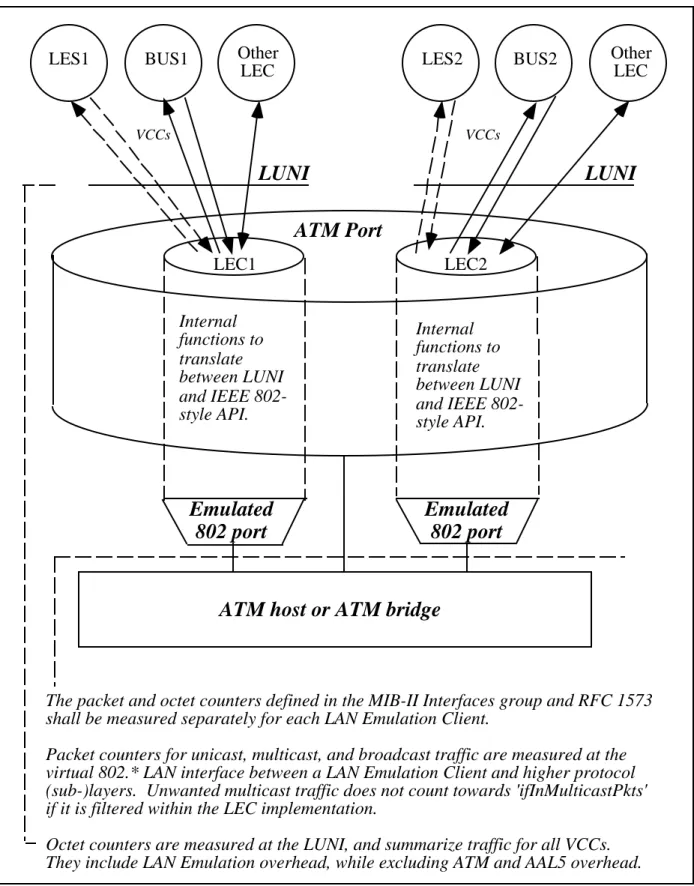
host in Figure 1 would have at least three ifTable entries - one for the physical ATM port, and two
for the emulated network interfaces corresponding to its LAN Emulation Clients.
To identify an interface as belonging to an emulated LAN, it must be tagged with one of these
ifType constants:
•
'aflane8023(59)', for an emulated LAN that supports the IEEE 802.3 and Ethernet data frame
formats.
•
'aflane8025(60)', for an emulated LAN that supports the IEEE 802.5 / Token Ring data frame
format.
These constants let a network management application know that additional information about the
interface is available via the LAN Emulation Client MIB.
Unlike most kinds of interfaces, LAN Emulation Client interfaces can be created and destroyed by
network management. So that agents can control ifIndex allocation, most tables in the LEC MIB
use a separate lecIndex. For convenience,
•
lecMappingIndex converts an ifIndex to a lecIndex.
•
lecIfIndex converts the other way.
2
The mapping may be, but is not required to be, one-to-one. A single ATM port may support several active LAN
Figure 1 - Emulated Network Interfaces at a LAN Emulation Client Host
LES1
BUS1
LES2
BUS2
LUNI
LUNI
Emulated
802 port
ATM host or ATM bridge
Internal
functions to
translate
between LUNI
and IEEE
802-style API.
The packet and octet counters defined in the MIB-II Interfaces group and RFC 1573
shall be measured separately for each LAN Emulation Client.
Packet counters for unicast, multicast, and broadcast traffic are measured at the
virtual 802.* LAN interface between a LAN Emulation Client and higher protocol
(sub-)layers. Unwanted multicast traffic does not count towards 'ifInMulticastPkts'
if it is filtered within the LEC implementation.
Octet counters are measured at the LUNI, and summarize traffic for all VCCs.
They include LAN Emulation overhead, while excluding ATM and AAL5 overhead.
ATM Port
LEC1
LEC2
Other
LEC
VCCs
VCCs
Internal
functions to
translate
between LUNI
and IEEE
802-style API.
Emulated
802 port
Other
LEC
4.2 Interpretations of Interface tables for ATM emulated LANs
RFC 1573 "defines a portion of the Management Information Base (MIB) for use with the
network management protocols in the Internet community." Specifically, this includes an updated
version of the MIB-II 'ifTable' and an extension table called the 'ifXTable'.
The following tables specify interpretations for 'ifTable' and 'ifXTable' objects, as they apply to
emulated LANs. Text copied verbatim from RFC 1573 is printed in the
Courier
font, to
distinguish it from this document's additions and changes.
Note 1
Although 'ifSpeed' and 'ifHighSpeed' are defined to be 0, decisions as to which of RFC 1573's
64-bit octet and/or packet counters must be implemented must be based on the maximum AAL
SDU bandwidth that a host theoretically offers to its LAN Emulation Clients. This is an extra
requirement that the LAN Emulation Client MIB imposes above and beyond the conformance
statement in RFC 1573, to ensure that LAN Emulation Clients implement the spirit as well as the
letter of that MIB.
For instance, a host whose LAN Emulation Clients have access to a single 155 Mb/S SONET
interface would be required to implement 64-bit octet counters and 32-bit packet counters, as
specified in the compliance statement for 'ifHCPacketGroup'.
Note 2
As a result of people's real-world experience, the interpretation of 'ifInDiscards' has changed.
Echo packets and unwanted, filtered multicast packets are now excluded from 'ifInDiscards' and
counted in the LEC MIB. This is intended to make the behavior of a LEC interface more like that
of real Ethernet and Token Ring hardware adapters, and to prevent false alarms in network
management systems which assume that all discards are bad.
Object
Use for the emulated network interface layer
ifIndex
Same interpretation as RFC 1573.
A unique value,
greater than zero, for each interface.
Note that
the LAN Emulation Client MIB's 'LeConnectionInterface' textual
convention depends upon the assurance that no Interfaces table entry
has an 'ifIndex' of zero.
ifDescr
Same interpretation as RFC 1573.
A textual string
containing information about the interface.
This string should include the name of the
manufacturer, the
product
name,
and
the
version of the interface hardware/software.
ifType
If the 'lecActualLanType' for the corresponding LAN Emulation
Client is 'unspecified' or 'aflane8023', the IANA ifType constant
'aflane8023(59)'.
If the 'lecActualLanType' is 'aflane8025', the IANA ifType constant
'aflane8025(60)'.
ifMtu
This read-only value is a function of the 'lecActualLanType' and
'lecActualMaxDataFrameSize' objects in the LAN Emulation Client
MIB. For the purposes of calculating this value, an unspecified
maximum frame size is taken to mean the smallest standard size.
For a client whose 'lecActualLanType' is 'unspecified' or
'aflane8023', 'ifMtu' is equal to the maximum AAL5 SDU size for
a non-multiplexed VCC minus 'X' octets. The value of 'X' is up to
the implementation, and may be either 16 (Ethernet encapsulation)
or 24 (LLC/SNAP encapsulation).
For a client whose 'lecActualLanType' is 'aflane8025', 'ifMtu' is
equal to the maximum AAL5 SDU size for a non-multiplexed VCC
minus 54 octets.
ifSpeed, ifHighSpeed
Set to 0. Note that decisions as to whether to implement 64-bit
octet and/or packet counters must be made on the basis of the
maximum AAL5 SDU bandwidth that is theoretically available to
any of the managed device's LAN Emulation Clients.
ifPhysAddress
For an active LAN Emulation client, (one of) the MAC address(es)
registered for this emulated network interface, stored using the
MacAddress convention defined in RFC 1443. For an inactive
client which has at least one MAC address, one of those addresses.
For an inactive client with no MAC addresses, the empty string.
The LUNI lets clients register MAC addresses dynamically. Thus,
the value of this object may change over time. However, a client
should only change the value of 'ifPhysAddress' at the time that it
joins an emulated LAN or deregisters the current 'ifPhysAddress'.
Note that the ATM addresses of the LAN Emulation Client and
LAN Emulation Server are located in the LEC MIB.
Object
Use for the emulated network interface layer
ifAdminStatus
Provides manual control over Joins and terminations.
To make an inactive client join an emulated LAN, set its
'ifAdminStatus' to 'up'. The MIB-II 'ifOperStatus' and LAN
Emulation Client MIB 'lecInterfaceState' will reflect the progress
and success of the attempt. Once 'ifAdminStatus' has been set to
'up', it will stay 'up' until the manager changes it, or until the
managed system changes it as specified in RFC 1573. It will not
go 'down' simply because a Join attempt fails or because the client
becomes disconnected from an emulated LAN. This makes it easy
to distinguish operational problems from intentional termination,
ensuring that 'ifAdminStatus' reflects
the desired state of
the interface.
To make a client leave an emulated LAN, set its 'ifAdminStatus' to
'down'. This will cause 'ifOperStatus' to change to 'down', and
'lecInterfaceState' to change to 'initialState'.
The 'testing' value is not currently supported for LE Clients.
ifOperStatus
The
current
operational
state
of
the
interface.
In particular, the state of the MAC interface
between the LAN Emulation Client and higher (sub-)layers, as
opposed to the health of the client.
'ifOperStatus' is defined to be 'up' when, and only when, the
'lecInterfaceState' of the LAN Emulation Client is 'operational'. It
may take on the values 'down' or 'unknown' at other times. The
values 'testing' and 'dormant' are not used.
ifLastChange
Same interpretation as RFC 1573.
The value of
sysUpTime at the time the interface entered
its current operational state.
If
the
current state was entered prior to the last
re-initialization
of
the
local
network
management
subsystem,
then
this
object
contains a zero value.
ifInOctets, ifOutOctets, and
their 64-bit HC counterparts
The total number of PDU octets (received, transmitted) on all of the
non-multiplexed VCCs or LLC-multiplexed flows associated with
this emulated network interface. This includes octets from circuits
(and flows) which have been torn down (or terminated) since this
client joined the emulated LAN.
Note that these counters are not measured at the emulated network
interface between the LEC and higher (sub-)layers. Instead they are
measured at the interface between the LEC and the AAL layer.
Thus, all received multicast packets and LAN Emulation control
packets count towards 'ifInOctets', even if the LEC implementation
filters out unwanted multicast packets before they reach higher
(sub-)layers.
Object
Use for the emulated network interface layer
(continued)
These counts exclude ATM cell layer overhead and AAL overhead.
They include LAN Emulation overhead: the LEC-ID, and the LLC
header on LLC-multiplexed VCC flows.
Packet counters in general
Traffic counters: Total number of qualifying packets received or
transmitted across the emulated network interface between this LAN
Emulation Client and higher (sub-)layers. Error counters: Total
number of errored PDUs, including control and data PDUs. All
counters include packets from VCCs (or flows) torn down (or
terminated) since this client joined the emulated LAN.
Specific interpretations for each counter follow.
ifInUcastPkts,
ifHCInUcastPkts
The number of
data
packets delivered by this
LAN Emulation Client
to a higher (sub-)layer,
which were not addressed to a multicast or
broadcast
LAN Destination
.
ifInNUcastPkts
Required in MIB-II; deprecated in RFC 1573.
The sum of 'ifInMulticastPkts' and 'ifInBroadcastPkts'.
ifInDiscards
The number of inbound
LAN Emulation PDU
packets
which were chosen to be discarded even though
no errors had been detected to prevent their
being deliverable to a higher-layer protocol
or to the control entity in the LAN Emulation Client
. One
possible reason for discarding such a packet
could be to free up buffer space.
This count does
not include discarded echo packets and filtered multicast packets.
ifInErrors
The number of inbound
LAN Emulation PDU
packets
that contained errors preventing them from
being deliverable to a higher-layer protocol
or to the control entity in the LAN Emulation Client
.
ifInUnknownProtos
The number of
LAN Emulation PDU
packets
this client
received via the LUNI
which were discarded because
of an unknown or unsupported
LAN Emulation
Control, IEEE 802.3, Ethernet, or IEEE 802.5
protocol.
ifOutUcastPkts,
ifHCOutUcastPkts
The total number of
data
packets that
higher-level protocols
asked this LAN Emulation Client to
transmit,
and which were not addressed to a
multicast or broadcast
LAN Destination,
including
those that were discarded or not sent.
ifOutNUcastPkts
Required in MIB-II; deprecated in RFC 1573.
Object
Use for the emulated network interface layer
ifOutDiscards
The number of outbound
LAN Emulation PDU
packets which were chosen to be discarded
even though no errors had been detected to
prevent their being transmitted. One
possible reason for discarding such a packet
could be to free up buffer space.
This count
includes all types of LAN Emulation PDUs: Ethernet, 802.3,
802.5, and Control.
ifOutErrors
The number of outbound
LAN Emulation PDU
packets that could not be transmitted because
of errors.
This count includes all types of LAN Emulation
PDUs: Ethernet, 802.3, 802.5, and Control.
ifOutQLen
Deprecated in RFC 1573.
The number of data packets that higher-level protocols have
requested this LAN Emulation Client to transmit, and which have
not (yet) been discarded or transmitted across the LUNI.
ifSpecific
Deprecated in RFC 1573.
Set to OBJECT IDENTIFIER { 0 0 } if present.
ifName
Same interpretation as RFC 1573.
ifInMulticastPkts,
ifHCInMulticastPkts
The number of data packets, delivered by this
sub-layer to a higher (sub-)layer, which were
addressed to a multicast
LAN Destination.
This
includes
both
Group
and
Functional
MAC
addresses.
The LANE V1.0 LUNI requires the BUS to forward all broadcast
and multicast packets whose ages do not exceed the maximum hold
time to all clients. The LANE V2.0 LUNI allows a LAN
Emulation Service to offer selective multicasting, but clients still
must be able to deal with unwanted multicast frames.
LAN Emulation Clients are permitted to filter unwanted, received,
multicast frames, but are not required to do so. These counters are
measured at the emulated packet interface between the LEC and
higher (sub-)layers. Thus, unwanted multicast frames are included
in the count if, and only if, the implementation delivers them to a
higher (sub-)layer.
ifInBroadcastPkts,
ifHCInBroadcastPkts
The number of
data
packets delivered by this
LAN Emulation Client
to a higher (sub-)layer,
which were addressed to
the broadcast MAC address.
Object
Use for the emulated network interface layer
ifOutMulticastPkts,
ifHCOutMulticastPkts
The total number of
data
packets that
higher-level protocols
asked this LAN Emulation Client to
transmit,
and
which
were
addressed
to
a
multicast
LAN Destination,
including those that
were discarded or not sent. This includes
both Group and Functional
MAC
addresses.
ifOutBroadcastPkts,
ifHCOutBroadcastPkts
The total number of
data
packets that
higher-level protocols
asked this LAN Emulation Client to
transmit,
and which were addressed to
the broadcast
MAC address,
including those that were discarded
or not sent.
ifLinkUpDownTrapEnable
Default is disabled(2).
ifPromiscuousMode
Set to false(2). LE Clients do not support promiscuous mode in
the sense that a network manager or user understands.
ifConnectorPresent
Set to false(2).
4.3 AToM MIB support and the Interfaces Stack Table
Hosts which implement the LAN Emulation Client MIB may also implement RFC 1573. If a
client uses AAL5 encapsulation, its Interfaces Stack looks like this:
ATM emulated LAN Layer
AAL5
ATM Layer
Physical Layer
Note that
•
There may be both upwards and downwards multiplexing between the emulated LAN layer
and the AAL5 layer. One client may use several ATM ports, and several clients may share an
ATM port - perhaps at the same time.
•
On hosts with multiple ATM ports, a writeable ifStackTable may be desirable, so a manager
can control the assignment of LECs to AAL5 entities and their associated ATM interfaces.
•
In a sense, each LAN Emulation Client row in the Interfaces table represents two interfaces:
the emulated IEEE 802.* packet interface between the LEC and higher (sub-)layers, and the
VCC-oriented interface between the LEC and the AAL5 (sub-)layer. The reason why there is
one Interfaces table row per LEC is that the LEC-to-AAL5 interface does not have enough
interesting MIB-II-style traffic measurements to justify a separate Interfaces table entry.
4.4 Maximum Data Frame Sizes
'lecActualMaxDataFrameSize' and 'ifMtu' both reflect a client's current maximum frame size.
Since 'ifMtu' is the "size of the largest network datagram that can be sent", it depends on the
packet format as well. (Octets before the INFO field and octets that are part of LLC/SNAP fields
don't count.) For convenience, here is a table summarizing the relationship.
lecActualMaxData
FrameSize
ifMtu
(Ethernet)
ifMtu
( 8 0 2 . 3 )
ifMtu
( 8 0 2 . 5 )
AAL5 SDU
max. octets
unspecified
1500
1492
1462
n/a
max1516
1500
1492
1462
1516 / 1528
max1580
1564
1556
1526
1580 / 1592
max4544
4528
4520
4490
4544 / 4556
max9234
9218
9210
9180
9234 / 9246
max18190
18174
18166
18136
18190 / 18202
Note that
•
Clients whose LAN Type is unspecified should use either the Ethernet column or the 802.3
column.
•
The 1580 octet size is new in LANE Version 2 and is only supported for clients whose "C29
V2 Capable" flag is set.
•
The sizes shown on the left side of the AAL5 SDU column are for non-multiplexed VCCs.
LANE V2 clients may use multiplexed VCCs as outlined in the LUNI specification. When
doing so, they should add 12 octets to the non-multiplexed size to cover the LLC overhead.
5. LAN Emulation Client Addresses
Because they live in both the IEEE 802.* and ATM worlds, LAN Emulation Clients have both
MAC and ATM addresses. Furthermore, although MIB-II models interfaces as having a single
'ifPhysAddress', a LEC may have several addresses of each type.
This chapter addresses the question of how to store and configure these addresses.
5.1 MAC Addresses
Each LAN Emulation Client has
•
Zero or more unicast MAC addresses which it has registered, or wishes to register.
•
Zero or more multicast MAC addresses which it wishes to receive
3.
In keeping with the principle that Interfaces table entries should model the emulated IEEE 802.*
packet interface between a LEC and higher protocol (sub-)layers, these addresses are stored and
configured using objects defined in MIB-II and RFC 1573. For hosts which implement MIB-II
and the LEC MIB,
•
'ifPhysAddress' contains one of a client's local unicast MAC addresses. It follows the RFC
1443 MacAddress convention.
•
'lecMacAddressTable' contains all of a client's registered local unicast MAC addresses and the
ATM addresses associated with them. It is a read-only table.
For hosts which implement RFC 1573 and the LEC MIB,
•
Implementation of the 'ifRcvAddressGroup' is mandatory. Interpretations of its objects can
be found in the table at the end of this section.
•
'ifRcvAddressTable' holds all of a client's local unicast MAC addresses, all of the multicast
MAC addresses the client wishes to receive
4, and the broadcast MAC address.
•
Write and create access to 'ifRcvAddressTable' are optional. A host may allow such access
but restrict it to a subset of rows - for instance, to allow configuration of multicast filters for a
client whose MAC address is hardwired.
•
Creating, enabling, disabling, or deleting unicast MAC address rows for an operational client
will cause it to generate LE_[UN]REGISTER_REQUESTs as appropriate.
•
Creating or enabling multicast MAC address rows will ensure that an operational client passes
all received frames with those addresses to higher (sub-)layers. Clients MAY filter unwanted
frames, but are not required to do so. Unwanted multicast frames count towards
'ifIn[HC]MulticastPkts' if and only if they are "delivered" to a higher (sub-)layer.
3
Not counting the broadcast MAC address.
4
This may not be true for all clients. For instance, a bridge LEC which wishes to receive all multicast traffic
Object
Use for the emulated network interface layer
ifRcvAddressAddress
One of the 48-bit MAC addresses associated with the corresponding LAN Emulation Client, stored using the MacAddress convention. Rows for unicast MAC addresses denote addresses that clients own or want to own (use as source MAC addresses). Rows for multicast and broadcast MAC addresses denote addresses higher (sub-)layers wish to receive. 'ifRcvAddressTable' must include rows for all of the unicast MAC addresses the client has successfully registered with the LES. This includes 'ifPhysAddress'. This table must also include one row for the broadcast MAC address (present by default).ifRcvAddressStatus
Un i ca s t MA C A d d res s esFor a client whose 'lecInterfaceState' is 'busConnect' or 'operational', 'ifRcvAddressStatus' is defined to be 'active' if a unicast address is registered, 'notInService' if it is unregistered and administratively disabled, or 'notReady' otherwise (LES rejected registration, information needed to activate row is missing, etc.).
For a client whose 'lecInterfaceState' is 'initialState', 'lecsConnect', or 'configure', 'ifRcvAddressStatus' is defined to be 'active' if the client is configured to register the unicast MAC address on its next Join, 'notInService' if an address is administratively disabled, or 'notReady' otherwise.
For a client whose 'lecInterfaceState' is either 'join' or 'initialRegistration', a unicast address which the client will attempt to register, but which the client has not yet attempted to register, shall have the status 'active'.
Multicast MAC Addresses
An 'ifRcvAddressStatus' of 'active' means that incoming packets addressed to the specified multicast address should be delivered to higher protocol (sub-)layers. LEC implementations may, but are not required to, filter out unwanted received multicast traffic based on the multicast MAC addresses in 'ifRcvAddressTable'.
Other status values mean that the row will be ignored because it has been disabled ('notInService'), or it has not been properly configured ('notReady'). The client is free to filter incoming packets for the specified multicast address, rather than delivering them to higher (sub-) layers.
Broadcast MAC Addresses
These addresses are treated in a similar fashion to multicast MAC addresses, with one major exception: a management station may not create or delete broadcast address rows. An implementation may permit management stations to set the status of a broadcast address row to 'notInService'. In this event, a client may discard incoming frames, but may not tear down the Multicast Forward VCC.