RESEARCH ARTICLE
Optimal Channel Selection for Simultaneous RF Energy
Harvesting and Data Transmission in Cognitive Radio
Networks
A. Hooshiary1, P. Azmi1*, N. Mokari1, S. Maleki2
1Department of Electrical and Computer Engineering, Tarbiat Modares University, Tehran, Iran. 2
Iran Interdisciplinary Center for Security and Reliability, University of Luxembourg, Luxembourg.
ABSTRACT
In this paper, an RF-powered cognitive radio network is considered, in which the secondary users are powered by an RF energy harvester (Rectenna). Unlike most existing works, we consider a realistic Rectenna characteristic function, and derive the actual amount of harvested energy and thus, the resulting actual energy level of the secondary users. We consider a system architecture at which simultaneous energy harvesting and data transmission for each secondary user is possible. We introduce a strategy to manage the challenge of network throughput decreasing due to lack of the secondary users’ energy, via selecting the best possible channels for energy harvesting and simultaneously by allocating the best channels for data transmission. Therefore, we implement cognition in spectrum utilization and in energy harvesting. We show that the amount of harvested energy affects the available energy of the secondary user and consequently the throughput, therefore, the channels selection to maximize energy harvesting affects the network throughput. To maximize the network throughput, the Hungarian algorithm is employed, and then, an algorithm with lower complexity based on the matching theory is proposed. Finally, we compare our proposed approach with some existing benchmarks and show its high performance in energy harvesting and system throughput.
*Correspondence
P. Azmi, Department of Electrical and Computer Engineering, Tarbiat Modares University, Tehran, Iran. E-mail: [email protected]
1. INTRODUCTION
Energy harvesting is considered as a promising solution for extending the lifetime of communication networks by introducing self-sustainability for energy-limited devices. Energy can be harvested from different sources includ-ing solar, radio frequency (RF), wind, thermal gradients, mechanical vibrations, etc [1,2].The ambient RF power is a good potential candidate for the energy supply as it is widely broadcasted from numerous reliable electromag-netic resources. Unlike most of the energy sources, the RF energy sources do not depend on the nature, therefore, they are more controllable at the receivers compared to conventional natural energy sources [3,4]. However, since the power density of the ambient RF sources is small, it is very challenging to design RF energy harvesting systems with a high RF-to-DC power conversion efficiency. The key element of an RF energy harvesting system is a device called Rectenna (rectifying antenna) [5], which converts the received RF power to DC power.
Cognitive radio, which allows opportunistic spectrum shar-ing between primary (licensed) users and secondary (unli-censed) users to improve spectral efficiency, is considered as one of the main technologies for solving the wireless spectrum scarcity problem.
Therefore, the energy harvesting cognitive radio network (EHCRN) is emerged to satisfy two wireless communi-cation requirements, i.e., increasing energy efficiency and spectral efficiency. Energy efficiency of EHCRN enhances due to its harvesting capability, that may lead to perpetually operation without need for a wired external power supply [3]. At the same time, EHCRN also improves spectral effi-ciency by dynamically accessing the underutilized licensed spectrum.
In an EHCRN that is equipped with the RF energy har-vesting device, to obtain enough energy and spectrum opportunity for data transmission, the secondary user (SU) should search for not only an idle channel of primary users (PUs) to transmit its data, but also should search for a busy channel to harvest RF energy. Such a contradictory necessities, makes throughput optimization in RF powered
EHCRNs an interesting problem to solve.
It should be noted that in order to maximize the throughput in EHCRNs where the SUs harvest energy, the main factors are energy level of the SUs and channel access opportuni-ties. Therefore, proper channel selection for energy har-vesting and proper channel selection for data transmission are the key elements which affect the throughput of such networks.
1.1. Related Work
There are some research works studying different issues of RF energy harvesting cognitive wireless network [6,7]. A policy for deciding between harvesting and transmitting, to achieve an optimal balance between the immediate throughput and the harvested energy for future use, is proposed in [3].
In [8], a Markov decision process is formulated to obtain an optimal channel selection policy to maximize the long-term average throughput of the SU for a multiple-channel RF-powered EHCRN.
The channel selection problem is considered in [9,10]. In [9], the authors have formulated a Markov decision process model and used an offline method to find an optimal policy to maximize the average throughput of the SU in the case where the SU has incomplete information about the channels. In [10], an online method is developed that allows finding an optimal solution to maximize average throughput of the SU when the SU has no information about the channels. In [11], the authors proposed a decentralized channel selection policy for EHCRN, where the SUs can either harvest RF energy from PUs’ transmission or obtain channel access for data transmission. In [8]-[10], each SU selects a channel for energy harvesting and also estimates the resulting energy level regardless of the realistic parameters of the energy harvester and only based on statistical information e.g., probability of successful packet transmission, probability of a packet arrival at the SU, probability of successful RF energy harvesting and idle probability of channels. In [3], [8]-[11], the SU transmits its data with a fixed power. In [3], [6] and [8]-[11], the SU selects a channel, if the selected channel is idle the SU can transmit its data and if the selected channel is occupied the SU can harvest energy from the PU’s received RF power.
Nevertheless, to the best of our knowledge, the actual energy level of the SUs through implementation of Rectenna conversion efficiency has not been investigated in the existing literature. A novel contribution of the present paper is to obtain the actual harvested energy of the SU by considering the characteristic function of Rectenna and consequently calculate the resulting energy level.
1.2. Contributions
In this paper, we consider an EHCRN, where the SUs harvest energy from PUs’ received RF power. The main contributions of this paper are summarized as follows:
• Unlike existing works, which calculate the energy level of the SUs only based on statistical information and without taking into account the energy harvester realistic parameters, we derive formula for calculating the actual value of SUs’ harvested energy by considering the realistic parameters of Rectenna and also considering the network parameters. It is worth noting that non-linearity of Rectenna conversion efficiency is also considered in the derived formula.
• We manage the challenge of the required energy in the RF-powered EHCRNs, by simultaneously selecting the best possible channels for energy harvesting as well as allocating the best channel for data transmission. Through the proposed method, we minimize the system throughput reduction due to the shortage of the SUs’ energy.
• The performance of proposed method is compared with other existing approaches and shown that the proposed method performs better than the existing ones.
• We present the problem of channel selection for maximizing energy harvesting and the problem of channel allocation for maximizing the net-work throughput as two binary linear program-ming (BLP) problems. Then, for maximizing the expected achievable throughput, we employ the Hungarian algorithm and the matching theory algo-rithm. The proposed matching theory algorithm has lower complexity compared to the Hungarian algorithm. Its performance is lower but close to the Hungarian algorithm.
The rest of this paper is organized as follows:
Section 2 presents a review on Rectenna. Section 3 describes the system model and assumptions of this paper. In Section4, we discuss channel selection methods and the underlying optimization formulas and also, we derive solutions for optimization problems. The simulation results are given in Section 5. Finally, the paper is concluded in Section6.
2. REVIEW OF RECTENNA
The goal of an ambient RF energy harvester is to convert the RF energy received from ambient RF sources into DC power. Fig.1 shows an RF energy harvester, composed of an RF antenna, an impedance matching, a voltage multiplier and a capacitor to collect the RF signals and convert them into DC power. The antenna can be designed to work on either single or multiple frequency bands. In other words, the Rf energy harvester can harvest from a single or multiple sources simultaneously [6]. The impedance matching is a resonator circuit operating at the designed frequency to maximize the power transfer
Figure 1.General structure of an RF energy harvester [6].
between the antenna and the voltage multiplier. The main components of the voltage multiplier are diodes of the rectifying circuit which convert RF signals (AC signals in ambient) into DC voltage. The capacitor ensures to deliver power smoothly to the load. Additionally, when RF energy is unavailable, the capacitor can also serve as a reserve for a short duration [6].
The RF to DC conversion efficiency of the RF energy harvester is equal to the ratio of DC output power to the input ambient RF power. It should be noted that the Rectenna characteristic function is nonlinear [12], therefore, the optimal channel selection for energy harvesting considering the Rectenna characteristic functions is a critical issue. If this is not taken into account, the result of system analysis may differ significantly from the actual behavior of the network. We consider this issue in the problem formulations of this paper.
3. SYSTEM MODEL
We consider an RF-powered EHCRN, that consists multiple PUs (M) and multiple SUs (N). The PUs utilize their channels to transmit data on a time slot basis. All PUs follow the same time slot structure. In each time slot, a channel can either be idle (free) or occupied (busy). Here, it is considered that the SUs are capable to harvest RF energy from K frequency bands of PUs and K≤
M. An schematic channels selection model for optimal energy harvesting and optimal data transmission is shown in Fig.2. The harvested energy from PU’s channel depends on the active status of the PU. The activity status of the PU is assumed to be a Bernoulli process [13].
The traffic of primary network is modeled as a time-homogeneous discrete Markov process, in which the spectrum randomly switches its states between idle and occupied according to a discrete Markov process [14,15]. The spectrum of themthfrequency band transits from idle
state to occupied state with probability1−P1m and stays
in occupied state with probability1−P0m. Using Markov
chain analysis, the steady-state probabilities of being idle and occupied for themth primary channel are given by
πimandπom, respectively as follows [15]:
πim= 1−P0m 2−P1m−P0m and πom= 1−P1m 2−P1m−P0m . (1)
Figure 2.Schematic model for channels selection for optimal energy harvesting and data transmission, K=2
It is assumed that the transition probabilities,P0mandP1m
are known to the EHCRN through long-term spectrum measurements. We use the energy detector method because it does not require any information about the PUs’ signal, and also it is easy to implement and has the low computational complexity.
If we consider flm and fhm as the lowest and highest
marginal frequencies of the bandfm, when it is mentioned
that Rectenna can harvest from frequency bandfm, this
actually means that it can harvest fromflmtofhm.
Another assumption of this paper is that the SUs are equipped with separate RF energy harvester and transceiver. Therefore, the SUs can perform energy harvesting and data transmitting simultaneously. This system is applicable for EHCRNs with RF energy harvesting, and practically it is useful for low rate cognitive sensor networks which are compatible with standards such as the IEEE 802.5.14.
4. OPTIMAL CHANNELS SELECTIONS
FOR ENERGY HARVESTING AND
DATA TRANSMISSION
In this section, we formulate the underlying problems and provide solutions to maximize the throughput of the systems. It consists of two main stages; the purpose of the first stage is to select the best channels such that the energy level of the SUs is maximized. In the second stage, according to the energy level that was obtained from the first stage, the best channel is assigned to each SU such that the network throughput is maximized. Therefore, the
goal of our proposed scheme is to maximize the harvested energy level and maximize the network throughput, briefly we call it “MEHMT” (maximize energy harvesting & maximize throughput).
4.1. Channel Selection for Energy Harvesting
In EHCRNs which the SUs harvest energy and they are not fed by a fixed power supply, maintaining their energy level is crucial. This is because in the case of lack of energy, their data transmission breaks, and in turn, no throughput can be expected. Here, we devise an approach which can be utilized to calculate the actual value of SUs’ harvested energy and their resulting energy level.
The channel between the mth primary transmitter and the nth SU is denoted by h
mn and hmn=gmnd−mnδ,
wheregmnis exponential random variable representing the
Rayleigh fading,dmn is distance between themthPU’s
transmitter and the nth
SU’s receiver andδ is path loss exponent. The received RF power at thenthSU from the
mth
primary transmitter isPR,mn=PT m|hmn|2, where PT mis the transmission power of themthPU [16].
The output voltage of Rectenna for the nth SU in the
case of harvesting energy from themthfrequency band, is derived as follows [17]: Vout,mn= 1 2(|Vrf,mn| − nVT 2 ln (2π |Vrf,mn| nVT )), (2)
wherenandVTdenote ideality factor and thermal voltage
for diode of Rectenna, respectively. Vrf,mn presets the
input voltage of the Rectenna for the nth SU when it harvests from themth
frequency band.
The output voltage of Rectenna for the nth SU when it harvests fromMfrequency bands, is obtained by [17]:
Vout,M n= 1 2 M X m=1 (|Vrf,mn| − nVT 2 ln(2π |Vrf,mn| nVT )). (3) Lemma 1. The output power of Rectenna for thenthSU, when it harvests frommth
frequency band is obtained as follows: Pout,mn= (Vout,mn)2 RL = 1 4RL n (2PT m|hmn|2Ra,n) 1 2− nVT 2 ln(2π (2PT m|hmn|2Ra,n) 1 2 nVt )o (4) Proof. Receiving antenna of the nth SU is modeled as a simpleRa,n resistor at the selected frequencies. As in
general,P =(Vrms)R 2 andVrms=√V2, whereP denotes
power andVrmsis root mean square voltage, thenV =
(2P R)12, hence the input voltage of Rectenna for thenth SU when it harvests from themthfrequency band, is as follows: Vrf,mn= (2PR,mnRa,n) 1 2. (5) By substitutingPR,mnin (5), we obtain Vrf,mn= (2PT m|hmn|2Ra,n) 1 2 (6)
By combining (2) and (6), the output power of Rectenna is derived as (4), whereRLdenotes the load resistance.
By considering Lemma 1 and (3), the output power of Rectenna for the nth SU when it harvests from M
frequency bands, is obtained as follows:
Pout,M n= (Vout,M n)2 RL = 1 4RL M X m=1 n 2PT m|hmn|2 Ra,n 1 2 −nVT 2 ln 2π 2PT m|hmn| 2 Ra,n 1 2 nVt o (7) The harvested energy by thenthSU from themthPU’s channel is obtained as follows:
eh,mn= T−τ 4RL n (2PT m|hmn|2Ra,n) 1 2 −nVT 2 ln(2π(2PT m|hmn| 2R a,n) 1 2 nVT )o, (8)
whereτ andT denote the sensing time and slot duration, respectively. In (8), uncertainty in the channel status identification is not considered. Thus, it is required to implement the imperfect sensing parameters including detection and false alarm probabilities. The SU can harvest energy from primary channels in two states:
• The primary channel is reported as busy and actu-ally is busy with the probability(1−πim)Pd,mn.
• The primary channel is reported as idle, but actually is busy, this means there is a false alarm, the probability for such cases to occur isπimPf,mn.
Therefore, the average harvested energy is obtained as follows: Eh,mn= T−τ 4RL (2PT m|hmn|2Ra,n) 1 2 −nVT 2 ln(2π (2PT m|hmn|2Ra,n) 1 2 nVT ) (1−πimPd,mn+πimPf,mn , (9) whereπimandπomdenote the idle and occupied status of
themthprimary channel, respectively i.e.,
1−πim=πom=
(
1 , occupied status
0 , idle status . Also,Pd,mndenotes the detection probability of themth
PU’s band by thenth SU andPf,mn is the false alarm
probability of the mth PU’s band by thenth SU [18].
Pd,mnandPf,mnare obtained as follows:
Pd,mn=Q ( ε σ2 n −γmn−1) p τ fs , (10) Pf,mn=Q ( ε σ2 n −1)pτ fs , (11) where Q=R∞ x exp(− u2 2 ) du is the complementary
γmn is the received signal to noise ratio (SNR) of the mth
band measured at thenth
SU,εdenotes the detection threshold for all the SUs,fsis the sampling frequency of
the received signal from PU for thenthSU,τis a multiple
of f1
s, and thus the number of samples isτ fs.
The considered optimization problem for optimal channel selection to harvest energy is derived as follows:
max ρ M X m=1 N X n=1 ρmnEh,mn, (12a) s.t.: M X m=1 ρmn=K, ∀n , (12b) ∀ρmn∈ {0,1}, (12c)
whereρmnis the assignment index and is set to “1” if the nthSU selects the channel of the mth PU, otherwise it is set to “0”. The constraint (12b) denotes that each SU is capable to harvest fromKprimary channels.
The optimization problem is a BLP problem, as its objective function and constraints can be decoupled into
Nsub-problems, therefore, to solve problem (12), it can be transformed intoNsub-problems. Howevere, to maximize energy harvesting, each SU nselectsKchannels which provide the highest harvesting energy.
4.2. Channel Allocation for Data Transmission
Here, our goal is to maximize the total throughput of the SUs by considering the results of the energy harvesting. We presented the channel selection problem for maximizing the harvested energy in Section 4.1. The throughput of the nth SU when it operates in the absence of the mth PU is denoted by C0,mn,
and C1,mn denotes the throughput of the nth SU
when it operates in the presence of the mth PU. Considering the case in which there is only one point-to-point transmission in the secondary network, the SNR for this secondary link is denoted by SN Rs,
and SN Rp denotes the received SNR from the PU at
the SU’s receiver. Then C0,mn= log2(1 +SN Rs) =
log2(1 +Ptnγsn) and C1,mn= log2(1 +
SN Rs
1+SN Rp) =
log2(
Ptnγsn
1+SN Rp), whereγsn denotes the channel to noise
ratio of thenthSU.Ptndenotes the transmission power
of thenthSU andPtn=xPtn,a, wherePtn,adenotes the
maximum available power for transmission of thenthSU andxis a coefficient to define the utilized portion of the available power for transmission of the SU. AlsoPtn,ais
defined as follows:
Ptn,a= (T−τ)En(t), (13)
where En(t) is the energy level of the nth SU at the
beginning of time slottand is expressed as follows:
En(t) =En(t−1) +Eh,mn(t−1)−1xEcn(t−1)−
1yEs(t−1),
(14)
whereEn(t−1)denotes the amount of energy remaining
in the battery of thenth
SU at the beginning of time slot
t−1, alsoEh,mn(t−1)is the amount of thenth SU’s
harvested energy from themthprimary channels during
slot t−1, Ecn(t−1) is the consumed energy for data
transmission of thenthSU during slott−1,E s(t−1)
is consumed energy for spectrum sensing in slott−1and
En(0) = 0. Indicator function1x, is equal to one ifxis
true, otherwise is equal to zero. On the other hand,xis true if data transmission is performed. Also1yis an indicator
function,yis true if the SU has enough energy to transmit data. It is worth noting that the energy consumption for spectrum sensing of all the SUs is assumed to be of the same value.
To utilize PU’s frequency band by the SU there are the following two scenarios:
• Scenario I: When themth PU is not present and the nth SU produces no false alarm, then the achievable throughput of thenth
SU isTT−τC0,mn.
The probability of occurring this condition is(1−
Pf,mn)πi,m. Therefore, the average throughput for
this case is as follows:
R0,mn=
T−τ
T C0,mn(1−Pf,mn)πi,m. (15)
• Scenario II: When themthPU is active but thenth
SU does not detect it, then the achievable through-put of thenthSU isTT−τC1,mn. The probability of
occurring this condition is(1−Pd,mn)(1−πi,m).
Therefore, the average throughput for this scenario is as follows:
R1,mn=
T−τ
T C1,mn(1−Pd,mn)(1−πi,m).
(16) Therefore, when thenthSU utilizes themthchannel of PU for data transmission, the average throughput is calculated as follows:
Rmn=R0,mn+R1,mn. (17)
The higher detection probability protects a PU’s mission from the interferences caused by the SU’s trans-mission. Thus, the constraintPd≥β is defined as a PU
protection, whereβis a threshold for acceptable detection probability. Since in practice the considered threshold for
Pd,mn is very close to 1 [18],(1−Pd,mn)is always a
very small value. Lower false alarm probability provides the opportunity of using idle channel for the SUs and in practice the false alarm probability is lower than 0.1 [19]. Since C0,mn≥C1,mn [18] and considering the above
explanation,R0,mndominates the achievable throughput.
In other words, by proper spectrum sensing, the throughput of the SU when it operates in presence of the PU is negligible. Among primary channels, only those channels can be allocated to a SU that their detection probability by that SU is desirable, i.e.,Cmn={m;Pd,mn≥β}.
transmit their data, thus we define a set of the SUs denoted bySn, such thatSn={n;En≥Eth}, whereEthis the
target energy that is required for the SUs data transmission. Optimization problem in order to allocate the best channels to SUs for data transmission and to maximize the related total throughput is cast as follows:
max ϕ X n∈Sn X m∈Cmn ϕmnRmn,∀m∈ Cmn,∀n∈ Sn (18a) Sn={n;En≥Eth}; Cmn={m;Pd,mn≥β} s.t.: M X m=1 ϕmn≤1 ∀n∈ Sn, (18b) N X n=1 ϕmn≤1 ∀m∈ Cmn, (18c) ∀ϕmn∈ {0,1}, (18d)
whereϕmn is assignment index and is set to “1” if the mth primary channel is allocated to thenth SU for data
transmission, otherwise it is set to “0”. The constraint (18b) assures that at most one primary channel is assigned to one SU, whereas (18c) ensures that one channel should be selected just for one SU.
Considering the aforementioned explanation, we observe that Eh,mn which is obtained from (12), has effect in
calculation of En(t), on the other hand, transmission
power of the SU is related to En(t), i.e., Ptn=x(T− τ)En(t), therefore, the throughput maximization problem
depends on the energy harvesting maximization problem. The optimization problem is again a BLP problem. We utilize the Hungarian algorithm to solve it optimally in polynomial time, as the complexity of this algorithm is high, we also propose a lower complexity method based on the matching theory algorithm and later we show that our proposed algorithm performs near to the optimal solution.
4.2.1. Matching-Based Channel Allocation
In order to obtain a less complex solution for the channel allocation formulation and to solve the optimization problem, we employ the matching theory algorithm as the mathematical framework to form relationships between primary channels and SUs. Matching theory approach has the following advantages to solve the presented optimization problem (18): 1) as our model is decentralized, matching theory can be applied properly, 2) matching theory algorithm allows SUs and primary channels to define their individual utilities based on their local information, 3) efficient algorithmic implementations that are inherently self-organizing and amenable to fast implementation, 4) low complexity and acceptable optimality [20]. This technique divides the matching players into two distinct sets and each member of a set ranks a subset of other set’s members in the order of preference. The preference of one set over the other set is derived from the local information available to
Algorithm 2:Matching Theory
Data:Pn,Pm ∀m, n, β, Eth Output:µ(t)
Step 1: Initialization:
1. Create the preference list of SUs and primary channels:Pn,Pm∀m, n.
2. Create the set of channels (U) that are not matched. 3. t= 0, µt={µ(n)t, µ(m)t}=∅ ∀m, n.
4. Pm(0)=Pm,Pn(0)=Pn,L(mt)=∅. Step 2: Matching:
5. Repeat 6. t:=t+ 1.
7. foreach SUnthatEn≥Eth, proposes channel maccording toPn. 8. whilen /∈µ(m)(t)andPn(t)6=∅ 9. ifPd,mn≥β ,then 10. ifnµ(m)(t)thenµ(m)(t):=n 11. P0(mt)={n 0 ∈µ(m)(t)|n mn0}. 12. else 13. P00(mt)={µ(m)(t)mn}. 14. else 15. P000(t) m ={n|Pd,mn< β}. 16. L(mt)={P0 (t) m} ∪ {P 00(t) m}. 17. forl∈ L(mt) do 18. Pl(t):=P (t) l \{m}. 19. Pm(t):=P (t) m\{l}. 20. Untilµ(t)=µ(t−1).
Step 3: Channel allocation:
21.Output:µ(t)
each member. The channel allocation matching problem is defined in order to find the best matching between SUs and primary channels. Based on the constraints (18b) and (18c), our design corresponds to a one-to-one matching given by the related sets (M,N,M,N).
HereM,{m}m∈M and N,{n}n∈N represent
the set of the preference relations of the SUs and primary channels, respectively.
Definition 1:A matchingµis defined by a function from the setM ∪ N into the set of elements ofM ∪ N such that
1. |µ(n)| ≤1andµ(n)∈ M, 2. |µ(m)| ≤1andµ(m)∈ N ∪∅,
3. µ(n) =mif and only ifnis inµ(m),
where µ(n) ={m} ⇔µ(m) ={n} for ∀m∈ M and
∀n∈ N, also|µ(.)|denotes the cardinality of matching outcome µ(.). The first two conditions state that the matching is a one-to-one relation such that a primary channel mcan be allocated to only one SU (18b), and cannot be shared among different SUs (18c). Note that
µ(m) =∅, when a SUnis not allowed to use a primary
Algorithm 3:MEHMT 1. Parameters initialization. 2.fort= 1:slot−number
3. Select the best channels for energy harvesting (ρ) by solving (12).
4. CalculatingEh,mn.
5. En(t) =En(t−1) +PmEh,nm(t−1).
6. CreateSn={n;En(t)≥Eth}.
7. CreateCmn={m;Pd,mn≥β}.
8. The best channel for data transmission is allocated to SUs (ϕ) by solving (18).
9. CalculatingRmn.
10. En(t) =En(t)−1xEcn(t−1).
11.end for
4.2.1.1. Preferences List
Matching is performed in accordance to preference profiles which are formed by the SUs and primary channels to rank potential matchings with considering the local information. Note that each SUnchooses primary channelmbased on the following preference function
Un=Rmn, (19)
which is obtained from the objective of our problem, i.e., throughput maximization of each SU. Therefore, each SU ranks all the primary channelsm∈ Min non-increasing order in its preference list which is introduced by Pn.
Similarly, each primary channel also requires to has a preference list of the SUs (Pm) which are ranked in a
non-increasing order, and is provided by its following preference function
Um=Pd,mn−β . (20)
4.2.1.2. Proposed Matching Algorithm
In this section, we present the allocation algorithm based on the matching approach and the purpose of this algorithm is to find a stable allocation which is a main solution concept in matching theory [21,22]. A matchingµis stable if no other pair(m, n)exists, wherem∈ Mandn∈ N, such thatmnµ(n)and nmµ(m)whereµ(n) and µ(m)represent the current matched partners ofnandm, respectively.
The pseudo code is given in Algorithm 2. There are three steps for performing matching process. In the first step, all SUs start the initialization process by computing their utilities regarding primary channels and also primary channels perform such calculation regarding the SUs. Then, the non-increasing order preference list of all primary channels and SUs are created (i.e.,Pm,Pn). A
set of unmatched primary channels are created asU. At the beginning of the algorithm, all the primary channels
Table I.Complexity and Performance Comparison
Number of PUs & SUs C P
M=8, N=5 16% 12%
M=8, N=6 40% 14%
M=8, N=7 55% 18%
M=6, N=5 40% 16%
C= Difference between complexity of Hungarian and matching algorithms.
P= Difference between performance of Hungarian and matching algorithms.
Table II.Channel selection methods in the presented approaches
Algorithm Name
Channel Selection Method for Energy
Harvesting
Solution Method for Maximizing Throughput Problem
MEHMT-MT problem (12) Matching theory MEHMT-HU problem (12) Hungarian MD SU selectsK nearest primary channels Hungarian RA SU selectsK channels randomly Hungarian
HoT problem (12) Hungarian
are in the U. In the second step, each SU n which has sufficient energy for data transmission but no primary channel has been assigned to it, based on its preference list proposes to its most preferred primary channel m. Then, the primary channel first determines the detection probability (Pd,mn) relevant to the SUn, ifPd,mnis below
the predefined detection probability threshold, that primary channel is added to the rejected list. If not rejected, then the primary channel checks the preference ranking based on Pm for the SU n, if SUn has a higher preference
utility than the current match(µ(m)t), the current match n0 will be rejected and the SUn will be matched to the
m. Moreover, the rejected SU n0 will be added in the rejected listP0(t)
m. Also, if the SUnhas a lower preference
than the current match(µ(m)t), n will be rejected and added in the rejected listP00(t)
m. Finally, at iterationtall
the rejected SUs, i.e., the setL(mt), is then used by SUs
and primary channels to update their preference lists. Thus, each primary channelmremoves the rejected SUnfrom thePm(t), and also these SUs removemfromP
(t)
n .
0 0.1 0.2 0.3 0.4 0.5 0.6 0.7 0.8 0 10 20 30 40 50 60 70 80 90
Idle Probability of channels
Total Average of Harvested Energy (mJ)
4 channel for EH 3 channel for EH 2 channel for EH 1 channel for EH
(a)Total average of harvested energy
0 0.1 0.2 0.3 0.4 0.5 0.6 0.7 0.8 0.05 0.1 0.15 0.2 0.25 0.3 0.35 0.4 0.45 0.5 0.55
Idle Probability of channels
Average Throughput (bit/sec/hz)
4 channel for EH 3 channel for EH 2 channel for EH 1 channel for EH
(b)Average Throughput
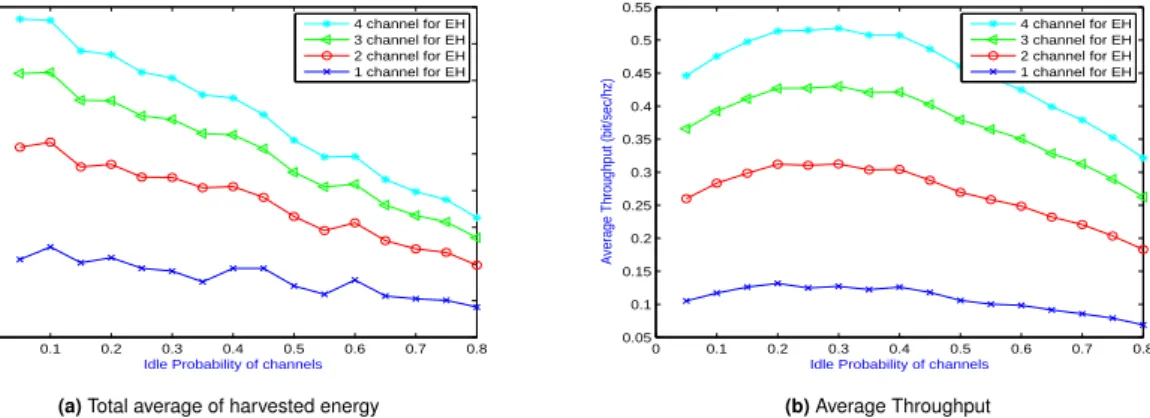
Figure 3.Total average of harvested energy and throughput of the SUs versus idle probability of primary channels for differentK.
match is found between both sides. When a primary channel is allocated to a SU which have enough energy, and the matching of two consecutive iterations remains unchanged, the algorithm converges and the process is stopped. Finally, based on the result of the mentioned process, the matched SUs are allowed to transmit their data on the matched allocated channels.
4.2.1.3. Complexity
In the proposed matching theory algorithm, the SUs and primary channels in initialization phase should construct their preference list using standard sorting algorithm (e.g. merge sort, heap sort [23]), and thus the complexity is O(N Mlog(N M)). In the matching phase, each SU proposes the most preferred channel, hence the number of iteration at most isN. On the other hand in each iteration, at mostM channels are assigned, thus the complexity is
O(M N). Therefore, the total complexity of the proposed algorithm is O N Mlog(N M)
+O(N M). It worth noting that the delay time of the matching theory algorithm by increasing the number of PUs and SUs does not increase exponentially. For instance, the elapsed time for running the algorithm for the case M = 8 and N = 2 is 0.223 millisecond, while for M= 10 and N= 8 the elapsed time is 0.976 millisecond.
4.2.2. Comparing the Matching Theory with the Hungarian Algorithm
We utilize the Hungarian algorithm to solve the throughput optimization problem (18) optimally with polynomial time. The complexity of this algorithm is
O(N3) [24,25]. We also propose a lower complexity method based on the matching theory algorithm and we show that our proposed algorithm is close to the optimal. Differences between complexity and performance of the Hungarian as well as the proposed matching theory algorithm are presented in Table I.
We can see that the complexity of the proposed matching
algorithm is lower than that of the Hungarian algorithm. As an example for M= 8 and N= 6, the complexity of the proposed matching theory algorithm is40%lower than the Hungarian algorithm, while for this case its performance is only14% lower than the performance of the Hungarian algorithm.
As already mentioned, the throughput of the proposed system depends on energy levels of SUs, because in the cases that the energy level is less than minimum required energy, no data can be transmitted, and thus no throughput can be excepted for that SU. The proposed algorithm (MEHMT) is summarized in Algorithm 3. As already explained the purpose of this algorithm is selecting the best channel for energy harvesting and simultaneously allocating the best channel for data transmission to maximize network throughput.
5. SIMULATION RESULT
In this section, a brief description of algorithms and parameters setting are described. Also analysis of result under various system parameters are presented.
5.1. Brief Description of Algorithms
We present the MEHMT approach to maximize the har-vested energy and the network throughput simultaneously. We present other approaches, which we call them, min-imum distance (MD) and random (RA) algorithms. Also we utilize an existing algorithm [26] which we call it harvesting or transmitting (HoT). We compared these algo-rithms with each other. It should be noted that in all of the aforementioned algorithms, the amount of harvested energy is calculated based on (9). We considered two structures for energy harvesting and data transmission i.e., ’MEHMT’ and ’HoT’. In MEHMT energy harvesting and data transmission are performed simultaneously, but in
0 0.1 0.2 0.3 0.4 0.5 0.6 0.7 0.8 0 10 20 30 40 50 60
Idle Probability of Channels
Total Average of Harvested Energy (mJ)
MEHMT−HU MEHMT−MT HoT MD Alg RA Alg
(a)Total average of harvested energy
0 0.1 0.2 0.3 0.4 0.5 0.6 0.7 0.8 0 0.05 0.1 0.15 0.2 0.25 0.3 0.35
Idle Probability of Channels
Average Throughput (bit/sec/Hz)
MEHMT−HU MEHMT−MT HoT MD Alg RA Alg (b) Average Throughput 0 0.1 0.2 0.3 0.4 0.5 0.6 0.7 0.8 0 10 20 30 40 50 60 70
Idle Probability of Channels
Possible Transmission Percentage
MEHMT−HU MEHMT−MT HoT MD Alg RA Alg
(c) Possible transmission percentage
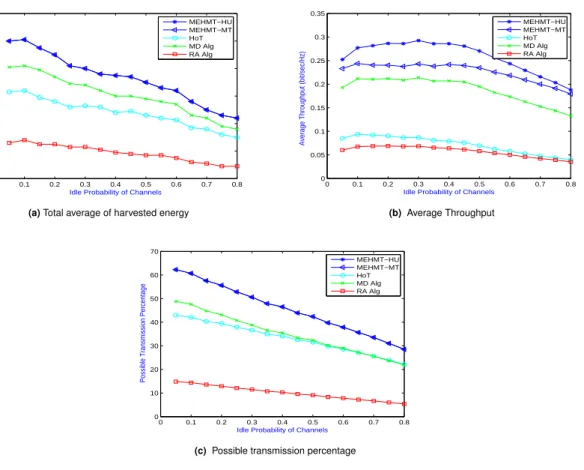
Figure 4.Total average of harvested energy, throughput and possible transmission percentage of the SUs under different idle probability of primary channels,K= 2.
HoT either harvesting or transmitting is performed. In HoT, if the SU has enough energy, it transmits its data and doesn’t harvest energy, but if it doesn’t have enough energy it harvests energy and cannot transmit its data. For MEHMT, we investigate four channel selection approaches to harvest energy and compared them with each other and also with HoT. A brief description about these approaches is presented in Table II.
5.2. Parameters Setting
Here we consider an RF-powered EHCRN which is distributed in an area of500×500m2, five SUs and eight PUs are randomly located. It is assumed that GSM900, GSM1800, UMTS2100 and UTMS1900 are utilized by SUs for harvesting energy and data transmission . The GSM900 entire band is from 876 to 959 MHz, the GSM1800 is from 1710 to 1880 MHz, the UMTS2100 band is from 1920 to 2170 MHz and finally the UTMS1900 band is from 1850 to 1990 MHz. The SUs are capable to harvest fromK frequency bands, here forK= 1,2,3,4
results are presented. The ideality factor, the thermal voltage of Rectenna, the load and the antenna resistance, are drawn from [17], and are set to 1.3, 23 millivolts, 11
kΩand 50Ω, respectively.
Target detection probability of PUs’ band (β) is set to 0.9. The target of energy that is required for data transmission (Eth) of the SUs is set to 0.6 mJ [17].
Also, to validate the performance of the maximum energy harvesting and maximum throughput approach (MEHMT), we perform simulation for 50 time slots. The slot duration, sensing time and required energy for spectrum sensing are set to T = 0.1sec, τ= 1ms and Es= 0.1mJ,
respectively.
5.3. Analysis on Results
Fig. 3aand Fig.3b show the total average of harvested energy and the average throughput of the SUs versus the idle probability of channels, for different numbers ofK, respectively. As illustrated, by increasing the number of channels that the SUs are capable to harvest from them, the total average of harvested energy and the throughput of the SUs increase.
Fig. 4aand Fig.4b show the total average of harvested energy and throughput of the SUs versus the idle probability of channels, respectively . As the idle probability of channels increases (i.e. becomes less
0.1 0.2 0.3 0.4 0.5 0.6 0.7 0.8 0.4 0.5 0.6 0.7 0.8 0.9 1
Idle Probability of Channels
Average Throughput (bit/sec/Hz)
x=100% x=60% x=30% x=20%
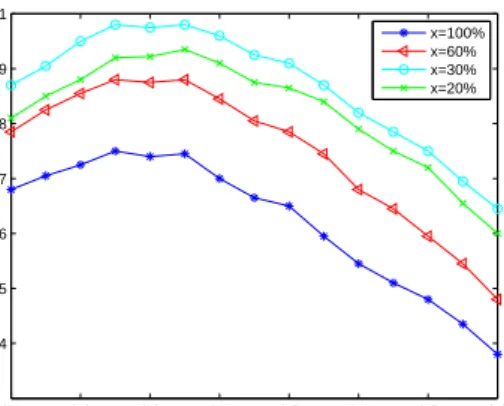
Figure 5.Average Throughput,M= 6,N= 2,K= 4
occupied), the total average of harvested energy decreases (Fig. 4a), because the SUs have less chance to harvest energy. As shown in Fig. 4b, by increasing the idle probability of channels, the throughput first increases and then, decreases. The increment is because, the SUs have more chance to transmit their data and still have enough energy. On the other hand, when the channels are mostly idle, the SUs cannot harvest much RF energy, therefore, they dont have enough energy to transmit their data, thus the throughput decreases.
As shown in Fig.4a, the total average of harvested energy for MEHMT-MT and MEHMT-HU approaches are the same and the highest, the lowest is RA policy. Although the HoT approach either harvests or transmits its data, but here HoT harvested energy is superior than the RA approach and is near to the MD approach, because HoT selects the best channels for energy harvesting while RA selects the channels randomly. As shown in Fig. 4b, MEHMT-HU and MEHMT-MT approaches have the highest throughput, MEHMT-HU is the optimal solution and its throughput is slightly higher, but its complexity is higher too. Disadvantage of MEHMT-HU is high complexity, but our proposed matching theory algorithm (MEHMT-MT) has lower complexity and is near to optimal solution. Since HoT either harvests or transmits, loses some opportunities, therefore, the throughput of MD is higher than that of HoT. Regarding the RA, as it selects the channels for energy harvesting randomly its energy level is the lowest,and consequently its throughput is lowest too. Fig.4cshows possible transmission percentage (PTP) of the approaches when the idle probability of channels is varied. The MEHM-MT and the MEHM-HU have the highest PTPs, and the lowest is for RA approach. PTPs of MD and HoT approaches are near to each other. Generally, for all approaches by increasing the idle probability of channels due to decrement of harvested energy, PTP decreases. Fig.5shows the average throughput of the SUs versus idle probability for different power transmissions of the SUs. Unlike conventional wireless networks, which have no
0 5 10 15 20 0 2 4 6 8x 10 −3 x=100% Time slots
SUs’ Total Average Energy Level
0 5 10 15 20 0 0.002 0.004 0.006 0.008 0.01 0.012 x=60% Time slots
SUs’ Total Average Energy Level
0 5 10 15 20 0 0.002 0.004 0.006 0.008 0.01 0.012 x=30% Time slots
SUs’ Total Average Energy Level
0 5 10 15 20 0 0.005 0.01 0.015 0.02 x=20% Time slots
SUs’ Total Average Energy Level
Energy Threshold
Energy Threshold Energy Threshold
Energy Threshold
Figure 6.Total average energy level of the SU,M= 6,N= 2, K= 4 5 10 15 20 0 0.5 1 1.5 2 x=100% Time slots
Transmission On / Off Status
5 10 15 20 0 0.5 1 1.5 2 x=60% Time slots
Transmission On / Off Status
5 10 15 20 0 0.5 1 1.5 2 x=30% Time slots
Transmission On / Off Status
5 10 15 20 0 0.5 1 1.5 2 x=20% Time slots
Transmission On / Off Status
Figure 7.Transmission on/off status,M= 6,N= 2,K= 4
limitation in the power supply, for our presented EHCRN system, we can see that by increasing the transmission power of the SUs, the throughput may not be increased. For instance, in Fig. 5, when the transmission powers of the SUs are set to 30% of their available power, the highest throughput is obtained. The reason is that when the transmission powers of the SUs are higher (i.e., x=60 % or x=100%), in more slots the SUs confront with lack of the remaining energy and only waiting for energy harvesting, without any data transmission. This interval results in missing the available spectrum opportunities and leads to a reduction in the average throughput of the SUs. When the SUs transmission power are set to lower value than that of the optimal value (e.g., 20%), although they transmit in more time slots, due to reduction of their transmit power, the related average throughput is lower and the energy is not utilized optimally. For better explaining about reason of this matter, the total average energy level of the SUs and the transmission on/off status in some time slots are illustrated in Fig.6and Fig.7, respectively. For instance, in Fig.6, in time slot 11, the remaining energy level of the SUs forx= 100%andx= 30%is higher than required energy for transmission (Eth), therefore, in both cases the
SUs were able to transmit. After these transmissions for
x= 100%until time slot 17 no further transmission is
performed, but forx= 30%in this interval (from time slot 11 until 17) in four time slots transmission is performed. However, the network throughput depends on both the
number of transmissions and the value of transmission power.
6. CONCLUSION
We considered an RF-powered EHCRN that is consist of multiple SUs and multiple primary channels. By utilizing the nonlinear characteristic function of the Rectenna, we derived formulas for calculating the actual harvested energy of the SUs from the primary channels and their resulting energy level. The amount of harvested energy affects the available energy of the SUs and consequently their throughput, therefore, by selecting the best possible channels for energy harvesting and simultaneously allocating the best channel for data transmission, we proposed an approach to manage the challenge of required energy such that the maximum harvested energy and maximum throughput are obtained. It is shown that the proposed approach significantly achieves higher throughput compared to the previous existing works. We also investigated the effects of harvested energy on the system throughput, we observed that as the idle probability of channels increases, the throughput first increases and then, decreases. The increment is because, the SUs have more chance to transmit their data and still have enough energy. On the other hand, when channels are mostly idle, the SUs cannot harvest much RF energy, therefore, they don’t have enough energy to transmit their data, thus the throughput decreases.
Also it is shown that unlike conventional wireless networks which have no limitation in the power supply, for our presented EHCRN system, by increasing the transmission power of the SUs, due to lack of the SUs’ remaining energy, the throughput may not be increased. As the extension to this work, some other traffic models can be considered and also other types of EHCRN paradigm such as underlay schemes can be investigated.
REFERENCES
1. LU X, Wang P, Niyato D and Kim DI. Wireless Charging Technologies: Fundamentals, Standards, and Network Applications. IEEE Communications Surveys & Tutorials; Nov. 2016, 18, (2), pp. 1413– 1452.
2. Alvarado U, Juanicorena A, Adin I, Sedano B, Gutier-rez I and de No J. Energy harvesting technologies for low-power electronics. Transactions on Emerging Telecommunications Technologies; May. 2012,23, pp. 728–741.
3. Park S, Heo J and Kim B. Optimal Mode Selection for Cognitive Radio Sensor Networks with RF Energy Harvesting. In Proceedings. IEEE PIMRC; Sept. 2012, pp. 2155–2159.
4. Lu X, Wang P and Niyato D. Resource Allocation in Wireless Networks with RF Energy Harvesting and Transfer. IEEE Network; Dec. 2015,29, (6), pp. 68– 75.
5. Akkermans JAG, van Beurden MC and Doodeman GJN. Analytical Models for Low-Power Rectenna Design. IEEE Antennas and Wireless Propagation Letters; Jun. 2005,4, pp. 187–190.
6. Lu X, Wang P and Niyato D. Wireless Networks with RF Energy Harvesting, A Contemporary Survey. IEEE Communications Surveys & Tutorials; May. 2015,19, (2), pp. 757–789.
7. Park S, Kim H and Hong D. Cognitive Radio Networks with Energy Harvesting. IEEE Wireless Communication; Mar. 2013,12, (3), pp. 1386–1397. 8. Lu X, Wang D and Hossain E. Dynamic Spectrum
Access in Cognitive Radio Networks with RF Energy Harvesting. IEEE Wireless Communication; Jun. 2014,21, (3), pp. 102–110.
9. Niyato D, Wang P and Kim DI. Channel Selection in Cognitive Radio Networks with Opportunistic RF Energy Harvesting. In Proceedings. IEEE ICC; Sydney, Australia, Jun. 2014, pp.1555–1560. 10. Hoang DT, Niyato D and Wang P. Opportunistic
Channel Access and RF Energy Harvesting in Cognitive Radio networks. IEEE Journal on Selected Areas in Communications; Nov. 2014,32, (11), pp. 2039-2052, 2039–2052.
11. Pratibha, Li KH and Teh KC. Channel Selection in Multichannel Cognitive Radio Systems Employing RF Energy Harvesting. IEEE Transactions on Vehicular Technology; Jan. 2016,65, (1), pp. 457–462. 12. Song C, Huang Y and Zhang J. A High-Efficiency
Broadband Rectenna for Ambient Wireless Energy Harvesting. IEEE Transactions on Antennas and Propagation; Aug. 2015,63, (8), pp. 3486–3495. 13. Papoulis A and Pillai S. Random Variables and
Stochastic Processes. New York: McGraw-Hill, 4 ed, 2002.
14. Zhao Q, Tong L and Swami A. Decentralized Cognitive Mac for Opportunistic Spectrum Access in Ad Hoc Networks: A POMDP Framework. IEEE Journal on Selected Areas in Communications; Apr. 2007,25, (3), pp. 589–600.
15. Chen Y, Zhao Q and Swami A. Joint Design and Separation Principle for Opportunistic Spectrum Access in the Presence of Sensing Errors. IEEE Transactions on Information Theory; May. 2008,54, (5), pp. 2053–2071.
16. Goldsmith A. Wireless Communications. Cambridge, United Kingdom: Cambridge University Press, 2005. 17. Kuhn V, Lahuec C and Seguin F. A
Multi-Band Stacked RF Energy Harvester with RF-to-DC Efficiency Up to 84%’. IEEE Transactions on Microwave Theory and Techniques; May. 2015,63, (5), pp. 1768–1778.
18. Liang YC, Zeng Y and Peh ECY. Sensing-Throughput Tradeoff for Cognitive Radio Networks. IEEE Trans-action Wireless Communication; Apr. 2008,7, (4), pp. 1326–1337.
19. Atapattu S., Tellambura C., Jiang H. Conventional Energy Detector. In: Energy Detection for Spectrum Sensing in Cognitive Radio. SpringerBriefs in Com-puter Science. Springer, New York, NY, 2014. 20. Gu Y, Saad W and Bennis M. Matching Theory
for Future Wireless Networks: Fundamentals and Applications. IEEE Communications Magazine; May. 2015,53, (5), pp. 52–59.
21. Roth AE. Deferred Acceptance Algorithms: History, Theory, Practice, and Open Questions. International Journal of Game Theory; Mar. 2008,36, (3), pp.537– 569.
22. Gale D and Shapley L. College Admissions and the Stability of Marriage. Mathematical Association of America; Jan. 1962,69, (1), pp. 9–15.
23. Shi H and Schaeffer J. Parallel Sorting by Regular Sampling. Journal of Parallel and Distributed Comput-ing; Apr. 1992,14, (14), pp. 361–372.
24. D. B. West, Introduction to Graph Theory. Prentice Hall, 2001.
25. Ma B, Shah-Mansouri H, and Wong V. W. S. A Match-ing Approach for Power Efficient Relay Selection in Full Duplex D2D Networks. In Proceedings. IEEE ICC, Kuala Lumpur, Malaysia, May. 2016, pp. 1–6. 26. Chung W, Park S and Lim S. Optimal Transmit
Power Control for Energy-Harvesting Cognitive Radio System. In Vehicular Technology Conference (VTC Fall); Sep. 2013, pp. 1–5.
![Figure 1. General structure of an RF energy harvester [6].](https://thumb-us.123doks.com/thumbv2/123dok_us/8997959.2797610/3.892.479.780.94.439/figure-general-structure-rf-energy-harvester.webp)