Volume 7, Issue 9 [September 2018] PP: 26-31
Experimental Investigation Of Using Hydroxy Gas (HHO)
Addition On Gasoline Engine Performance
Esmael Sadek
Automotive Technology Department, Faculty of Industrial Education, Helwan University, Cairo, Egypt.
ABSTRACT: Nowadays, several new technologies support the highway transportations to reduce the fuel consumption, emissions and improve the brake thermal efficiency. Among these technologies, is the using of hydrogen (H2) in the Internal combustion Engine (ICE), which can be found in Water and air. The aim of work is to experimentally assess the effect of using hydroxy gas on the ICE performance. HHO cell was designed, fabricated and optimized for maximum HHO gas productivity per input power. The optimized parameters were the number of neutral plates and distance between them. The performance of a single cylinder gasoline engine was measured with and without the HHO gas. The results showed that the maximum productivity of HHO gas of the cell was 180 L/hr, using 43 neutrals plates with 3 mm distance between each couple. The results also showed that the engine power can be improved between 2.5-5% depend on engine load, increase in the brake thermal efficiency between 25-44%, and reduction in the brake specific fuel consumption between 15-40% based on engine load.
KEYWORDS: Hydroxy gas, petrol engine, brake power, brake specific fuel consumption, brake thermal efficiency.
--- --- Date of Submission: 18-10-2018 Date of acceptance:04-11-2018
---I.
INTRODUCTIONA global concern toward reducing fuel consumption and emissions of internal combustion engines is motivating researchers to seek alternative solutions which would not require a dramatic modification in engines design. Among such solutions is using H2 as an alternative fuel [1]. Hydrogen is the most basic of all Earth elements. The hydrogen atom is made up of a single proton and a single electron. As such, it is very abundant, but it doesn’t really exist as a separate form of matter. Instead it is usually combined with other elements. To separate hydrogen gas from its companion substances takes a lot of work but it produces a powerful, nearly clean source of energy. As a gas, it can be used in fuel cells to power engines. There have been many investigations on enriched combustion in ICEs. Rudolf A. Erren [2] has made practical the hydrogen-fueled engine in the 1920s and converted over 1,000 engines. His projects have included trucks and buses. After World War II the allies have discovered a submarine converted by Erren [2] to hydrogen power. Even the torpedoes have been hydrogen powered.Since World War I hydrogen and pure oxygen have been considered for submarine use because the crew can get drinkable water from the exhaust. Hydrogen has been also considered for use in powering airship engines. The gas used for buoyancy has also been used for fuel. Even if helium has been used to provide lift, hydrogen gas can be used to supply additional buoyancy if stored at low pressure in a light container [3].
Stebar and Parks [4-5] investigated the effects of hydrogen-supplemented fuel on emission control with lean operation and the test results demonstrated that with small additions of hydrogen to the fuel, very low NOx and CO emissions were achieved for hydrogen-isooctane mixtures leaner than equivalence ratio of 0.55. Also, significant thermal efficiency improvements resulted from the extension beyond isooctane lean limit operation.
Robert Zweig [6] has converted a pickup truck to hydrogen power. It has been running ever since. He has solved the backfiring problem by using an extra intake valve to admit hydrogen separately from air. It is a simple, elegant vehicle that uses compressed hydrogen. The American Hydrogen Association has been displaying the Zweig hydrogen pickup trucks in public exhibits. Cunningham et al. [7] made researches on method and apparatus for enhancing combustion in an ICE through electrolysis and produced hydrogen along with oxygen yielded enhanced combustion at low engine loads for all types of engines.
could be installed on different vehicles of various types and sizes of engines. Test results under city traffic conditions showed that the fuel consumption for the Volvo 940 dropped to 6L/100 km from 10.5L/100 km, a reduction of 43% in fuel consumption. It was 36% for Mercedes 280.
The fuel induction systems have been developed and designed to provide two intake paths; one for hydrogen and one for air. The fuel and air are kept separate until entering the cylinder to prevent backfiring [10]. Masood et al. [11] have studied on experimental verification of computational combustion and emission analysis of hydrogen–diesel blends and the test results showed that the hydrogen–diesel co-fueling solved the drawback of lean operation of hydrocarbon fuels such as diesel, which were hard to ignite and resulted in reduced power output, by reducing misfires, improving emissions, performance and fuel economy (Masood et al., 2006).
Saravanan et al. [12] have experimentally investigated the hydrogen-enriched air induction in a diesel engine system. The test results have showed that an efficiency of 27.9% has been achieved without knocking over the entire load range with 30% hydrogen enrichment. Also, they have observed that SFC decreased with increase in hydrogen percentage over the entire range of operation (Saravanan et al., 2007).
Ji and Wang [13] experimentally studied on combustion and emissions performance of a hybrid hydrogen–gasoline engine and they concluded that wide flammability and fast burning velocity of hydrogen yielded reduced CO and HC emissions at idle and lean conditions (Ji and Wang, 2009).
Musmar and Al-Rousan [14-15] have designed, integrated and tested a compact HHO generating device on a gasoline engine. Their results showed that nitrogen oxides (NOx), carbon monoxide (CO), and fuel consumption were reduced by 50%, 20%, and ~30%, respectively, with an addition of HHO gas. The effect of HHO addition on CI engines was studied by Yilmaz et al. [16]; their results reported an increase in engine torque by an average of 19.1%, a reduction in CO and Hydrocarbons (HC) emissions, and Specific Fuel Consumption (SFC) by averages of 13.5%, 5%, and 14%, respectively.
Ji et al. [17] have studied the effect of H2 enrichment on a SI methanol-fueled engine, and reported an increase in Brake Mean Effective Pressure (Bmep) and both the thermal and volumetric efficiencies, with 3% of H2 by volume of the intake air.
Shivaprasad et al. [18] have experimented on a single cylinder SI gasoline engine while injecting H2 in the intake manifold in volumetric fractions (Vf) of the intake air between 5% and 25%. The results reported a continuous increase in Bmep and thermal efficiency, and a decrease in both HC and CO emissions, with an increase in H2 fraction. Unfavorably, a corresponding increase in NOx was reported with the rise in H2%. The aim of this paper is to study the effect of hydroxy (HHO) gas addition on gasoline engine performance.
II.
EXPERIMENTAL SETUP AND TEST PROCEDURE2.1. HHO Generator 2.1.1. System Description
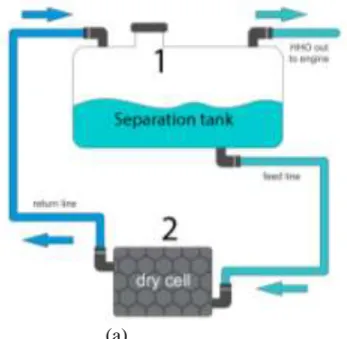
HHO generator used in this study is shown in Fig. 1. It consists of separation tank (1) which supplies the HHO cell (2) with continuous flow of water to prevent the increase in the temperature inside the cell and to provide continuous hydrogen generation.
(a) (b)
Figure 1: Schematic diagram of the HHO gas generation system.
gas flowmeter (3) which is shown in Fig. 1(b). The HHO gas leaves the separation tank and flows into the gas flowmeter per unit of time was measured as the HHO flow rate.
Figure 2: HHO fuel cell. (a) Plates’ arrangement (using 43 neutral plates). (b ) HHO dry cell with Water inlet
and gas outlet ports.
Stainless steel plates were used as the electrodes. There are 45 electrodes 200 - 160 - 0.8 mm thickness, configured as shown in Fig. 2 in alternate form (+,43N, -), where (+) represents the positive electrode, (N) is neutral, and (-) is the negative electrode. Amperage flows from the negative bridge rectifier terminal through the neutral plates to the positive plate and onto the positive terminal. Neutrals reduce the plate voltage, share the same amperage and increase surface area for HHO production.
The gap between adjacent plates was limited to 3 mm using rubber gaskets. In addition, 200-160-3 mm thickness cover plates were made of acrylic to provide visual indication of electrolyte level. HHO cell is supplied by electrical energy from the Wall source 220volt 1.2 Ampere. The cell productivity was tested without being connected to the engine without any catalysts to find the best configuration of electrode connect with best amperage consuming and low temperature experimentally. HHO flow rate is 3L/min, at HHO generator power consumption 264 watt (1.2 Amp, and 220 Volt DC) at HHO generator temperature 40 °C.
2.1.2. HHO separation tank
The HHO separation tank and its components are shown in Fig. 1. It was constructed from PVC tank with a capacity of 5 L. A 0.5 in PVC Caps was used to refill the tank with Distilled water without any dissolved catalyst. Hoses were used for water inlet and HHO gas outlet from the cell, the condensed water carried to the cell through outlet and HHO gas outlet to the engine. It is equipped by a Pressure gauge with vacuum range 0–1 bar and a spring-loaded vacuum breaker.
2.2. Engine and test bed description
These research experiments were performed on 168F-1 engine whose specifications are shown in Table 1 that is presented in Appendix 1; tests were carried out at engine speeds of 3000, 3250, 3500, 3750, 4000 and 4250 rpm with different loads (500, 1000, 1500, 2000 and 2500 watt).
Figure 3: Schematic diagram of engine and test bed description.
HHO cell connected to the inlet manifold. A constant speed test at variable load has been performed on this engine. The engine is tested and the measured data are collected at the same operating conditions for both cases of HHO/gasoline and gasoline fuel only. For the safety purpose, HHO generation system is connected to the engine intake manifold through two flash-back arrestors which close gasoline engine in event of the intake manifold flashback.
Fig. 4: Schematic diagram of the HHO system with safety component installed to the engine.
III.
RESULTS AND DISCUSSION3.1. Engine performance
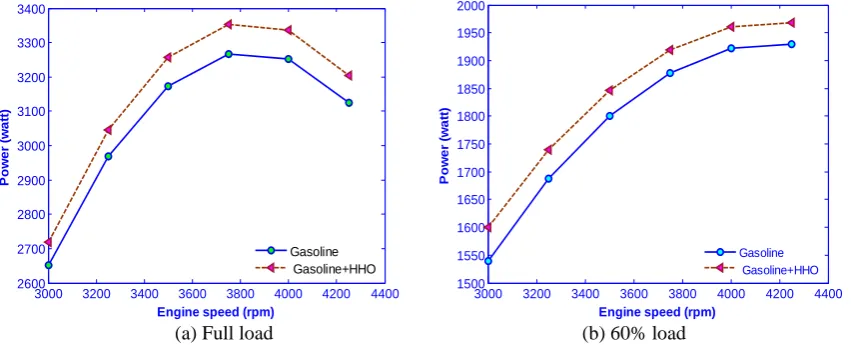
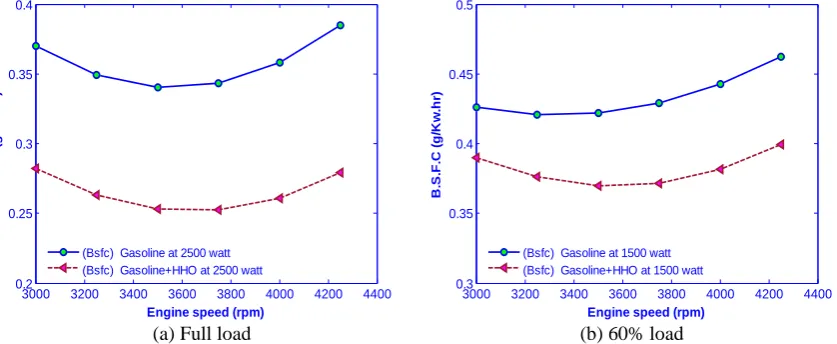
The effect of using HHO gas with gasoline in the IC engine power is shown in Figs. 5, while its effect in engine thermal efficiency is shown in Fig. 6 and its effect in the IC fuel consumption is shown in Fig. 7. It can be noted that HHO gas enhances the combustion process through increasing engine brake power, thermal efficiency and reducing the specific fuel consumption. Comparing HHO gas to commercial gasoline fuel, HHO is extremely efficient in terms of fuel chemical structure. Hydrogen and oxygen exist in HHO as two atoms per combustible unit with independent clusters, while a gasoline fuel consists of thousands of large molecules hydrocarbon. This diatomic configuration of HHO gas (H2 and O2) results in efficient combustion because the hydrogen and oxygen atoms interact directly without any ignition propagation delays due to surface travel time of the reaction. On ignition, its flame front flashes through the cylinder wall at a much higher velocity than in ordinary gasoline/air. It can be summarized that the use of HHO with the gasoline improve the engine power between 2.5-5% depend on engine load, increase the brake thermal efficiency between 25-44%, and reduce the brake specific fuel consumption between 15-40% based on engine load.
3000 3200 3400 3600 3800 4000 4200 4400 2600
2700 2800 2900 3000 3100 3200 3300 3400
Engine speed (rpm)
P
o
w
e
r
(w
a
tt
)
Gasoline Gasoline+HHO
3000 3200 3400 3600 3800 4000 4200 4400 1500
1550 1600 1650 1700 1750 1800 1850 1900 1950 2000
Engine speed (rpm)
P
o
w
e
r
(w
a
tt
)
Gasoline Gasoline+HHO
(a) Full load (b) 60% load
30000 3200 3400 3600 3800 4000 4200 4400 5 10 15 20 25 30 35
Engine speed (rpm)
B re a k T h e rm a l E ff ic ie n c y ( B T E )
(BTE) Gasoline at 2500 watt (BTE) Gasoline+HHO at 2500 watt
30000 3200 3400 3600 3800 4000 4200 4400 5
10 15 20 25
Engine speed (rpm)
B re a k T h e rm a l E ff ic ie n c y ( B T E )
(BTE) Gasoline at 1500 watt (BTE) Gasoline+HHO at 1500 watt
(a) Full load (b) 60% load
Figure 6. Variation of brake thermal efficiency versus engine speed at different loads with/without HHO.
3000 3200 3400 3600 3800 4000 4200 4400 0.2
0.25 0.3 0.35 0.4
Engine speed (rpm)
B .S .F .C ( g /K w .h r)
(Bsfc) Gasoline at 2500 watt (Bsfc) Gasoline+HHO at 2500 watt
3000 3200 3400 3600 3800 4000 4200 4400 0.3
0.35 0.4 0.45 0.5
Engine speed (rpm)
B .S .F .C ( g /K w .h r)
(Bsfc) Gasoline at 1500 watt (Bsfc) Gasoline+HHO at 1500 watt
(a) Full load (b) 60% load
Figure 7. Variation of brake specific fuel consumption versus engine speed at different loads with/without
HHO.
IV.
CONCLUSIONLaboratory experiments have been carried out to investigate the effect of HHO gas on the emission and performance of a 168F-1 engine. A new design of HHO fuel cell has been performed to generate HHO gas required for engine operation. The generated gas is mixed with a fresh air in the intake manifold. The exhaust gas concentrations have been sampled and measured using a gas analyzer. The following conclusions can be drawn.
HHO cell can be integrated easily with existing engine systems.
The engine thermal efficiency has been increased up to 44% when HHO gas has been introduced into the air/fuel mixture, consequently reducing fuel consumption up to 40%.
The high voltage run HHO generator will without any catalyst.
The proposed design for separation tank takes into consideration the safety precautions needed when dealing with hydrogen fuel.
The effect of HHO on concentration of NOx, CO and HC gases is still under investigation.
V.
CONFLICT OF INTERESTSThe authors declare that there is no conflict of interests regarding the published results of this article.
ACKNOWLEDGMENTS
REFERENCES
[1]. A. Boretti, Comparison of fuel economies of high efficiency diesel and hydrogen engines powering a compact car with a flywheel based kinetic energy recovery systems, Int. J. Hydrogen Energy 35 (2010) 8417–8424.
[2]. ERREN, R. A., CAMPBELL, W. H., 1933. Hydrogen: A Commercial Fuel for Internal Combustion Engines and Other Purposes. J Inst Fuel. 6:277-90.
[3]. KING, R. O., and RAND, M., 1955. The Hydrogen engine. Canada Journal of Technology, 33:452–73.
[4]. STEBAR, R. F., and PARKS, F. B., 1974. Emission Control with Lean Operation Using Hydrogen-Supplemented Fuel. SAE Paper (Document No. 740187).
[5]. STEBAR, R. F., and PARKS, F. B., 1974. Emission Control with Lean Operation Using Hydrogen-Supplemented Fuel. SAE Paper (Document No. 740192).
[6]. ZWEIG, R. M., 1992. Proceedings of the Ninth World Hydrogen Energy Conference. October, 8-12, Paris, France.
[7]. CUNNINGHAM, J. E., and GOODENOUGH, R. Method and Apparatus for Enhancing Combustion in an Internal Combustion Engine Through Electrolysis. United States Patent, April, 21, 1992.
[8]. SIERENS, R., and ROSSEEL, E., 1998. Variable Composition Hydrogen-Natural Gas Mixtures for Increased Engine Efficiency and Decreased Emissions. ASME Spring Engine Technology Conference. April, 26-29, Fort Lauderdale, Florida, USA.
[9]. DULGER, Z., and OZCELIK, K. R., 2000. Fuel Economy Improvement by On-Board Electrolytic Hydrogen Production, International Journal of Hydrogen Energy, 25:895-97.
[10]. PEAVEY, M. A., 2003. Fuel from Water: Energy Independence with Hydrogen. Eleventh Edition. New York, USA. 256 p. [11]. MASOOD, M., ISHRAT, M. M., and REDDY, A. S., 2006. Computational Combustion and Emission Analysis of Hydrogen–Diesel
Blends with Experimental Verification. International Journal of Hydrogen Energy, 32:2548-52.
[12]. SARAVANAN, N., NAGARAJAN, G., DHANASEKARAN, C., and KALAISELVAN, K. M., 2007. Experimental Investigation of Hydrogen Port Fuel Injection in DI Diesel Engine. International Journal of Hydrogen Energy, 32:4071-80.
[13]. JI, C., and WANG, S., 2009. Combustion And Emissions Performance of a Hybrid Hydrogen–Gasoline Engine at Idle and Lean Conditions. International Journal of Hydrogen Energy, 35(1): 346-55
[14]. A.A. Al-Rousan, Reduction of fuel consumption in gasoline engines by introducing HHO gas into intake manifold, Int. J. Hydrogen Energy 35 (2010) 12930–12935.
[15]. S.e.A. Musmar, A.A. Al-Rousan, Effect of HHO gas on combustion emissions in gasoline engines, Fuel 90 (10) (2011) 3066–3070. [16]. A.C. Yilmaz, E. Uludamar, K. Aydin, Effect of hydroxy (HHO) gas addition on performance and exhaust emissions in compression
ignition engines, Int. J. Hydrogen Energy 35 (2010) 11366–11372.
[17]. C. Ji, B. Zhang, S. Wang, Enhancing the performance of a spark-ignition methanol engine with hydrogen addition, Int. J. Hydrogen Energy 38 (2013) 7490–7498.
[18]. K.V. Shivaprasad, S. Raviteja, P. Chitragar, G.N. Kumar, Experimental investigation of the effect of hydrogen addition on combustion performance and emissions characteristics of a spark ignition high speed gasoline engine, Procedia Technol. 14 (2014) 141–148.
Appendix 1
Engine model 168F-1
Engine type Forced air cooling, overhead valve type gasoline engine Displacement (ml3) 163
Rated power (KW/rpm) 3.1/3000
Ignition system Contactless, transistor type Start mode Manual
Capacity of fuel tank (L) 15 Volume of machine oil(L) 0.6
Noise (7 m away) 63