Orthogonal Frequency Division Multiplexing, OFDM for
Optimizing the Services of Wireless
Communication System
1
Sanjay Kumar Gautam,
2Nitesh Arya,
3Dr. Y.P.Singh
1,2,3OPJS, Churu, Rajasthan, India
Abstract
The communication in the past decades has made the revolution in the ICT techniques. It is only due to the recent advancement communication techniques, OFDM have opened the developed area for further Research. Many advantages of OFDM over single carrier scheme is ,its ability to cope with severe channel conditions such as attenuation of high frequency in a long copper wire .OFDM is a multi-carrier modulation technique with densely spaced sub-carriers that has gained a lot of popularity among the broadband community in the last few years. OFDM has been shown to be an effective technique to combat multipath fading in wireless communications. OFDM has chosen as the standard for digital audio broadcasting and high-speed wireless local areas networks. Present Paper, explore the OFDM Modulation its advantages and demerits, and some applications of OFDM. OFDM Techniques for peak-to-average power ratio reduction (PAPR), time and frequency synchronization, and channel estimation will be discussed. We conclude with a brief overview of current application areas.
Keywords
OFDM, Diversity, fading, PAR, NLOS, High Speed wireless local area Networks, FFT, ISI, IFI HPA Communication over Power line (PLC ] ,HPA , PAPR, space diversity, Serial to Parallel conversion, NLOS, PN :Pseudonoise, FH:n Frequency Hopping DS:Direct Sequence CSMA:Carrier Sense Multiple Access, SFH,: Slow Frequency Hopping FFH :Fast Frequency Hopping , CDPD: Cellular Digital Packet Data.
Organization of Paper
Present paper OFDM has been organized in to 8 topics, starting from Introduction. Topic 2 tells about the purpose of the study followed by topic 3 is literature Review and topic 4 narrates about the Different types of Diversity Techniques. Topic 5 is all about OFDM and Power peak Problem; Topic 6 is merits and demerits of the OFDM followed by Topic 7 i.e. conclusion of the Study, Topic 8 is all about references and at last about the authors of the Paper.
I. Introduction
The Basic idea of OFDM is to divide the available spectrum to several orthogonal sub channels so that each narrow band channels
experience s almost flat tadins. In past years, Technology and system requirements in the telecommunications field are changing
very fast. Over the previous years, since the transition from analog to digital communications, and from wired to wireless, different standards and solutions have been adopted and implemented.
Wireless communications is a rapidly growing piece of the communications manufacturing, with the potential to provide high-speed high-quality information exchange between the portable devices located anywhere in the world [1][2]. Potential applications enabled by this technology include multimedia Internet-enabled, Global System for Mobile (GSM), smart homes,
automated highway systems, video teleconferencing and distance learning, and autonomous sensor networks, just to name a few.
However, supporting these applications using wireless techniques
creates a significant technical Challenge [3].The motion in space
of a wireless receiver operating in a multipath channel results in a Communications link that experiences small-scale fading. The
rapid fluctuations of the received power level due to 2 | P age
small sub-wavelength changes in receiver position are described as small-scale fading [4]. Basically, mobile radio communication channels are time varying, multipath fading channels [3], [4]. In a radio communication system, there are many paths for a signal to pass through from a transmitter to a receiver. Sometimes there is a direct path where the signal travels without being obstructed, which is known as a Line Of Sight (LOS) path. In most cases, components of the signal are refracted by different atmospheric
layers or reflected by the ground and objects between the transmitter
and the receiver such as vehicles, buildings, and hills, which is known as Non Line Of Sight (NLOS) paths. These components travel in different paths of different length and combine at the receiver. Thus, signals on each path suffer different transmission
delays and attenuation due to the finite propagation velocity.
The combination of these signals at the receiver results in a destructive or constructive interference, depending on the relative delays involved. In fact, the environment changes with time which leads to signal variation. This is called time variant environment.
Also, the motion of the object influences signals. A short distance
movement can cause an obvious change in the propagation paths and vary the strength of the received signals. OFDM has been shown to be an effective technique to combat multipath fading in wireless communications. OFDM is a modulation scheme that
allows digital data to be efficiently and reliably transmitted over
a radio channel, even in multipath environments.
II. Purpose of the Study
It is well known fact that to obtain a sufficient transmission power the transmitter is employed with High Power Amplifier (HPA). So to obtain a maximum output power efficiency the HPA is
usually operated at or near the saturation region. Due to non linear characteristics of HPA ,it is very sensitive to variation in signal amplitudes. Present study is pertaining the different types of diversity techniques in order to improve the performance and reliability of mobile wireless communication system on one way and also to list the merits and demerits of the OFDM.
III. Literature Review and Study
OFDM is mainly because of its way of handling the multipath interference at the receiver. Multipath phenomenon generates two effects (a) Frequency selective fading and (b) Inter symbol
interference (ISI).The “flatness” perceived by a narrowband
channel overcomes the frequency selective fading. On the other hand, modulating symbols at a very low rate makes the symbols much longer than channel impulse response and hence reduces the ISI. Use of suitable error correcting codes provides more robustness against frequency selective fading. The insertion of an extra guard interval between consecutive OFDM symbols can reduce the effects of ISI even more. The frequency spacing and time synchronization of the carriers is chosen in such a way that the carriers are orthogonal, meaning that they do not cause interference to each other [5]. Serial to Parallel Conversion of OFDM System: As wireless communication evolves towards broadband systems to support high data rate applications, we need a technology that
can efficiently handle frequency selective fading. The key idea
of OFDM is to divide the whole transmission band into a number of parallel sub channels (also called subcarriers) so that each sub
channel is a flat fading channel [11]-[13]. In this case, channel
equalization can be performed in all sub channels in parallel using simple one-tap equalizers, which have very small computational complexity. In this case, channel equalization can be performed in all sub channels in parallel using simple one-tap equalizers, which have very small computational complexity. It is important feature of OFDM is the orthogonal relationship between the subcarrier signals. Orthogonality allows the OFDM subcarriers to overlap each other without interference. OFDM uses FH to create a spread spectrum system.
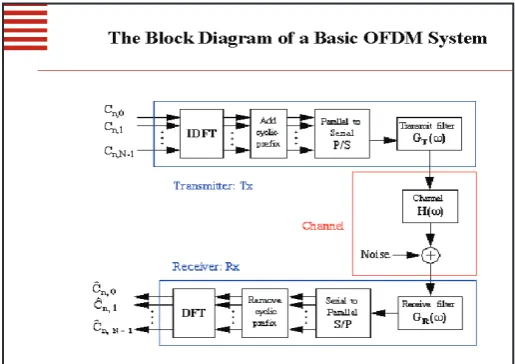
FH has several advantages over DSSS, for example, near-far problem, easier synchronization, less complex receivers. Serial-to parallel conversion and Modulation. Figure (1) Block diagram of an OFDM system.
Fig. 1: Block Diagram of a basic OFDM System
A block diagram of an OFDM system is depicted in fig.1 Here, for
simplicity and clearness of Illustration, channel coding block is left
out. The incoming digital data are first passed to a serial to parallel
converter (S/P) and converted to blocks of N data symbols. Each block is called a frequency domain OFDM symbol and N is the number of sub channels. OFDM the input information sequence
is first coded data send to symbol mapping than converted into
serial to parallel conversion and modulation data sequences and output is multiplied with spreading code. Data from all subcarriers is Modulated in baseband by inverse fast Fourier transform (IFFT) and converted back into parallel to serial conversion data. The
guard interval is inserted between symbols to avoid ISI caused
by multipath fading and finally the signal is transmitted after
RF up-conversion. At the receiver, after down- conversion, the m-subcarrier component corresponding to the received data is
first coherently detected with FFT and then multiplied with gain
to combine the energy of the received signal scattered in the frequency domain. The subcarriers are combined using an IFFT and transmitted. At the receiver, the carrier is converted back to a multicarrier lower data rate from using FFT. The lower data subcarriers are combined to form a high rate data unit.
A. Different types of Diversity Techniques
Diversity techniques have been developed in order to improve the performance and reliability ‘of mobile wireless communication systems. Basic diversity techniques can be divided into three
schemes.These schemes shown below in figure2.
Fig. 2: Different type of Diversity
B. Time Diversity
When the same data are sent over the channel at different time slots, the received signals can be uncorrelated if the time separations are large. The required time separation is at least as great as the reciprocal of the fading and width, which is two times the speed of the mobile station divided by the wavelength. Hence, the time separation is inversely proportional to the speed of the mobile station. When the mobile station is time diversity (temporal diversity) in terms of multiple transmissions of the same symbol is not as useful. This is in contrast to all of the other diversity types listed above, because they are independent of the speed of the mobile station.
C. Frequency Diversity
When Signals with different carrier frequencies far apart with each other are possibly independent. The Carrier frequencies must be separated enough so that the fading associated with the different frequencies are uncorrelated. For frequency separations of more than several times the coherence bandwidth, the signal fading would be essentially uncorrelated.
D. Space Diversity
When the receiver or transmitter has multiple antennas, then distance between the antennas is made large. so which type of fading is independent fading. Then independent fading is called space diversity. Space separation of half of the wavelength is
sufficient to obtain two uncorrelated signals.
IV. OFDM in Peak Power Problem
signal. The OFDM signal is basically a sum of N complex random variables, each of which can be considered as a complex modulated signal at different frequencies. In some cases, all the signal components can add up in phase and produce a large output and in some cases, they may cancel each other producing zero output. Thus the peak-to average ratio (PAR) of the OFDM system is very large. The problem of Peak-To-Average Ratio is more serious in the transmitter. In order to avoid clipping of the transmitted
waveform, the power-amplifier at the transmitter frontend must
have a wide linear range to include the peaks in the transmitted
waveform. Building power amplifiers with such wide linear
ranges is a costly affair. Further, this also results in high power consumption. The DAC’s and the ADC’s must also have a wide range to avoid clipping. There has been a lot of research put into the study of overcoming the PAR problem in OFDM [7,8,9]. The following sections discuss some of common important of those techniques as well as other issues.
A. Power Amplifier Linearity
Practical Power Amplifiers have an input power range over which
they have a linear transfer curve. Usually the linearity of
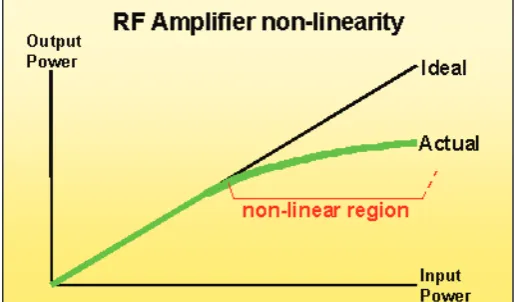
non-ideal power amplifiers is measured using a term called the 1 dB Compression point. It is defined as the input power at which the output power of the amplifier is 1 dB less than the output power obtained with an ideal amplifier. The figure (power) shows a typical Response curve of a non-ideal power amplifier.
Fig. 3: Power Amplifier Linearity
B. Clipping
One important feature of the peak-to-average ratio in the OFDM is the fact that the percentage of symbols have a very large peak-power is less (and the percentage decreases with an increase in the number of sub-carriers). Thus in this case, the simplest possible solution to the peak-power problem would be Clipping, i.e., limiting the peak amplitude to some maximum level. Although simple, this method has a few disadvantages. Clipping produces a kind of self-interference that causes some degradation in the BER performance. The non-linear distortion caused due to clipping increases the amount of out-of-band radiation. The increase in the out-of-band radiation is basically because of the fact that the clipping operation is a multiplication of the OFDM symbol with a rectangular function that is 1 if the amplitude is below a threshold and a smaller value if the amplitude is above the threshold. This rectangular waveform increases the out-of-band radiation, and as a result, the spectrum has a roll-off that is inversely proportional to the frequency.(Figure-4)
Fig. 4: BER vs Peak Power Clipping
The problem of slow spectrum roll-off can be overcome to some extent, by windowing the rectangular clipping waveform. Several windows are proposed in literature. Some of the most common ones are Gaussian, Cosine, Hamming, Kaiser etc. Simulation results show a slight degradation in BER with clipping. When windowing is applied the BER performance is still worse, since a large portion of the signal is affected by windowing than by
clipping alone. The required back-off for the power amplifier can
be determined by specifying the amount of attenuation for the out-of-band spectral components, relative to the in-band spectral components. It has been shown that windowing offers a 3-dB gain in the required back-off when compared to clipping alone.
C. Error-Control Coding
One of the problems with clipping is the degradation in BER.
Specifically, the symbols that have a large PAR ratio are vulnerable
to errors. To reduce this effect, forward error correction (FEC) can be applied across several OFDM symbols. When FEC is applied, the errors caused due to large PAR in particular symbols can be corrected by the surrounding symbols.
D. Peak Cancellation
Another method of removing the peaks in a OFDM signal is to subtract a time-shifted and scaled reference function such that each subtracted reference function reduces the peak power of at least one signal sample. It is desirable to choose a signal with approximately the same bandwidth as the transmitted signal. The most commonly used peak-canceling function is the sinc function because of its desirable frequency-domain properties. The sinc function can be time-limited by multiplying by a raised-cosine window. It can be shown that the peak cancellation technique will result in a lesser out of-band interference than the clipping and windowing techniques. A further advantage of the peak cancellation technique is the fact that it can be digitally implemented, following the IFFT in the transmitter.
E. PAR Reduction Codes
these results have lead to the usage of Golay Complementary sequences for generating these codes. Golay complementary sequences are sequence pairs for which the sum of autocorrelation function is zero for all delay shifts that are not equal to zero. A lot of research papers have been published on the usage of Golay Codes
for OFDM transmission, that deal with the efficient generation of
these code and the optimal and suboptimal decoding and other interesting properties.
Fig. 5: C D F plots of PAPR
F. Symbol Scrambling Techniques
The basic idea of these techniques is that, for each OFDM symbol, the input sequence is scrambled by a certain number of scrambling sequences. The output signal with the smallest PAR is transmitted. If the PAR for one OFDM symbol has a probability p of exceeding a certain level without scrambling, the probability that it will exceed with scrambling (given a set of k scrambling codes) is pk. Thus scrambling hopes to reduce the probability of occurrence of high PARs, rather than reducing the levels of these PARs.
V. Merits and Demerits of OFDM
Though the merits of OFDM has been the backbone of the wireless communication systems. On the basis of the above study , Merits and Demerits are annexed as under:
The OFDM is a promising transmission scheme, which has been 1.
considered extensively for broad band communication.
OFDM makes efficient use of the spectrum.
2.
OFDM becomes more resistant to frequency selective fading 3.
than single carrier systems by converting the frequency
selective fading channel into narrowband flat fading sub
channels.
OFDM eliminates Inter Symbol Interference (ISI) and Inter 4.
Frame Interference (IFI) through use of a Cyclic Prefix
(CP). OFDM recovers the symbols lost due to the frequency selectivity of the channel by using adequate channel coding and interleaving.
OFDM makes channel equalization simpler than single carrier 5.
systems by using adaptive equalization techniques.
OFDM seems to be less sensitive to sample timing offsets in 6.
comparison with single carrier systems.
OFDM provides good protection against co -channel 7.
interference and impulsive parasitic noise. OFDM makes it possible to use Maximum Likelihood (ML) decoding with reasonable complexity
OFDM is computationally efficient with FFT techniques. The
8.
several advantages of the OFDM systems could only appear if the main three drawbacks were treated carefully. OFDM has the following negative aspect:
OFDM signal has a noise like amplitude with a very large 9.
dynamic range; therefore, it requires RF power amplifiers
with a high peak to average power ratio, which may require
a large amplifier power back off and a large number of bits
in the Analog to Digital (A/D) and Digital to Analog (D/A) designs. OFDM is very sensitive to Carrier Frequency Offset (CFO) caused by Doppler Effect. Hence, CFO should be estimated and cancelled completely.
OFDM receiver suffers from the difficulty to make a decision
10.
about the starting time of In this case, channel equalization can be performed in all sub channels in parallel using simple one-tap equalizers, which have very small computational complexity.
OFDM may be utilized in Broadband Communication over 11.
Power line (PLC).
VI. Conclusion
In this paper we analyzed several interesting properties that use Wireless channels its also used OFDM for modulation and multiple access. There are various methods of generation and demodulation of OFDM and synchronization were analyzed.
We can under -stand merits and demerits of OFDM and different types of diversity techniques. In totality it is concluded that OFDM Techniques has prove a boon and backbone to wireless communication System.
References
[1] A. Goldsmith, Wireless Communications, Cambridge University Press, 2006.
[2] R. Prasad, OFDM for Wireless Communications Systems, Artech House, 2004.
[3] J. G. Proakis, Digital Communications, 4 thEd. New York, McGraw- Hill, Inc., 2001.
[4] T. S. Rappaport, Wireless Communications: Principles and Practice, Englewood Cliffs, NJ: Prentice Hall, 1996. [5] Upena Dalal, Wireless Communications:3rdimpression,Ox
ford University press,2010.
[6] J. A. C. Bingham, “Multicarrier Modulation for Data
Transmission: An idea whose time has come,” IEEE
Communications Magazine, vol.28, no.5, pp.5-14, May 1990.
[7] May T., Rohling H, “Reducing the Peak to Average Power
Ratio of OFDM Radio Transmission Systems”, Proceedings
of IEEE VTC ’98, Ottawa, Canada, pp. 2474-2478, May 18-21, 1998.
[8] Li X., Cimini L. J., “Effects of Clipping and Filtering on the
performance of OFDM”,Proceedings of IEEE VTC ’97, pp.
1634-1638, 1997.
[9] Wilkinson T. A, Jones A. E., “Minimization of the Peak-To-Mean Envelope Power Ratio of Multi- Carrier Transmission
Schemes by Block Coding”, Proceedings of the IEEE VTC,
Chicago, pp. 825- 829, July 1995.
[10] K. Sathananthan, and C. Tellambura, “Probability of Error
Calculation of OFDM Systems with Frequency Offset,” IEEE
Transactions on Communications, vol. 49, no. 11, pp. 1884- 1888, Nov. 2001.
[11] F. Yang, and K. H. Li, “A Carrier Frequency Offset Estimator
Communications Letters, vol. 8, no.11, Nov. 2004. [12] L. Hanzo, T. Keller, OFDM and MC- CDMA: A Premier,
1st Ed. Wiley-IEEE Press, ISBN: 0470030070, July 2006. [13] J. Armstrong, OFDM, John Wiley and Sons Ltd., January
2007.
[14] Ishan Seth, Dr. Deepak Nagaria, Prof. Y.P. Singh, Analysis of the Utility & Comparative Study of Reduction Techniques of Peak-to-Average power Ratio in OFDM System & Its Performances Analysis , IJIEASR ISSN 2319-4413, Vol. 2 No.7, July 2013.
[15] Russell, and M. Stuber, “Interchannel Interference Analysis
of OFDM in a Mobile Environment”, IEEE Vehicular
Technology Conference,vol.2, pp. 820- 824, July 1995. [16] J. Heiskala, J. Terry, OFDM Wireless LANs: A Theoretical and
Practical Guide, Sams Publishing 2002. Science Technology & Management Journal By AISECT University, March 2013 ISSN: 2778- 4187
[17] Science Technology & Management Journal By AISECT University, March 2013 ISSN: 2778-4187 [20] Prof. Chandna,
Prof. Y.P. Singh, “ Utility of OFDM Techniques”
[18] K. Fazel,& S. Kaiser, Multi-Carrier and Spread Spectrum System, John Wiley & Sons, Inc.,2003.
Mr Sanjay Kumar Gautam is a Research scholar and He is also pursuing Ph.D. Degree from the OPJS University, Churu. He has published 3-4 Research papers on the 4G Technology. He also attended a handful of conferences . He has attended the conference and presented the paper in Thailand.
Nitesh Arya, is pursuing the Ph.D. degree from the OPJS university, Churu. She has choosen the challenging Research Topic, and have attended some conference on the Topic. PostGraduate in Electronics and communication Engineering.
Prof. Y.P. Singh, Professor in Electronics & Communication Engineering, OPJS University, He has worked as Director, Somany (P.G.) Institute of Technology and Management , Rewari, Haryana . He has also worked about 31 years as Lecturer, Dean of academics & Principal in many Engineering institutions and organization. He has also served with Training and Technical Deptt. Govt. Of Delhi, almost for 17 years. He has about 162 research paper published in National and 564 papers published in international journals in his credit. He has been selected and
awarded by Govt. of Delhi as “Best Technical Teacher-2004”. He
has been conferred Outstanding Teacher Award 2012 and 2013 respectively.