Stability Analysis of 2-D PSV System Represented
by Givone–Roesser Model
Prashant K. Shah
Dept. of ECED, SVNIT, Surat, Gujarat, India
Abstract
Multidimensional systems have been very interesting area from several past decades due to its increasing demands in various areas like digital signal processing, Image processing, Gas absorption, temperature measurements etc. As systems aremulti-dimensional in nature stability of those systems decreases due to more than one
dimension. These systems are difficult to represent, such systems
can be represented by discrete state space models. There are several state space models are available among them FM1, FM2, GR, and R are very famous models even though they developed before
four-five decade. In this paper our focus is to derive stability
conditions for two-dimensional (2-D) Periodically Shift Varying
(PSV) filters using GR models. As PSV filters has applicable in
various places like Image Scrambling, video scrambling, design
multiplier less filters etc. To check whether PSV system is stable or not, we have derived twosufficient stability conditions for PSV filter which helps to tell about stability. After that using Matlab
LMI tool box we have done various analysis also An algorithm using linear matrix inequality is proposed to determine the stability of a given 2-D PSV system. As well as examples and comparative analysis also discussed in terms of stability for GR model.
Keywords
2-D Periodically Shift Varying Filters, Givone–Roesser Model, Stability, Linear Matrix inequality.
I. Introduction
Periodic shift varying systems have received wide spread attention over last three four decades due to its wide range applications as
filtering of cyclostationary signals, Image scrambling, Speech scrambling, multi rate filter banks etc. [1]. Implementations of 2-D PSV filters compare to 1-D filters [2] is complicated due to its multidimensional nature. PSV filters are also important for designing 2-D filters with power of two coefficient [3]. That
multipliers help to do real time processing with large amount of data.
PSV systems have been analysed and designed from several past
decades. [4] Which has direct form 2-D PSV filter have been analysed, equivalent shift invariant structure were derived in [5]. In [6] different formulation of two-dimensional filters with state
space models which have been studied by several authors due to
its efficient applicability. There are several authors who derived
state space models for multi-dimensional systems but among them,
The Givone-Roesser [7] and Fornasini-Marchesini [8] models
are two such variations that have frequently been the subject of analysis. These models have developed for different purposes FMs
models were developed for filtering purpose where GR model was
developed for ILC (Iterative Learning Control) systems which are
periodically repeated. Any filter form raises questions regarding
stability, and these models are no exception. The objective of this paper is to establish two stability conditions for the Givone-Roesser model when they are shift variant. For 1-D state space models, stability conditions for time-varying systems have been
derived in [9]. The condition is shown in [9] to be sufficient for
stability of the system, and this result is the major building block on which the research herein is based.
Stability analysis of 2-D system are technically complicated than 1-D systems. Taking about shift-invariant difference equations form, the issue of a nonessential singularity of the second kind
results in that there is no necessary and sufficient conditions
for 2-D rational polynomials. Stability of not only 2-D but also
multidimensional shift varying systems takes attentions [10] the stability of periodic 2-D system has also been studied [11]. Stability condition which is presented in [12] was studied. [13]
which gives idea of asymptotic stability for two-dimensional shift
variant system which is discrete in nature. [14] gives idea about robust stability for 2-D shift varying systems, [15] establishing
stability in the case of constrained perturbations about a stable,
shift-invariant Givone-Roesser model, and [16] presenting a very
elegant result for the case where the system is positive. The goal
of this paper is to derive sufficient conditions for PSV system
using GR model.
II. GIVONE–ROESSER Model
The 2-D PSV system can be written in form of difference equation
(1)
The coefficient amn, bmn with (m, n) ≠ (0,0) are used for are
periodically shift variant system with periods (P,Q).
As with a 2-D LSIV system, several different state-space forms
with periodic coefficient matrices can be used to represent the
above 2-D PSV system.
The Givone–Roesser (GR) model from (1) can be changed to
(2)
In this paper, the zero-input stability of a GR state-space model
is studied so that only the periodic coefficient matrices A1 (i,j), A2 (i,j), A2 (i,j), A4 (i,j) need to beconsidered. A zero-input 2-D PSV GR model can be written as
(3)
Note that the GR model can also be written in another form using
the second model of FM [17] as follows. Define
Then the equation (4) can be modified as
Where A10(i,j) and A01 (i,j) are Periodic with period (P,Q) and O denotes a zero matrix of appropriate size for the application. The initial conditions can be assumed such that w(i,j), i<0 or j<0 and
w(i,0) = w(0,j) for i ≥ I, j ≥ J.
Stability conditions for the stability of 2-D PSV GR models are established using both absolute-value and vector-norm energy functions. Using matrix norms, we derive upper bounds of matrices given in theorem below.
Theorem-1: [Existing Result] [6] If
where Gr [for r = 0,1…., S-1], and all relevant parameters
are defined in [6], then
III. Proposed Criteria
As 2-D system has more than one parameter we can define them
in by two points those are P1 and P2 where P1= (i1, j1) and P2
= (i2, j2). This assumption is for representation of 2-D systems, so we can say that if P1>P2, P1 comes after P2 while processing sequence or scan the order. P+1 is indication of point that would processed after P,normally (i+1,j), unless a boundary in the space
has been reached, and similarly for P − 1.
Sufficient condition for LSIV 2-D GR is
At the time of processing in Two dimensional system best and
easiest way is first travers completely through one dimension then
go through other dimensions in increasing order as well as process
through next row of the first dimension When this approach is
applied to a Givone-Roesser–type model, it implies that xh is
being updated at every iteration, and that there are constantly M versions of xv kept in memory.
Sufficientcondition 1:
For Stability analysis, MatrixA is change of A+∆A. ∆A is modelled
into H, F, E to be able to use the Lemma. Derivation for second
condition is more complex and hence few steps are described there.
Here, derivation is in the similar lines and hence result is shown
directly. Lemma-1 used for derivations and Theorem-2 [Proposed result 1] is mentioned below.
Linear matrix inequality which helps to solve various problems in simple manner, in that Lyapunov equation are very famous in terms of stability due to its regional pole placements. Combining
these specifications defines a multi-objective design problem that
can be solved numerically.
Lemma-1:
Let A∈Rn×n, H∈Rn×n, E∈Rn×n and Q=QT∈Rn×n be the given matrices.
Then, there exists a positive definite matrix P such that,
(A+HFE)T P (A+HFE)-Q<0
For all Fsatisfying FTF ≤ I, if & only if there exists a scalar k>0
such that
Theorem-2 [Proposed result 1]
For 2-D PSV system (3) represented by GR modelis globally
asymptotically stable provided there existsn × npositive definite
symmetric matrix P and positive scalar k such that,
(5)
Where Matrices H and E are H =
and
Sufficient Condition 2:
For Stability analysis, MatrixA is change of A+∆A. ∆A is modeled
into change of H, F, E.
Lemma-2 used for derivation followed by two important
intermediate steps and Theorem-3 [Proposed result 2] are shown
below:
Lemma-2:
Let represent change for corresponding and be real matrices of appropriate dimension with then the Lemma
Let H, F, E represent change for corresponding and M be real
matrices of appropriate dimension with M=MT then the Lemma
M + HFE + ET FT HT < 0
For all FTF ≤ I if and only if there exists scalar k > 0 such that
M + kHHT + k-1 ETE < 0
1.
3. Theorem-3 [Proposed result 2]
For 2-D PSV system (3) represented by GR model is globally
asymptotically stable provided that, there exists n×npositive
definite symmetric matrices P1, P2 and positive scalars k1, k2,k3, k4 such that S > 0.
Where S is defined below.
Comment:
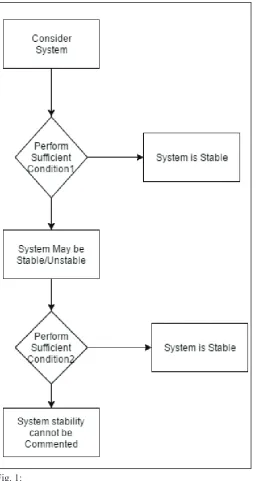
As we have two results for stability analysis of 2-D PSV systems, we need to take decision on which of these criterion is to be used
for stability analysis. So, the proposed flow chart of the proposed
work with two criteria can be shown as follows.
Fig. 1:
By using the above flow chart, the two step stability analysiscriteria
can be implemented. As they are LMI based criteria, It has two implicit advantages:
They are implementable by tools such as, MATLAB LMI 1.
TOOL BOX.
By hundreds of LMI based results existing in literature, It 2.
is evident that LMI based stability criteria are more relaxed. That means, in 2-d case there cannot be necessary and
sufficient condition. But, Gap between them may have been
minimised as compared to the results existing in literature
[6]. Of course, this claim need to be validated by numerical example as done in [18] for similar results of the system
represented by FM-1.
Taking [19]’s example as references and comparison of our result
with existing results for stability.
Table 1 [19].
The result we have obtained
Table 2: Our results
Ex\Thm Thm 1 Thm 2 Conclusion
1 √ - stable
2 × √ stable
3 × √ stable
4 √ - stable
5 - - unstable
6 × √ stable
Table 1 is analysis table of examples which has been concluded
in the [19]. We have taken same examples and performed for our
derived stability theorem 1 and 2, analysis for that is available in Table 2, in that we conclude that our stability criteria has only two theorem which can easily give stability information about system. More ever in terms of computational complexity factor
and other parameters is discussed in Table 3. Table 3 gives over
Table 3: (Stability Analysis of 2D PSV System for GR model)
Proposed Method(I) Proposed Method(II) Existing Methods Comment
Stability
Criteria Total Six Result
Proposed method is LMI based, existing method is linear algebra based
Computational complexity,
memory Less More Much
more(Total Six algorithm)
Existing
Method required to six algorithms in contrast to only two for proposed method, in terms of memory Result –I is better
Speed More Less
Gap between necessary
and sufficient
Conditions
More Less Much more
Purposed method result-II is better than result-I and existing method
Ease of
handling algorithm for stability criteria
Yes Yes No
Proposed methods use LMI approach which helps to get fast and accurate result
Stability Analysis of real life example 1:
To do stability analysis of real life example we have taken example
of 2-D LSV digital filter from [20] which can be written in form
of difference equation is
y(i+1,j+1)=Q[a(i,j)y(i+1,j)+b(i,j)y(i,j+1) ]+U(i,j) (7)
Equation (7) can be represented as figure 1 below.
where Q represents a quantization operation, U(i,j) is input which assumed as zero input (i,j) also b(i,j) taken as zero. Here,
(8)
in this case a(i,j) periodic separable with period (2,2) and this
system is stable according to [20]. It may be represented in matrix
form as
(9)
From the above equations we can write matrix for
(10)
(11)
Taking a(i,j)=A and a(i+2,j), a(i,j+2) are matrices which can
be help for finding ∆A Respected to equation (10),
(11) we can write ∆A for equation (9) is
Using this ∆A, (∆ A= HFE) we can find H,F,E and follow the steps
which discussed in [18]. As FTF≤1 for that we have taken
Using above values in Matlab LMI toolbox for equation (5) which is our first proposed criteria. Matlab LMI toolbox gives t= -0.14 which is a negative value. According to Matlab LMI
toolbox, negative value suggests that system is feasible. Same
procedure we can follow for b (i, j) and checked its stability. We
have already taken the stable system as discussed previously. Here
we get stability in our first criteria only so we do not have to go through second criteria, as we have discussed in the derived flow
Example 2:
We have borrowed example from [21] and taken it for e.q (2) where the coefficient are periodic with period and given above.
Using A(0,0) = A and A(0,1),A(1,0),A(1,1) used for find ∆A,we
have followed steps which are discussed in [18]. As FTF ≤ I for
that we have taken.
Using above values in Matlab LMI toolbox for equation (5) which is our first proposed criteria. Matlab LMI toolbox gives t= -0.013
so system is feasible,which suggest the system is stable. Here also
we get stability in our first criteria only so following our derived flow chart we do not go towards second derived criteria.
IV. Conclusion
In this paper, we have presented two important results for the
Givone-Roesser model of 2-D PSV system. Two sufficient
conditions are established for the stability which can be done using Lyapunov inequality is an LMI expressing stability criteria. So
our first condition for stability is relaxed as far as Computational
complexity is concerned and second condition could be applied if
first condition for stability fails. Hence this makes the algorithm
more robust and useful for the stability analysis of GR model
systems. The supremacy of the algorithm is verified with numerical
example as well as comparisons with existing results.
References
[1] W. A. Gardner, L. E. Franks,“Characterization of cyclostationary random signal processing”, IEEE Trans. Inform. Theory, Vol. IT-21, pp. 4–14, 1975.
[2] F. L. Kitson, L. J. Griffiths,“Design and analysis of recursive periodically time varying digital filters with highly quantized coefficients”. IEEE Trans. Acoust., Speech, Signal Processing, Vol. 36, pp. 674–685, 1988.
[3] R. Thamvichai, T. Bose, D. M. Etter,“Design of multiplierless 2-D filters”, In Proc. IEEE Int. Symp. Intelligent Signal Processing and Communication Systems, Nov. 2000, pp. 760–764.
[4] D. C. Mclernon,“Periodically time-varying two dimensional system”, Electron. Lett., Vol. 26, No. 6, pp. 412–413, 1990.
[5] S. Rajan, K. S. Joo, T. Bose,“Analysis of 2-D state-space periodically shift variant discrete systems”, J. Circuits, Syst.,
Signal Processing, Vol. 15, No. 3, pp. 395–413, 1996. [6] T. Bose, M. Q. Chen, K. S. Joo, G. F. Xu,“Stability of
two-dimensional discrete systems with periodic coefficients”, IEEE Trans. Circuits Syst. II, Vol. 45, July 1998.
[7] D. D. Givone, R. P. Roesser,“Minimization of multidimensional linear iterative circuits”, IEEE Trans. Comput., Vol. C-22, pp. 673–678, 1973.
[8] E. Fornasini,“A 2-D systems approach to river pollution
modelling”, Multidim. Syst. Signal Process, Vol. 2, pp.
233–265, 1991.
[9] P. Regalia,"Adaptive IIR Filtering in Signal Processing and Control", New York: Marcel Dekker, 1995.
[10] J. H. Lodge, M. M. Fahmy,“Stability and overflow oscillations in 2-D state-space digital filters”, IEEE Trans. Acoust., Speech, Signal Process., Vol. ASSP-29, No. 6, pp. 1161– 1171, Dec. 1981.
[11] R. Thamvichai, T. Bose,“Stability of 2-D periodically shift variant filters”, IEEE Trans. Circuits Syst. II, Analog Digit. Signal Process., Vol. 49, No. 1, pp. 61–64, Jan. 2002. [12] P. Bauer, E. Jury,“BIBO stability of multidimensional (mD)
shiftinvariant discrete systems”, IEEE Trans. Autom. Control, Vol. 36, No. 9, pp. 1057–1061, 1991.
[13] Y. Xiao,“Finite state test for asymptotic stability of two-dimensional shift-variant discrete systems”, In Proc. 5th Int. Conf. Signal Process. (WCCC-ICSP 2000), Vol. 1, pp. 409–412.
[14] S. Yost, P. Bauer,“Robust asymptotic stability of 2-D shift-variant discrete state-space systems”, In Proc. 38th Midwest Symp. Circuits Syst., Vol. 1, pp. 482–485, 1995.
[15] H. Fan, C. Wen,“A sufficient condition on the exponential
stability of two-dimensional (2-D) shift-variant systems”,
IEEE Trans. Autom. Control, Vol. 47, No. 4, pp. 647–655, 2002.
[16] B. Chu, Y. Liu,“On the asymptotic stability of positive 2-D systems described by the Roesser model”, IEEE Trans. Circuits Syst. II, Exp. Briefs, Vol. 54, No. 12, pp. 1102–1104, 2007.
[17] S. Yost, P. Bauer,“Shift-variant -D systems and singularities on : Implications for robust stability”, IEEE Trans. Circuits Syst. I, Fundam. Theory Appl., Vol. 42, No. 8, pp. 477–479, Aug. 1995.
[18] Prashant Shah, Prof. Haranath Kar, Prof. Vinaya Kumar Srivastava,“Stability Analysis of 2-D PSV Filters described byFM-1 Model” ICECE-2011 IEEE conference at Yi-Cheng,
China.
[19] Tamal Bose, Mei-Qin Chen, RatchaneekornThamvichai, "Stability of the 2-D Givone–Roesser Model With Periodic Coefficients", IEEE Transactions On Circuits And Systems—I: Regular Papers, Vol. 54, No. 3, 2007.
[20] T. Bose, D. P. Brown,“Limit cycles in 2-D linear shift varying digital filters”, Proc. 31st Midwest Symp. onCkts and Syst., 1988-Aug.
Prashant K. Shah received the B.E
degree from the M.S University,
Baroda in 1991 after completing it he continued the M.E with specialization
in‘Microprocessor Systems and
Applications’.
From 1992 to 1997 he was working as
a lecturer, he joined the S.V. National
Institute of Technology, Surat in 1998,
where he is currently an Associate Professor. His current research interests are in the areas of Signal Processing,