BMC Medical Informatics and Decision Making 2002,
2 x
Research article
Interactive decision support in hepatic surgery
Martin Dugas*
1
, Rolf Schauer
2
, Andreas Volk
2
and Horst Rau
2
Address: 1Department of Medical Informatics, Biometrics and Epidemiology, University of Munich, D-81377 Munich, Germany and 2Department
of Surgery, University of Munich, D-81377 Munich, Germany
E-mail: Martin Dugas* - [email protected]; Rolf Schauer - [email protected]; Andreas Volk - [email protected]; Horst Rau - [email protected]
*Corresponding author
Abstract
Background: Hepatic surgery is characterized by complicated operations with a significant peri-and postoperative risk for the patient. We developed a web-based, high-granular research database for comprehensive documentation of all relevant variables to evaluate new surgical techniques.
Methods: To integrate this research system into the clinical setting, we designed an interactive decision support component. The objective is to provide relevant information for the surgeon and the patient to assess preoperatively the risk of a specific surgical procedure.
Based on five established predictors of patient outcomes, the risk assessment tool searches for similar cases in the database and aggregates the information to estimate the risk for an individual patient.
Results: The physician can verify the analysis and exclude manually non-matching cases according to his expertise. The analysis is visualized by means of a Kaplan-Meier plot.
To evaluate the decision support component we analyzed data on 165 patients diagnosed with hepatocellular carcinoma (period 1996–2000). The similarity search provides a two-peak distribution indicating there are groups of similar patients and singular cases which are quite different to the average. The results of the risk estimation are consistent with the observed survival data, but must be interpreted with caution because of the limited number of matching reference cases.
Conclusion: Critical issues for the decision support system are clinical integration, a transparent and reliable knowledge base and user feedback.
Background
For many years hepatic surgery has been a research focus at the department of surgery of the university of Munich [1–5].
In the case of liver neoplasms surgery is highly complicat-ed and difficult; it takes sometimes 10 hours to operate
malignant liver neoplasms with a perioperative fatality rate as high as three to four percent, which is much higher than the usual operative risk.
Since six years there has been a research database covering in detail the conducted surgical procedures, relevant
med-Published: 10 May 2002
BMC Medical Informatics and Decision Making 2002, 2:5
Received: 30 July 2001 Accepted: 10 May 2002
This article is available from: http://www.biomedcentral.com/1472-6947/2/5
ical parameters of the patient and the postoperative course.
The primary goals of this documentation in the past and present is to collect detailed data about patient character-istics and outcomes to determine what kind of patients do benefit from specific procedures based on survival and complication rates. There is a demand from the surgeons to extend the capabilities from a pure research database towards a clinically integrated decision support system.
The database is currently being used by five surgeons, one medical student, one person of the administrative staff, one statistician, one computer scientist and finally by one anesthesiologist. In the future two radiologists will also be involved. All these users are scattered among the hospital. In this context of a highly interdisciplinary complex re-search topic our main focus is set on the following issues:
• Is a knowledge base for this medical domain with an ap-propriate data structure and high-quality content feasible from a technical point of view?
• Does a decision support system for this medical domain provide clinically relevant information?
Methods
Concept of risk assessment tool
The basic idea of the risk assessment tool is to find similar cases to a given patient. The prognosis of the matching subjects is aggregated and taken as an estimate for the risk of the individual patient.
From a methodical point of view similarity search in com-plex, multidimensional records which are partially in-complete is a difficult problem [6]. To make it even worse, the problem is characterized by a high number of varia-bles in relation to the number of records (we do have 451 items and altogether 766 patients).
For this reason the risk assessment tool is based on select-ed parameters which are known prselect-edictors for outcome of hepatic liver tumor resection [5]. A case is defined to be similar to the actual patient, if all predictive parameters correspond within a given level of tolerance.
The final decision on surgery is taken by the patient and the surgeon; thus both methodology and result of the analysis should be transparent and easy to understand. For this reason the risk is visualized as Kaplan-Meier plot [7], which is the established standard for visualizing sur-vival data in medicine.
In addition, summarized data on all cases classified by the computer as similar to the actual patient is displayed to enable the physician to verify the analysis.
Cases which are inappropriate according to the physicians expertise can be excluded from the analysis in an interac-tive manner.
Database design
The software engineering approach was iterative. By means of regular user meetings and rapid prototyping af-ter approximately 10 iaf-teration cycles a suitable database structure was defined.
The following design objectives were identified:
• high-granular documentation to enable detailed statisti-cal analysis (e.g. association between laboratory parame-ters and outcomes)
• reports on data quality (e.g. lost followup)
• access from many locations within the clinic
• different access rights for each user group (surgeons, anaesthetists, administrative staff, statistician)
Automatic generation of web programs
Data entry is performed with a standard web browser. A dedicated software tool (see [8,9]) has been developed for rapid prototyping of ergonomic, highly adaptive web forms and management of data transformations. It ena-bles to define a data structure (e.g. database table) interac-tively. A preview of the forms can be generated and presented to the clinical user. When the data structure is defined, all PERL [10] programs and database tables are generated from templates, i.e. no line of code is pro-grammed manually. The function of the tool is similar to the UltraDev™ extension of Macromedia Dreamweaver™ [http://www.macromedia.com/] , but is adapted to the needs of medical databases (e.g. specific templates).
The general documentation workflow is as follows: After login the patient is selected from a current list provided by the legacy system. The most recent document for this pa-tient is displayed. The user can navigate within the docu-ments, create new ones or edit the current page. The structure of each document is described in XML format [11].
ID to enable data transformations when the data structure is updated.
The Intranet tool provides the following functions:
• generation of custom data entry forms
• combination of free text and structured data entry
• individual layout for clinical reports
• data transformations
• user authorization and access control
• tools for data export (XML format)
Security and confidentiality of patient information is pro-tected by means of individual logins and a firewall.
Hard- and software
Both the database program and the risk assessment tool are written in PERL (version 5.005_03) [10] running on a Linux machine [12] providing Apache web server (version 1.3) [13] and a PostgreSQL database (version 6.5.3) [14].
Results
Frontend and structure of the database
The database itself consists of eight tables (demographics, medical history, volumetrics, surgical documentation, histology, laboratory values, complications, outcome) with an overall number of 451 items indicating a high lev-el of granularity which is required for this complex re-search topic. Information on 766 patients are recorded. Caused by the high number of items missing values can-not be avoided; this fact must be taken into account by the decision support component.
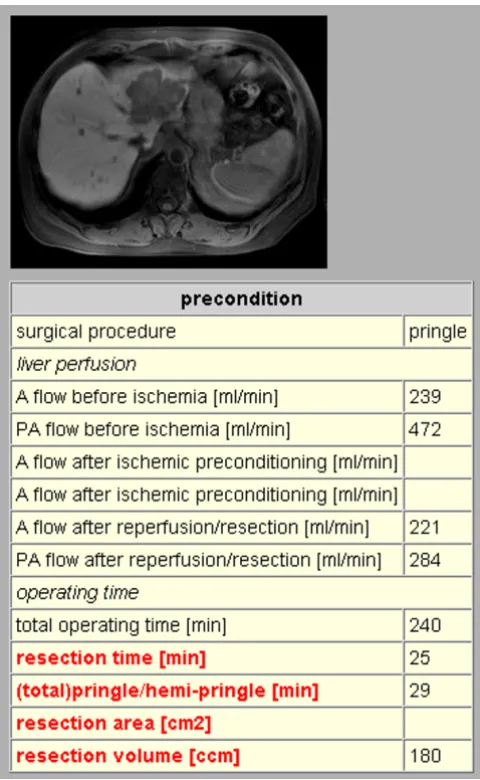
Fig. 1 presents a small section from the surgical documen-tation; besides numerical and categorical items multime-dia data like CT or MR scans can be stored. Altogether 70 items are recorded per operation.
The interactive decision support component
The decision support component is a server side web ap-plication and is accessed using a standard web browser. The application itself is written in PERL invoked by an Apache web server. The knowledge base is stored in a Post-greSQL database which is located on the same server as the application and webserver. Standard techniques such as SQL are used to query the database via the appropriate interfaces.
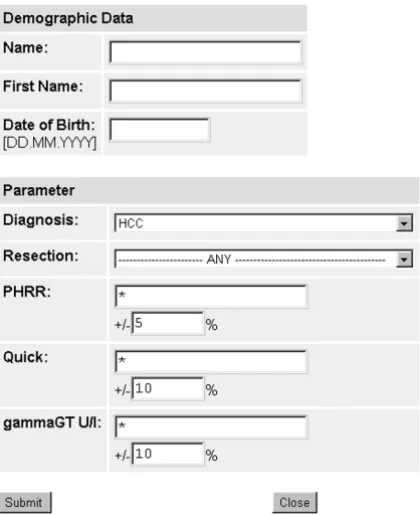
After invoking the program by the web client a form is pre-sented (Fig. 2) which requires the user to provide
demo-graphic data of the patient for whom a suggestion is needed. Clinically relevant parameters must be specified, which have shown to be predictive for patient outcomes (see [5]); for this reason we selected diagnosis, type of planned resection, PHRR (partial hepatic resection rate [15]), prothrombin activity (Quick, a blood clotting pa-rameter) and gamma-GT (gamma-Glutamyltranspepti-dase, a liver enzyme).
Sometimes not all parameters for an individual patient are available, e.g. estimation of the PHRR is very time con-suming. The similarity search also includes datasets which have missing values. It is possible to specify a range for each of the numerical parameters.
Figure 1
Because the number of documented cases is small in com-parison to the quantity of possible parameter combina-tions, the algorithm was designed to avoid overlooking of similar cases (high sensitivity, low specificity). For exam-ple there are 35 different diagnoses resulting in approxi-mately 22 cases under the assumption of equipartition of diagnoses within the 766 patients. Therefore all cases that are not contradictory to the query are considered similar.
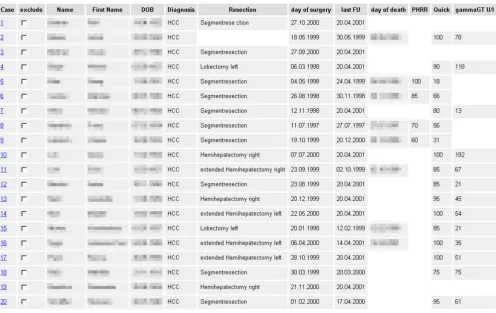
After submitting the form to the system it connects to the database to retrieve the appropriate results based on the specified parameters and their ranges. The system then computes the data necessary for the Kaplan-Meier plot and generates a web page containing the plot and the un-derlying data (Fig. 3, Fig. 4).
The Kaplan-Meier plot presents the course of survival over time. It takes into account that the information per patient is limited with respect to time as long as the patient isn't
dead. For instance, if a patient had surgery three years ago and is alive, this information can be used only until the third year of the plot. After then, this information is cen-sored, because it is unknown, for how long this patient will be alive.
By simple clicking on a similar case the surgeon can go di-rectly to the database and verify the source information. Then the physician decides, whether this case should be excluded from the analysis by selecting the 'exclude' checkbox. After exclusion of inappropriate cases the anal-ysis can be recalculated. By means of this interactive tech-nique the physician gets involved into the analysis and has the ability to verify and adjust it for an individual pa-tient according to his expert knowledge.
Evaluation
To evaluate the decision support component we analyzed data provided by the clinical information system (CIS) concerning the period from January 1996 to September 2000.
Figure 2
Risk assessment form: Demographic data and five parameters can be entered. Diagnosis and type of resection can be selected on a pulldown menu. For the numerical data a range can be specified, which is applied to the similarity search. PHRR=partial hepatic resection rate; Quick=prothrombin activity (parameter of blood clotting); GT = gamma-Glutamyltranspeptidase (liver enzyme)
Figure 3
According to the CIS, within this time frame 3269 surgical procedures from 744 patients were performed covering diagnoses of malign and benign liver tumors. 165 of these patients were assigned HCC (hepatocellular carcinoma) as main diagnosis. These 165 patients are partitioned into 93 with no liver resection (conservative therapy, e.g. chemoembolisation) and 72 with liver resection. 21 of the 72 patients were subject to liver transplantation. The re-maining 51 patients with HCC and liver resection without transplantation were grouped into 23 covered by the re-search database and 28 not covered by the rere-search data-base. Therefore it is evident that a substantial number of patients treated in our hospital is not covered by the re-search database.
We used a batch version of our decision support system to calculate the Kaplan-Meier estimation for all 165 patients from the CIS diagnosed with HCC. Fig. 5 shows the distri-bution of the number of cases rated to be similar to a giv-en patigiv-ent. It has two peaks indicating there are groups of similar patients and singular cases which are quite differ-ent from the average. This may be influenced by the small
number of reference cases in the database (range: 1 to 25 matched cases), but can also be interpreted that there are patients with exclusive features which are very different from "the average patient".
In the group of 51 patients who underwent liver resection we analyzed perioperative fatality rate (within 30 days) to assess whether there is a shift over time (e.g. due to medi-cal progress) which would bias the survival estimation, but we did not find a significant change. In this group the risk assessment tool estimated a mean 1 year survival rate of 78+/-5% (mean +/- S.D.), which is consistent with an observed fatality rate of 20% (10 of 51 patients died with-in the first year after operation). This must be with-interpreted very carefully, because of the limited number of reference cases. We could not evaluate the survival estimations in the group of 93 patients without liver resection, because we do not have reliable information about the followup status of these patients and for this reason we do not know the correct fatality rate in this group.
Figure 4
Discussion
The problem of similarity search in medicine
The situation with the hepatic surgery dataset concerning number of items, number of records and data quality is-sues, i.e. many variables, limited number of patients and missing values, is typical for medical, patient-oriented re-search databases [16,17]. For this reason data mining and visualization techniques for large databases [18] cannot be applied easily.
Care must be taken in defining "similar patients" to avoid selection bias, either by too imprecise or too strict criteria. We decided to apply an interactive approach: the compu-ter presents a list of similar patients, but the medical ex-pert can exclude certain cases from the analysis. This provides a synthesis of formalized computer rules and empirical medical expertise.
One might argue why we applied quite few parameter to the similarity search. From a technical point of view, very few variables can split our dataset in manageable units,
e.g. there are as many as 35 different diagnoses resulting in approximately 22 cases per diagnosis under the theoret-ical assumption of equipartition within the 766 patients.
From a clinical viewpoint, the risk assessment tool must be fast and easy to use – for this reason we applied 5 pa-rameters, which have shown to be predictive for patient outcomes (see [5]).
Data monitoring
The research database provides a set of specific reports, e.g. the number of patients per diagnostic category or a list of patients with lost-followup (i.e. followup status is un-known for more than 6 months).
The new decision support component has also an impact on data quality, because when the list of similar cases is displayed it becomes evident, which parameters are im-plausible or missing. Given the direct link to the individ-ual patient record missing data can be entered directly if it is available.
However, we did not verify whether all eligible patients were entered into the database, therefore a selection bias may occur.
By searching similar cases for very common or clinically relevant situations, targeted data monitoring is feasible, which can improve data quality in an efficient way and might lead to better medical decisions in the long run – it is hard to prove this hypothesis, but because this research database is the foundation for many clinical studies in this field better data quality will enable faster and more relia-ble scientific results.
Risk assessment
The decision about whether or not an individual patient is eligible for a surgical procedure is essential for the rou-tine work of any surgeon. A standalone research database is not suitable for supporting this difficult task. For this reason we developed a tool to extract and visualize infor-mation from the research database relevant for an individ-ual patient. This aggregation enables specific insights, tailored to a specific patient, which are not available by simple database queries.
A stepwise decision support is provided:
First, the surgeon and the patient get assistance whether or not a surgical procedure is appropriate. The risk can be cal-culated specifically for each patient by established predic-tors of outcomes for this operation.
Second, the surgeon can select different procedure types (extent of liver resection) and analyze the risk.
Figure 5
Third, the clinical decision is stored into the database to enable statistical analysis for future improvements of the system.
The evaluation based on retrospective data of the clinical information system provides evidence, that the risk assess-ment tools delivers clinically relevant information. How-ever, we did not quantify the potential clinical impact of our system; in this case, a controlled trial would be re-quired.
So far surgeons have made decisions based on their per-sonal expertise and intuition – we want to provide addi-tional, objective information to facilitate this difficult task. The patient also benefits from this comprehensive information.
Visualization and aggregation of medical information
Our approach is visualization by means of the Kaplan-Meier plot which is – in the field of medicine – the estab-lished method for displaying survival data. The surgeon and furthermore the patient can get an idea of the risk of the surgery supporting both of them in their decision whether or not to perform the surgery. The benefit of the Kaplan-Meier plot compared to complex decisions trees [19] is obvious. A decision tree is often hard to understand especially for persons not familiar with this kind of repre-sentation. However, due to limitations in sample size and length of follow-up, the Kaplan-Meier plot must be inter-preted carefully.
There is no special training needed to introduce the risk assessment tool. The surgeon isn't influenced in his opin-ion by a unary suggestopin-ion presented by the system. But his decision process is supported by data of documented sur-geries. In addition Kaplan-Meier plots for certain patient groups can be generated for scientific purposes, i.e. with-out regard to an individual patient.
High-granular database design
One might argue why we store so many different variables (451 items per patient) in our database. For answering a specific research question (e.g. which of two surgical pro-cedures is more efficient?) much less items were sufficient. But due to medical progress, for example the invention of the jet-cutter [3], new scientific questions arose in the past and very probably will arise in the future. Retrospective data collection is not only expensive, but also prone to er-rors and in many cases the data cannot be reconstructed precisely. For this reason we decided to implement a com-prehensive medical record for liver resection patients, to prospectively document all potentially relevant items. An alternative approach would be a smaller data model, which would be limited to a specific research question, but could provide more complete data.
With the risk assessment tool we want to bridge the gap between a pure research and a clinical database and by this means improve the data quality.
Success factors for clinical decision support
There are not many, but some relevant examples for effec-tive clinical decision support, e.g. the classical "Computer reminders" of McDonald [20] and recent applications concerning efficient use of antibiotics [21,22]. We tried to implement the following common characteristics in our system:
• Clinical integration
Clinical decisions are and should be taken in the forseea-ble future by doctors and their patients, not by machines. For this reason the computer has the role of enabling the physician to find the correct conclusions. In this setting, any system must provide a comprehensible benefit for the clinical user. Without workflow integration, the data in the computer will not correspond to the medical reality around it and any system will not be able to provide clin-ically useful information.
• Transparent, up-to-date knowledge base
A "black box" approach is inappropriate in the medical setting, because many decisions are ambiguous. The med-ical evidence behind a specific statement must be availa-ble on demand, to enaavaila-ble the doctor to verify the rationale behind it. In our case, we provide the user the opportunity to view the full record of a case rated as similar to the ac-tual patient. As a side effect of this approach errors in the knowledge base are detected spontaneously.
• User feedback
Neither physicians nor computer scientists know an ap-propriate data model for a specific medical domain in the beginning. From our experience, in a theoretical setting clinically adequate data structures cannot be defined, thus an iterative approach in software engineering is required. User feedback is important not only for fine tuning of data structures, but also for general acceptance, because the physicians get involved. By collecting the real decisions taken in a particular case we want to gather information on the clinical use of the system.
Future directions
influ-ence patient outcomes and the progress in surgery, inter-institutional cooperation is required to build a comprehensive knowledge base. Internet technology can provide the technical platform for this collaboration. Once the knowledge base and the update mechanisms for the content are established, a public accessible decision support tool is feasible.
Authors' contributions
Dr. Dugas: Database design and implementation, data analysis, preparation of the manuscript
Dr. Schauer, Mr. Volk, Dr. Rau: Clinical implementation, data management, review
Competing interests
none declared
Acknowledgements
We acknowledge the important contributions from Dr. Hornung, depart-ment of surgery and Dr. Sator, departdepart-ment of clinical chemistry, University Hospital of Munich, Germany. The CT scan was provided by Dr. Hundt, de-partment of radiology, University Hospital of Munich, Germany.
References
1. Rau HG, Schardey HM, Buttler E, Reuter C, Cohnert TU, Schildberg FW: A comparison of different techniques for liver resection: blunt dissection, ultrasonic aspirator and jet-cutter.Eur J Surg Oncol 1995, 21:183-7
2. Schauer R, Rau H, Baretton G, Blasenbreu S, Meyer G, Schildberg FW: Prognostic factors in gallbladder carcinoma as a decision aid for reoperation.Langenbecks Arch Surg 1997, 114:1072-4 3. Rau HG, Buttler ER, Baretton G, Schardey HM, Schildberg FW:
Jet-cutting supported by high frequency current: new technique for hepatic surgery.World J Surg 1997, 21:254-9
4. Rau HG, Buttler ER, Baretton G, Schardey HM, Schildberg FW: Jet-cutting Supported by High Frequency Current: New Tech-nique for Hepatic Surgery.World J Surg 1997, 21:254-260 5. Rau HG, Schauer R, Helmberger T, Holzknecht N, von Rückmann B,
Meyer L, Buttler E, Kessler M, Zahlmann G, Schuhmann D, Schildberg FW: Impact of virtual reality imaging on hepatic liver tumor resection: calculation of risk. Langenbecks Arch Surg 2000, 385:162-170
6. Kanth KV, Agrawal D, Singh AK: Dimensionality Reduction for Similarity Searching in Dynamic Databases.In: SIGMOD 1998 (Edited by: Haas LM, Tiwary A) ACM Press 1998, 166-176
7. Altman DG: Practical Statistics for Medical Research.Chapman & Hall, London 1991, 368-371
8. Dugas M, Überla K: Intranet Based Clinical Workstations.In: Medical Informatics, Biostatistics and Epidemiology for Efficient Health Care and Medical Research (Edited by: Victor N) Urban und Vogel, Munich
1999, 235-238
9. Dugas M, Überla K: Intranet-Based Clinical Data Entry.AMIA Proc 1999, 1051
10. L. Wall, R. Schwartz: Programming PERL.O'Reilly & Associates Inc., Sebastopol, CA, USA 1992
11. Extensible Markup Language (XML) [resource on World Wide Web]. 2000 [http://www.w3.org/XML]
12. SuSE Linux Home Page [resource on World Wide Web]. 2000 [http://www.suse.de]
13. The Apache Software Foundation Home Page [resource on World Wide Web]. 2001 [http://www.apache.org]
14. PostgreSQL [resource on World Wide Web]. 2000 [http:// www.de.postgresql.org/]
15. Okamoto EKA, Yamanaka N: Prediction of safe limits of hepate-ctomy by combined volumetric and function measurements in patients with impaired hepatic function. Surgery 1984, 95:586-592
16. Morik K, Imboff M, Brockhausen P, Joachims T, Gather U: Knowl-edge discovery and knowlKnowl-edge validation in intensive care.
Artif Intell Med 2000, 19:225-249
17. Lavrac N: Selected techniques for data mining in medicine. Ar-tif Intell Med 1999, 16:3-23
18. Keim DA: Visual Database Exploration Techniques.Int. Confer-ence on Knowledge Discovery & Data mining, Newport Beach, CA 1997 (KDD'97). [resource on World Wide Web]. 2001 [http://www.informa-tik.uni-halle.de/~keim/PS/KDD97.pdf]
19. Ankerst M, Elsen Ch, Ester M, Kriegel HP: Visual Classification: An Interactive Approach to Decision Tree Construction.ACM SIGKDD Int. Conf. on Knowledge Discovery & Data Mining (KDD'99), San Diego, CA 1999
20. McDonald CJ: Protocol-based computer reminders, the quali-ty of care and the non-perfectibiliquali-ty of man.N Engl J Med 1976, 295:1351-1355
21. Evans RS, Pestotnik SL, Classen DC, Clemmer TP, Weaver LK, Orme JF Jr, Lloyd JF, Burke JP: A Computer-Assisted Management Program for Antibiotics and Other Antiinfective Agents.N Engl J Med 1998, 338:232-8
22. Shojania K, et al: Reducing vancomycin use utilizing a compu-ter guideline: results of a randomized controlled trial.JAMIA
1998, 5:554-562
23. Dugas M: Clinical applications of Intranet-Technology.In: New Technologies in Hospital Information Systems (Edited by: Dudeck J) IOS Press, Amsterdam 1997, 115-118
Pre-publication history
The pre-publication history for this paper can be accessed here:
http://www.biomedcentral.com/1472-6947/2/5/prepub
Publish with BioMed Central and every scientist can read your work free of charge
"BioMedcentral will be the most significant development for disseminating the results of biomedical research in our lifetime."
Paul Nurse, Director-General, Imperial Cancer Research Fund
Publish with BMC and your research papers will be:
available free of charge to the entire biomedical community
peer reviewed and published immediately upon acceptance
cited in PubMed and archived on PubMed Central
yours - you keep the copyright
[email protected] Submit your manuscript here:
http://www.biomedcentral.com/manuscript/