1535-9778/09/$08.00⫹0 doi:10.1128/EC.00191-09
Copyright © 2009, American Society for Microbiology. All Rights Reserved.
A Single
dicer
Gene Is Required for Efficient Gene Silencing
Associated with Two Classes of Small Antisense RNAs in
Mucor circinelloides
䌤
†
Juan P. de Haro, Silvia Calo, María Cervantes, Francisco E. Nicola
´s,‡
Santiago Torres-Martínez, and Rosa M. Ruiz-Va
´zquez*
Departamento de Gene´tica y Microbiología, Facultad de Biología, Universidad de Murcia, 30100 Murcia, Spain
Received 30 June 2009/Accepted 29 July 2009
RNA silencing in the zygomycete Mucor circinelloidesexhibits uncommon features, such as induction by self-replicative sense transgenes and the accumulation of two size classes of antisense small interfering RNAs (siRNAs). To investigate whether this silencing phenomenon follows the rules of a canonical RNA-silencing mechanism, we used hairpin RNA (hpRNA)-producing constructs as silencing triggers and analyzed the efficiency and stability of silencing in different genetic backgrounds. We show here that the dsRNA-induced silencing mechanism is also associated with the accumulation of two sizes of antisense siRNAs and that this mechanism is not mediated by the previously knowndcl-1(dicer-like) gene, which implies the existence of an additionaldicergene. AnM. circinelloides dcl-2gene was cloned and characterized, and the corresponding null mutant was generated by gene replacement. This mutant is severely impaired in the silencing mechanism induced by self-replicative sense or inverted-repeat transgenes, providing the first genetic evidence of a canonical silencing mechanism in this class of fungus and pointing to a role fordcl-2 in the mechanism. Moreover, a functionaldcl-2gene is required for the normal accumulation of the two sizes of antisense RNAs, as deduced from the analysis ofdcl-2ⴚtransformants containing hpRNA-expressing plasmids. In addition to its critical role in transgene-induced silencing, thedcl-2gene seems to play a role in the control of vegetative development, since thedcl-2null mutants showed a significant decrease in their production of asexual spores.
RNA-mediated gene silencing (RNA silencing) acts through transcriptional and posttranscriptional mechanisms to sup-press gene exsup-pression in a sequence-specific manner. Wide-spread among plants, animals, and fungi, these mechanisms are involved in a wide variety of biological processes, including defense against viruses and transposons, the regulation of en-dogenous gene expression, and heterochromatin formation (reviewed in references 2, 5, 31, and 35). Although a number of specialized RNA-silencing pathways have been reported, a common mechanism has emerged, with homologous genes and proteins acting in different organisms. A central feature in all of these silencing phenomena is the processing of double-stranded RNA (dsRNA) (long dsRNA and pre-microRNAs [miRNAs]) into small duplexes of 21 to 25 nucleotides (nt) (small interfering RNAs [siRNAs] and miRNAs) by the RNase III enzyme Dicer. The small RNAs generated by Dicer are subsequently incorporated into the RNA-induced silencing complex (RISC), where they are used as a guide for the se-quence-specific degradation of the target mRNA, the repres-sion of its translation, or the inhibition of its transcription.
The Dicer endonucleases are multidomain proteins evolu-tionarily conserved in eukaryotes. In metazoans and plants, in
addition to two copies of the RNase III domain and a dsRNA-binding domain at the carboxyl terminus, the Dicer proteins include an amino-terminal ATP-dependent RNA helicase do-main, a small domain of unknown function found specifically in Dicer proteins and proposed to fold as a dsRNA-binding do-main (the DUF283 dodo-main), and a Piwi-Argonaut-Zwille (PAZ) domain, which binds specifically to the 3⬘end of single-stranded RNA. In lower eukaryotes, Dicer proteins frequently have a less complex domain organization (9).
The number of Dicer proteins varies among organisms. Thus, mammalian genomes, Caenorhabditis elegans, and the fission yeastSchizosaccharomyces pombecontain only onedicer gene, which is involved in the siRNA and miRNA pathways.
Two dicer genes have been identified in organisms such as
Drosophila melanogaster, whereas plants, such as Arabidopsis
thaliana and rice, contain four dicer-like (dcl) genes. These
paralogous genes may have different roles in the siRNA/ miRNA-silencing pathways. Thus, inD. melanogaster, distinct roles in RNA silencing have been established for Dicer-1 and Dicer-2, which generate miRNA and siRNA, respectively, al-though the functional separation is not absolute, since both enzymes are required for siRNA-directed target mRNA cleav-age and gene silencing (12). The fourArabidopsisDicer-like proteins also have specialized functions in small-RNA biogen-esis: DCL1 processes miRNA precursors and is also involved in the production of small RNAs from endogenous inverted repeats, while DCL2 produces siRNAs associated with antivi-ral defense and from natuantivi-ralcis-acting antisense transcripts; DCL3, on the other hand, produces 24-nt siRNAs that are involved in chromatin modification and transcriptional silenc-ing, and DCL4 generates 21-nttrans-acting siRNAs (8, 9). In
* Corresponding author. Mailing address: Departamento de Ge-ne´tica y Microbiología, Facultad de Biología, Universidad de Murcia, 30100 Murcia, Spain. Phone: 34 868 887136. Fax: 34 868 883963. E-mail: [email protected].
† Supplemental material for this article may be found at http://ec .asm.org/.
‡ Present address: School of Biological Sciences, University of East Anglia, Norwich, NR4 7TJ, United Kingdom.
䌤Published ahead of print on 7 August 2009.
1486
on September 8, 2020 by guest
http://ec.asm.org/
a fungus taxonomically close toN. crassa, only one of the two
dicergenes,mdl-2, is required for siRNA biogenesis (10), and
no role has been assigned to themdl-1gene. Also, twodicer genes have been functionally analyzed in the chestnut blight fungus,Cryphonectria parasitica, an ascomycota closely related
toN. crassa, and it has been demonstrated thatdcl-2is
essen-tial for the RNA-silencing pathway involved in antiviral de-fense (29, 39).
The zygomyceteMucor circinelloidesis one of the few fungi of this clade which is accessible to a molecular approach for the study of a number of processes, including RNA silencing. Moreover, the fact that it is evolutionarily distant from other fungal model organisms makes it an evolutionary indicator in the fungal kingdom. We have previously demonstrated that sense transgenes trigger an RNA-silencing response inM.
cir-cinelloides(18). One of the interesting features of the
gene-silencing phenomenon in this organism is its induction by non-integrative transgenes. As a result, transgene expression is not affected by position effects or host regulatory sequences at the insertion sites, which allows the effects of transgene expression on silencing frequency and stability to be analyzed (21). Nota-bly, the gene silencing triggered by sense transgenes in M.
circinelloides is associated with two different classes of
anti-sense siRNA, 21 nt and 25 nt long, which are differentially accumulated during the vegetative growth of silenced strains (18). This makes the silencing mechanism in this fungus unique. To date, only one dicer-like gene (dcl-1) has been identified inM. circinelloides. However, phenotypic analysis of
dcl-1null mutants indicated that this gene is not involved in the
silencing response and is not essential for the biogenesis of self-replicative transgene-derived siRNAs (19). Moreover, the
dcl-1mutants showed a reduced growth rate and alterations in
hyphal growth, which suggested that the gene plays a role in the control of endogenous functions (19). Since there is no genetic evidence to date concerning the participation of silenc-ing proteins in the self-replicative transgene-induced silencsilenc-ing pathway inM. circinelloides, one of the questions we pose in this paper is whether a canonical RNA-silencing mechanism operates inM. circinelloides. We show here that silencing trig-gered by hairpin RNA (hpRNA)-expressing constructs is also associated with the two size classes of antisense siRNAs and
thatdcl-1is not involved in this mechanism, which suggests the
existence of an additional dicergene in the M. circinelloides genome. By coupling two different strategies, we cloned adcl-2 gene. The disruption of this gene resulted in severe impair-ment of the gene silencing triggered by hpRNA or aberrant transgenic RNA, as well as in the production of the two classes of siRNAs, which provides direct evidence of the crucial role of Dcl-2 in the RNA-silencing pathway. In addition, we found that thedcl-2null mutants showed a significant decrease in the
MU402 (19). Strain MU241 (kindly provided by M. D. Quiles-Rosillo, University of Murcia) is a prototrophic strain derived from R7B after replacement of the
leuA1mutant allele by the wild-type allele. Cultures were grown at 26°C in minimal YNB medium, complete YPG medium, or MMC medium as described previously (19). The media were supplemented withL-leucine (20g/ml) or uridine (200g/ml) when required. The pH was adjusted to 4.5 and 3.2 for mycelial and colonial growth, respectively. Transformation was carried out as described previously (18). Transformants were grown in selective medium for several vegetative cycles to increase the proportion of transformed nuclei, since primary transformants are heterokaryons due to the presence of several nuclei in the protoplasts. Illumination conditions were as previously described (25). Esch-erichia colistrain DH5␣was used for all cloning experiments and strain LE392 (Promega, Madison, WI) for the propagation of M. circinelloides genomic lambda clones.
Plasmids.Plasmid pMAT1253, which expresses a carBhpRNA under the control of theM. circinelloides gpd1promoter, was constructed by inserting an inverted-repeat sequence corresponding to thecarBgene (accession number AJ238028) into theM. circinelloidesexpression vector pEUKA4 (37), which uses theM. circinelloides leuAgene as a selectable marker. To obtain the inverted-repeat transgene, a 1,189-bp PCR-generated fragment (primers dsrna5 forward and dsrna3a reverse; see Table S1 in the supplemental material) was digested with SalI and ligated, in the opposite orientation, to an XhoI-digested 840-bp PCR fragment generated with the same primer at the 5⬘end and the reverse primer dsrna5b (see Table S1 in the supplemental material). The resulting inverted repeat was digested with BamHI and cloned into the pBluescript vector to obtain plasmid pMAT1251. The 2-kb inverted-repeat fragment was excised from plasmid pMAT1251 with XhoI and NotI and cloned into pEUKA4 digested with the same enzymes.
Plasmids pMAT1254 and pMAT1255 express the carBhpRNA under the control of the light-inducible promoter of thecarBgene. To construct these plasmids, the 2-kb inverted-repeat fragment isolated from pMAT1251 by BamHI digestion was cloned, in opposite orientations with respect to thecarBpromoter, into plasmid pMAT678. This plasmid consists of a 4.4-kb PstI fragment that includes theleuAgene ofM. circinelloidesand a 492-bp PCR-generated fragment amplified with primers carRP and carBSpe (see Table S1 in the supplemental material), which contains the light-induciblecarBpromoter. Plasmid pMAT1254 expresses the hpRNA in the required orientation for processing the intron included in the spacer region between the inverted-repeat sequences, whereas orientation of the inverted-repeat fragment with respect to the promoter in pMAT1255 produces an unspliceable transcript.
Plasmid pMAT1203 contains an 880-bp PCR-amplified fragment of thedcl-2
gene. This fragment was amplified using the degenerate oligonucleotides di-certrun2 and dicer5 (see Table S1 in the supplemental material), corresponding to sequences of the PAZ and RNase III domains of Dicer proteins (PI[SN]AS VY and EFLGDAIF, respectively), and DNA of the nulldcl-1mutant as a template. The primers were designed taking into account the DNA sequences of theM. circinelloides dcl-1gene and thedicer-like genes of the zygomycete Rhi-zopus oryzae, whose genomic sequence is available at http://www.broad.mit.edu /annotation/genome/rhizopus_oryzae/Home.html. PCR amplifications were car-ried out at 52°C using 50 ng of thedcl-1null mutant MU406 as a template and 2.5 U of EcoTaq Plus (Ecogen, Spain).
Plasmid pMAT1208 contains the 5.5-kb EcoRI genomic fragment that in-cludes a 3⬘-truncated version of thedcl-2gene, isolated from aM. circinelloides -positive lambda clone and cloned into the pBluescript SK vector.
Plasmid pMAT1214 contains a 480-bp fragment that was obtained in a 3⬘rapid amplification of cDNA ends (RACE) experiment designed to identify the 3⬘end of thedcl-2gene. The fragment was cloned into the pGEM-T Easy vector (Promega).
Plasmid pMAT1220 includes a genomic fragment of 7,941 bp that comprises the completedcl-2sequence. It was constructed by cloning the 4.9-kb XhoI fragment isolated from a positive lambda clone, which expands the 3⬘region of
on September 8, 2020 by guest
http://ec.asm.org/
dcl-2, between the two XhoI sites of pMAT1208. This plasmid, together with pMAT1208, was used to obtain the complete genomic sequence of thedcl-2
gene.
Plasmid pMAT1218 was constructed to disrupt thedcl-2gene. In brief, the 5.5-kb EcoRI fragment of thedcl-2gene, cloned into the pGEMT Easy vector, was digested with BamHI and ligated to a 3.2-kb BamHI fragment isolated from plasmid pEPM1 (kindly provided by A. P. Eslava, University of Salamanca, Salamanca, Spain), which includes a wild-type allele of theM. circinelloides pyrG
gene. The resulting plasmid has a deletion of 1.7 kb in thedcl-2coding region and contains the selective markerpyrG⫹flanked by sufficient sequences of the
dcl-2gene (1.35 kb upstream and 2.45 kb downstream) to allow homologous recombination. The 7-kb disruption fragment was released from pMAT1218 by EcoRI digestion and introduced into MU402 protoplasts by transformation. Only transformants showing a stable PyrG⫹phenotype, as an indicator of exo-genous DNA integration, were considered for further analysis.
Plasmid pMAT1223 was used to complement thedcl-2⫺mutation. This plas-mid contains a complete version of the wild-typedcl-2gene and regulatory sequences and was constructed by cloning a 7.13-kb SpeI fragment of thedcl-2
locus, isolated from pMAT1220, into thepyrG⫹-containing plasmid pEPM1. This fragment expands 1,300 bp upstream of the putative ATG initiation site and 758 bp downstream of the TAG stop codon.
Plasmid pMAT1228 was designed to obtain adcl-1null mutation by gene replacement, using theleuAgene ofM. circinelloidesas a selective marker. This plasmid contains a 4.4-kb PstI fragment isolated from pLEU4, which contains the
leuAgene and regulatory sequences, flanked by 1.3-kb and 1.5-kb PCR-amplified fragments of thedcl-1locus. SacI digestion of this plasmid produced a 7.2-kb disruption fragment that allowed homologous recombination at thedcl-1locus, leading to replacement of 4.7 kb of thedcl-1coding region by theleuAgene.
Plasmid pMAT689 contains the completedcl-1coding region and adjacent sequences. It expands 7.4 kb of thedcl-1locus and was constructed by cloning the 2.2-kb and 5.2-kb SacI fragments of thedcl-1locus into the pBluescript SK vector.
Plasmid pMAT1330 contains the same inverted-repeat carB transgene as pMAT1253 and thepyrGgene as a selective marker. It was obtained by isolating the complete inverted-repeat construct from pMAT1253, including the promoter and terminator regions, and cloning it in thepyrG⫹plasmid pEPM1.
Selection fordcl-2ⴚpyrGⴚmutants.Spores of the MU410 (dcl-2⫺pyrG⫹ leuA⫺) and MU411 (dcl-1⫺ dcl-2⫺ pyrG⫹leuA⫹) strains were treated with
N-methyl-N⬘-nitro-N-nitrosoguanidine (0.1 mg/ml) as described previously (19). After completion of a cycle of vegetative growth on complete-medium plates containing 200g/ml uridine, the resulting spores were inoculated on minimal medium containing 3 mg/ml 5-fluoroorotic acid and 200g/ml uridine. Leucine (20g/ml) was added when required. 5-Fluoroorotic acid-resistant colonies were tested for uracil auxotrophy, and several independent Ura⫺mutants were as-sayed for orotidine 5⬘-phosphate decarboxylase activity. SevenpyrG⫺mutants obtained in independent mutagenesis experiments were isolated from MU410, and onepyrG⫺mutant was derived from MU411. PyrG⫹transformants of the
dcl-2⫺pyrG⫺leuA⫺mutant were selected in MMC medium.
Nucleic acid manipulation and analysis.Standard recombinant DNA manip-ulations were performed as described previously (28). Genomic DNA fromM. circinelloideswas prepared as described previously forPhycomyces blakesleeanus
(27). A LambdaGEM-11 genomic library of theM. circinelloideswild-type strain CBS 277.49 (25) was screened with three distinct probes under two different conditions to isolate recombinant plaques containing the completedcl-2gene. Screening of 36,000 plaques with a 2.5-kb fragment of thedcl-1gene cloned in plasmid pMAT660 (19) was performed using low-stringency conditions. Filters (Hybond N⫹; GE Healthcare) were hybridized to the radioactively labeled probe at 60°C in 0.9 M NaCl, 1% SDS, 0.1 g/ml dextran sulfate and washed in 2⫻SSC (1⫻SSC is 0.15 M NaCl plus 0.015 M sodium citrate), 0.1% sodium dodecyl sulfate (SDS) at 60°C for 20 min; 1⫻SSC, 0.1% SDS at 60°C for 20 min; and 0.5⫻SSC, 0.1% SDS at 60°C for 10 min. Twenty-seven positive recombinant plaques were further screened with an 880-bp fragment of thedcl-2gene isolated from plasmid pMAT1203 under high-stringency conditions (19). A positive clone containing a 5.5-kb EcoRI fragment with a 3⬘-truncated version of thedcl-2gene was isolated. A second screening of 9,000 plaques of the genomic library was carried out under stringent conditions to isolate the completedcl-2gene, using as a probe a 480-bp DNA fragment cloned in plasmid pMAT1214, which cor-responds to the 3⬘end of thedcl-2gene. Probes were labeled with [␣-32
P]dCTP using Ready-to-Go DNA-labeling beads (GE Healthcare), following the instruc-tions of the supplier.
For Southern blot analysis, genomic DNA (1g) isolated from the wild-type strain and thedcl-2⫺ordcl-1⫺dcl-2⫺mutant was digested with the appropriate restriction enzymes, fractionated on a Tris-acetate-EDTA-agarose gel, blotted
onto positively charged nylon filters (Hybond-N⫹; GE Healthcare), and hybrid-ized at 65°C to radioactively labeleddcl-2ordcl-1probes. The hybridization and washing conditions were as described previously (18).
For Northern blot hybridization, total RNA was isolated using the guani-dinium thiocyanate-cesium chloride method. About 20g of total RNA was hybridized to radioactively labeled probes as previously described (19). Thedcl-2
probe corresponded to a 2.5-kb XhoI-EcoRI fragment isolated from plasmid pMAT1208. ThepyrGprobe was a 1.5-kb BamHI-SalI fragment isolated from plasmid pEPM1.
Reverse transcription (RT)-PCR amplifications were performed to identify introns in thedcl-2genomic sequence. Total RNA was isolated from cultures grown for 24 h on minimal liquid medium (pH 4.5) and reverse transcribed with
dcl-2-specific primers. Primers DBlong5 and DB3 (see Table S1 in the supple-mental material) were used to identify exon-intron boundaries in introns 1 and 2. To identify intron 3, primers DBs5 and DBex3 (see Table S1 in the supple-mental material) were used. Intron 4 and the 3⬘end of thedcl-2mRNA were identified by 3⬘-RACE experiments, using thedcl-2sense-specific primers DB10 and DB9 (see Table S1 in the supplemental material) to amplify the cDNA reverse transcribed with the RACE-T primer (Roche), using as a template total RNA isolated from cultures of a silenced transformant grown for 24 h on minimal liquid medium. To characterizedcl-2transcripts in thedcl-2⫺mutant, RT-PCR amplifications were performed using total RNA isolated from 24-h cultures of thedcl-2⫺mutant and primers DBex3 and DBs5 to amplify the RNase III catalytic domains and pyrG3 and pyrG9 to amplify thepyrGsequence (see Table S1 in the supplemental material). Expand reverse transcriptase (Roche) and EcoTaq Plus (Ecogen, Spain) were used in all the experiments. The amplified fragments were cloned in pGEM-T Easy vectors (Promega) and se-quenced.
To identify transformants that correctly integrated the knockout vector de-signed to disrupt thedcl-2gene, a rapid protocol for isolating the DNA to be used in PCR amplifications was utilized (19). Primers pyrG10 and DB16 (see Table S1 in the supplemental material) were used in the PCRs to identify homologous integrations at thedcl-2locus. Primers leua-P2 and dicer19 were used to identify transformants of thedcl-2⫺mutant that correctly integrated the knockout vector designed to disrupt thedcl-1gene.
Computer analysis of the sequence was carried out using European Bioinfor-matic Institute server software (EMBL Outstation, Hinxton, United Kingdom); the National Center for Biotechnology Information server (NCBI, Bethesda, MD); the ExPASy Molecular Biology server (Swiss Institute of Bioinformatics); and the Baylor College of Medicine search launcher (Houston, TX).
Small-RNA analysis.For siRNA analysis, total RNA was extracted from frozen mycelia of wild-type and silenced strains grown under illumination with white light (blue light component at 4 W/m2
) using Trizol reagent, following the recommendations of the supplier (Invitrogen). Low-molecular-weight RNA was prepared from total RNA, separated by electrophoresis, and hybridized to ra-dioactive riboprobes as previously described (18). Filters were washed as de-scribed previously (19), except that treatment with the RNase A-RNase T1 cocktail was carried out at 37°C for 60 min.
ThecarBantisense-specific riboprobe was prepared by in vitro transcription of the linearized pMAT652 plasmid (18), using the Maxiscript transcription kit (Ambion) following supplier-recommended protocols. Riboprobes were treated as described previously (18) to be broken to an average size of 50 nt. Oligonu-cleotides corresponding to sense and antisense sequences of thecarBgene were used as size and polarity controls.
Sporulation measurements.To quantify the sporulation efficiencies ofdcl-2⫺
mutants, spores were harvested fromdcl-2⫺,dcl-1⫺dcl-2⫺, and wild-type mycelia as described previously (20). Briefly, small colonies (2-mm diameter;n⫽10) of the different strains were transplanted to MMC solid medium, pH 3.2, and grown for 72 h under dark or light conditions. After incubation, the diameter of each colony was determined, and the complete colony was harvested in 1.0 ml distilled water and vortexed to allow suspension of the spores. The spores were counted with a hemocytometer.
Nucleotide sequence accession number.The nucleotide sequence of thedcl-2
gene ofM. circinelloideshas been deposited in the EMBL/GenBank/DDBJ databases under accession number FN421463.
RESULTS
HpRNA efficiently induces stable gene silencing. Previous studies demonstrated that the introduction of self-replicative sense transgenes inM. circinelloidestriggers a gene-silencing response in a low percentage of the transformants (18, 19). To
on September 8, 2020 by guest
http://ec.asm.org/
investigate whether a canonical RNA-silencing mechanism, which is induced by dsRNA, operates inM. circinelloides, we constructed an inverted-repeat transgene that produces, upon transcription, an hpRNA corresponding to thecarBgene. The silencing ofcarB, a gene required for carotenoid biosynthesis, results in albino colonies that strongly contrast with the bright-yellow phenotype of the wild-type strain in the light. Two different endogenous promoters were used to drive transcrip-tion of thecarBtransgene, the stronggpd1promoter, which is active during vegetative growth and is regulated by the carbon source (37), and the light-inducedcarBpromoter (36). Plasmid pMAT1253 expresses a carB hpRNA comprising an 840-bp stem and a 349-bp loop under the control of thegpd1promoter and theAspergillus nidulans trpCterminator (Fig. 1). Plasmid pMAT1254 expresses the same construct under the control of thecarBpromoter. In both cases, a spliceable intron was in-cluded in the loop region, since the presence of introns has been reported to increase silencing efficiency in plants and fungi (6, 34). We expected that splicing of the primary RNA would produce a 286-bp loop in the mature transcripts derived from both constructs. Plasmid pMAT1255 expresses thecarB inverted-repeat sequence in the reverse orientation with re-spect to thecarBpromoter. Thus, this construct would produce an hpRNA with an unspliceable intron within the loop region (Fig. 1).
To evaluate the silencing efficiencies of the three constructs
in M. circinelloides, the wild-type strain for carotenogenesis,
R7B, was transformed with these plasmids, and the color phe-notypes of the transformants grown in glucose medium (YNB) and under light conditions were analyzed (Table 1). The high-est frequency of albino transformants was obtained using plas-mid pMAT1253, which was able to trigger silencing of thecarB
gene in more than 85% of transformants. Most of the silenced primary transformants showed albino and yellow patches, but after a cycle of vegetative growth in selective medium to in-crease the proportion of transformed nuclei, more than 95% of the mycelia were uniformly albino. Transgenes expressing hpRNA under the control of the light-induciblecarBpromoter were also able to induce silencing, although the frequency of albino transformants was lower than that obtained with the gpd1 promoter (Table 1). The lowest efficacy as a silencing trigger was displayed by the hpRNA-expressing transgene in which the intron included in the spacer region could not be spliced out (pMAT1255). In fact, only 32% of transformants showed an albino phenotype after a cycle of vegetative growth, compared with the 54% obtained in transformations with the construct containing a correctly oriented intron. These results suggest that, similarly to what has been reported for plants and ascomycetes, the presence of a spliceable intron enhances the silencing triggered by hpRNA inM. circinelloides.
In addition to the silencing efficiency, the stability of the silenced phenotype was also dependent on the construct used as a silencing trigger. To measure the phenotypic reversion rate, spores of albino transformants harboring different con-structs were grown in glucose medium under light conditions for 48 h, and the proportion of nonsilenced (bright-yellow) colonies was calculated. Under these conditions, the silenced phenotype of transformants containing sense transgenes was unstable, since they segregated to the wild-type phenotype after a cycle of vegetative growth (18). Results with the hpRNA constructs demonstrated that 100% of the descen-dants of pMAT1253 albino transformants showed a silenced phenotype after a cycle of vegetative growth, whereas silenced transformants expressing hpRNA driven by the light-induced carBpromoter maintained the albino phenotype in only 77% of descendants, on average. Moreover, the stability of the si-lenced phenotype in the latter transformants was reduced to 12 to 30% when incubation was carried out for 48 h in the dark followed by 24 h under illumination. These results suggest that the frequency and stability of gene silencing inM. circinelloides are highly dependent on the level of transcription of the hpRNA, and they agree with previous results obtained using sense transgenes as silencing triggers (21). Due to its high silencing efficiency and stability, plasmid pMAT1253, express-ing hpRNA driven by thegpd1promoter, was used as a silenc-ing trigger in the subsequent research.
FIG. 1. Schematic representation of inverted-repeat transgenes used in this study. Promoters (P), terminators (T), and introns are represented as boxes and coding regions as thick arrows. The sizes of the stem-and-loop regions of the hpRNAs obtained upon transcription are shown. Only relevant restriction sites are indicated.
TABLE 1. Efficiencies of hpRNA-expressing constructs as silencing triggersa
Plasmid
No. of transformants Silencing
frequency (%) Albino Wild type Total
pMAT1253 143 25 168 85.1
pMAT1254 85 71 156 54.5
pMAT1255 69 146 215 32.1
pLEU4 0 1,758 1,758 0
a
Plasmid pLEU4 was used as a control. The colors of the transformants were observed after 48 h under illumination with blue light.
on September 8, 2020 by guest
http://ec.asm.org/
Gene silencing induced by hpRNA is associated with two classes of small antisense RNAs and does not require thedcl-1
gene.Gene silencing inM. circinelloidesis correlated with the accumulation of two classes of antisense siRNAs, 25-nt and
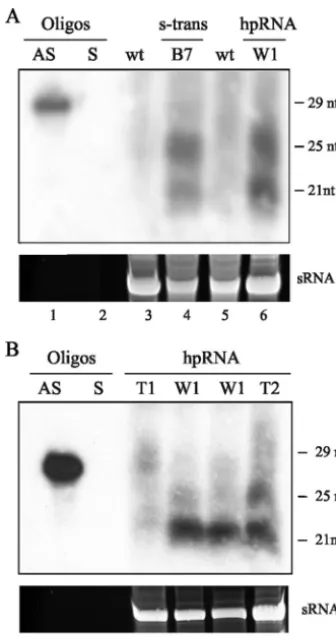
21-nt long, which are differentially accumulated during the vegetative cycle (18). These two classes of siRNAs may be specific to sense transgene-induced silencing and may be gen-erated via a different pathway from canonical RNA silencing, since, to date, no genetic evidence has been provided to show that RNA-silencing proteins (such as Dicer, Argonaute, or RdRP), actually participate in the sense transgene-induced gene-silencing pathway inM. circinelloides. To verify that gene silencing induced by hpRNA-expressing plasmids is also asso-ciated with two different size classes of siRNA, samples of low-molecular-weight RNAs were isolated from albino trans-formants of the wild-type strain harboring sense or inverted-repeat transgenes. RNA blot hybridization with acarB anti-sense-specific riboprobe indicated that hpRNA-triggered silenced strains were able to accumulate the two size classes of antisense RNAs, as did the wild-type strain transformed with sense transgenes (Fig. 2A, lanes 4 and 6). These results indi-cate that accumulation of two size classes of siRNAs does not depend on the silencing trigger but is a specific feature of the
M. circinelloidessilencing mechanism.
Previous results had indicated that gene silencing triggered by self-replicative sense transgenes was not impaired in the
dcl-1⫺strain MU406, which has a null mutation in adicer-like
1 gene (19). To investigate whether this mutant was able to silence gene expression using hpRNA as a trigger, plasmid pMAT1253 was introduced into MU406 and the color pheno-types of transformants were scored. As a control, plasmid pMAT647 (18), which expresses a sense carB transgene, in-cluding the complete genomic sequence and promoter region, was also used (Table 2). The results indicated that silencing efficiency in thedcl-1⫺mutant was identical to that of the wild-type strain, regardless of the construct used as a silencing trigger. The stability of the silenced phenotype in thedcl-1⫺ genetic background after a cycle of vegetative growth was also similar to that in the wild-type strain, as was the accumulation of the two size classes of antisense siRNAs (data not shown). These results confirm thatdcl-1⫺mutants are silencing com-petent and suggest that thedcl-1gene is not essential to the silencing mechanism triggered by sense transgenes or inverted-repeat transgenes.
Cloning anM. circinelloides dcl-2gene.Thedcl-1gene is not required for the biogenesis of siRNAs, sincedcl-1⫺mutants are perfectly able to produce the 25-nt and 21-nt siRNAs associated with gene silencing inM. circinelloides(19). These
FIG. 2. siRNA production in hpRNA-induced gene silencing. (A) Northern blot analysis of low-molecular-weight RNAs (50g) isolated from the wild-type strain R7B (lanes 3 and 5), a silenced albino transformant obtained by introduction of the sense transgene (s-trans) expressing plasmid pMAT647 into the wild-type strain (trans-formant B7; lane 4), and a silenced albino trans(trans-formant obtained by introduction of the hpRNA-expressing plasmid pMAT1253 into the wild-type strain (transformant W1; lane 6). The cultures were grown for 24 h in liquid medium under continuous-illumination conditions. Oligos, oligonucleotides; AS, antisense; S, sense; wt, wild type. (B) Production of siRNAs in thedcl-2⫺genetic background. Northern blot analysis of low-molecular-weight RNAs (50 g) isolated from cultures grown for 24 h in liquid medium from transformants of the
dcl-2⫺mutant (transformant T1; lane 3) or the wild-type strain (trans-formant W1; lane 4) carrying the hpRNA-expressing transgene pMAT1253. Analysis of otherdcl-2⫺ transformants gave the same results. To detect siRNAs in thedcl-2⫺genetic background, cultures of one of the 15dcl-2⫺transformants with a partially silenced phenotype (T2) and a wild-type silenced strain (W1) were grown for 48 h in solid minimal medium pH 3.2 (lanes 5 and 6). Ten picomoles per lane of 29-mer DNA oligonucleotide in antisense orientation (AS; lane 1) and 25-mer DNA oligonucleotide in sense orientation (S; lane 2) were used as size markers and to control the hybridization specificity. The RNA blot was hybridized with a hydrolyzedcarB antisense-specific ribo-probe, which corresponded to a 1,662-bp DNA fragment of thecarB
sequence that extends from position⫹863 to the end of thecarBgene (18). The predominant RNA species in the small-RNA samples (sRNA) were stained with ethidium bromide after size separation by agarose gel electrophoresis.
TABLE 2. Gene silencing by hpRNA-expressing constructs indcl-1⫺mutantsa
Plasmidb Strain
No. of transformants Silencing
frequency (%) Albino Wild
type Total
pMAT1253 (hpRNA) wtc 543 96 639 85.1
dcl-1⫺ 544 82 626 86.9
pMAT647 (s-transgene) wt 26 489 515 5.0
dcl-1⫺ 93 1,513 1,606 5.7
a
The colors of the transformants were observed after 48 h under illumination with white light.
b
hpRNA, construct expressing hpRNA; s-transgene, construct expressing the sense transgene.
c
wt, wild type.
on September 8, 2020 by guest
http://ec.asm.org/
results imply that at least one additionaldicergene would have to exist inM. circinelloidesto produce the siRNA molecules. A
dcl-2 gene was cloned by screening a genomic
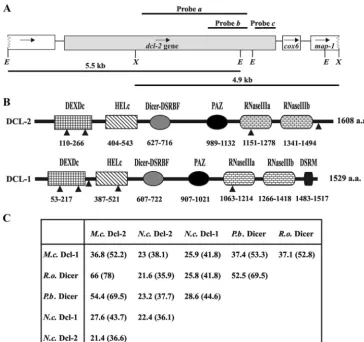
Lambda-GEM-11 library of the wild-type strain ofM. circinelloideswith three different probes, a 2.5-kb fragment of the dcl-1 gene corresponding to the HELc-RNase III domains (Fig. 3A, probea), an 880-bp fragment ofdcl-2amplified with degener-ate oligonucleotides (Fig. 3A, probeb), and a 480-bp fragment
ofdcl-2obtained in a 3⬘-RACE experiment (Fig. 3A, probec)
(see Materials and Methods). A nucleotide sequence of 7,941 bp was obtained by sequencing the two DNA strands of the 5.5-kb EcoRI and 4.9-kb XhoI fragments isolated from positive lambda clones (Fig. 3A). This sequence included the complete 5,073-bp structural region of thedcl-2gene and located the polyadenylation site 23 bp downstream of the AAUAAA poly-adenylation sequence found 71 bp downstream of the stop codon. This gene was flanked downstream by a highly
con-served sequence corresponding to the cytochromec oxidase chain VI precursor (COX6gene), followed by a sequence similar to that of the map-1 gene of N. crassa (accession number AF323912), which encodes an ATP-dependent Zn protease that belongs to the AAA superfamily of ATPases. The same genomic structure is found downstream of the singledicer-like sequence of
P. blakesleeanus, which has recently been made available (http:
//genome.jgi-psf.org/Phybl1/Phybl1.home.html), and the com-pletedicer-like sequence ofR. oryzae, which denotes a high degree of synteny among zygomycete fungi in this region. The sequence upstream of the predicted ATG initiation codon of theM.
cir-cinelloides dcl-2 gene contains pyrimidine-rich tracks that are
common to many fungal promoters (7). This region has been involved in the correct initiation of transcription in someA. nidu-lanspromoters (23).
Comparison of thedcl-2cDNA and the genomic sequence identified four introns in the gene (Fig. 3B). The protein
se-FIG. 3. Isolation of thedcl-2gene. (A) Schematic representation of thedcl-2genomic region. The probes used in the screening of the genomic library are shown above the scheme. Probeacorresponds to adcl-1sequence. Probesbandc correspond todcl-2. The arrows indicate the directions of transcription. Only relevant restriction sites are indicated. E, EcoRI; X, XhoI. (B) Domain organization of the Dcl-2 protein. Dicer domains are shown by boxes with the starting and stopping amino acid (a.a.) of each domain indicated. For comparison, the domain organization of the Dcl-1 protein is included. The black bars correspond to the full protein sequences. DEXDc, DEAD-like helicase superfamily domain; HELc, helicase C domain; Dicer-DSRBF, a dsRNA-binding domain found in members of the Dicer family; PAZ, Piwi/Argonaut/Zwille domain; RNase III a and b, dsRNA-specific endonuclease domains; DSRM, dsRNA-binding motif. The arrowheads indicate the positions of introns. (C) Identity and similarity (in parentheses) between the deduced amino acid sequences ofM. circinelloidesDcl-2 and other Dicer proteins.M.c.,M. circinelloides
(Dcl-1, accession no. AM269947); R.o., R. oryzae (http://www.broad.mit.edu/annotation/genome/rhizopus_oryzae/Home.html; protein ID, RO3G_15434.3);P.b.,P. blakesleeanus(http://genome.jgi-psf.org/Phybl1/Phybl1.home.html; protein ID, 24670);N.c.,N. crassa(Dcl-1, accession no. Q7S8J7; Dcl-2, accession no. Q7SCC1).
on September 8, 2020 by guest
http://ec.asm.org/
quence deduced from the dcl-2 gene contains 1,608 amino acids, and its analysis revealed the presence of all the structural domains normally found in Dicer proteins, including two he-licase domains (DEXDc-DEAD-DEAH and HELc) at the N terminus of the protein, a Dicer-specific dsRNA-binding do-main (Dicer-DSRBF), a PAZ dodo-main, and two RNase III domains. The C-terminal end of the protein contains a se-quence similar to that found in the same region of the M.
circinelloidesDcl-1 protein, where a canonical dsRNA-binding
domain (DSRM) was detected. However, all the computer programs tested failed to identify such a domain at the C-terminal end of the Dcl-2 protein (Fig. 3B). The predicted protein sequence ofM. circinelloidesDcl-2 showed a high de-gree of similarity to the Dicer-like proteins of zygomycete and, to a lesser extent, ascomycete fungi (Fig. 3C). Among these proteins, the similarity to the complete Dicer-like protein ofR.
oryzae(78% similarity) was much higher than that observed to
theM. circinelloidesparalogous protein, Dcl-1 (52.2%
similar-ity). The high similarity amongM. circinelloidesDcl-2 and the
P. blakesleeanusandR. oryzaeputative Dicer proteins, together
with the analogous sequence organization found among the corresponding genomic regions, suggests that the dicer-like sequences ofPhycomycesandRhizopus correspond to theM.
circinelloides dcl-2gene.
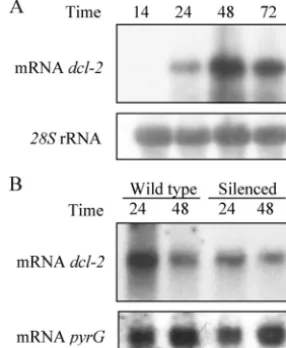
Expression analysis of the M. circinelloides dcl-2 gene. In order to analyze the expression pattern of thedcl-2gene dur-ing vegetative growth and the response of this expression to the induction of the silencing mechanism, the transcript abun-dance of the corresponding mRNA was determined by North-ern blot experiments. Total RNA was isolated from the wild-type strain MU241 grown for different periods of time in minimal liquid medium. Hybridization with a dcl-2-specific probe corresponding to a 2.5-kb XhoI-EcoRI fragment iden-tified a 5-kb transcript that matched the expected size of the
dcl-2mRNA (Fig. 4A). The amount of transcripts increased
during the vegetative cycle, with maximum accumulation after 48 h of growth, when the liquid cultures reached the end of the exponential phase. Accumulation of thedcl-2mRNA at early times in vegetative growth (14 h) was observed when cultures were grown in complete medium or after overexposure of the membranes (data not shown).
To investigate whether expression of the dcl-2 gene was regulated by activation of the silencing mechanism, Northern blot experiments were carried out using total-RNA samples isolated from solid cultures of the wild-type strain and a si-lenced transformant obtained with plasmid pMAT1253, which expresses acarBhpRNA (Fig. 4B). The expression of thedcl-2 gene was unaffected by the presence of an active silencing mechanism, since the levels of transcripts detected with the
dcl-2-specific probe were similar in wild-type and silenced
strains. This result suggests that induction of the silencing mechanism is not required for expression of the dcl-2gene. Differences in the mRNA accumulation patterns of the wild-type and silenced strains with respect to the data shown in Fig. 4A were due to the different growth profiles ofM. circinelloides in liquid and solid media.
Generation of knockout mutants for the dcl-2gene.To in-vestigate the role of thedcl-2gene in the silencing mechanism, a knockout vector, named pMAT1218, was designed to disrupt the gene. A 7-kb EcoRI fragment from this plasmid, containing
the pyrG gene and sufficient sequences of thedcl-2 gene to allow homologous recombination (see Materials and Methods for details), was used to transform the MU402 strain. Integra-tion of this fragment by homologous recombinaIntegra-tion into the
dcl-2locus was expected to result in the replacement of 1.71 kb
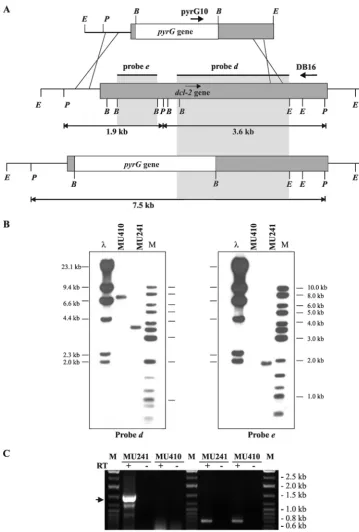
of the endogenousdcl-2gene by thepyrGgene (Fig. 5). One out of 14 homokaryotic transformants PCR analyzed to distin-guish between homologous and ectopic integration amplified the expected 4-kb fragment. Disruption of thedcl-2gene in this strain, named MU410, was confirmed by Southern analysis. Hybridization of digested DNA from MU410 with a dcl-2 probe that recognized the wild-type and the disrupted dcl-2 alleles but could discriminate between them (Fig. 5A, probed) and with a probe corresponding to the DNA region deleted in the knockout vector (Fig. 5A, probee) showed the expected fragments, indicating that thedcl-2wild-type allele had been successfully replaced (Fig. 5B). Since the knockout mutant maintained the 3⬘region of thedcl-2gene downstream of the pyrGsequence, an RT-PCR experiment was performed to con-firm that the disrupted gene could not generate a fusion pro-tein containing a catalytic RNase III domain. Unsurprisingly, primers flanking the RNase III domains were able to amplify
dcl-2-specific transcripts in the wild-type strain, but not in the
MU410dcl-2⫺mutant (Fig. 5C), whilepyrG-specific primers, used as controls, amplifiedpyrGtranscripts in both thedcl-2⫺ and wild-type strains. These results demonstrate that the dis-rupted mutant was unable to synthesize a Dicer protein frag-ment with RNase III activity, confirming the loss of function of
thedcl-2⫺mutant.
FIG. 4. Expression of thedcl-2gene. (A) Northern blot analysis of total RNA (20g) isolated from the wild-type strain MU241 grown for different times (hours) in liquid minimal medium under continuous illumination. The filter was hybridized with a 2.5-kbdcl-2fragment corresponding to the central region of the gene. The membrane was reprobed with a 28S rRNA probe to check loading. (B) Northern blot analysis of total RNA (20g) isolated from the wild-type strain R7B transformed with the control plasmid pLEU4 (leuA⫹) and a carB
silenced transformant harboring plasmid pMAT1253 (carB leuA⫹) grown for different times (hours) in solid minimal medium under continuous illumination. The filter was hybridized with the same probe as for panel A. The membrane was reprobed with a 1.5-kb BamHI-SalI fragment of thepyrGgene to check loading.
on September 8, 2020 by guest
http://ec.asm.org/
FIG. 5. Disruption of thedcl-2gene. (A) Schematic representation of the wild-typedcl-2locus (middle) and after homologous recombination with the disruption fragment (below). Dark-gray boxes, genomicdcl-2loci; white boxes,pyrGselectable markers. The positions of the probes used and the expected sizes of the PstI restriction fragments are indicated.P, PstI;E, EcoRI;B, BamHI. The primers used to identify homologous integration events are shown (pyrG10 and DB16). (B) Southern blot analysis of thedcl-2⫹strain MU241 and thedcl-2⫺mutant MU410. Genomic DNA (1g) was digested with PstI and hybridized with probed, which corresponds to a 2.5-kb XhoI-EcoRI fragment of thedcl-2coding region (left), and with probee, a 1.2-kb BamHI fragment isolated from plasmid pMAT1208 (right). The positions and sizes of the-HindIII () and the GeneRuler DNA ladder mixture (M) (Fermentas) size markers are indicated. (C) RT-PCR analysis ofdcl-2expression in thedcl-2⫺mutant. Total RNA isolated from the wild-type strain MU241 and thedcl-2⫺mutant MU410 was retrotranscribed using an oligo(dT) primer and amplified with primers corresponding todcl-2sequences flanking the RNase III catalytic domains (left side). The arrow marks the size of the expected fragment. As a positive control,pyrG-specific primers were used to amplifypyrGtranscripts (right side). Total RNA without RT was used as a negative control. M, GeneRuler DNA ladder mixture (Fermentas).
on September 8, 2020 by guest
http://ec.asm.org/
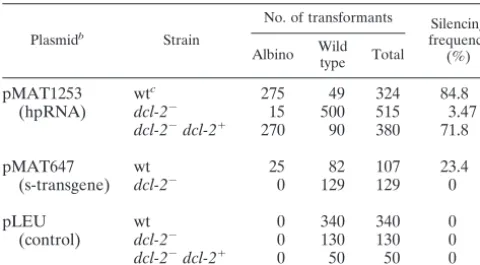
The dcl-2 gene is essential for efficient gene silencing. To investigate the involvement ofdcl-2in transgene-induced gene silencing, mutant MU410 (dcl-2⫺ pyrG⫹ leuA⫺) was trans-formed with plasmids pMAT1253, which produces a carB hpRNA upon transcription, and pMAT647 (19), which carries a sensecarBtransgene, and the frequency of albino transfor-mants was compared with that in the wild-type strain. Trans-formation of the strain R7B (dcl-2⫹pyrG⫹leuA⫺) with these self-replicative plasmids caused silencing of thecarBfunction in a high proportion of the transformants (Table 3). However, the frequency of albino transformants was severely impaired in
thedcl-2⫺mutant, in which only a few colonies with patches of
partially silenced phenotype were obtained when the hpRNA-expressing transgene was used as a silencing trigger. The sta-bility of the silenced phenotype in thedcl-2⫺ genetic back-ground was also affected, as seen from a comparison with the type strain. Whereas 100% of the descendants of wild-type silenced colonies obtained with the hairpin transgene maintained the albino phenotype after a cycle of vegetative growth, only 10% of the colonies derived from the silenced
dcl-2⫺mutant showed an albino phenotype. This indicates that
the residual silencing activity shown by thedcl-2⫺mutant was not sufficient to maintain a silenced phenotype and highlights the need for thedcl-2gene in transgene-induced gene silencing.
The phenotype shown by the MU410 mutant was exclusively due to the absence of the dcl-2 gene, as was confirmed by transformation of thedcl-2 null mutant with a plasmid con-taining a dcl-2 wild-type allele and analysis of the silencing efficiency of the resultant strain. This strategy required induc-tion of apyrG⫺mutation in the MU410 genetic background, since two distinct auxotrophic markers were needed, one for introduction of thedcl-2wild-type allele and the other one for introduction of silencing vectors. Seven independent uracil auxotroph strains (pyrG⫺) were derived from the MU410 mu-tant. As a control, one of them was transformed with plasmid pMAT1330, which contained the inverted-repeatcarB trans-gene and thepyrG⫹selective marker, to confirm its silencing phenotype. In fact, none of the 50 transformants analyzed showed an albino phenotype. ThispyrG⫺derivative of MU410
was then transformed with plasmid pMAT1223, which contains a complete version of the wild-typedcl-2gene and thepyrG gene as the selectable marker. To investigate the silencing efficiency of thedcl-2⫺dcl-2⫹transformants, one of them was further transformed with the silencing plasmid pMAT1253, which contains theleuAgene as a selectable marker and ex-presses acarBhpRNA. The silencing frequency and the sta-bility of the albino phenotype of thedcl-2⫺dcl-2⫹strain were similar to those obtained in the wild-type strain (Table 3), indicating that the wild-typedcl-2 allele fully complemented the mutant phenotype of the MU410 strain. Similar results were obtained when different pyrG⫺ derivatives of MU410 were used, the small differences observed in the silencing fre-quency being due to differences in the plasmid copy numbers of the analyzed transformants (data not shown).
Disruption ofdcl-2impaired dsRNA dicing.To determine the biochemical role of Dcl-2 in the RNA-silencing pathway, the ability of thedcl-2⫺mutant to accumulate the two classes of siRNAs described inM. circinelloides(18) was tested. Sam-ples of low-molecular-weight RNAs were isolated from trans-formants expressing the hpRNA, in a wild-type ordcl-2⫺ ge-netic background, after being grown for 24 h in liquid culture. RNA blot hybridization with a carB antisense-specific RNA probe detected the accumulation of siRNAs in the wild-type transformant (W1), but neither of the two size classes of siRNA was identified in adcl-2⫺transformant (T1) (Fig. 2B, lanes 3 and 4). This is consistent with the idea thatdcl-2plays a pivotal role in the transgene-induced silencing mechanism and that it is required for efficient siRNA production. How-ever, the partially silenced phenotype shown by a reduced number ofdcl-2⫺transformants must require some amount of siRNAs, the effector molecules of the silencing mechanism. Therefore, we carefully examined siRNA accumulation in the 15 partially silenced dcl-2⫺ transformants (Table 3), which presented patches of albino and wild-type phenotypes. Due to the instability of the silenced phenotype in thedcl-2⫺genetic background, it was impossible to obtain albino mycelia from those transformants when they were grown for 24 h in liquid medium. To circumvent this problem, small albino patches of each transformant were transferred to solid YNB medium, pH 3.2, and grown for 48 h. Under these conditions, the expansion of the colonies was reduced and the stability of the silenced phenotype increased (our unpublished results). After growth, only one of the 15 partially silenced transformants gave rise to enough albino mycelium for Northern analysis. Overloading low-molecular-weight RNA samples isolated from that myce-lium allowed us to detect the two size classes of siRNAs in the
dcl-2⫺transformant (T2) (Fig. 2B, lane 6). As a control,
small-RNA samples of an albino transformant of the wild-type strain grown under the same conditions were used (Fig. 2B, lane 5). Differences in the accumulation of the two size classes of siRNAs between the wild-type anddcl-2⫺transformants were probably due to growth differences of the cultures, since the two classes of siRNA are differentially accumulated during the vegetative growth of the silenced transformants, with the 21-nt class being predominant at the end of vegetative growth (18). The results described above strongly suggest that the Dcl-2 protein is required for efficient dsRNA dicing in the RNA-silencing pathway. They also indicate that a residual dicing activity is present in a dcl-2⫺genetic background. Since we
TABLE 3. Gene silencing by self-replicative sense and inverted-repeat transgenes in thedcl-2⫺mutant MU410 and a MU410
transformant carrying a wild-type allele ofdcl-2a
Plasmidb
Strain
No. of transformants Silencing
frequency (%) Albino Wild
type Total
pMAT1253 (hpRNA)
wtc 275 49 324 84.8
dcl-2⫺ 15 500 515 3.47
dcl-2⫺dcl-2⫹ 270 90 380 71.8
pMAT647 (s-transgene)
wt 25 82 107 23.4
dcl-2⫺ 0 129 129 0
pLEU (control)
wt 0 340 340 0
dcl-2⫺ 0 130 130 0
dcl-2⫺dcl-2⫹ 0 50 50 0
a
The colors of the transformants were observed after 48 h under illumination with white light.
b
hpRNA, construct expressing hpRNA; s-transgene, construct expressing the sense transgene.
c
wt, wild type.
on September 8, 2020 by guest
http://ec.asm.org/
pMAT661, which was designed to disrupt thedcl-1gene (19). The fragment contained the pyrG gene of M. circinelloides flanked by 1.8 kb and 0.76 kb of thedcl-1gene, and its inte-gration by homologous recombination provoked replacement of thedcl-1sequence by thepyrGgene. However, all thepyrG⫺ derivatives of MU410 spontaneously reverted to the PyrG⫹ phenotype with a frequency higher than that of homologous recombination. These strains contain two mutant copies of the pyrGgene, one at its endogenous locus and the other at the
dcl-2locus, which can generate a wild-typepyrGsequence by
gene conversion or homologous recombination. Whatever the case, PCR analysis of 138 stable PyrG⫹transformants obtained in different transformation experiments indicated no integra-tion of thepyrGgene in thedcl-1locus.
To check whether the difficulty of obtaining a doubledcl-1⫺
dcl-2⫺mutant was due to the lethality of this condition, we
tried a different approach and searched for a double mutant using thedcl-2⫺mutant MU410 (dcl-2⫺leuA⫺) as the recipi-ent strain and generating a knockout mutation at the dcl-1 locus by disruption with theleuA⫹gene. This strategy provided a strain that did not retain any auxotrophic marker, which meant that it could not be used as a recipient of silencing vectors to investigate silencing efficiency. To generate such a strain, a 7.2-kb SacI fragment isolated from plasmid pMAT1228 was used to transform MU410. The disruption fragment contained theleuAgene ofM. circinelloidesflanked by 1.3 kb and 1.5 kb of thedcl-1genomic region. Five LeuA⫹ transformants showing more than 35% leuA⫹ spores were PCR analyzed to detect homologous recombination at the
dcl-1locus. One of the homokaryotic transformants amplified
the expected 1.9-kb fragment and was subjected to Southern analysis to confirm the correct disruption of thedcl-1gene (see Fig. S1 in the supplemental material). The results indicated that the dcl-1 gene in this strain, named MU411, had been successfully disrupted and demonstrated that the double
dcl-1⫺dcl-2⫺mutation is not lethal.
One uracil auxotroph derivative (pyrG⫺) obtained from the double mutant MU411 was used as the recipient in transforma-tion experiments with the silencing vector pMAT1330, which con-tains the inverted-repeatcarBtransgene and thepyrG⫹selective marker. ThepyrG⫺strain showed a high rate of spontaneous reversion to the PyrG⫹phenotype, as described above for the pyrG⫺ derivatives of thedcl-2⫺mutant MU410. However, we were able to analyze the phenotypes of 137 pMAT1330-contain-ing transformants, none of which showed a silencpMAT1330-contain-ing phenotype, suggesting that the silencing mechanism was completely blocked in the doubledcl-1⫺dcl-2⫺mutant.
Impaired asexual sporulation indcl-2mutants.We investi-gated whether, apart from its resistance to gene silencing, the
dcl-2⫺mutant showed any major phenotypic changes during
veg-etative growth with respect to the wild-type strain. The growth rate was similar to that of the wild type, as was its hyphal mor-phology. However, a reduction in spore production was consis-tently detected in thedcl-2⫺genetic background. To quantify the defective phenotype for sporulation of thedcl-2⫺mutant, spores from wild-type and MU410 mycelia (n⫽ 10) grown on MMC plates under dark or light conditions were harvested and counted (Fig. 6A). Sporulation in the dcl-2⫺mutant was stimulated by light, as occurs in the wild-type strain (20). However, the results pointed to a significant difference in spore production between the two strains, since there was less than 0.001 probability (Stu-dentttest) that the average spore production of thedcl-2⫺ mu-tant and that of the wild-type strain would be identical. Similar results were obtained when the doubledcl-1⫺dcl-2⫺mutant was analyzed (Fig. 6B) (t⬍0.001), suggesting a role for thedcl-2gene in the control, direct or indirect, of asexual development inM.
circinelloides.
DISCUSSION
The canonical RNA-silencing mechanism is triggered by dsRNA molecules and results in the production, mediated by the Dicer proteins, of siRNAs of defined sizes, which act as
FIG. 6. Effect of thedcl-2⫺mutation on asexual-spore production. (A) Production of asexual spores in mycelia of the wild-type strain R7B (leuA⫺) and thedcl-2⫺ mutant MU410 (leuA⫺) grown under white light and dark conditions for 3 days. (B) Production of asexual spores in mycelia of the prototrophic wild-type strain MU241 and the
dcl-1⫺dcl-2⫺double mutant MU411 (leuA⫹) grown under the same conditions as for panel A. The values are means and standard errors of 10 independent measurements.
on September 8, 2020 by guest
http://ec.asm.org/
effectors for the suppression of gene expression. We demon-strated here that the gene-silencing phenomenon operating in
M. circinelloidesfollows a canonical mechanism with some
pe-culiarities, since it is efficiently activated by hpRNA, as occurs in other organisms, but is associated with the production of two size classes of antisense siRNAs, most probably generated by a single Dicer activity.
We had previously seen that thedcl-1gene is not required for the biogenesis of the siRNAs associated with sense trans-gene-induced gene silencing inM. circinelloides(19). Here, we showed that it is also not necessary for the silencing triggered by hpRNA-expressing plasmids, which implies the existence of at least one additionaldicergene. The demonstration that the silencing triggered by hpRNA or aberrant transgenic RNA is severely impaired indcl-2⫺mutants provides direct evidence of the pivotal role of Dcl-2 in the RNA-silencing pathway. Our findings contrast with results inN. crassa, where singledcl-1or
dcl-2mutants are perfectly able to silence gene expression (3),
pointing to the redundant functions of these proteins in vivo, even though theN. crassaDicer enzymes preferentially act in different silencing pathways (1, 30). The phenotype of theM.
circinelloides dcl-2⫺ strain resembles that of the D.
melano-gaster Dicer-2 mutants, which exhibit a large reduction in
hpRNA-derived siRNA accumulation in vivo, but not a com-plete loss (12). Similarly, residual Dicer activity could be de-tected in the M. circinelloides dcl-2⫺ mutant, although this activity is not sufficient to maintain the silenced phenotype. The residual activity is most probably due to the Dicer-1 pro-tein, since RNA silencing is completely abolished in the double
dcl-1⫺dcl-2⫺mutant, and the recent release of theM.
circinel-loides genome sequence by JGI (http://genome.jgi-psf.org
/Mucci1/Mucci1.home.html) reveals the absence of additional putativedicergenes.
Most of the transformants harboring hpRNA-expressing plasmids in adcl-2⫺genetic background do not show a silenced phenotype and do not accumulate any of the two different sizes of antisense siRNAs, suggesting that both siRNAs are gener-ated by the Dcl-2 activity. This is also the case with the asco-myceteM. oryzae, in which only one of the twodicergenes is involved in the production of different sizes of siRNAs (10). Only a small number ofM. circinelloides dcl-2⫺transformants exhibited a partially silenced phenotype, probably due to re-sidual Dicer activity of the Dicer-1 protein in thedcl-2⫺ mu-tant, and this activity is also able to produce small amounts of the two size classes of antisense siRNAs. Therefore, the situ-ation in a number of fungi seems to be divergent from that described in plants, where distinct Dicer enzymes are respon-sible for the generation of different-size siRNAs that act in different silencing pathways (38).
The unique spatial arrangement of the binding PAZ domain and the RNase III domains within Dicer suggests that it acts as a molecular ruler, generating siRNA products of defined lengths by anchoring the 3⬘end of the substrate dsRNA in the PAZ domain and cleaving it at a fixed distance from that end (13). Thus, differences in siRNA sizes may arise from intrinsic structural characteristics of the Dicer enzymes, although interaction of these enzymes with specific dsRNA-binding proteins may provoke slight differences in the sizes of the siRNA molecules (2). The re-sults discussed above suggest that a single Dicer enzyme is able to produce, directly or indirectly, two different sizes of antisense
siRNAs. We have tried to characterize the dicing activity of re-combinant Dcl-2 in vitro. However, the Dcl-2 protein expressed in insect cells failed to exhibit significant dicing activity toward dsRNA in vitro (our unpublished results), suggesting that the functional enzyme requires interaction with other proteins. Dcl-2 could form a complex with a dsRNA-binding protein that it is required for the RISC loading of small RNA in plants and ani-mals (24), and this interaction may result in the production of different sizes of siRNAs. However, taking into account that only 25-nt sense siRNAs are accumulated in silenced strains (18), we cannot rule out the possibility that the intrinsic dicing activity of Dcl-2 generates only the 25-nt duplex siRNA, with the antisense 21-nt class being produced by cutting 4 bp off the 25-nt antisense siRNA within the RISC. This unusual siRNA processing may require a very specific Dicer protein and, possibly, additional components, perhaps an exonuclease, such as theN. crassaQIP, which converts the duplex siRNA into single strands within the RISC by removing the passenger strand (14). No specific roles have been assigned to theM. circinelloides21-nt and 25-nt anti-sense siRNAs, although overaccumulation of the 21-nt class has been associated with an increase in silencing efficiency and sta-bility (21). This suggests a role for this siRNA class as effectors of silencing, taking part in the degradation of the target mRNA and thus contributing to the efficient induction and maintenance of silencing inM. circinelloides.
Our attempts to analyze the silencing efficiency of a double
dcl-1⫺dcl-2⫺mutant were hampered by the high frequency of
spontaneous PyrG⫹ reversion in strains carrying two mutated copies of thepyrGgene (pyrG⫺derivatives of the strains MU410 and MU411). Seven different pyrG⫺ mutants obtained from MU410 in independent mutagenesis experiments showed the same behavior, with the frequency of spontaneous reversion rang-ing between 1.28⫻10⫺7and 4.68⫻10⫺7spores. This indicates that the observed reversion is not related to a particularpyrG⫺ mutation. The high frequency of reversion is probably a conse-quence of gene conversion events occurring between the dupli-cated copies of the pyrGsequence. A high frequency of gene conversion has been described in the zygomycete R. oryzae, a fungus closely related toM. circinelloides, in which the integration of linearized plasmids is typically associated with gene conversion or the replacement of the selectable marker (15, 33). Gene con-version among homologous unlinked sequences is more than 10 times more frequent than homologous recombination inR. oryzae (32), which supports the idea that repairing one of the nonfunc-tionalpyrGsequences in thepyrG⫺derivatives of strains MU410 and MU411 could account for the high frequency of spontaneous reversion in those strains.
Dicer and other enzymes with critical roles in the silencing mechanism have been described as being upregulated by long dsRNA inN. crassaas part of a dsRNA response (4). We inves-tigated the expression pattern of thedcl-2gene and found that its expression is very low at the beginning of the vegetative cycle and increases considerably during the exponential phase. The level of expression did not change in the silenced strains with respect to the nonsilenced strains, which indicates that induction of the silencing mechanism by hpRNA-producing transgenes is not nec-essary to activatedcl-2expression. This could be explained if the
dcl-2gene has a constitutive expression pattern as a consequence
of its role in the control of endogenous functions. In fact, we demonstrated here thatdcl-2⫺mutants show a significant