Beyond Birthday Secure Nonce-Based MAC
?Nilanjan Datta1, Avijit Dutta2, Mridul Nandi2 and Kan Yasuda3
1 Indian Institute of Technology, Kharagpur 2
Indian Statistical Institute, Kolkata
3
NTT Secure Platform Laboratories, NTT Corporation, Japan. nilanjan isi [email protected], [email protected],
[email protected], [email protected]
Abstract. At CRYPTO 2016, Cogliati and Seurin have proposed a highly secure nonce-based MAC called Encrypted Wegman-Carter with Davies-Meyer (EWCDM) construction, asEK2 EK1(N)⊕N⊕HKh(M)
for a nonce N and a message M. This construction achieves roughly 22n/3 bit MAC security with the assumption that E is a PRP secure
n-bit block cipher andHis an almost xor universaln-bit hash function. In this paper we propose Decrypted Wegman-Carter with Davies-Meyer (DWCDM) construction, which is structurally very similar to its pre-decessor EWCDM except that the outer encryption call is replaced by decryption. The biggest advantage ofDWCDM is that we can make a truly single key MAC: the two block cipher calls can use the same block cipher key K = K1 = K2. Moreover, we can derive the hash key as
Kh = EK(1), as long as |Kh|= n. Whether we use encryption or de-cryption in the outer layer makes a huge difference; using the dede-cryption instead enables us to apply an extended version of the mirror theory by Patarin to the security analysis of the construction. DWCDMis se-cure beyond the birthday bound, roughly up to 22n/3 MAC queries and 2nverification queries against nonce-respecting adversaries.DWCDM re-mains secure up to 2n/2 MAC queries and 2nverification queries against nonce-misusing adversaries.
Keywords: EDM, EWCDM, Mirror Theory, Extended Mirror Theory, H-Coefficient.
1
Introduction
Almost all symmetric-key cryptographic systems that use secret keys, includ-ing encryption, authentication and authenticated-encryption, are realized via Pseudo-Random Functions (PRFs). Therefore, the study of practical candidates of PRF is essential in providing solutions for the increasing use of cryptogra-phy in real-world applications. But unfortunately, very few PRFs are actually available in practice, and it is not easy to construct a sufficiently secure PRF.
?
As a result, Pseudo-Random Permutations (PRPs) or block ciphers, which are available in plenty [16, 20, 11, 10], replace the PRF and are deployed as building blocks for almost every cryptographic systems.
Although various block ciphers [16, 20, 11, 10] are available and can be as-sumed to be PRFs, such an assumption comes at the cost of security degrada-tion due to the PRF-PRP switch [6] which tells that a PRF can be replaced by a PRP up to quadratic degradation in security (often called “birthday bound security”). This loss of security is sometimes acceptable in practice if the block size of the cipher is large enough (e.g. AES-128). But with lightweight block ciphers with relatively small block sizes (e.g. 64-bit), whose number has grown tremendously in recent years (e.g. [10, 20, 11, 2, 1]), the quadratic security loss severly limits their applicability, and as a result it seems to be challenging to use these small ciphers in modern-day lightweight cryptography (e.g. Smart Card, RFID etc.).
In order to save these ciphers from obsolescence, various PRP-to-PRF con-structions have been proposed in recent years that guarantee higher security than the usual birthday bound security. Such constructions are often called BBB (Be-yond Birthday Bound)—i.e., security against more than 2n/2queries wherenis the block size of the underlying cipher. A popular BBB construction is the XOR of permutations [7, 23, 3, 28].
XOR of Permutations.Bellare et al. [7] suggested a way to construct a PRF from PRPs by taking the xor (more generally sum) of two independent PRPs.
XOREK1,EK2(x) =EK1(x)⊕EK2(x).
The construction was later analyzed by Lucks [23] and proved its security up to 22n/3 queries, wheren is the block size of the underlying PRP. Single-keyed variant of this construction was first analyzed by Bellare and Impagliazzo [3] and showed its security upto O(nq/2n) by using some advanced probability theory.
However, their proof was sketchy and hard to verify. Subsequently, a lot of efforts have been invested towards improving the bound of XOR construction and its single-keyed variant (even proving upto n-bit security) by Patarin as evident in [28, 32, 31], but the proof contains serious gaps. Later in FSE 2014, the result was generalized to the xor of three or more independent PRPs [13]. However, a verifiable n-bit security proof of XOR construction is later provided by Dai et al. [17] using chi-squared method. Although, the original proof contained a glitch, which was pointed out by Bhattacharya and Nandi [8], was later fixed in the full version of [17].
se-curity bound of CENCby analysing the PRF security bound of variable output length of xor of permutations using chi-squared method.
Though useful for encryption, the XOR construction does not seem to be directly usable for authentication. A problem for authentication is that we have to extend the domain size, so that the construction can authenticate long mes-sages. This can be done by hashing the message, but with theXORconstruction it seems that we need some subtle combination with a double-block hash function, as employed in PMAC Plus [33],1K-PMAC Plus[18] andLightMAC Plus [26]. Encrypted Davies-Meyer. The above problem with the XOR construction in authentication was solved by Cogliati and Seurin [14], who proposed a PRP-to-PRF conversion method, called Encrypted Davies-Meyer (EDM). TheEDM construction is defined as follows:
EDMEK1,EK2(x) =EK2(EK1(x)⊕x).
EDMuses two independent block-cipher keys and achievesO(q3/22n) security [14].
Soon after, Dai et al. [17] improved its bound to O(q4/23n) by applying chi-squared method. Concurrently, Mennink and Neves [24] proved its almost opti-mal security, i.e.O(2n/67n), using mirror theory technique.
As EDM requires two indepenent keys for the cipher calls, it would be in-teresting to see that whether BBB security holds for the single key setting of the construction, as mentioned by authors of [14]. Recently, Cogliati and Seurin answers the question in positive and proved its security uptoO(q/22n/3) [15], as originally conjectured by themselves [14].
Encrypted Wegman-Carter with Davies-Meyer.Following the construc-tion of EDM, Cogliati and Seurin extended the idea to construct EWCDM, a nonce-based BBB secure MAC, which is defined as follows:
EWCDMEK1,EK2,HKh(N, M) =EK2 EK1(N)⊕N⊕HK(M)
,
where N is the nonce and M is the message to be authenticated. Note that, EWCDMuses two independent block-cipher keys, K1 andK2, and also another independent hash-key Kh for the AXU hash function. 4 In this way, EDM
ob-viated the necessity of using double-block hash function that existed with the XORconstruction. It has been proved thatEWCDMis secure against all nonce-respecting MAC adversaries5 that make at most 22n/3 MAC queries and 2n
verification queries. Cogliati and Seurin also provedO(2n/2) security of the con-struction against nonce-misusing adversaries. Later, Mennink and Neves [24] proved itsn-bit PRF security using mirror theory in the nonce respecting setting and mentioned that the analysis straightforwardly generalizes to the analysis for unforgeability or for the nonce-misusing setting of the construction. The trick
4 An AXU hash function is a keyed hash function such that for any two distinct
messages, the probability, over a random draw of a hash key, of the hash differential being equal to a specific output is small.
5
involved in proving the optimal security of EWCDMis by replacing the last block cipher call with its inverse. This subtle change does not make any difference in the output distribution and as a bonus, it trivially allows one to express the output of the construction as a sum of two random permutations (or in general a bi-variate affine equation 6). It is only this feature which is captured by the
mirror theoryto derive the security bound of the construction.
Motivation behind This Work.Constructions with multiple secret keys nec-cessarily requires larger storage space for storing them, which is sometimes in-feasible for lightweight crypto devices like RFID, Smart Card etc. All popular MACs, includingCMAC[27] andHMAC[4], require only a single secret key. But most of the time reducing the number of keys without compromising the security is not a trivial task.
As evident from the definition of the construction, EWCDM requires three keys; two block cipher keysK1andK2and one hash keyKh. Thus, it is natural
to ask that whether one can achieve the similar security in the case of using less number of keys. Cogliati and Seurin [14] believed that BBB security should hold for single-keyedEWCDM(withK1=K2) but be likely cumbersome to prove. In fact, proving BBB security of single-keyedEDM, as mentioned earlier, is a highly complicated task as evident from [15] and it is not clear at all how to build on this result to prove the MAC security of EWCDMconstruction with K1 =K2. Moreover, Cogliati and Seurin, in their proof of single-keyedEDM[15], have also stated that
“For now, we have been unable to extend the current (already cumbersome) counting used for the proof of the single-permutation EDM construction to the more complicated case of single-key EWCDM.”
Thus, we expect that proving the MAC security of single-keyedEWCDMshould be a notably hard task and very likely require heavy mathematical tools like
Sum Capture Lemmaas already used for single-keyedEDM. This motivates us to design an another single-keyed, nonce-based MAC built from block ciphers (and a hash function) with BBB security that can be proven by a simpler approach.
Our Contribution.Our contribution in this paper is fourfold which we outline as follows:
• DWCDM:New Nonce-Based MAC.We proposeDecrypted Wegman-Carter with Davies-Meyer, in shortDWCDM, a nonce-based BBB secure MAC. The design philosophy of DWCDM is inspired from the trick used in [24] while proving the optimal security ofEWCDM. Recall that, in [24], authors replace the last block cipher call with its inverse so that the output of EWCDMcan be expressed as a sum of two independent PRPs. But the same trick does not work at the time of using the same block cipher key in the construction.
6 For two variables,P, Qandλ∈GF(2n) we call an equation of the formP⊕Q=λ,
This phenomenon triggers us to design a nonce based MAC, very similar toEWCDM, in which instead of using the encryption algorithm in the last block-cipher call, we use itsdecryptionalgorithm so that the output of the construction can be expressed as a sum of twoidenticalPRPs and hence the nameDecrypted Wegman-Carter with Davies-Meyer. The construction is
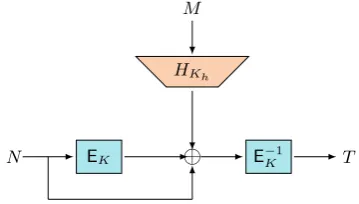
single-keyedin the sense that thesame block cipher keyis used for the two cipher calls. Schematic diagram of DWCDM is shown in Fig.4.1 where the last n/3 bits of the nonce N is zero, i.e. N =N∗k0n/3. We would like to mention here that one cannot use the fulln-bit nonce in DWCDM as that would end up with a birthday bound MAC attack which is described in sec-tion 4.1. We show thatDWCDMis secure up to 22n/3 MAC queries and 2n
verification queries against nonce-respecting adversaries. We also show that DWCDM is secure up to 2n/2 MAC queries and 2n verification queries in
the nonce-misuse setting, where the bound is tight. As a concrete example of DWCDM, we present an instantiation of DWCDM with the AXU hash function being realized via PolyHash [25]. We show thatnPolyMACachieves 22n/3-bit MAC security in the nonce-respecting setting.
• Extended Mirror Theory. Since, our study of interest is the MAC se-curity of the construction, we require to analyze the number of solutions of a system of affine bi-variate equations along withaffine uni-variate and bi-variate non-equations7. Such a general treatment of analysing system of affine equations with non-equations was only mentioned in [32] without giv-ing any formal analysis. To the best of our knowledge, this is the first time we analyse such a generic system of equations with non-equations, which we regard to asextended mirror theoryand our MAC security proofs ofDWCDM and1K-DWCDMare crucially based on this new result.
• 1K-DWCDM: “Pure” Single-Keyed Variant of DWCDM. Moreover, we exhibit a truly single-keyed nonce-based MAC construction,1K-DWCDM. Under the condition that the length of the hash key is equal to the block size as |Kh| = n, we can even derive the hash key as Kh = EK(0n−1k1),
which results in the construction1K-DWCDM. We prove that 1K-DWCDM is essentially as secure asDWCDM.
• Potentiality of Achieving Higher Security. Finally, we show how one can boost the security forDWCDM type constructions using extended generalized version of Mirror Theory.
Proof Approach. Our MAC security proof of DWCDM and 1K-DWCDM is fundamentally relied on Patarin’s H-coefficient technique [29]. Similar to the technique of [14, 19], we cast the unforgeability game of MAC to an equivalent indistinguishablity game, with some suitable choice of ideal world, that allows us to apply the H-coefficient technique for bounding the distinguishing advantage of the construction of our concern.
7 For two variables,P, Qandλ∈GF(2n)\0nwe callP⊕Q6=λ, an affine bi-variate
As mentioned earlier that one can express the output of DWCDM as a sum of two identical permutations. Thus,qmany such evaluations of DWCDMgives us a system ofq many affine bi-variate equations
EK(N1)⊕EK(T1) =N1⊕HKh(M1)
EK(N2)⊕EK(T2) =N2⊕HKh(M2)
.. .
EK(Nq)⊕EK(Tq) =Nq⊕HKh(Mq)
Along with this, we also need to ensure that the verification attempt of the adversary should fail (as a part of the good transcript), i.e. for a verification query (N0, M0, T0), chosen by the adversary, we should always have
E−K1(EK(N0)⊕N0⊕HKh(M
0))6=T0.
Hence, it tells us that we also need to incorporate affine non-equations along with the system of bi-variate affine equations. This leads us toextendthe mirror theory technique (extension as in incorporating affine non-equations along with affine bi-variate equations). We require the result of extended mirror theory while lower bounding the real interpolation probability for a good transcript.
Remark 1. We would like to point out that a possible alternative approach is to use the chi-square method, a recently discovered technique which has been reported in [16, 7, 8] for upper bounding the statistical distance between the an-swers of two interactive systems and is typically used to prove the information-theoretic pseudorandomness of constructions. It is interesting to observe that in some settings chi-square outperforms H-coefficient technique in terms of guar-ranting security with quadratic improvement on the number of queries that adversary can make [17]. However, it is difficult to apply this technique in our construction. The reason behind this difficulty is the lack of sufficient entropy of the conditional distribution when we condition on the hash key. The same holds true for the analysis of EWCDMas well. In fact, this negative phenomenon mo-tivates us to consider DWCDM so that we can represent the construction as a sum of permutations and eventually apply extended mirror theory.
2
Preliminaries
Symbols and Notations. For a set X, X←$X denotes that X is sampled uniformly at random from X and independent to all random variables defined so far. {0,1}n denotes the set of all binary strings of length n. The set of all
functions fromX toY is denoted asFunc(X,Y) and the set of all permutations overX is denoted asPerm(X).FuncX denotes the set of all functions fromX to
{0,1}nandPermdenotes the set of all permutations over{0,1}n. We often write
Funcinstead ofFuncX when the domain of the functions is understood from the
For any binary stringx,|x|denotes the length i.e. the number of bits inx. For x, y∈ {0,1}n, we writez=x⊕yto denote the modulo 2 addition ofxandy. We
write 0to denote the zero element of the field {0,1}n (i.e. 0n) and 1to denote
0n−1k1. For integers 1≤b≤a, we write (a)b to denotea(a−1). . .(a−b+ 1),
where (a)0= 1 by convention.
2.1 Security Definitions
PRF and PRP and SPRP. A keyed function with key space K, domain X and range Y is a functionF: K × X → Y and we denote F(K, X) by FK(X).
Similarly, a keyed permutation with key space K and domain X is a mapping E :K × X → X such that for all key K ∈ K, X 7→ E(K, X) is a permutation overX and we denoteEK(X) forE(K, X).
PRF. Given an oracle algorithm Awith oracle access to a function from X to Y, making at mostq queries, running time is at mostt and outputting a single bit. We define prf-advantage ofAagainst the family of keyed functionsFas
AdvPRFF (A) :=|Pr[K←$K:AFK = 1]−Pr[RF←$Func(X,Y) :ARF= 1]|.
We say that Fis (q, t, ) secure PRF, ifAdvPRFF (q, t) := max
A Adv
PRF
F (A)≤,
where the maximum is taken over all adversaries Athat makesqmany queries and running time is at mostt.
PRP. Given an oracle algorithm A with oracle access to a permutation of X, making at mostqqueries, running time is at mosttand outputting a single bit. We define prp-advantage ofAagainst the family of keyed permutationsEas
AdvPRPE (A) :=|Pr[K←$K:AEK = 1]−Pr[Π←$Perm(X) :AΠ= 1]|.
We say that Eis (q, t, ) secure PRP, if AdvPRPE (q, t) := max A Adv
PRP
E (A)≤,
where the maximum is taken over all adversaries Athat makesqmany queries and running time is at mostt.
SPRP. Given an oracle algorithm A with oracle access to a permutation and its inverse overX, making at mostq+ queries to permutation andq− queries to
inverse permutation, running time is at most t and outputting a single bit. We define sprp-advantage ofAagainst the family of keyed permutationsEas
AdvSPRPE (A) :=|Pr[K←$K:AEK,E −1
K = 1]−Pr[Π←$Perm(X) :AΠ,Π −1
= 1]|.
We say thatEis (q, t, ) secure SPRP, ifAdvSPRPE (q, t) := max
A Adv
SPRP
E (A)≤,
where the maximum is taken over all adversariesAthat makesqmany encryption and decryption queries altogether and running time is at mostt.
Definition 1 (Nonce Based MAC). Let K,N,M andT be four non-empty finite sets andF:K × N × M → T be a nonce based keyed function. ForK∈ K, letVerK be the verification oracle that takes as input (N, M, T)∈ N × M × T and outputs 1 if FK(N, M) = T, otherwise outputs 0. A (qm, qv, t) adversary against the MAC security of Fis an adversary A with access to two oraclesFK andVerK forK∈ K such that it makes at mostqm many MAC queries to first oracle and qv many verification queries to second oracle. We say thatA forges
Fif any of its queries to VerK returns 1. The advantage of Aagainst the MAC security ofFis defined as
AdvMACF (A) := Pr[K←$K:AFK,VerK forges],
where the probability is taken over the randomness of the underlying key and the random coin of adversary A(if any). We assume thatAdoes not make any verification query (N, M, T) to VerK if T is obtained in previous MAC query with input (N, M)and it does not repeat any query. We call such an adversary as “non-trivial” adversary. The adversary is said to be “nonce respecting” if it does not repeat nonces in its queries to the MAC oracle 8.
Regular And AXU Hash Function. We will need the following definition of regular, almost xor-universal (AXU) and 3-way regular property of a hash function.
(1) His said to be anregular hash function, if for anyX ∈ X and anyY ∈ Y,
Pr[Kh←$Kh:HKh(X) =Y]≤. (1)
(2) H is said to be an almost xor universal (AXU) hash function if for any distinctX, X0∈ X and for anyY ∈ Y,
Pr[Kh←$Kh:HKh(X)⊕HKh(X0) =Y]≤. (2)
(3) His said to be an3-way regular hash function if for any distinctX1, X2, , X3∈ X and for anynon-zero Y ∈ Y,
Pr[Kh←$Kh:HKh(X1)⊕HKh(X2)⊕HKh(X3) =Y]≤. (3)
In the following, we state that PolyHash [25] is one of the examples of algebraic hash function which is`/2n regular, AXU as well as 3-way regular hash function.
Proposition 1. Let Poly : {0,1}n ×({0,1}n)∗ → {0,1}n be a hash function defined as follows: For a fixed key Kh ∈ {0,1}n and for a fixed message M, we first apply an injective padding such as 10∗ i.e., pad1 followed by minimum number of zeros so that the total number of bits in the padded message becomes
8
mutiple of n. Let the padded message beM∗ =M1kM2k. . .kMl where for each
i,|Mi|=n. Then we define
PolyKh(M) =Ml·Kh⊕Ml−1·K
2
h⊕. . .⊕M1·K l
h, (4)
wherelis the number ofn-bit blocks. Then,Polyis`/2nregular, AXU and3-way regular hash function, where ` denotes the maximum number of message blocks of size n-bits.
Proof.For any three distinct messagesM, M0andM00,PolyK
h(M)⊕PolyKh(M
0)⊕
PolyK
h(M
00)⊕Y, whereY 6=0, is a polynomial ofK
h. Now, if the polynomial
PolyKh(M)⊕PolyKh(M0)⊕PolyKh(M00) reduces to a zero polynomial, which is possible by certain choices of M, M0 and M00 (e.g., M = M1kM2, M0 = (M1⊕M2)kM3 andM00 =M2k(M2⊕M3)), then we have, 3 = 0. Otherwise, PolyKh(M)⊕PolyKh(M0)⊕PolyKh(M00) is a non-zero polynomial and hence we have,3=`/2n, where`is the maximum number of message blocks among three messages. Similarly, it is easy to see thatPolyis a`/2n regular hash function as the maximum number of roots for the polynomial PolyKh(M)⊕Y is `.
More-over, for any two distinct messagesM andM0,PolyKh(M)⊕PolyKh(M
0)⊕Y is
a non-trivial polynomial ofKh with degree at most`, and hence the maximum
number of roots this can polynomial can have is `. Therefore, the AXU
advan-tage of Polyis`/2n. ut
3
Patarin’s Mirror Theory
Mirror theory, as defined in [32] is the theory of evaluating the number of solu-tions of affine system of equalities and non-equalities in a finite group. Patarin, who coined this theory, has given a lower bound on the number of solutions of a finite system of affine bi-variate equations using an inductive proof when the variables in the equations are wor samples [30]. The proof is tractable upto the order of 22n/3 security bound, but the proof becomes highly complex and too difficult to verify in the case of deriving the optimal security bound. In specific, once the first-order recursion is considered, one needs to consider a second-order recursion, and so on, until then-th recursion. For thei-th order recursion, there areO(2i) many cases and Patarin’s proof only addresses the first (and perhaps
the second) order recursion by a tedious analysis, but the cases of the higher-order ones are quite different, and it’s not at all clear how to bridge the gap, given an exponential number of cases that one has to consider. Moreover, to the best of our knowledge, the proof did not consider any affine non-equation as well.
becomes at least (2n)
3q/2/2nq. For the sake of presentation and interoperability with the results in the remainder of the paper, we use different parameterization and naming convention.
3.1 General Setting of Mirror Theory
Given a bi-variate affine equationP⊕Q=λ, the associated linear equation of this affine equation isP⊕Q= 0. Now, givenλ1, . . . , λq ∈GF(2n)\0which we
write as Λ = (λ1, . . . , λq), let us consider a system ofq many bi-variate affine
equations over GF(2n):
EΛ={Pn1⊕Pt1 =λ1, Pn2⊕Pt2 =λ2, . . . , Pnq⊕Ptq=λq}.
Given a functionφ:{n1, t1, . . . , nq, tq} → I, calledindex mapping function, we
associate another system of bi-variate affine equations:
EΛ,φ={Pφ(n1)⊕Pφ(t1)=λ1, Pφ(n2)⊕Pφ(t2)=λ2, . . . , Pφ(nq)⊕Pφ(tq)=λq}.
Let αdenotes the cardinality of the image set of φ. Then, EΛ,φ is a system of
bi-variate affine equations over αvariables. In our paper, a specific choice ofI would be{0,1}n.
Example.Consider a system of equations:
{P1⊕P2=λ1, P1⊕P3=λ2, P2⊕P4=λ3}.
Then, the index mapping function for the above system of equations isφ(n1) = 1, φ(t1) = 2, φ(n2) = 1, φ(t2) = 3, φ(n3) = 2, φ(t3) = 4. For this system of equationsα= 4.
Equation-Dependent Graph.For index mapping functionφ:{n1, t1, . . . , nq, tq} →
I, we associate a undirected graphGφ= ([q],S) where{i, j} ∈ S if
|{φ(ni), φ(ti)} ∩ {φ(nj), φ(tj)} | ≥1
or ifi=jandφ(ni) =φ(ti). We call such an edge aself-loop. In other words, we
introduce an edge between two equations (node represents the equation number) in the equation-dependent graph if the corresponding equations have at least one common unknown variable. Note that the set{φ(ni), φ(ti)}can be a multi-set.
For a subset{i1, . . . , ic} ⊆[q], let
{Pφ(ni1)⊕Pφ(ti1)= 0, Pφ(ni2)⊕Pφ(ti2)= 0, . . . , Pφ(nic)⊕Pφ(tic)= 0}
be the sub-system of associated linear equations. We say this sub-system of associated linear equations is linearly dependent if{i1, . . . , ic}is the minimal set
and all variablesPx, which appeared in the above sub-system, appears exactly
(i) c= 1: Self-loop.If there exists isuch thatφ(ni) =φ(ti).
(ii) c= 2: Parallel-edge.If there existsi6=j such that either:
(a)φ(ni) =φ(nj) andφ(ti) =φ(tj) or (b)φ(ni) =φ(tj) andφ(ti) =φ(nj).
(iii) c≥3: Alternating-cycle.If there exists distinct i1, i2, . . . , ic such that
for everyj∈[c] either
- φ(nij)∈ {φ(nij+1), φ(tij+1)} andφ(tij)∈ {φ(nij−1), φ(tij−1)}or - φ(tij)∈ {φ(nij+1), φ(tij+1)}andφ(nij)∈ {φ(nij−1), φ(tij−1)}.
When i = 1, i−1 is considered as c and when i = c, i+ 1 is considered as 1. We say that φ is dependentif any one of the above condition holds. Other-wise, we call it independent. Given an independentφ, the graph Gφ becomes a
simple graph and EΛ,φ becomes linearly independent. In this case, the number
of variables present in a connected component C ={i1, . . . , ic} ofGφ (i.e., the
size of the set {φ(ni1), φ(ti1), . . . , φ(nic), φ(tic)}) is exactly c+ 1. We call the
set {φ(ni1), φ(ti1), . . . , φ(nic), φ(tic)} a block. Theblock maximality, denoted by
ξmax, of an independentφis defined asζmax+1 whereζmaxis the size of the max-imum connected components of Gφ (Note that, a block withpmany elements
introduces p−1 many affine equations.).
Example. Suppose, E ={(1) P1⊕P2 =λ1,(2) P1⊕P3 =λ2,(3) P2⊕P4 = λ3,(4)P5⊕P6=λ4}, then we have two blocks{1,2,3,4}and{5,6}andξmax= 4. Observe that, we also have two connected components{1,2,3} and{4}and the size of the maximum connected componentζmax= 3 as depicted in Fig. 3.1 and ξmax=ζmax+ 1 = 4.
1
2
3 4
Fig. 3.1.Equation dependent graphG[E] comprised of two components; largest com-ponent size is 3.
3.2 Extended Mirror Theory
In this section, we introduce the extended Mirror theory technique by incor-porating two types of non-equations with a finite number of bi-variate affine equations. We consider (i) uni-variate affine non-equation of the form Xi 6=c
and (ii) bi-variate affine non-equation of the form Xi⊕Yi 6= c, where c is a
finite number of affine equations9and uni(bi-) variate affine non-equations. To begin with, let us investigate what happens when we introduce a single uni(bi-) variate affine non-equation with a finite number of affine equations.
LetE= be a system ofq many affine equations of the form
E=={P
n1⊕Pt1 =λ1, . . . , Pnq⊕Ptq=λq}. (5)
Let φ be an index mapping function that maps from {n1, t1, . . . , nq, tq} → I.
Let Λ== (λ1, λ2, . . . , λq), where eachλi∈GF(2n)\0. Now, for an independent
choice ofφ,E=
φ,Λ=is a linearly independent set ofqmany affine equations. LetE
6
=
be a system ofrmany bi-variate affine non-equations andv−rmany uni-variate affine non-equations of the form
E6== {P
nq+1⊕Ptq+16=λ
0
1, . . . , Pn(q+r)⊕Pt(q+r) 6=λ
0 r}
S{P
nq+r+16=λ
0
r+1, . . . , Pn(q+v) 6=λ
0 v}.
We denote Λ6= = (λ01, λ02, . . . , λ0v), where each λ0i ∈ GF(2
n)\ 0, and Λ0 =
(λ1, λ2, . . . , λq, λ01, λ02, . . . , λ0v). Now, for the system of affine equations and
non-equationsE:=E=∪ E6=, we consider the index mapping function
φ0:{n1, t1, . . . , nq, tq, nq+1, tq+1, . . . , nq+v, tq+v} → I.
Moreover, we denote φ := φ0|q to be the index mapping function that maps {n1, t1, . . . , nq, tq} → I and Λ=:= Λ0|q to be (λ1, λ2, . . . , λq).
Characterizing Good (φ0,Λ0).We say that a pair (φ0,Λ0) isgoodif
- (C1)φis independent and for all x6=y,Pφ(x)=Pφ(y) cannot be generated from the system of equationsE=
φ,Λ=.
- (C2) for all j∈[v] andi1, . . . , ic ∈[q], c≥0, such that {i1, . . . , ic, q+j} is
dependent system thenλi1⊕ · · · ⊕λic⊕λ
0 j 6=0.
In words, a good (φ0,Λ0) says that: (i) the system of equationEφ,Λ= is linearly independent system of equations and one cannot generate an equation of the form Pφ(x)=Pφ(y) by linearly combining the equation ofEφ,Λ=. Moreover, (ii) by linearly combining the equation ofEφ,Λ=, one cannot generate an equation of the formPx⊕Py =λx,y such thatPx⊕Py6=λx,y already exist inE6
=
φ0,Λ0. Summarizing above, we state and prove the following main theorem, which we call asExtended Mirror Theorem forξmax= 3. For the notational simplicity we assume the index setI = [α].
9
Theorem 1. Let(E=∪ E6=, φ0,Λ0)be a system ofqmany affine equations andv many uni(bi-) variate affine non-equations associated with index mapping func-tionφ0 overGF(2n) which are of the form
(a)Pφ(ni)⊕Pφ(ti)=λi(6=0), ∀i∈[q]
(b)Pφ(nj)⊕Pφ(tj)6=λ
0
j(6=0), ∀j∈[q+ 1, q+r]
(c)Pφ(nj)6=λ
00
j(6=0), ∀j∈[q+r+ 1, q+v]
over the set of α many unknown variables P ={P1, . . . , Pα} such thatPa may be equals to some Pφ(ni) or Pφ(ti), where a ∈ {φ(nj), φ(tj)}, j ∈ [q+ 1, q+v]. Now, if
- (i) (φ0,Λ0)is good and - (ii) ξmax= 3
then the number of solutions for P, denoted by h3q
2 such that Pi 6= Pj for all
distinct i, j∈ {1, . . . , α} is
h3q
2 ≥ (2n)3q
2 2nq
1−5q
3
22n −
v 2n
. (6)
An Overview of the Proof.We prove the result by induction on the number of blocks. Let us assume that we have exactlyumany blocks with total number of equations 2u and total number of variables 3u. Let us also assume that we have ω3u many uni-variate and bi-variate affine non equations and h3u be the
total number of solutions of such a system of affine equations and non-equations. Now, we introduce one more block that adds two new equations and three new variables with the existing set of equations and variables. We also consider an affine bi-variate non-equation such that one of its variables comes from the ex-isting 3umany variables and the other one comes from the newly introduced three variables. Moreover, we also consider an affine uni-variate non-equation such that the variable comes from the newly introduced three variables. Given we haveh3umany solutions, we calculate the number of solutions for the newly
introduced affine equations and non-equations such that the solution does not end up with any inconsistencies.
Proof. As mentioned, our proof is an inductive proof based on the number of blocks u. Our first observation is that as (φ0,Λ0) is good,φis independent and thusξmax=ζmax+ 1 and hence, the maximum number of variablesPi that can
reside in the same block is 3. For the simplicity of the proof, assume that we have exactly 3 variables at each blocks. Now, it is easy to see that Eqn. (6) holds whenu= 1.
As the next step of the proof, leth3ube the solutions for first 2umany affine
equations, which we denote asE=
2u. Now as soon as we add the (u+ 1)thblock,
we consider the following bi-variate affine equations
and those bi-variate affine non-equations which are of the form
Pσi⊕Pδi6=λ
0
i, whereσi∈ {1, . . . ,3u+ 3}, δi∈ {3u+ 1,3u+ 2,3u+ 3},
and also those uni-variate affine non-equations of the form
Pδi 6=λ
00
i, where δi∈ {3u+ 1,3u+ 2,3u+ 3}.
Let v0 and v00 be the number of such bi-variate and uni-variate affine non-equations. Now, note that each such bi-variate affine non-equation of the form Pσi ⊕Pδi 6= λ
0
i where σi ∈ {1, . . . ,3u+ 3}, δi ∈ {3u+ 1,3u+ 2,3u+ 3}
can be written as P3u+1 6= Pσi ⊕λ
?
i, where σi ∈ {1, . . . ,3u+ 3} and λ?i ∈
{λ0i, λ0i⊕λ2u+1, λ0i⊕λ2u+2}. Moreover, each such uni-variate affine non-equation of the form Pδi 6= λ
00
i where δi ∈ {3u+ 1,3u+ 2,3u+ 3} can be written as
P3u+16=λ??i , where λ??i ∈ {λi00, λ00i ⊕λ2u+1, λ00i ⊕λ2u+2}.
Nowh3u+3counts for the number of solutions to{P1, . . . , P3u, P3u+1, P3u+2, P3u+3} such that
- {P1, . . . , P3u}is a valid solution of E2=u.
- P3u+1⊕P3u+2=λ2u+1, P3u+1⊕P3u+3=λ2u+2.
- P3u+1 ∈ {/ P1, . . . , P3u, P1⊕λ2u+1, . . . , P3u⊕λ2u+1, P1⊕λ2u+2, . . . , P3u⊕
λ2u+2}.
- P3u+1∈ {/ Pσ1⊕λ
?
1, . . . , Pσv0 ⊕λ
? v0}. - P3u+1∈ {/ λ??1 , . . . , λ??v00}.
Let V1 = {P1, . . . , P3u}, V2 = {P1 ⊕λ2u+1, . . . , P3u ⊕λ2u+1}, V3 = {P1 ⊕ λ2u+2, . . . , P3u⊕λ2u+2},V4={Pσ1⊕λ
?
1, . . . , Pσv0⊕λ?v0}andV5={λ??1 , . . . , λ??v00}. Note that,|Vi|= 3u, i= 1,2,3 and|V4|=v0,|V5|=v00. Therefore, we can write
h3u+3=h3u(2n− |V1∪V2∪V3∪V4∪V5|)≥h3u(2n− |V1| − |V2| − |V3| − |V4| − |V5|)
≥h3u(2n−9u−v0−v00).
By applying repeated induction, we obtain
h3q
2 ≥
2n−9(q
2−1)−v
0−v00h
3(q2−1)≥. . .≥
q/2−1 Y
u=0
for which we have,
h3q
22
nq
(2n)3q
2 ≥
q/2−1 Y
u=0
22n(2n−9u−v0−v00)
(2n−3u)(2n−3u−1)(2n−3u−2)
≥
q/2−1 Y
u=0
22n(2n−9u−v0−v00)
23n−(9u+ 3)22n+ (27u2+ 18u+ 2)2n
[1] ≥
q/2−1 Y
u=0
1 + 3 2n −
27u2+ 18u+ 2
22n −
v0+v00 2n
!
[2] ≥
q/2−1 Y
u=0
1−27u 2
22n −
9u2 22n −
v0+v00 2n
! ≥
q/2−1 Y
u=0
1−36u 2
22n −
v0+v00 2n
!
≥ 1−
q/2−1 X
u=0 36u2
22n − q/2−1
X
u=0
v0+v00 2n
! [3]
≥ 1−5q 3
22n −
v 2n
!
where [1] follows from the assumptionsu≤2n/9, [2] follows as9u2 22n ≥
(18u+3) 22n −
3 2n
and [3] follows as
q/2−1 P
u=0
(v0+v00)≤v. ut
4
DWCDM
and Its Security Result
In this section, we discuss our proposed construction DWCDM and state its security in nonce respecting and nonce misuse setting. Let us recall theDWCDM construction:
DWCDM[E,E−1,H](N, M) :=EK−1(EK(N)⊕N⊕HKh(M))
where N = N∗k0n/3. EK is a n-bit block cipher and HKh is an 1 regular,
2 AXU and 3 3-way regular n-bit keyed hash function. A schematic diagram of DWCDM is shown in Fig.4.1. Note that, DWCDM is structurally similar to EWCDM, but unlike EWCDM, our construction uses the same block cipher key and the last block cipher call of EWCDMis replaced by its decryption function. Moreover,DWCDMcannot exploit the full nonce space likeEWCDM, otherwise its beyond birthday security will be compromised as explained below.
4.1 Why DWCDM Cannot Accommodate Full n-bit Nonce
As mentioned above, forDWCDM we need to reduce the nonce space to 2n/3-bits. If it uses the full nonce space then using a nonce respecting adversary A who set the tags as nonce repeatedly, can mount a birthday bound forging attack onDWCDMas follows:
N EK
⊕
E−K1 THKh
M
Fig. 4.1.Decrypted Wegman-Carter with Davies-Meyer Construction.
response of the previous (i−1)-th query, until the first time collision occurs (i.e. a responce matches with one of the previous responses). If the adversary makes uptoq ≈2n/2 queries, it gets a collision Ti =Tj with high probability.
Interestingly, if (j−i)10is even (which holds with probability 1/2), then
Tj =Ti iff (Ti+Ti+1+· · ·+Tj−1= 0).
Now, this property can be easily usedAto predictTi=Tjif it findsTi+Ti+1+ · · ·+Tj−1 = 0 for some i, j such that (j−i) is even. Thus, A can mount the following forging attack as shown in Figure 4.2.
MAC Adversary A
1. Take any arbitraryN andM; set T0←N.
2. for(j= 1;j≤q;j+ +) 3. Tj←DWCDM(Tj−1, M).
4. for(i=j−1;i≥0;i=i−2) 5. if((Ti+· · ·+Tj) = 0) 6. forge(Tj, M, Ti).
Fig. 4.2.Birthday bound MAC attack againstDWCDMif full nonce space is used.
However, if we restrict the nonce space to 2n/3 bits, then this attack doesn’t work because now using the tag as a valid nonce is a probabilistic event. Prob-ability that a tag is a valid nonce is 2−n/3. This restricts the adversary from forming a chain as used in the attack. In fact, if adversary makes 22n/3 many MAC queries then the expected number of tags whose lastn/3 bits are all zeros is 2n/3. Now, if adversary uses these 2n/3 tags as the nonces, then the expected number of tags whose last n/3 bits are zeros is 1 and then adversary cannot
10
proceed further. This phenomenon effectively invalidates the above attack to happen.
4.2 Nonce Respecting Security of DWCDM
In this section, we state thatDWCDM is secure up to 22n/3 MAC queries and 2n verification queries against nonce respecting adversaries. Formally, the
fol-lowing result bounds the MAC advantage of DWCDM against nonce respecting adversaries.
Theorem 2. Let M,K and Kh be finite and non-empty sets. Let E : K ×
{0,1}n→ {0,1}n be a block cipher andH:K
h× M → {0,1}n be an 1 regular,
2 AXU and 3 3-way regular and hash function. Then, the MAC advantage for any (qm, qv, t) nonce respecting adversary against DWCDM[E,E−1,H] is given by,
AdvMACDWCDM[E,E−1,H](qm, qv, t)≤AdvSPRPE (qm+qv, t0) +
2qm
22n/3 +qm1+ 2qm2
2n/3 + max{qv1,2qv2,2qv3,
qm
22n/3}+
(qm+qv)
2n +
5q3
m
22n, wheret0 =O(t+ (qm+qv)tH),tH be the time for computing the hash function. By assuming 1, 2, 3≈2−n andqm≤22n/3,DWCDM is secured up to roughly
qm≈22n/3 MAC queries andqv≈2n verification queries.
4.3 Nonce Misuse Security of DWCDM
Similar toEWCDM[14], one can prove thatDWCDM[E,E−1,H] is birthday bound secure MAC against nonce misuse adversaries. In particular,DWCDM is secure up to 2n/2 MAC queries and 2nverification queries against nonce misuse adver-saries and that the security bound is essentially tight. More formally, we have the following MAC security result of DWCDMin nonce misuse setting.
Theorem 3. LetM,K andKhbe finite and non-empty sets,E:K × {0,1}n→
{0,1}nbe a block cipher andH:K
h× M → {0,1}nbe an1regular and2 AXU
hash function. Then, the MAC security of DWCDM[E,E−1,H] in nonce misuse
setting is given by
AdvMACDWCDM(qm, qv, t)≤AdvSPRPE (qm+qv, t0) +q2m2+ 4q2
m
2n +qm1+
(qm+qv)
2n , wheret0=O(t+q(qm+qv)tH), tH be the time for computing hash function.
By assuming1≈2−nand2≈2−n,DWCDMis secure up to roughlyqm≈2n/2
MAC queries and qv ≈2n verification queries. For completeness of the paper,
Tightness of the Bound
We show that the above bound of DWCDMis tight by demonstrating a forging attack which shows thats roughly 2n/2 MAC queries are enough to break the MAC security of DWCDM when an adversary is allowed to repeat nonce only for once. The attack is as follows:
1. AdversaryAmakesqmany MAC queries (Ni, Mi) with distinct nonces where
a collision in the response, i.e.Ti=Tj for somei < j occurs.
2. Make a MAC query (Nj, Mi). LetTq+1be the response. 3. Forge with (Ni, Mj, Tq+1).
As Π(Tq+1) = Π(Ni)⊕Ni⊕HKh(Mj), (Ni, Mj, Tq+1) is a valid forgery. If we
makeq= 2n/2many queries, with very high probability, we will get a collision in step 1, and mount the attack. Note that, the attack does not exploit any specific properties of the hash function and a single time repitition of nonce makes the construction vulnerable above birthday bound security.
4.4 nPolyMAC: An Instantiation of DWCDM
In this section, we proposenPolyMAC, an algebraic hash function based instan-tiation of DWCDM, as defined in Eqn. (4), as the underlying hash function of DWCDM construction.
PolyHash [25] is one of the popular examples of algebraic hash function. For a hash key Kh and a for a fixed messageM, first we pad the messageM with
10∗ such that the number of bits in it becomes multiple of n. Let the padded message beM∗=M
1kM2k. . .kMlwhere for eachi,|Mi|=n. Then we define
PolyK
h(M) =Ml·Kh⊕Ml−1·K
2
h⊕. . .⊕M1·Khl,
wherel is the number ofn-bit blocks.
It has already been shown in Proposition 1 that Poly is`/2n 3-way and 1-way
regular hash function. Moreover, the AXU advantage of Polyis`/2n. Following these results, we show in the following thatnPolyMAC[Poly,E,E−1] is secure up to 22n/3 MAC and 2n verification queries against nonce respecting adversaries.
Theorem 4. Let K,Kh and M be three non-empty finite sets. Let E : K ×
{0,1}n → {0,1}n be a block cipher. Then, the MAC security of nPolyMAC in nonce respeting setting is given by
AdvMACnPolyMAC(qm, qv, t)≤AdvSPRPE (qm+qv, t0) +
11qm`
22n/3 + 3qv`
2n , wheret0=O(t+ (qm+qv)`),`be the maximum number of message blocks among all qqueries.
5
Proof of Theorem 2
In this section, we prove Theorem 2. We would like to note that we will often refer to the constructionDWCDM[E,E−1,H] as simplyDWCDMwhere the underlying primitives are assumed to be understood.
As the first step of the proof, we replaceEK andE−K1 with ann-bit uniform
ran-dom permutationΠand its inverseΠ−1respectively both in the MAC and veri-fication oracle of DWCDMand denote the construction asDWCDM∗[Π,Π−1,H]. This conversion will add a termAdvSPRPE (qm+qv, t0) where t0 =O(t+ (qm+
qv)tH) and hence one simply has
AdvMACDWCDM(qm, qv, t)≤AdvSPRPE (qm+qv, t0) +AdvMACDWCDM∗(qm, qv, t)
| {z }
δ∗
. (7)
Now, our goal is to upper boundδ∗. For doing this, we considerTG[Π,Π−1,H
Kh]
be the tag generation andVF[Π,Π−1,H
Kh] be the verification oracle ofDWCDM
∗
construction. We also consider that Rand be a perfect random oracle that on input (N, M) ∈ {0,1}n× M, returns T, sampled uniformly at random from
{0,1}n, whereasRej be an oracle with inputs (N, M, T), returns always ⊥(i.e.
rejects). Now, due to [14, 19] we write
δ∗:= max
D Pr[D
TG[Π,Π−1,HKh],VF[Π,Π−1,HKh] = 1]−Pr[DRand,Rej= 1],
where the maximum is taken over all non-trivial distinguishersD. This formula-tion allows us to apply the H-Coefficient Technique [29], as we explain in more detail below, to prove
δ∗≤ 2qm
22n/3+qm1+ 2qm2
2n/3 + max{qv1,2qv2,2qv3, qm
22n/3}+
(qm+qv)
2n +
5q3
m
22n.
(8) H-Coefficient Technique.From now on, we fix a non-trivial distinguisherD that interacts with either (1) the real oracle (TG[Π,Π−1,HKh],VF[Π,Π
−1,H
Kh])
for a random permutationΠ, its inverseΠ−1 and a random hashing key Kh or
(2) the ideal oracle (Rand,Rej) making at most qm queries to its left (MAC)
oracle and at mostqv queries to its right (verification) oracle, and outputting a
single bit. We let
Adv(D) = Pr[DTG[Π,Π−1,HKh],VF[Π,Π−1,HKh]= 1]−Pr[DRand,Rej= 1].
We assume thatDis computationally unbounded and hence wlog deterministic and that it never repeats a query. Let
τm:={(N1, M1, T1),(N2, M2, T2), . . . ,(Nqm, Mqm, Tqm)}
be the list of MAC queries ofDand its corresponding responses. Note that, as Dis nonce respecting, there cannot be any repetition of triplet inτm. Let also
τv:={(N10, M10, T10, b01),(N20, M20, T20, b02), . . . ,(Nq0v, M
0 qv, T
0 qv, b
be the list of verification queries of D and its corresponding responses, where for all j, b0j ∈ {>,⊥} denotes the accept (b0j = >) or reject (b0j = ⊥). The pair (τm, τv) constitutes the query transcript of the attack. For convenience, we
slightly modify the experiment where we reveal to the distinguisher (after it made all its queries and obtains corresponding responses but before it output its decision) the hashing keyKh, if we are in the real world, or a uniformly random
dummy keyKhif we are in the ideal world. All in all, the transcript of the attack
isτ= (τm, τv, Kh) whereτmandτvis the tuple of MAC and verification queries
respectively. We will often simply name a tuple (N, M, T)∈τm a MAC query,
and a tuple (N0, M0, T0, b)∈τv averification query.
A transcriptτ is said to be anattainable(with respect toD) transcript if the probability to realize this transcript in ideal world is non-zero. For an attainable transcript τ = (τm, τv, Kh), any verification query (Ni0, Mi0, Ti0, b0i)∈ τv is such
that b0i = ⊥. We denote Θ to be the set of all attainable transcripts and Xre andXid denotes the probability distribution of transcriptτ induced by the real world and ideal world respectively. In the following we state the main lemma of the H-coefficient technique (see e.g. [12] for the proof).
Lemma 1. Let Dbe a fixed deterministic distinguisher and Θ=ΘgtΘb
(dis-joint union) be some partition of the set of all attainable transcripts. Suppose there existsratio≥0such that for any τ∈Θg,
Pr[Xre=τ]
Pr[Xid=τ] ≥1−ratio,
and there exists bad ≥ 0 such that Pr[Xid ∈ Θb] ≤ bad. Then, Adv(D) ≤ ratio+bad.
The remaining of the proof of Theorem 2 is structured as follows: in section 5.1 we define the transcript graph; in section. 5.2 we define bad transcripts and upper bound their probability in the ideal world; in section 5.3, we analyze good transcripts and prove that they are almost as likely in the real and the ideal world. Theorem 2 follows easily by combining Lemma 1, Eqn. (7) and (8) above, and Lemmas 3 and 4 proven below.
5.1 Transcript Graph
Given a transcriptτ = (τm, τv, Kh), we define the following two types of graphs:
(a) MAC Graph and (b) Verification Graph.
MAC Graph.Given a transcript τ = (τm, τv, Kh), we define the MAC graph,
denoted asGm
τ as follows:
Gm
τ = ([qm], Em) whereEm={(i, j)∈[qm]×[qm] :Ni=Tj∨Nj =Ti∨Ti=Tj}.
i j i j i j
(a) (b) (c)
Fig. 5.1.Different types of edges of MAC and Verification Graphs. (a) :Ni=Tj/Ti=
Nj, (b) :Ti=Tj, (c) :Ni=Nj.
of two different types of edges as depicted in Fig. 5.1 (a) and (b). Note that, for a MAC graph we cannot have edges of type (c).
Given such a MAC graph, we can partition the set of vertices in the following way: if vertex i and j are connected by an edge then they belong to the same partition. Each partition is called a component of the graph and the number of vertices in the component is called its size, which we denote asζ.
Verification Graph. Given a MAC graphGmτ, we define Verification graph,
denoted as Gv
τ, by extending Gmτ with adding one more vertex and at most
two edges for incorporating a verification query as follows: For convenience, we reorder the set of MAC queries and verification queries so that all verification queries appears after all MAC queries. Therefore, after such a reordering, j-th verification query becomes (qm+j)-th verification query. Let (qm+j)-th
verification query be (Nq0
m+j, M
0 qm+j, T
0 qm+j, b
0
qm+j) ∈ τv and G
m
τ be the MAC
graph corresponding to τ = (τm, τv, Kh). Then we define Gvτ = ([qm]∪ {qm+
j}, Ev) whereEv is defined as follows:
Ev=Em∪ {(q
m+j, r),(qm+j, s) :r6=s∈[qm] such that either of (1)-(4) holds}.
(1)Nq0
m+j =Nr∧T
0
qm+j =Ns
(2)Nq0m+j =Nr∧Tq0m+j =Ts
(3)Nq0
m+j =Tr∧T
0
qm+j=Ns
(4)Nq0m+j =Tr∧Tq0m+j=Ts
Definition 2 (Valid Cycle). A cycle C = (i1, i2, . . . , ip) of length p in the MAC graph Gm
τ is said to be valid if the imposed equality pattern of (N, T), generated out of C, derives
0=M
i∈C
Ni⊕HKh(Mi)
equation from the given system of equations.
Lemma 2. For two MAC queriesi, j, we have
(a)if i < j, Pr[Tj =Ni] =
1
2n; (b)ifi > j, Pr[Tj=Ni] =
1 2n/3.
Proof.Proof of the first result holds due to the randomness ofTj, i.e a randomly
sampled valueTj is equal to a fixed nonce valueNiholds with probability 2−n.
For the later one, conditioni > j ensures that one can set the nonce valueNi to
a previously sampled tag value Tj. But this would be valid only when the last
n/3 bits ofTi are all zero, probability of which is 2−n/3. ut
5.2 Definition and Probability of Bad Transcripts
In this section, we define and bound the probability of bad transcript in ideal world. But, before that we first briefly justify the reason about our identified bad events and there after we define the bad transcript accordingly.
Let τ = (τm, τv, Kh) be an attainable transcript. Then, for all MAC queries
(Ni, Mi, Ti) in real oracle, we have
i∈ {1, . . . , qm},Π(Ni)⊕Π(Ti) =Ni⊕HKh(Mi).
Moreover, for all verification queries (Na0, Ma0, Ta0, ba) in real oracle, we have
a∈ {1, . . . , qv},Π(Na0)⊕Π(Ta0)6=Na0⊕HKh(M
0 a).
We refer to the system of equations as “MAC Equations” which involve only the MAC queries. Similarly, we refer to the system of non-equations as “Verification non-equations” which involve only the verification queries.
Therefore, from a given attainable transcript τ, one can write exactly qm
many affine equations and qv many non-equations. Now, as one needs to lower
bound the number of solutions of this system of equations and non-equations (for analyzing the real interpolation probability), it essentially leads us to the model of extended Mirror theory where the equivalence of two set up is established as follows:
(
φ0(ni) =Ni, φ0(ti) =Ti, λi=Ni⊕HKh(Mi), i∈ {1, . . . , qm}
φ0(na) =Na0, φ0(ta) =Ta0, λ0a=Na0 ⊕HKh(M
0
a), a∈ {1, . . . , qv}
Recall that, (φ0,Λ0) where Λ0 = (λ1, . . . , λqm, λ
0
1, . . . , λ0qv), was characterized to
be bad if either of the following holds:
(i) φ(ni) =φ(ti).
(ii) - φ(ni) =φ(nj) andφ(ti) =φ(tj)
- φ(ni) =φ(tj) andφ(ti) =φ(nj) fori6=j∈[qm].
(iv) for allj ∈[qv] andi1, . . . , ic ∈[qm], c ≥0, such that{i1, . . . , ic, qm+j} is
dependent system thenλi1⊕ · · · ⊕λic⊕λ
0 j =0.
whereφ=φ0|q
m. Therefore, with the help of equivalence of two set up as
estab-lished above, we justify our identified bad events: - (i)⇒Ni=Ti
- (ii)⇒existence of a valid cycle in the MAC graphGm
τ.
- (iii)⇒Ni⊕HKh(Mi) =Nj⊕HKh(Mj), Ti=TjorNi=Tj, Ni⊕HKh(Mi) =
Nj⊕HKh(Mj) such thati6=j∈[qm].
Moreover, recall that while considering the non-equation then we considered that any ofqvnon-equations can be determined from a subset ofqmmany affine
equations with their correponding sum ofλconstant becomes zero, which is to say that
- the verification graphGv
τ contains any valid cycle.
Summarizing above, we now define the bad transcript.
Definition 3. A transcript τ = (τm, τv, Kh) is said to bebad if the associated MAC graphGm
τ and the Verification graphGvτ satisfies the either of the following properties:
- B0: ∃i∈[qm]such that Ti=0. - B1: Gm
τ has a component of size 3 or more. - B2: Gm
τ contains a valid cycle of any arbitrary length that also includes the self loop (that implicitly takes care of the conditionNi=Ti).
- B3:Gv
τ contains a valid cycle of any arbitrary length that involves the veri-fication query.
Moreover,τ is also said to be bad if
- B4: ∃i6=j∈[qm] such thatNi⊕HKh(Mi) =Nj⊕HKh(Mj), Ti=Tj. - B5:∃i6=j∈[qm]such that Ni=Tj, Ni⊕HKh(Mi) =Nj⊕HKh(Mj). - B6: ∃i∈[qm]such that HKh(Mi) =Ni.
Condition B1 actually imposes a restriction on the block maximality as we do not allow to have a larger component size for a good transcript. Condi-tionB6 ensures that for a good transcript, all the elements of the tuple N1⊕ HKh(M1), . . . , Nqm⊕HKh(Mqm)
are non-zero. Note that, if we do not consider the condition B6, then for a good attainable transcript the real interpolation probability would become zero.
We denote Θb ⊆Θ be the set of all attainable bad transcripts and the eventB
denotes B:= B0∨B1∨B2∨B3∨B4∨B5∨B6, We bound the probability of event Bin ideal world as follows:
Lemma 3. Let Xid and Θb be defined as above. If qm ≤ 22n/3 and qv ≤ 2n, then
Pr[Xid∈Θb]≤bad=
2qm
22n/3+ qm
2n+qm1+
2qm2
2n/3 +max
qv1,2qv2,2qv3,
qm
5.3 Analysis of Good Transcripts
In this section, we show that for a good transcript τ, realizing τ is almost as likely in the real world as in the ideal world. Formally, we prove the following lemma.
Lemma 4. Let τ= (τm, τv, Kh)be a good transcript. Then
pre(τ) pid(τ)
:= Pr[Xre=τ] Pr[Xid=τ]
≥(1−ratio) =
1−5q 3
m
22n −
qv
2n
.
Proof. Consider the good transcriptτ = (τm, τv, Kh). Since in the ideal world
the MAC oracle is perfectly random and the verification always rejects, one simply has
pid:= Pr[Xid=τ] = 1 |Kh|
· 1
2nqm (9)
We must now lower bound the probability of getting τ in real world. We say that a permutation Πis compatible with τmif
∀i∈[qm],Π(Ni)⊕Π(Ti) =Ni⊕HKh(Mi)
| {z }
λi
and we say that it is compatible withτv if
∀a∈[qv],Π(Na0)⊕Π(Ta0)6=Na0 ⊕HKh(M
0 a)
| {z }
λ0
a
.
We simply say thatΠis compatible withτif it is compatible withτmandτv. We
denoteComp(τ) the set of permutations that are compatible withτ. Therefore,
pre(τ) = 1 |Kh|
·Pr[Π←$Perm:Π∈Comp(τ)]
= 1
|Kh|
·Pr[Π(Ni)⊕Π(Ti) =λi,∀i∈[qm],Π(Na0)⊕Π(T 0 a)6=λ
0
a,∀a∈[qv]]
| {z }
Pmv
Lower BoundingPmv: Observe that lower boundingPmvimplies lower
bound-ing the probability of the number of solutions to the followbound-ing system ofqmmany
equations andqv many non-equations:
(Em) =
Π(N1)⊕Π(T1) =λ1 Π(N2)⊕Π(T2) =λ2 ..
.
Π(Nqm)⊕Π(Tqm) =λqm
(Ev) =
Π(N10)⊕Π(T10)6=λ01 Π(N20)⊕Π(T20)6=λ02 ..
. Π(N0
qv)⊕Π(T
0 qv) =λ
0 qv
- (i) allλi values are non-zero (otherwise conditionB6is satisfied).
- (ii) (φ0,Λ0) is good.
- (iii) Finally, block maximalityξmax is 3.
Above properties enable us directly to apply Theorem 1 to lower boundPmv as
follows:
Pmv≥
1 2nqm
1−5q
3
m
22n −
qv
2n
(10)
Therefore, from Eqn. (10), we have
pre(τ)≥ 1 |Kh|
· 1 2nqm ·
1−5q
3
m
22n −
qv
2n
(11)
Finally, taking the ratio of Eqn. (11) to Eqn. (9), the result follows. ut
5.4 Proof of Lemma 3
In order to bound Pr[Xid∈Θb], it is enough to bound Pr[B]. Therefore, we write
Pr[B]≤ X
v∈{0,1,4,5,6}
Pr[Bv] + Pr[B2|B1] + Pr[B3 |B0∧B1∧B2] (12)
In the following, we bound the probabilities of all the bad events individually.
Bounding B0. Event B0 occurs if there exists a MAC query whose response is all zero. For a fixed MAC query, the probability of this event in ideal world is 2−n as the responses are sampled uniformly and independently to all other sampled random variables. Now, varying over all such MAC queries we obtain the bound to be
Pr[B0]≤qm
2n (13)
Bounding B1.EventB1occurs if there exists a component of size at least 3 in Gm
τ. This essentially implies there is a chain of two edges. Depending on whether
the edges are dotted (Dot) or continuous (Con), there are three possible choices of components: components with both the edges being dotted, components with one dotted and one continuous edge and component with both continuous edges. We analyze each of them one by one:
(Dot-Dot)Component.∃i, j, k∈[qm] such thatTi=Tj=Tk. For a fixed set of
i, j, k ∈[qm], this event is bounded by 2−2n as eachTi is sampled uniformly at
random from{0,1}n. Summing over all possible choices ofi, jandk, we obtain
the bound qm3
6·22n ≤
qm
22n/3, assumingqm≤2 2n/3.
(Dot-Con) Component.∃i, j, k ∈[qm] such thatNi =Tj =Tk. For a fixed set
of i, j and k, Tj =Tk is bounded by 2−n. Now, we have the following two sub
i j k i j k i j k
(a) (b) (c)
Fig. 5.2.Different components of size of three. (a)Ti =Tj =Tk, (b)Ti =Tj=Nk or
Ti=Tj, Nj=Tkand (c)Ni=Tj, Nj=TkorTi=Nj, Tj=Nk.
2−n and thus the overall probability becomes 2−2n. Summing over all possible
choices ofi, j, k, we obtain q3m
6·22n. (b) if j < ithen from Lemma 2, probability of
Ni=Tj is bounded by 2−n/3. Hence the overall probability becomes 2−4n/3. In
this case, choice ofiis 1 and that ofj andkis at mostqm. Therefore, summing
over all possible choices ofi, j, k we have q2m
2·24n/3 ≤
qm
22n/3, assumingqm≤2 2n/3. (Con-Con) Component.∃i, j, k ∈[qm] such thatNi =Tj, Nj =Tk. We bound
this event using different sub cases. (a) wheni < j < k, then due to Lemma 2, we obtain 2−2n bound and varying over all possible choices ofi, j, k, we obtain
q3m
22n bound. (b) when i < j andj > k, then we obtain 2
−4n/3 bound, but there is exactly one choice of j andqm many choices foriandk. Hence, by summing
over all possible choices ofi, j, k we obtain q2m
24n/3 ≤
qm
22n/3 bound. (c)i > j, j < k is similar to case (b) and finally (d) when i > j > k, then due to Lemma 2, probability of the event is bounded by 22n/3 and there is exactly one choice ofi andj, leavingqmchoices forkwhich eventually gives 22qn/m3 bound.
For each of the above cases, we obtain the maximum bound to be qm
22n/3 and therefore, we have
Pr[B1]≤ qm
22n/3. (14)
Bounding B2 |B1:Recall that eventB2 holds if there exists any cycle in Gm
τ.
But, as we conditioned on B1, it is enough to bound the existence of a cycle of length one (self loop) and two (parallel edges).
Self Loop. A self loop or cycle of length 1 inGmτ implies that ∃i∈[qm] such
that Ni=Ti.For a fixed choice ofi, probability ofNi=Ti is bounded by 2−n
due to randomness ofTi. Summing over all choices ofi, we obtain q2mn bound.
i
(a)
i j
(b)
Fig. 5.3.(a) Self Loop: whenNi=Ti, (b) Parallel Edges:Ni=Tj, Nj=Ti.
Parallel Edges. A parallel edge or cycle of length 2 inGm
τ implies that∃i6=
of generality we assume i < j), probability ofNi =Tj, Nj =Ti is bounded by
2−4n/3. This is because of Lemma 2, the probability ofNi =Tj is bounded by
2−n and the probability of Nj =Ti is bounded by 2−n/3. As there exists only
one choice ofjandqmmany choices ofi, summing over all possible choices ofi
andj, we obtain qm
24n/3 ≤
qm
22n/3 bound.
From the above two cases, we obtain the maximum bound to be qm
22n/3 and thus we write
Pr[B2 |B1]≤ qm
22n/3. (15)
Bounding B3 | B0∧B1∧B2.Recall that event B3 holds if there exists any cycle inGv
τ and the sum of the correspondingN⊕HKh(M) is zero. But, as we
conditioned on B0∧B1∧B2, it is enough to bound the existence of a cycle of length one two and three.
Self Loop. A self loop or cycle of length 1 in Gvτ implies that ∃a∈[qv] such
that Na0 =Ta0 andHKh(M
0
a) =Na0. Note that, for a fixed choice of a, the above
event holds with probability at most 1 as we assume the hash function is 1 regular. Summing over all choices of a, we obtainqv1 bound.
a a
(a)
a i
(b.1)
a i
(b.2)
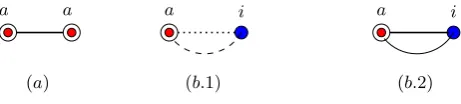
Fig. 5.4.(a) Self Loop: whenNa0 =Ta, (b) Parallel Edges: (b.1)Na0 =Ni, Ta0 =Ti, (b.2)
Na0 =Ti, Ta0 =Ni. Node with concentric circle denotes the verification query node.
Parallel Edges. A parallel edge or cycle of length 2 in Gvτ implies that the
edges would be (i) one dashed (Dash) and one dotted(Dot)or (ii) both contin-uous(Con-Con). Formally∃i∈[qm], a∈[qv] :
(
(Dot-Dash):Ni=Na0, Ti =Ta0,HKh(Mi)⊕HKh(M
0
a) =Ni⊕Na0
(Con-Con):Na0 =Ti, Ta0 =Ni,HKh(Mi)⊕HKh(M
0
a) =Ni⊕Na0
• Bounding (Dot-Dash) Edges. For a fixed choice of i and a, probability of Ni=Na0, Ti=Ta0,HKh(Mi)⊕HKh(M
0
a) =Ni⊕Na0 is bounded by2due to
the randomness of hash keyKh(note thatMi6=Ma0, as we have assumed a
non-trivial distinguisher). As there exists only one choice ofifor which the above probability is bounded by2, summing over all possible choices of i anda, we obtain the boundqv2.
• Bounding(Con-Con) Edges. Similarly, for a fixed choice of i, a, probability ofNa0 =Ti, Ta0 =Ni,HKh(Mi)⊕HKh(M
0
a) =Ni⊕Na0 is bounded by2 due
two choices ofi(as we have at most two collision ofT) for which the above probability is bounded by2. Summing over all possible choices ofiand a, we obtain the bound 2qv2.
Thus, we see from the above two cases that the probability of forming a parallel edge is bounded by 2qv2.
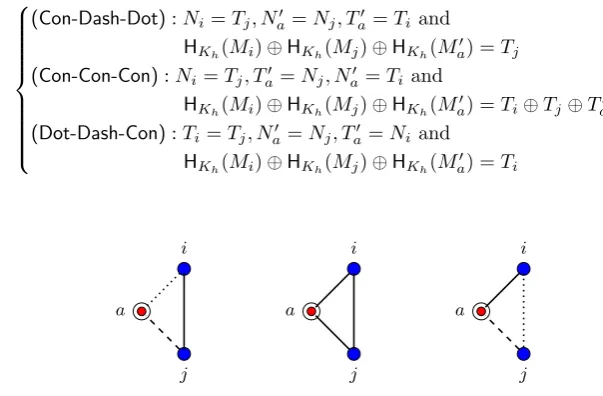
Closed Triangle.For the case of a closed triangle, it has the following restric-tions on the edges: (a) maximum one edge can be dashed and if exist, it must contain the verification nodea, (b) maximum one edge can be dotted (otherwise there exists a self loop or parallel edges). These restrictions impose the following properties on the closed triangle:
• if (i, j)-th edge is dotted, then the other edges must be one dashed and one continuous.
• if (i, j)-th edge is continuous, then there must be a dashed edge. Hence, a closed triangle or cycle of length 3 in Gv
τ implies that ∃i, j∈[qm], a∈
[qv] such that either of the following holds:
(Con-Dash-Dot):Ni=Tj, Na0 =Nj, Ta0 =Ti and
HKh(Mi)⊕HKh(Mj)⊕HKh(M
0 a) =Tj
(Con-Con-Con):Ni=Tj, Ta0 =Nj, Na0 =Ti and
HKh(Mi)⊕HKh(Mj)⊕HKh(M
0
a) =Ti⊕Tj⊕Ta0.
(Dot-Dash-Con):Ti=Tj, Na0 =Nj, Ta0 =Ni and
HKh(Mi)⊕HKh(Mj)⊕HKh(M
0 a) =Ti
i
j a
i
j a
i
j a
Fig. 5.5. Cycles of length 3 including the verification query which is denoted by the concentric circle node.
We bound each of these events for a fixed choice ofi, j anda.
• Bounding(Con-Dash-Dot)Triangle. For a fixed choice ofi, j, a, probability of the event is bounded by3using the randomness of the hash key as we have assumed the hash function is33-way regular (note that we have conditioned onB0 and therefore Tj 6=0). Note that, choice of j and i is one and two
• Bounding (Con-Con-Con) Triangle. We analyze this case in two different subcases:
- (a) For a fixed choice of i, j and a, if Nj 6= Ti⊕Tj, then HKh(Mi)⊕
HKh(Mj)⊕HKh(M
0
a) 6=0 and thus we can bound the event by 3. In
this case, choices ofi and j is 2 an 1 respectively and hence we obtain the bound to be 2qv3.
- (b) For a fixed choice of i, j and a, if Nj = Ti⊕Tj, then HKh(Mi)⊕
HKh(Mj)⊕HKh(M
0
a) =0and in that case we again consider two different
sub cases: (i) if i < j, thenTj =Ni holds with probability 2−n andTi
is to be valid (i.e. lastn/3 bits ofTi has to be zero), which holds with
probability 2−n/3. Moreover, number of choices of i and j in this case is qm and thus we obtain the bound to be
q2
m
24n/3 ≤
qm
22n/3, assuming qm≤22n/3. (ii) Ifi > j, then Tj =Niholds with probability 2−n/3 and
Ti should be Ni⊕Nj which holds with probability 2−n. In this case,
number of choices of j is qm and i in 1, resulting in probability of the
event to be bounded by qm
24n/3 ≤
qm
22n/3.
• Bounding(Dot-Dash-Con)Triangle. For a fixed choice ofi, janda, the prob-ability of the event is bounded by3asHKh(Mi)⊕HKh(Mj)⊕HKh(M
0 a) =Ti
holds with probability at most3(by the assumption that the hash function is3 3-way regular). Note that, in this case choice ofj andiis one. Hence, summing over all possible choices of indices, we obtain the bound to beqv3. Therefore, we see that for all the above cases, the maximum probability of form-ing a closed triangle inGv
τ is max{2qv3,22qn/m3}.
Therefore, we see from all of the above cases the maximum probability of forming a cycle inGv
τ is max{2qv3,2qv2, qv1,22qn/m3}. Thus, we have
Pr[B3|B0∧B1∧B2]≤max{2qv3,2qv2, qv1, qm
22n/3}. (16)
Bounding B4: Recall that, the event B4 holds if ∃i 6= j ∈ [qm] such that
Ni⊕HKh(Mi) =Nj⊕HKh(Mj), Ti=Tj. Since, in the ideal oracle the hash key
is sampled independent to all previously sampled MAC responsesTi, we write
Pr[B4]≤X
i,j
Pr[HKh(Mi)⊕HKh(Mj) =Ni⊕Nj]·Pr[Ti=Tj]≤
q2m.2
2n
(1) ≤ qm2
2n/3, (17) where (1) follows due to the assumptionqm≤22n/3.
Bounding B5: Recall that, the event B5 holds if ∃i 6= j ∈ [qm] such that
Ni⊕HKh(Mi) =Nj⊕HKh(Mj), Ni=Tj. Now, we consider two sub cases:
• (a) for fixedi andj ifi < j, then Ni=Tj holds with probability 2−n (due
to Lemma 2) andNi⊕HKh(Mi) = Nj⊕HKh(Mj) holds with probability
2. Summing over all possible choices of iand j we obtain the bound to be
q2
• (b) Wheni > j, thenNi=Tjholds with probability 2−n/3(due to Lemma 2)
and as beforeNi⊕HKh(Mi) =Nj⊕HKh(Mj) holds with probability2. In
this case, possible choices ofi andj is 1 andqm respectively and therefore
by summing over all possible choices of indices, we obtain the bound to be
qm2 2n/3.
By assuming qm≤22n/3, from each of the above cases we have
Pr[B5]≤ qm2
2n/3. (18)
Bounding B6: Recall that, the event B6 holds if ∃i ∈ [qm] such that Ni =
HKh(Mi). For a fixed i ∈ [qm], the event holds with probability 1 due to the
regular property of the hash function. Summing over all choices of i, we obtain the bound
Pr[B6]≤qm1. (19)
Finally, by assuming qm≤22n/3, Lemma 3 follows from Eqn. (22)-(19). ut
6
1K-DWCDM
: A Single Keyed
DWCDM
Recall that, our proposed construction DWCDM is instantiated with a hash function and a block cipher where the hash key is independent to block cipher keys, leading to have a two-keyed (counting hash key separately from block cipher keys) nonce based MAC. In this section, we transform theDWCDMconstruction to a purely single keyed construction by setting the underlying hash keyKh to
the encryption of1(i.e.Kh:=EK(1)) and argue that the modified construction
(that we call as1K-DWCDM) is secure.
Now, we state and prove that1K-DWCDMis secure up to 22n/3MAC queries and 2n verification queries against all nonce respecting adversaries. We mainly focus on the nonce respecting security of the construction, as its nonce misuse security is very similar to that of DWCDMand hence we skip it.
Theorem 5. LetMandK be finite and non-empty sets. LetE:K × {0,1}n→
{0,1}n be a block cipher andH:E
K(1)× M → {0,1}n be an1regular,2 AXU
and 3 3-way regular hash function. Then, the MAC advantage of1K-DWCDM
is given by:
AdvMAC1K-DWCDM[E,E−1,H](qm, qv, t)≤AdvSPRPE (qm+qv, t0) +
3qm
22n/3 + q2
m2 2n +
qv
2n−1
+ max{qv1,2qv2,2qv3,
qm
22n/3}+qv1+ qm
2n +
5q3
m
![Fig. 3.1. Equation dependent graph G[E] comprised of two components; largest com-ponent size is 3.](https://thumb-us.123doks.com/thumbv2/123dok_us/7980822.1323740/11.595.280.339.456.510/fig-equation-dependent-graph-comprised-components-largest-ponent.webp)