INTRODUCTION
Ion exchange is one of the most common techniques that have been employed for many years in chemical process industries and effluent treatment plant. The ion exchange process is very effective at transferring the content of a large volume of industrial effluent into a small volume of solid. Extensive work was done by previous researchers to study the properties of the ion exchange resins, to generate thermodynamic data related to various uni-univalent and heterovalent ion exchange
systems1-7. Recently theor ies explaining ion
exchange equilibrium between the resin phase and
solution was also developed8. A number of
researchers carried out equilibrium studies, extending over a wide range of composition of
solution and resin phase9-31. Attempts were also
Ion exchange equilibrium study using strongly
basic anion exchange resin Indion-102
P.U. SINGARE¹*, R.S. LOKHANDE² and M.B. NADAR³
¹Department of Chemistry, Bhavan’s College, Andheri, Mumbai - 58 (India). ²Department of Chemistry, University of Mumbai,
Vidyanagari, Santacruz, Mumbai - 98 (India).
³Department of Chemistry, SIES College of Arts, Science & Commerce, Sion (W), Mumbai – 22 (India).
(Received: April 18, 2009; Accepted: May 24, 2009)
ABSTRACT
The thermodynamic study was carried to predict the selectivity behaviour of anion exchange resin Indion-102 in chloride form for iodide and bromide ions in solution. The equilibrium constant K values for the ion exchange reactions were calculated at different temperatures from which the enthalpy values were obtained. The equilibrium constant K calculated for Cl –/ I – and Cl - / Br - uni-univalent ion
exchange reaction systems were observed to decrease with rise in temperature indicating the endothermic exchange reactions having enthalpy values 3.86 and 6.36 kJ /mol respectively.
Key words: Ion exchange equilibrium; equilibrium constant; ionic selectivity; enthalpy; endothermic reactions; anion exchange; Indion-102.
made to study the equilibrium of cation exchange
systems 9-23. However very little work was carried
out to study the temperature effect on anion
exchange systems 12, 24-31 for computing the
thermodynamic equilibrium constants. Therefore in the present investigation attempts were made to study the thermodynamics of uni-univalent anion exchange equilibrium, the results of which will be of considerable use in explaining the selectivity of ion exchanger for various univalent ions in solution.
EXPERIMENTAL
The ion exchange resin Indion-102 as supplied by the manufacturer (Ion Exchange India Ltd., Mumbai) was a strongly basic anion exchange
resin in OH - form of 16-50 mesh size. For present
were used. The conditioning of the resins in chloride form was done by usual methods using 10%
potassium chloride solution25-28.
Ion exchange resins in Cl – form (0.500g),
was equilibrated with I- ion solution of different
concentrations at a constant temperature of 350 C
for 3 h. From the results of kinetics study reported
earlier 32-43; it was observed that this duration was
adequate to attain the ion exchange equilibrium.
After 3 h the different I - ion solutions in equilibrium
with ion exchange resins were analysed for their
Cl– and I- ion concentration by potentiometric titration
with standard 0.1N AgNO3 solution. From the results
the equilibrium constant K for the reaction
...(1)
was determined at 35.0°C. The equilibrium
constants K for the above Cl- / I- system was
determined for different temperatures up to 45.0°C.
Similar study was also carried out for Cl - /
Br - system in the same temperature range, to study
the equilibrium constant K for the reaction
...(2)
The chloride, bromide and iodide ion solutions used in the entire experimental work were prepared by dissolving their respective analytical grade potassium salts in distilled deionised water. In the present study, a semi-micro burette having an accuracy of 0.05 mL was used in the titrations and the titration readings were accurate to ± 0.05 mL. Considering the magnitude of the titer values, the average equilibrium constants reported in the experiment are accurate to ± 3 %.
RESULTS AND DISCUSSION
The equilibrium constants for the uni-univalent ion exchange reactions (1 and 2) would be given by the expression
...(3)
here A is the ion exchange capacity of the
resin, x - represents I - or Br - ions.
For different concentrations of x - ions in
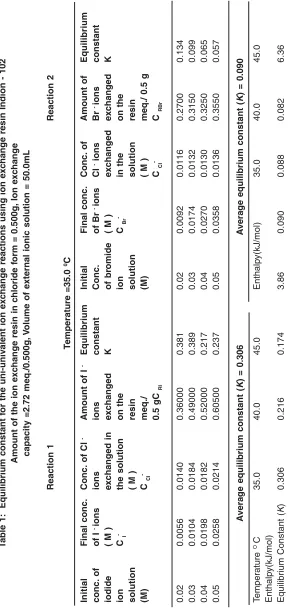
solution at a given temperature, K values was calculated from which average value of K for that set of experiment was calculated. Similar values of
K were calculated for both Cl-/I- and Cl-/Br - systems
for different temperatures (Table 1). Ear lier researchers have expressed the concentration of ions in the solution in terms of molality and concentration of ions in resin in terms of mole
fraction 23. In view of above, the experimental results
obtained in the present study have been substituted
in the following equation by Bonner et.al 16, 20 and
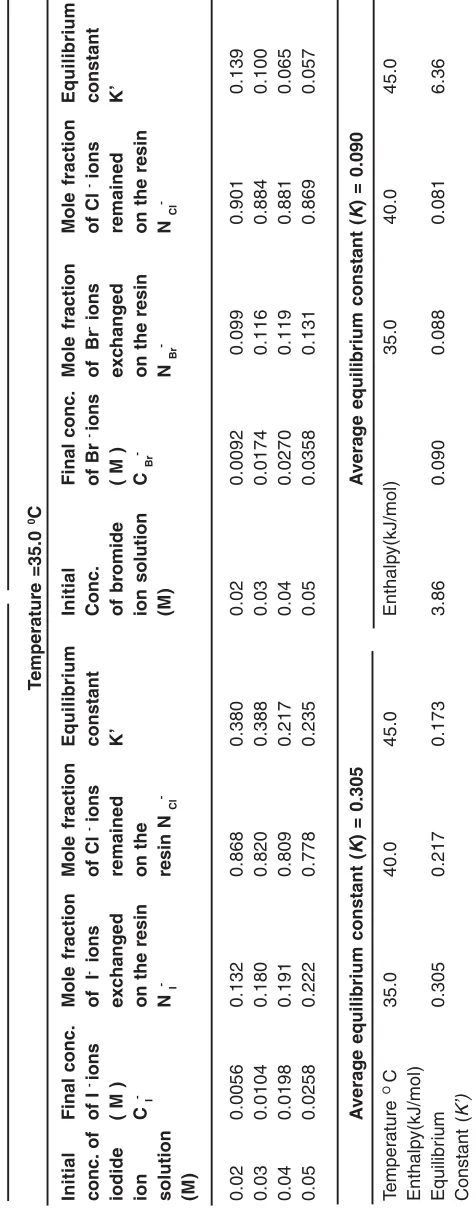
the equilibrium constant K’ was calculated (Table 2).
...(4)
here NX- = mole fraction of I - or Br - ions
exchanged on the resin
mCl- = molality of Cl - ions exchanged in the solution
NCl- = mole fraction of Cl - ions remained on the
resin
mx- = molality of I - or Br - ions remained in the
solution at equilibrium.
Since in the present study the solution was dilute, the molality and molarity of the ions in the solution were almost the same, with negligible error. Therefore the molality of the ions can be easily replaced by molarity. The equilibrium constant K’ was calculated by equation 4 and the average value
of K’ is reported (Table 2).Such K’ values were
calculated for different temperatures and the values were in good agreement with K values calculated by equation 3 (Tables 1 and 2).This justifies that the choice of units for the concentration in the present study is insignificant. The enthalpy value for the ion exchange reactions 1 and 2 were calculated from the slope of the graph log K against
1 / T 25-28. In the present investigation, for the
T
a
ble 1:
Equilibrium constant f
o
r the uni-univ
alent ion e
x
c
hang
e reactions using ion e
x
c
hang
e resin Indion - 102
Amount of the ion e
x
c
hang
e resin in c
hloride f
orm = 0.500g,
Ion e
x
c
hang
e
capacity =2.72 meq./0.500g,
V
olume of e
xternal ionic solution = 50.0mL
Reaction 1 Reaction 2 T emperature =35.0 0C Initial Final conc.
Conc. of Cl
-Amount of I
-Equilibrium Initial Final conc. Conc. of Amount of Equilibrium conc. of of I
- ions
ions
ions
constant
Conc.
of Br
- ions
Cl
- ions
Br
- ions
constant
iodide
( M )
e x c hang ed in e x chang ed K o f b romide
( M )
e x c hang ed e x changed K ion C I -the solution on the io n C Br -in the on the solution ( M ) resin solution solution resin (M) C Cl -meq./ (M ) ( M )
meq./ 0.5 g
0.5 gC RI C Cl -C RBr 0.02 0.0056 0.0140 0.36000 0.381 0.02 0.0092 0.0116 0.2700 0.134 0.03 0.0104 0.0184 0.49000 0.389 0.03 0.0174 0.0132 0.3150 0.099 0.04 0.0198 0.0182 0.52000 0.217 0.04 0.0270 0.0130 0.3250 0.065 0.05 0.0258 0.0214 0.60500 0.237 0.05 0.0358 0.0136 0.3550 0.057 A vera g e
equilibrium constant (
K
) = 0.306
A
vera
g
e
equilibrium constant (
K
) = 0.090
T emperature O C 35.0 40.0 45.0 Enthalp y(kJ/mol) 35.0 40.0 45.0 Enthalp y(kJ/mol) Equilibr
ium Constant (
T
a
ble 2.
Equilibrium constant f
or the uni-univ
alent ion e
x
chang
e reactions
using ion e
x
chang
e resin Indion – 102 calculated b
y
Bonner et.al.
Equation
Amount of the ion e
xchange resin in chlor
ide f
o
rm
= 0.500g, Ion e
xchange
capacity = 2.72 meq./0.500g,
V
olume of e
xter
nal ionic solution = 50.0mL
Reaction 1 Reaction 2 T emperature =35.0 0C Initial Final conc. Mole fraction Mole fraction Equilibrium Initial Final conc. Mole fraction Mole fraction Equilibrium conc. of of I
- ions
of I
- ions
of Cl
- ions
constant
Conc.
of Br
- ions
of Br
- ions
of Cl
- ions
constant
iodide
( M )
e x c hanged remained K ’ o f b romide
( M )
e x c hang ed remained K ’ ion C I
-on the resin
on the ion solution C Br
-on the resin
on the resin
solution N I -resin N Cl -(M) N Br -N Cl -(M) 0.02 0.0056 0.132 0.868 0.380 0.02 0.0092 0.099 0.901 0.139 0.03 0.0104 0.180 0.820 0.388 0.03 0.0174 0.116 0.884 0.100 0.04 0.0198 0.191 0.809 0.217 0.04 0.0270 0.119 0.881 0.065 0.05 0.0258 0.222 0.778 0.235 0.05 0.0358 0.131 0.869 0.057 A
verage equilibrium constant (
K
) = 0.305
A
vera
g
e
equilibrium constant (
K
) = 0.090
Cl- / I- exchange as compared to that for Cl - / Br -exchange (Tables 1 and 2), indicate that the resins
in Cl - form are having more affinity for I - ions in
solution as compared to that for Br - ions also in the
solution.
CONCLUSION
Var ious aspects of ion exchange technologies have been continuously studied to improve the efficiency and economy of ion
exchangers in various technical applications. The selection of an appropriate ion exchange material for the specific industrial and research application is possible on the basis of information provided by the manufacturer. However, it is expected that the data obtained from the actual experimental trials will prove to be more helpful. The thermodynamic data obtained in the present experimental work will be useful to understand the selectivity behaviour of ion exchange resins for various ions in solution thereby helping in characterization of resins.
1. N.N. Andreev and Yu.I.Kuznetsov, Russ. J.
Phys.Chem., 64: 1537 (1990).
2. A. Bhargava and C. Janardanan, Indian
J.Chem., 36A: 624 (1997).
3. D. Muraviev, A. Gonzalo and M. Valiente,
Anal.Chem., 67: 3028 (1995).
4. G.E. Boyd, F. Vaslow and S. Lindenbaum,
J.Phys.Chem., 71: 2214 (1967).
5. J.F. Duncan, Aus.J.Chem.Soc., 8: 1 (1955).
6. G.E. Boyd, F. Vaslow and S. Lindenbaum,
J.Phys.Chem., 68: 590 (1964).
7. A. Schwarz and G.E. Boyd, J.Phys.Chem.,
69: 4268 (1965).
8. N.I. Gamayunov, Russ.J.Phys.Chem., 64:
1787 (1990).
9. G.E. Boyd and G.E. Myers, J.Phys.Chem.,
60: 521 (1956).
10. O.D. Bonner, J.Phys.Chem., 59: 719 (1955).
11. O.D.Bonner, J.Phys.Chem., 58: 318 (1954).
12. S.Lindenbaum, C.F.Jumper and G.E. Boyd,
J.Phys.Chem., 63: 1924 (1959).
13. K.A. Kraus and R.J. Raridon, J.Phys.Chem.,
63: 1901 (1959).
14. O.D. Bonner and W.H. Payne, J.Phys.Chem.,
58: 183 (1954).
15. W.J. Argersinger and A.W. Davidson,
J.Phys.Chem., 56: 92 (1952).
16. O.D.Bonner and R.R. Pruett, J.Phys.Chem.,
63: 1420 (1959).
17. O.D.Bonner and F.L.Livingston,
J.Phys.Chem., 60: 530 (1956).
18. O.D.Bonner and L.L.Smith, J.Phys.Chem.,
61: 326 (1957).
19. O.D.Bonner, C.F.Jumper and O.C.Rogers,
J.Phys.Chem., 62: 250 (1958).
20. O.D.Bonner and L.L.Smith, J.Phys.Chem.,
61: 1614 (1957).
21. J.Kielland, J.Soc.Chem.Ind., (London) 54:
232 (1935).
22. A.P.Vanselow, J.Am.Chem.Soc., 54: 1307
(1932).
23. G.L. Gaines (Jr.) and H.C.Thomas,
J.Chem.Phys., 21: 714 (1953).
24. K.A.Kraus, R.J.Raridon and D.L. Holcomb,
Chromatogr.J., 3: 178 (1960).
25. R.S. Lokhande, P.U. Singare and A.B. Patil,
Russ. J. Phys. Chem. A, 81: 2059 (2007)
26. P.U. Singare, R.S. Lokhande and T.S.
Prabhavalkar, Bull. Chem. Soc. Ethiop., 22:
415 (2008).
27. R.S. Lokhande and P. U. Singare, J.Ind.
Council Chem., 24: 73 (2007)
28. R.S. Lokhande, P.U. Singare and A.R. Kolte,
Bull. Chem. Soc. Ethiop., 22: 107 (2008).
29. K.G.Heumann and K. Baier,
Chromatographia, 15: 701 (1982).
30. O.D. Bonner, G.Dickel and H.Brummer,
Z.Physik.Chem., (Frankfurt), 25: 81 (1960).
31. G.L.Starobinet, V.S. Soldatov and
A.A.Krylova, Russ.J.Phys.Chem., 41: 194
(1967).
32. R.S.Lokhande, P.U.Singare and A.B. Patil,
Radiochim. Acta, 95: 111 (2007).
33. R. S. Lokhande and P. U. Singare, Radiochim.
Acta, 95: 173 (2007).
34. R.S.Lokhande, P.U.Singare and A.R.Kolte,
Radiochim. Acta, 95: 595 (2007)
35. R. S. Lokhande, P. U. Singare and M. H. Dole,
J.Nucl.Radiochem. Sci., 7: 29 (2006)
36. R.S. Lokhande and P.U. Singare, J .Porous
Mater, 15: 253 (2008)
37. R.S. Lokhande, P.U. Singare and P.
Karthikeyan, Russ. J. Phys. Chem. A, 81:
1768 (2007).
38. R.S.Lokhande, P.U.Singare and M.H.Dole,
Radiochemistry, 49: 519 (2007).
39. P.U. Singare,R.S. Lokhande and A.B. Patil,
Radiochim. Acta, 96: 99 (2008).
40. R.S .Lokhande, P.U.Singare and S.R.D.
Tiwari, Radiochemistry, 50: 633 (2008).
41. R.S. Lokhande,P.U. Singare and T.S.
Prabhavalkar, Russ.J.Phys. Chem. A, 82:
1589 (2008).
42. R.S.Lokhande, P.U.Singare and S.A.Parab,
Radiochemistry, 50: 642 (2008).
43. R.S. Lokhande, P.U. Singare and V. V. Patil,