p r a c ti tio n e r e n q u i r y t o t r a n sf o r m p r a c ti c e . Te a c h e r E d u c a tio n
Adv a n c e m e n t N e t w o r k Jo u r n al (TEA N), 9 ( 1). p p . 1 1 3-1 2 3 .
Do w n l o a d e d fr o m : h t t p ://i n si g h t . c u m b r i a . a c . u k /i d/ e p ri n t/ 2 6 0 1 /
U s a g e o f a n y i t e m s f r o m t h e U n i v e r s i t y o f C u m b r i a’ s i n s t i t u t i o n a l r e p o s i t o r y ‘I n s i g h t ’ m u s t c o n f o r m t o t h e f o l l o w i n g f a i r u s a g e g u i d e l i n e s .
Any it e m a n d it s a s s o ci a t e d m e t a d a t a h el d i n t h e U niv e r si ty of C u m b r i a ’s in s ti t u ti o n al r e p o si t o r y I n si g h t ( u nl e s s s t a t e d o t h e r wi s e o n t h e m e t a d a t a r e c o r d ) m a y b e c o pi e d , di s pl ay e d o r p e rf o r m e d , a n d s t o r e d i n li n e wi t h t h e JIS C f ai r d e a li n g g ui d eli n e s ( av ail a bl e h e r e) fo r e d u c a t i o n al a n d n o t-fo r-p r ofi t a c tiviti e s
p r o v i d e d t h a t
• t h e a u t h o r s , ti tl e a n d full bi blio g r a p h i c d e t ail s of t h e it e m a r e ci t e d cl e a rly w h e n a n y p a r t
of t h e w o r k is r ef e r r e d t o v e r b a lly o r i n t h e w ri t t e n fo r m
• a h y p e rli n k/ U RL t o t h e o ri gi n al I n si g h t r e c o r d of t h a t it e m is i n cl u d e d i n a n y ci t a ti o n s of t h e w o r k
• t h e c o n t e n t is n o t c h a n g e d i n a n y w a y
• all fil e s r e q ui r e d fo r u s a g e of t h e it e m a r e k e p t t o g e t h e r wi t h t h e m a i n it e m fil e.
Yo u m a y n o t
• s ell a n y p a r t of a n it e m
• r e f e r t o a n y p a r t of a n it e m wi t h o u t ci t a ti o n
• a m e n d a n y it e m o r c o n t e x t u ali s e it i n a w a y t h a t will i m p u g n t h e c r e a t o r ’s r e p u t a t i o n
• r e m ov e o r a l t e r t h e c o py ri g h t s t a t e m e n t o n a n it e m .
T h e full p oli cy c a n b e fo u n d h e r e.
Citation
Duncalf, D., Lloyd, D., Pratt, A., Horsfall, P. (2017) ‘Teacher perspectives of cultivating learning through practitioner enquiry to transform practice, TEAN Journal, 9(1), pp 113-123
113 Teacher perspectives of cultivating learning
through practitioner enquiry to transform practice
Teacher Education Advancement Network Journal Copyright © 2017 University of Cumbria Vol 9(1) pages 113-123 Debbie Duncalf, Di Lloyd, Andrea Pratt, Peter Horsfall
Liverpool John Moores University
Abstract
This paper reports on the first year of an innovative Postgraduate Certificate (PGCert) in Advanced Education Practice, designed to meet the specific staff and development needs of one school in the North West of England. The programme is underpinned by three strands of practice based learning: learning about practice (theory), learning in practice (application) and learning through practice (reflection) through critical reflection. This paper considers professional development situated around teaching and learning and outlines a new approach to cultivating learning, both for teachers and educational practitioners through a collaborative learning model with a Higher Education Institute (HEI). A further strand to the research considers transformative impact on practice including references to personal experience and reflections by the participants. Throughout the report it is evident that school leaders were keen to enhance the performance of staff by supporting them in Masters level study to enhance professional practice and impact on learning. Through questionnaires and interviews, an insight into personal and professional impact, challenges,
evaluation, details of the progression, next steps in the small scale research study were considered.
Key words
Practice based learning; impact; reflection; transformation; professional development; learning community; collaboration.
Background
This research focuses on the creation of a professional learning community based on the research principles of action research through practitioner research in the classroom with the support of a HEI in the North West of England. The paper aims to move beyond the principles of continuing
professional development to focus on the demands of accredited professional development originating from the lessons learned from Continuing Professional Development (CPD) provision, however acknowledging that both can have an impact in the classroom.
The aim of this research paper is to:
Provide evidence regarding the transformative potential of collaborative practitioner research, exploring the role of professional learning in a collaborative and innovative context.
To explore the value of school situated research through a journey of co-validation to create a school led Postgraduate Certificate in Education delivered in partnership with an HEI.
114 The PGCert programme design enabled participants to develop knowledge and understanding through critical engagement with current theory, literature and their own research findings and explores the dissemination of findings within in a school context. Fullan (2003) highlights that professional learning communities will not necessarily lead to changes in practice if the interactions simply reinforce ineffective practice, hence the need for the critical reading and reflection that was provided by a model of support from the university. Nelson and O’Beirne (2014) explain that professional development needs to focus on impact in the classroom with the issues identified relevant to teachers and their pupils. Within this piece of research this was deemed a key theme to consider, in particular there needed to be a focus on challenging existing practice, with sufficient time for depth of reflection on practice. The context of teachers as researchers and researching their own practice can sometimes feel disconnected, reinforced by Furlong and Oancea (2005:5) who identify a dichotomy between research and policy and practice in the ‘real world’. The model of the Postgraduate Certificate (PGCert) aimed to bring the research and practice together through applied research and depth of theoretical underpinning to practice, and further reinforced the need for quality research to be clearly positioned between research and practice (Furlong and Oancea 2005).
A fundamental aspect to the planning of this course rested on three core aims:
Learning about practice: by making strong links between the content of taught sessions and on-line learning to the daily professional practice and expectations of the teacher.
Learning in practice: requiring the student to apply learning to the professional role through learning activities and assessment tasks.
Learning through practice: providing a structured approach which enables students to revisit aspects of practice following a period of time, and by providing additional support (through for example, a Newly Qualified Teacher network) to explore practice based issues with experienced practitioners.
Professional learning
The research considered moving beyond continuing professional development to create more meaningful research in the classroom, moving further towards evidence or researched based practice. Timperley (2011) considers that professional learning requires serious engagement in teachers’ learning at the centre of the process, whereas professional development is experienced more as a participatory activity. In this piece of research the teachers are at the centre of
practitioner research so supporting the work of Timperley (2011). Timperley goes on to further explain that learning in a professional context should be driven by both teacher and student needs; without this there is little motivation to make any improvements that come to light. The
introduction of the PGCert very much reinforced this view with the leadership team and teachers designing the content of the course for maximum impact. Donaldson (2011:6) provides a valuable statement to support this:
Expert practitioners whose professional practice and relationships are rooted in strong values, who take responsibility for their own development.
This quote is significant in that it reflects very much the dynamics of the group in this piece of research who have taken responsibility for their own learning in the classroom.
Professional learning, by definition, was recognised as far back as 2006:
A school that is research-engaged uses that engagement to sharpen its focus on school improvement and improve teaching and learning
115 The work of the GTC (General Teaching Council for England) (2006) is still very current today and within this piece of research wewill consider if participants have improved teaching and learning through engaging with the theory around practice.
In devising a coherent programme to meet the needs of practitioners it was important to consider The Carter Review (2015), a recent report on initial teacher training in England, and the role of research at the point of training and beyond. In the report Carter recommended that teaching should be evidence based and that research should be embedded at every level. Further evidence from the RSA-BERA inquiry (2014), a report that considered how research can make a contribution to teacher education, was an insight used to inform the foundation on which to develop the PGCert programme. The RSA/BERA (2014:2) inquiry indicated that teachers engaging in research was
important and that schools should be ‘research-rich environments’. In further consideration of the of the programme, the following guidance provided by The Department for Education (DfE) (2016:1) underpinned the rationale for a more robust engagement with research, in stating that professional development should:
have a focus on improving and evaluating pupil outcomes… be underpinned by robust evidence and expertise...include collaboration and expert challenge…be sustained over time and prioritised by school leadership.
The school senior leadership team of this collaborative programme demonstrated from the very beginning a clear commitment to prioritising research and therefore built on the recommendation of the DfE (2016). In moving forward, it was also important to consider the ‘intention for teacher research’ (McLaughlin et al., 2004:7) and consider this being knitted together, with personal enquiry and school improvement being the key drivers. Leat, Lofthouse and Reid (BERA-RSA 2014) recognise that research partnerships between Universities and teachers focus less on the outputs or reports developed by teachers, and acknowledge the need for presenting teachers’ views in research. This validates the purpose and function of the PGCert, placing the teachers and participants firmly at the fore front of practitioner research in their classroom and school. The DfE (2016) further extend this view with the recommendation that there should be collaboration and expert challenge in research informed practice. The role of the HEI in this learning community was to facilitate the research, support, challenge and link theory to practice (DfE 2016).
Practitioner research
Murray posits that there are four key features of practitioner research:
Firstly, the educational focus or research problem of Practitioner Based Enquiry derives from and informs the professional concerns of educators. Secondly, such enquiries are conducted as part of a networked and developmental discourse between tutors, practitioners and significant others. Thirdly, practitioners are confirmed in a range of approaches to educational enquiry and research methodology. Fourthly, through the process of enquiry, educators are directed towards the acquisition of intellectual autonomy, improved judgement making, and enhanced technical competence in the classroom.
(Murray 2006:191).
116 The teachers and participants involved recognised themselves as problem solvers, who react to the needs of the learner, and who, through reflection, select the best tools for the job (Baumfield, Hall and Wall 2013). The National College for Teaching and Leadership (NCTL) state that practitioner enquiry can play a significant role in enabling teachers to develop a deeper understanding of
learning and practice which should lead to changes in attitude and practice (2015), and this was very evident in evaluations from the participants. BERA RSA (2014:10) also highlighted ‘research literacy’ as an important element to consider and viewed it as a key dimension of teachers’ broader
professional identity, one that reinforces other pillars of teacher quality, notably subject knowledge and classroom practice; again this emerged in the teacher evaluations of the course.
In considering the role of the University, evidence suggests that teachers engaging in their own research or enquiry are best served when they also engage in external evidence, and in this case research beyond the classroom, as this would reinforce the relevance of their work (CUREE, 2011; Dagenais et al., 2012). This highlights the value of collaboration and partnership between teachers and HEIs and in this case the university to provide this evidence. According to Norton (2009), instances of understanding are not enough on their own to result in change and she highlights the necessity for an evaluation of alternative methods and a dedication to change. This view (Norton 2009) is informed by Mezirow’s Transformative Learning Theory. (Mezirow 2000, cited in Norton 2009:28). This theory is defined as the process of ‘effecting change in a frame of reference based on our experiences’ and self-evaluation (Mezirow, 1997:5). It is therefore clear that teachers need to develop skills of evaluation and this is imperative to one’s own practice. Fiszer (2004) is critical of the more traditional professional development in that new learning is not consistently incorporated into actual classroom practice; he discusses the need for an ongoing model of learning with opportunities for dialogue with professionals and trial and error in the classroom. Within the PGCert, staff
focussed on an aspect of practice, and through trial and error and dialogue with colleagues, evaluated the impact of the focus area. For some staff the outcomes of their research were incorporated into current practice, thus transforming practice and leading to eliciting positive change in the classroom. Goldacre (2013) states that this trial and error should be part of being research engaged and research active.
Transforming practice
The DfE (2016) states that schools should be in control of their own improvement (confirming the approach and engagement from the school at the design stage) and that this makes it easier for them to learn from each other and access best practice, in this case a learning community based at the school. However, the Sutton Trust (2014) argue that expertise external to the group of
participating teachers is necessary to challenge existing assumptions and develop the kinds of new knowledge and skills associated with positive outcomes for students. This expertise can come from within or outside the school, hence the emergence of the partnership between the school and the HEI. Philpott (2015) states that a sustained focus on improving practice is the most effective way of supporting professional development. A robust model of academic and professional learning was created which facilitated a shift in practice and knowledge in the certified programme.
Zeichner (2003) indicates that to be transformative, school based teacher research relies on the creation of a shared philosophy of inquiry and the need to develop and define the research focus. Therefore, the school and the HEI worked in collaboration to provide the necessary stimulation and academic rigour required to achieve this. An alternative perspective on the school /HEI partnership is provided by Gore and Gitlin (2004, cited in Leat, Lofthouse & Reid, 2016:4) who acknowledge that:
117 This was certainly not the case in this piece of the research with a strong and positive relationship established, with mutual respect for both knowledge and practice.
It was also clear the research conducted by the practitioners moved beyond the traditions of continuing professional development (CPD) to a more commanding position, with practitioners reporting transformation in practice (Leat, Lofthouse and Reid in BERA RSA 2014). The authors of this research highlight that partnerships between Universities and teachers can often lead to an absence in teachers’ views of research engagement in publications, further suggesting that
prevailing literature is more about school leadership rather than the focus of the teacher research. This highlights the need for HEIs to nurture the research that is directly relevant to the educational system (BERA RSA 2014). Our piece of research aims to place teacher views of research of their practice at the heart of this paper.
Research Design
The research explores the impact of practitioner based inquiry and implications for future practice from both a school and HEI standpoint and reports on the first year of a Postgraduate Certificate in Advanced Education Practice. The findings of the participants’ perspectives were captured through questionnaires and interviews including the senior leadership team. Participants agreed not be named but fully appreciated they might be identified due to the nature of their role and the dissemination.
Using practitioner research, participants were asked to reflect on their professional learning, a process chosen which led to reflection, evaluation and self-development (Burton & Bartlett, 2005), and which gave the opportunity to reflect on current practice within the school (Murray, 2006). The use of qualitative data collected enabled the authors to develop an understanding of the findings (Biggam, 2015). Qualitative data were collected through the use of a questionnaire and semi structured interviews. Both data collection methods are seen as common in educational research (Lai & Waltman, 2008) and used together can provide validity through triangulation (Denzin, 2009).
We used questionnaires because they could be used to collect data from a large group of people without variation (Brace 2008), questionnaires are also low cost and easy to use (Gillham, 2008), and give immediate response (McNiff, 2013). As the programme was based in the school the
questionnaires were administered and collected with little effort, with a high response rate of n=15, which provided a representation of 100%, (McAteer, 2013). This allowed for anonymous gathering of data through carefully structured clear questions, which were not leading, giving a full range of answers (Denscombe, 2014) The design of the questions was informed by the necessity to evaluate the experience of practitioner research and impact on practice.
Following on from the questionnaires, we used semi structured interviews (using guideline questions but with flexibility within the wording) to obtain a good understanding of the student experience (Kvale, 2006), and to gain rich data (Baumfield et al., 2013). The interviews were also a successful method as they allowed the participants to say what they are thinking (Stringer, 2014; Cotterell, 2014), and the researcher to ‘get inside’ the story (McAteer, 2013). The interviews were held with a range of participants (n=6) a representation of 40% of the cohort including members of the senior leadership team (SLT) and the Head teacher. Burton et al. (2008) state that interviews are useful to gather further qualitative data following questionnaires, although participants can feel nervous about answering honestly.
The researchers used Denscombe’s (2010) five stage analysis process of: preparation, looking for trends and themes, analysing the data, presenting the data and finally validating the data.
118 the interpretation of the data more straightforward and logical (Biggam, 2015). In analysing the qualitative data from the questionnaires and interviews, the following themes were identified: reflection on practice, applying theory to practice, impact on the learning, collaboration and widening of professional development.
Findings
The findings are confined to questionnaire responses from all staff who took part in the programme and responses from interviews with senior leaders (SLT).
Table 1. Reflection on practice.
Question Response
Do you think you have had time to reflect on your existing practice during this programme?
There have been opportunities to reflect on practice which has been beneficial to my practice
I found time for deep reflection on my own practice, during the sessions.
I have reflected on my practice throughout the course which has helped to bring about change
Interestingly staff on the course acknowledged that the creation of a professional learning community gave them the opportunity and time, to reflect deeply on practice.
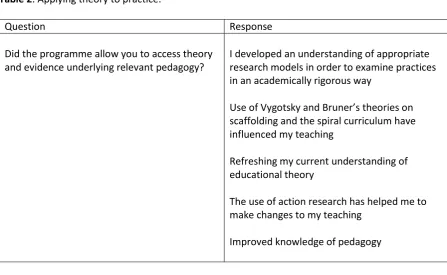
Table 2. Applying theory to practice.
Question Response
Did the programme allow you to access theory and evidence underlying relevant pedagogy?
I developed an understanding of appropriate research models in order to examine practices in an academically rigorous way
Use of Vygotsky and Bruner’s theories on scaffolding and the spiral curriculum have influenced my teaching
Refreshing my current understanding of educational theory
The use of action research has helped me to make changes to my teaching
Improved knowledge of pedagogy
119 research. The data highlights the impact on approaches to learning in the classroom and signpost positive change. This is evident in this response:
To discover how the pupils felt about the way I mark was a huge revelation and has impacted significantly on both me and the way I work and also on them and the feedback they get
(SLT3).
This significant perspective demonstrates transformation.
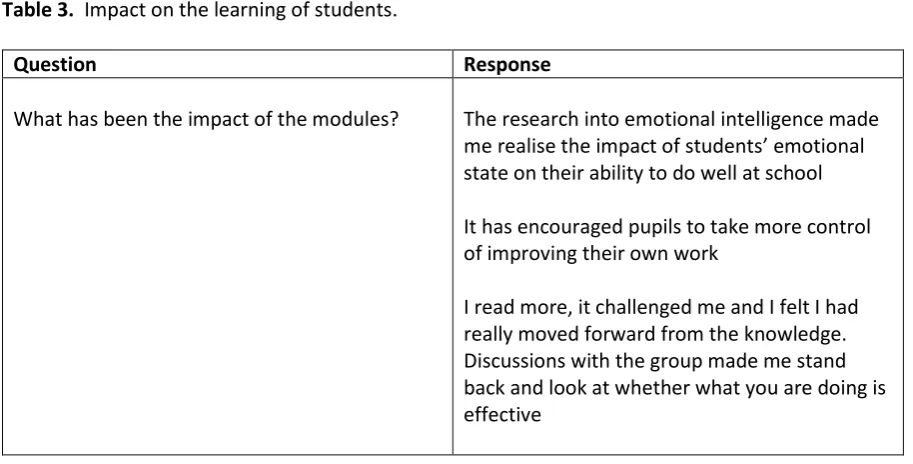
Table 3. Impact on the learning of students.
Question Response
What has been the impact of the modules? The research into emotional intelligence made
me realise the impact of students’ emotional state on their ability to do well at school
It has encouraged pupils to take more control of improving their own work
I read more, it challenged me and I felt I had really moved forward from the knowledge. Discussions with the group made me stand back and look at whether what you are doing is effective
The SLT recognised that the impact of the course has been huge and that the course was about transforming practice; an accredited university programme was secondary.
“The impact has been tremendous, far better actually than we had anticipated because the dialogue in the staff room has completely changed, teachers share ideas, practice has been developed both within the classroom and across whole school approaches so it’s been remarkable “(SLT1)
Table 4. Collaboration.
Question Response
Have you made any changes in how you work with colleagues?
It’s a chance to look at the bigger picture and to work collaboratively with colleagues
Opportunities for staff to collaborate and learn from each other
120 The data around developing a professional learning community and collaboration has shown that staff on all levels valued the opportunity to meet, learn, share practice, and work with the university as a facilitator:
We are sharing what we have learnt and what research we have done with the others members of the department so it has had a big impact overall on the whole department
(SLT4).
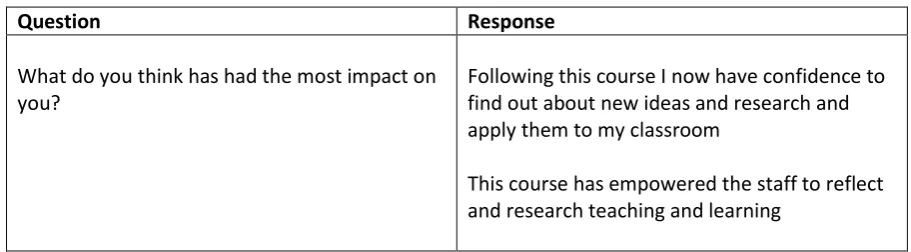
Table 5. Widening of Professional Development.
Question Response
What do you think has had the most impact on you?
Following this course I now have confidence to find out about new ideas and research and apply them to my classroom
This course has empowered the staff to reflect and research teaching and learning
There is strong recognition that both staff and pupils have gained from the course, through the widening of professional development. The quotes from the SLT very strongly support all aspects of impact:
I think just the fact that they are willing to take risks within the classroom and the new ideas they are trying out and then talking to other staff in the school about it, so it’s not even in just our small cohort, it’s actually having an impact right across the school which is great
(SLT1).
I liked the idea that suddenly in school the discourse about teaching and learning was very vibrant and for me that was a real positive
(SLT2).
I firmly believe that the positive impact of doing Masters has been so successful in improving standards in the classroom, improving teaching, professional dialogue and also bringing the community together
(SLT1).
Overall, the evidence from the research reveals the staff have fully engaged in the study and that clear links between theory and practice have been made. The impact in the classroom has centred on new knowledge and changes in approaches to teaching and learning. The impact on leadership has also been evidenced with a review of approaches to leadership and management at all levels. The new approaches and knowledge gain did not all emerge from the input provided by the
university but from teachers sharing new knowledge and their emerging practice. The senior leaders recognised the impact on the whole school in terms of staff discussion and the spheres of influence which have arisen are having a wide impact.
Discussion
121 will reflect on the perspectives of staff at all levels of the organisation in light of the current research context. This research presents the views of the participants of the programme rather than the outputs of research (Leat, Lofthouse & Reid, 2014) and demonstrates the participants were deeply engaged in practitioner enquiry. The evidence presented supports the views of Timperley (2007) and reaffirms the value of undertaking evidenced based research in classrooms and departments. The work carried out by the participants sat between research and practice (Furlong & Oancea, 2005) and confirmed the importance in developing practice as a school engaged in research (GTC, 2006). BERA RSA (2014:6) further reaffirm that teachers need to engage with research and enquiry to be at their best.
The development of the three strands of practice based learning and reflection formed the basis of the course (PG Cert) and provided opportunities for staff to share and talk about practice, something not done within the school on this scale before (McLaughlin, 2004:7). It was very clear that the staff were problem solvers who on a daily basis where reacting to the learners and through reflection and research began to transform practice (Baumfield, Hall & Wall, 2013). The transformation of practice in the classroom emerged through a series of planned events and tasks (research and university led sessions) which gave time for reflection and professional learning (Philpott, 2015). The programme therefore supported the view of the DfE (2016) who stated schools should be in control of their improvement and that teachers best learn from other professionals.
Engagement in high level reflection has been an outcome of this programme. Behaviours exhibited by teachers such as reflecting on and developing professional practice and participation in
professional development are recognised by the Sutton Trust (2014) as elements of what makes great teaching. This focus on challenging practice with time for deep reflection is identified by NCTL (2015). The reflection was facilitated from within the school and led by an associate tutor who knew the participants well and who could put learning and reflection in the school context.
Within this research the role of the HEI has been central to the success of the programme but has not been the only role, which contradicts the view of Gore and Gitlin cited in 2004, who argue that the role of the HEI is not valued by teachers and is a positive outcome of this research. NCSL (2015), DFE (2016) and the Sutton Trust (2014) all support the idea of collaboration through a professional learning community being facilitated and shared in order to create a rich research culture. Working collaboratively may lead to transformation (Zeichner 2003) and evidence suggests this was the case. The model of support from the university provided critical reading and reflection (Fullan 2003) an essential factor to facilitate academic rigour. Through practice based learning in a professional learning community the positive impact of colleagues collaborating beyond the personal paradigm was highlighted through the research findings.
Conclusion
122 The next steps will be to work with a new cohort of teachers from a wider community of schools which reflects a research rich culture that is connected and collaborative (BERA, 2014:23). Furthermore, this is established as a meaningful collaboration that facilitates and coordinates clusters of schools collaborating in a community of practice. This could potentially contribute to the aspirations of a vision of a self-improving, research engaged and active school or network as envisaged by Goldacre (2013) and Greany (2015). A further step is to share and celebrate these renewed perspectives with the wider school community which will give further opportunities to evaluate the course and disseminate findings which highlight that cultivating learning can indeed lead to change in practice.
Acknowledgements
We would like to thank the Head teacher and staff of the school whom this research is based on and who engaged in the programme of professional learning.
Reference list
Bartlett and Burton (2005) Practitioner Research for Teachers. London: Paul Chapman. Baumfield V, Hall, E, Wall K (2013) Action Research in Education. London: Sage. BERA (2014) Research and the teaching profession. Available at:
https://www.thersa.org/discover/publications-and-articles/reports/research-and-the-teaching-profession-building-the-capacity-for-a-self-improving-education-system (Accessed:
23 November 2016).
Biggam, J. (2015) Succeeding with your Master’s Dissertation (3rd Edition.) Maidenhead: Open University Press.
Brace, I. (2008) Questionnaire Design: How to Plan, Structure and Write Survey Material for Effective Market Research. London: Kogan Page.
Cottrell, S. (2014) Dissertations & Project Reports. Basingstoke: Palgrave Macmillan.
Centre for the Use of Research & Evidence in Education (2011) Report of Professional Practitioner Use of Research Review: Practitioner Engagement in and/or with Research. Coventry: CUREE. Dagenais, C., Lysenko L., Abrami, P., Bernard R, Ramde, J.,Janosz, M. (2012) ‘Use of research based
information by school practitioners and determinants of use: A review of empirical research’, Evidence and Policy: A journal of research, Debate and Practice, 8(3, pp.) 285-309.
Denscombe, M. (2014) The Good Research Guide for small scale social research projects. Maidenhead: McGraw Hill.
Denzin, N. (2009) The research act: A theoretical orientation to sociological methods. New York: McGraw Hill.
Department of Education (2015) The Carter Review. Available at:
https://www.gov.uk/government/uploads/system/uploads/attachment_data/file/399957/Car
ter_Review.pdf (Accessed: 23 November 2016).
Department of Education (2016) Education Excellence Everywhere. Available at:
https://www.gov.uk/government/publications/educational-excellence-everywhere (Accessed:
23 November 2016).
Department for Education (2016) Standards for Teachers professional development. Available at:
https://www.gov.uk/government/publications/standard-for-teachers-professional-development (Accessed: 23 November 2016).
Donaldson (2010) Teaching Scotland's Future dera.ioe.ac.uk/.../the-report-of-the-review-of-teacher-employment-in-scotland-0911_
Fiszer, E. P. (2004). How teachers learn best: An ongoing professional development model. Lanham, MD: Rowman & Littlefield Publishing Group, Inc.
Fullan, M. (2003) ‘We need lots of leaders,’ Times Educational Supplement 4540, 11 July. pp.21. Furlong, J. and Oancea, A. (2005) Assessing quality in applied and practice based educational
123 General Teaching Council (2006) Using research in your school and your teaching. Research engaged
professional practice. TPLF06. London: General Teaching Council for England. Gillham, B. (2008) Developing a Questionnaire: Real World Research. London: A&C Black. Goldacre, B. (2013) Building Evidence in Education. Department of Education. Available at:
https://www.gov.uk/government/news/building-evidence-into-education (Accessed 23
November 2016).
Gore and Gitlin (2004) cited in Leat, Lofthouse and Reid 2016:4 Teachers Views: Perspectives on research engagement. BERA.
Greany, T. (2015) ‘How can evidence informed teaching and decision making across 21,000
autonomous schools? Learning from the journey in England,’ in Brown, C. (ed) Leading the use of Research and Evidence in schools. London: Institute of Education Press, pp 11-28.
Kvale, S (2006) Interviews: An introduction to qualitative research interviewin.g London: Sage. Lai, E. R., & Waltman, K. (2008) ‘Test preparation: Examining teacher perceptions and practices,’
Educational Measurement: Issues and Practice, 27(2), pp. 28-45.
McAteer, M. (2013) Action Research in Education. London: SAGE Publications Ltd.
McLaughlin, C., Black-Hawkins, K., & McIntyre, D. (2004) Researching teachers, researching schools, researching networks: A review of the literature Cambridge: University Press.
McNiff, J. (2013) Action Research: Principles and Practice. Basingstoke: Macmillan.
Mezirow (1997) New Directions for adult and continuing education No 74. San Francisco: Jossey-Bass Publisher.s
Murray L (2006) ‘What is Practitioner Based Enquiry?’, British Journal of In-Service Education, 18(3), pp. 191-196.
Nelson, J., O’Beirne, C. (2014). Using Evidence in the Classroom: What Works and Why? Slough: NFER.
Norton L. S. (2009) Action Research in Teaching & Learning: a practical guide to conducting pedagogical research in universities. London. Routledge.
NCTL (2015) Evidence-based teaching: advancing capability and capacity for enquiry in schools. Available at: http://dera.ioe.ac.uk/24429/1/EBT_Interim_report_FINAL.pdf ( Accessed 23November 2016).
Philpott, C, (2015) Theories of Professional Learning: A critical guide for teacher educators. St Albans: Critical Publishing.
RSA-BERA (2014) Research and the teaching profession. Available at:
https://www.thersa.org/discover/publications-and-articles/reports/research-and-the-teaching-profession-building-the-capacity-for-a-self-improving-education-system (Accessed:
23 November 2016).
Stringer, E. (2014) Action Research (2nd Edition) London: Sage.
Sutton Trust (2014) What makes great Teaching. Available at: http://www.suttontrust.com/wp-content/uploads/2014/10/What-Makes-Great-Teaching-REPORT.pdf (Accessed:01 June 2016). Timperley, H., Wilson, A., Barrar, H. & Fung, I. (2007) Teacher professional learning and
development: Best evidence synthesis iteration. Wellington, New Zealand: Ministry of Education.
Timperley, H. (2011) Realising the power of professional learning. Open UniversityPress: London. Zeichner, K. (2003) ‘Teacher research as professional development for P–12 educators in the USA’,