Page 479
BRIDGING CULTURE AND AGRICULTURE Maria Niculiu
School of Literary and Cultural Studies, Faculty of Foreign Languages and Literatures, University of Bucharest, Edgar Quinet 5-7, 010017 Bucharest, Romania
Abstract
Fast growing population, resources scarcity and complex global events render every prediction futile. We need to change the paradigm from presentism and linear thinking to systems thinking. Whatever scenarios deriving from that, we should consider continuous monitoring and adequate reconfigurations. The two archetype scenarios of today, global efficiency versus urban connected need both be mastered by conscience. A possible approach might be raising the human level of comprehension through education and the moral function of proximity in small-interconnected communities.
Key words: culture, agriculture, conscience, moral function of proximity, rural creativity
1. ARGUMENT
In the context of globalization, increase of world population and diminishing resources, food issues require switching from a local to a global approach, from unilateral solutions to a holistic approach of problems. Local crises rapidly evolve in global crises. We are forced to accept the paradigm change: from intensive to extensive, from fast to sustainable, from quantity to quality, form competition to search and research of harmonious integration. Faced with these challenges, science as a tool of truth, engineering as a tool of good and art as an expression of beauty, must all mutually potentiate to build a new kind of thinking cantered on enhancement of the human power of comprehension. This cannot be achieved without conscience, whether we call it “universal moral sense”1 or “rencontrer l'Autre”2. In our opinion, only through culture as a sum of all personal and collective experiences, knowledge, abilities, wisdom, customs, linguistic aspects among others, can we conceive raising the human awareness, liberating him from the cohesion of temporal distortions and placing his acts “sub specie aeternitatis”3
. By “culture”, we understand that “holistic society-specific culture”4, in fact the multitude of cultures in their diversity, acting as both elements of cohesion and elements of harmonisation within a given society, adopting adequate influences and rejecting the unsuitable ones. It is time for agriculture to revert into the genealogic tree of culture. Agriculture and culture must collaborate again towards the above-mentioned change of paradigm. The act of eating itself needs reconsideration: it is a moral act mirroring the basic ethics of individual against the exogenous pressure of consumerism.
2. CULTURAL LANDSCAPES
Culture, environment and human language have evolved together and interrelated all along the entire development of human species. In their article on habitats-inhabitants-habits, Ricardo Rozzi and Alexandria Poole5, cite studies of the last decades confirming the intrinsic connections between
1 James Q. Wilson, The Moral Sense, New York, The Free Press, 1993: 18.
2 Emmanuel Levinas, “Totalité et infini: essai sur l’extériorité”, La Haye, 1961 (trad. Martinus Nijhoff, Totality and Infinity:
An Essay on Exteriority, Dordrecht, Kluwer Academic Publishers, 1991): 100.
3 Roger Scruton, The Great Philosophers: Spinoza, New York, Routledge, 1999: 40.
4 Kensei Hiwaki, Culture and Economics in the Global Community. A Framework for Socioeconomic Development, Surrey,
Gower, 2011: 69.
5 Ricardo Rozzi, Alexandria Poole, “Habitats-Habits-Inhabitants. A Biocultural Triad to Promote Sustainable Cultures” in
Page 480
biological and linguistic diversity. According to Luiza Maffi6 and Lohn Harmon7, these connections are derived from the co-evolutionary processes of human communities and local ecosystems along the entire evolutionary process of Homo sapiens. Humans interaction with environment, change it and develop specialised knowledge about this action8. To transmit this vital knowledge about environment, humans have developed a specialised language.
These eco-linguistic relations have developed in thousands of years and the use of language has favoured the continuity of human communities in the surrounding environment. According to Maffi9 , the connection between language and the relation with the environment is particularly visible in communities that maintain a close material and spiritual relation with natural ecosystems. Rozzi10 claims that the reasons for which biological and cultural diversity are tightly interconnected are: 1. Homo sapiens is a component part of ecosystems and biodiversity, participating in the
transformation of their structure and their processes;
2. Human perception and understanding biodiversity are both processes influenced by language and technology as cultural elements.
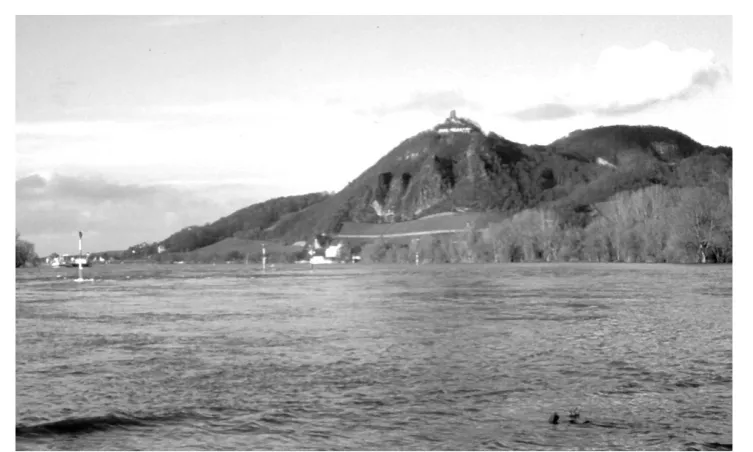
Following this rationale, humans have created along their coevolution with environment, a cultural landscape. According to Mark McDonnell and Steward Pickett11 , humans, as other species, participate at structures, processes and change of ecosystems. Through the biodiversity of human species and cultural variety, we generate a net of bio cultural relations that diversify and are themselves diversified by the heterogeneity of landscapes and ecosystems in which they develop. Recent studies have shown that landscapes initially considered totally natural and uninfluenced by human culture are actually cultural landscapes that have either been created by man or modified during human activities.12 In Europe, UNESCO adopted in 2005 the concept of “cultural landscape” as an integral part of the international effort to overcome “one of the most pervasive dualisms in Western thought – that of nature and culture.”13 This type of initiative has however a long history in Europe. According to the same Ricardo Rozzi and Alexandria Poole14, the first protected landscape was settled in 1830 in Germany at Drachenfels. In Drachenfels, beginning of the XIX-th century, the remains of an old castle south of Bonn near Rhine were jeopardised by the construction of a pier on the base of the hill (figure 1).15
6 Luisa Maffi, “Linguistic, Cultural, and Biological Diversity” în Annual Review of Anthropology, Vol. 34, pp. 599-617, cited
in Ricardo Rozzi, Alexandria Poole, op. cit.: 54.
7 Jonathan Lohn and David Harmon, “A Global Index of Biocultural Diversity” in Ecological Indicators, Vol.5, pp. 231-241,
cited in Ricardo Rozzi, Alexandria Poole, op. cit.: 54.
8 Victor M. Toledo, “Ethnoecology: A Conceptual Framework for the Study of Indigenous Knowledge of Nature”, discourse
at the VII-th International Ethnobiology Congress, Athens, Georgia, USA, October 2000, cited in Ricardo Rozzi, Alexandria Poole, op. cit.: 54.
9 Luiza Maffi, op.cit.
10 Ricardo Rozzi, “Éticas ambientales latinoamericanas: raíces y ramas” in R Primack et al., Fundamentos de conservación
biológica: perspectivas Latinoamericanas, México City, México (Fondo de Cultura Económica), 2001, pp. 311-362, cited in Ricardo Rozzi, Alexandria Poole, op. cit.: 55.
11 Mark J. McDonnell, Steward T.A. Pickett (ed.), Humans as Components of Ecosystems. The Ecology of Subtle Human
Effects and Populated Areas, New York, Springer, 1993, in Ricardo Rozzi, Alexandria Poole, op. cit.: 55.
12 Ricardo Rozzi, Alexandria Poole, op. cit.: 56.
13 UNESCO – United Nations Educational, Scientific and Cultural Organization, Operational Guidelines for the
Implementation of the World Heritage Convention, Paris (UNESCO World Heritage Centre), 2005: 84, http://whc.unesco.org/archive/opguide05-en.pdf, accessed 09.02.2014.
14 Ricardo Rozzi, Alexandria Poole, op. cit.: 57.
15 Kurt Jax, Ricardo Rozzi, “Ecological Theory and Values in the Determination of Conservation Goals: examples from
Page 481
Figure 1. Drachenfels, the first protected area in Europe Source: K.Jax, R.Rozzi16
Part of the castle was already damaged but at that moment, according to Kurt Jax si Ricardo Rozzi, the area had acquired a special significance for the German identity and was declared “natural monument” (“Naturdenkmal”). The area was subsequently extended to surrounding hills and declared “natural protected area” (“Naturschutzgebiet”). Drachenfels Naturdenkmal was therefore protected in the sense of preserving a “home landscape” („Heimatschutz”)17,18
and not a wild landscape meaning actually the protection of the German cultural landscape.
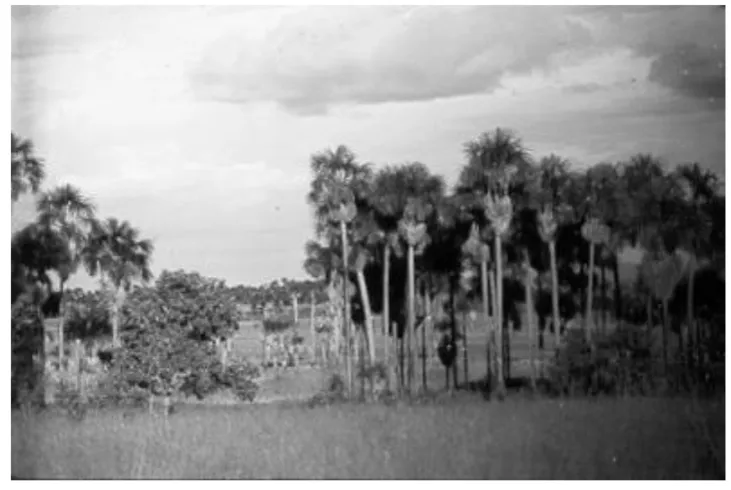
In the American continent starting 1970, researchers distinguished different patterns of vegetation in the Amazonian forest. Extensive plantations of fruits and nuts called “apêtê” (“forest islands” – see figure 2) obtained through arsons, planting and transplanting created vegetal mosaics and access tracks that enable changes in local flora and fauna. Kayapo Indians that created these islands, master complex agricultural procedures and poses knowledge on humidity and soil fertility, microclimates and plant varieties. The good management of these areas depends not only on the knowledge plant cultivation requires but also on the appropriate succession of plants required to attract animals in the area. The knowledge Kayapo indigenes master is today necessary to plan deforestation programs and afforestation of areas already deforested. Important areas in the Amazonian forest previously considered virgin, had thus to be reinterpreted as “cultural landscapes”. According to Michael Heckenberger19 and Charles Mann20, extended agricultural areas, open lands, clay hills, and covered swamps may be considered “cultural landscapes.”21
16 Kurt Jax, Ricardo Rozzi, op. cit.
17 Raymond Dominick, The Environmental Movement in Germany. Prophets and Pioneers 1871-1971, Bloomington, Indiana
University Press, 1992.
18 Andreas Knaut, “Zurück zur Natur! Die Wurzeln der Ökologiebewegung”, Jahrbuch für Naturschutz und
Landschaftspflege (supplement), Bonn, Vol. 1, 1993.
19 Michael J. Heckenberger et al., “Amazonia 1492: Pristine Forest or Cultural Parkland?”, Science, Vol. 301, pp. 1710-1714. 20 Charles Mann, 1491. New Revelations of the Americas before Columbus, New York, Alfred A.Knopf, 2005.
Page 482
Figure 2. „Apêtê”, forest islands created by man in the Amazonian forest Source: Jose Fragoso22
According to Jerry Moore23, Inca civilization built as early as 10,000 years ago, multiple cultural landscapes on the high hills of the Andes to trade routes low lands. Aymara, Quechua and Mestizo populations, use these lands nowadays.
3. NOT PREDICTIONS, JUST SCENARIOS
We cannot predict the future of agriculture as predictions tend to go wrong. A better preparedness for the future may mean avoiding presentism and adopting a more explicit, contestable and flexible sense of future. This type of necessary systemic thinking takes into consideration different worldviews starting from present megatrends. According to Freija van Duijne24, the main megatrends shaping the future are:
- Increasing population up to 9 billions in 2050; - Changing diets (from vegetarian to meat diets); - Global warming;
- Aging population, aging framers; - Robotised economy;
- Global trade rules;
- New philosophies of growth.
22 Jose Fragoso in Ricardo Rozzi, “Éticas ambientales latinoamericanas: raíces y ramas”, Ricardo Rozzi et al., Fundamentos
de conservación biológica: perspectivas Latinoamericanas, México City, Fondo de Cultura Económica, 2001, pp. 311-362, cited in Ricardo Rozzi, Alexandria Poole, op. cit.: 56.
23 Jerry Moore, Cultural Landscapes in the Ancient Andes: Archaeologies of Place, Gainsville, University of Florida Press,
2005.
24 Freija van Duijne, “The Future of Agriculture: Where will we be in 10 years time?”, Informa Conference, Berlin, February
Page 483
Starting from these main megatrends, Freija van Duijne drafts two archetype scenarios built by futurologists for the economic structure of 2040 horizon:
- Global efficiency; - Urban connected.
3.1 Global efficiency
This scenario builds around efficient production systems and low prices with a primary focus on economic growth, privatized knowledge, Big Data analysis and global governance systems. Future agriculture may develop large-scale production systems managing plant breeding, seed treatment and pest control through a mix of bio control and softer synthetic chemistry. Public opinion expressed by a powerful media connectivity and global network opposes the use of classical chemicals and GMO. Access of powerful Research & Development companies to advanced technologies insures uniform and rapid application of modern pest control techniques, improved soil management and maximal use of biomass. Biologic control still faces an important dose of reluctance due to perishability, high costs and lack of long-term experience, their mode of action also requiring smart agro-logistics and advanced agricultural knowledge. Risks arising from this global approach include unequal access to technologies due to costs and supplier relationships and large-scale impact of any unwanted side effects (fragility of the systems).
Erosion and soil damage because of human agricultural activity is however not a new phenomena. Recent studies25 place the first examples of soil erosion in Anthropocene, at the beginning of Neolithic Revolution approximately 10,000 BC. During Roman Empire, extended areas in Europe have been deforested with consequences seen today in Italian Apennines, Greek Peloponnesus and Spain.26 These “anthrosols” - defined in jargon as soils transformed through prolonged human agricultural practices - are also visible in Netherlands, North of Germany and Denmark. Starting as early as Middle Ages, generations of farmers used to cut and peel the upper soil layer dense in vegetation and use it as bed in stables. After being fertilised with urine and dejections, this soil was spread as fertilizer on cultivated fields. Practice continued until 1930 when farmers started to use mineral fertilizers on a large scale. The plough that turns the furrow always on the right created ridges and depressions still visible on abandoned croplands. Traces of the recent wars and abandoned minefields, all reflect recent human history.
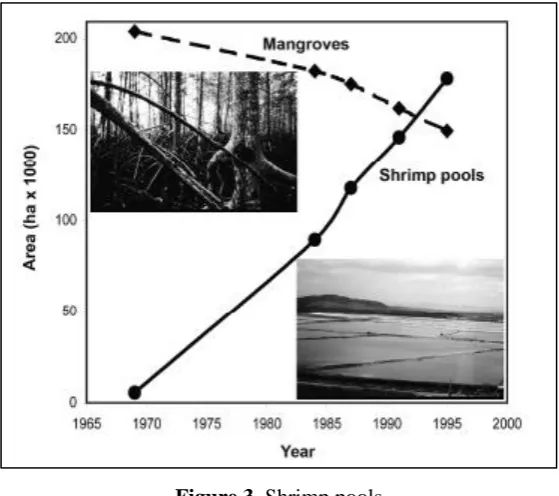
Even today, numerous global rural development projects overlook ecological and social problems that derive from habitats and habits disruptions of local communities. One of the most cited example is that of shrimp cultivation in Ecuador. Rozzi and Poole27 describe the impact the two species of shrimp (Penaeus stylirostris and P. vannamei) had on environment and natives starting 1968 and until 2000. Shrimp pools surpass in surface the mangrove areas in the coastal zone of Ecuador (Figure 3).
Shrimp industry caused an increased level of sediments and serious perturbation of mangroves microclimate and implicitly of the local fauna growing in these ecosystems. The same industry discharged contaminated water and diverted the course of rivers affecting the life of natives depending on costal fauna for survival. Social disturbances led to enrichment of a few and a rose the number of poor people. With governmental support, shrimp industry continued to affect anglers’ life in the area diminishing fish population growing in the mangrove forest. Following the often dramatic opposition of “concheras”women (women that collect edible shells “conchas” for subsistence), government banned in 1999 mangrove cutting in Ecuador.
This example shows how rapid planet bio climates degrade but also gives reason to believe that integrating solutions between social and environment politics are available. Furthermore, local
25 Markus Dotterweich, “The history of human-induced soil erosion: Geomorphic legacies, early descriptions and research,
and the development of soil conservation – a global synopsis”, Geomorphology, 10.07.2013: 3.
26 Soil Atlas 2015. Fact and figures about earth, land and fields, Heinrich Böll Foundation, Berlin, AZ Druck und
Datentechnik, 2015: 16.
Page 484
populations are sensitive to environment changes and often regard the notion of “good life” closely interconnected with natural equilibrium and not with economic indicators.
Figure 3. Shrimp pools Source: Suárez and Ortiz28
The same study of Rozzi and Poole offers numerous examples of environment disruptions among which: monocultures of exotic trees and salmon farms in Chile, Peruvian anchovy farms, oil companies in tropical Columbian forest and dams building in Brazil.
In summary, the critical points of such global development plans identified by Rozzi and Poole are29: - Economic growth does not help natives, on the contrary, megaprojects negatively affect their
quality of life and natives oppose them. Example cited is the Pantanal Hidrovia project in which Paraguay-Parana river would be dredged to let large ships pass from Buenos Aires to Bolivia, Paraguay, and Brazil potentially jeopardizing the habitat of both numerous species and Indian tribes;
- Macroeconomic indicators are not relevant as income concentration is not linear. In Peru for example, the richest 20% of the inhabitants receive over 60% of the national income and the poorest 20% receive less than 3%;
- Products resulting from large-scale exploitations are not destined to locals but to remote markets. According to Suárez and Ortiz30 over 90% of the shrimp production is exported from Ecuador to USA (51%), Japan (27%) and European Union (17%);
- Major differences exist between legal frame and reality, marked by corruption; - Monocultures reduce biodiversity;
- Short-term economic projects produce rapid socio-ecologic degradation.
28 Luis Suárez and Doris Ortiz, “Producción de camarones y destrucción de manglares en Ecuador”, Ricardo Rozzi et al.,
Fundamentos de conservación biológica: perspectivas Latinoamericanas, México City, México (Fondo de Cultura Económica), 2006, pp. 195-197, cited in Ricardo Rozzi, Alexandria Poole, op.cit.: 61.
Page 485
In their study, Rozzi and Poole31 conclusively mention numerous examples of such degradations: “[...] tropical forests have been replaced by large-scale plantations of sugar cane, banana, and cotton in South, Central, and North America, respectively; large-scale ranching of cattle and sheep also crossed the American continent from Tierra del Fuego to North America; silver and gold fever existed as much in Patagonia, Potosí, Ouro Prêto, Zacatecas, and Chihuahua as in California [...]. These are not mere cases from the past. Today in South America extensive mono-specific plantations of Eucalyptus in Colombia, southern Brazil, and Chile are replacing native forests; vast areas of native tropical and temperate forests are cleared and burned for ranching activities; mercury pollution caused by the amalgamation of gold in tropical regions such as the Amazon is affecting the health of aquatic invertebrates, fish, and humans downstream from gold-mining activities32[...]. Historical analyses of these and similar cases throughout South America show repeatedly that they have been associated with ephemeral economic booms that left behind degraded social and ecological environments.”
3.2 Urban connected
Focused primarily on sustainability for future generations, this second scenario favours artisanal quality through revival of craftsmanship and encouragement of local specificities. Citizens participate to local networks accessing information from open sources, ready to participate, experiment, share and follow. Training and local value chains provide on a small scale the introduction of novelty and bio control on a “learning by doing” principle. Resilient agricultural and farming systems oppose even more to “chemicals” but encourage high tech solutions and monitoring systems as Big Data insights and smart iPhone applications. Biological products promoted add to the local business identity. Strength of the scenario resides from accepted and integrated diversity and the sense of responsibility derived from the moral function of proximity. Experimentation however can be hurried, misunderstood and little exploited (“doing but not learning”).
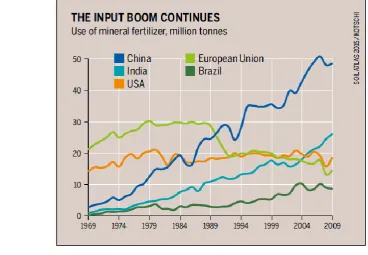
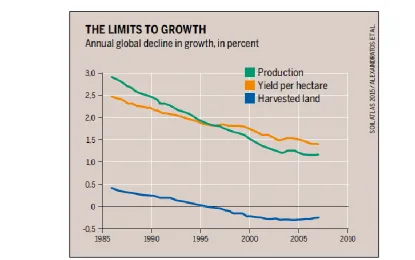
To better integrate this scenario into present reality, it is useful to briefly analyse the transformation traditional rural communities worldwide have undergone in the last decades. Development of agriculture has been dominated by the modernization of productive systems. The purpose of this modernization was the increase and intensification of production to adapt to the new life style and the new urban-industrial diets. The ways of like and traditions in rural communities were often ignored or considered old-fashioned of archaic. Reaction to change in rural traditional environment has often been associated with a reduced level of acceptance to novelty. Although the term “tradition” is still associated to terms like “passivity and resistance to change”, macro sociological studies showed that there are “many roads of modernization”33 conditioned by the different development processes in different cultural contexts. Outside the academic approach, social change does not stop to the so-called “modernisation” process or transition process. According to Elwert and Bierschenk34, “These societies have specific ways of creating innovations and transforming and incorporating innovations brought from outside”. Social pressure on food production and the seemingly paradoxical stagnation of agricultural production in spite of mechanisation (see figure 4 and 5), led to more profound studies on live and habits of farmers, in both developed and in transition countries. Some of these studies show that under some conditions, maintained agricultural traditions were the element that led to the successful adaptation to both human and environment requirements. In an analyse of cultural tradition
31 Ricardo Rozzi, Alexandria Poole, op.cit.: 65.
32 Jean Remy, Davee Guimarães et al., “Mercury in Human and Environmental Samples from Two Lakes in Amapá,
Brazilian Amazon”, Ambio, Vol. 28, 1999, pp. 296-301, cited in Ricardo Rozzi, Alexandria Poole, op.cit.: 65.
33 Alain Touraine, “Modernity and cultural specificities”, International Social Science Journal, 1988, nr. 40, p. 444
(443-457), cited in Hans Pongratz, “Cultural Tradition and Social Change in Agriculture”, Sociologia Ruralis, 1990, vol. XXX-1, http://epub.ub.uni-muenchen.de/5314/1/pongratz_5314.pdf, accessed 16.08.2013.: 9.
34 Georg Elwert and Thomas Bierschenk, “Development aid as an intervention in dynamic systems. An introduction”,
Page 486
and social change in agriculture, Hans Pongratz35 argues that three theories can synthesize the process of adaptation of rural communities to the global changes induces by modern society:
- Rural community has changed and the “differences between urban and rural communities had become blurred to a large extent"36, changing its fundamental traits and values;
- Rural community has changed to a "new historical type"37 maintaining the essence;
- Rural community has structurally changed and the process of adaptation to the new structure allows but little and limited autonomy. A new synthesis is thus created, a "rural synthesis between individual freedom and social obligation, and between progressive and conservative elements."38
Figure 4. Input boom in agriculture Source: Soil Atlas 201539
35 Hans Pongratz, “Cultural Tradition and Social Change in Agriculture”, Sociologia Ruralis, 1990, vol. XXX-1,
http://epub.ub.uni-muenchen.de/5314/1/pongratz_5314.pdf, accessed 16.08.2013.
36 Heinrich Kötter, “Die Gemeinde in der ländlichen Soziologie”, R. König, Soziologie der Gemeinde, Opladen,
Westdeutscher Verlag, 1956, p. 23, citat în Hans Pongratz, op. cit., p. 6.
37 Georg Weippert, “Grundfragen der ländlichen Soziologie” în H.-J. Seraphim, Deutsche Siedlungs- und Wohnungspolitik,
Köln-Braunsfeld, Verlagsgesellschaft Rudolf, 1956, p. 201, citat în Hans Pongratz, op. cit.: 6.
38 Gerhard Wurzbacher and Renate Pflaum, Das Dorf im Spannungsfeld industrieller Entwicklung, Stuttgart, Enke, 1954, p.
290, citat în Hans Pongratz, op. ci.: 7.
Page 487
Figure 5. Global evolution of agricultural production Source: Soil Atlas 201540
In this constant effort to adapt and under the increasing economic pressure, starting with 1970, small and medium farmers in Europe have modernised the equipment and purchased constantly last generation inputs. Farms and agriculture have not been abandoned although the investment – as shown41 - was done outside the profit judgment and based on the traditional attitude of rural buyer and seldom amortized. buying criteria were the price farmer could afford, reduction in workload, “independence” towards other organisms and personal prestige. This traditional approach was apparently the element that supported small farmers in their survival. In their study on German farmers, Inhetveen and Blasche42 note that:
“Traditionalism can be considered as one of the most basic reasons why small holdings have managed at all to survive the attacks on their existence that arose from their integration into the capitalist economic system.”
These observations lead to the conclusion that in the information age, rural communities have found their own way of modernization: not completely rejected the attack of industrialization but also did not completely abandon cultural traditions. To these we might add that, as previously mentioned, despite repeated fertilization, agricultural production knows very little growth in the last decade (see figures 4 and 5).
Another aspect of high significance in this scenario is the creative potential of small communities. In the general context of the XXI-st century, the creativity necessary to innovate is one of the most precious human capitals. Research in itself has undergone important changes in the last 50 years. The dichotomist division “science for science” versus “applied science” has evolved into a much more flexible and complex concept. In the modern theory of innovation, the process is no longer linear but rather complex and function of multiple parameters.
40Ibidem.
41 Hans Pongratz, op. cit.: 7.
42 Heide Inhetveen and Margret Blasche, Frauen in der kleinbäuerlichen Landwirtschaft, Opladen, Westdeutscher Verlag,
Page 488
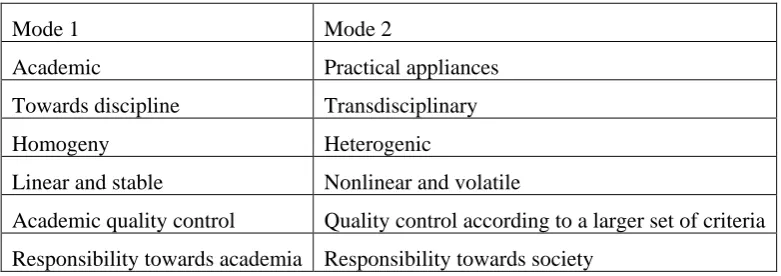
Michael Gibbons43 has a named this transition passing from Mode 1 to Mode 2 (see table 6):
Table 6. Science in Mode 1 and Mode 2
Mode 1 Mode 2
Academic Practical appliances
Towards discipline Transdisciplinary
Homogeny Heterogenic
Linear and stable Nonlinear and volatile
Academic quality control Quality control according to a larger set of criteria
Responsibility towards academia Responsibility towards society
Innovation becomes a cooperation process or open innovation, a process of social innovation. This process has practically no end as collaboration brins permanent changes. Smith et al.44 define the process as follows:
“By and large the systemic perspective on innovation as a socio-economic and technological process has advanced - to some degrees also [via the innovation management literature] in firms- that any innovation success [...] should rather be viewed as a by-product along the innovation journey than as an end result. Such journeys are characterised by numerous setbacks along the road. Innovation management is not a control problem, it should be seen as one of orchestrating a highly complex, uncertain and probabilistic process of collective action in a systemic context.”
In rural development, there are several approaches of innovation. Sustainable and multifunctional development is the core of most of these approaches. This new paradigm stresses the equilibrium between the use of local resources and community implication in local development projects. From the strictly economic approach, social responsibility and welfare, environment integration and community implication are also considered. Social responsibility, the new dimension of social innovation, must consider planet recourses, costs and durability.
The theoretical concepts mentioned above are particularly important as they reflect a practical reality: in rural communities, learning as a vital activity for any living creature, is “emulative learning” in contrast with urban spaces in which “imitative learning” predominates. The concept were coined by Tomasello through the “the ratchet effect” concept.45
Emulative learning is oriented toward environment adaptation and reaching the purpose, meaning that from a variety of action possibilities, the most efficient one will be selected. This type of learning is typical for non-human primate groups and relatively small human communities, characterized by a stabil environment and simple social relations. In these communities, reaching the purpose through the most economic means is more important than understanding the intentions of the others.
Imitative learning is the characteristic of human species along the cultural accumulation process in millennia. Typical for complex and unstable communities, the purpose of imitative learning is
43 Michael Gibbons, „Science’s new social contract with society”, Nature 102, 1999,
http://www.nature.com/nature/journal/v402/n6761supp/full/402c81a0.html, accessed 27.09.2015, cited in EU SCAR, Agricultural knowledge and innovation systems in transition – a reflection paper, Brussels, 2012: 18.
44 Adrian Smith et al., „Innovation studies and sustainability transitions: The allure of the multi-level perspective and its
challenges”, Research Policy, 2010, 39, p. 10, cited in EU SCAR, Agricultural knowledge and innovation systems in transition – a reflection paper, Brussels, 2012.
45Michael Tomasello et al., “Ratcheting up the ratchet: on the evolution of cumulative culture”, Philosophical Transactions
Page 489
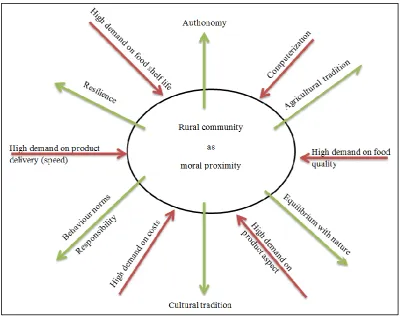
adaptation to social complex environment and understanding the actions of the others. To this purpose, imitation is much more suitable and reaching a target of preforming a task becomes secondary. Another particularly important trait of this second scenario is the necessary process of enhancing human sense of responsibility through the power of community regarded as moral proximity. This trait is important, as globalization has brought the separation of responsibility from the essential aspects of everyday life. The moral function of proximity (responsibility to community and environment) might prove one of the few factors to counter the exogenous pressure of consumerism upon small rural communities (see figure 7).
Figure 7. Rural community as moral proximity
According to Goodsell:46
“Community is a form of social organization wherein the social interactions necessary for the reproduction of daily life occur within the boundaries of moral proximity. The overriding problem of modernity—the loss of community—allows for the removal of these interactions from that proximity. In late-modern life, this problem has only been exacerbated, as the globalization of economics has provided a context in which individuals’ mundane daily actions sometimes result in singularly immoral consequences on a global level for which the individuals feel no responsibility.”
Community studies show how people draw moral lessons from their natural environment47 and abstract context drawing conclusions on certain behaviours.
46 Todd Goodsel et al., Community as Moral Proximity: Theorizing Community in a Global Economy,
http://www.ag.auburn.edu/~bailelc/Goodsell.pdf, accessed 10.05.2014.
Page 490
Furthermore, in the era of globalization, the strongest elements of rural community scholarship (solidarity, belonging, density of an acquaintanceship) need be extended beyond the rural insularity and its geographical borders as for all rural communities worldwide, there are the same moral universal values at play.48
4. CONCLUSIONS
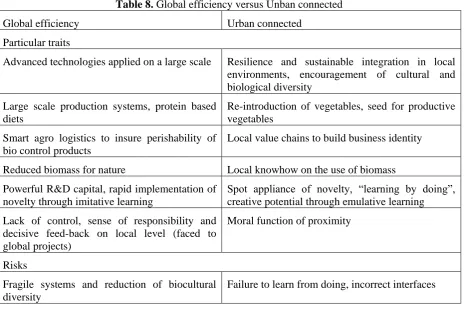
In a short comparison, the two scenarios display the following particular traits (Table 8):
Table 8. Global efficiency versus Unban connected
Global efficiency Urban connected
Particular traits
Advanced technologies applied on a large scale Resilience and sustainable integration in local environments, encouragement of cultural and biological diversity
Large scale production systems, protein based diets
Re-introduction of vegetables, seed for productive vegetables
Smart agro logistics to insure perishability of bio control products
Local value chains to build business identity
Reduced biomass for nature Local knowhow on the use of biomass Powerful R&D capital, rapid implementation of
novelty through imitative learning
Spot appliance of novelty, “learning by doing”, creative potential through emulative learning
Lack of control, sense of responsibility and decisive feed-back on local level (faced to global projects)
Moral function of proximity
Risks
Fragile systems and reduction of biocultural diversity
Failure to learn from doing, incorrect interfaces
Man must be regarded as an integral part of the ecosystems he inhabits, changing and being changed in the process. Whichever scenario we might consider, it must be mastered by conscience. The human level of comprehension needs enhancement in order to coherently and timely understand and apply complex and rapidly changing technologies.
48 See the concept of sameness of all rural communities worldwide, in original "from the westernmost reaches of Europe, in
Page 491 REFERENCES
Bell, MM 1994, Childerley: Nature and Morality in a Country Village. Chicago: University of Chicago Press.
Dominick, R 1992, The Environmental Movement in Germany. Prophets and Pioneers 1871-1971, Indiana University Press, Bloomington.
Dotterweich, M 2013, “The history of human-induced soil erosion: Geomorphic legacies, early descriptions and research, and the development of soil conservation – a global synopsis”, Geomorphology, 10.07.2013.
Duijne van, F 2016, “The Future of Agriculture: Where will we be in 10 years time?”, Informa Conference, February 2016, Berlin.
Elwert, G & Bierschenk, R 1988, “Development aid as an intervention in dynamic systems. An introduction”, Sociologia Ruralis, 28, pp. 99-112.
Fragoso, J 2001, “Éticas ambientales latinoamericanas: raíces y ramas”, in Ricardo Rozzi et al., Fundamentos de conservación biológica: perspectivas Latinoamericanas, Fondo de Cultura Económica, México City, pp. 311-362.
Heckenberger, MJ. et al., “Amazonia 1492: Pristine Forest or Cultural Parkland?”, Science, Vol. 301, pp. 1710-1714.
Hiwaki, K 2011, Culture and Economics in the Global Community. A Framework for Socioeconomic Development, Gower, Surrey.
Jax, K & Rozzi, R 2011, “Ecological Theory and Values in the Determination of Conservation Goals: examples from Temperate Regions of Germany, USA and Chile”, Revista Chilena de Historia Natural, Vol. 77, pp. 349-366.
Knaut , A 1993, “Zurück zur Natur! Die Wurzeln der Ökologiebewegung”, Jahrbuch für Naturschutz und Landschaftspflege (supplement), Vol. 1, Bonn.
Kötter, H 1956, “Die Gemeinde in der ländlichen Soziologie”, R. König, Soziologie der Gemeinde, Westdeutscher Verlag, Opladen.
Levinas, E 1961, “Totalité et infini: essai sur l’extériorité”, La Haye, Paris.
Lohn, J & Harmon, D 2011, “A Global Index of Biocultural Diversity” in Ecological Indicators, Vol.5, pp. 231-241.
Maffi, L 2011, “Linguistic, Cultural, and Biological Diversity” in Annual Review of Anthropology, Vol. 34, pp. 599-617.
Mann, C 2005, 1491. New Revelations of the Americas before Columbus, Alfred A.Knopf , New York. McDonnell, MJ & Pickett STA (ed.) 1993, Humans as Components of Ecosystems. The Ecology of Subtle Human Effects and Populated Areas, Springer, New York.
Pongratz, H 1990, “Cultural Tradition and Social Change in Agriculture”, Sociologia Ruralis, vol. XXX-1, accessed 16.08.2013, http://epub.ub.uni-muenchen.de/5314/1/pongratz_5314.pdf.
Redfield, R 1956, Peasant Society and Culture, University of Chicago Press, Chicago.
Remy, J, Guimarães, D et al. 1999, “Mercury in Human and Environmental Samples from Two Lakes in Amapá, Brazilian Amazon”, Ambio, Vol. 28, pp. 296-301.
Page 492
Rozzi, R 2001, “Éticas ambientales latinoamericanas: raíces y ramas” in R Primack et al., Fundamentos de conservación biológica: perspectivas Latinoamericanas, México City, México (Fondo de Cultura Económica), pp. 311-362.
Scruton, R 1999, The Great Philosophers: Spinoza, Routledge, New York.
Soil Atlas 2015. Fact and figures about earth, land and fields, Heinrich Böll Foundation, AZ Druck und Datentechnik, Berlin.
Suárez, L & and Ortiz, D 2006, “Producción de camarones y destrucción de manglares en Ecuador”, in Rozzi, R et al., Fundamentos de conservación biológica: perspectivas Latinoamericanas, Fondo de Cultura Económica), México City, México, pp. 195-197.
Toledo, VM 2000, “Ethnoecology: A Conceptual Framework for the Study of Indigenous Knowledge of Nature”, discourse at the VII-th International Ethnobiology Congress, October 2000, Athens, Georgia, USA.
Touraine, A 1988, “Modernity and cultural specificities”, International Social Science Journal, nr. 40, pp. 443-457.
UNESCO – United Nations Educational, Scientific and Cultural Organization, Operational Guidelines for the Implementation of the World Heritage Convention, Paris (UNESCO World Heritage Centre), 2005: 84, accessed 09.02.2014, http://whc.unesco.org/archive/opguide05-en.pdf.
Weippert, G 1956, “Grundfragen der ländlichen Soziologie” in H.-J. Seraphim, Deutsche Siedlungs- und Wohnungspolitik, Verlagsgesellschaft Rudolf, Köln-Braunsfeld.