Wavelet trees: a survey
Christos Makris1
1Department of Computer Engineering and Informatics,
University of Patras, 26500 Patras, Greece [email protected]
Abstract. The topic of this paper is the exploration of the various characteristics of the wavelet tree data structure, a data structure that was initially proposed for text compression applications but has found a plethora of other uses in text indexing and retrieval. Issues concerning the efficient maintenance of the structure, plus its handling in various applications are explored. Our main aim is to provide to computer science researchers that would like to explore the specific area, an up-to-date comprehensive material covering a wide range of applications. This kind of up-to-date survey is missing from the current bibliography and we hope that it will help young researchers to get familiar with the notions of this research area.
Keywords: information retrieval, text algorithms, data structures.
1.
Introduction
The constant increase in the volume of transmitted and stored data makes imperative the design of efficient algorithms and data structures for handling them. The field of data and text compression has been traditionally involved in providing tools that could face effectively the problems emerging in large scale information retrieval applications. Moreover in the time course of the previous decade, a challenging and interesting issue has flourished: self-indexing data structures, that is data structures that do not need the storage of the source text to operate, but embed in them both the text, and the indexer that operates on it. Self indexed data structures move the compression target from the source text to the indexing module and permit further functionalities.
The basic theme in the present paper is to examine the various issues involved and the basic characteristics of the specific data structure, dealing with a set of selected applications. There exists various works [38], [51], [68] exploring different aspects of the wavelet tree data structure however there does not exist in the literature an up to date survey covering its plethora of applications and referring to the till now space and time complexities bounds for them, in order to be provided as a roadmap to young researchers entering the area. We aim to cover this gap in the scientific literature by condensing all relevant information in one single reference, appropriately putting all the pieces together, thus helping young researchers and enter them smoothly in the notions of the specific scientific area.
2.1 General Characteristics [87], [90], [12], [37], [38],
[14], [31], [88], [14], [75], [62], [20]
2.2 Practical Issues [68], [31], [49], [28]
3.1 Static solutions [79], [25], [99], [92] [103],[90]
[98], [100], [66], [55], [56] [45],[57], [28], [36], [8],
[6]
3.2 Dynamic solutions [73], [86], [70], [84], [86], [59], [85], [97], [71]
4.1. Reorganizing text [15]
4.2. Compressing highly repetitive sequences
[91], [108]
4.3. Compressing permutations
[10],[6]
4.4. indexing efficiently images [89] LZ compression, [4] [104] Web graph compression [30], [29], [17]
5.1 Spatial searching
[18]
5.2 Bidirectional search [106], [109], [110]
5.3 Binary relations
[5] [7]
5.4 Range quantile, enumeration, document retrieval, top k retrieval [51], [53], [93], [111], [11], [81], [76], [33], [96], [52], [74]
5.5 Range next value, range
intersect [51], [113], [114]
5.6 Posting lists [51], [95],
[3], [2]
5.7 XML retrieval [51], [13], [1],
[42], [41] Description and main issues
Wavelet trees and their use as a rank and select structure
Applications in information handling Applications in compression
Fig. 1. A tree diagram of the paper’s structure
distinct symbol, and that the length of the sequence is n. That is, the produced sequence S, is of the form, S=p1,p2,…, pn where pi ϵ Σ, and Σ
denotes the alphabet of symbols. Then the wavelet tree can be used to support two elementary operations: (1) locate the number of occurrences of a given page, in a given position of the sequence (starting counting from the beginning of the sequence), and (2) locate the position in the sequence of the i-th occurrence of a given page. Using these two elementary operations, it is possible to answer interesting queries in the available sequence, such as counting how many times a given page was visited in a period of time, find the most visited pages, and queries of similar nature that could be a value to Web designers and/or Web miners. It would be helpful for the reader to have this simple example as a working exercise while reading the paper, and find out how wavelet trees efficiently handle the described operations.
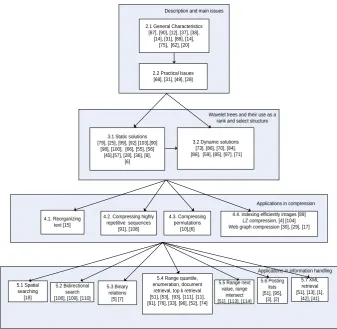
We organize the whole material in the following sections: in section 2 we present the main characteristics of the structure, in section 3 we describe its connection with rank and select structures, in section 4 we describe various of its applications in data compression, and in section 5 we describe its main applications in information handling (information retrieval, data retrieval and spatial objects retrieval). Finally in section 6 we conclude with discussion and open problems. In figure 1 we provide the reader with a tree diagram depicting the structure of the paper, in relation with the various application areas that are covered and the references used in them.
Before proceeding and in order to make the paper self contained we provide some definitions that will be used continuously in the sequel. Consider a sequence S of n symbols from an alphabet Σ={c1,…,cσ} of
cardinality σ, we call as entropy H the sum1:
1
1 log
i i
i p p H
where pi, is the probability of appearance in S, of the i-th symbol in the
alphabet. According to the coding theorem of Shannon [107], this notion of entropy represents a lower bound to the average numbers of bits needed to represent each symbol in S, provided that the symbols appear independently. This probabilistic notion of the entropy that takes into account the statistical nature of the source, is usually replaced in the scientific literature by the most practical notion of empirical entropy.
In particular the zero-order empirical entropy of S is defined as:
i
c i
i n
n n n S H
H0 0( ) log
where ni is the number of appearances of character ci in S. If we take also
into account the context of appearances this definition can be extended to the so called k-th order empirical entropy. For a string wΣk let us denote with wS the subsequence of characters that follow2 w in S, then the k-th order
empirical entropy of S, is defined as follows:
1 Throughout the paper, the symbol log, will denote base 2 logarithms.
k w S S kk w H w
n S H
H ( ) 1 | | 0( )
Both zero-order and the k-th order empirical entropy are more practical measures when one needs to lower bound the compressibility of a text (the first when considering symbols as independent from each other, and the second, when taken into account the size k context, where the symbols appear), since they do not need to make any assumption concerning the probabilistic nature of the source of the text.
A related notion is the modified empirical entropy, a notion that is helpful for highly compressible text [39]. The zero-order modified empirical entropy is defined as:
otherwise (S) H (S) H S S S S S H o 0 0* (1 log| |)/| | if| | 0 and 0
0 | | if 0 ) (
A set Sk of substrings of S of length at most k is termed a suffix cover if
any string in Σk
has a unique suffix in Sk; in this case define:
k k S w S SS
w
H
w
S
S
H
|
|
(
)
|
|
1
)
(
*0*
Then, the k-th order empirical entropy of S is defined as:
). ( min ) ( * * S H S H k k S S k
2.
Description and Main Issues
2.1. General characteristics
The wavelet trees have their roots in a range searching data structure described in a paper by Bernard Chazelle [20] and were introduced as a distinct structure in [64], as a component of a self-indexed compressor based on suffix arrays, and afterwards a set of other papers explored and extended their use (the majority of the papers referred to in the bibliography listing). A wavelet tree acts basically as a mechanism that permits the efficient implementation of specific operations on sets of objects from non-binary alphabets, via the use of the respective bit vector operations on sets of objects from the binary alphabet, with a logarithmic slowdown in the attained performance.
as a general tool for reducing computationally the compression of a string from an arbitrary alphabet to the compression of binary strings.
a b c d e f g h
abcdabcdefefefghghab 0000000011111111100
abcdabcdab 0011001100
efefefghgh 0000001111
ababab 010101
cdcd 0101
efefef 010101
ghgh 0101 v
r
u
w
Fig. 2. The wavelet tree for S=abcdabcdefefefghghab, Σ={a,b,c,d,e,f,g,h}
A wavelet tree can act both as a compression mechanism on its own, and as a component of a compression algorithm; that is a wavelet tree can simply store a text by itself [38] and provide both an indexing and a compression mechanism or it can be used as a data structural component storing auxiliary information for a compression algorithm [4], [94].
More analytically consider a sequence S, of length n where the elements belong to an alphabet Σ, of size σ. A wavelet tree T is a static complete binary tree whose leaves store the symbols of the alphabet Σ in order from left to right (that is the number of leaves of the tree is equal to the size of the alphabet) and where each internal node v corresponds to a subsequence Sv
of S that is stored through a binary vector Bv. The subsequence Sv is formed
by the symbols of the sequence S that are stored in the subtree with root v, while the binary vector Bv has the same length as Sv, and each of its
positions corresponds to a distinct symbol in the specific subsequence, such that Bv[i]=0 if the i-th symbol of Sv is stored in the left subtree of v, and Bv[i]=1
if the i-th symbol of Sv is stored in the right subtree of v.
If we state this recursively each subtree Tv of T is itself a wavelet tree for
Sv. As an example see figure 2 for an exposition of a wavelet tree for the
In each node of the wavelet tree, the bitvector Bv is stored in a structure
suitable for accessing any of its stored elements, and answering efficiently rank and select queries [25], [79], [99], [103]. More analytically, rank and select queries on bit vector are defined as follows:
Bv(i), for returning the i-th bit of the bit vector Bv,
rankb(Bv,i), that returns the number of times bit b appears in the prefix
of Bvconsisting of its i first symbols and
selectb(Bv,i), that returns the position of the i-th appearance of bit b in
Bv.
Attaching these structures to each node we can use the wavelet tree to answer rank and select queries for any symbol in the sequence S, with a time complexity that is equal to the depth of the tree (that is logσ) multiplied by the time to perform a rank and select query in a bit vector of size at most n. Note, that the rank and select queries for S are defined similarly to their binary counterparts that is:
rankc(S,i), return the number of times symbol c appears in the prefix of
Sconsisting of its i first symbols, and
selectc(S,i), that returns the position of the i-th appearance of symbol c
in S)
In order to answer the rank query rankc(S,i), we start from the root r of the
wavelet tree and if c is stored in the right child we compute as new i the value rank1(Br,i) otherwise the new i is the value rank0(Br,i), and the procedure
continues till reaching a leaf. On the other hand and for the query selectc(S,i)
we move bottom up, starting from the leaf corresponding to c, and if it is a right child the corresponding position to its parent v is select1(Bv, i) otherwise
it is select0(Bv,i); the procedure moves similarly upwards until reaching the
root, where the answer is reported.
We provide a toy example of how these algorithms work by treating queries rankd (S,9) and selectd (S,2). The procedure for rankd (S,9) starts at
r. Since d is stored in the left subtree, we compute rank0(Br, 9)=8, and we go
to v. Since d is stored in the right child of v, we compute rank1(Bv, 8)=4, to
locate the proper position in the right child and move to w, there d is stored as a leaf in the right child of w, and hence the answer is rank1(Bw,4)=2. In
order to answer selectd (S,2), we start from the leaf of the tree corresponding
to d and we move upwards. Since the leaf storing d is at the right child of w, the new position is select1(Bw,2)=4. Moving to v, since we come from the right
child the new position is select1(Bv,4)=8. Finally, at the root the seeked
position is select0(Br,8)=8.
If the bitvectors are implemented using the structure in [25], then the overall space complexity of the construction is nlogσ(1+o(1)) bits, while the time to answer a query is O(logσ). If we use for the implementation of the rank and select structure the construction described in [103] then the space complexity becomes entropy bounded by nH0(S)+O(nloglogn/logσn) bits, while the time complexity remains O(logσ).
searching applications are presented. We explore this connection, that was noticed also by various researchers, see e.g. [87], more deeply.
Therefore, consider a set of points in the xy-plane with the x- and y-coordinates taking values in {1,…,n}; assume without loss of generality that no two points share the same x- and y-coordinates, and that each value in {1,…,n} appears as a x- and y- coordinate. We need a data structure in order to count the points that are in a range [lx, rx] × [by, uy] in time O(logn), and
permits the retrieval of each of these points in O(logn) time. The structure proposed in [20] for this problem needs nlogn(1+o(1)) bits, and we will describe it as in the version provided in [87], which is simpler, and more clearly described; this structure is essentially equivalent to the wavelet tree. The structure is a perfect binary tree, according to the x–coordinates of the search points, with each node of the tree storing its corresponding set of points ordered according to the y-coordinate. In this way the tree mimics the distinct phases of a mergesort procedure that sorts the points according to the y-coordinate, assuming that the initial order was given by the x-coordinate. This construction takes O(nlogn) space, that can be reduced to nlogn(1+o(1)) bits by the functional approach introduced in [20] that principally states that each node of a data structure does not need to store the sets of points that correspond to it, but needs only to provide the means (functions) for computing them. Hence each node instead of the real points stores a bitmap Bv with Bv[i]=0 iff the i-th point in the subsequence mapped to
v belongs to the left child, otherwise Bv[i]=1. This bitmap is preprocessed, for
the computation of rank and select queries in constant time.
Using this repertoire of structures we can retrieve the identity of any point, giving a specific node, and a specified bit of its bit vector, by descending a path in the tree to a respective leaf by performing suitable rank queries; the time cost is O(logn). In order to count the points that are in the range [lx, rx] ×
[by, uy] we just need to find in the tree by two searches the O(logn) maximal
tree nodes that cover [lx, rx], and for each of these nodes perform a
subtraction in the result of two rank queries (for more details see [20] and [87]). If we do not want to count but also to retrieve the points we have to identify each of these points, paying an extra logarithmic term for each of them. The aforementioned construction, that works for distinct sequences can also be extended for handling arbitrary sets of points in a continuous space, as shown in [19] .
The connection between wavelet trees and range searching was more clearly depicted in [12] and in [37]. In [12] a solution was presented for storing n points with x- and y- coordinates from the rank space, using nlogn+o(nlogn) bits, supporting range counting in O(logn/loglogn) time and range reporting in O(klogn/loglogn) time, where k is the size of the output; a basic ingredient of this solution is a multi-ary wavelet tree. In [37] the entropy of the stored two dimensional set came into play. In particular consider a set of m points with x- and y- coordinates from the space {1,…n}; the “entropy” H of this set is
defined as the total number of the different possible grids that is: log .
2
m n
It was proved in [37] that there exists a representation of this set, that takes H+O(H) bits of space; the proposed representation employs a block partitioning of the points combined with wavelet trees for handling these partitions. The solution can answer range counting queries in O(log(n2/m)) time, range reporting queries in O(log2(n2/m)) time per reported element, while point selection queries require O(log2n) time. By taking into account the density of the involved rank space it is possible to have the various times reduced down to O(1) per reported element.
Wavelet trees have been mainly exploited as auxiliary structures for self-indexes based on the Burrows-Wheeler transformation [38], [40], [43], [44], [94]. In these algorithms it has been shown that indexing compressed text is reduced to performing rank and select operations in the sequence that is produced by applying the Burrows-Wheeler transformation on the text. Hence, these works have shown that the Burrows-Wheeler transform is not only useful for compressing a given sequence but it also allows to support search operations, if rank queries are supported over BWT. In these cases the binary vectors of the wavelet tree are compressed using run length encoded or gap encoding [38]. The application of run length encoding3 compresses the sequence to its k-th order entropy, while the gap encoding does not achieve analogous bounds. However it is possible to apply gap encoding in combination with the compression boosting technique of [39] and have a compression algorithm of size 2.2618|S|H*k(S)+log|S|+Θ(|Σ|
k+1
) bits, for any positive k, thus improving the bound achieved in [39] into an almost optimal result. It should be noted that if the wavelet trees store the initial sequence (not its Burrows-Wheeler transformation) then they can be considered as standalone general purpose compressors.
Concerning the performance of wavelet trees as standalone compressors, it was noted in [38] that their use reduces the problem of compressing a string to that of compressing a set of binary strings, with the specification of the set being determined by the topology of the underlying tree structure, and the coding of the alphabet symbols at the tree leaves. The authors pursue their remarks even further by introducing the paradigm of the generalized wavelet tree and noting that it is possible by pruning whole subtrees of the initial tree, to have a mixed compression strategy where only some strings are binary and the others use symbols that are compressed with general purpose order zero compressors (for example Huffman or arithmetic coding). The authors apply this pruning strategy, by developing a combinatorial optimization framework based on the notion of leaf covers and by providing a polynomial time algorithm for selecting the optimal tree shape for some special cases.
In [44] it has been shown that run-length compression on the wavelet tree is not mandatory, if the wavelet tree is applied not to the whole Burrows-Wheeler transformed text, but separately to each one of the partitions of the
transformed text (provided an optimal partitioning has been found). The technique is called compression boosting [39] and permits the formation of k-order compressors, by using 0-k-order compressors. If compression boosting is used then the bit vectors in the nodes of the used wavelet trees, can be compressed by simply using the structure in [102]. This technique was improved in [88] (see also [86]) where it was shown that there is no need to apply the wavelet tree approach to every piece produced by the partitioning provided by the Burrows-Wheeler transform, but one can simply use the wavelet tree (using however [103] for representing the bit vectors) for the complete Burrows-Wheeler transformed text. In essence, the technique provides a way to do compression boosting implicitly, with a trivial linear time algorithm, but using a specific zero order compressor [103].
There have been proposed also variants of the above compressed representations of the wavelet tree, that exploit the observation, that the binary skeleton of a wavelet tree, if labeling the left edge of each node with 0 and the right edge of each node with 1, is basically a trie storing the binary string representations corresponding to each distinct symbol of its leaves. Henceforth it could be possible to achieve greater compression, by using instead of the binary representation for each symbol its code according to a prefix free code such as Huffman code (this appeared in [14], [28], [49], [68], [88]). In this case the tree is not balanced, and hence the time complexity of the query operations is no longer O(logσ), but can be as bad as O(σ); however the average query time is bounded by O(logσ) since it is bounded by the entropy plus one, and the space needed to store it is reduced, since the average length of the paths to reach each leaf nodes is smaller.
Extending this approach we can use the wavelet tree by codifying words instead of characters and employing multi-ary wavelet trees. An example is provided in [14] where the wavelet tree is built over the codes associated to each word of the text using End-Tagged Dense Code (ETDC). This code produces sequences of bytes, and the constructed wavelet tree is no longer binary but multi-ary since the label of each edge equals a byte (the edge from the root signifies the first symbol) and each node can have up to 256 children, moreover each node will contain now a byte vector instead of a vector of bits. In [14] it is mentioned that, when working with natural languages, the codes generated by ETDC will never have length greater than 4, and hence the produced wavelet tree will have at most four levels.
2.2. Practical Issues
Concerning practical implementation and experimental outcomes of the wavelet tree a set of results have been published in [49], [28], [68]. In particular in [49] wavelet trees are implemented using mainly run length encoding and γ encoding for codifying the involved bit vectors. Moreover Huffman shaped wavelet trees, are involved with the provision of applying fractional cascading, in order to access efficiently the various dictionaries. An interesting aspect of the [49] construction is that besides using Huffman shaped wavelet trees (note that in this case of already compressed bit dictionaries variations in the tree shape does not seem to affect the total space) a frequency based construction is applied where the wavelet tree is built as an optimal Huffman prefix tree not on the frequency of appearance of the symbols, but on the a-priory distribution of the queries on them.
Experiments are performed that depict the usefulness of the frequency based heuristics, in search scenarios, though the fractional cascading does not seem to lead to considerable improvements. Moreover the proposed scheme was applied to the Burrows-Wheeler streams of various text files from the Canterbury and Calgary corpora and besides γ coding the following codes (for the run lengths of the bit vectors of the wavelet tree) were used: δ code, Golomb code, Maniscalo code, Bernouli code, or MixBernoulli code. It was depicted that run length encoding in combination with γ coding constitutes a simple solution capable of providing efficient compression.
In [28] a practical implementation of the [103] bit vector dictionary is provided, and its use in wavelet trees is experimentally tested. In particular the [103] dictionary is experimentally tested against the dictionaries described in [58] and it is shown that for uniformly and independently distributed bitmaps the dictionary in [103] is superior for high density data. Moreover by using [103] to implement the bit vectors at the nodes of a balanced wavelet tree of the Burrows Wheeler transform of natural language english text, it is proved that this structure is clearly superior to the [58] implementations; this is natural since the [103] structure exploits local regularities in the bit sequence. Moreover efficient implementations of the Huffman-shaped wavelet trees are provided that use no pointer information (or just logσ pointers) while the bitmaps at each level are stored concatenated. Experiments performed in various datasets show that the [103] structure in combination with a Huffman shaped wavelet tree (with or without pointers) provide excellent compression, and helps reaching entropy bounds, even for very large alphabets.
Finally, and extending the findings of [49], [28] a set of alternatives concerning the tree topology and the implementation of the accompanied bit vectors is explored in [68]. The authors initially prove theoretically that for data of low entropy (formally when the 0-th order empirical order is asymptotically less than logσ), the run length δ coding is superior to the run length γ encoding, achieving nH0(S) (plus lower order terms) compression
of wavelet trees able to embed a large number of available options both in the tree topologies and in the involved bit dictionaries. The various topologies explored are: a balanced shape, an alphabetic weight balanced wavelet tree [10], and a Huffman shaped wavelet tree; moreover the attached bit vectors are implemented as: the structure in [103], run length γ-encoding [112], run length δ-encoding [112], pure arithmetic coding [112], selective compression at the lower levels of the tree, and compression with t-subset encoding.
A set of experiments are performed that depict that run-length encoding gives the more space efficient implementation especially when compressing Burrows Wheeler transformed text and low entropy data; they show that generally run length γ encoding is superior but for very low entropy data run length δ encoding becomes better. However the query performance of the run length implementation is quite poor, due to the need for handling the run length encoding. In these cases the weight balanced implementation using [103] or with compression at the lower levels are superior. Moreover concerning building times, run length compressed wavelet trees are the slowest, the other implementations are competitive to each other, and all implementations take advantage of Burrows Wheeler transformed text that is amenable to faster compression. Finally, and for applications where a good tradeoff is what is needed, Huffman shaped wavelet trees and weight balanced wavelet trees in conjunction with the structure in [103], are proved to be the best choice, a fact that revalidates the findings of [28].
In [49] and [31] the issue of efficiently building a wavelet tree was handled. In particular in [49] a time efficient algorithm is presented for constructing a wavelet tree for the Burrows-Wheeler output of a sequence S of size n in O(n+min(n,Hk(S))logσ) time; the bit vector dictionaries are run length γ
encoded and are concatenated together to heap order. The method is a bottom up procedure, that traverses the tree upwards, processes consecutive runs of equal symbols and extends appropriately the bitvectors of each node. The specific construction depicts that data that are highly compressible can be indexed faster.
In [31] the focus is on space efficient implementations, and novel algorithms are presented for constructing wavelet trees with virtually no space. The construction works for both binary and multi-ary wavelet trees, however it does work only for uncompressed wavelet trees (the bit vectors are not compressed in contrast to [31]), and extending their techniques to compressed wavelet trees, is left as an open problem. The techniques used are based on in place sorting and exploit properties of permutations, that permit the execution of the necessary partitioning (moving top down) and merging (moving bottom up) steps of the construction algorithms, without using extra storage. Two classes of algorithms are presented non-destructive, that do not alter the initial array of symbols and destructive that alter it, and use it for storing the created dictionaries of the tree nodes.
the extra data structures for supporting rank and select on the bit dictionaries and not on the space of the bitmap itself. The authors initially describe a non-destructive algorithm for a binary wavelet tree that needs O(nlogσ + C(nlogσ)) time and O(lognlogσ)+E(nlogσ) bits beyond the space for the array of symbols and the tree nodes. Then they describe destructive algorithms and show that it is possible to store a sequence of n symbols in a binary wavelet tree in (i) O(nlognlog2σ)+C(nlogσ) time using O(lognlogσ)+E(nlogσ) extra bits beyond the space required for the tree, (ii) O(nlogσ+C(nlogσ)) time and n+O(lognlogσ)+Ε(nlogσ) extra bits beyond the space required for the tree. Μoreover if incrementally constructed the O(lognlogσ) bits term in the space bound can be replaced with O(logn) bits.
3.
Wavelet Trees and their Use as a Rank and Select
Structure
3.1. Static Solutions
Wavelet trees, though having many uses, can be considered mainly as rank and select data structures for large alphabets and during their lifetime have been used as component substructures in various solutions to the rank and select problem. We remind the reader that in that problem we are given a sequence S of n symbols from an alphabet Σ of size σ, and we want to access the i-th element of the sequence, and answer, for every symbol c in Σ,
the following queries: rankc(S,i) (that returns the number of times symbol c
appears in the prefix of Sconsisting of its i first symbols), and selectc(S,i)
(that returns the position of the i-th appearance of symbol c in S).
In [79] the problem was handled for the case of sequences from a binary alphabet and a data structure was presented that needed n+o(n) bits and supported both rank and select in O(logn) time. This solution was extended and improved in [25] and [92] where using the same space, both rank and select operations were handled in O(1) time. We will discuss these solutions following the presentation given in [25]. The general idea behind the construction is to store in tables, precomputed answers for the query arguments, and then at query time, just retrieve in O(1) time, with a simple lookup, the appropriate answer. If this idea is applied naively then the space complexity will be O(nlogn) bits, but this can be overcome by precomputing answers for properly chosen samples in the query ranges and by employing multilevel schemes.
on the rank1 and select1 queries, rank0 follows from rank1, while select0 can
be computed as select1.
Sequence S
r/r’ r
r’ n/r
c lookup tables
Fig. 3.The rank multilevel structure
In the rank case a multi-level directory scheme (see figure 3) is employed where the first level divides the sequence S, into consecutive chunks of size r=logn2, and stores precomputed answers for arguments that are multiples of r. The second level deals separately with each chunk, dividing it in consecutive subparts of size r =logn, and storing precomputed answers for arguments that are multiples of r. Finally each subpart having size r is divided into a constant number c of subsegments of size r /c. These segments are handled by a global lookup table that for each possible segment (there are 2r/c=n1/c of these) and for each possible argument stores the answer(this technique can be considered [94] as a different application of the classical four-Russians technique).
In order to answer rank queries we first locate, with two table lookups, the correct entries in the first and the second level, and the sum of the appropriate values gives an r-sized range. There we locate in constant time the appropriate subsegment, and using the global lookup table produce the rank in the segment (adding at most c values). Overall the query time is constant while the space consumption is: O(n/logn) bits for the first level, O(nloglogn/logn) bits for the second level, and O(n1/clognloglogn) bits for the global lookup table, thus in total o(n) bits.
Considering now the select1 operation, it is a folklore solution to solve it by
O(logn) calls to rank1 with each call taking O(1) time. We can solve the
problem by employing again a multilevel dictionary structure that is a bit more complicated than the construction for the rank1 query. The first level records
the position of every l1=logn loglogn 1 bits. If the size of a range r in the
initial vector between two of these 1-bits is greater than (l1)2 then the answers
greater than logr'logr loglogn2, then we store them explicitly, otherwise we note that the size of the range is less than (loglogn)4. For these small ranges we can again employ a trick similar to the four-Russians technique and a lookup table suffices for performing select in constant time. Hence by a constant number of table lookups we can compute the answer to the select operation.
This construction was improved in [99] and [103] with a data structure of entropy bounded size nH0(S)+o(n) bits that could answer queries in constant
time. In particular the idea is to replace the original bit sequence representation of O(n) bits, with an entropy bounded representation, upon which the extra information and techniques needed by the [25] and [92] of O(1) query time tank and select, is employed. In particular the original sequence is divided into chunks of b=(logn)/2 size. Each of these chunks can belong to one of (logn)/2 classes according to its number of 1-bits, and a
class with identifier j (that is having j bits set), can contain at most
j
b
elements (that is, different chunks). A chunk therefore can be coded with two numbers: its class and its position inside its class. It is proved in [25] and [92] that the total storage of this representation is nH0(S)+o(n) bits, while the
constant time query complexities for rank and select remain unaffected, by employing the same techniques but on the new representation.
In [90] it is shown how to implement efficiently the rank and select operations on top of sparse bit sequences using the gap encoding technique (see also [69]); in particular the gap between consecutive 1’s was encoded using arbitrary random access self-delimiting integer codes. The provided construction needs constant time for both queries and takes lαlog(n/l)+O(l)+o(n) bits of space, where α is a constant depending on the coding used and l is the number of 1 bits. In the same paper, a new problem is also introduced, the so called position restricted substring searching, and based on this, the rank and select operations are extended by taking as input not a single symbol but a whole string, while the presented solution entails the heavy use of wavelet trees. In particular if the text is of length n, from an alphabet of size σ, and the searched substring is p, then the provided solution needs O(ntlogσ) bits of space and supports the various rank and select operations in O(|p|logσ/loglogn) time; here t is a given construction parameter such that |p|<t.
Finally, and still remaining in binary alphabets, in [98] several practical alternatives were presented, while in [100], [55], [56], [66] a suite of solutions with various tradeoffs concerning the space and time complexities were presented. In particular, the sparse problem where the number of ones is small attracted attention; note that if the sequence contains k 1’s then the
optimal space consumption is: log .
The best solution was provided in [100] depicting that O(t) query time can be attained using4 B+n/(logn/t)t+ Õ(n3/4) bits of space, while in [66] a parametric construction was provided that for 0δ1/2, 0ε1, (δ, ε are any real constants), and positive integer s, has O(sδ-1+ε-1) query time and uses B+O(k1+δ+k(n/ks)ε) bits.
Moving now to the case of large alphabets, wavelet trees provide a solution that needs nH0(S)+o(nlogσ) (or nH0(S)+o(n)logσ) bits of space and
O(logσ) time for rank and select. This construction was improved in [45] by designing efficient structures for alphabets of small size and then moving to alphabets of larger size by employing properly defined multi-ary wavelet trees. In that paper initially a solution using nH0(S)+O((σnloglogn)/logσn) bits
was provided answering queries in constant time, when the alphabet size is of the order o(logn/loglogn).
a b c d
klmnopabcdefghijklmabcdbcdabcdefefefghghab 334444111122223333411111111111222222222211
abcdabcdbcdabcdab 12341234234123412
e f g h i j k l m n o p
efghefefefghgh 12341212123434
ijkl 1234
mnop 1234
Fig. 4.The 4-ary wavelet tree
The construction is inspired by the ideas of [99] and [103], concerning the representation used for getting entropy bounds. The original ideas are delicately modified in order to handle non-binary alphabets, and are carefully tuned in order to attain efficient compression, this is the reason for the upper bound on the alphabet size. Let Σ={c1, ..,cσ} be the alphabet. The basic idea,
as in [99] and [103], is to separate the sequence S into chunks of size
(logσn)/2, and codify the classes of the chunks according to the participation
of the symbols in the chunk; a symbol decomposition is defined as an σ-tuple (n1, n2, …, nσ), where ni is the frequency of appearance of symbol ci. Hence a
chunck is codified by its symbol composition, and its unique relative position among all the chunks having the same symbol composition. Moreover precomputed tables store the answers for all possible combinations of rank and select queries, while the rank and select procedures follow the same logic as previously described.
The encoding of the sequence using the block decomposition and the relative position of the block in its symbol decomposition gives rise to the nH0(S) space complexity, with the various other tables employed needing a
total of extra O((σnloglogn)/logσn) bits; these extra bits are the reason for the
4 With the Õ notation poly-logarithmic factors are ignored, that is Õ(f(n))=O(f(n)logO(1)
constraint on the size of the alphabet, since larger values could make the space complexity larger than nlogσ, which is the uncompressed space complexity.
The result is then generalized to alphabets of arbitrary size by employing a multi-ary generalization of the binary wavelet tree. In particular an h-ary tree is used with height 1+loghσ, with each node of the tree containing instead of
binary vectors, vectors of integers in the range [1,h]. Let v be a node with children v1 . . . vh, then the subsequence Sv is stored in an array Av such that
Av[j]=i, iff the j-th symbol in the sequence is stored in the i-th subtree of v. All
the arrays at a specific level are physically stored concatenated, and they are handled by using the rank and select structures for the small alphabet case. In particular the rank query is implemented as in the binary tree case by starting from the root moving to the proper child in O(1) time, and calculating as new argument of the rank operation the result of the rank at the root, the same procedure is followed until reaching the appropriate leaf. Similarly and for the select operation we start from the leaf of the given symbol, and move upwards by setting as new argument the result of the select operation at the current node; the answer is the value returned at the root of the tree. Finally the value of h is set to be equal to O(logδn) with δ < 1, and since descending each level takes constant time, it follows that the whole construction uses o(nlogσ) extra space over the nH0(S) term and O(log σ/ log log n) query time.
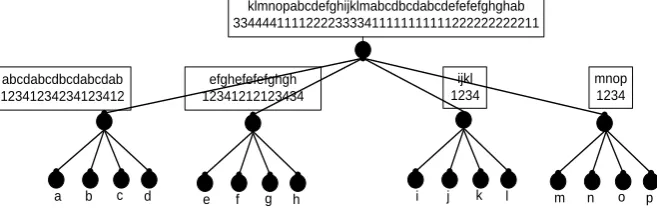
In figure 4, a 4-ary wavelet tree is depicted where for reasons of simplicity we depict the arrays at each level separately at each node.
Besides wavelet trees, in [57] two data structures were proposed, one that can access an element and handle the rank operation in O(log log σ) time, and the select operation in O(1) time, using nlogσ +no(logσ) bits of space, and another that supports the operations in the same time, but using space nH0(S)+O(n) bits. The main idea is to reduce the problem over one sequence
to chunks of length σ, handle efficiently each chunk, and represent in a unified way all the chunks together.
As mentioned, in [28] a practical study was presented on the compact representation of sequences supporting rank, select, and access queries. This paper implements the structures described in [103] and in [57] (the first such implementation at the time [28] was written) and offers a well tuned implementation of Huffman-shaped wavelet trees showing that this provides an excellent solution for representing a sequence within zero-order entropy bounded space, even when the alphabet size is very large.
In [36] different implementation strategies are presented (without however providing new complexity bounds), while in [8] (see also [46]) a structure was provided using nHk(S)+o(nlogσ) bits supporting access/rank/select operations
in o((loglogσ)2) time, but without using wavelet trees. In particular in [105], [46], [61], general techniques are presented for compressing general sequences to the k-th entropy bound, without affecting the query complexities; these constructions permit the compression of the various rank/select structures to nHk(S)+o(n) bits.
presented in order to handle large alphabets. The specific technique uses the frequencies of appearances of the characters, in order to divide the alphabet into subalphabets, and produces a new string by replacing each character on the original string by identifiers of their subalphabets; this string is stored in a multi-ary wavelet tree. Moreover the projections of the original string to the characters belonging to each sub-alphabet, are stored using the structure in [57] for large alphabets.
The outcome of this construction is a data structure that stores a string of n characters over an alphabet of size σ, in nH0(S) + o(n)(H0(s)+1) bits. This
structure supports the operators access and rank in time O(loglogσ), and the select operator in constant time; while it can be extended and be easily implemented. The technique can be improved achieving nHk(S)+o(n)logσ bits
space complexity and needing poly double logarithmic time, for the query time. Moreover the construction has applications to the design of full-text self-indices, to the representation of compressed permutations, and to efficient handling the compressed representation of dynamic collections of disjoint sets.
3.2. Dynamic Solutions
In the dynamic version of the problem, the rank and select operations are extended by the update operations of inserting an arbitrary object (bit/ symbol) between two specified objects in the sequence, and by deleting an object (bit/symbol) from the sequence. The problem was dealed with in [73] for binary sequences with a solution requiring n+o(n) bits of space, O(b) amortized update time, and O(logbn) time for rank, select, where
b=(polylogn).
In [86] the aforementioned solution was improved producing a construction able to handle binary strings in nH0(S)+o(n) bits of space, and O(logn) worst
case time complexity for all operations. In that paper the dynamic solution was generalized to symbols in an arbitrary alphabet by using the wavelet tree machinery and preprocessing the bit vectors at each level of the tree structure with the dynamic structure for handling bit sequences. The result is a structure that uses the same nH0(S)+o(nlogσ) bits of space, and supports
all the operations in O(lognlogσ) time (that is the use of the wavelet tree, as anticipated, incurred a logσ slowdown in the operations time complexity).
Now a leaf is attached to a superblock that is equivalent to a group of simple blocks (though it can be considered simply as a block of a larger capacity).
11101111
00101110
0001
001011 000011
100011 01001011 101010 101011 11101111
(14,7) (14,11) (28,18)
(12,5) (14,7)
(12,8) (26,12)
(38,20) (66,38)
(8,4) (6,3) (6,4) (8,7)
(6,3) (6,2) (8,4) (6,3)
(4,1) (8,7)
Fig. 5. The tree structure
A superblock is composed of f(n) consecutive blocks (f(n) is a parameter judiciously chosen for guaranteeing acceptable time and space bounds) with the size of them being equal to (1/2)logn. The superblocks are all full, with the exception of some partial leafs; the authors impose the invariant that every f(n) full leaves there exists a partial leaf, and implement each leaf as circular arrays except the partial leafs that are implemented as simple arrays. It is shown that the whole scheme needs O(n/f(n))=o(n) extra bits and permits the handling of the various operation in O(logn) time. In particular the space is n+O(n/f(n)) bits and the update/query time is at most O(logn + f(n)), hence by choosing f(n)=(logn) we get a total construction of n+O(n/logn) bits and O(logn) worst case time for all query and update operations.
Then the authors propose two approaches for making the scheme entropy bounded either by applying gap encoding or by applying block identifier encoding, in order to compress the original sequence. Note that in both cases the dynamic structure follows the same design principles and the time bounds remain O(logn) worst case with the difference that in the second case the f(n) function should be (logn)1/2. Assuming that w designates the machine’s word size, then it is proved that: (i) using gap encoding, the attained space is n(1+o(1))H0(S)+O(l+n
1/2
polylog(n)+w), where l denotes the number of 1’s, and (ii) using block identifier encoding, the attained space is n(1+o(1))H0(S)+O(nloglogn/logn + w).
The construction is then extended to small alphabets of size σ (with the limitation that σ=o((logn)1/2) by using the same techniques (superblocks contain 2f(n) blocks, while blocks are (1/2)logn bits long that is (1/2)logσn
used in [45] (that is exploiting the symbol decomposition and encoding a block by its position in its specific class). By carefully handling the various technical details arising from this new representation and by using again (as in the block identifier scheme mentioned before) f(n)=(logn)1/2 the attained complexity is nH0(S)+o(nlogσ) +O(w) bits of space, O(logn) worst case time
for rank and select, and O(σlogn) worst case time for insert/delete. The careful reader would notice here the difference between query and update time, a difference that has focused the attention of several authors for possible improvement. Finally, the construction (as [45]), employs a multilevel wavelet tree in order to extend the solution to larger alphabets. In particular a q-ary wavelet tree is employed with q=o(logn) and the resulted construction needs nH0(S)+o(nlogσ)+O(w) bits of space, handles query operations in
O(lognlogqσ) worst-case time, and update operations in O(qlognlogqσ) worst
case time; for q=2 the worst case query and update time are asymptotically the same: O(lognlogσ).
The above structures achieve entropy bounds in the space complexity, but are not so fast; this was tried to be handled in subsequent efforts that removed the entropy from the space complexity, in order to become faster in the time complexity. In particular in [70], a construction was provided without using wavelet trees that used nlogσ+o(nlogσ) bits in the space complexity, providing O((1/δ)loglogn) time for rank and select queries, and O((1/δ)nδ) time for updates.
In another attempt, in [84] an improvement to the [86] data structure was presented in the context of a general dynamic rank and select framework that was later explored in other works too. In particular the authors presented initially a solution for a small alphabet with size σ less than logn, and then they extended this solution for an alphabet of arbitrary size. Their small alphabet solution follows the [86] solution with the difference that it separated their construction into two schemes a counting and a storing scheme, thus having the opportunity to optimize both of them simultaneously; the proposed construction supports rank and select queries in O(logn) worst case time, and update operations in O(logn) amortized time, moreover the space required is nlogσ+o(nlogσ) bits. In order to handle alphabets of arbitrary size the authors employ once more multi-ary wavelet trees, for a carefully chosen branching factor. In particular for an alphabet of size σ they regard each symbol of logσ bits as logσ/loglogn digits from a logn-size alphabet. Hence the built h-ary wavelet tree is an logn-ary tree. As usual the sequence vectors at each node are represented by the dynamic rank and select structures employed previously for the small dictionaries, and it is proved that the provided structure can handle sequences of alphabets of arbitrary size using nlogσ+o(nlogσ) bits, supporting updates inO(logn(1+logσ/loglogn)) amortized time, and needing O(logn(1+logσ/loglogn)) worst case rank and select query time.
constructions. Besides combining ideas, the authors in [59] imported also new ideas such as embedding a substructure for handling dynamic partial sums and novel deamortization approaches. The proposed construction initially provides a solution for alphabets of small size (σ=o(logn/loglogn)) that needs nH0(S)+O(nlogσ/ (logn)
1/2
) bits of space, and supports all operations in O(logn) worst case time. This solution is then extended for alphabets of larger size by using a generalized h-ary wavelet tree where h=(logn), and thus obtaining a solution with nH0(S)+O(nlogσ/(logn)
1/2
) bits of space and supporting all operations in O( (1+logσ/loglogn) logn) worst case time.
In [85] an alternative to the [59] structure is presented that is a compressed version of their construction in [84]. In particular while [59] uses a block identifier encoding to compress and a theoretical counting argument to guarantee worst case time, the authors in [85] employ gap encoding in order to achieve compression plus a simple counting structure to have amortized updated time. The proposed solution needs nH0(S)+o(nlogσ)+Ο(n)
bits, the rank/select queries take worst-case time O(logn) and the update operations are handled in amortized O(logn) time for a logn-sized alphabet. This can be extended to arbitrary alphabets by using logn-ary wavelet trees that need the same space, rank/select queries are handled in O((1+logσ/loglogn)logn) time, while update operations are handled in O((1+logσ/loglogn)logn) amortized time.
Finally in [97], [71] an improvement to the above time complexities was attained.
In particular in [97] a data structure for manipulating efficiently bit vector operations the range min max tree was presented, in the context of dealing effectively with various operations on static and dynamic succinct trees. By using this structure and exploiting techniques presented in [21], [45], [86], the authors were able to show that: (i) a sequence S of n bits can be maintained in nH0(S)+O(nloglogn/logn) bits such that query and update operations can
be handled in O(logn/loglogn) time, (ii) a sequence S of n symbols of an alphabet σ=O(log1-εn/loglogn) can be handled in nH0(S)+O(nσloglogn/logn)
bits of space, so that all the operations can be handled in O(logn/loglogn) time. The result for alphabets of small size, can be extended by using a multi-ary wavelet tree with branching factor O(1+logσ/((1-ε)loglogn). The resultant structure needs space nH0(S)+O(nlogσ/log
εn + σlogε
n) bits and supports the query and update operations in O(logn/loglogn(1+logσ/loglogn)) time.
On the other hand in [71], a construction was proposed that follows (and improves) the construction of [59], and employs generalized wavelet trees in order to support rank, select, insert and delete in O(logn/loglogn(logσ/loglogn+1)) time using nH0(S)+o(n)logσ+O(w) bits. It
4.
Applications in Compression
4.1 In [15] a novel application of wavelet trees, in order to effectively compress natural language text is proposed. In particular it is shown that wavelet trees can be used as a means of reorganizing natural text that has been word-compressed in order to guarantee self-synchronization, even for compression algorithms that are not self-synchronized.
Table 1. codewords
Symbol Codeword
you b4
can
compute the
complexity in
a data structure
b3 b5b0 b5b1 b5b2 b5b3b0 b5b3b1 b5b3b2 b5b3b3
Fig. 6. The wavelet tree for reorganizing text P
Note here that self-synchronization for compressed text is a property that permits fast search and random access, while its lack means that locating a word in the compressed text needs to sequentially traverse it from the beginning. For example Huffman and Restricted Prefix Byte Codes are not self-synchronized while Tagged Huffman, End-Tagged Dense Code and (s,c)-Dense Code are; however their self-synchronization comes with a loss in efficiency.
The technique proposed by the authors of the paper can be applied to any word-based, byte-oriented semistatic statistical prefix-free compression
b4 b3 b5 b5 b5 b5 b5 b5 b5
you can
b0 b1 b2 b3 b3 b3 b3 b5
b3
b0 b1 b2 b3 compute the
algorithm, and it is shown that with this reorganization the compressed text is synchronized even for codes that by nature are not self synchronized and hence all the required advantages (good compression, fast search and random access ability) can be gained simultaneously.
In particular the main idea is to firstly compress the text and then reorganize the different bytes of each codeword laying them out as they appear in the different nodes of a tree structure resembling closely that of a wavelet tree. In this reorganization the first byte of each codeword appears in the root of the wavelet tree, in the same order as it appears in the text, while the root has so many children as are the different first bytes that a codeword can have; inductively at the i-th level, at node v, will be stored the i-th bytes of all codewords that start with the byte sequence from the root to v. It is clear that the produced tree will have depth equal to the maximum length that a codeword can have.
For example let us assume that the text is P=“you can compute the complexity in a data structure” and assume that the codewords are as that provided in table 1. In figure 6 it is depicted how the respective wavelet tree is constructed and the bytes of the words of the text reorganized.
In [15] it is proved that by using little extra space, the compressed text can be indexed so that the resultant structure can compete block-addressing inverted indices (the natural choice for indexing natural language texts) and appear as a viable alternative to them; experiments are performed by the authors of the paper to validate such claims.
4.2. In [91], [108] the problem of compressing and indexing highly repetitive sequence collections is considered. Such collections appear in various applications of practice, such as version control systems, and in computational molecular biology for the storage of biological data. In such highly repetitive collections the classical self indexes do not work effectively since the notion of k-th order entropy around which these indices are built, fails to capture the notion of repetitiveness. In order to face this fact the authors present a variant of the wavelet tree data structure that embeds in it run length encoding; the compression method of choice when someone compresses repetitive collections. The result is the so called run length encoded wavelet tree and is described as follows: let R be the number of runs (that is sequences of identical symbols) in the sequence of n characters to be stored (either the initial text or its Burrows-Wheeler transformation). Let Ball be the concatenation of all the bit vectors, in a level of the wavelet tree. The bit vector Ball is encoded into two separate vectors B1 and Brl, with B1 storing the starting positions of 1-bit runs, and Brl encoding the run lengths of these runs in unary coding. The value rank1(B
all
, i) can be computed, in this modified wavelet tree, by noting that the required answer is the number of 1-bits in [1, j −1] and [j, i], where j is the first place in the 1-bit run that precedes i; these quantities can be computed by appropriate rank and select queries to B1 and Brl (see [91], [108]).
time O(tBSDlogσ), where tBSD is the query time in [69] (u is the length of the
handled bit vector and b is its number of 1’s) :
)) log log log log log , log log log log log log log log log log (min( ) , ( u b b u b u b b O u b
tBSD
Moreover the structure, similarly to the various structures mentioned previously for dynamic rank and select, can be made dynamic, by using various available dynamic bit vector representations for B1 and Ball.
4.3 In [10] various techniques are examined to compress a permutation π over n integers, taking advantage of ordered subsequences in π, while supporting the application of π(i) and the application of its inverse π−1(i) efficiently. The problem is interesting since the techniques presented can be used for various applications and its byproducts improve previous results; it should be remembered that the main idea behind the wavelet tree construction, the range search structure in [20] emerged as an application of mergesort, that can be defined as a series of element permutations. Before proceeding we should note that a run in a permutation is defined as the maximal range of consecutive positions that do not contain two consecutive elements in the wrong order. It is shown in [10] that there exists an encoding scheme with space complexity n(2+H(Runs))(1+o(1))+O(ρlogn)) bits that can encode a permutation over the n first integer numbers, that is covered by ρ
runs of length Runs=<n1, n2,..,n ρ>; here
i i n n n n RunsH( ) log is the entropy of
the runs. The construction supports π(i) and π−1(i) in O(1+logρ) time for any
value i in {1,…,n}; if i is chosen uniformly at random then the average time is O(1+H(Runs)).
The specific construction uses a wavelet tree that is built as follows: proceed from the root, and handle recursively each child; when at leaves do nothing and when coming from two siblings of a node, merge their permutations in order to produce the permutation at the father and append a 1 bit, when an element is taken from the right child and a 0 bit when an element is taken from the left child. When the construction is finished the permutation has been sorted in O(n + ρlogρ) time, plus the total number of bits appended to all bitmaps, and if the wavelet tree is Hu-Tucker shaped then the total number of bits is at most n(2+H(Runs)). Using the wavelet tree and the attached bit maps, π() and π-1() can be computed in time O(1+logρ).
The construction was improved in [6] where they used their rank and select data structure, and solved the problem in 2nH(Runs)+o(n)(H(Runs)+1) bits supporting the queries π() and π−1
() in O(1+loglogρ) time.
L-suffixes. Experimental results in that paper validate the usefulness of the proposed approaches. In particular it is verified experimentally that wavelet trees can be seen as an improvement over the classical bit-plane encoding, and be used to obtain both lossless and lossy compression.
Use of the wavelet tree structure also appears in [4], [104] where it is applied as a range structure, for their compressed self-index on texts compressed with the LZ78 data compression, and in [82] as a component of various substructures, in their implementation of a self-index handling texts compressed with the LZ77 data compression algorithm. The last application is very interesting since LZ77 can benefit from the existence of frequent repetitions in a text, and as discussed previously these repetitions, appear in various applications. It is mentioned that the proposed self-index is smaller (up to one half) than the best current self-index for repetitive collections, and in many cases it is also faster.
Finally, in [30] it is depicted how the use of wavelet trees can support efficient representation and navigational operations in a compressed representation of the Web graph (for other approaches see [29], [17]). In particular the paper represents the adjacency list of each node of the graph as a sequence that is compressed using the re-pair [83] compression technique, and then it is handled by two alternative representations for rank and select, the structure in [57] and a wavelet tree, in order to support the operations of retrieving direct and reverse neighbors. Experiments with these two approaches and with various alternatives, depict that the wavelet tree representation though slower (sometimes by an order of magnitude) from its alternatives achieves the smaller space reported in the scientific literature (in comparison with similar techniques to represent the web graph), and can be considered to be the practically better choice.
5.
Applications in Information Handling
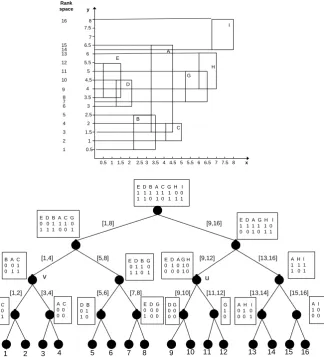
In particular consider a set of N objects that are represented by their Minimum Bounding Rectangles (MBR) as defined by their lower left and their upper right corners (each corner is a pair of coordinates in x- and y- axis).
1 5 6 7 8 10 11
E D B A C G H I 1 1 1 1 1 1 0 0 1 1 0 1 0 1 1 1
2 3 4 9 12 13 14 15 16
[1,8] [9,16]
[1,4] [5,8] [9,12] [13,16]
[1,2] [3,4] [5,6] [7,8] [9,10] [11,12] [13,14] [15,16]
E D B A C G 0 0 1 1 1 0 1 1 1 0 0 1
E D A G H I 1 1 1 1 1 0 0 0 1 0 1 1
B A C 0 0 1 0 1 1
E D B G 0 1 1 0 1 1 0 1
E D A G H 0 1 0 1 0 0 0 0 1 0
A H I 1 1 1 1 0 1
C 0 1
D Β 0 1 1 0
Ε D G 0 0 0 1 0 0
G 1 0
A I 1 0 0 0 A H I
0 1 0 0 0 1 D G
0 0 0 0 A C
0 0 0 0
0.5 1 1.5 2 2.5 3 3.5 4 4.5 5 5.5 6 6.5 7 7.5 8
0.5 1 1.5 2 2.5 3 3.5 4 4.5 5 5.5 6 6.5 7 7.5 8 x y Α Β C D E G H I 1 2 3 5 6 7 4 8 10 11 9 12 13 14 16 15 Rank space u v
Fig. 7. The wavelet tree for representing a set of maximal Minimum Bounding Rectangles {A, B, C, D, E, F, G}