REVIEW ARTICLE
THE EFFECT OF CEMENT STABILIZATION ON THE PHYSICAL AND MECHANICAL PROPERTIES OF
COMPRESSED EARTH BLOCKS: IN A COASTAL CITY: THE CASE OF DOUALA IN CAMEROON
*1
Marcelline Blanche Manjia,
2Aimé Elime Bouboama and
1Chrispin Pettang
1
Department of Civil Engineering and Urban Planning, National Advanced School of Engineering, University
of Yaoundé I, P.O. Box. 8390, Yaoundé, Cameroon
2
Departments of Industrial and Mechanical Engineering, National Advanced School of Engineering,
University of Yaoundé I, P.O. Box. 8390, Yaoundé, Cameroon
ARTICLE INFO
ABSTRACT
Housing affordability remains a key challenge in some developing countries including Cameroon. Recent studies reveal that the use of local building materials has been considered the cornerstone of sustainable construction that can be used in providing affordable housing. Despite the cheapness and availability of local building materials as earth block, its uptake has been very slow. This has been partly due to the fact that, its technical know-how is not yet vulgarized, the potential of local building materials towards the delivery of affordable housing is still not known, and its principles and practices are not yet imbedded in the practice of the construction industry. In the other hand, the constructions made in earth suffer from pathologies due to the humidity. These alter their durability and strength compared to other materials such as cement blocks or concrete. Cement stabilization is one of the technical methods of earth blocks properties improving, as local building materials that can be used in the provision of affordable housing in Cameroon. The aim of this study to investigate the effect of the stabilization rate on earth blocks properties applied in a construction project located in Douala. It reports an ongoing laboratory investigation in which the compressive strength of stabilized earth blocks is studied under dry and wet curing conditions. Five rates of cement stabilization 0%, 4%, 6%, 8% and 10% were used on the specimens of 230 × 110 × 80 mm. At 28 days of curing, the greatest values of the wet and dry cured compressive strength obtained were 4.66 MPa and 2.56 MPa respectively, with an absorption rate of 14.67% at 14 days of curing for a 10% of cement content.
Copyright©2017,Marcelline Blanche Manjia et al.This is an open access article distributed under the Creative Commons Attribution License, which permits
unrestricted use, distribution, and reproduction in any medium, provided the original work is properly cited.
INTRODUCTION
Like most African countries, Cameroon is being plagued by two major setbacks that are holding the widespread use of local building materials. More developing countries including Cameroon lack advanced institutions and policies in place for adopting local construction materials principles and policies that could contribute to the delivery of technical low-income housing. The absence of these policies reduces the chances of local building materials being chosen as a material of first choice in construction projects. Rammed earth involves the compacting of moist soil between rigid forms to create monolithic earth walls with similar properties as those of adobe walls. Allen & Thallon (2001) note that the soil for rammed earth construction must have about 30% clay and 70% sand and small gravel, although cement is sometimes added as a stabilizer.
*Corresponding author: Marcelline Blanche Manjia
Department of Civil Engineering and Urban Planning, National Advanced School of Engineering, University of Yaoundé I, P.O. Box. 8390, Yaoundé, Cameroon
Traditionally in Cameroon, earth blocks are obtained when earth is poured into moulds and compressed manually. The constituents of the earth mix are: clay, sand and additives or stabilizers such as cement or fly ash. However, the manual processing of Compressed Earth Blocks (CEB) is very slow and constitutes a barrier to its uptake. Thus, the mechanical technique of processing earth blocks has emerged. The structure of CEBs has been found to be a lot stronger and more weather-resistant than the traditional adobe structures. One of the main advantages of earth construction is that it is not knowledge intensive; a crew can quickly learn to make and lay bricks efficiently. This technology represents a ‘New Economic Perspective’ on sustainability agenda as it is a bottom-up, value-led innovative method that follows social and environmental tenets. This vision and practice promotes a new paradigm, it differs from mainstream construction practices in the developed world in that it does involve women and children in the building process. The process is suited to individuals and community self-build, and aims to empower people to create their own low-cost environmentally-sound
ISSN: 0976-3376
Vol. 08, Issue, 10, pp.6110-6114, October,Asian Journal of Science and Technology 2017Available Online at http://www.journalajst.com
ASIAN JOURNAL OF
SCIENCE AND TECHNOLOGY
Article History:
Received 22nd July, 2017 Received in revised form 29th August, 2017
Accepted 06th September, 2017
Published online 17th October, 2017
Key words:
shelter. Recent studies indicate that the use of earth as a building material minimizes the dissipation of embodied energy and carbon. The findings of a study conducted on a comparative embodied energy and CO2 analysis of two construction materials revealed that the mud-brick house expends at least 1.5 times less embodied energy and emits at least 1.7 times less embodied CO2 than cement-block house (Abanda and al. 2014). A study enabled to identify and locate the quarries in operation and provide an estimate of their volume in the town of Douala and Yaoundé, and its findings revealed that the volume of soil from quarries can exceed 20
million m3 and can construct more than 363300 types
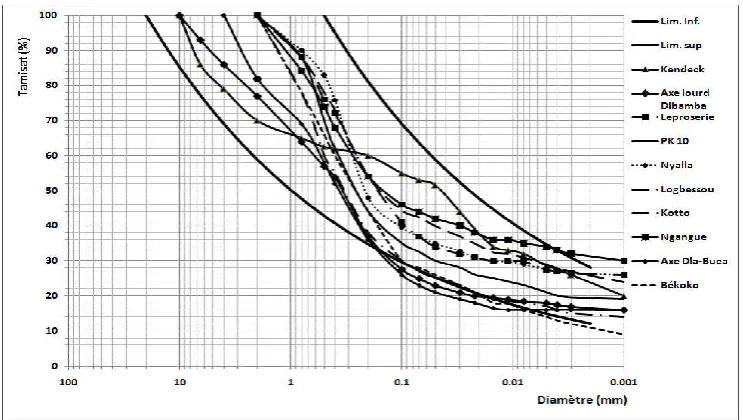
T4-lodging (4 pieces), thereby providing more than 1/3 of the need for social housing in both urban centers (A.B. Tchamba, 2012). Figure 1 indicates some soil grading curve in Douala city. Earth construction has various other potential advantages.
Some of these are fire strength, non-toxic and the reduction of low-carbon footprint in housing delivery, production of sufficient thermal mass, low sound transmission levels, no costly tools, the technique is highly suitable for owner builders. Others are the ability to hold heat, the
non-requirement of skilled personnel as builders can quickly learn how to make and lay bricks efficiently with ease. The extraction and production of compressed earth blocks do not need chemical processing and the energy consumed is less important. The global reduction cost with compressed earth blocks varying between 3 to 4% from the cement blocks (A.B. Tchamba, 2012). In this paper, a study is proposed to illustrate the behavior of the physical and mechanical properties of cement stabilized earth blocks. This material is intended for the construction of housing in Douala city, where the relative humidity is very high. Indeed, the city of Douala is known for its climatic parameters not favorable to the constructions in earth in particular the problems of capillary ascents and water infiltration. It is therefore essential to control its pathologies related to moisture, but also those related to mechanical stability.
MATERIALS AND METHODS
The methodological approach is organized in three main stages: i) the identification of the earth material; (ii) the stabilization of the earth material with cement; (iii) the
Figure 1. Some soil grading curve in Douala city
evaluation of the compressive strength and water absorption rate of the finished products. The tests were carried out in the laboratory of the Coast University Institute of Douala. The tests carried out were concerned with the determination of the physical and mechanical characteristics of the blocks made from the earth from the site of the future construction. The field equipment consists essentially of a manual AURAM press with a static compression principle, dosers and a needle scale.
The laboratory equipment consists of a Casagrande apparatus, a precision scale, a hydraulic press, a bin and an oven. The water content is w = 2.4%. The Proctor test yielded a water content value at the optimum of Wopt = 12.88%. We stabilized the soil with cement at different levels: 4; 6; 8 and 10% (Figure 2). Field tests (bottle testing, ball testing) and laboratory tests (Atterberg limits, compressive strength, water absorption rate) were carried out. For the bottle testing, after 24 hours, we observe the deposit of 03 distinct layers. With a graduated rule we, measured 5.8 cm for the whole. We thus obtained: 1.1 cm for the first layer (Clay) with 18, 97℅; 0.85 cm for the 2nd layer (Silt) with 4.65℅; 3.85 cm for the 3rd layer (Sand + gravel) with 6, 37℅. For ball testing, the mixing is manual and the water is sprayed while ensuring that the optimum water content has been reached. This quantity of water will be sufficient when a ball thrown to the ground at a height of 1.5 m will break in a few pieces. For the Atterberg limits, the plasticity limit is Wp = 15.715%.
The plasticity index is Ip = W1-Wp = 19.596% - 15.715% = 3.881%. The consistency index takes into account the soil water content in the natural state for the soil fraction less than 400 μm. Ic = (W1-w) / Ip = 4.43.
Table 1. Summary of Submerged Blocks for Absorption Rate
Block type Stabilization rate Curing time (days)
7 14 28
BTC (non-stabilized
earth block)
0% 3 3 2
BTCS (Stabilized earth block)
4% 2 2 3
6% 2 2 2
8% 2 2 2
10% 2 1 1
Total number of blocks 11 20 20
For dry compressive strength, the blocks dimensions are 230 × 110 × 80 mm, so the contact area with the plates A = 230 × 110 = 25300 mm². The dry compressive strength of the stabilized blocks (BTC) is Fcj = F / A. For wet compression strength, the blocks are immersed for 24 hours in water. For the water absorption rate, Table 1 presents a summary of the submerged blocks.
RESULTS
Dry compressive strength and curing time
Figure 3 shows that the dry compressive strength of the non-stabilized blocks decreases with curing time.
Dry compressive strength, curing time and cement content
Figure 4 shows the curves of the dry compressive strengths corresponding to each cement content.
Figure 3. Dry cured compressive strength of the not stabilized blocks as a function of the curing time
Figure 4. Dry cured compressive strength of BTCS (MPa) as a function of curing time and cement rate
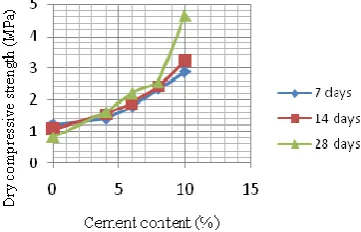
As a result, for a given curing time, the dry compressive strength increases with the cement content. It is also observed that, for a given cement content, the dry compressive strength increases with the curing time. This last observation is confirmed by the results presented in Figure 5.
Figure 5. Dry cured compressive strength of the blocks as a function of the cement content during the curing time
of non-stabilized blocks. The curves of the cured compressive strength, as a function of the cement dosage, grow increasingly. The maximum compressive strength at 28 days curing time is 4.66 MPa for 10% cement content versus 0.83 MPa for the cement content of 0%.
Wet compressive strength and cement content
The wet compressive strength are in increasing order as a function of the curing time and the cement content in a range of 0.65 to 2.56 MPa (FIG. 6)
Figure 6. Wet cured compressive strength of blocks as a function of cement content
Compared to dry compression strength, there is resistance decreases due to immersion of the blocks is observed, but the values remain above 1 MPa, except that of the content at 4% at its 7th day of curing time. The drop is between 53% and 55% compared to the cured compressive strength. This confirms the effect of cement on the earth sensitivity to water. It should be remembered that, after immersion, the non - stabilized blocks had zero Dry cured compressive strength. The fact that the resistance of BTCS to 6% at 7 days of cure is slightly higher than that of 14 days is related to the density.
Water absorption rate and cement content
The non-stabilized block is destroyed after 24 hours of immersion in water. This may be explained by the fact that the emptiness index is high.
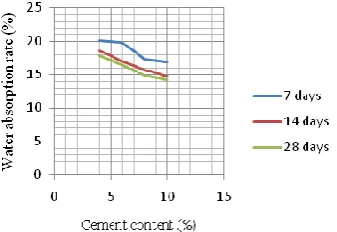
FIG.7 shows the water absorption rate of the blocks as a function of the cement content.
Figure 7. Rate of water absorption of blocks as a function of cement content
It is noted that the water absorption rate of the stabilized blocks decreases as the cement content is increased and the curing time evolves. This would mean that the cement clogs the interstices and reduces more and more the emptiness existing between the grains.
DISCUSSION
The non-stabilized BTCs have a dry compressive strength which oscillates between 0.83 and 1.21 MPa and decreases as the curing time increases. This loss of strength is due to the progressive decrease of water contained in the blocks. On the other hand, they have a zero wet cured compressive strength. According to Cameroon Standard NC 112, these non-cement-stabilized blocks exhibit very poor mechanical performances (ranging from 1.21 to 0.83MPa), contrary to stabilized blocks which have good performances starting from 6% cement content in this case. Which relates to their Dry cured compressive strength (ranging from 2.21 to 4.66 MPa). On the other hand, the wet Dry cured compressive strength of the stabilized blocks is less than that at dry (ranging from 0.65 to 2.66). According to this standard, the dry strength from 14 days of curing must be greater than or equal to 2MPa and for this same curing time the wet strength must be greater than 1 MPa. For the water absorption rate, according to (NC, 114-116, 2002-2006), our BTCS have very poor water absorption rates. According to this standard, the water absorption rate of the BTC must be less than or equal to 15%. At 10% of cement content with 14 days of curing time, and 8% of cement content with 28 days of curing time, acceptable values of 14.67% and 14.85% were recorded respectively. These values are adequate according to those found for the water absorption rate of some blocks in Douala, and which oscillate between 16, 02% and
21.06% for 14 days of treatment (Tchamba et al, 2012).
Conclusion
The interest of this work was to study the physical and mechanical performance of the compressed earth blocks for our project to build a duplex in blocks of compressed earth in Beedi district in the district of Douala 5e whose specificities are: 2 MPa for dry strength, 1MPa for wet strength and a water absorption rate of less than 15%. To achieve this goal, we first identified the earth material from the site where the project was located, followed by stabilization of the soil using e few different cement contents (0, 4, 6, 8 and 10 %), and finally, the samples of non-stabilized blocks and stabilized blocks were produced and tested in order to evaluate their compressive strengths and their water absorption rates. The field and laboratory tests carried out made it possible to observe that the stabilized blocks have acceptable dry and wet compressive strengths in contrast to those which have not been stabilized. The optimal cement rate (cost and quality) that we propose to stabilize our blocks is 8% for a minimum cure time of 28 days.
REFERENCES
Enongene, K. E., Murray, P., Holland, J., Abanda, F.H., Manjia, M.B. 2016. Patterns in the use of domestic energy appliances in Cameroon. Proceedings of SBE16 Dubai, 17-19 January 2016, Dubai-UAE
Houben Hugo, Guillaud Hubert, 1995. Traité de construction en terre, édition Parenthèse, Marseille, France, 355p Houben Hugo, Guillaud Hubert, Dayre Michel, Bard
Pierre-Yves, Perrier Guy, CRATerre Traité de Construction en Terre, Editions Parenthèses, 3ème édition, Marseille, 2006.p80
International Journal of Civil Engineering and Technology
(IJCIET), ISSN 0976 – 6308 (Print), ISSN 0976 – 6316(Online), Volume 5, Issue 12, December (2014), pp. 334-353 © IAEME
Mesbah, A., Morel, J.C., Olivier, M. 1999. Comportement des sols fin argileux pendant un essai de compactage statique: détermination des paramètres pertinents, Matériaux et constructions, vol 32, N°223
Mipromalo, 2007. Constructions des bâtiments en blocs de terre comprimée, p3-4
Mipromalo, 2007. Fiche technique de production et de mise en œuvre des BTC, p.2
Olivier, M., Mesbah, A. 1997. Mécanique de la construction en terre, mode opératoire pour la réalisation des essais de résistance sur les blocs en terre comprimée
Pettang, C., Manjia, M. B., and Abanda, F. H. 2016. Decision Support for Construction Cost Control in Developing Countries (pp. 1-325). Hershey, PA: IGI Global. doi:10.4018/978-1-4666-9873-4
Pierre Meukam, Caractérisation des matériaux locaux en vue de l’isolation thermique de bâtiments, Thèse de doctorat, en cotutelle entre l’université de Cergy-Pontoise et l’université de Yaoundé I, 2004, p9
P'kla Abalo., Caractérisation en compression simple des blocs de terre comprimée (BTC): Application aux maçonneries "BTC-Mortier de terre, Thèse de doctorat, Institut national des sciences appliquées de Lyon, France, 2002.p26
Tchamba, A.B., Nzeukou, A.N., Tené, R.F. and Melo, U.C. 2012. Building Potentials of Stabilized Earth Blocks in
Yaoundé and Douala (Cameroon): International Journal of
Civil Engineering Research. Volume 3, Number 1, pp. 1-14
Vincent Rigassi CRATerre-EAG, 1995. Blocs de terre comprimée Volume I. Manuel de production p19