www.pharmascholars.com
278
Research Article
CODEN: IJPNL6
DEVELOPMENT AND EVALUATION OF NASAL IN SITU GEL FORMULATIONS
OF ALPRAZOLAM USING IN VITRO AND IN VIVO METHODS
Hemanth Kumar Mamidi, Madhavi Harika Srimathkandala, Krishna Sanka, Madhu Babu
Ananthula, Vasudha Bakshi*
Department of Pharmaceutics, School of Pharmacy, (Formerly Lalitha College of Pharmacy),
Anurag Group of Institutions, Hyderabad-500088, Telangana, India
*Corresponding author e-mail:
[email protected]
ABSTRACT
The objective of the present research work was to develop and evaluate the nasal in situe gel formulations of alprazolam for better availability in the brain. Formulations were developed using Pluronic F127 and sodium alginate by cold method. Formulations were evaluated for permeation study through sheep nasal mucosa, histopathological evaluation of mucosa and pharmacodynamic study in rats. Optimized formulation showed a diffusion of 78.75 ± 0.077 % drug in 240 min, effective permeation coefficient (Peff) and gelling temperature were
found to be 6.44×10⁻⁵ cm sec-1 and 33.80 ± 0.57°C respectively. Histopathological study did not show any damage to the nasal mucosa during permeation. The locomotor activity and anti-anxiety effect of Alprazolam differed significantly by I.N and I.V routes compared to control. It can be concluded that Alprazolam given by nasal route is more effective and show quick onset of action when compared to Intravenous administration of equivalent dose.
Keywords: Nasal in situ gel, Sodium alginate, Pluronic F127, Blood brain barrier.
INTRODUCTION
Central nervous system disorders still remain as the world’s leading cause of disability, although extensive research has been done to deliver therapeutics to the brain. Brain is the most important organ of human body and is protected by blood brain barrier (BBB) and blood cerebro spinal fluid barrier. The BBB is critical in maintaining the CNS homeostasis. It restricts the entry of potential neurotoxin substances into the brain, at the same time it also restricts the entry of therapeutics for disease treatment.[1] Many approaches like disruption of the blood brain barrier by osmotic, [2, 3] biochemical methods, [4, 5] manipulation of the drug molecule into prodrug,6, 7 chemical drug delivery,[8, 9] carrier mediated drug delivery10,11 are used to deliver drugs to the brain.[12,13] Alternate routes of administration by intraparenchymal,[14, 15] intracerebro ventricular[15] and intrathecal injections/infusion[16] are capable of delivering therapeutics directly to the CNS, but these routes are invasive and not practical for chronic conditions. The olfactory pathway provides a gateway
for the substances entering the CNS due to the neural connection between the brain and the nasal mucosa.[17,
18] The intra nasal route is associated with a number of
advantages like rapid onset of action, non-invasiveness, more permeable nasal mucosa, but has received very low attention.[1, 19, 20]
Alprazolam (ALP) is an approved anti-anxiety drug available as tablets for oral delivery. It enhances the activity of GABA in the brain.[21] Even though it shows good oral bioavailability, only a small portion of the administered dose reaches the brain from the blood. A major portion of the administered drug remains in the systemic circulation, which results in specific clinical complications like respiratory disturbances, skin rashes, nausea, vomiting and musculoskeletal disorder.[22] Therefore, a drug delivery system which delivers the drug directly to the CNS with reduced systemic exposure is required. The previous studies show that olfactory pathway can effectively deliver the drug directly to the brain.[23-26]
International Journal of Pharmacy
www.pharmascholars.com
279
In situ gelling systems are polymeric solutions, which gets transformed into gels due to change in environment like pH[27, 30], presence of ions[28, 30], temperature.[29, 30] They are the ideal formulations to deliver drugs through nasal route with ease of administration and increased residence time.[31] Thermosensitive gels are the most preferred in situ
gelling systems which are prepared from Pluronics, chemically, poly (ethylene oxide)-poly (propylene oxide) block copolymers.[32-34] The objective of the present study is to formulate thermosensitive in situ
gels of Alprazolam by using Pluronics and to perform
in vitro and in vivo characterization.
MATERIALS AND METHODS
Materials: Alprazolam was received as a gift from Novartis Ltd., Hyderabad, India. Pluronic F127, sodium alginate and benzalkonium chloride were procured from S.D fine chemicals., Mumbai, India.
Methodology
Development of thermoresponsive nasal in situ gel: As Alprazolam is a poorly water soluble drug, solid dispersions of it were prepared by solvent evaporation method.[35] A mixture of Alprazolam and PVP K30 were taken in 1:4 ratio by weight in a beaker. To this, ethanol was added to solubilise the mixture. This was dried in the vacuum drier at 60°C for 2 h. The obtained mass was size reduced and passed through sieve no.60. The gels were prepared by cold method.[36] The solid dispersion and sodium alginate (0.1%, 0.3% and 0.5%) were dissolved in distilled water and then 18% Pluronic F127 was dispersed in it. The dispersed liquid was kept at 4°C until clear solution was obtained. Appropriate quantity of benzalkonium chloride was also added and the pH of the formulations was adjusted between 4.5 and 5.5 using 0.1N HCl. The developed formulations were stored in refrigerator for further studies.
Characterization of in situ gel:
Gelation studies by visual inspection: Briefly, a 10 ml transparent vial with a magnetic bar was taken and the formulations were placed in it. The vials were kept in a water bath and the bath temperature was constantly increased while stirring. The gelation temperature was determined when the magnetic bar stopped moving. Each formulation was tested in triplicate.[37]
Viscosity Studies: A thermostatically controlled
Brookfield viscometer (DV II+ Pro, Brookfield engineering Ltd, Middleboro, MA) fitted with Helipath stand and T-spindle was used to determine the viscosity. The viscosity of each formulation in sol state and gel state were determined at 3, 6, 12, 30 and 60 rpm. The temperature dependent viscosity was
determined by using a thermostatically controlled water bath. The temperature was increased in steps of 1°C/minute from 20-30 °C and 0.5 °C/minute from 30-35 °C. The gelling temperature was determined from the inflection point on the curve of viscosity and temperature (°C). Different shear rates were applied to know the flow behaviour of the preparations. The shear rate (S-1) and viscosity (cPs) can be fitted to constitutive equation.[38, 39]
Two constants were acquired: m is consistency index and n is flow index. If n = 1, it indicates Newtonian behaviour. If n is less than 1, it means shear thinning flow. Measurement was repeated at least three times to control the repeatability.
Evaluation of Mucoadhesive strength: It was
measured by using a modified balance.[40] Briefly, nasal tissue was carefully removed from the nasal cavity of the goat obtained from the local slaughter house. During testing, the mucosal tissue with a surface area of 1cm2 was secured to the upper probe using a cyanoacrylate adhesive (the mucosal side is exposed). The upper probe was connected to a precalibrated force displacement transducer FT-03 (Grass technologies, Warwick, USA) which inturn was connected to a student physiographic apparatus. The formulations were placed on the lower probe. The lower probe is equilibrated and maintained at 35°C. The upper probe was lowered until the tissue contacted the surface of the sample. It was allowed to equilibrate for 2 min to ensure intimate contact between sample and the tissue. The upper probe was then moved upwards at a constant speed of 15mm/sec. The bioadhesive force expressed as the detachment stress in dyne/cm2 was determined from the minimal weight that detached the tissue from the surface of each formulation using the following equation.
Detachment stress (dyne/cm2) =
Where m is the weight added to the balance in grams; g is the acceleration due to gravity taken as 980 cm/sec2; and A is the surface area of the tissue exposed. Measurements were taken in triplicate to ensure repeatability of the method.
www.pharmascholars.com
280
formulations equivalent to 1.25 mg of Alprazolam were placed in the donor chamber separately. At predetermined time points, 0.5ml sample was withdrawn from the acceptor compartment, replacing the sampled volume with phosphate buffer pH 6.8 after each sampling for a period of 240 min and is estimated by double beam UV-Visible spectrophotometer (UV 3200, Lab India, Mumbai, India).
The data obtained from the in vitro release experiments was analyzed by the following commonly used exponential equation.[39]
= ktn
Where Mt/M∞ : the fraction of released drug at time t;
k: release constant and it depends on structural and geometric characteristics of the drug/polymer. n: release exponent indicative of the release mechanism.
Ex vivo permeation studies: Fresh nasal tissue was carefully removed from the nasal cavity of sheep obtained from the local slaughter house. Tissue samples were mounted on Franz diffusion cells with a permeation area of 1cm2. 16 ml of PB pH 6.8 was added to the acceptor chamber. The temperature was maintained at 35°C. After a pre-incubation time of 20 min, dose equivalent amount of the selected formulation was placed in the donor chamber. At predetermined time points, 0.5mL samples were withdrawn from the acceptor compartment, replacing the sampled volume with PBS pH 6.8 after each sampling for a period of 4 h and is estimated by double beam UV-Visible spectrophotometer (UV 3200, Lab India, Mumbai, India).[41]
Effective Permeability coefficient (P) was calculated by the following equation.[29]
Where, dQ/dt is the flux or permeability rate (mg/h), Co is the initial concentration in donor compartment, A is the effective surface area of nasal mucosa.
Histopathological evaluation of mucosa: The
histopathology of the tissue incubated in phosphate buffer saline (PBS pH 6.8) was compared with the tissue incubated in the diffusion chamber with gel formulation (F2). Tissue was fixed in 10% buffered formalin, routinely processed and embedded in paraffin. Paraffin sections (7µm) were cut on a glass slide and
stained with haematoxylin and eosin. Sections were examined under light microscope to detect any changes during permeation study.
Stability studies: Stability studies were carried out on gel formulation according to ICH (International Conference on Harmonization) guidelines. Formulations showing optimum gelation, rheological properties, mucoadhesive force and drug release rate were selected for stability studies. The samples were stored at 30 ± 2 °C and relative humidity of 60 ± 5 °C in a stability chamber. The samples were withdrawn at 0, 30, 60, 90 days interval and were observed for occurrence of turbidity, gelation and viscosity.[42]
In vivo Pharmacodynamics
Animals: Adult male, Wistar albino rats weighing 150-200 g were used in the study. The rats were maintained under standard conditions in Central Animal House, School of Pharmacy, approved by the Committee for the Purpose of Control and Supervision of Experiments on Animals (CPCSEA).The rats were kept in polypropylene cages under standard environmental conditions and maintained on standard pellet diet and water ad libitum. The rats were maintained on a 12:12 hour light-dark cycle.
Experimental design: The experimental protocol was approved by the animal ethics committee. IAEC Reference No: I/IAEC/LCP/025/2013/SAM/028. Animals were divided into four groups of six animals each. Group I serve as a control group treated with PBS (Phosphate buffer saline) given by nasal route through a micro pipette. Group II was treated with placebo given by nasal route to study the effect of excipient. Group III was treated with optimized formulation (1.2 mg/kg) given by nasal route through a micro pipette. Group IV was treated with I.V injection of Alprazolam (1.2 mg/kg) given through tail vein. All the behavioural parameters were tested before and after dosing. Behavioural testing was done after 2 min and 10 min of dosing. The animals were sacrificed after 30 min of dosing and brains were isolated for estimation of acetylcholinesterase levels.
Behavioural studies
Locomotor Activity (Actophotometer): Locomotor
www.pharmascholars.com
281
actophotometer for recording the activity score after 2 min and 10 min of dosing.[43]
Assessment of Anxiolytic Activity in rats using the
Holeboard Apparatus: Anxiety level was also
evaluated in rats using a holeboard apparatus. The hole board apparatus consisted of wooden box (40×40×25 cm) with 16 holes (Diameter, 3cm) evenly distributed in the floor. The holeboard was elevated to the height of 25 cm. The test was performed 2 min after administration of placebo (I.N), Alprazolam (1.2 mg/kg I.N) and Alprazolam (1.2 mg/kg I.V). The number of holepokings during 5 min period was recorded and the percentage decrease in holepoking was also calculated.[44, 45]
Estimation of Acetyl cholinesterase: All the animals were sacrificed after 30 min of dosing and brain tissues were isolated and homogenized in Phosphate buffer (pH 8, 0.1 M). The homogenate was centrifuged at 3000 rpm for 10 min. 0.5 ml of supernatant was diluted to 25 ml with freshly prepared DTNB solution (10 mg DTNB in 100 ml of Sorenson phosphate buffer, pH 8.0). From this solution, two portions of 4 ml were taken in two test tubes. Into one of the test tube, 2 drops of eserine solution was added. 1 ml of substrate solution (75 mg of acetylcholine iodide per 50 ml of distilled water) was pipette out into both of the test tubes and incubated for 10 min at 30°C. The change in absorbance per min of the sample was read spectrophotometrically using double beam UV-Visible double beam spectrophotometer (UV 3200, Lab India, Mumbai, India) at 420 nm against eserine solution as blank. The enzyme activity was expressed as μM/min/g tissue.[46]
RESULTS AND DISCUSSION
Gelation study: The gellation temperatures of the formulations were shown in Table 1. From the preliminary study, the minimum concentration of Pluronic F127 (with solid dispersion) that can form gel below 35°C was found to be 18%. The gelation of Pluronic F127 vehicle is known to result from the change in micellar number with temperature. With increasing temperature, the number of micelles formed increases as a consequence of the negative coefficient of solubility of block copolymer micelles. Eventually the micelles become so tightly packed that the solution becomes immobile and gel is formed.[47] The gelation temperature of Pluronic F127 vehicle was increased from 29°C to 31.9°C with the addition of solid dispersions. This is due to the presence of PVP K30 which interferes with micellar formation.
The combination of thermosensitive polymer Pluronic F127 with sodium alginate is ideal for nasal drug
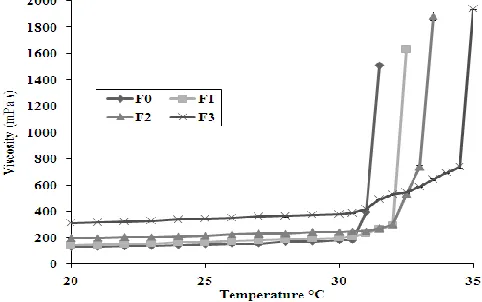
delivery due to its dual responsive nature. From the results of gelation study, the concentration of Sodium alginate to be used as mucoadhesive agent was found to be 0.1% to 0.5%. Fig.1 shows the viscosity versus temperature curves of all the formulations. The gelation temperature of Pluronic F127 (with solid dispersion) as determined by rheological method was increased from 31.2°C to 32.4°C in the presence of 0.1% mucoadhesive polymer Sodium alginate. It is to be noted that increased concentration of Sodium alginate from 0.1% to 0.5% further increases the gelation temperature from 32.4°C to 34.8°C. The gelation temperature enhancing effect of Sodium alginate might be due to the interference of Sodium alginate with micellar formation of Pluronic F127. The formulations containing higher concentrations of Sodium alginate were found to have very high viscosity and so were difficult to administer into the nostril. Regardless of the concentration of mucoadhesive polymers, all the formulations gelled at temperature ranging from 31.9°C to 34.8°C.
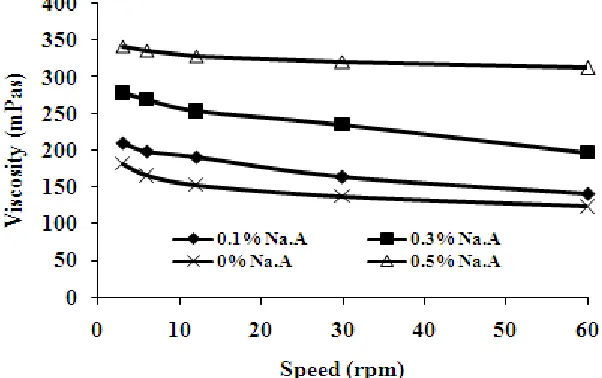
Viscosity measurements: A plot of viscosity versus different rotational speeds of the viscometer was shown in Fig. 2. The viscosity of the gels increased with increasing concentrations of mucoadhesive polymer and large viscosity change was found in the gel state. The observed increase in viscosity with increasing polymer concentration is attributed to a consequence of increasing chain interaction with polymer concentration rising. Table 2 shows the viscosity enhancing effect of mucoadhesive polymer as evident from the consistency index (m). Fig. 3 is the representative profile showing that at 25°C the in situ gel was in a liquid form and exhibited a Newtonian behaviour. Conversely at 35°C, a dramatic shear thinning behaviour was observed. At 25°C the value of the flow index (n) and consistency index (m) indicative of lower viscosity at shelf condition. However, when the temperature was increased to 35°C, the n value decreased. The lower the value of (n), the more shear thinning the formulation.[48]
Mucoadhesive strength: Assessment of mucoadhesive
www.pharmascholars.com
282
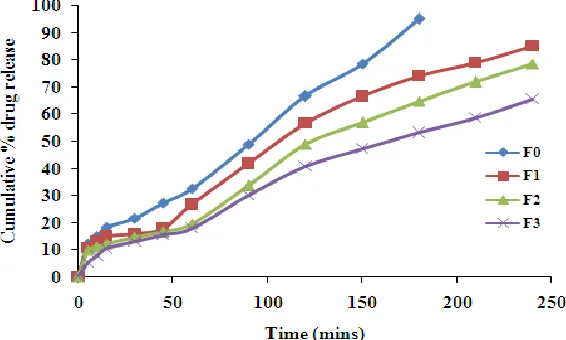
In vitro diffusion study: The release profiles of all the formulations were shown in Fig. 5. The initial rates of drug release were very rapid due to incomplete gel formation, but as the time progresses the release rate was found to be decreased due to complete gel formation. With increase in concentration of Sodium alginate the release rates were found to decrease gradually. During gel formation, a portion of drug might be loaded into the gel matrix, thus the cross linking of polymer reduces the drug release rate. The initial rapid release of Alprazolam was may be due to formation of prehydrated matrix containing water filled pores due to presence of aqueous vehicle. The results showed that the formed gels had the ability to extend the release of the drug for the duration of about 240 min. The results further showed that the amount of the drug released in first hour decreased with the increasing polymer concentration. Results also revealed that in situ
gel has values of n between 0.485 to 0.648, indicating non-Fickian release (Table 3).
However the in vitro drug release was decreased by increasing concentration of Sodium alginate compared to the control gel without polymer. By considering all the aforementioned results, F2 and F3 were found to be suitable in situ gelling formulations with good rheological and mucoadhesive characteristics. However, the diffusion profile of F2 was found superior to F3. Thus, F2 with 0.3% Sodium alginate and 18% Pluronic F127 was optimized and taken for further studies.
Ex vivo permeation study: Ex vivo permeation studies were performed for the pure drug (Alprazolam) and optimized formulation (F2) using the goat nasal mucosa (Fig. 6). The percentage permeated after 4 h was found to be 50.34 % and 92.77 % with permeability coefficients of 3.50 ×10⁻⁵ and 6.44×10⁻⁵ cm sec-1 respectively for pure drug and optimized formulation. The high permeability of Alprazolam in pluronic formulation can be attributed to surfactant nature of Pluronic F127.
Histopathology of mucosa: Photomicrographs of goat nasal mucosa (Fig. 7) after the permeation studies were observed for histopathological changes in comparison with the PBS treated mucosa. The section of mucosa treated with F2 showed very slight degeneration of nasal epithelium along with no erosion. There was increased vascularity in basal membrane and superficial part of sub mucosa when compared to PBS treated mucosa. This might be the result of mucoadhesive and permeability enhancing property of sodium alginate in the formulation. None of the severe signs such as appearance of epithelial necrosis, sloughing of epithelial cells were detected.
Accelerated Stability Studies: The stability studies were carried out on optimized formulation F2 at 30 ± 2 °C temperature and 60 ± 5 % RH for 90 days. As per the data shown in Table 4, the formulation had shown good stability with no remarkable change in appearance, gelation, gelling temperature and viscosity.
Pharmacodynamic studies
Locomotor activity: As shown in Table 5, after 2 min of dosing, Alprazolam (1.2 mg/kg, I.N) produced significant reduction in locomotor activity at P < 0.001 compared to the control animals receiving saline. Whereas Alprazolam (1.2 mg/kg, I.V) failed to produce significant reduction in locomotor activity at p < 0.001 compared to control animals. After 10 mins of dosing, Alprazolam (1.2 mg/kg, I.N and 1.2 mg/kg, I.V) showed a significant reduction in locomotor activity at P < 0.001 compared to control animals. The slow onset of action by I.V route can be attributed due to the time taken to cross the blood brain barrier. Animals treated with placebo did not show any significant reduction in locomotor activity, which confirms that the excepients do not have any effect.[49]
Antianxiety study: The statistical analysis of the data obtained indicates that, animals treated with Alprazolam (1.2 mg/kg, I.N and I.V) showed significant decrease in number of holepokings compared to control animals. However the decrease in the number of holepokings was found to be more by intranasal route when compared to I.V route. Placebo treated groups showed no significant decrease at p > 0.05 compared to control animals. Results are shown in Table 6.
Acetylcholinesterase Estimation: Animals treated with Alprazolam (1.2 mg/kg, I.N and I.V) have produced a significant decrease in the level of acetylcholinesterase when compared to the control animals at p < 0.05. However placebo treated animals did not produce any significant effect on acetylcholinesterase levels. This confirms that the decrease in acetylcholinesterase level with Alprazolam (1.2 mg/kg, I.N and I.V) was due to the antianxiety effect produced by Alprazolam (Table 7).[50]
CONCLUSION
www.pharmascholars.com
283
administration of equivalent dose. However a slight decrease in the acetyl cholinesterase levels is observed due to the anti-anxiety effect produced by the drug. In conclusion, this study demonstrated that the use of in situ gelling agents incorporating sodium alginate as mucoadhesive polymer could effectively and safely
improve the nasal residence time and brain targeting of Alprazolam.
ACKNOWLEDGEMENT
All the authors are grateful to Dr. Palla Rajeshwar Reddy for providing lab facilities required for the study.
Table 1. Viscosity and gelling temperature of the formulations determined by rheological and by visual inspection
Formulation
code Composition Viscosity
Gelling temperature (°C)
20°C 35°C Rheology
Visual inspection
F0 18% PF127 128.0±2.44 1512.3±6.94 31.2 31.7±0.28
F1 18% PF127, 0.1%
Sodium alginate
142.6±1.24 1632.6±4.69 32.4 32.9±0.16
F2 18% PF127, 0.3%
Sodium alginate
196.3±1.69 1884.0±7.04 33.2 33.8±0.57
F3 18% PF127, 0.5%
Sodium alginate
313.0±1.24 1939.3±3.09 34.8 35.6±0.28
Table 2. Flow index and Consistency index of the formulations.
Formulation code Flow index (n) Consistency index (m)
25°C 35°C 25°C 35°C
F0 0.8021 0.0983 521 10495
F1 0.8836 0.1993 628 16481
F2 0.9032 0.2821 723 11748
F3 0.9086 0.2904 554 9289
Table 3. Release profile of the formulations
Formulation % drug release N R2 Release mechanism
F0 95.31±0.14 0.5085 0.9841 Non Fickian
F1 85.14±0.23 0.4851 0.8660 Non Fickian
F2 78.75±0.13 0.5141 0.8554 Non Fickian
F3 65.68±0.08 0.6480 0.9685 Non Fickian
Table 4. Appearance, Gelation, Gelling temperature and Viscosity of F2 during stability studies.
Parameters Storage period (days) at 30 ± 2°C temperature and 60 ± 5% RH
0 30 60 90
Appearance Clear Clear Clear Clear
Gelation Stiff gel Stiff gel Stiff gel Stiff gel
www.pharmascholars.com
284
Table 5. Effect of Alprazolam on Locomotor Activity Using ActophotometerTreatment Locomotor activity (scores) in 10 min
Before Treatment After treatment
2min 10min
Control 164.33±5.48 139.16±3.92 153.66±5.31
Placebo 174.83±8.01 128.16±5.10 141.50±5.84
I.V ALP (1.2mg/kg) 171.83±7.49 124.50±3.07* 10.50±1.17** I.N ALP(1.2mg/kg) 168.16±6.88 10.33±1.02** 9.16±0.87**
Statistical significance test was done by ANOVA (n = 6); Values are mean ± SEM of 6 animals per group; *P < 0.05; **P < 0.001 vs control; ALP- Alprazolam
Table 6. Effect of Alprazolam on Anxiety in Rats Using Holeboard Apparatus
Treatment Number of holepoking
Control 9.66 ± 0.76
Placebo 8.78 ± 0.82*
ALP (1.2mg/kg I.V) 2.66 ± 0.33**
ALP (1.2mg/kg I.N) 1.50 ± 0.42**
Statistical significance test was done by ANOVA (n=6); Values are mean ± SEM of 6 animals per group; *P > 0.05; **P < 0.001 vs control; ALP- Alprazolam
Table 7. Effect of Alprazolam on acetylcholinesterase levels
Treatment AchE levels
(µM/min/mg protein)
Control 11.31 ± 0.531*
Placebo 10.61 ± 0.441
ALP (1.2 mg/kg I.V) 9.46 ± 0.386
ALP (1.2 mg/kg I.N) 9.30 ± 0.420
Statistical significance test was done by ANOVA (n = 6); Values are mean ± SEM of 6 animals per group; *P < 0.05; ALP- Alprazolam.
www.pharmascholars.com
285
Figure 2: Effect on rpm on viscosity of the formulations.Figure 3: Effect of shear rate on viscosity of F2 at 25°C and 35°C
www.pharmascholars.com
286
Figure 5: Diffusion profile of the formulations. All the values are expressed as mean ± S.D (n = 3)Figure 6: Ex vivo permeation profile for pure drug (Alprazolam) and optimized formulation (F2).
www.pharmascholars.com
287
REFERENCES:1. Jeffrey JL, Robert ;GT. Adv Drug Deliv Rev,2012; 64: 614-28.
2. Roman-Goldstein S, Clunie DA, Stevens J, Hogan R, Monard J, Ramsey F, Neuwelt EF. AJNR Am J Neuroradiol, 1994; 15(3): 581-90.
3. Guillaume DJ, Doolittle ND, Gahramanov S, Hedrick NA, Delashaw JB, Neuwelt EA. Neurosurgery, 2010; 66(1): 48-58.
4. Svetlana MS, Richard FK, Anuska VA. Current Neuropharmacology, 2008; 6(3): 179-192. 5. Richard TF, Karen SA, Joseph N. Biochimica et Biophysica Acta, 2011; 1816: 191-98. 6. Jarkko R, Krista L, Mikko G, Jouko S. The AAPS J, 2008; 10(1): 92-102.
7. Prokai-Tatrai K, Prokai L. Methods Mol Biol, 2011; 789: 313-36.
8. Patel MM, Goyal BR, Bhadada SV, Bhatt JS, Amin AF. CNS drugs, 2009; 23(1): 35-58. 9. Lucienne JJ. Drug Discovery Today, 2008; 13: 1099-1106.
10. Smith QR. Adv Exp Med Biol, 1993; 331:83-93.
11. Reichel A, Abbott NJ, Begley DJ. J Drug Target, 2002; 10(4): 277-83. 12. Mishra AN, Shah SP. J Pharm Pharm Sci, 2003; 6: 252-73.
13. Blasi P, Giovagnoli S, Schoubben A, Ricci M, Rossi C. Adv Drug Deliv Rev, 2007; 59: 454-77. 14. Moore AH, Olschowka JA, Banion MK. J Neuroimmunol, 2004; 148(1-2): 32-40.
15. Siuciak JA, Boylan C, Fritsche M, Altar CA, Lindsay RM. Brain Res, 1996; 710(1-2): 11-20.
16. Meuli-Simmen C, Liu Y, Yeo TT, Liggitt D, Tu G, Yang T, Meuli M, Knauer S, Heath TD, Longo FM, Debs RJ. Hum Gene Ther, 1999;10(16):2689-700.
17. Mygind N, Dahl R. Adv Drug Deliv Rev, 1998; 29: 3-12. 18. Illum L. Drug Discov Today, 2002; 7: 1184-89.
19. Patel S, Chavhan S, Soni H, Babbar AK, Mathur R, Mishra AK, Sawant K. J Drug Traget, 2011; 19(6): 468-74. 20. Mittal D, Md S, Hasan Q, Fazil M, Ali A, Baboota S, Ali J Drug deliv, 2014; Apr 30: [ahead of print]
21. Tripathi KD. Essentials of medical pharmacology. 6th ed. New Delhi, India: Jay Pee Brothers Medical, 2008. 22. Sweetman SC. Martindale: The Complete Drug Reference. 33rd ed. London, England: The Pharmaceutical
Press, 2002.
23. Elisabetta G, Giovanna R, Valeria C, Gianpiera S, Massimo C, Paolo G. J Nanoneurosci,2012; 2: 47-55. 24. Shiv B, Kamla P. Expert opin drug deliv, 2012; 9: 19-31.
25. Khan S, Patil K, Bobade N, Yeole P, Gaikwad R. J Drug Target,2010; 18: 223-34. 26. Tao T, Zhao Y, Yue P, Dong WX, Chen QH. Yao Xue Xue Bao2006; 41: 1104-10. 27. Srividya B, Cardoza RM, Amin PD. J Control Release, 2001; 73: 205–211.
28. Rozier A, Mazuel C, Grove J, Plazonnet BG. Int J Pharm, 1989; 57: 163-168. 29. Balasubramaniam J, Kant S, Pandit JK. Acta Pharm, 2003; 53: 251-61. 30. Swamy NGN, Zaheer Abbas. Asian J Pharm Sci, 2012; 7(3): 168-180. 31. Kiechel JR, Malmison R. Nasal compositions. US Patent: 4, 1989;885:305. 32. Bromberg LE, Ron ES. Adv Drug Deliv Rev, 1998; 31: 197–221.
33. Cabana A, Abdellatif K, Julianna J. J Colloid Interface sci,1997; 190: 307-12. 34. Alexander VK, Elena VB, Alakhov VY. J Control Release, 2002; 82:189-212.
35. Roul LK, Manna NK, Parhi RN, Sahoo S, Suresh P. Ind J Pharm Edu Res,2012; 46: 38-44. 36. Cao SL, Chen E, Zhang QZ, Jiang XG. Arch Pharm Res, 2007; 30: 1014-9.
37. Choi HG, Oh YK, Kim CK. Int J Pharm, 1998; 165: 23-32.
38. Karthikeyan K, Gopal N, Jayanta KP. Sci Pharm,2010; 78: 941-57. 39. Peppas NA. Pharm Acta helv, 1985; 60:110-11.
40. Jones DS, Woolfson AD, Brown AF, Coulter WA, McClelland C, Irwin CR. J Control Release 2000; 67: 357-68.
41. Behl CR, Harper NJ, Pei JY. A general method of accessing skin permeation enhancement mechanisms and optimization. In: Hsies DS, ed. Drug permeation enhancement: theory and applications. New York: Marcel Dekker, 1998:115.
42. Hitendra S. Mahajan, Saurabh K Shah, Sanjay J. Surana. J Incl Phenom Macrocycl Chem, 2011; 70: 49–58. 43. Turner RA. Depressants of the central nervous system. In: Screening procedure in Pharmacology. New York:
Academic press,1972:78-88.
www.pharmascholars.com
288
46. Raju TR, Kutty BM, Sathyaprabha TN, Shanakranarayana BS. Assay of acetylcholinesterase activity in the brain. In: Raju TR, Kutty BM, Sathyaprabha TN, Shanakranarayana BS, ed. Brain and Behaviour. Bangalore: National Institute of Mental Health and Neuro Sciences, 2004: 142-44.
47. Kabanov AV, Batrakova EV, Alakhov VU. J Control Release, 2002; 82: 189-212. 48. Tung C. Int J Pharm, 1994; 107: 85-90.
49. Dawson GW, Jue SG, Brogden RW. Drugs, 1984; 27: 132-7.