Priority-Oriented Spectrum Allocation for
Cognitive Ad Hoc Networks
Jianli Xie
School of Electronic and Information Engineering, Lanzhou Jiaotong University, Lanzhou, China Email: [email protected]
Cuiran Li
School of Electronic and Information Engineering, Lanzhou Jiaotong University, Lanzhou, China Email: [email protected]
Jianwu Dang
School of Electronic and Information Engineering, Lanzhou Jiaotong University, Lanzhou, China Email: [email protected]
Abstract—In this paper, we develop a spectrum allocation
algorithm for hierarchical cognitive ad hoc networks based on the secondary user (SU) priority. The algorithm assures that the SUs with higher priority can get more spectrum bandwidths, and thus the revenue of the whole spectrum band can be maximized. The proposed algorithm is a two-stage spectrum allocation scheme, in which the licensed spectrum allocation between the primary users (PUs) and SUs acting as CH (CH-SU) is implemented in the first stage, and in the second stage, the spectrum purchased from spectrum owner is traded between the CH-SUs and cluster member (CM)-SUs. Performance analysis shows that the convergence speed of the proposed algorithm can be improved by adjusting the value of learning factors. Meanwhile, it allocates different size of spectrum bandwidth for SUs according to the different priority levels, which reflect the rationality and difference in spectrum allocation. Also, the simulation results reveals if the number of priority level of CM-SUs is less than 4, our algorithm has the lower time overhead than other spectrum allocation algorithm without taking the SU’s priority level into consideration.
Index Terms—Cognitive ad hoc networks, spectrum
allocation, priority
I. INTRODUCTION
Radio spectrum is one of the most scarce and valuable resources for wireless communications [1]. Some surveys performing actual measurements have shown that most of the allocated spectrum is largely under-utilized [2,3]. Similar views on the under-utilization of allocated spectrum were reported by the Spectrum-Policy Task Force appointed by Federal Communications
Commissions (FCC) [4]. Cognitive radio (CR) has been proposed as a way to improve spectrum efficiency by exploiting the unused spectrum in dynamically changing environments [5].
Cognitive radio networks (CRNs), are envisioned to deliver high bandwidth to mobile users via heterogeneous wireless architectures and dynamic spectrum access techniques [6,7]. Such networks provide the capability to share the wireless channel with primary users in an opportunistic manner. In CRNs, the spectrum can be utilized by two kinds of users: primary users (PUs) and secondary users (SUs). The PUs are those users having exclusive licenses to use certain spectrum bands for specific wireless application. On the other hand, the SUs can exploit any under utilized band. The CRNs can be centralized or ad hoc networks. Due to the ease of rapidly deployable, frequency-agile, the cognitive ad hoc networks are expected to attract more future applications of the secondary spectrum usage. The concept of the CRNs leads to support the increasing demands of advanced wireless applications and to efficiently utilize the precious radio resource. However, there are many challenges that must be tackled in order to realize this concept. In addition to identify and exploit the spectrum opportunities in CRNs, providing QoS in the spectrum allocation for SUs is very critical.
Nowadays, various techniques have been used to model the spectrum allocation problem for CRNs. Graph theory was used to analyze spectrum allocation among SUs [8,9]. Game theory has been identified as one of the key techniques to characterize the competition and cooperation among SUs [10-12]. Market-based mechanisms have been explored as a promising approach for spectrum allocation, where PUs can dynamically trade unused spectrum with SUs. In particular, compared to auction-based spectrum allocation, pricing-based spectrum allocation has been extensively studied [13-16].
For the efficient dynamic spectrum allocation, an economic model would be required for the spectrum
This work was partially supported by Nation Science Foundation of China (61261014), by the State Key Laboratory of Rail Traffic Control and Safety (RCS2011K006), Beijing Jiaotong University, and by the Fundamental Research Funds for the Gansu Universities (212087-2).
owners and the spectrum users so that the revenue can be maximized. When the allocated spectrum is not fully utilized, the spectrum owner (or PU) has an opportunity to sell (lease) the spectrum opportunities to SUs, and thereby, generate revenue. For the spectrum trading, one of the challenging issues is pricing, for example, how to set the spectrum price in competitive cognitive ad hoc environments.
Spectrum trading is successfully formulated by economic models and competitive and cooperative pricing schemes are developed in [16]. In [17], hierarchical spectrum sharing is formulated as a unified market and a novel interrelated market model is proposed for hierarchical spectrum/bandwidth sharing among primary, secondary, tertiary, and quaternary services. Specifically, the pricing mechanism for the bandwidth allocations equates the supply to the demand. In [18], the economic interactions between SUs and primary operators (POs) in a CRN scenario are studied, assuming that the transmission rate of each SU is a function of network congestion (such as TCP traffic) and the price per unit of bandwidth. SUs are charged a fixed price per unit of bandwidth. Also, the issue of spectrum trading between single PO and multiple SUs is considered in [19], which focuses on the attribute of spectrum trading through the notion of “quality”, that is, each spectrum resource can be traded in different qualities with different price. Furthermore, it classifies the SUs into multiple categories (types) according to their preference for a given spectrum quality. However, the spectrum management in the paper considers only one level of QoS for SUs. In [20] and [21], the authors propose a spectrum management model with multiple levels of QoS for different SUs. In [21], a two-phase spectrum allocation scheme is executed. In the first phase, the SU selects the spectrum by observing the changes in the price and the level of QoS offered by different PUs. In the second phase, the PU controls its strategy in renting the spectrum to SUs to achieve the highest utility.
With an explosion in the diversity of real-time services, the more reliable communication and the better QoS guarantee are required. In the above literatures, most of them consider the QoS problem assuming that: 1) allow SUs opportunistic access spectrum holes with the constraint of guaranteeing the PU’s QoS; 2) PUs control the price and the demand for spectrum access based on SU’s QoS requirement. However, in practical wireless communication scenarios, such as dispatch communications and emergency communications, the mobile SUs usually have a fixed level of function priority and QoS requirement. Due to the scarcity of available spectrum holes, the SUs need to compete to use these radio resources. However, it is notified that the QoS and priority levels of the SUs are different, and the SUs with higher QoS and priority levels should be served first in such communication scenarios. Meanwhile, the implementation complexity of the spectrum allocation among the SUs must be taken into consideration for a cognitive radio to be operable.
To solve the problems, we develop a priority-oriented
spectrum allocation algorithm for hierarchical cognitive ad hoc networks. The algorithm is implemented to assure the SUs with higher priority might occupy more available spectrum resources to maximize the spectrum revenue. A two-stage spectrum allocation algorithm is proposed in the paper, which consist of inner-cluster and inter-cluster spectrum allocations. In a hierarchical cognitive ad hoc network, spectrum trading between the PUs and multiple SUs acting as cluster-head (CH) is executed firstly, then each CH allocate the available spectrum bands in a cluster according to the priority levels. Simulation results show that the proposed algorithm can better meets the different spectrum requirements for multiple-priority levels of SUs, with a little loss of total revenue of the whole spectrum bands. Also, the performances of convergence and time overhead of the algorithm are evaluated.
The remainder of this paper is organized as follows. In Section II, the system model and framework is introduced for a priority-oriented two-stage spectrum allocation (PTSA) algorithm. In Section III, we present the PTSA in detail and the spectrum revenue is conducted. The performances of the convergence and time overhead of the algorithm are investigated in Section IV. Section V presents the simulation results and Section VI provides conclusions.
II. SYSTEM MODEL
The problem of hierarchical bandwidth sharing is formulated as an interrelated market model [17] in which a multiple-level market is established among the primary, secondary, tertiary, and quaternary services. Based on the model, the paper presents a PTSA algorithm in cognitive ad hoc networks scenario. Different from the model in [17], the priority of SUs and the time overhead for the spectrum allocation are discussed in the paper.
Figure1. The model of PTSA algorithm
between the PUs and SUs acting as CH is implemented. Assume the spectrum owner provides spectrum units of size W for N1 PUs, and N1 PUs share the spectrum of size
Q1 with N2 SUs acting as CH who has m priority levels.
The price per unit of bandwidth in this stage is P1. In the
second stage (stage-II), the spectrum purchased from spectrum owner is traded between the CH-SUs and cluster member (CM)-SUs. In the stage, each CH sells a proportion of purchased spectrum to N3 CM-SUs who has
k priority levels, and the price per unit of bandwidth is denoted by P2. The remainder of the purchased spectrum
is used for the CH-SUs’ self communication activities.
III. PTSAALGORITHM
According to the equilibrium price theory [22], the time-variation price of the market will reach equilibrium when the demand is equal to the supply. Based on this, the price and the time occupying the spectrum holes could be negotiated between PUs and SUs for efficient spectrum allocation.
In a market-driven economic environment, the equilibrium of quantity and the price changes with the varying relationship of supply and demand. And the changing relationship will affect the equilibrium rate. Once the market price per unit of bandwidth reaches the equilibrium price, i.e., the optimal price, the maximal spectrum utility (revenue) for the SUs can be obtained. The spectrum utility function, U(B), is given in [23], which is a function of the data transmission rate B: U(B)=cln(dB)+s, where c, d, s are constants. In most cases, we set c=d=1, s=0, then U(B)=lnB. A. Stage-I Spectrum Allocation
In the stage-I spectrum allocation, the total spectrum bandwidth that owned by the spectrum supplier is W. The revenue of spectrum supplier includes two parts. The first part of revenue is obtained from N1 PUs who are
transmitting data by W-Q1 spectrum bandwidth, and the
second part comes from the Q1 spectrum bandwidth
bought by N2 CH-SUs at the price P1 for per unit of
bandwidth.
The revenue of the spectrum supplier is expressed by
1
1 1 1 1
1
1 1 1 1
( ) ln( )
N p
i i
U B PQ N W Q N PQ
π
=
=
∑
+ = − + (1)To maximize the revenue, the partial derivative of equation (1) is calculated, that is 1 1 0
p Q
π
∂ ∂ = . Then, the spectrum supply function is obtained as
1 = 1 1
QS W−N P
(2)
Assume that there are m priority levels for CH-SUs, in the priority order of 1, 2, ···, m. Let ni be the number of CH-SUs at level-i (i=1, 2, ···, m), and the spectrum bandwidth bought is denoted by Mi. Then ni and Mi subject to
1 2 2
1 2 1
m
m
n n n N
M M M Q
+ + + =
+ + + =
⎧
⎨
⎩
" "
(3)
Usually, the number of CH-SUs in low priority level is larger than that of CH-SUs in high priority level. Then, let n1=n,n2=2n,···, nm=mn, where n is a positive integer.
Besides, the CRN is suggested to adopt the Soft-QoS strategy [24]. For the strategy, the CH-SUs define the QoS-based priority level, and which priority level a CH-SU belongs to depends on the demanded spectrum bandwidth. The more demanded spectrum bandwidth, the higher priority level a CH-SU belongs to, in order to satisfy the low delay and high reliability requirements. In general, the CH-SUs with higher priority will need more spectrum bandwidth compared to the CH-SUs with lower priority. Therefore, let M1=x,M2=x/2,···,Mm=x/m,
where x is a positive integer. Equation (3) can be rewritten as
2 1
2
(1 1/ 2 1/ )
n n mn N
m x Q
+ + + = + + + =
⎧
⎨
⎩
" "
(4)
Then,
2
1
2
( 1)
ln N n
m m Q x
m r =
+
= +
⎧
⎪⎪
⎨
⎪
⎪⎩
(5)
where r is Euler constant.
Next, let us consider the revenue of the CH-SUs, which can be expressed as
2
1 1 1 2 1 1
1 2
= ( ) ln( ) 2 ln
N m
i
i i
U B PQ N x n n i i PQ π
= =
− = − −
∑
∑
(6)To meet the optimal spectrum demand, the partial derivative of equation (6) is calculated, that is∂π1 ∂Q1 =0. Then, the spectrum demand function is
obtained as
1 ( 1) 2 =1 2 1
QD =nm m+ P N P
(7)
As mentioned, the optimal price is the price when the
supply and demand reaches equilibrium. Therefore, the optimal market price in the stage-I spectrum allocation is calculated as
*
1 ( 1 2)
P = N +N W
(8)
B. Stage-II Spectrum Allocation
In the stage-II spectrum allocation, each CH-SU at level-i (i=1, 2, ···, m) sells spectrum bandwidth Q2 to N3
spectrum, Q
i
2 is used for the CH-SUs’ self communication activities. Assume that there are k priority levels for CM-SUs, in the priority order of 1, 2, ···, k. Let aj be the number of CM-SUs at level-j (j=1, 2, ···, k), and the spectrum bandwidth bought denoted by bj. Then aj and bj subject to1 2 3
1 2 2
k
k
a a a N
b b b Q
+ + + = + + + =
⎧
⎨
⎩
" "
(9)
The same explanation as the previous one for
equations (4) and (5) in stage-I spectrum allocation, we assume a1=a, a 2=2a,···, ak=ka;b1=y, b2= y/2,···, bk= y/k,
where a and y are positive integers. Then, equation (9) can be rewritten as
3 2
2
(1 1/ 2 1/ )
a a ka N
k y Q
+ + + = + + + =
⎧
⎨
⎩
" "
(10)
Then, we get
3
2
2
( 1)
ln N a
k k Q y
k r =
+
= +
⎧
⎪⎪
⎨
⎪
⎪⎩
(11)
Let Z be the number of communication activity of CH-SUs. The revenue of the CH-SUs can be obtained as
2 2 2 1
1
( )
Z
p i
i
i i
M
U B P Q P
n π
=
=
∑
+ −(12)
To maximize the revenue, the partial derivative of equation (12) is calculated. Then, the spectrum supply function is obtained as
1 2 S
2 1 ln 2 1
i
i
M Z Q Z
Q
n −P −P m r+ − P −P
= =
(13)
The revenue of the CM-SUs can be expressed by
3
2 2 2
1
( )
N s
i i
U B P Q
π
=
=
∑
−(14)
To meet the optimal spectrum demand, the partial derivative of equation (14) is calculated. Then, the spectrum demand function is obtained as
3 2
2 2
( 1) = 2
N ak k
Q
P P
+ = D
(15)
When the supply and demand reaches the equilibrium, the optimal market price in the stage- II spectrum allocation
is calculated by
2 *
2
' ' 4 ' '
2 '
b b a c
P
a
− ± −
=
(16)
where 'a , 'b , and 'c subject to
1
2
3 3
1 1 2
2 2 3 1
' = ln
2 '
ln ( 1) 1 1
2 '
( 1)
Q a
m r
kN N
PQ i N
b Z
m r m m k k
N N i P c
m m +
= − − + +
+ + + +
= +
⎧
⎪
⎪
⎪
⎛
⎞
⎨
⎜
⎟
⎝
⎠
⎪
⎪
⎪
⎩
(17)
The equation (16) reveals that the optimal spectrum
price in the stage-II is related to the number of spectrum bandwidth Q1 in the stage-I, the number of CH-SUs (N2),
the number of priority level for CH-SUs (m), the priority level-i the CH-SUs belong to, the number of CM-SUs (N3), the number of communication activity of CH-SUs
(Z), the number of priority level for CM-SUs (k), and the price per unit of bandwidthP1in the stage-I.
Also, it can be seen that the equation (18) is a quadratic equation with one unknown. There exit two solutions for it. The actual optimal solution must satisfy the following condition
* *
2 1 0
P >P >
(18)
Which means the optimal price in the stage-II spectrum allocation must be not negative, and it should be higher than the optimal price in the stage-I.
IV. PERFORMANCE MEASURE
In theory, the equations (8) and (16) give the optimal market price in the stage-I and the stage-II spectrum allocation respectively. However, in practical market environments, the price per unit of bandwidth for two- stage spectrum allocation is time-varying, the equilibrium price, i.e., the optimal price is not easy to obtain. It should be negotiated iteratively between the supplier and the demander to achieve the equilibrium.
To evaluate the rapidity of time-dependent market price convergence to the theoretically optimal price, two iterative algorithms, excess demand-based price adjustment (EDB) and successive over-relaxation algorithm (SOR) [25]-[28], are used to analyze the convergence of PTSA. The supplier and the demander in PTSA are defined in Table 1.
TABLE 1
DEFINITION OF SPECTRUM SUPPLIER AND DEMANDER
Spectrum supplier and demander
Participants in spectrum allocation
stage-II supplier CH-SUs stage-II demander CM-SUs
A. PTSA Convergence with EDB
The philosophy of PTSA with EDB is, for each spectrum allocation stage, the supplier adjusts the price gradually in the iteration by observing the demander’s bandwidth demanding to obtain the optimal price.
In the stage-I spectrum allocation, stage-I supplier chooses the initial price, P1[0], randomly, and sends it to
stage-I demander. According to the demand function, the demander determines the bandwidth required and feedback the information. The supplier computes the excess demand by subtracting the bandwidth supply from the bandwidth demand from the demander. If the bandwidth demand is larger than the bandwidth supply, the supplier would put up the price to obtain the higher revenue. On the contrary, the supplier has to lower the price.
To obtain the next iteration price, the price difference between the spectrum supply and demand in the current need to be computed. The relationship of iterative prices is expressed by
1[ 1] 1[ ] 1( 1[ ]- 1D[ ])
P t+ =P t +α Q t Q tS (19) where P1[t+1] is the price at time t+1, P1[t] is the price at
time t, α1 is the learning factor, and Q1D[t], Q1S[t] are the
spectrum demand function and the supply function at time t respectively in the stage-I. The iterative process repeats until |P1[t+1]- P1[t]|≤ε1 (ε1is a given threshold) is
satisfied.
In the stage-II spectrum allocation, stage-II supplier adjusts the price P2 based on the excess demand and the
stage-I supplier’s charge. The relationship of iterative prices can be obtained by
2[ 1] 2[ ] 2( [ ]- [ ])
P t+ = P t +α Q t Q t2D 2S (20)
where P2[t+1] is the price at time t+1, P2[t] is the price at
time t, α2 is the learning factor, and Q2D[t], Q2S[t] are the
spectrum demand function and the supply function at time t respectively in the stage-II. The iterative process repeats until |P2[t+1]- P2[t]|≤ε2 (ε2is a given threshold) is
satisfied.
It is noted that the equilibrium (steady state) will be significantly affected by the learning factors. In particular, if the value of learning factors is large enough that the supplier will rely mainly on the excess demand information, and this would result in the price fluctuation. On the other hand, the supplier will rely less on the excess demand information with smaller learning factors, the equilibrium might be reached quickly. Consequently, the stability condition should be investigated by setting the range of the learning factors to reach the steady state (equilibrium). At the steady state, we will haveP tj[ + =1] F
( )
P tj[ ] , where F( )
⋅ is a self-mappingfunction of the market price which reflects the relationship of the spectrum prices at the various times.
According to the analysis of a matrix’s local asymptotic stability, a system is stable if the eigenvalues of the Jacobian matrix are all inside the unit circle in the complex plane. The Jacobian matrix for the price per unit of bandwidth is given by
1 1
1 2
2 2
1 2
[ 1] [ 1]
[ ] [ ]
[ 1] [ 1]
[ ] [ ]
P t P t
P t P t
J
P t P t
P t P t
∂ + ∂ +
∂ ∂
=
∂ + ∂ +
∂ ∂
⎡
⎤
⎢
⎥
⎢
⎥
⎢
⎥
⎢
⎥
⎣
⎦
(21)
Then, the Jacobian matrix for EDB iterative algorithm is expressed by
1 2 1 * 2
1
3 2
2
* * 2 * 2 * * 2
2 1 1 2 1
1 0
( )
1
( ) ( ) ( )
N N P J
N
Z Z
P P P P P
α
α
α
+ − =
− +
− −
⎛
⎞
⎡
⎤
⎜
⎟
⎢
⎝
⎠
⎥
⎢
⎥
⎢
⎛
⎞
⎥
⎢
⎜
⎟
⎥
⎣
⎝
⎠⎦
(22)
Furthermore, the eigenvalues of EDB satisfies
1 2 1 * 2
1 3
2 * 2 * * 2
1 2 1
1 1
( )
1 1
( ) ( )
N N
P
N Z
P P P
α
α +
− <
− + <
−
⎛
⎞
⎧
⎜
⎟
⎪
⎝
⎠
⎪
⎨
⎛
⎞
⎪
⎜
⎟
⎪⎩
⎝
⎠
(23)
Therefore, the stable range of the learning factors in PTSA with EDB can be achieved as
1 1 2
1 * 2
1
1 3
2 * 2 * * 2
1 2 1
0 2
( )
0 2
( ) ( )
N N
P
N Z
P P P
α
α
−
−
+ < <
< < + −
⎧
⎛
⎞
⎪
⎜
⎟
⎝
⎠
⎪
⎨
⎛
⎞
⎪
⎜
⎟
⎪⎩
⎝
⎠
(24)
B. PTSA Convergence with SOR
As an accelerating algorithm for Gauss-Seidel iteration, The SOR has fast convergence speed. In the SOR, the relationship of iterative prices for two stage spectrum allocation can be expressed respectively by
1
1 1 1 1
1
[ 1] (1 ) [ ]
[ ] N
P t P t
W Q t
ω ω
+ = − +
−
⎛
⎞
⎜
⎟
⎝
D⎠
(25)
And
2[ +1]=(1- ) [ ]2 2
P t ω P t
2 1
1 3 2
[ 1]
[ 1] (ln ) [ ]
Z
P t
Q t m r N P t
ω
+ + +
+ + −
⎛
⎞
⎜
⎟
⎝
S⎠
(26)
where ω1 and ω2 are the learning factors of stage-I and
stage-II respectively. In particular, if ω1=ω2=1, then SOR
turns into Gauss-Seidel iterative algorithm. Generally, the value of 1 is not suggested for ω1 or ω2, and SOR is the
Gauss-Seidel’s expansion.
Similar, the stability condition should be investigated by setting the range of the learning factors to reach the steady state (equilibrium). The elements of Jacobian matrix for SOR iterative algorithm can be derived by
* *
1 2 1 1 1 11 1 1 * 2
1 2
12
* * * * 2 * * 2 1 1 2 3 1 2 1 2 2 3
21 2 * * * 2
1 1 2 1 3
* *
1 2 1 1 1 1 1 * 2
1 2 * * 1 1 2 22 2 2
( ) 1 +
( ) 0
2 (ln ) 2 (ln ) 2( (ln ))
( ) 1 +
( ) 2 ( 1
WP N N WN P J
WP N J
WN P P ZN P P m r WN P ZP N m r J
WN P P P N m r WP N N WN P
WP N WN P P Z P J ω ω ω ω ω ω ω − − = − − = − + − + + = − + − − + − − − = − + ⎛ ⎞ ⎜ ⎟ ⎝ ⎠ ⎛ ⎞ ⎜ ⎟ ⎝ ⎠
* 2 2 * 2 * 1 3 1 1 2
* * * 2 1 1 2 1 3
) (ln ) 2 ( ) (ln ) 2( (ln ))
N m r ZWN P P m r WN P P P N m r
+ − + − + ⎧ ⎪ ⎪ ⎪ ⎪ ⎪ ⎪⎪ ⎨ ⎪ ⎪ ⎪ ⎪ ⎪ ⎪ ⎪⎩ (27)
The eigenvalues of Jacobian matrix for SOR iterative algorithm satisfies
* *
1 2 1 1 1
1 1 * 2
1 2
* * * 2 2
1 1 2 1 3
2 2 * * * 2
1 1 2 1 3 * 2 * 1 1 2
* * * 2
1 1 2 1 3
( )
1 + 1
( )
2 ( ) (ln )
1
2( (ln ))
1
( ) (ln )
( (ln ))
WP N N WN P WP N
WN P P Z P N m r WN P P P N m r
ZWN P P m r WN P P P N m r ω ω ω ω − − − < − − + − + − + < + − − +
⎛
⎞
⎧
⎜
⎟
⎪
⎝
⎠
⎪
⎪⎪
⎨
⎪
⎪
⎪
⎪⎩
(28)Then, the stable range of the learning factors in PTSA with SOR can be achieved as
1
1
* *
1 2 1 1 1
1 * 2
1 2
* * 2
1 2 1 3
* * 2
1 1 2 3
2 * *
1 1 2
* * 2
1 1 2 3
( )
0 2 1
( )
2 (ln )
1
2 ( (ln ))
0 2
(ln )
( (ln ))
WP N N WN P WP N
WN P ZP N m r P WN P N m r
ZWN P P m r P WN P N m r ω
ω
−
−
− − < < −
− − + − − + < < + − + ⎧ ⎛ ⎞ ⎪ ⎜ ⎟ ⎝ ⎠ ⎪ ⎪⎪ ⎛ ⎞ ⎨ ⎜ ⎟ ⎪ ⎜ ⎟ ⎪ ⎜ ⎟ ⎪ ⎜ ⎟ ⎪⎩ ⎝
−
⎠ (29) C. Time OverheadWe suppose that the period of cyclic spectrum allocation is τ, then the total time overhead of spectrum
allocation is the number of cyclic spectrum allocation multiplied by τ. Therefore, the time overhead of PTSA can be calculated as
3
2 8
8 1
= ( + ) 1 1 1
2
= N N
m T
n a
k
τ τ
⎡ ⎛
⎢
⎜
+ + +⎞ ⎤
⎟
−⎥
⎣ ⎝
⎠ ⎦
(30)Where n and a are positive integer, the expressions for them refer to equation (5) and equation (11) respectively.
V. PERFORMANCE EVALUATIONS
The performance evaluations are presented in this section to demonstrate the performances of PTSA in terms of convergence, spectrum utility, and time overhead. The results of the hierarchical bandwidth sharing allocation (denoted as HBSA) scheme proposed in [17] are also shown for a comparison. We consider a dynamic spectrum allocation environment with one spectrum supplier, N1 PUs and multiple SUs in a
hierarchical cognitive ad hoc network. The main parameters are listed in Table.2.
TABLE 2
PARAMETER SETTINGS
Parameters Values Number of PUs 10
Number of CH-SUs 3 Number of CM-SUs 6 Total spectrum bandwidth provided by the
spectrum supplier 20MHz stage-I: initial price per unit of bandwidth 0.2 stage-II: initial price per unit of bandwidth 2
Number of priority levels for CH-SUs 2 Number of priority levels for CM-SUs 3 Number of communication activities for level-1
CH-SU 3
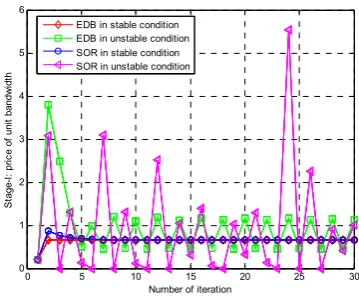
Fig.2 and Fig.3 illustrate the convergence performances of PTSA for the price per unit of bandwidth based on EDB and SOR iterative algorithm in stage-I and stage-II respectively. It can be seen that the price per unit of bandwidth will converges to the equilibrium price (the optimal price) quickly for both the EDB iteration and SOR iteration, if the learning factors are in the range of stable condition. Also, we can see that the effects of EDB iteration and SOR iteration on the price per unit of bandwidth are different when the spectrum market is in unstable condition. The price per unit of bandwidth fluctuates between the several fixed values for the EDB iteration, whereas, the price fluctuation appears the more uncertainty for the SOR iteration.
0 5 10 15 20 25 30 0
1 2 3 4 5 6
Number of iteration
S
ta
ge-I:
p
ric
e of
u
ni
t bandw
idt
h
EDB in stable condition EDB in unstable condition SOR in stable condition SOR in unstable condition
Figure2.Stage-I: The convergence performance of PTSA
0 5 10 15 20 25 30
0 5 10 15
Number of iteration
S
tage-2:
pr
ic
e of
uni
t bandw
idt
h
EDB in stable condition EDB in unstable condition SOR in stable condition SOR in unstable condition
Figure 3. Stage-II: The convergence performance of PTSA
0 5 10 15 20 25 30
0.2 0.3 0.4 0.5 0.6 0.7 0.8 0.9 1 1.1 1.2
Number of iteration
S
ta
ge-I:
p
ric
e of
u
ni
t bandw
idt
h
EDB:α1=0.01 EDB:α1=0.02 SOR:ω1=0.3 SOR:ω1=0.37
Figure 4. Stage-I: The effect of learning factors on the convergence speed of PTSA
0 5 10 15 20 25 30
2 2.5 3 3.5 4 4.5 5 5.5
Number of iteration
S
tage-2:
pr
ic
e of
uni
t bandw
idt
h
EDB:α2=1.5 EDB:α2=2 SOR:ω2=0.3 SOR:ω2=0.37
Figure 5. Stage- II: The effect of learning factors on the convergence speed of PTSA
0 5 10 15 20 25 30
-6 -4 -2 0 2 4 6 8 10 12
Number of iteration
S
tage-2:
pr
ic
e of
uni
t bandw
idt
h
EDB:m=2 EDB:m=5 EDB:m=6 EDB:m=10 SOR:m=2 SOR:m=5 SOR:m=6 SOR:m=10
Figure 6. The effect of the number of CH-SUs’ priority levels on the equilibrium price of PTSA
Fig.6 shows the influence of the number of CH-SUs’ priority levels, m, on the equilibrium price of PTSA. It can be seen that with m increasing (o<m≤5), the price per unit of bandwidth in stage-II increases with EDB iteration and SOR iteration. It is the reason that with larger m, the spectrum bandwidth allocated to each CH-SU decreases accordingly, so the CH-SU will sell the unit bandwidth at a higher price to maximize its revenue. Furthermore, we can see that with smaller m (o<m≤5), the price per unit of bandwidth in stage-II could converges to a rational equilibrium price both in EDB iteration and SOR iteration. However, if the value of m is larger than 5, there is great difference on the price per unit of bandwidth between the EDB iteration and SOR iteration. Especially, the price per unit of bandwidth with SOR iteration drops even below the initial price.
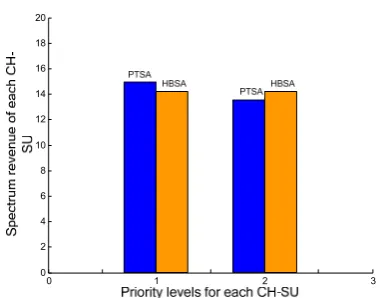
Next, we examine the spectrum revenue of PTSA in contrast with that of HBSA [17].Both of them adopt the same spectrum utility function, whereas, the philosophy is different: in PTSA, spectrum allocation is carried out considering the priority levels of CH-SUs and CM-SUs, while the spectrum bandwidth is allocated equally among the SUs in HBSA.
The spectrum revenues of each CH-SU and each CM-SU at different priority level are illustrated in Fig.7 and Fig.8 respectively. It is observed from Fig.7 that, in PTSA, the spectrum revenue of each CH-SU at priority level-1 is 14.9395 and 13.5531 at priority level-2. And in HBSA, the spectrum revenue of each SU is a fixed value of 14.2460, regardless of priority levels.
We can see from Fig.8, in PTSA, the spectrum revenue of each CM-SU is 13.8464 at priority level-1, 12.4603 at priority level-2, and 11.6492 at priority level-3. And in HBSA, the spectrum revenue of each SU appears to be a fixed value of 12.4541, regardless of priority levels.
The results from Fig.7 and Fig.8 reveal that our proposed PTSA algorithm reflects the rationality in spectrum allocation that the spectrum revenue of SUs should be different for different priority level.
Fig.9 and Fig.10 show the time overhead performances. It can be seen that the time overhead of PTSA increases slowly with the increment of number of CM-SUs for given N2=3, m=2, and k=2. In contrast, the time overhead
0 0.5 1 1.5 2 2.5 3 0
2 4 6 8 10 12 14 16 18 20
簇簇簇簇簇簇簇
不不簇簇簇
不不不簇簇簇
簇不不不不不
不不
Figure 7. Spectrum revenue of each CH-SU for different priority level
0 0.5 1 1.5 2 2.5 3 3.5 4 0
2 4 6 8 10 12 14 16 18 20
簇簇簇簇簇簇簇簇
不不簇簇
簇不不不簇簇簇簇簇不不不不不不不
Figure 8. Spectrum revenue of each CM-SU for different priority level
0 5 10 15 20 25 30
0 5 10 15 20 25 30 35
Number of CM-SUs
T
im
e ov
er
head
PTSA HBSA
Figure 9. The time overhead under different number of CM-SUs
0 5 10 15 20 25 30
0 5 10 15 20 25 30 35
Number of priority levels for CM-SUs
T
im
e ov
er
head
PTSA HBSA
Figure 10. The time overhead under different number of priority levels for CM-SUs
We can see from Fig.10 that the time overhead of PTSA increases linearly with the number of priority levels increasing for given N2=3, N3=3, and m=2. In
contrast, the time overhead of HBSA maintains constant. Furthermore, it can be seen that the time overhead of PTSA is superior to that of HBSA for k≤4, whereas, HBSA has the lower time overhead than PTSA for k>4.
VI. CONCLUSIONS
In this paper, we proposed a priority-oriented two-stage spectrum allocation (PTSA) algorithm for hierarchical cognitive ad hoc networks, the convergence, spectrum revenue and time overhead of PTSA are analyzed and evaluated. The results show that: 1) When learning factors are set within the range of the stable condition, the number of priority levels of CH-SUs is not larger than 5, the price per unit of bandwidth in PTSA will converge to the unique optimal value, no matter EDB or SOR iterative method is adopted. And, in the progress towards convergence, the smaller the learning factors, the faster convergence speed can be obtained. 2) Compared with the spectrum allocation algorithm without taking the SU’s priority level into consideration, PTSA algorithm allocates different size of spectrum bandwidth for SUs according to the different priority levels, which reflect the rationality and difference in spectrum allocation. 3) When the number of priority level of CM-SUs is less than 4, PTSA has the lower time overhead than other similar algorithm.
ACKNOWLEDGMENT
This work was partially supported by Nation Science Foundation of China (61261014), by the State Key Laboratory of Rail Traffic Control and Safety (RCS2011K006), Beijing Jiaotong University, and by the Fundamental Research Funds for the Gansu Universities (212087-2).
REFERENCES
[1] X. D. Jia, X. P. Yuan, L. X. Meng, L. M. Wang, “EPAS: Efficient Privacy-preserving Authentication Scheme for VANETs-based Emergency Communication ,” Journal of Software, 2013, 8(8): 1914-1922.
[2] R. W. Brodersen, A. Wolisz, and D. Cabric et al, “Corvus: a cognitive radio approach for usage of virtual unlicensed spectrum,” Berkeley Wireless Research Center (BWRC) White paper, 2004.
[3] Y. Q. Ding, G. T. Han, X. M. Mu, “A distributed localization algorithm for wireless sensor network based on the two-hop connection relationship,” Journal of Software, 2012, 7(7): 1657-1663.
[4] Federal Communications Commission, “Spectrum Policy Task Force. Rep. ET Docket no. 02-135,” Nov. 2002. [5] J. Mitola, “The software radio architecture,” IEEE
Communications Magazine, 1995, 33(5): 26-38.
[7] J. Elias, F. Martignon, and A. Capone et al, “Non-cooperative spectrum access in cognitive radio networks: a game theoretical model,” Computer Networks, 2011, 55(17): 3832-3846.
[8] W. Wei and L. Xin, “List-Coloring Based Channel Allocation for Open-Spectrum Wireless Network,” in Proc. IEEE VTC’05, Dallas, Texas, USA, May 2005, pp. 690-694.
[9] H. Zheng and C. Peng, “Collaboration and Fairness in Opportunistic Spectrum Access,” in Proc. IEEE ICC’05, Seoul, Korea, May 2005, 5: 3132-3136.
[10]A. Heydarnoori, W. Binder, “A graph-based approach for deploying component-based applications into channel-based distributed environments,” Journal of Software, 2011, 6(8): 1381-1394.
[11]D. Niyato and E. Hossain, “A game-theoretic approach to competitive spectrum sharing in cognitive radio networks,” in Proc. IEEE WCNC’07, Hong Kong, March 2007, pp.16-20
[12]D. Niyato and E. Hossain, “Competitive pricing for spectrum sharing in cognitive radio networks: Dynamic game, inefficiency of nash equilibrium, and collusion,” IEEE Journal on Selected Areas in Communications, 2008, 26(1): 192-202.
[13]Y. Xing, R. Chandramouli and C. D. M. Cordeiro, “Price dynamics in competitive agile spectrum access markets,” IEEE Journal on Selected Areas in Communications, 2007, 25(3): 613-621.
[14]D. Xu, X. Liu and Z. Han, “A two-tier market for decentralized dynamic spectrum access in cognitive radio networks,” in Proc. IEEE SECON 2010, Boston, Massachusetts, USA. June 2010, pp. 1-9.
[15]L. Duan, J. Huang and B. Shou, “Investment and pricing with spectrum uncertainty: a cognitive operator's perspective,” IEEE Transactions on Mobile Computing, 2011, 10(11): 1590-1604.
[16]D. Niyato, E. Hossain, and Z. Han, “Dynamic spectrum access in IEEE 802.22-based cognitive wireless networks: a game theoretic model for competitive spectrum bidding and pricing,” IEEE Wireless Communications, 2009, 16(2): 16-23.
[17]D. Niyato and E. Hossain, “A microeconomic model for hierarchical bandwidth sharing in dynamic spectrum access networks,” IEEE Transactions on Computers, 2010, 59(7): 865-877.
[18]J. Elias and F. Martignon, “Joint spectrum access and pricing in cognitive radio networks with elastic traffic,” in Proc. IEEE ICC 2010, Cape Town, South Africa, May 2010, pp. 1-5.
[19]L. Gao, X. Wang, and Y. Xu et al, “Spectrum trading in cognitive radio networks: A contract-theoretic modeling approach,” IEEE Journal on Selected Areas in Communications, 2011, 29(4): 843-855.
[20]G. I. Alptekin and A. B. Bener, “Spectrum trading in cognitive radio networks with strict transmission power control,” European Transactions on Telecommunications, 2011, 22(6): 282-295.
[21]S. Alrabaee, M. Khasawneh, and A. Agarwal et al, “A game theory approach: Dynamic behaviours for spectrum management in cognitive radio network,” in Proc. IEEE Globecom Workshops, Anaheim, California USA. Dec. 2012, pp. 919-924.
[22]B. D. Bemheim and D. M. Whinston, “Microeconomics,” McGraw-Hill/Irwin: New York, 2007.
[23]A. Tang, J. Wang, and S. H. Low, “Counter-Intuitive Throughput Behaviors in Networks under End-to-End Control,” IEEE/ACMTrans. Networking, 2006, 14(2): 355-368.
[24]A. Veres, A. T. Campbell, M. Barry and L. H. Sun, “Supporting service differentiation in wireless packet networks using distributed control,” IEEE Journal on Selected Areas in Communications, 2001, 19(10): 2081−2093.
[25]E. R. Gomes and R. Kowalczyk, “Learning the IPA market with individual and social rewards,” Web Intelligence and Agent Systems, 2009, 7(2): 123-138.
[26]E. Gomes and R. Kowalczyk, “Learning in market-based resource allocation,” in Proc. IEEE ICIS, Québec, Canada. Jul.2007, pp. 475-482.
[27]Y. Qiu and P. Marbach, “Bandwidth allocation in ad hoc networks: A price-based approach,” in Proc. IEEE INFOCOM 2003, San Franciso, CA, USA, Mar. 2003, 2: 797-807.
[28]W. Xin and S. Henning, “Pricing network resources for adaptive applications,” IEEE/ACM Transaction on Networking, 2006, 14(3): 506-519
Jianli Xie was born in Gansu Province in China in 1972. He received a BSc. Degree from Sichuan University in 1993. From 1993 to 1996, he worked as an engineer in Lanzhou General Machinery Plant. He received a Master degree from the Department of Communication Engineering, Lanzhou Jiaotong University in 1999. From 1999-2007, he was a senior hardware engineer in Beijing Great Dragon company. Now he is a teacher of Lanzhou Jiaotong University and a candidate for doctor’s degree. He has published over 10 scientific papers in his research area till now. His research interests include wireless communication network and cognitive radio techniques.
Cuiran Li (M’09) was born in Shanxi Province in China in 1975. She received a BSc. and Master degree from the Department of Communication Engineering, Lanzhou Jiaotong University, in 1996 and 1999, respectively, and a Dr. degree from the School of Electronics and Information Engineering, Beijing Jiaotong University in 2003. She is now working in Lanzhou Jiaotong University as a professor and an IEEE member. She has published a book and over 40 scientific papers in her research area till now. Her research interests include cognitive radio techniques, mobile ad hoc network and GSM-R/LTE-R systems.