ISSN (e): 2250-3021, ISSN (p): 2278-8719
Vol. 09, Issue 4 (April. 2019), ||S (III) || PP 26-31
An Improved Channel Allocation Scheme for Mobile Cellular
Network
Shubham Srivastava, Saurav Kumar Tripathi, Hiralal Saw, Anjali Aakanchha
and Jibendu Sekhar Roy
School of Electronics Engineering, KIIT Deemed to be University, Bhubaneswar-751024, Odisha, India Corresponding Author: Jibendu Sekhar Roy
Abstract:
In this paper, the normal fixed channel allocation (FCA) is improved by introducing the concept of channel borrowing and it was found that the call blocking probability for a given set of conditions was 14% and dropped to 10% approximately also the handoff dropping probability reduced from 9% to 1 %. This paper also focuses on hybrid channel allocation (HCA), where the average number of channels, allocated dynamically to each cell in a cluster, is maximized and then channel borrowing scheme is introduced. HCA was used on a cluster of cells and the blocking probability for each cell was significantly reduced. Here it was aimed to keep the blocking probability below 6%.Index Terms –
Channel allocation, cellular network, blocking probability, handoff, channel borrowing --- --- Date of Submission: 03-04-2019 Date of acceptance: 18-04-2019---
I.
INTRODUCTION
In a cellular network, the geographical area is divided into different smaller areas known as cells, and each cell has its own base station, transmitter and receiver, and control unit [1]. The shape of the cell is assumed to be hexagonal because there is no case of area overlap and gap when they are arranged together [2]. Each cell is allotted a set of the disjoint frequency channel [3], by keeping in mind the concept of frequency reuse [4]. It is a technique through which user at the distinct location may simultaneously use the same channel or frequency by using this concept, the spectral efficiency of the communication system is enhanced. There are three main types of channel allocation schemes (a) Fixed channel allocation (FCA) (b) Dynamic channel allocation (DCA), (c) Hybrid channel allocation (HCA) [4, 5]. There is a possibility that user in a call will move from one cell to another cell, then at that time to serve that call a concept of handoff or handover [6] arises, through this concept, there is a smooth transition of a call from one cell to another cell. It is mainly of two types (a) soft handoff (b) hard handoff [7]. Different algorithms are proposed [6-8] to improve spectral efficiency by using channel borrowing FCA and by using optimal spatial dynamic allocation of channels and by using HCA schemes. For each cell, the call blocking and call dropping probability are also calculated by using Erlang B and Erlang C formula [9].
In this paper an algorithm is proposed by combining FCA and channel borrowing scheme to improve call blocking probability and call drop probability in cellular communication. The paper also presents the improved performance in a cellular network by extending this concept by combing HCA with channel borrowing scheme. Simulated results, obtained by using MATLAB, are presented.
II.
CELLULAR CONCEPT
variable channels can be shared with other cells [2]. In a channel borrowing scheme, if necessary to handle more number of traffics, one cell can borrow certain number of frequency channels from another cell. Hand off or handover is an important phenomenon in a mobile network where the job of a base station is handed over to the next neighbouring base station when the mobile unit is crossing from one to cell to another [7-8]. Blocking probability and call drop probability are two important parameters to determine the quality of service (QoS) of a mobile network [2].
III.
IMPROVED CHANNEL ALLOCATION SCHEMES
Here FCA is used and the blocking probability of originating calls was high when FCA is used, so in order to minimize the blocking probability, allocation with channel borrowing strategy is used. In this strategy, priority to handoff calls is given here because a call being dropped is more annoying than a call being blocked at its start. A certain number of channels Sr is dedicated to serving the handoff call only and the rest (Sc=S-Sr) is
used to serve the originating calls of the cell. The value of Sc and Sr varies with traffic if the traffic of
originating calls is high and the traffic of handoff calls is less then some channels from Sr is added to Sc and vice
versa. In order to further minimize the blocking or dropping probability (say below 6%), channel borrowing strategy is used. in this, a cell with high traffic can borrow channels from the guard channel of the neighboring cells. To achieve a more efficient reduction of blocking probability hybrid channel allocation (HCA) Scheme is used, HCA is a combination of both FCA and DCA Scheme. It allocates some channels statically and some channels dynamically, in this scheme total channels are divided into two sets of fixed sets and dynamic sets. The channels that are present in fixed sets are assigned to a cell by using FCA scheme, whereas the dynamic set of channels are reserved in the central pool, if all the fix sets of channels are busy then to new call in a cell will be served by dynamic sets of channels.
In DCA the channels are allocated based on the traffic of the cell. For more efficient allocation it is necessary to increase the maximum average channels allocated to each cell and for that, optimal spatial dynamic allocation of channels is used [8].
Let the number of cells is N and total available channels are M, and P1, P2, P3,……. Pn are the
probabilities corresponding to the call density of each cell. Aim is to maximize the average number of channels allocated to a cell and for that it is necessary to maximize the equation [8]
𝐸[𝑋] = 𝑁𝑖=1𝑛𝑖𝑃𝑖
(1)
X is a random variable corresponding to a number of channels or cell index and Pi is the probability
corresponding to i. The constraint is
𝑛𝑖 = 𝑀 𝑁
𝑖=1 (2)
For maximizing the eqn(1) following cases are possible: Case 1: All values of ni (1 ≤ i ≤ 𝑁 − 1)=0 , nN =M
E[X] is maximized but the trivial solution.
Case2: If the minimum number of channels in a cell has a lower boundary R.
n1 = R, n2 = R, n3 = R, … … … nN = M − (N − 1) ∗ R with nN ≥ M (3) Case3: If the minimum number of channels in a cell has a lower boundary R and channel should differ by 1 at least.
n1 = R, n2 = R + 1, … … … nN − 1 = R + (N − 2), nN = M − S with (M − S ≥ 𝑅) (4)
𝑆 = 𝑅 + 𝑅 + 1 + 𝑅 + 2 … … … … + (𝑅 + (𝑁 − 2))
Case4: If the minimum number of channels in a cell has a lower boundary R and channel should differ by „d‟ at least.
n1 = R, n2 = R + d, … … … nN − 1 = R + (N − 2)d, nN = M − S with (M − S ≥ 𝑅) (5)
𝑆 = 𝑅 + 𝑅 + 𝑑 + 𝑅 + 2𝑑 … … … … + (𝑅 + (𝑁 − 2)𝑑)
Practical Constraint:- Let the value of ni be in AP. Therefore n1,n2,…….,nN equal to a, a+d,……..,a+(N-1)*d.
Sum of the series =M=𝑁𝑎 +𝑑(𝑁−1)𝑁
2 . Its solution is GCD of N and (𝑁−1)𝑁
2 . This holds true when M is the
multiple of GCD. General expression for other solution
𝑎 = 𝑎0+ 𝑘𝑁 (𝑁 −1)
2
𝐺𝐶𝐷 , 𝑑 = 𝑑0− 𝑘 𝑁
𝐺𝐶𝐷 (6)
Where „k „ is an integer constant. Let p= 𝑀𝑁(𝑁−1)
2 = 𝑞, when N is odd then GCD of N and 𝑁(𝑁−1)
2 is N then the solution is
𝑎 = 𝑎0+ 𝑘(𝑁−1)
𝐺𝐶𝐷 , 𝑑 = 𝑑0− 𝑘 (7)
when N is even the GCD can be found using extended Euclidean [8] then the solution is:-
𝑎 = 𝑎0+ 𝑘 ∗𝑞
𝐺𝐶𝐷(𝑝,𝑞), 𝑑 = 𝑑0− 𝑘∗𝑞
In order to further minimize the blocking or dropping probability (say below 6%), channels can be borrowed from the neighboring cell whose traffic is less.
The assumptions made here are:
1. The formula used for calculating the call blocking probability is Erlang B [9]
𝑃 =
𝜆 0𝑆 𝑆!µ0𝑆
𝜆 0𝑖 𝑖!µ0𝑖
𝑆 𝑖=0
(9)
The formula used for calculating the Call Dropping Probability is Erlang C [9]
𝑃 = 𝜆 𝐻𝑆 𝑆!µ𝐻𝑆 𝑆 𝑆−𝜆 𝐻 µ𝐻 ( 𝜆 𝐻 𝑖 𝑖!µ𝐻𝑖 𝑆
𝑖=0 )+𝜆 𝐻
𝑆 𝑆!µ𝐻𝑆 𝑆 𝑆−𝜆 𝐻µ 𝐻 (10)
Where 𝜆0 is the arrival rate of originating calls, µ0 is the departure rate of originating calls, 𝜆𝐻 is the arrival rate
of handoff calls,µ𝐻 is the departure rate of handoff calls and S is the number of channels.
2. In the case of FCA, the value of S=60 and value of Sc and Sr are 43 and 17 respectively. The value for λ0 and
λH are 48 and 12 and values for µ0 and µH are 1.2 and 1.12 respectively. The number of borrowed channels is 6.
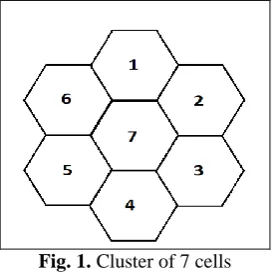
3. In the case of HCA, a cluster of 7 cells is used (Fig.1) .
Fig. 1. Cluster of 7 cells
Here S=60 and the call arrival rates of each cell are 𝜆1= 69, 𝜆4= 82, 𝜆7= 90, 𝜆2= 76, 𝜆5= 71, 𝜆3= 73,
𝜆6= 83.
Value of the µ0 for each cell is 1.3 and the value of 𝑎0 and 𝑑0 in DCA calculation are 5 and 2 respectively.
4. Neighbors of each cell are: 1=> 6,7,2 5=> 6,7,4 2=> 1,7,3 6=> 1,7,5 3=> 2,7,4 7=> 1,2,3,4,5,6 and 4=> 5,7,3
5.The channels are borrowed by maintaining the blocking probability of the donor cell below 6%. The algorithm for combined HCA and channel borrowing scheme is explained below step-wise:
Step-1: Using Erlang B calculate the blocking probability of each cell (B1, B2, B3, B4, B5, B6, B7) for a range from λ to λ+7, where λ is the call arrival rate of each cell.
Step-2: Now check whether the last value of the blocking probability array of each cell is less than 6% or not. Step-3: If the value is below 6% then the number of the dynamic channels that was to be assigned to that cell should be added to dysave instead of allocating those channels to that cell.
Step-4: If the value is above 6% then the dynamic channels will be added to the total number of channels of that cell.
Step-5: For the last cell, if the blocking probability is above 6% then the dynamic channels will be added to it and also the dysave will be added to it.
Step-6: Now again calculate the blocking probability for each cell in which dynamic allocation of channels was done.
Step-7: Again check whether the last value of the blocking probability array is less than 6% or not. If the value is above 6% then it will take channels from its neighboring cells but the number of channels borrowed from a particular cell should be such that the blocking probability of the donor cell is below 6%.
IV.
SIMULATION AND RESULTS
Fig. 2. Call blocking probabilities for FCA and FCA with channel borrowing
Fig. 3. Blocking probabilities of handoff calls for FCA and FCA with channel borrowing
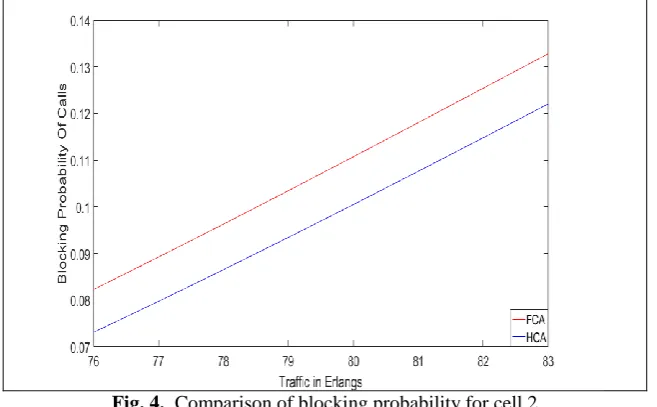
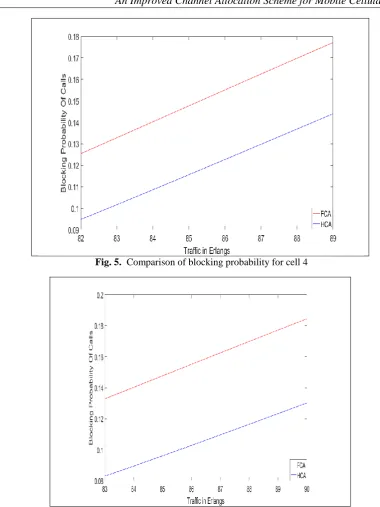
The Blocking Probability of each cell was reduced when HCA with channel borrowing is used instead of FCA with channel borrowing. In cell1 the value of the blocking probability is already below 6% so its value is the same for both FCA and HCA. These comparisons for the cells 2, 4 and 6 in a cluster are shown in Fig.4 – Fig.6.
Fig. 5. Comparison of blocking probability for cell 4
Fig. 6. Comparison of blocking probability for cell 6
V.
CONCLUSION
International organization of Scientific Research
31 | Page
REFERENCES
[1]. Subramanya SR, Yi BK. Mobile communications-an overview. IEEE Potentials. 2005;24(5):36-40. [2]. Haykin S, and Moher M. Modern Wireless Communications. Singapore. 2002. Pearson Education, Inc. [3]. Mark JW, and Zhuang W. Wireless Communications and Networking. 2005. PHI, New Delhi.
[4]. Mishra MP, Saxena PC. Survey of channel allocation algorithms research for cellular systems.
International Journal of Networks and Communications. 2012;2(5):75-104. [5]. Katzis K, Pearce DAJ, Grace D. Fixed channel allocation techniques exploiting cell overlap for high
altitude platforms. Proc. of European Wireless Conf‟04. 2004.
[6]. Iera A, Molinaro A, and Marano S. Handoff management with mobility estimation in hierarchical systems. IEEE Transactions on Vehicular Technology. 2002;51: 915-934.
[7]. Sarddar D, Chatterjee S, Mazumder SP, Mukherjee M, Mallik MS, Biswas U, Naskar MK. Minimization of call blocking probability using auxiliary stations. International Journal of Computer Applications. 2011;25(7); 50-56.
[8]. Divija G, Grover J, Ramamurthy G. Dynamic channel allocation in small cells. IEEE 7th International Conference on Reliability, Infocom Technologies and Optimization (IIIT/TR/2018/-1). Aug 2018. [9]. Rappaport TS. Wireless Communications Principles and Practice. 2018, Pearson Education.