Advanced Development in information and communication technologies, there are so many things that gives facility to deal with these technology using internet. This advanced technology brings revolution or convenient system for users. This advance technologies are applied to many applications such as healthcare or medical area, provide security in people information personally or financially, provide interactions among different kinds of devices, like smart vehicles management, for patients medical sensors, monitoring CCD cameras, advanced technology based home appliances, smart city, home automation, smart grid, traffic management, RTO offices etc. For that purpose, we need a unique identification system for each task. For providing proper identification we using RFID (Radio-frequency identification) system. Radio-frequency identification (RFID) is the most important wireless communication technologies used in the Internet of Things as it can store sensitive data, used for wireless communication with other objects, and identify/track particular object automatically. To provide better security and performance to RFID authentication scheme, Elliptic Curve Cryptography is going to be used. Elliptical curve cryptography (ECC) is based on a public key cryptosystem based system that is on elliptic curve theory. Elliptic Curve Cryptography can be used to create smaller, faster, and efficient cryptographic keys. ECC authentication scheme is well suited for wireless communications, like mobile phones and smart cards, personal information like financial transaction or some secret medical reports, confidential data where main consideration is to provide secure data. Elliptic curve cryptography (ECC) system is for provide suitable authentication RFID system because it can provide similar security level but using a smaller key size and has low computational system requirements. The low processing associated with ECC authentication scheme is to make suitable for use with RFID tags because they have consuming limited computing power. In this paper we present a survey paper on ECC based RFID authentication scheme that is suitable for many applications where security is main concern.
Keywords: Authentication schemes, Elliptic curve cryptography (ECC), Radio frequency identification(RFID), RSA (Rivest, Shamir and Adleman), Public key Cryptosystem(PKC)
________________________________________________________________________________________________________
I. INTRODUCTION
Today’s advanced technology of internet brings revolution or convenient system for users. This advance technology is applied to many applications like healthcare or medical area, provide security in people information personally or financially, provide interactions among different types of devices, like smart vehicles management, for patient’s medical sensors, monitoring CCD cameras, advanced technology based home appliances, smart city, home automation, smart grid, traffic management, RTO offices etc. For that purpose, we need a unique identification system for each task. Radio Frequency Identification (RFID) systems are becoming popular due to their vast applications like supply chains, inventory, tolling, baggage management, access control, medical, financial etc. By use these technologies not only improve our lives but they also cause of privacy risk. In many applications privacy is neglected, but due to security reason of RFIDs the issue has to be taken. However, providing additional security to the system is always comes with price and the scarceness of resources on a tag makes conventional privacy-preserving protocols.
Radio-frequency identification (RFID) is a wireless communication technology that is useful for precisely identifying objects. RFID technology uses the radio-frequency waves to transfer identifying information between tagged objects and readers without line of sight (LOS), providing an automatic identification system.
RFID technology attracts a lot of attention in recent years because of it large convergence of lower cost and the increased capabilities of RFID keys. But when RFID scheme is used the data is in open space so there is possibility to hack the data. It doesn’t provide proper security to your data that is either your personnel or financial or for that system dealing with security. So the main requirement for this RFID is small computational capacity system that have strong authentication and good performance. RFID attract a lot of attention from users only in recent years because of the large convergence in low cost and the increased capabilities, provide of RFID tags. Currently, RFID is emerging as an important technology that is cause for revolution in a wide range of applications that include supply-chain management, retail sales, anti-counterfeiting, and healthcare.
RFID is most important and popular technology that is used in Internet of things because it can store any kind of data, wireless communication with different system, identifying and track object properly and automatically.
When we compared RFID with traditional barcode system it can be applied for rough surfaces also, it has read write capability, does not require Line of Sight(LOS) and it can read many tags simultaneously
All the above benefits make RFID a superior technology than traditional systems. RFID system can be used in many applications. For example in the healthcare environment[1], RFID technology is being used within IoT and common applications like location
Authentication Scheme for Secured RFID
Himja Agrawal Prof. P. R. Badadapure
PG Student Associate Professor
Department of Electronics & Telecommunication Engineering Department of Electronics & Telecommunication Engineering
Pune, Maharashtra Pune, Maharashtra
tracking of medical assets new-born and patient identification , tracking of medical treatment and validation patient location and procedure management at a wellness centre , and surgical process management
Mutual authentication in RFID systems is a strong requirement that must be met to ensure secure communication between RFID tags and the server. The RFID authentication scheme should be efficient and secure against various attacks through hackers.
II. CLASSIFICATION OF RFID AUTHENTICATION SCHEME
RFID authentication scheme have been used for many applications. According to cryptographic primitives used in various schemes, RFID scheme can be classified in two types
1) Non Public-key cryptosystem(NPKC) based schemes 2) Public key cryptosystem(PKC)-based scheme
The NPKC based RFID authentication scheme have no complex operation is needed so it gives better performance. In this scheme simple logic gate operations, symmetric encryption technique, cyclic redundancy codes are used. So this type or schemes have been proposed for normal practical applications like book management, verification, road traffic administration etc where security of data is not so much concern.
PKC based scheme are necessary where security of data is main concern. Because that attributes cannot be implemented by NPKC based scheme. Development in micro electric technology many complex algorithms have been implemented on RFID chips. In many schemes ECC authentication system is more suitable for system because it can provide same security but using shorter key size and low computational requirement so it limit the computing power. In PK algorithms it uses a mechanism where large number of participants share keys in complex information system. Compare to RSA (Rivest, Shamir and Adleman) or other schemes, ECC is using shorter key length.
To authenticate RFID is the most important steps to set up a secure communication in RFID system. We are using different authentication scheme for this purpose. Because RFID tags and readers are exposed in many kind of security threats.
III. SECURITY REQUIREMENTS
RFID security requirements are fulfilled when they satisfied following requirements to make efficient authentication scheme. 1) Mutual authentication:
In mutual authentication among the RFID Tag and RFID reader should be fixed before starting any session. In system we assume that our communication channel between server and tag is secured only mutual authentication is required.
2) Confidentiality:
It is essential to provide security to secret information such as identity, passwords financial transaction when it is transmitted through communication channel. The information can be hacked during transmission so it must be encrypted before transmission. 3) Anonymity:
RFID authentication should provide anonymity that means it traces the owner’s activity, its location and privacy if the tag’s identity is known, so the tag should be encrypted.
4) Availability:
The authentication process for RFID should be executed during the life cycle period of Tag. When the information is executed the authentication scheme should give a update the secret information. If this is fail to synchronization of any update, then authentication scheme will become invalid.
5) Forward security:
It is very necessary to provide forward security to authentication scheme. Because in many authentications scheme you can track the past location of the tag. This would be very serious for owner’s privacy and security.
6) Scalability:
To provide the authentication to RFID Tag the system has to find the records from the data base. If the computational work on algorithm increases the number of tags increases so no longer the system will remain scalable
7) Attack resistance:
To provide guaranteed authentication scheme this scheme should be secure against various attacks like man in the middle attack, reply attack, modification attack, server spoofing attack etc.
For providing secure authentication scheme which fulfill above requirements
IV. ELLIPTICAL CURVE CRYPTOGRAPHY
Cryptography is a electronic technique that is used to protect valuable data over transmission. Mainly cryptography is science to provide security to information. To protect our data by using different authentication scheme is the main objective of cryptography. when authentication of data is main consider that should be less cost than the value of original information.
Two main terms that is used for the cryptography technique are Encryption and Decryption.
Encryption is happened at the sender side. Encrypted algorithm is made to make information unreadable by all intended receivers.
Encrypt (plaintext, key) = cipher text Decrypt (cipher text, key) = plaintext
Decryption is the reverse process of encryption. It is technique to convert the encrypted data to its original data that is now readable. Decryption technique need separate Decryption algorithm and a key. Encryption and Decryption algorithm are same.
Elliptical curve cryptography (ECC) is a (PKC) public key encryption technique based on elliptic curve theory that can be used to create faster in speed, smaller in size, and more efficient Cryptographic keys to provide authentication scheme to RFID system. ECC is PKC based crypto system like RSA (Rivest-Shamir-Adleman) but it different from RSA because of its quicker evolving capacity and it provide attractive and alternative way to researchers to create cryptographic algorithm according to their requirement that means how much security they want to provide to the system.
Previous research shows that the security level that is provided by RSA, using ECC that same security can be provided but using smaller key size. Research shows that using RSA algorithm that same security level can be achieved using 1024 bits key size but using ECC require only 160 bits key size. ECC algorithm can be implemented on compact size of RFID tags. So ECC authentication scheme is well suited for wireless communications, like mobile phones and smart cards. ECC point of multiplication operation is found to be computationally more efficient than RSA using fast and effective computational time. There are two types of attacks from which we have to provide security to the system
Active Attack: Attacker can send old or manipulated messages or it can be deleted
Passive Attack: In case of passive attacks, the attacker can interleave and make statistics about the communication. The detection of these attacks is difficult, so the goal is to prevent them. In case of active attacks, the attacker can send old/manipulated messages and delete messages.
V. BLOCK DIAGRAM
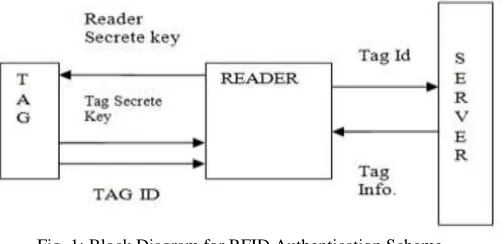
The basic architecture shown in figure.1 for an RFID authentication scheme includes three main parts: 1) The RFID tag
2) The RFID reader 3) The server.
We have to achieve authentication between the tag and the server, some of the secret data that are transmitted are already predefined between tag and the reader when the system is firstly set up. Data transmitted through communication channel between RFID tag and the RFID reader is not secure because their exchange of data is through wirelessly so anybody intercept data easily. So to prevent data proper authentication scheme is needed between RFID tag reader and RFID server.
RFID Tag:
RFID tag is microchip based technology, an antenna which is used to transmit data and hardware which has cryptographic operations. It stores secrete data that is going to use in authentication. RFID tag is used for communication with RFID reader.
Fig. 1: Block Diagram for RFID Authentication Scheme
Usually, computing capacity of the RFID tag’s and used memory storage are very limited. Based on that RFID tags could be divided into three types:
1) Passive tag
This type of RFID tag gets power through wireless signals from the reader 2) Semi active tag
This semi active tag is equipped with a small battery and semi active tag gets power from it. The passive and the semi active tags both type of RFID tag use backscatter modulation to send messages.
3) Active tag:
RFID Reader:
An RFID reader is like composed of a radio transmitter, a radio receiver, a control unit, and a memory unit. The motive of an RFID reader is to enable the communication between RFID tag and the RFID server for exchange of messages between each other and achieve predefine mutual authentication. RFID reader’s computing capacity is higher as compared to the RFID tag.
Server:
A server is a trusted entity. To achieve the mutual authentication, Server stores all the identification information of RFID tag in its database when the system is set up. Using the stored identification information, the server determines the validity of tag. Computing capability and memory capacity of server are very high.
VI. CRYPTOGRAPHY ALGORITHM
There are so many ways to do the classification of Cryptography Algorithm. This categorization are based on different number of keys that is used for encryption and description.
Based on that keys there are three types of algorithm used for Cryptography. Secret Key Cryptography (SKC):
In this type of algorithm, it uses Single key for both side Encryption and Decryption. That means Single key is used for encoding the message that is going to be transmitted and the same key is used for decode the received message. This is also called Symmetric Key Cryptography.
K K
Plain text→ Cipher text→ Plain text Public Key Cryptography (PKC):
In this type of algorithm one key is used for Encryption and another key is used for Decryption. One key is used for encode the message and second key is used for decode the method. There are no symmetry in keys so this method is also called Asymmetric key cryptography.
K1 K2
Plain text→ Cipher text→ Plain text
The basic goal of our protocol is to provide the strong authentication scheme in the RFID system. In defining this system, we should consider so many factors that is recommended for achieve goal and the environment of the system where it will going to use.
The main requirement for computational capacity system are strong authentication and good and fast performance.
When any system that operates of the air interface or which uses radio signals for transmit and receive signals is cause of many security risks when defining any kind of authentication scheme it is necessary to know that who is the other user or how to prevent unauthorized access.
The main arithmetic computation of ECC is an operation denoted as point multiplication
When you define a protocol it is divided into two types one is fixed access control and randomized access control. In randomized access control common secret key is used for whole system wide or not. They could not satisfy some basic operation. In fixed access control a RFID tag replies a fixed message to the reader so that they can be designed area and memory.
VII.PROPOSED ALGORITHM
In this algorithm two parties one sender and another receiver share a secret key. They exchange some public information. They have to be agreed on some domain parameters. They calculate their public information and their private key to calculate the secret data. At both of the end they have private key and public key. The information that is going to transmit is multiplied with transmitter side secret key. The newly formed multiplied information is received at receiver end, which is multiplied with receiver’s secret key. Third Party doesn’t have access to calculate the shared information between transmitter and receiver from the available information.
Step1:
Consider an elliptic curve whose equation is Y^2 = X^3 + AX + B which is also known as WeiestraB Equation. Step2:
We have to find the coordinates for the above equation: {(x1,y1),(x2,y2),(x3,y3)…… ∞}
Step3:
Generate the generation points that are the multiple of the coordinates on the Elliptic curve lying on the curve Example:2G,3G,4G…so on.
Encryption Step5:
Both end have key pair private key and public key. Let (p1,Qa)is private key-public key pair at one side suppose A.(p2,Qb) is the private public key pair of another side B.
Step6:
At side A, X=p1*Qb Step7:
At side B, Y=p2*Qa Step8:
p1*Qb*p2=p2*Qa*p1 Therefore We know information is X=Y, where Qa, Qb is the common generation point so p1*G*p2=p2*G*p1
Step9:
Secret shared is x THE END
VIII. RESULT
For implementation of the authentication scheme to the RFID tag using Elliptic Curve Cryptography ,the system has to recognize the RFID tag . Normally our system should provide access to valid user and should be denied to invalid user .
We have generated the RFID key. This RFID key is read by RFID reader. By using ARDUINO we send this data on laptop device. This data can be read on serial port which is connected to ARDUINO. For that purpose we have to interface the key reader to laptop. Now this data will be sent to global server. We receive data on personal device like mobile phones. But this data is not secure. During the transmission, this information is not secured and anybody can hack that information. Our main aim is to provide security. Hence our next aim is to provide security. We follow the implementation of Elliptical Curve Cryptography Algorithm to provide secured data.
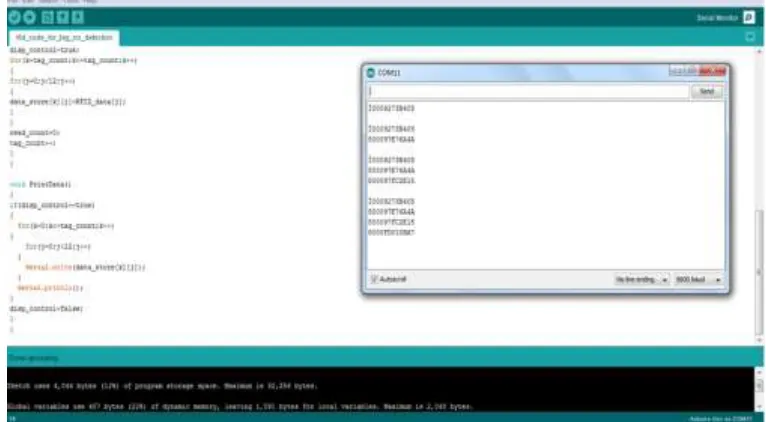
For this First we need to install the RFID software. Now the RFID tag is going to be read. That process is done by the Serial Port. That is shown in Figure 2.
Fig. 2: RFID tag is read by serial port
Fig. 3:RFID code at receiver side
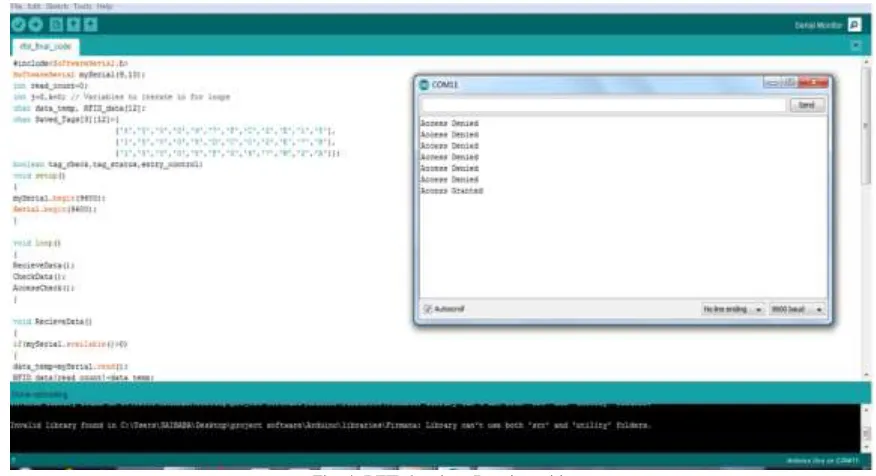
After RFID code is uploaded at receiver side .We have to enter the key number and Upload this RFID code in RFID sensor.So at receiver side only that key is entered in the RFID code only those code is going to access otherwise that key is denied by the system.
Fig. 4: RFID key is at Receiver side
In first step we will make RFID normally read by transmitter and recognize related information and then transmit to the server.In this process RFID that is allowed by the system only they can access any information otherwise the access is denied by the system that we can see in Figure 4.
Our next step is to provide security to information that is transmitting. So that our information will be secure and no one can hack that information.
IX. ADVANTAGES
ECC is more compact implementations for a given level of security
Faster cryptographic operations, running on smaller chips or more compact software In ECC less heat production and less power consumption
ECC is based on multiplication technique so it is faster , cheap and complex than other techniques ECC save cost ,time and memory
X. APPLICATIONS
In the health care environment location tracking of medical assets , newborn and patient identification, surgical process management
In personal data care credit cards, to secure personal information Toll management, access control, live stock, inventory tracking etc
XI. CONCLUSION
In this Result RFID is recognized by the system to allow or to deny the access to the information. To provide the security to information it is necessary to provide authentication to scheme. So Elliptic Curve Cryptography is used for provide the authentication scheme to RFID system.
Elliptic curve Cryptography authentication scheme offers considerably greater data security for a given key size. If the key size is smaller it is also possible to implement for a given level of security so that it consumes less power and less heat production. The smaller key size makes faster cryptographic operations, running on smaller chip and on more compact software.
REFERENCES
[1] Debiao He and Sherali Zeadally ,”An Analysis of RFID Authentication Schemes for Internet of things in Healthcare Environment Using Elliptic Curve Cryptography” IEEE Internet Of Things Journal, Vol. 2, no.. 1, February 2015
[2] R. Weinstein, “RFID: A technical overview and its application to the enterprise,” IEEE IT Prof., vol. 7, no. 3, pp. 27–33, May/Jun. 2005.
[3] S. Amendola, R. Lodato, S. Manzari, C. Occhiuzzi, and G. Marrocco ,“RFID technology for IoT-based personal healthcare in smart spaces,”IEEE Internet Things J., vol. 1, no. 2, pp. 144–152, Apr. 2014.
[4] C. Lai et al., “CPAL: A conditional privacy-preserving authentication with access likability for roaming service,” IEEE Internet Things J. ,vol . 1, no. 1, pp. 46–57, Feb. 2014
[5] G. Godor and S. Imre, “Elliptic curve cryptography based authentication protocol for low-cost RFID tags,” in Proc. IEEE Int. Conf. RFID-Technol. Appl., 2011
[6] Y. Lee, L. Batina, and I. Verbauwhede, “Untraceable RFID authentication protocols: Revision of EC-RAC,” in Proc. IEEE Int. Conf. RFID, 2009 [7] Q. Sheng, X. Li, and S. Zeadally, “Enabling next-generation RFID applications: Solutions and challenges,” IEEE Comput., vol. 41, no. 9, pp. 21–28, Sep.
2008.
[8] L. Batina et al., “Public-key cryptography for RFID-Tags,” in Proc. IEEE Int. Workshop Pervasive Comput. Commun. Secur ., 2007, pp. 217–222. [9] Y. Lee, L. Batina, and I. Verbauwhede, “EC-RAC (ECDLP based randomized access control): Provably secure RFID authentication protocol, “in Proc. IEEE
Int. Conf. RFID, 2008, pp. 97–104.
[10] M. Burmester, B. Medeiros and R. Motta. Robust, anonymous RFID authentication with constant key-lookup. Cryptology ePrint Archive: listing for 2007 (2007/402), 2007.
[11] R. Weinstein, “RFID: A technical overview and its application to the enterprise,” IEEE IT Prof., vol. 7, no. 3, pp. 27–33, May/Jun. 2005.
[12] G. Gaubatz, J. Kaps, E. Ozturk, and B. Sunar, “State of the art in ultra-low power public key cryptography for wireless sensor networks, “in Proc. 3rd IEEE Int. Conf. Pervasive Comput. Commun. Workshops (PERCOMW’05), 2005, pp. 146–150.