Fast Mode Decision Algorithm for Multiview
Video Coding Based on Binocular Just
Noticeable Difference
Yapei Zhu1
1Faculty of Information Science and Engineering of Ningbo University, Ningbo, China
Mei Yu1,2, Xin Jin1, Zongju Peng1, Feng Shao1 and Gangyi Jiang1,2* 1Faculty of Information Science and Engineering of Ningbo University, Ningbo, China 2 National Key Lab of Software New Technology of Nanjing University, Nanjing, China
Email:{[email protected], [email protected], [email protected], [email protected], [email protected]}
Abstract—Although multiview video and its applications are becoming increasingly prevalent, there have been very limited researches on multiview video coding (MVC) specially combined with human visual system. To reduce computational complexity of MVC, a fast mode decision algorithm for MVC based on binocular just noticeable difference is proposed in this paper. A binocular just noticeable difference model that describes the sensitivity of the human visual system to luminance changes is used. A solution is found within establishing an optimization framework with a threshold obtained from the relationship between the binocular just noticeable difference values and the inter mode decision. It is able to early terminate the unnecessary mode decision in the imperceptible changed regions for achieving time saving. Experimental results show that the proposed algorithm can significantly reduce the MVC time with negligible bit rate increment.
Index Terms—multiview video coding, fast coding, binocular just noticeable difference
I. INTRODUCTION
With the advent of three dimensional televisions (3DTV), video communication has been becoming increasingly important for humans [1]. Since multiview videos are used to improve perceptions of realism and depth, the well perceptual quality for stereo video content is one of the most important techniques for 3DTV and other 3D display applications [2]. The H.264/AVC video coding standard is widely applied by its high coding efficiency, but its computational complexity is also extensively increased [3]. Moreover, because human eyes are the final receivers of scene, human perception plays a major part in designing high-efficiency coding algorithms for 3D video [4]. The paper aims to improve the computational efficiency of H.264/AVC by proposing a fast mode decision algorithm which considers the properties of the human visual system (HVS).
In the field of HVS, one achievement is the concept of just-noticeable distortion (JND) model [5], which implies
that any error around a pixel below a JND threshold cannot be perceived by the human being. Liu et.al
utilized the JND model to separate edge and textured regions of the image [6]. Gao et.al proposed two fast
coding methods to generate the JND maps of multiview videos, and a perceptual multiview video coding (MVC) scheme was developed based on the synthesized and predicted JND maps [7]. Recently, several studies have concentrated on constructing a visibility threshold for 3D image/video and two types of thresholds, the JND in depth (denoted as JNDD) [8] and the binocular JND (BJND) [9, 10], were reported. The JNDD indicates that a human cannot perceive a depth difference smaller than the threshold. Silve et.al exploited the JNDD to suppress
the unnecessary spatial depth details, which reduced the bit rate for depth map without affecting the 3-D visual quality or the arbitrary view synthesis quality. BJND indicates that human being cannot realize the distortion when viewing the stereo image if the distortion in one view image is less than the BJND value.
Since many video streams are involved in the next generation visual communication services such as 3DTV, efficient MVC is critical to their successful developments. For example, a low-complex mode decision which consists of four efficient mode decision techniques, including early SKIP mode decision, adaptive early termination, fast mode size decision, and selective intra coding in inter frame was proposed in [11]. Taking into account of the fast mode decision in the coding process of MVC, it can significantly reduce the computational complexity of MVC while maintaining almost the same rate-distortion (RD) performance. In [12], neighboring blocks’ motion vectors were produced as 2-D values, and computational efficiency is increased by projecting the 2-D values of the current block. Zeng et.al experimented
with the connection between the QP and rate-distortion cost to act as the threshold, and calculated the activity by utilizing a current block’s neighboring and co-located blocks’ motion vectors [13]. Park et.al proposed an
changes among different views [14]. All these methods were efficient in reducing computational complexity with acceptable quality degradation. However, in the coding process of MVC, the human visual characteristics have not taken into account in these methods. There is still much room for further improvement in the perceptual MVC.
In this paper, a novel fast mode decision algorithm is proposed for compressing multiview videos. The proposed algorithm is designed based on the relationship between BJND values and macroblock (MB) mode. The rest of this paper is organized as follows. Section II describes the proposed algorithm. Experimental results and discussions are shown in Section III and the work is concluded in Section IV.
II. THE PROPOSED ALGORITHM
This section describes the proposed algorithm in detail. Firstly, the mode decision process in MVC is analyzed. Secondly, the overview of BJND is described. Thirdly, the threshold is derived, which determines the necessity to further predict the smaller inter mode sizes. Finally, a fast mode decision algorithm is proposed based on the results of BJND values and MB mode.
A. Analyses of Mode Decision in MVC
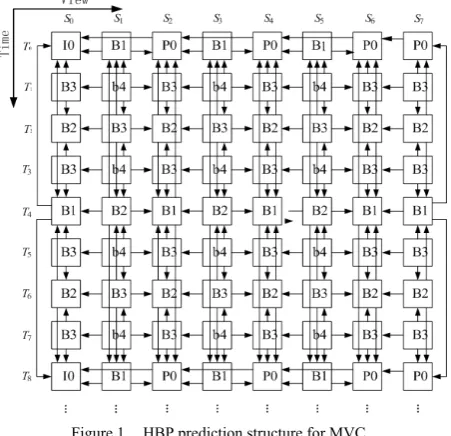
Standardization of MVC has been investigated by Joint Video Team (JVT) formed by ISO/IEC MPEG and ITU-T VCEG. ITU-The team has developed a joint multiview video model (JMVM) [15], which is based on the video coding standard H.264/AVC [16]. Since views are captured from the same scene at the same time, multiview video data have both temporal redundancy and inter-view redundancy. MVC employs both the temporal prediction in conventional video coding and the inter-view prediction among views to improve coding efficiency [17]. Therefore, MVC computational complexity is much higher than the H.264/AVC. The basic reference coding scheme of MVC is shown in Fig. 1, and it uses the hierarchical B prediction (HBP) structure for each view. There are many MB modes in MVC reference software JMVM, including SKIP, Inter 16×16, Inter 16×8, Inter 8×16, Inter 8×8, Inter8×8Frext, Intra 16×16, Intra 8×8 and Intra 4×4. Each mode is probed among all temporal and inter-view frames to decide the optimal MB mode so as to achieve the best RD performance. In general, the mode decision process with motion estimation (ME) and disparity estimation (DE) would take about 70% of the overall encoding time [18].
Hence, it is necessary to develop a fast coding algorithm to reduce computational complexity of MVC. The above mentioned fast mode algorithms are well designed, there needs to further develop more efficient algorithms, especially combined with the characteristics of HVS.
Figure 1. HBP prediction structure for MVC.
B. Analyses of the BJND
There are many known and unknown high-level processes involved in stereo perception. In this work, we will exclusively consider binocular disparity, a low-level, pre-attentive cue, attributed to the primary visual cortical areas, which is one of the most important stereo cues [19]. A model to account for the mutual effect on the minimum distortion in one view that evokes perceptual differences in the stereo image, measured with a consistent set of psychophysical stimuli was proposed [9]. It has been demonstrated that the BJND is binocular combination of injected noises, luminance masking and contrast masking in binocular viewing. In this subsection, we summarize the derivation of the BJND formula provided in [9]. Since binocular combination property is the main concentration of the stereo images, the disparity between the patterns is zero in [9]. In practice, binocular disparity, a low-level, pre-attentive cue, attributes to the primary visual cortical areas, which is one of the most important stereo cues. Stereo matching itself has been a difficult task in computer vision, and a comprehensive review of stereo matching is given in [19]. In our work, for decreasing the encoding complexity of the MVC, a state-of-the-art stereo matching technique of the traditional sum of squared differences (SSD) algorithm is adopted [20].
Given the left and right images with the disparity image corresponding to the right image, by incorporating the models of the binocular combination of injected noises, luminance and contrast masking effects, a binocular JND (BJND) at the left view is defined as Eq. (1).
1/ min
,lim
( , , ) ( ( , ), ( , ), ( , )) ( , )
( ( , ), ( , )) (1 ( ) )
( ( , ), ( , ))
l l r r r
r
C, r r
C r r
BJND i j d BJND bg i d j eh i d j n i d j
n i d j
A bg i d j eh i d j
A bg i d j eh i d j
λ λ
= + + +
+
= + + × −
+ +
(1) where i and j are the pixel coordinates, d is the
disparity value at (i, j), and nr is the noise amplitude in
influence of the noise in the right view, and is set to 1.25 as suggested in [8]. The bg(i) is the background
luminance, and the eh(i) is the edge height in the right
view. If there is no noise in the right view, BJNDl is
equivalent to AC,min, which is defined by Eq. (2).
eh
bg
K
bg
A
eh
bg
A
C,min(
,
)
=
lim(
)
+
(
)
⋅
(2)where bg is the background luminance, obtained by
averaging the luminance values in the 5×5 region at the corresponding region. In addition, Alim(bg) and K(bg) are respectively defined by bg.
Fig. 2 shows the BND results on the test sequence Exit and Vassar. Because the BJND values are usually smaller than 10, the BJND values are scaled 20 times for visualization.
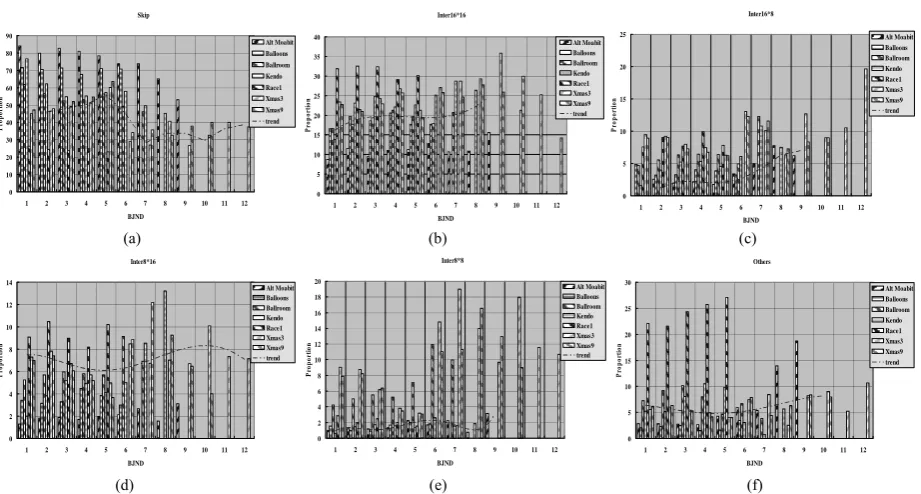
This paper addresses the MB partitioning problem of inter mode decision based on BJND. We analyses how the BJND model characterizes the distortion and the rate. The BJND model just involves the HVS binocular perceptual combination of injected noises, luminance and contrast masking effects. The following MB mode decision scheme is based on the experimental analysis results from the BJND model. Fig. 3 shows the statistical results of the relationship between the BJND values and
the mode decision. Seven sequences with different activities and characteristics are tested, including “Alt Moabit”, “Ballroom”, “Kendo”, “Race1”, “Xmas3” and “Xmas9”. The horizontal axis represents the BJND values of the MB in the right view, and every value corresponds with a proportion of optimal modes after the Rate-Distortion Optimization (RDO) process on the vertical axis. It is found that the video content are predicted by Skip and Inter 16×16 modes occupy more than 60% and 20% of all the MB counts respectively, and other modes only occupies a small proportion (less than 20%). Moreover, for example, the Inter 16×8, Inter 8×16 and the Inter 8×8, the modes proportion increases as the BJND value becomes larger. Thus, the selected value of BJND value should keep the accuracy of the sensitive regions in HVS while greatly reducing the complexity. It is observed from figure 3 that when BJND value is larger, the sensitivity of HVS is increased. It leads to a significant increase of the modes proportion. Thus, if the SKIP mode and Inter 16×16 modes could be determined to be the optimal MB mode as earlier as possible, it will reduce a lot of estimation operation for other modes which consume most of the encoding time.
(a) (b) (c) (d)
Figure 2. BJND results. (a) the first frame of the right –view and (b) the corresponding BJND image for Exit, which is scaled 20 times for visualization, (c) the first frame of the right –view and (d) the corresponding BJND image for Vassar, which is scaled 20 times for visualization.
Skip 0 10 20 30 40 50 60 70 80 90
1 2 3 4 5 6 7 8 9 10 11 12 BJND P rop or ti o n Alt Moabit Balloons Ballroom Kendo Race1 Xmas3 Xmas9 trend Inter16*16 0 5 10 15 20 25 30 35 40
1 2 3 4 5 6 7 8 9 10 11 12 BJND P rop or ti o n Alt Moabit Balloons Ballroom Kendo Race1 Xmas3 Xmas9 trend Inter16*8 0 5 10 15 20 25
1 2 3 4 5 6 7 8 9 10 11 12 BJND P ro p or ti on Alt Moabit Balloons Ballroom Kendo Race1 Xmas3 Xmas9 trend
(a) (b) (c)
Inter8*16 0 2 4 6 8 10 12 14
1 2 3 4 5 6 7 8 9 10 11 12 BJND Pr o p o rt io n Alt Moabit Balloons Ballroom Kendo Race1 Xmas3 Xmas9 trend Inter8*8 0 2 4 6 8 10 12 14 16 18 20
1 2 3 4 5 6 7 8 9 10 11 12 BJND P rop or ti on Alt Moabit Balloons Ballroom Kendo Race1 Xmas3 Xmas9 trend Others 0 5 10 15 20 25 30
1 2 3 4 5 6 7 8 9 10 11 12 BJND Pr o p o rt io n Alt Moabit Balloons Ballroom Kendo Race1 Xmas3 Xmas9 trend
(d) (e) (f)
Figure 3. Relationship between the BJND values and different mode proportion. (a) Relationship between the BJND values and the SKIP mode proportion. (b) Relationship between the BJND values and the Inter 16×16 mode proportion. (c) Relationship between the BJND values and the Inter
C. The Proposed Fast MVC Coding Algorithm
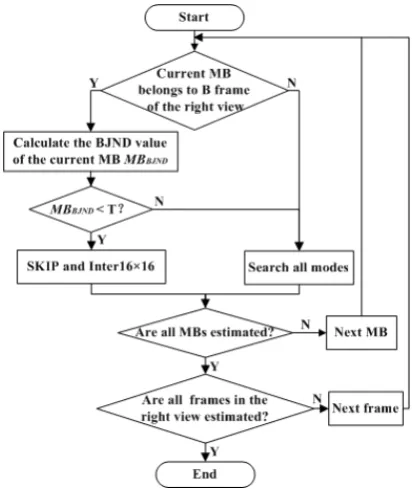
The fast MVC coding algorithm is proposed based on the analysis of mode decision in MVC and overview of the BJND. The whole process of MB mode decision does not get involved in motion estimation and RD cost computation and therefore reduces complexity significantly. Fig. 4 shows the flowchart of proposed algorithm which is described as follows
Step-(1) If the current frame belongs to B frame in a
GOP of the right view, go to Step-(2). Otherwise, go to Step-(4).
Step-(2) Compute the BJND values of each MB in the
current frame of the right view.
Step-(3) Compare the BJND value of the current
encoding MB with the threshold. If the BJND value is larger than the threshold, go to Step-(4), else go to Step-(5).
Step-(4) Test all inter and intra modes. Then go to step
1 for next MB.
Step-(5) Test the SKIP and the Inter 16×16. Then go to
Step-(1) for next MB.
Figure 4. Flowchart of the proposed fast MVC algorithm.
III. EXPERIMENTAL RESULTS AND ANALYSES In order to evaluate the performance of the proposed fast MVC algorithm, we perform the proposed algorithm on the reference software of JMVM. Five multiview video sequences, Exit, Vassar, Lovebird1, Champagne tower and Newspaper, the resolution ranges from 640×480, 1024×768 to 1280×960, are tested under common test conditions. Fig. 5 shows one of views of the test sequences, Exit, Vassar, Lovebird1, Champagne tower and Newspaper, respectively. Not only the sequences of low motion activity such as Newspaper and the very high motion such as Exit are tested, but also the sequences with larger resolution such as Champagne tower were tested. The detailed parameters are shown in Table 1. The threshold T is set as 5 empirically in the
process of mode decision.
The performance of the proposed algorithm is overall evaluated by comparing with Shen’s low-complexity mode decision (LCMD) algorithm for MVC [11].
(a) (b)
(c) (d)
(e)
Figure 5. One view in test sequences. (a) Exit. (b) Vassar. (c) Lovebird1. (d) Champagne tower and (e) Newspaper.
TABLE I. PARAMETERS OF SIMULATION
Software Basis QP Delta Layer X Quant Structure
JMVM 6.0 24, 28, 32, 36 0 1 2 3 4 5 HBP
0 3 4 5 6 7 Color sequences Resolution views Properties of array length GOP Frames of encoding
MERL Exit 640×480 0, 2 1D/parallel 15 61
MERL Vassar 640×480 0, 2 1D/parallel 15 61
Nagoya AkkoKayo 640×480 26, 27 1D/parallel 15 61
MERL Ballroom 640×480 0, 2 1D/parallel 15 61
GIST Lovebird1 1024×768 0, 2 1D/parallel 15 61
Nagoya Champagne tower 1280×960 36, 37 1D/parallel 15 61
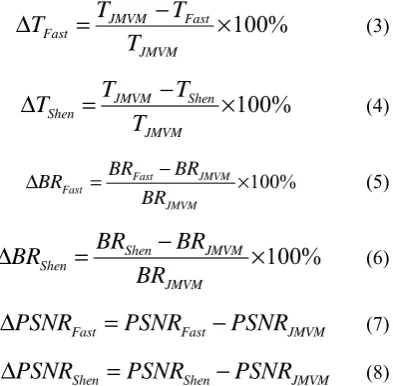
Table 2 compares the time reduction ratios of the proposed algorithm and JMVM. Table 3 compares the time reduction ratios of Shen’s LCMD algorithm and JMVM where
%
100
×
−
=
Δ
JMVM Fast JMVM Fast
T
T
T
T
(3)100%
JMVM Shen Shen
JMVM
T
T
T
T
−
Δ
=
×
(4)100%
Fast JMVM
Fast
JMVM
BR BR
BR
BR
−
Δ = × (5)
100%
Shen JMVM Shen
JMVM
BR
BR
BR
BR
−
Δ
=
×
(6)Fast Fast JMVM
PSNR
PSNR
PSNR
Δ
=
−
(7)Shen Shen JMVM
PSNR
PSNR
PSNR
Δ
=
−
(8)where TJMVM, TFast, and TShen are encoding time of the
JMVM platform, the proposed fast MVC algorithm
(including the time of BJND values computing) and Shen’s LCMD algorithm. BRJMVM, BRFast and BRShen are
bit rate of JMVM platform, the proposed fast MVC algorithm and Shen’s algorithm. PSNRJMVM, PSNRFast and
PSNRShen are PSNR by the reconstructed video of JMVC
platform, the proposed fast MVC algorithm, Shen’s algorithm.
Table 2 and Table 3 show the time saving and the PSNR decrease by adopting the proposed fast MVC algorithm and the Shen’s algorithm, respectively,
ΔPSNRFast is -0.06dB to -0.02dB while ΔPSNRShen is
-0.08dB to -0.02dB. ΔTFast is 67.92% to 71.72% while
ΔTShen is 65.84% to 70.97%.
The proposed fast MVC algorithm early terminates the unnecessary mode decision in some regions of the frames, in which the BJND values are smaller than the threshold. That means people are insensitive to the regions. So it is necessary to adopt the proposed fast MVC algorithm to save the coding time. Meanwhile, for the regions which BJND values are bigger than the threshold, we adopt the mode decision process in the JMVM to meets the requirements of HVS.
TABLE II.
COMPARISON OF TIME REDUCTION RATIO REGARDING THE PROPOSED ALGORITHM AND JMVM(%).
Sequences △TFast (%) △BRFast (%) △PSNRFast (dB)
Vassar 70.92 +0.48 -0.02
AkkoKayo 71.40 +0.16 -0.01
Ballroom 71.51 +0.56 -0.04
Exit 68.30 +0.34 -0.06
Champagne tower 71.45 +0.17 -0.03
Lovebird1 67.92 +0.70 -0.06
Newspaper 71.72 +0.83 -0.06
Average 70.46 +0.46 -0.04
TABLE III.
COMPARISON OF TIME REDUCTION RATIO REGARDING SHEN’SALGORITHM AND JMVM(%).
Sequences △TShen (%) △BRShen (%) △PSNRShen (dB)
Flamenco1 68.10 -0.44 -0.07
Exit 70.97 +1.14 -0.02
Rena 67.70 -0.25 -0.03
AkkoKayo 67.86 +0.34 -0.02
Race1 70.94 +0.23 -0.02
Ballroom 68.09 +0.73 -0.04
Uli 65.84 +1.58 -0.08
Average 68.94 +0.29 -0.03
For example, as Exit sequence, ΔPSNRFast is -0.06dB
and ΔPSNRShen is -0.02dB while ΔBRFast is +0.34% and
ΔBRShen is +1.14%. It means the bit rate is decreased
compared with Shen’s algorithm at the cost of image quality degradation in the imperceptible changed regions.
videos such as Champagne tower. The underlying reason of the phenomenon is that most BJND values of MBs are smaller than the noticeable difference. It tends to select the SKIP or Inter 16×16 mode as the optimal mode.
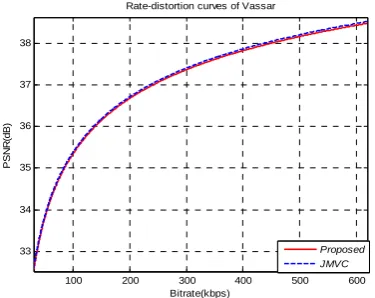
Also, in the rate-distortion (RD) curves of the original method and the proposed fast MVC algorithm for Exit and Vassar test sequences are shown in Figs. 6 and 7, and the proposed fast MVC algorithm maintains almost the same RD performances as the original encoder.
Figure 6. Rate-distortion curves of the proposed method and JMVM for Exit.
100 200 300 400 500 600
33 34 35 36 37 38
Rate-distortion curves of Vassar
Bitrate(kbps)
P
S
NR(
d
B
)
Proposed JMVC
Figure 7. Rate-distortion curves of the proposed method and JMVM for Vassar.
In summary, the proposed fast MVC algorithm can achieve significant time saving, up to 67.92%~71.72% at the cost of the image quality degradation in the insensitive regions compared to the Shen’s algorithm.
IV. CONCLUSION
In this paper, an efficient mode decision algorithm for multiview video coding (MVC) using binocular just noticeable difference (BJND) was presented. The perceptual characteristics of human visual system (HVS) are adopted to detect the mode type. By early terminating the unnecessary mode decision in some regions which people are insensitive to, the proposed fast MVC algorithm can reduce the coding time of average 70.46% compared with MVC while maintaining almost the same
rate-distortion performances as the original encoder. Moreover, it achieved a better result than the low-complexity mode decision for MVC.
Future work includes the design of more advanced state-of-the-art stereo matching technique to obtain more accurate disparity, and taking full advantage of the BJND model to perceptual MVC. There is also some room for improvement in the threshold determination.
ACKNOWLEDGMENT
This work was supported by the Natural Science Foundation of China (Grant Nos.U1301257, 61271270, 61171163, 61271021, 61311140262), and the Zhejiang Scientific and Technical Key Innovation Team Project (Grant No. 2010R50009).
REFERENCES
[1] S. Zinger, L. Do and P. H. N. de With, “Recent developments in Free-viewpoint interpolation for 3DTV,”
3D Research, vol. 3, no. 4, pp. 1-6, February, 2012.
[2] D. H. Shin, “3DTV as a social platform for communication and interaction,” Information Technology & People, vol. 25, no. 1, pp. 55-80, April, 2012.
[3] A. Vetro, T. Wiegand and G. J. Sullivan, “Overview of the stereo and multiview video coding extensions of the H.264/MPEG-4 AVC standard,” Proceedings of the IEEE,
vol. 99, no. 4, pp. 626-642, April, 2011.
[4] H. Quan, M. Barkowsky and P. Le Callet, “The importance of visual attention in improving the 3D-TV viewing experience: overview sand new perspectives,”
IEEE Transactions on Broadcasting, vol. 57, no. 2, pp. 421-431, June, 2011.
[5] W. Lin, L. Dong and P. Xue, “Visual distortion gauge based on discrimination of noticeable contrast changes,”
IEEE Trans. on Circuits and Systems for Video Technology,
vol. 15, no. 7, pp. 900-909, July, 2005.
[6] A. Liu, W. Lin and M. Paul. “Just Noticeable Difference for Images with Decomposition Model for Separating Edge and Textured Regions,” IEEE Trans. on Circuits and Systems for Video Technology, vol. 20, no. 11, pp.
1648-1652, November, 2005.
[7] Y. Gao, X. Y. Xiu, J. Liang, et al., “fast synthesized and predicted just noticeable distortion maps for perceptual multiview video coding,” Journal of Visual Communication and Image Representation, vol.24, pp. 700-707, 2013.
[8] D. V. S. X. De Silva, E. Ekmekcioglu et al., “Display dependent preprocessing of depth maps based on just noticeable depth difference modeling,” IEEE Journal of Selected Topics in Signal Processing, vol. 5 no. 2, pp.
335-351, April, 2011.
[9] Y. Zhao, Z. Z. Chen and C. Zhu “BinocularJust-noticeable-difference mModel for stereoscopic images,”
IEEE Signal Processing Letters, vol. 18, no. 1, pp. 19-22, Jan., 2011.
[10] S. W. Jung, J. Y. Jeong and S. J. Ko, “Sharpness enhancement of stereo images using binocular just-noticeable difference,” IEEE Trans. on Image Processing, vol. 21, no. 3, pp. 1191-1199, March, 2012.
[11] L. Q. Shen, Z. Liu and P. An, “Low-complexity mode decision for MVC,” IEEE Transactions on Circuits and Systems for Video Technology, vol. 21, no. 6, pp. 837-843,
[12] T. Zhao, H. Wang and S. Kwong, “Fast mode decision based on mode adaptation,” IEEE Transactions on Circuits and Systems for Video Technology, vol. 20, no. 5, pp.
697-705, May, 2010.
[13] H. Zeng, C. Cai and K. K. Ma, “Fast mode decision for H.264/AVC based on macroblock motion activity,” IEEE Transactions on Circuits and Systems for Video Technology, vol. 19, no. 4, pp. 491-499, April, 2004.
[14] S.Park, D.Sim and B.Jeon, “Distributed video coding for illumination compensation of multi-view video,” KSII Transactions on Internet and Information Systems, vol. 4,
no. 6, pp. 1222-1236, December, 2010.
[15] K. Mueller, P. Merkle and A. Smolic, “Multiview coding using AVC,” ISO/IEC JTC1/SC29/WG11, Bangkok, Thailand, Doc. M12945, January, 2006.
[16] G. Sullivan, T. Wiegand and A. Luthra, “Draft of version 4 of H.264/AVC (ITU-T Recommendations H.264 and ISO/IEC 14496-10 (MPEG-4 Part 10) Advanced Video Coding),” ISO/IEC JTC1/SC29/WG11 and ITU-T Q6/SG16, Doc. JVT-N050d1, 2005.
[17] Z. J. Peng, G. Y. Jiang and M. Yu, “Fast macroblock mode selection algorithm for multiview video coding,”
EURASIP Journal on Image and Video Processing, vol.
2008, no. 1, pp. rec.No:393727, 2008.
[18] M. J. Chen, G. L. Li and Y. Y. Chiang, “Fast multiframe motion estimation algorithms by motion vector composition for the MPEG-4/AVC/H.264 standard,” IEEE Trans. on Multimedia, vol. 8, no. 3, pp. 478-487, June,
2006.
[19] P. Didyk, T. Ritschel and E. Eisemann, “A perceptual model for disparity,” ACM Transactions on Graphics, vol. 30, no. 4, Article 96, 9 pages, April, 2011.
Yapei Zhu received her B.S. degree in Electronic Information
Science and Technology from Hengyang Normal University, China, in 2006. She is studying as a student in the Ningbo University, China. Her research interests concentrate on image video compression and communication.
Yu Mei received her M.S. degree from Hangzhou Institute of
Electronics Engineering, China, in 1993, and Ph.D. degree from Ajou University, Korea, in 2000. She is now a professor in Faculty of Information Science and Engineering, Ningbo
University, China. Prof. Yu’s research interests include image/video coding and video transmission.
Xin Jin received her B.S. degree in communication engineering
from China Ji Liang University Hangzhou, China, in 2012. She is currently working toward the M.S. degree at Ningbo University, Ningbo, China. Her research interests are in image/video processing and image quality assessment and noise classification.
Zongju Peng received his B.S. degree from Sichuan Normal
College, China, in 1995, M.S. degree from Sichuan University, China, in 1998, and Ph.D. degree from Institute of Computing Technology, Chinese Academy of Science in 2010. He is now an associate professor in Faculty of Information Science and Engineering, Ningbo University, China. His research interests mainly include image/video compression, multi-view video coding and video perception.
Shao Feng received the B.S. and Ph.D. degrees from
Zhejiang University, Hangzhou, China, in 2002 and 2007, respectively, all in electronic science and technology. He is currently an ASSOCIATE PROFESSOR with the Faculty of Information Science and Engineering, Ningbo University, Ningbo, China. He was a Visiting Fellow with School of Computer Engineering, Nanyang Technological University, Singapore, from Feb. 2012 to Aug. 2012. Prof. Shao’s current research interests include 3D video coding, 3D quality assessment, and image perception.
Gangyi Jiang received his M.S. degree from Hangzhou