www.ijerd.com
Chance Constrained Multi-Objective Linear Plus Linear
Fractional Programming Problem Based on Taylor’s Series
Approximation
Surapati Pramanik
1, Durga Banerjee
21
Department of Mathematics, Nandalal Ghosh B.T. College, Panpur, P.O.- Narayanpur, District – North 24 Parganas, Pin Code-743126, West Bengal, India
2
Ranaghat Yusuf Institution,Rathtala,P.O.-Ranaghat,District-Nadia,Pin Code-741201,West Bengal, India
Abstract––In this paper, we present fuzzy goal programming approach to solve chance constrained multi-objective linear plus linear fractional programming problem based on first order Taylor’s series approximation. The chance constraints with right hand parameters as random variables of known distribution are converted into equivalent deterministic constraints by using the given confidence levels. In the model formulation, we first determine the individual best solution for each objective function subject to the deterministic system constraints. The objective functions are then transformed into linear objective function at their individual best solution point by using first order Taylor polynomial series. We then construct the membership function for each linearized objective function by considering the individual best solution of linearized objective function as fuzzy goal and using pay-off matrix. We formulate three fuzzy goal models for solving the problem by minimizing the negative deviational variables. To determine the best compromise solution obtained from the three fuzzy goal programming models, we use Euclidean distance function. To demonstrate the proposed approach a numerical example is solved.
Keywords––Chance-Constraints, Euclidean Distance Function, Fractional Programming, Fuzzy Goal Programming, Linear Plus Linear Fractional Programming, Multi-objective Linear Fractional Programming Problem, Taylor Series.
I.
INTRODUCTION
In the Management Science, there are numerous decision making problems where the objective functions are the sum of linear and linear fractional functions. This type of functions can be found in game theory, portfolio selection, inventory problems, agriculture based management systems.
Multi-objective linear fractional programming problem (MOLFPP) with system constraints is a prominent tool for solving many practical decision making problems. MOLFPP can be extended in the field where the objective functions are the sum of linear and linear fractional functions and the problem is then called Multi-objective linear plus linear fractional programming problem (MOLPLFPP). MOLPLFPP can be converted into multi-objective linear programming problem (MOLPP) by using variable transformation method or Taylor’s series approximation method. Charnes and Cooper [1] proposed variable transformation method to solve MOLFPP. MOLFPP can be solved by Bitran and Noveas [2] by adopting the updating objective functions method. Kornbluth and Steuer [3] studied goal programming approach for solving MOLFPP. In the goal programming approach the target goals are stated precisely. But in many real life decision making situations, it is impossible to describe the target levels accurately due to imprecise nature of human judgement, availability of resources. To overcome these difficulties, Luhandjula [4] proposed linguistic variable approach based on fuzzy sets to solve MOLFPP. Luhandjula’s linguistic technique was modified by Dutta et al. [5]. Dutta’s approach was further modified by Minasian and Pop [6]. Interactive approach for solving MOLFPPs with block angular structure involving fuzzy numbers was studied by Sakawa and Kato [7]. With the help of variable transformation method, Chakraborty and Gupta [8] converted the original MOLFPP to MOLPP using fuzzy set theoretic approach. Taylor’s series approximation method is another approach to linearize MOLFPP to MOLPP. Guzel and Sivri [9] used Taylor’s series approximation method for MOLFPP. Toksarı [10] developed Taylor series approach for dealing with MOFLPP in fuzzy environment. In the recent past Pramanik and Dey [11] studied MOLFPP in fuzzy environment. They [12] also studied priority based FGP for MOLFPP.
Teterav [13] introduced linear plus linear fractional programming problem (LPLFPP) and also introduced optimality criteria for it. In 1977, Schaible [14] made a note on the sum of a linear and linear fractional function. In 1993, Chadha [15] developed a dual of the sum of linear and linear fractional programming. Chadha’s approach was modified by Hirche [16]. Jain and Lachhwani [17] studied LPLFPP under fuzzy rules constraints. In the recent past, Jain et al. [18] introduced a solution method for MOLPLFPP containing non differential coefficients. Jain and Lachhwani [19] developed MOLPLFPP with homogeneous constraints using fuzzy approach. Recently, Singh et al. [20] developed an algorithm for solving MOLPLFPP with the help of Taylor’s series. Singh et al. [21] also studied FGP approach to solve MOLPLFPP. Pramanik et al. [22] developed FGP model for solving MOLPLFPP based on Taylor’s series approximation.
programming using probability theory. Chance constrained programming (CCP) [25] is one of the most important one in stochastic programming. In CCP, we transform the chance constraints into deterministic constraints by using known distribution function.
In this article, we use Taylor’s series approximation to transform the MOLPLFPP into MOLPP. FGP models are used to solve MOLPP after converting chance constraints into deterministic constraints. Lastly, the optimal solution with minimum Euclidean distance [26] is considered as the best compromise optimal solution.
Rest of the paper is organized in the following way: Section II presents formulation of chance constrained MOLPLFPP. Section III describes the process of transforming chance constraints into equivalent deterministic constraints. Section IV presents linearization technique of MOLPLFPP by using Taylor polynomial series approximation. Section V is devoted to present proposed FGP formulation for MOLPLFPP. Section VI provides Euclidean distance function for identifying the best compromise optimal solution. Numerical example has been solved in Section VII to show the efficiency of the proposed FGP models. Finally, Section VIII presents the concluding remarks.
II.
FORMULATION
OF
CHANCE
CONSTRAINED
MOLPLFPP
The objective functions of linear plus linear fractional programming problem can be formulated as:
Max Zk(
x
) =,
β
x
d
α
x
c
)
γ
x
p
(
k T k
k T k k T k
k = 1, 2, …, K (1)x
S`=
n:
Pr(
A
x
b
)
I
-
,
x
0
,
b
mx
(2)
A
is mnmatrix, b, are m1 matrices,I
is a matrix of order m1 having all components equal to 1 (unity),x
,T k
p
, cTk, T kd n and k,
k
,
kare constants, T denotes transposition, denotes the level of confidence andk T k
x
d
> 0 for allx
S
`
,S
`
is non empty, convex and compact in
n.III.
CONSTRUCTION
OF
EQUIVALENT
DETERMINISTIC
CONSTRAINTS
First, we consider the chance constraints of the form:
Pr( n i
1 j ij j
b
x
a
) ≥ 1-
i, i = 1, 2,…, m1. Pr(
)
b
var(
)
b
(
E
b
)
b
var(
)
b
(
E
x
a
i i i i
n
1 j
i j
ij
) ≥ 1-
i, i = 1,2,…, m1)
)
b
var(
)
b
(
E
b
)
b
var(
)
b
(
E
x
a
Pr(
1
i i i i
n
1
j ij j i i
)
)
b
var(
)
b
(
E
b
)
b
var(
)
b
(
E
x
a
Pr(
i i i i
n
1
j ij j i i
)
b
var(
)
b
(
E
x
a
)
(
i n
1
j ij j i i
1
n
1
j ij j i i
i
1
(
)
var(
b
)
a
x
E
(
b
)
n
1
j i i
1 i j
ij
x
E
(
b
)
(
)
var(
b
)
a
, i = 1, 2,…, m1 (3)Considering the case when Pr( i
n
1 j ij j
b
x
a
) ≥ 1-
i ,i = m1 +1, m1 +2, …, m.
The constraints can be rewritten as:
⇒Pr(
) b var(
) b ( E b
) b var(
) b ( E x a
i i i
i n
1
j ij j i
) ≥ 1-
i , i = m1 +1, m1 +2, …, m.⇒
i i
n
1
j ij j i
-1 ) ) b var(
) b ( E x a
(
⇒
1-i i
n
1
j ij j i
-1 ) ) b var(
) b ( E x a
(-
⇒ )
) b var(
) b ( E x a ) (
i n
1
j ij j i i
1
⇒
n
1
j i i
1 i j
ijx E(b ) ( ) var(b )
a , i = m1 + 1, m1 + 2, …, m (4)
x
≥ 0 (5) Let us denote the deterministic system constraints (3), (4) and (5) by S. Here, S` and S are equivalent constraints.IV.
LINEARIZATION
OF
MOLPLFPP
BY
FIRST
ORDER
TAYLOR’S
SERIES
APPROXIMATION
Here, we find optimal solution of each objective function separately subject to the deterministic constraints. After solving
each objective function, the ideal solution point for each objective function is taken into account. Let x*k=
*
kn *
2 k *
1
k ,x ,...,x
x be the ideal solution for the k-th objective function. For the linearization, we use Taylor’s series of first
order expanding about the ideal solution point for each objective function. The series can be expressed as:
n
1
j *
k x x at k j * kj j *
k k
k
(
x
)
Z
(
x
)
(
x
x
)
x
Z
(
x
)
Z
=
Z
ˆ
k(
x
)
k = 1, 2, …, K. (6)
Here we assume that
Z
(
x
*k)
k =
max
xSZ
k(
x
)
V.
FGP FORMULATION OF CHANCE CONSTRAINED MOLPLFPP Using (6), we obtained the transformed linear objective functions asZˆ (x),1 Z (x),...,
ˆ
2 Z (x)
ˆ
k .
Let
Z
ˆ
(
x
1o)
k =
max
xS Z (x)ˆ
k = B k
Z
ˆ
be the aspiration level for the functionZˆ (x)k . B k
Z
ˆ
is the individual best solutionor ideal solution for the objective function Zˆ (x)
k .
Then the fuzzy goals appear as B k
k Z
ˆ > ) x ( Zˆ
) x ( Zˆ ... ) x ( Zˆ ) x ( Zˆ x . ... . . . ... . . . ... . . ) x ( Zˆ ... ) x ( Zˆ ) x ( Zˆ x ) x ( Zˆ ... ) x ( Zˆ ) x ( Zˆ x Zˆ ... Zˆ Zˆ o K K o K 2 o K 1 o K o 2 K o 2 2 o 2 1 o 2 o 1 K o 1 2 o 1 1 o 1 K 2 1
The maximum value of each column of the pay-off matrix provides upper tolerance limit for the objective functionZˆ ,k
)
x
(
Z
ˆ
okk =
max
xSZ
(
x
)
ˆ
k = B k
Z
ˆ
, k = 1, 2, …, K. The minimum value of each column provides lower tolerance limit forthe k-th objective function i.e.
L k
Z
ˆ
= Minimum of {Z
ˆ
(
x
),
Z
ˆ
(
x
),
...,
Z
ˆ
(
x
ok)
},
k o 2 k o 1
k k = 1, 2, …, K.
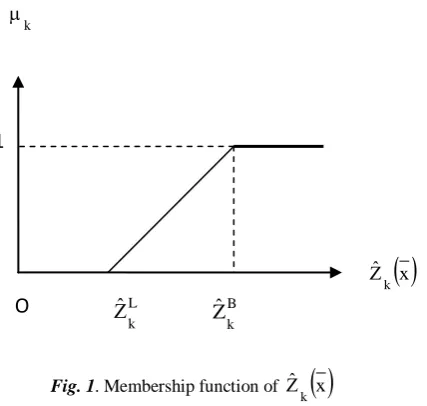
VA. Construction of Membership Function
The membership function (see Fig. 1) for the fuzzy goal of the form Zˆk(x)
~
Bk
Z
ˆ
can be written as: L k k B k k L k L k B k L k k B k k k Zˆ ) x ( Zˆ if , 0 , Zˆ ) x ( Zˆ Zˆ if , Zˆ Zˆ Zˆ ) x ( Zˆ , Zˆ ) x ( Zˆ if , 1 ) x ( (8)
k = 1, 2, …, K, where
Zˆ
Lk is the lower tolerance limit of the k-th fuzzy goal.Fig. 1. Membership function of ˆ
xk
Following Pramanik and Dey [27] and Pramanik and Roy [28] we can write
)
x
(
k
+ d =1, k = 1, 2, …, K (9) kHere
d
k(≥ 0) is the negative deviational variable for the k-th objective goal. Now, the FGP models for chance constrained MOLPLFPP can be formulated as:Model-I:
Min=
K k1 k k
d
w
(10)subject to ) x (
k
+ d =1, k = 1, 2, …, K, k
n i i 1 i jij
x
E
(
b
)
(
)
var(
b
)
a
, i = 1, 2, …, m1,O
1
B kZ
ˆ
L k
ˆ
x ˆk
k
n
1
j i i
1 i j
ij
x
E
(
b
)
(
)
var(
b
)
a
, i = m1 + 1, m1 + 2, …, m,1≥ dk≥ 0, k = 1, 2, …, K,
x
≥ 0Here, wk is the weight associated with the k- th membership function. The weight wk = L k B k Z
ˆ -Zˆ
1
is determined based on
Mohamed [29]. Alternatively, the decision making unit may suggest the weight according to the importance of the goals in the decision making situation.
Model-II
Min
=
K 1 k k
d (11)
subject to the same constraints of FGP Model I. Model-III
Min (12) subject to
) x (
k
+ d =1k k = 1, 2, …, K
n
1
j i i
1 i j
ij
x
E
(
b
)
(
)
var(
b
)
a
, i = 1, 2, …, m1,
n
1
j i i
1 i j
ij
x
E
(
b
)
(
)
var(
b
)
a
, i = m1 + 1, m1 + 2, …, m,1≥ dk≥ 0, k = 1, 2, …, K,
≥d
k , k = 1, 2, …, K,x
≥ 0.VI.
EUCLIDEAN
DISTANCE
FUNCTION
Euclidean distance function [26] can be defined as:
L2 (k) =
2 / 1 K
1 k
2 k x)
1
(
(13)
Here
x k is the membership function for the k-th objective goal. This function is calculated for three proposed models and the solution with minimum distance L2 would be considered as best compromise optimal solution.
VII.
NUMERICAL
EXAMPLE
We consider the following numerical example to illustrate the proposed approach.
Find
x
(x1, x2, x3) so as to (14) max Z1 = (2x1 + 3x2 - x3) +5 + 4x + 2x + x
3 + x + x + x
3 2 1
3 2 1
max Z2 = (-6x1 + 2x2+5x3) + +10 5x -9x + 2x
3x + x -7x
3 2 1
3 2 1
max Z3 = (3x1- 4x2+2x3 +15) +
2 + x + x + x 9
3 + x -x 2 + x 5
-3 2 1
3 2 1
subject to
E(b1) = 4, var(b1) = 1, 1= 0.05
E(b2) = 9, var(b2) = 4, 2= 0.03
E(b3) = 16, var(b3) = 9, 3= 0.01
Using (4), (5) the chance constraints involved in problem (14) are transformed into equivalent deterministic constraints as:
3x1 -x2 +x3 ≤ 5.645 -6x1 +4x2 +9x3 ≤ 12.77 11x1 -5x2 +7x3 ≥ 9.025
Using Taylor’s series approximation as described in (6), the transformed linear objective functions are obtained as:
x
Z
ˆ
1 = 2.013362x1 + 2.994672x2 -1.042708x3 + 0.585820,
x
Z
ˆ
2 = -5.182459x1 + 1.097886x2+ 5x3 + 10.599995,
x
Z
ˆ
3 = 2.866745x1 - 3.839293x2 +1.95467x3 + 14.9127616,We obtained the individual best solutions for each linearized objective function subject to transformed deterministic
system constraints as
Z
ˆ
(
x
1o)
1 = B 1
Z
ˆ
=39.51842, at (5.004688, 9.778438, 0.409375);Z
ˆ
(
x
o2)
2 =
B 2
Z
ˆ
= 17.69444, at(0, 0, 1.418889);
Z
ˆ
(
x
)
0 33 =
B 3
Z
ˆ
= 22.49230, at (1.152576, 0, 2.187273).The fuzzy goals appear as:
x Zˆ1
~
39.51842,Z
x
ˆ
2
~
17.69444,Z
ˆ
3
x
~
22.49230.The obtained Pay-off matrix is represented as:
49230 . 22 56318 . 15 62568 . 0 68622 . 17 69444 . 17 89367 . 0 48217 . 7 55411 . 2 51842 . 39
The corresponding membership functions are constructed with the help of pay-off matrix as follows:
x
1
=
x 0.89367 39.51842 Zˆ , 0 x Zˆ 89367 . 0 if , 89367 . 0 51842 . 39 89367 . 0 x Zˆ 51842 . 39 x Zˆ if , 1 1 1 1 1
x
2
=
x 2.55411 17.69444, Zˆ if , 0 x Zˆ 55411 . 2 if , 55411 . 2 69444 . 17 55411 . 2 x Zˆ , 69444 . 17 x Zˆ if , 1 2 2 2 2
x
3
=
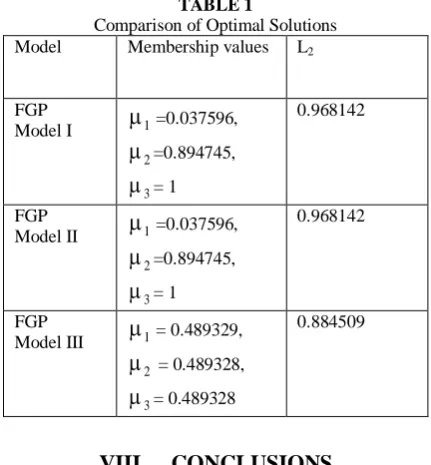
x -7.48217 22.49234, Zˆ if , 0 x Zˆ 48217 . 7 if , 48217 . 7 49234 . 22 48217 . 7 x Zˆ , 49234 . 22 x Zˆ if , 1 3 3 3 3 Using FGP models (10), (11), and (12), the obtained results are shown in Table 1.
TABLE 1
Comparison of Optimal Solutions Model Membership values L2
FGP
Model I
1=0.037596,2
=0.894745,3
= 10.968142
FGP
Model II
1=0.037596,2
=0.894745,3
= 10.968142
FGP
Model III
1= 0.489329,2
= 0.489328,3
= 0.4893280.884509
VIII.
CONCLUSIONS
In this paper, chance constrained multi-objective linear plus linear fractional programming problem with random variables is presented. To transform the fractional objectives into linear forms first order Taylor’s series approximation is used. Three FGP models are presented to illustrate the proposed approach. For the future research, the proposed approach can be extended to multi-objective linear plus linear fractional programming problem with fuzzy parameters. The proposed approach can also be used for solving bi-level as well as multilevel linear plus linear fractional programming problem with crisp and fuzzy parameters.
REFERENCES
[1]. A. Charnes, and W. W. Cooper, “Programming with linear fractional functions,” Naval Research Logistics Quarterly, vol. 9, no. 1, pp. 181-186, 1962.
[2]. G. R. Bitran, and A. G. Noveas, “Linear programming with a fractional objective function,” Operations Research, vol. 21, no. 1, pp. 22-29, 1973.
[3]. J. S. H. Kornbluth, and R. E. Steuer, “Goal programming with linear fractional criteria,” European Journal of Operational Research, vol. 8, no. 1, pp. 58-65, 1981.
[4]. M. K. Luhandjula, “Fuzzy approaches for multiple objective linear fractional optimization,” Fuzzy Sets and Systems, vol. 13, no. 1, pp. 11-23, 1984.
[5]. D. Dutta, J. R. Rao, and R. N. Tiwari, “Multiple objective linear fractional programming - a fuzzy set theoretic approach,”
Fuzzy Sets and Systems, vol. 52, no. 1, pp. 39-45, 1992.
[6]. I. M. S. Minasian, and B. Pop, “On a fuzzy set to solving multiple objective linear fractional programming problem,” Fuzzy Sets and Systems, vol.134, no. 3, pp. 397-405, 2003.
[7]. M. Sakawa, and K. Kato, “Interactive decision making for multi-objective linear fractional programming problems with block angular structure involving fuzzy numbers,” Fuzzy Sets and Systems, vol. 97, no.1, pp. 19-31, 1988.
[8]. M. Chakraborty, and S. Gupta, “Fuzzy mathematical programming for multi objective linear fractional programming problem,” Fuzzy Sets and Systems, vol. 125, no. 3, pp. 335-342, 2002.
[9]. N.Guzel, and M. Sivri, “Taylor series solution of multi-objective linear fractional programming problem,” Trakya University Journal Science, vol. 6, no. 2, pp. 80-87, 2005.
[10]. M. D. Toksarı, “Taylor series approach to fuzzy multi objective linear fractional programming,” Information Sciences, vol. 178, no. 4, pp. 1189-1204, 2008.
[11]. S. Pramanik, and P. P. Dey, “Multi-objective linear fractional programming problem based on fuzzy goal programming,”
International Journal of Mathematical Archive, vol. 2, no. 10, pp. 1875-1881, 2011.
[12]. S. Pramanik, and P. P. Dey, “A priority based fuzzy goal programming to multi-objective linear fractional programming,”
International Journal of Computer Applications, vol. 30, no.10, pp. 1-6, 2011.
[13]. A. G. Teterev, “On a generalization of linear and piecewise linear programming,” Metekon, vol. 6, pp. 246-259, 1970. [14]. S. Schaible, “A note on the sum of linear and linear fractional functions,” Naval Research Logistic Quarterly, vol. 24, pp.
691-692, 1977.
[15]. S. S. Chadha, “Dual of sum of a linear and linear fractional program,” European Journal of Operational Research, vol.67, no.1, pp. 136-139, 1993.
[16]. J. Hirche, “A note on programming problems with linear-plus-linear fractional objective functions,” European Journal of Operational Research, vol. 89, no.1, pp. 212-214, 1996.
[17]. S. Jain, and K. Lachhwani, “Sum of linear and linear fractional programming problem under fuzzy rule constraints,”
[18]. S. Jain, A. Mangal, and P. R. Parihar, “Solution of a multi objective linear plus fractional programming problem containing non-differentiable term,” International Journal of Mathematical Sciences & Engineering Applications, vol. 2, no. 2, pp. 221-229, 2008.
[19]. S. Jain, and K. Lachhwani, “Linear plus fractional multiobjective programming problem with homogeneous constraints using fuzzy approach,” Iranian Journal of Operations Research, vol. 2, no.1, pp. 41-49, 2010.
[20]. P. Sing, S. D. Kumar, and R. K. Singh, “An approach for multiobjective linear plus linear fractional programming problem,”
International Electronic Journal of pure and Applied Mathematics, vol. 2, no. 3, pp. 103-110, 2010.
[21]. P. Sing, S. D. Kumar, and R. K. Singh, “Fuzzy multiobjective linear plus linear fractional programming problem: approximation and goal programming approach,” International Journal Of Mathematics and Computers in Simulation, vol. 5, no. 5, pp. 395-404, 2011.
[22]. S. Pramanik, P. P. Dey, and B. C. Giri, “Multiobjective linear plus linear fractional programming problem based on Taylor series approximation,” International Journal of Computer Applications, vol. 32, no. 8, pp. 61-68, 2011.
[23]. G. B. Dantzig, “Linear programming under uncertainty,” Management Science, vol.1, no. 3&4, pp.197 – 206, 1955. [24]. G. B. Dantzig, and A. Mandansky, “On the solution of two-stage linear programs under uncertainty,” in Proc., 4th Berkeley
symp. Math. Stat. Prob., 1961, p. 165 – 176.
[25]. A. Charnes, and W. W. Cooper, “Chance-constrained programming,” Management Science, vol. 6, no. 1, pp. 73 – 79, 1959. [26]. S. Pramanik, and T. K. Roy, “Multiobjective transportation model with fuzzy parameters: a priority based fuzzy goal
programming,” Journal of Transportation Systems Engineering and Information Technology, vol. 8, no. 3, pp. 40-48, 2008. [27]. S. Pramanik, and P. P. Dey, “Quadratic bi-level programming problem based on fuzzy goal programming approach,”
International Journal of Software Engineering & Applications, vol. 2, no. 4, pp. 41-59, 2011.
[28]. S. Pramanik, and T. K. Roy, “Fuzzy goal programming approach to multilevel programming problems,” European Journal of Operational Research, vol.176, no. 2, pp. 1151-1166, 2007.