Flexural Behaviour of Self-curing Concrete
with Lightweight Aggregate and Polyethylene
Glycol
Sachin Julian Francis#1, B.Karthik*2, H.Gokulram#3
#
(PG Student, Dept Of Civil Engineering, CSI College Of Engineering, Ketti, The Nilgiris, Tamilnadu, India) (Head Of The Dept , Dept Of Structural Engineering, CSI College Of Engineering, Ketti, The Nilgiris, Tamilnadu, India) (Assistant Professor, Dept of Structural Engineering, CSI College of Engineering, Ketti, The Nilgiris, Tamilnadu, India)
ABSTRACT
Curing of concrete is maintaining
satisfactory moisture content in concrete during its early stages in order to develop the desired properties. Any laxity in curing will badly affect the strength and durability of concrete. The aim of the investigation is to evaluate the use of water-soluble polyethylene glycol as self-curing agent with partial replacement of conventional fine aggregate with light weight fine aggregate such as sand stone and to optimise the quantity of lightweight aggregate and poly-ethylene glycol. By studying the mechanical properties of concrete by replacing the fine aggregate with lightweight fine aggregate by 0%, 10%, 20%, 30%, 40% and 50%, the optimum quantity of lightweight aggregate was found as 25%. Self-curing concrete of M30 grade were cast by replacing fine aggregate with 25% lightweight fine aggregate, whose water absorption property is high, and by varying quantity of polymeric glycol by 0.5%, 1%, 1.5% and 2%, the optimum percentage of polyethylene glycol was found as 1%. In this study, compressive strength, split tensile strength of
self-curing concrete with varying quantity of
polyethylene glycol was evaluated and compared with the conventional concrete specimens.
Keywords - Water-soluble, Self-curing, Mechanical property, Light weight, polyethylene.
1. INTRODUCTION
Proper curing of concrete structures is important to ensure they meet their intended performance and durability requirements. In conventional construction, this is achieved through external curing, applied after mixing, placing and finishing. Internal curing (IC) is a very promising technique that can provide additional moisture in concrete for a more effective hydration of cement and reduced self-desiccation. Internal curing implies the introduction of a curing agent into concrete that will act as an internal source of water. Currently, there are two major methods available for internal curing of concrete. The first method uses saturated porous lightweight aggregate (LWA) in order to supply an
internal source of water, which can replace the water consumed by chemical shrinkage during cement hydration. The second method uses super-absorbent polymers (SAP), as these particles can absorb a very large quantity of water during concrete mixing and form large inclusions containing free water, thus preventing self-desiccation during cement hydration. For optimum performance, the internal curing agent should possess high water absorption capacity and high water desorption rates.
2. EXPERIMENTAL INVESTIGATION
2.1. Materials
Cement: The Bureau of Indian Standards (BIS) has classified OPC in three different grades. The classification is mainly based on the compressive strength of cement-sand mortar cubes of face area 50 cm2 composed of 1 part of cement to 3 parts of standard sand by weight with a water-cement ratio arrived at by a specified procedure. The grades are(i) 33 grade (ii) 43 grade (iii) 53 grade. The grade number indicates the minimum compressive strength of cement sand mortar in N/mm2 at 28 days, as tested by above mentioned procedure. In this project, Chettinad 53 Grade Ordinary Portland Cement was used conforming IS 12269:1987.
Fine Aggregate: Aggregate which passed through 4.75 mm IS Sieve and retained on 75 micron
(0.075 mm) IS Sieve is termed as fine aggregate. Fine aggregate is added to concrete to assist workability and to bring uniformity in mixture. Usually, the natural river sand is used as fine aggregate. Ordinary river sand conforming IS 383-1970 was used in this project.
not glossy) non-powdery surfaces. Aggregate should be properly screened and if necessary washed clean before use. Coarse aggregate containing flat, elongated or flaky pieces or mica should be rejected. The grading of coarse aggregate should be as per specifications of IS 383-1970.In this project, maximum normal size of coarse aggregate was 20 mm for controlled concrete.
Water: The water should be fit for mixing. The water should not have high concentrations of sodium and potassium and there is a danger of alkali-aggregate reaction. Natural waters that are slightly acidic are harmless, but water containing organic acids may adversely affect the hardening of concrete. Such water as well as highly alkaline water should be tested. The water should conform to IS 456-2000 standards. Generally, water satisfactory for mixing is also suitable for curing purposes. However, it is essential that curing water should be free from substances that attack hardened concrete like free CO2 etc.
LIGHTWEIGHT FINE AGGREGATE:
Lightweight fine aggregate used in this project was a natural lightweight aggregate, which was obtained from a sandstone quarry from Wayanad..
Fig 1 Sample of Lightweight Fine Aggregate
Polyethylene Glycol: Polyethylene glycol is a condensation polymers of ethylene oxide and water with the general formula H (OCH2CH2)nOH, where n is the average number of repeating oxyethylene groups typically from 4 to about 180. The abbreviation (PEG) is termed in combination with a numeric suffix which indicates the average molecular weights. One common feature of PEG appears to be the water-soluble. In this project, polyethylene glycol with molecular weight of 400 (PEG-400) was used as a self-curing agent, which was manufactured by Merck Pharmaceuticals.
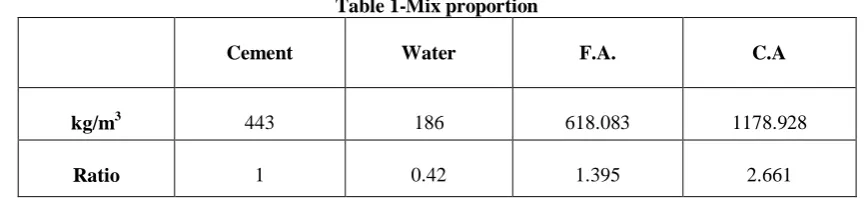
2.2 Mix Proprotion
GENERAL:
As per IS method, mix design for M30 grade concrete was carried out using the test data for cement, coarse aggregate, and fine aggregate obtained by preliminary investigations
.
Table 1-Mix proportion
Cement Water F.A. C.A
kg/m3 443 186 618.083 1178.928
Ratio 1 0.42 1.395 2.661
3.Result And Discussion
3.1.slump:
Slump test is used to determine the workability of fresh concrete. Slump test as per IS 1199 : 1959 is followed. The apparatus used for doing slump test were slump cone and tamping rod. The internal
The bearing surface of machine was wiped off clean and the surface of the specimen was cleaned. The specimen was placed in machine in such a manner, load was applied to opposite sides of the cubes such that casted side of specimen was not top and bottom. The axis of the specimen was carefully aligned at the
centre of loading frame. The load applied was increased continuously at a constant rate until the resistance of the specimen to the increasing load breaks down and no longer can be sustained. Maximum load applied on specimen was recorded.
3.3 Split Tensile Strength:
The split tensile strength test for cylinders was carried out as per IS 516 : 1964. This test was carried out by placing a cylinder specimen horizontally between the loading surfaces of a universal testing machine and the load was applied until failure of the cylinder along the vertical diameter. When the load was applied along the generatrixan element on the vertical diameter, the cylinder is subjected to a horizontal stress and the split tensile strength was found using subsequent formula.
Split tensile strength, fcr (N/mm2) = 2P/πLD Where,
P = Ultimate load (N) L = Length of cylinder (mm) D = Diameter of cylinder (mm)
3.4 Lightweight Aggregate:
The results of the investigation carried out for finding the optimum percentage of lightweight aggregate by determining the mechanical properties of concrete were as mentioned below in table 2
Table.2. Test Results for M30 Concrete with Replacement of Fine Aggregate with Lightweight Aggregate From 10% To 50%
3.4
.
1Slump ValueFrom table 2, it was observed that the slump value decreased with increase in percentage of lightweight aggregate. The graphical representation is shown in figure 2
Sl. No Description M30 Percentage of LWA
10% 20% 30% 40% 50%
1 Slump value 80 76 73 69 65 61
2 Average 7th day compressive strength of cubes (N/mm2)
31.30 32.66 33.28 33.25 30.59 28.66
3 Average 28th day compressive strength of cubes (N/mm2)
42.22 43.60 44.20 44.30 41.77 40.88
4 Average split-tensile strength of cylinders (N/mm2)
Fig 2 Variation of Slump Value for M30 Concrete with Replacement of Fine Aggregate with Lightweight Aggregate from 10% to 50%
3.4.2 Compressive Strength
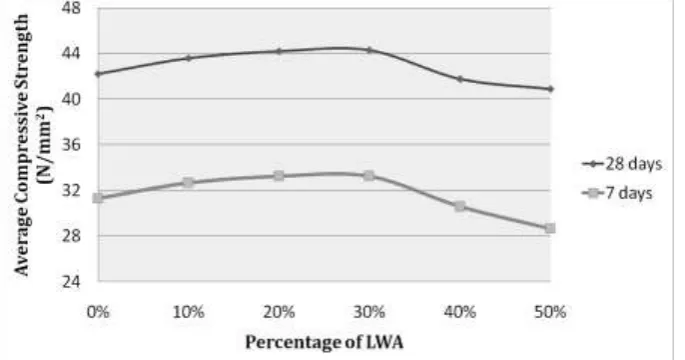
From table 2, it was observed that, average compressive strength at 7 days and 28 days increased with increase in percentage of lightweight aggregate up to 30% and then decreased for 40% and 50%. The graphical representation of the variation of average compressive strength at 7 days and 28 days is shown in figure 3.
Fig 3 Variation of Compressive Strength at 7 and 28 days for M30 Concrete with Replacement of Fine Aggregate with Lightweight Aggregate from 10% to 50%
3.4.3 Split-Tensile Strength
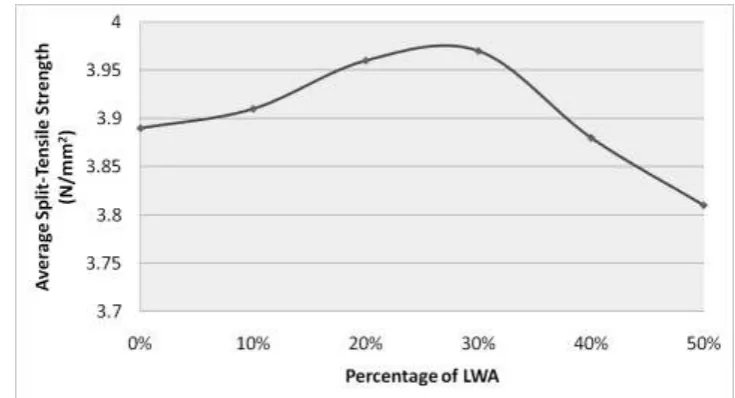
Fig 4 Variation of Split-Tensile Strength at 28 days for M30 Concrete with Replacement of Fine Aggregate with Lightweight Aggregate from 10% to 50%
3.5 POLYETHYLENE GLYCOL
The results of the investigation carried out for finding the optimum percentage of polyethylene glycol by determining the mechanical properties of M30 concrete with 25% replacement of fine aggregate with lightweight aggregate and varying polyethylene glycol-400 from 0% to 2% were as mentioned below in table 2.
Table 3 Test Results for M30 Concrete with 25% LWA and Variation of Polyethylene Glycol 400 from 0% to 2%
S. No Description
Percentage of PEG with 25% LWA
With Curing
Without Curing
0% 0% 0.5% 1% 1.5% 2%
1 Slump Value (mm) 70 70 74 80 88 94
2 Average 7th day compressive strength of cubes (N/mm2)
33.26 26.21 27.99 31.7 27.85 25.18
3 Average 28thday compressive strength of cubes (N/mm2)
44.33 37.43 38.37 42.07 36.74 33.48
4 Average split-tensile strength of cylinders (N/mm2)
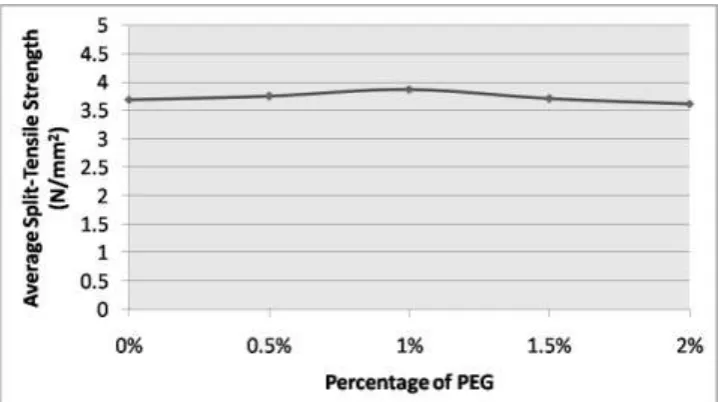
3.96 3.69 3.75 3.87 3.71 3.62
3.5.1Slump Value
Fig 5. Variation of Slump Value for M30 Concrete with 25% LWA and Variation of Polyethylene Glycol 400 from 0% to 2%
3.5.2 Compressive Strength
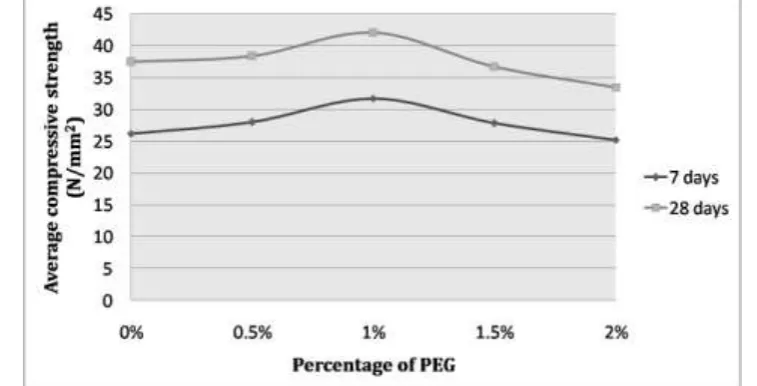
From table 3, it was observed that, average compressive strength at 7 days and 28 days increased with increase in percentage of polyethylene glycol up to 1% and then decreased for 1.5% and 2%. The graphical representation of the variation of average compressive strength at 7 days and 28 days is shown in figure 6.
Fig 6 Variation of Compressive Strength at 7 and 28 days for M30 Concrete with 25% LWA and Variation of Polyethylene Glycol 400 from 0% to 2%
3.5.3 Split-Tensile Strength
Fig 7 Variation of Split-Tensile Strength at 28 days for M30 Concrete with 25% LWA and Variation of Polyethylene Glycol 400 from 0% to 2%
CONCLUSIONS
In this project, the mix design for control concrete grade of M30 had been designed. Self-curing concrete is useful in water scarce areas and in places where good quality water is not available. The self-curing concrete required had been arrived from the control concrete by optimizing the percentage of lightweight aggregate and polyethylene glycol. From the test results observed, the following conclusion had been drawn:
The optimum percentage of lightweight aggregate for maximum strengths (compressive, split-tensile and modulus of rupture) was found to be 25% for M30 grade of concrete.
As the percentage of lightweight aggregate increased, the slump value decreased.
The optimum dosage of PEG400 with 25% lightweight aggregate for maximum strengths (compressive, tensile and modulus of rupture) was found to be 1% for M30 grade of concrete.
As percentage of PEG400 increased, slump increased for M30 grade of concrete.
REFERENCES
.
[1] Barrett T. J., De La Varga I., Schlitter J. and Weiss W. J. (2011), ‘Reducing the risk of cracking in high volume fly
ash concrete by using internal curing’, Construction and Building Materials, World of Coal Ash Conference. [2] Dale P. Bentz (2007), ‘Internal curing of high-performance
blended cement mortars’, ACI Materials Journal, Vol. 104, No. 4, pp. 408-415.
[3] Geetha M. (2006), ‘Comparitive study of strength and durability properties of polymeric materials as self curing agents’, International Journal of Engineering Science and Technology, Vol. 133, pp. 766-771.
[4] Haejin Kim and Dale Bentz (2008), ‘Internal curing with crushed returned concrete aggregates for high performance concrete’, NRMCA Concrete Technology Forum: Focus on Sustainable Development.
[5] Igor De La Varga, Javier Castro, Dale Bentz and Jason Weiss (2012), ‘Application of internal curing for mixtures containing high volumes of fly ash,’ Cement and Concrete Composites, Vol. 34, pp. 1001-1008.
[6] IS 10262: 2009 ‘Indian standard code of recommended guidelines for concrete mix design’, Bureau of Indian standards, New Delhi.
[7] IS: 383-1970 ‘Specifications for coarse and fine aggregates from natural sources for concrete’, Bureau of Indian Standards, New Delhi.
[8] IS 456: 2000 ‘Indian standard code of plain and reinforced concrete code of practice’, Bureau of Indian standards, New Delhi.
[9] Jagannadha Kumar, M. V., Srikanth, M. and Jagannadha Rao, K. (2012), ‘Strength characteristics of self-curing concrete’, IJRET, Vol. 1, pp. 51-57.
[10] Joann Browning, David Darwin, Diane Reynolds and Benjamin Pendergrass (2011), ‘Lightweight aggregate as internal curing agent to limit concrete shrinkage’, ACI Materials Journal, Vol. 108, No. 6, pp. 637-644.
[11] Norbert Delatte, Eric Mack, and John Cleary (2007), ‘Evaluation of high absorptive materials to improve internal curing of low permeability concrete’, FHWA/OH. [12] Ryan Henkensiefken, Javier Castro, Haejin Kim, Dale
Bentz, and Jason Weiss (2009), ‘Internal curing improves concrete performance throughout its life’, Concrete Infocus. [13] Samuel Green, Nicholas Brooke and Len Mcsaveney (2008), ‘Pumice Aggregates for Structural Lightweight and Internally Cured Concretes’, Light Weight New Zealand Construction.