ISSN(Online): 2319-8753 ISSN (Print) : 2347-6710
I
nternational
J
ournal of
I
nnovative
R
esearch in
S
cience,
E
ngineering and
T
echnology
(An ISO 3297: 2007 Certified Organization)
Vol. 5, Issue 6, June 2016
A Review: Methods for Sensor Identification
using Neural Network
Swarup Maske1, Dr.(Mrs.) S. S. Lokhande2
P.G. Student, Department of ENTC, Sinhgad College of Engineering, Vadgaon (BK), Pune, Maharashtra, India1 Professor, Department of ENTC, Sinhgad College of Engineering, Vadgaon (BK), Pune, Maharashtra, India2
ABSTRACT: It is crucial to quantify location of sensor in the dam, for this purport numbers of ,the sensor are placed at sundry locations in the dam. Central water and Power Research Station (CWPRS) provided data of Dam sensor which utilized in this project to train the Neural Network. Identification of sensor location is the arduous task if the quandary is arrived in the control room, because of Mismatching in the wire, Noise. For solving this quandary Artificial Neural Network is utilized. Compared with some traditional methods of Artificial Neural Network has lots of advantages in dealing with the highly non-linear quandary. Neural Network has Back propagation (BP), Conjugate Gradient Method, Learning Vector Quantization (LVQ) Algorithms and Levenberg-Marquardt (LM), Neuron by Neuron (NBN), Architectures. Artificial Neural Network used to identify exact sensor predicated on erudition about the dataset.
KEYWORDS- Artificial Neural Network; Back Propagation; Levenberg-Marquardt; Linear vector quantization; Neuron by Neuron.
I. INTRODUCTION
Dams in the country are a component of several multipurpose projects to accommodate a variety of needs. A multipurpose is often launched for storing water for irrigation purposes, Imbibing water and engendering hydroelectricity. Relegations in Submerged are paramount and conundrum because of submerged environment involution. For this project Central Water and Power Research Station has provided a data of dam sensor, the objective of the project is to analyse the data and performed an operation on data. Sensor data used to train the neural network and this trained network compare sensor value with the dataset and shows the sensor number. Sensor apprises the controller about its environment and verbally express of the system with incrementing performance, safety and automation requisites systems are increasingly sophisticated and are heavily reliant on their sensors. The impact of the failure depends on the application domain [1].
The dependence of sensor output signal on other physical quantities is considered as its disadvantages the sensor with output signal especially depended on several physical quantities. It is proposed to consider the approach of Artificial Neural Network utilization for identification of separate sensor from the signal in data acquisition systems [2].
Traditional signal processing application use methods of parameter estimation and feature analysis for signal prognostication predicated on experimenting estimating the parameters of the data and presaging its output signal[3]. Generally, the training samples are only a minuscule part of the set of the object to be apperceived. The submersed environments are always so discombobulating is not linear, so the signal received may be time-varying, non-linear. There are two ways to train the Neural Network online training and offline training.
ISSN(Online): 2319-8753 ISSN (Print) : 2347-6710
I
nternational
J
ournal of
I
nnovative
R
esearch in
S
cience,
E
ngineering and
T
echnology
(An ISO 3297: 2007 Certified Organization)
Vol. 5, Issue 6, June 2016
II. EARLIERWORK
A. Neuron By Neuron Neural Network
The MLP NN architecture is the popular choice for NN applications. This architecture however is neither powerful nor efficient, in comparison to other architectures with connections across layers .The FCC NN architecture allows connections across layers. Compared with the popular MLP architecture, this architecture is compact and efficient as it requires less neuron to solve a problem. MLP architecture requires 8 neurons compared with 3 by the FCC. With increasing number of neurons, the computational expenseincreases due to an increase in the number of network weights. Requires significantly low number of weights and neurons compared with MLP due to its unique architecture. If a system based on MLP is updated to use the FCC architecture.
Based on these results, the FCC NNis chosen for use as the NN-based sensor estimator. To train the FCC NN-based sensors estimators, the NBN learning algorithm is used. The NBN algorithm is an improved version of the second order Levenberg–Marquardt algorithm. Using the NBN algorithm, the weights are updated as follows:
= −( + ) (1)
where Wn+1 is the new weights vector,Wn is the previous weights vector, Q is the quasi-Hessian matrix, g is the
gradient vector, and μ is the combination coefficient. In comparison to the popular error back-propagation training algorithm, this algorithm cannot only train fast but also efficiently, with a small number of neurons within the NN.
= ( − )∗ + (2)
Wherexn is the normalized value, and xo is the value to benormalized. a and b are the minimum and maximum values
ofthe range to be normalized to, which, in this case, is +1 to −1.xmax andxmin are the maximum and minimum values of
therange from which xo is normalized.
B. Conjugate gradient method
The conjugate gradient method is based on computing a set of search directions that will be conjugate under the assumption of a quadratic error surface, allowing us to apply a line search to each search direction independently. At iteration t, the
= - ( ) + ᵧ( ) (t-1) (3)
After calculating each conjugate direction d(t), we perform a line search to find the optimal offset along that direction. The weights of the network are then updated according to:
( ) = ( −1)+∝( ) (t) (4)
C. Levenberg Marquardt Method
ISSN(Online): 2319-8753 ISSN (Print) : 2347-6710
I
nternational
J
ournal of
I
nnovative
R
esearch in
S
cience,
E
ngineering and
T
echnology
(An ISO 3297: 2007 Certified Organization)
Vol. 5, Issue 6, June 2016
WhereJ(w) is the Jacobian matrix, and _ is a regularization parameter adjusted by the algorithm. When the _ parameter is large, an approximation to gradient descentback propagation, whereas a small _ approximates Newton’s method. Hence, the LM algorithm adjusts _ by multiplying it by a factor _ whenever a step results in an increase in the error function, and by dividing by whenever a step results in a decrease in the error function. In this study, was initialized to 0.01, and was set to 10.
D. Learning Vector Quantization
The competitive learning algorithm takes a set of input vectors and uses them to form a set of categories: one category for each node on the second level of the network. This is accomplished by measuring the proximity of each input vector to the set of weights for each node on the second level and adaptively adjusting the weights of the closest node towards the input vector. After sufficient training, the network should categorizeall similar input vectors into a category based on their distance from the weight vector of the corresponding node.
The training of the competitive learning algorithm proceeds as follows. Initialize the weights from the N input nodes to the M output nodes. Present an inputvector from the data set. Compute the distance, dj, betweenthe input vector and
the weights of each outputnode j using the formula
d = ∑ [x (t)−w (t)] (6)
The principal problem with using competitive learning as a vector quantizer is underutilization of the output nodes. After training, we find that many of the output nodes are rarely used, while other nodes represent a substantial part of the input data set. Codebooks with these characteristics are suboptimal, and thus their performance is inferior to other methods such as the LBG algorithm.
( + 1) = ( ) +η(t)( ( )− ( )) (7)
A solution to this problem ofunderutilization is provided by the Frequency Sensitive Competitive Learning algorithm (FSCL). In this algorithm the distance, di, between the input vector and the output node weight vector is modified by:
III.METHODOLOGY
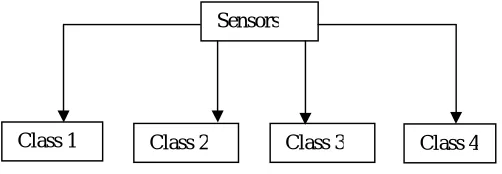
In this paper total number of sensor divided into four classes, train the neural network using learning vector Quantization, this algorithm is faster than other Algorithm. Classification of sensor used less amount of time to train the network. Second objective of this paper is to recovered data from the original data. In this it produces the removable value of sensor data.
Fig. 1: Classes for Sensor
Sensors
ISSN(Online): 2319-8753 ISSN (Print) : 2347-6710
I
nternational
J
ournal of
I
nnovative
R
esearch in
S
cience,
E
ngineering and
T
echnology
(An ISO 3297: 2007 Certified Organization)
Vol. 5, Issue 6, June 2016
Block diagram of sensor identification using the neural network is shown in the figure. 2 the steps that required are as follows
Fig. 2: Sensor Identification using Neural Network
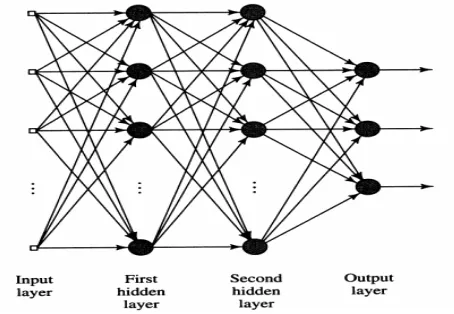
LVQ method train neural network using two hidden layers. Where inputs are number of sensor and outputs are classes and location of sensor.
Fig.3: Two layer Neural Network Structure
.
IV.CONCLUSION
Training of Neural Network depends on Learning Parameter and Numbers of Neuron Present in the hidden layer. Out of above four methods Learning Vector Quantization Method is good for classification to train the network. It takes less number of iteration (Epoch) to train the network and to achieve the goal, Mean Square error is 0.01.
ACKNOWLEDGMENT
Authors would like to express their gratitude towards respected Head of Department M. B. Mali for his dynamic and valuable guidance and also grateful to him for his constant encouragement in fulfillment of paper. Authors would also like to thank Dr. S.D.Lokhande principal, SCOE pune, for providing with all necessary infrastructure and facilities to complete the review paper.
Sensor Pre-Processing
Neural Network Sensor Location
ISSN(Online): 2319-8753 ISSN (Print) : 2347-6710
I
nternational
J
ournal of
I
nnovative
R
esearch in
S
cience,
E
ngineering and
T
echnology
(An ISO 3297: 2007 Certified Organization)
Vol. 5, Issue 6, June 2016
REFERENCES
[1] SaedHussain, MaizuraMokhtar, Joe M. Howe, “Sensor Failure Detection, Identification, and Accommodation Using Fully Connected Cascade Neural Network”,IEEE Transaction on Industrial Electronics, Vol, 62 No. 3 March 2015.
[2] Iryna V. Turchenko, “simulation Modeling of Multi-Parameter Sensor Signal Identification Using Neural Network”,Second IEEE International Conference on Intelligent System, June 2004.
[3] Saeedsetayeshi, Ferial and Mohamed E. El-Hawary,“Underwater Signal Prediction and Parameter Estimation Using Artificial Neural Network”,0-7803-2766-7-9/95/$4.00 @ 1995 IEEE.
[4] VenkataAtluri, Chih-Cheng Hung and Tommy L. Coleman, “An Artificial Neural Network for Classifying and Predicting Soil Moisture and Temperature Using Levenberg-Marquardt Algorithm”,0-7803-5237-8/99/$10.00 @ 1999 IEEE.
[5] SelvaBalan. ArtiKhaparde,Vanita Tank, TejeshriRade, KritiTalalkar, “Under Water Noise Reduction using Wavelet and Savitzky-Goley”, pp. 243-250, 2014.
[6] HamidrezaModares, Frank L. Lewis, Mohammad-bagherNaghibi-Sistani, “Adaptive Optimal Control of Unknown Constrained-Input Systems Using Policy Iteration and Neural Network”,IEEE transaction on Neural Network and Learning System, Vol. 24, NO. 10 October 2013. [7] JieTian, ShahueXue, HainingHuang,“Classification of Underwater Objects on Probabilistic Neural Network”, 2009 fifth
InternationalConferenceon Neural Computation.
[8] VenkataAtluri', Chih-Cheng Hung'! and Tommy L. Coleman, “An Artificial Neural Network for Classifying and Predicting Soil Moisture and Temperature Using Levenberg-iuarquardt Algorithm”,'Department of Mathematics and Computer Science 'Centre for Hydrology, SoiClimatology and Remote Sensing (EISCaRS)Alabama A&M University, Normal, AL 35762.