Performance analysis of FIR Low Pass
Filter Using Artificial Neural Network
Meenakshi Kumari
#1, Mukesh kumar
*2, Rohini saxena
*3, Prof. A. K. Jaiswal
*4#1PG Scholar, #2,3 Assistant Prof. of Department of electronics and communication, SHUATS, Allahabad SIET, SHUATS, Allahabad U.P. India-211007
ABSTRACT- The aim of this paper is to design and analysis of low pass FIR filter is used for comparison of different types of learning algorithm artificial neural network. A low pass FIR filter is design by using hamming window method with the help of FDA Toolbox in MATLAB. Hamming window is used in this proposed work for achieving minimize the maximum side lobe of signal. It is an optimized Windows method. The five different algorithm of artificial neural network namely generalized regression method, radial basis function, radial basis exact, linear layer and feed forward back propagation are used for comparison. Simulation result of a different artificial neural network has achieved general regression method with the best performance has compare to radial basis function, radial basis exact, linear layer and feed forward back propagation method.
Keywords: -Liner Layer, FIR Filter, ANN, GRNN, RBF, RBE, BPNN.
I. INTRODUCTION
A filter is a network that selectively changes phase frequency and amplitude frequency of a signal in systematic way.
Digital filter design method are utilised to eliminate redundant spectral content from the signal [1]. Digital filter are two types depending upon response behaviour named as finite impulse response (FIR) and infinite impulse response (IIR). The IIR filter or Digital counterpart to analog filter such a filter as internal feedback and may continue to respond indefinitely. FIR digital filter may remove signal element from a signal that contained various signal component concentrated at a different frequency [2]. FIR filter are having impulse response of finite duration because in this signal adjust to zero in finite duration. In particular to convert and ideal impulse response of finite duration Like a sine function to a finite impulse response duration [3].The FIR filter also named as non recursion recursive digital filter because FIR filter do not have feedback mechanism however it is used the recursive algorithm for FIR filter realisation [4]. According to [5] Window method is
suitable for designing of FIR filter before artificial neural network (ANN), as it gives optimal design better than other method. There are various other design method to design filter such as neural network, genetic algorithm [6], practical Swarm Optimization [7], radial basis function [8,9].Genetic Algorithm (GA), being the veteran member of the family, is being used for a long time particularly in the field of filter design [10-12]. GSA as implemented for the generation of optimal coefficients of FIR LP filter design problem is given in [13-14]. Hamming window method is used to compute the filter Coefficient to prepare data set the main advantage of hamming Window is the window is optimised to minimize the maximum (nearest) side lobe, giving it a height of about one fifth that of other window.
Window function is express below
W (n) = a-b Cos (2𝜋𝑛
𝑁−1) ...………..(1)
a = 0.54, b = 1-a= 0.45 ………….(2)
II. Artificial neural network (ANN)
An artificial neuron is a fundamentally an Engineering technique of biological neuron. It have device with many Input and one output, Artificial neural network consists of large number of simple processing component that are linked with each other and there also [15-16]. A General artificial neural network has multiple input, weigh related with each input a threshold that determine if the neuron should fire, and activation function that calculate the output and mode of the operation the structure of a neural network has a three type of layer that are interconnected: input layer, one or more hidden layer and output layer [17-18]. There are several algorithms that can be used to train and artificial neural network namely: back propagation: radial basis function: general regression neural network, Linear Layer and radial basis exact function etc.
In radial basis function (RBF) network the hidden neuron calculate radial basis function of the input, which are identical to Kernel function in kernel regression [20]. Specht has Popularized kernel regression which we call a General regression neural network [21]. General regression neural network is a variation of radial basis function network that is based on the Nadarayawatson kernel regression, the main features of GRNN are the fast training time and it can also model nonlinear function [22]. Linear network like the Perceptron, can only solve linearly separable problem the Perceptron learning rule, the least mean square (LMS) algorithm is an the example of supervisor training, radial basis exact function can be used to approximate function. High correlation was found between training and validation data, indicating that the developed radial basis artificial neural network model.
III. Proposed Neural Network Model
In propose model we are designing a high pass FIR filter using different Orders and window technique with the help of FDA tool in MATLAB. The window technique is used in hamming window. Neural network model of low pass FIR filter input are normalized cut off frequency that varies between 0 to 1 Hz first and scale value a constant value equal to 10. In above model all of five artificial neural network are used to find out output of network namely by GRNN, RBF, RBE, linear layer and feed forward back Propagation.
Step 1:- Use FDA Tool box in MATLAB to Generate Hamming window of size h
Step 2:- Design FIR filter using the FDA tool box & hamming window:
Step 3:- Use Input of FIR Filter a) Design GRNN
b) Design RBF c) Design RBE d) Design Linear Layer e) Design BPNN
In GRNN transfer function of hidden layer is radial basis function.
𝑦𝑖 = 𝑛𝑖=1𝑦𝑖 ∗exp − 𝐷 (𝑥−𝑥𝑖 ) exp − 𝐷 (𝑥−𝑥𝑖 ) 𝑛
𝑖=1 ………(3)
D (x- xi) = (𝑥𝑖 −𝑥𝑖𝑘
𝜎 ) 𝑚
𝑘=1 …………....(4)
Step 4:- Display the Frequency Response & MSE
IV. RESULT
The code has been implemented in MATLAB. In this paper ten value of filter coefficient is used for analysis and testing of the trained network. This result is obtained by using FDA tool of MATLAB with the help of Hamming window. Also, ANN is used to design low pass FIR filter. Comparison of these five type of artificial neural network RBF, RBE, GRNN, Linear Layer and BPNN.GRNN result show that designing of low pass FIR filter gives 100% result accuracy.
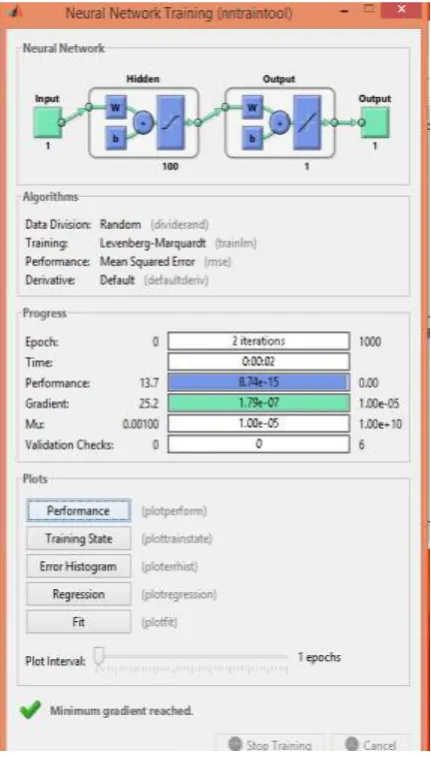
Fig. 1: general structure of neural network
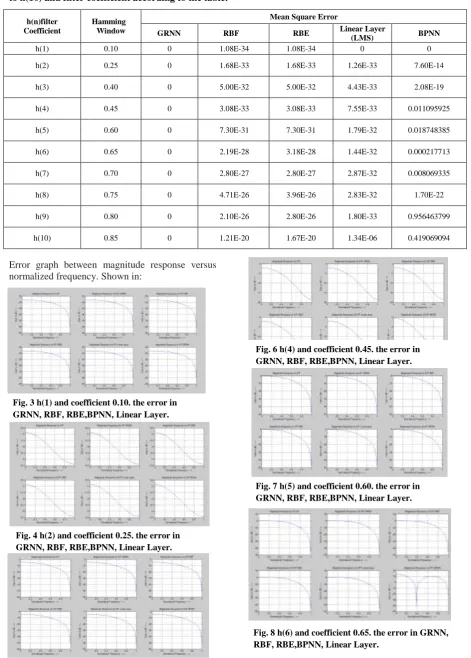
TABLE I. The results being obtained are against values of hamming windows from h(1) to h(10) and filter coefficient according to the table.
Error graph between magnitude response versus normalized frequency. Shown in:
h(n)filter Coefficient
Hamming Window
Mean Square Error
GRNN RBF RBE Linear Layer
(LMS) BPNN
h(1) 0.10 0 1.08E-34 1.08E-34 0 0
h(2) 0.25 0 1.68E-33 1.68E-33 1.26E-33 7.60E-14
h(3) 0.40 0 5.00E-32 5.00E-32 4.43E-33 2.08E-19
h(4) 0.45 0 3.08E-33 3.08E-33 7.55E-33 0.011095925
h(5) 0.60 0 7.30E-31 7.30E-31 1.79E-32 0.018748385
h(6) 0.65 0 2.19E-28 3.18E-28 1.44E-32 0.000217713
h(7) 0.70 0 2.80E-27 2.80E-27 2.87E-32 0.008069335
h(8) 0.75 0 4.71E-26 3.96E-26 2.83E-32 1.70E-22
h(9) 0.80 0 2.10E-26 2.80E-26 1.80E-33 0.956463799
h(10) 0.85 0 1.21E-20 1.67E-20 1.34E-06 0.419069094
Fig. 3 h(1) and coefficient 0.10. the error in GRNN, RBF, RBE,BPNN, Linear Layer.
Fig. 4 h(2) and coefficient 0.25. the error in GRNN, RBF, RBE,BPNN, Linear Layer.
Fig. 5 h(3) and coefficient 0.40. the error in
Fig. 6 h(4) and coefficient 0.45. the error in GRNN, RBF, RBE,BPNN, Linear Layer.
Fig. 7 h(5) and coefficient 0.60. the error in GRNN, RBF, RBE,BPNN, Linear Layer.
V. CONCLUSION
Artificial neural network is better and easy method of design of low pass FIR filter. Also, using window method the filter can be design but for each unknown parameter the filter coefficients have to calculated. In comparison of five type of artificial neural network namely RBF, GRNN, RBF,RBE, and BPNN, GRNN is found to be easy, fast and most accurate method to design low pass FIR filter one train properly the error between
GRNN calculated filter coefficient is 100% validates the proposed model
REFERENCES
[1] Design and Analysis of Low Pass FIR & IIR Filter and Find Optimum Result Using Neural Network [Global Journal of Researches in Engineering]. [2] Sara Moein, “FIR Cutoff Frequency Calculating for
ECG Signal Noise Removing Using Artificial Neural Network” Verlag Berlin Heidelberg,pp.124-131(2010).
[3] Sanjit K. Mitra, “Digital Signal Processing: AComputer-Based Approach”, Second Edition, Mc GrawHillScience/Engineering/Math,2001,pp.446-472.
[4] S. Salivahanan, “Digital Signal Processing”, McGraw-Hill, 2000, pp. 735-749.
[5] M. S. Chavan, R. A. Agarwala, and M. D. Uplane, “Use of Kaiser window FOR ECG processing,” in Proc. 5th WSEAS Int. Conf. on Signal Processing, Robotics and Automation, Madrid, Spain, Feb. 15-17, 2006, pp. 285-289.
[6] S. Thapar, “A low pass FIR filter design using genetic algorithm based artificial neural network,” International Journal of Computer Technology and Electronics Engineering (IJCTEE), vol. 2, no. 4, Aug. 2012.
[7] T. Saramaki and S. K. Mitra, Finite Impulse Response Filter Design, Handbook for Digital Signal Processing, New York: Wiley-Interscience, 1993. [8] Amanpreet Kaur, “Design of FIR filter using particle
swarm optimization algorithm for audio processing,” International Journal of Computer Science and Network (IJCSN), vol. 1, no. 4, Aug. 2012. [9] Harpreet Kaur and Balwinder Dhaliwal, “Design of
low pass FIR filter using artificial neural network,” International Journal of Information and Electronics Engineering, vol. 3, no. 2, Mar. 2013.
[10] D. Suckley, “Genetic Algorithm in the Design of FIR Filters”, IEEE Proceedings Circuits Devices and Systems, vol. 138, pp.234-238, April 1991. [11] M. Oner, “A Genetic Algorithm for Optimization of
Linear-phase FIR Filter Coefficients”, in Proc. Conference on Signals, Systems and Computers, vol. 2, pp. 1397-1400, November 1998.
[12] K. Dey, S. Saha, A. Saha and S. Ghosh, “A Method of Genetic Algorithm (GA) for FIR filter Construction: Design and Development with Newer Approaches in Neural Network Platform”, International Journal of Advanced Computer Science and Applications, vol. 1, no. 6, pp.87-90, December 2010.
[13] E. Rashedi, N. Hossien, S. Saryazdi, “Filter modelling using gravitational search algorithm,” Engineering Applications of Artificial Intelligence, vol. 24, issue. 1, pp. 117–122, 2011.
[14] Esmat Rashedi, Hossein Nezamabadi-pour, and Saeid Saryazdi, “GSA: A Gravitational Search Algorithm,” Information Sciences, vol. 179 pp. 2232–2248, 2009.
[15] Eldon Y. Li, “Artificial Neural Networks and their Business Applications”, Taiwan, 1994. FLEXChip Signal Processor (MC68175/D), Motorola, 1996. [16] Christos Stergiou and Dimitrios Siganos, “Neural
Networks”.
[17] Harpreet Kaur and Balwinder S. Dhaliwal,(2011) “Design of low pass FIR filter using Artificial Neural Network” 3 rd International Conference on Computer and Automation Engineering(ICCAE), Chongqing, China,2011,pp.463- 466.
[18] Hintz K. J. and Spofford J. J., (1990) “Evoling Neural Network” Proceedings of the IEEE Fig. 9 h(7) and coefficient 0.70. the error in GRNN,
RBF, RBE,BPNN, Linear Layer.
Fig. 10 h(8) and coefficient 0.75. the error in GRNN, RBF, RBE,BPNN, Linear Layer.
Fig. 11 h(9) and coefficient 0.80. the error in GRNN, RBF, RBE,BPNN, Linear Layer.
Transactions on Communication and Intelligence, May 1990, pp. 333–338.
[19] P. Pomenka and Z. Raida, “Methodology of neural design: applications in microwave engineering”, Radio Engineering June 2006, Vol. 15 No. 2,pp 12-17.
[20] Donald F. Specht. “A General Regression Neural Network”, IEEE Transactions on Neural Networks, November 1991. VOL. 2 . NO. 6, pp. 568-576. [21] K. Arun Kumar, R. Ashwath, D. Sriram Kumar, R.