
e
-ISSN: 2250-3021,
p
-ISSN: 2278-8719
Vol. 3, Issue 1 (Jan. 2013), ||V1|| PP 38-44
Adaptive Transcoders for Video & Image Sequence Using
Wavelet Transform
T. Arumuga Maria Devi
1, K.K Sherin
2 1Assistant Professor, 2Assistant Professor1Centre for Information Technology and Engineering, Manonmaniam Sundaranar University, Tirunelveli 2Bethlahem Institute of Engineering, Affiliated to Anna University, Chennai
Abstract — This paper deals mainly with the performance study and analysis of sending and retrieving an image across
Client/Server network. The image that is to be send across the network should be compressed in order to transfer it at a minimal amount of time. Other than that, the image when compressed will suffer loss in the image quality. The main work identified are that efficient retrieval of an image will be made possible using Wavelet transform and various other methods such as Transcoding etc. These methods used above to download an image from a distant location are found to be more efficient in comparison with the other image downloading techniques.
Keywords— 5/3 Wavelet Transform, Significant Mapping, Mosaicking, Refinement Mapping, Transcoding.
I.
INTRODUCTION
The transfer of images in wireless networks presents major challenges which raises issues related to its representation, its storage and its transmission. The challenges of image transmission includes limited bandwidth of cellular networks, the restriction in computational power, limited storage capability, and constraints related to the power sources of the appliances. To handle the problem, various methods are used. The preprocessing using wavelet based compression methodology is used. An efficient Wavelet based compression can significantly minimize the energy required for wireless image communication while meeting bandwidth constraints of wireless and network image quality. Based on Discrete Wavelet Transform, an efficient image compression scheme is used by enabling significant reduction in computation energy needed with minimal degradation of image quality. Wavelet transforms are based on small waves, called wavelets, of varying frequency and limited duration. The 5/3 wavelet transform is well suited for mosaic images, the interleaving of color components are automatically taken care and it transforms as a smooth channel without de-interleaving. The 5/3 wavelet transforms requires the least computation among the various reversible integer to integer wavelet transformations. Transcoding means a process for choosing, changing, or producing the content (text, image, voice and video) to be conformed with the current environment that user prefers. This can be achieved by changing the size of an image, its resolution and quality, replacing voice by its text or video by a number of images. Transcoding makes web pages more user-friendly and show them appropriately in different mobile devices with different screen sizes, reducing size of web pages in order to reduce network bandwidth and decreasing their loading time. Current Transcoding systems achieve these goals by either removing non-vital parts of web pages such as pictures or content to the required format on the mobile advertisements, or moving some content from one page to device.
II.
TECHNIQUE
signal. Wavelet transform divides the information of an image into approximation and detail sub signals. The approximation sub signal illustrates the general trend of pixel values and other three detail sub signals show the vertical, horizontal and diagonal details or changes in the images. If these details are very small (threshold) then they can be set to zero without significantly changing the image. The greater the number of zeros the greater the compression ratio. If the energy retained (amount of information retained by an image after compression and decompression) is 100% then the compression is lossless as the image can be reconstructed exactly. This occurs when the threshold value is set to zero, meaning that the details have not been changed. If any value is changed then energy will be lost and thus lossy compression occurs. As more zeros are obtained, more energy is lost. Therefore, a balance between the two is needed.
Image Mosaicking
Image Mosaickingis the process of reconstructing or stitching a single, continuous image from a set of separate or overlapped sub-images. The various methods adopted for image mosaicking can be broadly classified into;
1.) Direct methods 2.) Feature based methods.
Direct methods are found to be useful for mosaicking large overlapping regions, small translations and rotations. Feature based methods can usually handle small overlapping regions and in general tend to be more accurate but computationally intensive. Some of the basic problems in image mosaicking are Global alignment, Local adjustment, Automatic selection, Image blending, Auto exposure compensation.
Since the image may have incomplete color samples, reconstructing the image is necessary. For this purpose, De-Mosaicking algorithm is used. It should be able to avoid false color artifacts such as chromatic aliases, should preserve image resolution, should have low computational complexity and also should have an availability to reduce the noise.
The algorithms that are implemented in mosaicking are Nearest neighbor color and Wavelet Based De-mosaicking algorithms.
Discrete Wavelet Transform
Discrete Wavelet Transform (DWT) is the most popular transform for image-based application [16], [18], [20]. A 2-dimensional wavelet transform is applied to the original image in order to decompose it into a series of filtered sub band images. At the top left of the image is a low-pass filtered version of the original and moving to the bottom right, each component contains progressively frequency information that adds the detail of the image. It is clear that the higher-frequency components are relatively sparse, i.e., many of the coefficients in these components are zero or insignificant. The wavelet transform is thus an efficient way of decorrelating or concentrating the important information into a few significant coefficients. The wavelet transform is particularly effective for still image compression and has been adopted as part of the JPEG 2000 standard [6] and for still image texture coding in the MPEG-4 standard.
The Discrete Wavelet Transform of a signal, x(t) is defined to be the set of analysis coefficients:
Analysis: cj,k = ∫-∞∞ x(t)wj,k(t)dt
From these, the signal is recovered as,
Synthesis: x(t) = ∑j ∑k cj,k wj,k (t)
Assuming the existence of a scaling function Ф(t) , we can now modify this definition as follows. Since the spaces wjare
getting larger and larger as j goes to ∞, we can approximate any signal, x(t), closely by choosing a large enough value of j=J and projecting the signal into wj using the basis, Фj,m (t) (all values of k).
cA0m: ∫-∞∞
x(t) Фj,m (t) dt (1)
From these we can approximately recover the signal as:
x(t) ≈ ∑m cA0m Фj,m (t) (2)
In effect, we replace the signal, x(t) , by the approximate signal given by the projection coefficients, cA0m. After this approximation our signal is now in vj and we can decompose it using the subspaces vj-n and wj-n with their bases Фj-n,k(t) and
wj-n,k(t) . Note that the scale is getting larger and larger as the index j-n gets more negative. If we take n=1,we get:
vj = wj-1 + vj-1 (3)
Using the basis wj-1,k(t) in wj-1 and Фj,1,k(t) in vj-1we have:
x(t) = ∑m cA0(m) Фj,m (t)
∑k cA1(k) Фj-1, k (t) + ∑k cD1(k) wj-1, k (t)
A1(t) + D1(t) (4)
x(t)=A1(t) + D1(t)
∑k cA2(k) Фj-2, k (t) + ∑k cD2(k) wj-2, k (t) + ∑k cD1(k) wj-1, k (t)
A2(t) + D2(t) + D1(t) (5)
We call the signals A2(t) and D2(t) the approximation and details and we call the coefficients cA2(k) and cD2(k) the approximation coefficients and the detail coefficients at level 2. We can continue in this way to decompose our signal further and further such as given below:
[A0] ↔ [cA1, cD1] ↔ [cA2, cD2, cD1] ↔ [cA3, cD3, cD2, cD1] ↔ ……….
Preprocessing
In order to improve the quality of the image, one or more filtered versions of the image are stored in addition to the original patterns. This method is known as pre-processing. Pre-processing the images along with wavelet transform improves the quality of the image. As per the requirement, the image is broken down into sub images. This is the procedure done before processing which is to correct the image from different errors. This has to be done before image enhancement. Edges detection and noise reduction are a crucial and very important pre-processing step. The classical edge detection methods and filtering are less accurate in detecting complex edge and filtering various types of noise. Pre-processing is very useful in a variety of situations since it helps to suppress information that is not related to the exact image processing or analysis task. Image filtering and edge detection is an indispensable and necessary operation in image pre-processing step. When the image is acquired, the factors such as the projection, mix and noise are produced. These factors can lead to image blurring and distortion; consequently it can cause difficulty in extracting important feature in the image like edges of objects in image. Mathematical morphology is a mathematical method using structural elements to analyze image, which has been widely applied to variety fields like visual inspection. The morphological operations work to simplify image and preserve the main shape characteristics of objects. Morphological operators are mainly used in image preprocessing for noise filter, shape simplification and enhancing object structure. Mathematical morphology is a powerful tool to filter different types of noise and to detect the complex edge in variety directions.
Refinement Mapping
Lossless compression schemes with progressive transmission capability play a key role in critical data storage, retrieval and transmission, when a large volume of data must be handled fast, without distortions, over large networks with limited bandwidth. The standard wavelet compression techniques, even if loss-less in principle, do not reconstruct exactly the original image because of the rounding of the floating-point wavelet coefficients to integers caused by the coding. The use of the lifting scheme allows generating truly loss-less non-linear integer-to-integer wavelet transforms. In most of the cases, the filters used in wavelet transforms have floating point coefficients. Since the input images have integer entries, the filtered output no longer consists of integers and losses will result from rounding. For lossless coding it is necessary to make a reversible mapping between an integer image input and an integer wavelet representation. There are two ways to warp an image. The first, called forward mapping, scans through the source image pixel by pixel, and copies them to the appropriate place in the destination image. The second, reverse mapping, goes through the destination image pixel by pixel, and samples the correct pixel from the source image. The most important feature of inverse mapping is that every pixel in the destination image gets set to something appropriate. In the forward mapping case, some pixels in the destination might not get painted, and would have to be interpolated. We calculate the image deformation as a reverse mapping.
Transcoding
dynamic bit rate adjustment to facilitate proper scheduling of network resources. Thus, video transcoding is one of the essential components for current and future multimedia systems that aim to provide universal access. Currently, several video compression standards exist for different multimedia applications. Each standard may be used in a range of applications but is optimized for a limited range. H.261, H.263, H.263 designed by ITU (International Telecommunication Unit) are aimed for low-bit-rate video applications such as videophone and videoconferencing. MPEG standards are defined by ISO (International Organization for Standardization). MPEG-2 is aimed for high bit rate high quality applications such as digital TV broadcasting and DVD, and MPEG-4 is aimed at multimedia applications including streaming video applications on mobile devices. As the number of applications increases and various networks such as wire line and wireless integrate with each other, inter-compatibility between different systems and different platforms are becoming highly desirable. Transcoding is needed both within and across different standards to allow the interoperation of multimedia streams. The first and most important challenge in the context of a video conferencing is to provide transcoding on the fly with real-time speed and without any interruption of video flow.
There are three basic requirements in transcoding,
1)The information in the original bit stream should be exploited as much as possible;
2)The resulting video quality of the new bit stream should be as high as possible, or as close as possible to the bit stream created by coding the original source video at the reduced rate;
3) In real-time applications, the transcoding delay and memory requirement should be minimized to meet real-time constraints.
III.
FIGURES
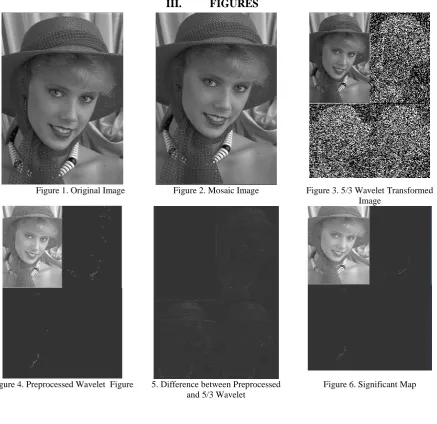
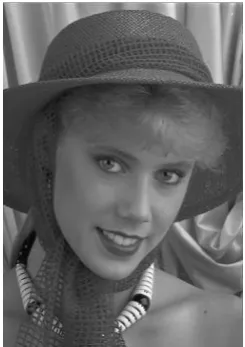
Figure 1. Original Image Figure 2. Mosaic Image Figure 3. 5/3 Wavelet Transformed Image
Figure 4. Preprocessed Wavelet Figure 5. Difference between Preprocessed
and 5/3 Wavelet
Figure 7. Refinement Map Figure 8. Restored Original Image Figure 9. Restored Refined Image
Figure 10. Restored Refined Image Video Output
IV.
RESULTS1.) PSNR RESULTS OBTAINED WITH TIME SAMPLES
Time – PSNR Table
2.) TIME PSNR GRAPH
Time – PSNR Graph
V.
CONCLUSIONS
used when the user intends to include secret information in images and is send to the destination. In order to improve the quality of the image, one or more filtered versions of the image is added to the original image. This technique is known as preprocessing. The problem that is associated when decompressing the images is that, due to the property of floating point nature of wavelet coefficients, the coding effect would round the values to integers. To handle the situation, Refinement Mapping is used. Since the image compressed has to be displayed in a wide variety of devices as chosen by the user, Transcoding is used since it is a bridge between many applications. By Transcoding, the image can be displayed in a wide variety of devices making it more user friendly. Requantization, spatial and temporal downscaling are the most popular Transcoding algorithms. The purpose of the Transcoder is to convert Mpeg-2 standard to Mpeg-4 for supporting mobile devices. It also supports color depth reduction, Text summarization, multi-model, for e.g., text-to-speech, audio driven animation model.
ACKNOWLEDGEMENT
The authors would like to thank the members of the Dept. of CITE, M S University, Tirunelveli for various algorithms used in this research, and all the people who helped in preparing and carrying out the experiments and data collection.
REFERENCES
[1]. S.A.Hussain , M.I. Razzak , A. A. Minhas, M. Sher, Energy Efficient Image Compression in wireless Sensor Networks International Journal of Recent Trends in Engineering, Vol 2, No. 1, November 2009
[2]. A.E. Gamal, Collaborative Visual Sensor Networks, 2004,
http://mediax.stanford.edu/projects/cvsn.html.
[3]. M. J. Nadenau, J. Reichel, and M. Kunt, ―Wavelet Based Color Image Compression: Exploiting the Contrast Sensitivity Function,‖ IEEE Transactions Image Processing, Vol. 12, no.1, Pp. 58-70, 2003.
[4]. L. Ferrigno, S. Marano, V. Paciello, and A. Pietrosanto, ―Balancing computational and transmission power
consumption in wireless image sensor networks‖, IEEE29 International Conference on Virtual Environments, Human- Computer Interfaces, and Measures Systems (VECIMS), Giardini Naxos, Italy, July 2005.
[5]. Min Wu and Chang Wen Chen, ―Multiple bitstream image transmission over wireless sensor networks‖,
Proceedings of IEEE Sensors, volume 2, pages 727–731, October 2003.
[6]. Huaming Wu and Alhussein A. Abouzeid, ―Energy efficient distributed JPEG2000 image compression in multi
hop wireless networks‖, 4th Workshop on Applications and Services in Wireless Networks (ASWN 2004), pages 152–160, August 2004.
[7]. H.M. Wu, A.A. Abused, Energy, ―efficient distributed image compression in resource constrained multichip
wireless networks‖, Computer Communication (Elsevier) 28 (14) (2005) 1658–1668.
[8]. R. Wagner, R. Nowak, and R. Baraniuk.―Distributed image compression for sensor networks using
correspondence analysis and super-resolution‖, Proceedings of IEEE International Conference on Image
Processing (ICIP), volume 1, pages 597–600, September 2003.
[9]. N. Boulgouris and M. Strintzis. ―A family of wavelet-based stereo image coders‖. IEEE Transactions on Circuits
and Systems for Video Technology, 12(10):898–203, October 2002.
[10]. A. Wang. A. Chandrakasan, ―Energy efficient system partitioning for distributed wireless sensor networks‖, Proceedings of the International Conference on Acoustics, Speech, and Signal processing (ICASSP-2001), Salt Lake City, Utah, 2001.
[11]. S.S. Pradhan, J. Kusuma, K. Ramchandran, ―Distributed compression in a dense microsensor network‖, IEEE
Signal Processing Magazine 19 (2) (2002) 51–60.
[12]. D. Devaguptapu, B. Krishnamachari, ―Applications of localized image processing techniques in wireless sensor networks‖, SPIE‘s 17th
Annual International Symposium on Aerospace/Defense Sensing, Simulation, and Controls (Aerosense‘03), Orlando, Florida, 2003.
[13]. D. Ganesan, B. Greenstein, D. Perelyubskiy, D. Estrin, J.Heidemann, ―An evaluation of multiresolution storage for
sensor networks‖, Proceedings of the First International Conference on Embedded Networked Sensor Systems, ACM Press, 2003, pp. 89–102.
[14]. S.D. Servetto, ―Sensing lena–massively distributed compression of sensor images‖, Proceedings of the IEEE
International Conference on Image Processing (ICIP) (special session on ‗Distributed Source Coding‘), Barcelona, Spain, 2003.
[15]. S. Bandyopadhyay, E.J. Coyle,―An energyefficient hierarchical clustering algorithm for wireless sensor networks‖,
INFOCOM, 2003.
[16]. Vincent Lecuire, Cristian Duran-Faundez, and Nicolas Krommenacker, ―Energy-Efficient Transmission of
Wavelet-Based Images in Wireless Sensor Networks‖, Eurasip journal on Image and Video Processing, 11 pages,2007.
[17]. H. Wu, A.A. Abouzeid, ―Energy efficient distributed JPEG2000 image compression in multihop wireless
networks‖ ASWN 2004. pp 152- 160.
[18]. C. Ben Amar, and O. Jemai, ―Wavelet Networks Approach for Image Compression,‖ ICGST, 2003.
[19]. V. Singh, N. Rajpal, and K. S. Murthy, ―Neuro-Wavelet Based Approach for Image Compression,‖ Computer
Graphics, Imaging and Visualization, CGIV apos‘07, Pp. 280-286, 2007.
[20]. Jung-Hua Wang, and Ker-Jiang Gou, ―Image compression using wavelet transform and self-development neural
T. Arumuga Maria Devi received B.E. Degree in Electronic and Communication Engineering from Manonmaniam Sundaranar University, Tirunelveli India in 2003, M.Tech degree in Computer and Information Technology from Manonmaniam Sundaranar University, Tirunelveli, India in 2005. Currently, she completed Ph.D in Computer and Information Technology and is also the Assistant Professor of Centre for Information Technology and Engineering of Manonmaniam Sundaranar University. Her research interests include Signal and Image Processing, Multimedia and Remote Communication.
Sherin K K, Assistant Professor, received M.Tech Degree in Computer and Information Technology from Manonmaniam Sundaranar University, Tirunelveli, India in 2011,
![catena Poly[[(3 methylsulfanyl 1,2,4 thiadiazole 5 thiolato)sodium]di μ aqua κ4O:O]](data:image/gif;base64,R0lGODlhAQABAIAAAP///wAAACH5BAEAAAAALAAAAAABAAEAAAICRAEAOw==)