Improving Export Performance with Product Innovation,
Trust, Technology Capability, and Partnership
Samsul Arifin
Economic and Bussiness Faculty, Universitas Islam Nahdlatul Ulama, Jepara
Hening Widi Oetomo Khuzaini
Sekolah Tinggi Ilmu Ekonomi Indonesia (STIESIA) Surabaya
Abstract
Furniture exporters as an export-oriented Small and Medium Enterprises (SMEs) have an economic role in contributing to a country's national products. Furniture exports from Jepara, Central Java, Indonesia contribute to the country's export performance. Constraints faced by furniture SMEs in reaching international business include financial capacity, promotion, lack of networks, business systems, culture, and new traditions. Therefore, they need a lot of experience and adjustments in facing global business competition. This study seeks to investigate the problem of the export performance decreasing of furniture SMEs in Jepara Regency. This study developed and empirically tested the export performance model carried out on 174 respondents from furniture exporter companies in Jepara Regency. The technique of analysis uses structural equation model (SEM) -AMOS test based on the parameter regression coefficient of critical ratio (CR) and probability value. The proposed hypothesis is accepted if the p value is <0.05. The results of this study indicated empirical findings that the export performance model had succeeded in confirming the relationship between the performance of Jepara Regency furniture exports with its variables that formed them to improve export performance positively and significantly. Based on these empirical findings, to overcome the problem of low export performance and to improve the furniture exports performance in Jepara Regency, it is necessary to improve product innovation, trust, technology capabilities and partnerships.
Keywords: Export Performance, Product Innovation, Trust, Technology Capability and Partnership, SMEs
INTRODUCTION
Background of the study
Indonesia is known to be one of the largest exporters of furniture products in the world. Wood-based furniture products from Indonesia are excellent on the world market and are in great demand because of their
quality. This business opportunity is wide open for furniture entrepreneurs and producers in Indonesia. The biggest market for Indonesia's timber industry exports is 40% of countries in the European Union, then followed
by the United States around 29%, and third is Japan, which is around 12% (data from the Department of Industry and Commerce of Jepara 2016). The European Union is a target market that must be maximized by furniture
exporters from Indonesia, apart from other countries such as America and the Middle East. Opportunities are still very wide open for Indonesian wood furniture products that have a unique and good quality wood. The furniture industry which has been developing in Jepara Regency has become a mainstay industry for Jepara Regency.
Export performance is defined as how a business entity achieves the strategic and financial goals of their export marketing strategy. The point of export performance includes the goals: how many sales to be achieved,
situations through improving product quality, product differentiation and appropriate marketing strategies so that
they can still compete in the international market (Boehe and Barin-Cruz, 2010).
Statement of the Problem
The furniture industry which has been developing in Jepara Regency, Central Java, Indonesia has become a
mainstay industry for Jepara Regency. The furniture industry is a pillar of support, even a breath of life for residents of Jepara Regency. This indicator can be seen in the absorption of labor where in 2015 there were
85,250 workers absorbed in the furniture industry. This figure does not include absorption in other sectors related to the furniture industry. Meanwhile, the number of business units registered in 2015 reached 3,593 units and around 15,000 home industry activities with a furniture base that developed in various types of processed wood
industries (Data from Department of Industry and Commerce of Jepara Regency 2016).
Another obstacle faced by Jepara's export furniture SMEs is the lack of technology that supports production,
business management, product innovation, and design development. Buyer's trust is a major factor in the process of buying and selling between countries to establish business cooperation. One of the strengths of investigating export performance at the company level is that it provides a comprehensive picture of company
activity which results in an in-depth understanding of export performance (Oliveira et al., (2012)). This study explores the problem of the export performance of furniture SMEs in Jepara Regency.
Study Objective
The objective of this study is to evaluate and analyze the effect of product innovation, trust, technology capabilities, and partnerships on the export performance of furniture SMEs in Jepara Regency, Central Java,
Indonesia.
LITERATURE REVIEW
Product Innovation on Partnership
Product innovation is a policy that directly or indirectly aims to encourage SMEs to carry out the process of
partnering with the government. This can increase innovation because the role of the government is usually realized by the support and establishment of public institutions or universities which its purpose is to increase
knowledge and innovation (Belderbos et al., 2004; Biggs and Kadia, 2006). Partnering with customers not only provides benefits in identifying market opportunities, but also reduces the likelihood of poor design in the early stages of product development; customer involvement in product innovation can lead to profit (Li and Calantone,
1998; Tsai, 2009).
Trust on Partnership
Trust and commitment are the foundation for building, developing and maintaining successful partnerships between parties in a relationship (Morgan and Hunt, 1994). Trust is the main prerequisite for interaction between organizations and companies. One of the most interesting research concepts has emerged over the past few
decades (Zaheer and Venkatraman, 1995; Zaheer et al., 1998). Morgan and Hunt (1994) define trust as a relationship of partner reliability and integrity. It is the main determinant of commitment, the key mediation
variable. It prevents partners from working opportunistically and encourages them to consider the expected long-term benefits rather than short-term benefits. The importance of trust is to develop and maintain productive cross-border businesses (Zaheer and Zaheer (2006)). Trust can be an effective tool for reducing the
opportunism of foreign partners (Cavusgil, et al., 2004). Partners tend to be less involved in unreliable behavior (Phan, et al., 2005). Reliable partners are known to be able to make good efforts to behave in accordance with
Technology Capability on Partnership
Radzi et al. (2017) examines technology capabilities and competition with correlational methods. The results show that a certain level of technological capability will have a positive effect on SMEs. Hao and Yu (2011) examine technology selection, technology capabilities, technology capability management, innovation success,
organizational performance with multiple regression methods. The results show that technological capabilities have a significant positive effect on innovation success. And the success of this innovation has a significant
positive influence on organizational performance. Latip et al., (2014) states that technological capabilities have a positive impact on the performance of partnership relationships.
Trust on Export Performance
Trust is a prerequisite that determines the success of imports and exports in an international context. Therefore, both parties (exporters and importers) need to have mutual trust. Moorman et al., 1993; Morgan and
Hunt, 1994; Mysen and Svensson, 2010 define commitment as the company's eternal desire to maintain valued relationships. The research conducted by Lages et al. (2005) takes the exporter's perspective on commitment, and is conceptualized as an exporter's desire to secure relationships and maximize profits. Caceres and
Paparoidamis, (2007); Wu et al., (2012) identify that trust is a precursor to commitment and that they have a positive and significant relationship. Ahamed (2015) found that trust affects export commitment and performance
positively. Meanwhile, Ismail (2011) in his research show that trust has a positive effect on export performance.
Partnership on Export Performance
Previous research shows that exporters must build high-level partnerships with their overseas distributors
because cooperation contributes positively to the company's export performance (Racela, (2014). Obadia (2008) mentions that the relationship between partnership and performance is important regardless of the context of its
performance. Alves (2015) in his research finds that there is a positive relationship among trust, commitment, and partnership; likewise, it is confirmed that there is also a positive relationship between partnership and export performance.
Technology Capability on Export Performance
Export intensity or export sales ratio to total sales is suggested as effective measures for export performance.
In previous studies, Cooper and Kleinschmidt (1985) and Aaby and Slater (1989) stated that the higher the companies involved in international markets, the greater the percentage of sales achieved by the company. This study hypothesizes the relationship between technology capability and export performance in three steps: export
intensity; export growth; and diversity of exports. Companies with higher productivity are more likely to export, and the amount of exports will be more than their output. Cooper and Kleinschmidt (1985) emphasize that
technological capability is a way of the company in terms of R & D intensity and technological product excellence that is strongly associated with export growth.
Product Innovation on Export Performance
Innovation concerns various problems including organizational processes, activities, knowledge, and capabilities. Samsir et al., (2013) stated that a more dynamic industrial environment supports innovation
capabilities and has an impact on the company's business performance. Haryanti (2016) in her research stated that product innovation has a positive effect on marketing performance. Research on the effect of innovation on export performance by Najib and Kiminami (2011) suggests that product innovation has a significant positive
influence on business performance in the food processing industry. The hypotheses developed in this study are as follows:
H1: Product innovation has a positive and significant effect on the Partnership H2: Trust has a positive and significant effect on the Partnership
H4: Trust has a positive and significant effect on Export Performance
H5: Partnership has a positive and significant effect on Export Performance
H6: Technology Capability has a positive and significant effect on Export Performance H7: Product Innovation has a positive and significant effect on Export Performance
RESEARCH METHODOLOGY
This study used a quantitative method. The population in this study was 307 furniture companies as exporters in the international furniture trade market (Data from the Department of Industry and Commerce of Jepara 2016) with the desired error limit of 5%. The sample in the study was taken using the Slovin formula as
follows:
2
N
1
N
n
ε
+
=
= 2])
05
,
0
[
*
307
(
1
307
+
=173,69≈ 174.Thus, the number of samples needed was 174 companies. Based on previous empirical evidence, it was
found that the problem related to export performance was the declining trend in export performance.
All hypotheses proposed in this study were tested using structural equation model (SEM). It was based on
parameter estimates from the complete structural equation model. The Testing the hypothesis by using SEM-AMOS was based on the parameter regression coefficient of critical ratio (CR) and probability value. The proposed hypothesis would be accepted if the p value is <0.05. The procedure used to analyze data with SEM
referred to seven stages of Hair, et al., (2010), Ghozali (2011) and Ferdinand (2014)
RESEARCH FINDINGS AND DISCUSSION
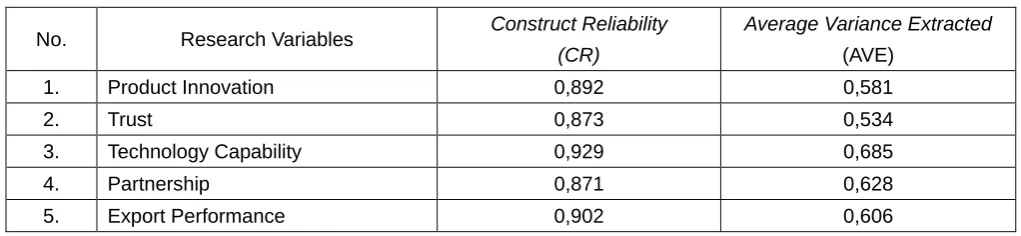
The hypothesis proposed in this study was tested using structural equation model (SEM). It is based on parameter estimates from the complete SEM. Calculation of AVE value is to determine convergent validity which
is more intended to measure the percentage of variance from a series of indicators that can be extracted or explained by its latent variables. A high AVE value indicates that the indicators have represented well-formed
variables developed and it will be accepted if it is greater than 0.5.
Table 1 AVE and CR Value
No. Research Variables Construct Reliability
(CR)
Average Variance Extracted
(AVE)
1. Product Innovation 0,892 0,581
2. Trust 0,873 0,534
3. Technology Capability 0,929 0,685
4. Partnership 0,871 0,628
5. Export Performance 0,902 0,606
Source: Data processed, 2017
Table 1 shows that all of the research variables have AVE values greater than 0.5; thus the hypothesis can be accepted.
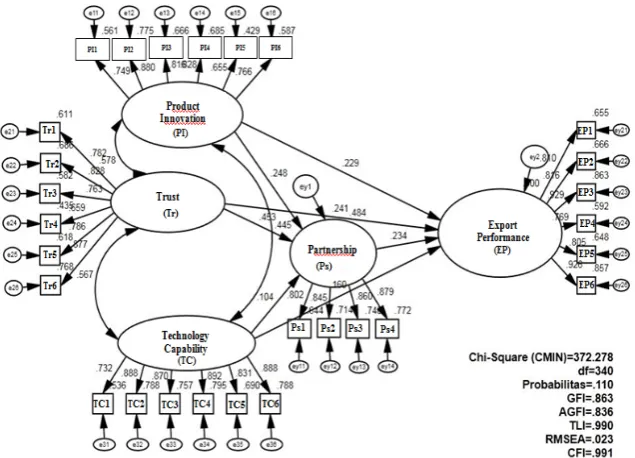
The analysis in this section is the analysis of the Structural Equation Model (SEM) in Full Model to test the
models and hypotheses developed in this study. Model testing in the Structural Equation Model was carried out with two tests, namely the model suitability test and the causality test through the regression coefficient test. The
Figure 1 Analysis Results of the Structural Equation Model
In measurement models, the suitability of the research model is used to test how well the level of goodness
of fit of the research model. The test results are as follows:
Table 2 Full Model Test Results
Criteria Cut of Value Result Note
Chi-Square Must be small 372,278 Good/Fit
Significant Probability ≥ 0,05 0,340 Good/Fit
RMSEA ≤ 0,08 0,023 Good/Fit
GFI ≥ 0,90 0,863 Marginal
AGFI ≥ 0,90 0,836 Marginal
CMIN/DF ≤ 2,00 1,095 Good/Fit
TLI ≥ 0,95 0,990 Good/Fit
CFI ≥ 0,95 0,991 Good/Fit
Source: Calculation Results with AMOS software
Based on table 2, the suitability testing of the research model is used to test how well the goodness of fit level of the research model and the results of the tests presented above. Of the 8 criteria, almost all of these criteria are in good or fit condition. There are 2 criteria, GFI and AGFI, which are in the marginal category.
Therefore, it can be concluded that the compatibility test is in good condition.
Research Hypothesis Testing
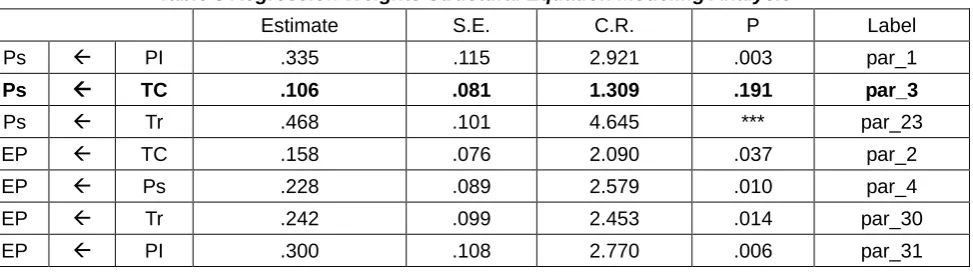
If the estimated goodness of fit structural model criteria are good, then the next step is an analysis of structural relations (hypothesis testing) as shown in the picture of the relationship between constructs indicated
which were above 2 for CR values and below 0.05 for P. If the results of the data show the value that meets these
requirements,, then the proposed research hypothesis is acceptable. In detail, the research hypothesis testing will be discussed in stages in accordance with the hypothesis that has been proposed. In this study, seven hypotheses were proposed which were then carried out in the following sections. The results of the tests are
presented in the following table.
Table 3 Regression Weights Structural Equation Modeling Analysis
Estimate S.E. C.R. P Label
Ps PI .335 .115 2.921 .003 par_1
Ps TC .106 .081 1.309 .191 par_3
Ps Tr .468 .101 4.645 *** par_23
EP TC .158 .076 2.090 .037 par_2
EP Ps .228 .089 2.579 .010 par_4
EP Tr .242 .099 2.453 .014 par_30
EP PI .300 .108 2.770 .006 par_31
Source: Results of calculations with AMOS Note:
PI = Product Innovation Tr = Trust
TC = Technology Capability Ps = Partnership
EP = Export Performance
Table 3 shows the results of testing Hypothesis 1. The value of the regression coefficient (estimate) is 0.335;
the value of CR is 2.921 with a p value of 0.003. This shows that p <0.05 and the CR value is positive (CR> 2.0); it proves that there is a significant positive effect of product innovation on partnerships. Thus, it can be concluded that H1 is accepted. The results of this study are consistent with the majority of previous studies which explain
that product innovation affects the partnership. Product innovation is a complex activity and requires the construction of networks that involve many people, both inside and outside the company (Nijhoff-Savvaki et al.,
(2008).
In testing Hypothesis 2, the regression coefficient (estimate) is at 0.468; the CR value is 4,645 with a p value of 0,000. This proves that p <0.05 and the CR value is positive (CR> 2.0); it informs that there is a significant
positive influence on trust in partnerships. So it can be concluded that H2 is accepted. Trust and commitment are the foundation for building, developing and maintaining successful cooperation between parties in a relationship
(Morgan and Hunt, 1994).
In Hypothesis 3, the regression coefficient (estimate) is 0.106; the CR value is 1.309 with a p value of 0.191. It is proven that p> 0.05 and the CR value is positive (CR <2.0); it informs that there is no significant effect of
technology capability on the partnership. Thus, H3 is rejected. The results of this study are different from previous studies where the majority of studies show that technology capabilities affect partnerships. Latip et al.,
(2014) stated that technology capabilities have a positive impact on the performance of partnership relationships. In Hypothesis 4, the regression coefficient (estimate) is 0.242; the CR value is 2.453 with a p value of 0.014. It is proven that p <0.05 and the CR value is positive (CR> 2.0); this provides information that there is a
performance. Makovec et al., (2015), Ahamed (2015), examined the intensity of competition, trust, commitment,
and performance of export of garment products in Bangladesh. The results showed that trust influenced export commitment and performance positively.
In Hypothesis 5, regression coefficient value (estimate) is 0.228; CR value is 2.561 with a p value of 0.010. It
is proven that p <0.05 and a positive CR value (CR> 2.0); this provides information that there is a significant positive effect of the partnership on export performance. Thus, H5 is accepted. The finding supports some
previous studies results which showed that partnerships had a positive effect on export performance (Mohr and Spekman, 1994; Rasela et al., 2014).
In Hypothesis 6, the regression coefficient (estimate) in the second model is 0.159; the CR value is 2.096
with a p value of 0.036. It is proven that p <0.05 and the CR value is positive (CR> 2.0); this provides information that there is a significant positive effect of technological capability on export performance. thus, H6 is accepted.
The results of this study are consistent with previous studies where the majority of studies confirms that technological capabilities affect export performance. This study refers to research conducted by Nakata et al., (2008) and Hsu (2014) which prove that information technology capabilities have a positive effect on the
business performance of a company.
In Hypothesis 7, the regression coefficient (estimate) is 0.300; the value of CR is 2.770 with a p value of
0.006. It is proven that p <0.05 and a positive CR value (CR> 2.0); this informs that there is a significant positive effect of product innovation on export performance. Thus, H7 is accepted. The results of this study are consistent with previous studies where the majority of studies proves that product innovation influences export performance.
Companies traditionally require absorption to improve product innovation and process performance (Cohen and Levinthal, 1990).
SUMMARY,CONCLUSION AND RECOMMENDATIONS
Conclusion and Recommendations
The main objective of this study is to analyze and test the factors that influence the export performance of export furniture SMEs in Jepara Regency, Central Java, Indonesia. The export performance model in this study
has succeeded in confirming the relationship between the performance of Jepara Regency furniture exports, and the variables that shape it to improve export performance. This study reveals that product innovation, trust, technological capabilities, and partnerships have a positive and significant effect on export performance. The
partnership variable is positively and significantly influenced by product innovation and trust factors. Meanwhile, the technology capability variable does not affect the partnership. In addition, exports are an important element
that must be considered to improve the economic performance of a country. Therefore, one way to improve the export performance of a country is to encourage its companies to carry out the innovation process. This study recommends that to improve export performance, companies must foster good relations with buyers so that the
established partnership is more harmonious and sustainable.
Suggestions for Further Research
For further research, it can be analyzed the influence of independent latent variables from outside the company that affect export performance, including: government support, technology support, business climate,
and business networking. In addition, future research can expand or take research samples on furniture export companies throughout Indonesia that have different characteristics from export furniture companies in this study.
REFERENCES
Aby, N.E. and S.F. Slater. 1989. Management influences on export performance: a review of the empirical literature 1978-88. International
Marketing Review. 6 (4): 7-26.
Ahamed, J. 2015. Competitive Intensity As A Moderator Of Trust–Commitment Relationships And Of Their Linkages With Export
Performance. Uit: The Arctic University Of Norway.
Belderbos, R., M. Carree, B. Diederen, B. Lokshin. and R. Veugelers. 2004. Heterogeneity in R and D co-operation strategies. International
Journal of Industrial Organization. 22(8/9): 1237-63.
Biggs, T. and S.M. Kadia. 2006. African SMEs, Networks, and Manufacturing Performance. Journal of Banking and Finance. 30(11): 1-27
Boehe, D.M. and L. Barin-Cruz. 2010. Corporate Social Responsibility, Product Differentiation Strategy And Export Performance. Journal Of
Bussiness Ethics. (91):325–346.
Cavusgil, T.S., S. Deligonul and C. Zhang. 2004. Curbing Foreign Distributor Opportunism: an Examination of Trust, Contracts, and The
Legal Environment in International Channel Relationships. Journal of International Marketing, 12(2) : 7-27.
Caceres, R.C. and N.G. Paparoidamis, N.G. 2007. Service Quality, Relationship Satisfaction, Trust, Commitment And Business-To-Business
Loyalty. European Journal of Marketing, 41 : 836–867.
Cooper, R. and E. Kleinschmidt. 1985. The impact of export strategy on export performance’, Journal of International Business Studies. (16):
37-55.
Cohen, W. M. and D.A. Levinthal. 1990. Absorptive Capacity: A New Perspective on Learning and Innovation. Administrative Science
Quarterly, 35 (1), 128-152.
Dryer, J.H. and W. Chu. 2011. The Determinants Of Trust In Supplier-Automaker Relationships in the US, Japan, and Korea. Journal of
International Business Studies, 31(2) 259-285.
Ferdinand, A 2014. Metode Penelitian Manajemen. Semarang: Universitas Diponegoro.
Ghozali, I. 2011. Aplikasi Analisis Multivariate Dengan Program SPSS. Semarang: Badan Penerbit Universitas Diponegoro.
Hair, J. W. Black, B. Babin, and R. Aderson. 2010. Multivariate Data Analysis. 7th edition. New Jersey: Upper Saddle River-Prentice Hall.
Hao, S. and B. Yu. 2011. The Impact Of Technology Selection On Innovation Success And Organizational Performance. Ibusiness
(3):366-371.
Haryati, S.S, and L. Nursila. 2016. Membangun kinerja Pemasaran berbasis inovasi produk dan keunggulan bersaing: studi empiris pada
kerajinan gitar di kabupaten Sukoharjo. Jurnal Aktual. (2)1:1-19
Ismail, M. D. 2011. Role Of Trust In Smes Export Performance. Proceeding.International Conference On Management, Economics And
Social Sciences (ICMESS'2011):499-503
Latip, N.A, M. I. Salleh, N.F. Habidin, and N.F. Sapengin. 2014. Technological Capability and Relationship Performance: The Roles of Power.
International Journal of Economics and Empirical Research (IJEER). 2(12):502-509
Lages, C. L. 2005. The Relqual Scale: A Measure Of Relationship Quality In Export Market Ventures. . Journal of Business Research, 58:
1040–1048.
Li, T. and R.J. Calantone. 1998. The impact of market knowledge competence on new product advantage: conceptualization and empirical
evidence. Journal of Marketing, 62(4):13-29.
Makovec, M. A. 2008. The Influence Of Relationship Marketing Components On Export Performance : Established Markets
Moorman, C., R. Deshpandé, and G. Zaltman. 1993. Factors Affecting Trust in Market Research Relationships. Journal of Marketing, (57):
81-101.
Morgan, N., and S. Hunt. 1994. The Commitment-Trust Theory Of Relationship Marketing. Journal of Marketing, 58(3):20-38.
Mohr, J and R. Spekman. 1994. Characteristics Of Partnership Success: Partnership Attributes, Communication Behavior, And Conflict
Resolution Techniques. Strategic Management Journal 12(2):135-152.
Mysen, T. and G. Svensson. 2010. Relqual's Impact on Satisfaction in Norwegian Business Relationships. Journal of Business & Industrial
Najib M, and A. Kiminami. 2011. Innovation, Cooperation, And Business Performance Some Evidence From Indonesian Small Food
Processing Cluster. Journal of Agribusiness in Developing and Emerging Economies, 1(1):75-96.
Nakata, C., Z. Zhen, and M.L. Kraimer. 2008. The Complex Contribution of Information Technology Capa-bility to Business Performance.
Journal of Managerial Issues, 20(4): 485-506.
Nijhoff-Savvaki, O. Omta, and J. Trienekens 2008. Netchain Innovation for Sustainable Pork Supply Chains in an EU Context, Book Chapter
: Agri-food business: Global Challenges – Innovative solutions IAMO : 22-34. ISBN 978-3-938584-33-0.
Oliveira J. S., J.W. Cadogan, and A. Souchon. 2012. Level Of Analysis In Export Performance Research. International Marketing Review,29
(1):114-127.
Obadia, C., 2008. Cross-Border Interfirm Cooperation: The Influence Of The Performance Context. International Marketing Review.
25(6):634-650
Phan, M.CT., C.W Styles, and P.G. Patterson. 2005. Relational competency's role in Southeast Asia business partnerships. Journal of
Business Research, 58(2) : 173-184.
Racela, O.C. and A. Thoumrungroje. 2014. Export Market Orientation, Interfirm Communication, Interfirm Cooperation and Export
Performance. International Journal of Management and Marketing Research, 7 (1):1-14.
Radzi, N. M., A. Shamsuddin and W. Wahab. 2017. Enhancing The Competitiveness Of Malaysian SMES Through Technological Capability :
A Perspective. The Social Science, 12 (4):719-724.
Tsai, K.-H. 2009. Collaborative Network And Product Innovation Performance. Research Policy. 38(5): 765-78.
Zaheer, S., and A. Zaheer. 2006. Trust across borders. Journal of International Business Studies. (37): 21-29.
Zaheer, A., B. McEvily, and V. Perrone. 1998. Does Trust Matter? Exploring The Effects Of Interorganizational And Interpersonal Trust On
Performance. Organization Science, 9 (2):141–159.
Zaheer A., and N. Venkatraman. 1995. Relational Governance As An Interorganizational Strategy: An Empirical Test Of The Role Of Trust In