Original Research Article
Comparative study of morbidities in sawmills workers from central
India: a cross sectional study
Atul Ajay Jagtap
1, Jyotsna Deshmukh
2*
INTRODUCTION
Wood has been harvested and processed for centuries all over the world for various purposes.1 In India it is used mainly as a fuel and construction material but before it can be used as a construction material it is subjected to sawing. Sawmill is a facility where logs are cut into boards.2
Large population is employed in sawmill industry in India. The main problem encountered in the sawmill environment is the respirable dust (<10 μm).2
Around 2 million people are exposed to the wood dust every year. Though there are many varieties of wood but commonly sawed are teak (Tectona grandis), seesam (Dalbergia sisso), mango (Magnifera indica) etc. Bhattacharjee et al have studied the toxicity of these types of wood species through animal studies and reported their chemical
ABSTRACT
Background: The main problem encountered in the sawmill environment is the respirable dust (<10 μm) which may be a cause of respiratory diseases. Further the sawmill workers are also exposed to other health hazards such as injuries from handling wood logs, high noise exposure etc. There are few studies who have studied respiratory health of sawmill workers in India but there is paucity of studies on sawmill workers and their health problems in India. So the study has been undertaken to find out the chief morbidities among sawmill workers by comparing them in control group.
Methods: A cross sectional study was conducted among sawmill workers in Nagpur city in central India from September 2013 to December 2015. Information regarding socio-demographic characteristics collected using predesigned proforma by interview technique. Thorough general, systemic examination and anthropometry was done to assess health status.
Results: Majority of the study subjects were males and belonged to younger age group (28-37 years). Most common morbidity among sawmill workers was musculoskeletal disorder (Table 4) and it was significantly more than comparison group (p<0.05). Some of the other significantly common morbidities among sawmill workers (p<0.05) were conjunctivitis, rhinitis, injuries, hearing impairment, ARI’s, bronchial asthma, chronic bronchitis, contact dermatitis, abdominal hernia, varicose veins and pulmonary tuberculosis.
Conclusions: Musculoskeletal disorders were the commonest morbidity among sawmill workers. Respiratory morbidities and other allergic effects of wood dust were other common morbidities among sawmill workers.
Keywords: Sawmill workers, Health profile, Wood dust, Morbidities
Department of Community Medicine, 1B.J. Govt. Medical College, Pune, 2Indira Gandhi Government Medical College, Nagpur, Maharashtra, India
Received: 08 February 2018
Revised: 07 May 2018
Accepted: 08 May 2018
*Correspondence:
Dr. Jyotsna Deshmukh,
E-mail: [email protected]
Copyright: © the author(s), publisher and licensee Medip Academy. This is an open-access article distributed under the terms of the Creative Commons Attribution Non-Commercial License, which permits unrestricted non-commercial use, distribution, and reproduction in any medium, provided the original work is properly cited.
constituents. Rastogi et al have reported restrictive type of respiratory impairment in workers exposed to sawdust of mango and seesam. Occupational exposure to wood dust may be a cause of respiratory diseases such as hypersensitivity pneumonitis (allergic alveolitis), rhinitis, asthma and chronic obstructive lung disease.3,4
Further the sawmill workers are also exposed to other types of health hazards such as injuries from handling wood logs, saw blade and unguarded machine parts, high noise exposure etc.
There is paucity of studies on sawmill workers and their health problems in India. This study therefore aimed at studying various morbidities in sawmills workers by comparing them in control group.
METHODS
A cross sectional study was conducted among Sawmill workers in Nagpur city in central India. Study duration was from September 2013 to December 2015. Inclusion criterion was saw mill workers exposed to saw dust as study group. Log transporters in sawmills whose exposure to wood dust is minimal were excluded.
Approval from the Institutional Ethics Committee was sought before the start of study. List of registered sawmills was obtained from the department of forest. A pilot study was carried out on 50 sawmill workers to assess the feasibility; test the proforma and get an idea about the prevalence of common morbidities in sawmill workers.
Musculoskeletal disorder (MSD) was found to be the most common morbidity in workers. (69%)
- Prevalence (p) = 0.69
- Relative error (d) = 10% of p. = 0.069
- Z (1-α) = 1.96 for 95% confidence interval.
- Sample size (n) of the study = z (1-α)2×p×(1-p)÷d2 = 3.84×0.69×0.31÷0.072 = 172.52
Based on the prevalence of MSD (69%) in the pilot study which was the commonest morbidity among sawmill workers, the estimated sample size was 172.52.
Two sawmills were selected randomly. All the workers in selected sawmills except log transporters were enrolled in the study i.e. 180.
Large homogenous group of local government workers were purposively selected by matching them with the selected sawmill workers in terms of socio-demographic characteristics such as age, sex (frequency matching). So 180 sawmill workers and 180 comparison group (SRPF) workers were selected.
The necessary permission for carrying out the study was obtained from the owner of the sawmill and appropriate authority in case of local government workers after apprising them about the nature and purpose of the study. After obtaining the necessary consent and explaining the nature and purpose of the study, data was collected as per the guidelines of international labour organization, at suitable timings convenient to both workers as well as the appropriate authority in order to seek their maximum co-operation.
There were various departments with different job descriptions in sawmills. When the tree logs transported from the forest, the log loaders transport the logs to the milling machine (log transporters); after the logs are cut into wide planks by the machine operators (cutters), stacked directly (stackers). There were laborers who assist in various operations (helpers). There was also an administrative staff that serves as the supervisor /manager /clerk / technician of the sawmill industries.
Information regarding socio-demographic characteristics collected using predesigned proforma by interview technique. Thorough general, systemic examination and anthropometry was done to assess health status.
Height of the subjects was measured using stadiometer (Seca) to the nearest 0.1 cm.5 Body weight was measured in light clothing, without shoes to the nearest 0.1 kg using the electronic weighing machine.6
Hearing function assessment done by Rinne’s test and Absolute bone conduction test using tuning fork.7
Operational definition of some important terms
Physical deformity: Acquired loss or malpositioning of finger, toes, limbs or other body parts.
Musculoskeletal disorders: Person with symptoms as myalgia, pain in the limbs/back/joints is labelled as having musculoskeletal disorders.
Bronchial asthma: Recurrent episodes of wheezing, breathlessness, chest tightness with or without cough particularly at night or in the early morning with or without decrease in FEV1or known cases those who are
taking asthma medication.
Chronic bronchitis: This is a productive cough that lasts for three months or more per year for at least two years.
Varicose veins: Dilated and tortuous veins. Brodie tredelenberg test used to confirm diagnosis.
Ziemans technique, ring occlusion test were used as necessary to confirm diagnosis.
Respiratory morbidity: If any one of asthma, chronic bronchitis, T.B., rhinitis and acute respiratory infection is present among study subjects then respiratory morbidity is said to be present.
Cardiovascular morbidity: Any one of hypertension, ischemic heart disease, piles and varicose veins is present among study subjects then cardiovascular morbidity is said to be present.
Statistical analysis
The data was analyzed using Epi info 7.0.1. The quantitative variables were expressed in terms of mean and standard deviation and the qualitative variables were expressed in percentages. Chi square test was used to find the difference between two proportions. Fischer exact test
and chi square test for trend was used wherever applicable. Unadjusted odd’s ratio was calculated for various morbidities.
RESULTS
Sawmills were located in the outskirts of Nagpur city. Main wood species used for sawing was Tectona grandis
(Teak). In total, 360 workers were employed in the study, 180 of them sawmill workers (study group) and 180 local government workers as a control group.
Socio-demographic characteristics of study subjects mentioned in the Table 1. It shown that majority of the study subjects were males (87%) and belonged to younger age group (28-37 years). But the two groups differ in socioeconomic status and education. Most of the sawmill workers were from lower socioeconomic class and had low level of education as compared to control group.
Table 1: Distribution of study subjects according to socio-demographic characteristics.
Socio-demographic characteristics
Sawmill workers Comparison group
No. % No. %
Age group (Years)#
18-27 46 25.55 46 25.55
28-37 88 48.88 88 48.88
38-47 25 13.89 25 13.89
48-57 18 10.00 18 10.00
58-67 03 00.00 03 00.00
Gender# Male 157 87.22 157 87.22
Female 23 12.78 23 12.78
Socioeconomic status*
I 05 02.78 120 66.66
II 39 21.66 47 26.11
III 50 27.78 07 03.89
IV 77 42.78 05 02.78
V 09 05.00 01 00.56
Education
Illiterate 18 10.00 01 00.56
Primary 57 31.67 06 03.33
Middle school 71 39.44 30 16.66
High school 23 12.78 75 41.67
Diploma 03 01.67 40 22.22
Degree 08 04.44 27 15.00
Postgraduate 00 00.00 01 00.56
*As per the B.G. Prasad Scale24 # Age and gender were matched.
Table 2: Distribution of sawmill workers according to category of work.
Category of work Study group
No. %
Cutter 57 31.66
Helper 103 57.22
Stacker 12 06.67
Clerk 03 01.67
Technician 02 01.11
Supervisor 03 01.67
Table 3: Distribution of sawmill workers according to duration of work.
Duration of work (years) Study group
No. %
<5 86 47.78
6-10 51 28.33
11-15 27 15.00
>16 16 08.89
Total 180 100
Mean duration of work (years)= 7.59±5.89.
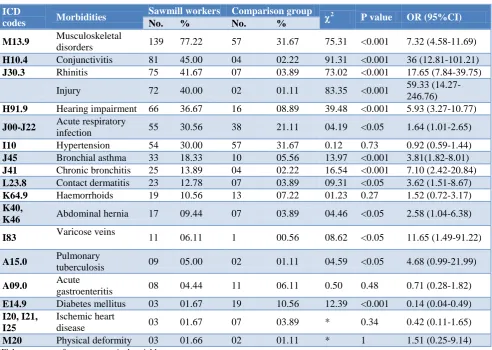
Table 4: Distribution of study subjects according to morbidities.
ICD
codes Morbidities
Sawmill workers Comparison group
2 P value OR (95%CI)
No. % No. % M13.9 Musculoskeletal
disorders 139 77.22 57 31.67 75.31 <0.001 7.32 (4.58-11.69)
H10.4 Conjunctivitis 81 45.00 04 02.22 91.31 <0.001 36 (12.81-101.21)
J30.3 Rhinitis 75 41.67 07 03.89 73.02 <0.001 17.65 (7.84-39.75) Injury 72 40.00 02 01.11 83.35 <0.001 59.33
(14.27-246.76)
H91.9 Hearing impairment 66 36.67 16 08.89 39.48 <0.001 5.93 (3.27-10.77)
J00-J22 Acute respiratory
infection 55 30.56 38 21.11 04.19 <0.05 1.64 (1.01-2.65)
I10 Hypertension 54 30.00 57 31.67 0.12 0.73 0.92 (0.59-1.44)
J45 Bronchial asthma 33 18.33 10 05.56 13.97 <0.001 3.81(1.82-8.01)
J41 Chronic bronchitis 25 13.89 04 02.22 16.54 <0.001 7.10 (2.42-20.84)
L23.8 Contact dermatitis 23 12.78 07 03.89 09.31 <0.05 3.62 (1.51-8.67)
K64.9 Haemorrhoids 19 10.56 13 07.22 01.23 0.27 1.52 (0.72-3.17)
K40,
K46 Abdominal hernia 17 09.44 07 03.89 04.46 <0.05 2.58 (1.04-6.38) I83 Varicose veins 11 06.11 1 00.56 08.62 <0.05 11.65 (1.49-91.22)
A15.0 Pulmonary
tuberculosis 09 05.00 02 01.11 04.59 <0.05 4.68 (0.99-21.99)
A09.0 Acute
gastroenteritis 08 04.44 11 06.11 0.50 0.48 0.71 (0.28-1.82)
E14.9 Diabetes mellitus 03 01.67 19 10.56 12.39 <0.001 0.14 (0.04-0.49)
I20, I21, I25
Ischemic heart
disease 03 01.67 07 03.89 * 0.34 0.42 (0.11-1.65)
M20 Physical deformity 03 01.66 02 01.11 * 1 1.51 (0.25-9.14)
*Fisher exact test for two categorical variables.
Table 5: Distribution of sawmill workers according to morbidities and duration of work.
Morbidities
Duration of exposure (Years) Total
≤5 n=86 6-10 n=51 11-15 n=27 ≥16 n=16 n=180 No. % No. % No. % No. % No. % Respiratory 69 80.23 39 76.47 20 74.07 11 68.75 139 77.22
Cardiovascular 24 27.91 23 45.10 17 62.96 10 62.50 74 41.11
Hernia 03 03.49 06 11.76 05 18.52 03 18.75 17 09.44
Musculoskeletal 70 81.40 36 70.59 21 77.78 12 75.00 139 77.22
Skin 12 13.95 06 11.76 04 14.81 01 06.25 23 12.78
Injuries 38 44.19 14 27.45 12 44.44 08 50.00 72 40.00
Hearing impairment 22 25.58 17 33.33 16 59.26 11 68.75 66 36.67
ᵡ2
Table 6: Distribution of sawmill workers according to morbidities and category of work.
Morbidities
Category of work Total
Cutters (n=57) Helpers
(n=103) Stackers (n=12)
Supervisors and others (n=8)
No. % No. % No. % No. % No. % Respiratory 48 84.21 76 73.79 11 91.66 04 50.00 139 77.22
Cardiovascular 26 45.61 40 38.83 04 33.33 04 50.00 74 41.11
Hernia 06 10.53 07 06.80 03 25.00 01 12.50 17 09.44
Musculoskeletal 44 77.19 79 76.70 09 75.00 07 87.50 139 77.22
Skin 07 12.28 14 13.59 01 08.33 01 12.50 23 12.78
Injuries 30 52.6* 37 35.92 04 33.33 01 12.50 72 40.00
Hearing impairment 22 38.60 38 36.89 05 41.67 01 12.50 66 36.67
*Injuries significantly more in cutters than others [2=5.55; df=1; p=0.01; OR=2.14 (1.13-4.06)].
Most of the sawmill workers working in cutters (31.66%) and helpers (57.22%) section while least (around 5%) were employed in the administrative section (Table 2). Study of distribution of sawmill workers according to duration of work (Table 3) shown that mean duration of work (years) was 7.59 with standard deviation of 5.89. Majority of the workers (47.78%) from our study had work exposure less than 5 years. 8.89% of the workers had work exposure of more than 16 years.
Most commonly sawmill workers were suffered from musculoskeletal disorders (Table 4) and it was significantly more than comparison group (p<0.05). Some of the other significantly common morbidities among sawmill workers (p<0.05) were conjunctivitis, rhinitis, injuries, hearing impairment, ARI’s, bronchial asthma, chronic bronchitis, contact dermatitis, abdominal hernia, varicose veins and pulmonary tuberculosis. When we studied the distribution of sawmill workers according to morbidities and duration of work (Table 5) we found that cardiovascular morbidity, hernia and hearing impairment had shown significantly (p<0.05) increasing trend with duration of work.
Study of morbidities according to category of work (Table 6), conclude that cutters were significantly (p<0.05) more prone to injuries than the workers in other section, while the other morbidities did not show any significant difference between various categories of work.
DISCUSSION
In our study workers employed in sawmills were exposed to high concentration of sawdust besides the other risk factors.
In the present studymajority of the sawmill workers were young productive males in the age group of 28-37 years with mean age 33.60±9.53 years. These findings were in line with the findings of Hessel et al, Deshpande et al (38.1±8.1 years), Adeoye et al (34.53±11.01 years) and
Ismaila et al, Bello et al found that majority of the participants were belong to the age group of 25-44 years.8-12 It indicates that this occupation demands young productive workforce.
Most of the participants from the study group had low level of education. Similar findings were reported by Yusuff, et al and Wani, et al.13,14
Majority of the sawmill workers had low socioeconomic profile and were employed in the wood cutters or helper category so they were more consistently exposed to the sawdust than the workers in administrative category like technician, clerk etc. In our study most of the workers had sawdust exposure of <5 years with a mean duration of exposure (years)= 7.59±5.89 years. These findings are consistent with the findings of Oluwatosin et al, Ugheoke et al.15,18 However contradictory observations were noted by Sakariya et al and Boskabady et al.1,16 This could be due to the unskilled workers employed in unorganized sector with frequent job changing tendency in present study.
In the present study sawmill workers significantly suffered from musculoskeletal disorders than comparison group. [2=75.31; p<0.001; OR=7.32; 95% CI (4.58-11.69)]. This could be due to the awkward posture of sawmill workers working for long hours and carrying excessive weight (wood logs). This finding was supported by Ismaila et al who found that musculoskeletal disorders were common among sawmill workers.11
Other common morbidities were conjunctivitis, rhinitis, hearing impairment, acute respiratory infection, bronchial asthma, chronic bronchitis, contact dermatitis in the sawmill workers and significantly more than in the comparison group [p<0.05]. Similar findings were reported by Wani et al,Fatusi et al.14,17
This could be due to chronic dust exposure which impairs the phagocytic activity of alveolar macrophages and also affects the mucociliary performance. When the dust particles are inhaled, scavenger cells like macrophages dissolve the dust by surrounding it, but if there is dust overload, the macrophages fail to completely clear the dust; consequently the dust particles lodge in and irritate the respiratory mucosa.18-20
Bello et al found high prevalence of injury i.e. 83%.12 This may be due to sawmill in our study were large and most of tasks which prone to injury were mechanized so we may have found less prevalence of injury (40%) in our study.
In this study we found that cardiovascular morbidities [2 trend = 13.23; p≤0.001], hernia [2 trend=6.79; p≤0.05]
and hearing impairment [2 trend =15.95; p≤0.001] have shown significantly increasing trend with duration of work. Similar findings were reported by Shrivastava et al who found respiratory and gastrointestinal (hernia) morbidities had shown significantly increasing trend as the duration of work increased.21
Alamgiret al found significant negative trend for injuries i.e. injuries decreased as the duration of work increased.22 Serious injuries decreases as the working duration increases as the skill increases but in our study most of the injuries were minor and occurred due to wood handling, that does not depend on skill, further skilful tasks were mechanized so we could not find any trend for injury.
Mandryk et al found significant dose-response relationships for respiratory morbidity but in our study we did not find significant trend for respiratory morbidities.23 This may be due to that respiratory disorders discussed in our study take years to manifest and most of the subjects in our study had <5 years of work exposure.
Only injuries were found to be significantly more in cutters than others [2=5.55; df=1; p=0.01; OR=2.14 (1.13-4.06)]. Also Bello et alreported significantly more injuries among cutters.12
CONCLUSION
Musculoskeletal disorders were the commonest morbidity among sawmill workers. Respiratory morbidities and other allergic effects of wood dust were other common morbidities among sawmill workers.
Cardiovascular morbidities, hearing impairment and hernia were chronic morbidities and they have shown increasing trend with the duration of work.
Cutters were more prone to injuries than the sawmill workers working in the other section. Controlling the dust in occupational environment, safety education, periodic
medical examination and occupational training could solve majority of these problems.
Funding: No funding sources Conflict of interest: None declared
Ethical approval: The study was approved by the Institutional Ethics Committee
REFERENCES
1. Sakariya K, Chavda B, Sorani A, Kakaiya M, Joshi V. A study on dynamic lung volumes of sawmill workers in Jamnagar city. Int J Basic Applied Physiol. 2014;3(1):70-2.
2. Mariammal T, Amuthajaisheeba A, Sornaraj R. Work related respiratory symptoms and pulmonary function tests observed among construction and sanitary workers of Thoothukudi. International J Pharmtech Res. 2012;4(3):1266-73.
3. Bhattacharjee JW, Dogra RKS, Lal MM, Zaidi SH. Wood dust toxicity; In vivo and in vitro studies. Environmental Res. 1979;20:455-65.
4. Rastogi S, Gupta BN, Mathur N, Husain T. Respiratory health effects from occupational exposure to wood dust in sawmills. American industrial Hygiene Association J. 1989;50:290-5. 5. Centre for disease control and prevention.
Measuring children’s height and weight accurately at home. Available at: http://www.cdc.gov/healthy weight/steps/assessing/bmi/childrens_bmi/measurin g_children.html. Accessed on 4 September 2014. 6. World health organization. The world health
organization STEPwise approach to chronic disease risk factor surveillance. Geneva; WHO press; 2005. Available at: http://www.who.int/chp/steps/ manuel/en. Accessed on 4 September 2014.
7. Barrett KE, Barman SM, Boitano S, Brooks HL. Ganong’s review of Medical Physiology. 24th edition. Tata McGraw-Hill, 2012.
8. Hessel PA, Herbert FA, Melenka LS, Yoshida K, Michaelchuk D, Nakaza M. Lung Health in Sawmill Worker exposed to Pine and Spruce. CHEST. 1995;108(3):643.
9. Deshpande A, Afshan A. Effect of Chronic Exposure of Sawdust in Workers Employed in Sawmills: A Cross-Sectional Study. Sch J App Med Sci. 2014;2(4):1202-5.
10. Adeoye OA, Adeomi AA, Olugbenga-Bello AI. Respiratory symptoms and peak expiratory flow among sawmill workers in South Western Nigeria. J Environ Occup Sci. 2014;3(3):141-6.
11. OlasunkanmiIsmaila S. Cardiovascular Strain of Sawmill Workers in South-Western Nigeria. Int J Occupational Safety Ergonomics. 2013;19(4):607– 61.
12. Bello SR, Mijinyawa Y. Assessment of Injuries in Small Scale Sawmill Industry of South Western Nigeria. J Sci Res Develop. 2010;1558(12):1-11. 13. Adegbite YAQ, Awotedu RA, Akinosho OL,
Occupational Health Hazards on Sawmill Workers. Acad J Interdisciplinary Studies. 2014;3(6):511-7. 14. Wani KA, Jaiswal YK. Effects of occupational
exposure on health of the workers of cricket bat manufacturing industries in Kashmir (India). Middle-East J Scientific Res. 2010;5(3):146-51. 15. Ugheoke AJ, Wahab KW, Erhabor GE. Prevalence
of Respiratory Symptoms among Sawmill Workers in Benin City, Nigeria. Int J Trop Med. 2009;4(1):1-3.
16. Boskabady MH, Rezaiyan MK, Navabi I, Shafiei S, Arab SS. Work-related respiratory symptoms and pulmonary function tests in northeast Iranian (the city of Mashhad) carpenters. Clinics. 2010;65(10):1003-7.
17. Fatusi A, Erhabor G. Occupational health status of sawmill workers in Nigeria. J R Soc Health. 1996;116(4):232-6.
18. Milanowski J, Gora A, Skorska C, Krysińska-Traczyk E. work related symptoms among furniture factory workers in urban region. Ann Agric Environ Med. 2002;9:99–103.
19. Itagi V, Patil VM, Patil RS, Vijaynath V. A cross sectional study of lung function amongmill worker. J Pharma Biomed Sci. 2011;6(6):1-6.
20. Culver BH, Butler J. Alterations in pulmonary functions. In: Andes R, Bierman EL, Hazard WR
editors; Principles of Geriatric Medicine. 3rd edition. London: McGraw Hill Book Co. Ltd.; 1985: 280–287.
21. Shrivastava AK, Gupta BN, Mathur N, Bihari V, Mahendra PN, Pangtey BS, et al. A croos sectional study of morbidity in sawmill workers. Indian J Community Med. 1993;18(4):181-5.
22. Alamgir H, Demers PA, Koehoorn M, Ostry A, Tompa E. Epidemiology of work-related injuries requiring hospitalization among sawmill workers in British Columbia. 2007;22(4):273-80.
23. Mandryk J, Alwis KU, Hocking AD. Effects of Personal Exposures on Pulmonary Function and Work-related Symptoms Among Sawmill Workers. Ann. Occup Hyg. 2000;44,(4):281-9.
24. Park K. Occupational health. In: Parks Textbook of Preventive and Social Medicine. 23rd edition. Jabalpur: M/S Banarasidas Bhanot; 2015.