MODIFIED RSA ENCRYPTION ALGORITHM IS
USED IN CLOUD COMPUTING FOR DATA
SECURITY
Yogita Gangboir
1, Praveen Shende
2 1.,2CSE Dept, CSIT Durg, (India)
ABSTRACT
Cloud computing is rising day by day around the world. It has potential to fulfill the requirements of users.
Cloud computing share distributed resources and services which belong to the different sites. However the
security threat to the data is the most critical problem faced by the organizations. Since data or information is
not secure in cloud computing, so there is need to provide some security method. When data is upload or
download in cloud, that time data can be hacked or crashed. Hence the cryptographic approach is a major
solution to the problem. Modified RSA Encryption Algorithm will secure the data in cloud. This algorithm will
ensures security to service model for upload and download data in cloud environment. Data can be in the form
of pdf file, images, text file etc.
Keywords:
Cloud Computing, Modified RSA Encryption Algorithm, Security, Software as A
Service..
I. INTRODUCTION
At presently, the cloud computing becomes most serviceable technology. In the conventional model of cloud
computing, the user’s computer is fully responsible for both computing, data storage and data analysis and manipulation. The user’s computer is integrated with data and all the software. As the data size and computational complexity increases exponentially, user’s system losses its computing efficiency. Moreover,
expansion of industries over the globe, make organizations to share database around the world. Indeed,
organizations require a system which can solve above problem efficiently. And hence cloud computing comes
into the picture. Cloud computing offers a cost-effective answer to manage the IT infrastructure in a flexible and
scalable way. Cloud computing enables software applications, deployment platforms, even the computing
resources to be made available on-demand using a pay-as-you-work model. This has got a great deal of attention
towards the domain in late years. Any user can share the resources in cloud. There are many security challenges
and issues. So we need to provide security in cloud system. Cryptography is one of the best solutions to provide
security in cloud computing. In cryptography, encryption and decryption are process are done. Encryption is the
process of converted plain text into cipher text and Decryption is reverse process of encryption that means to
convert cipher text into plain text at other end, this process is called decryption. Cryptography is an essential
part of secure communication. There are two types of cryptographic algorithm symmetric cryptography and
asymmetric cryptography. Initially unencrypted data is treated as normal text.
A Symmetric cryptography is used only 1 secret key which is knowing by both the user sender and receiver. For
eg. Data encryption standards (DES) and advanced encryption standards(AES). In asymmetric cryptography,
pair of keys : public key and private key. [yogi 6] Rivest Shamir Adleman(RSA) is best known pubic key
cryptosystem. ure. There are two ways in which we can achieve security 1.encrypted file transfer 2.Strong
secure protocol for transmission of files. RSA (Rivest, Shamir & Adleman) is an asymmetric cryptographic
algorithm developed in 1977. It generates two keys: public key for encryption and private key to decrypt
message [2].RSA algorithm consist of three parts: one is key generation which is to be used as key to encrypt
and decrypt data, second is encryption part, where process of conversion of plaintext to cipher text is being
carried out and third is decryption, where encrypted text is converted in to plain text at other side. As a public
key is used for encryption and is well known to everyone and with the help of public key, hacker can use brute
force method to find private key which is used to decrypt message. MREA prevents files and data from hackers
and help safe uploading and downloading data from one end to other [2]. In this paper we approach MREA
algorithm that is a modified RSA encryption algorithm to the existing RSA algorithm. Cloud computing works
in an open environment, when we upload or store data in cloud there are number of users in cloud who want to
access that file or data so need security concern. So that only authorized user can access file. When any user
share a file to client or other user that time brute force attacker can hack the file or unauthorized user can try to
access file. Hence need any security algorithm or cryptography technique which will security when we
uploading downloading and sharing a file.
II. DATA SECURITY ISSUES IN CLOUD
2.1 Data Integrity
To providing the security in cloud in data, cloud service providers should implement mechanisms to ensure data
integrity. The cloud provider should make the client aware of what particular data is hosted on the cloud, the
origin and the integrity mechanisms put in place.
2.2 Data Availability
Customer data is normally stored in chunk on different servers often residing in different locations or in
different Clouds. In this case, data availability becomes a major legitimate issue as the availability of
uninterruptible and seamless provision becomes relatively difficult.
2.3 Data Segregation
Because of the multi-tenancy feature of the cloud infrastructure, knowledge of many users share same physical
storage location, so giving rise to the chance of information intrusion. This could be achieved by hacking
through some vulnerability or by injecting shopper code. It will permit intrusion into others knowledge. A SaaS
model ought to so maintain correct isolation between the information of from totally different users.
2.4 Data Access
The issue of information access is said to the protection policies followed by the cloud supplier for accessing the
information. Security policies ought to be designed with a read to manage the access to the information by the
class of the user.
2.5 Privacy and Confidentiality[10]
Once the client host data to the cloud panel so there should be some guarantee that only authorized user can
place to assure the cloud users of the data safety. It should be assured to the cloud seeker that data hosted on the
cloud panel will be confidential.
III. RELATED WORKS
Cryptography means to store the data and transform that data in a particular form so that only authenticate user
can access that data and process with in it[8]. It associate with converting the plain text into cipher
text(encryption), then reverse process(decryption).
Fig. 1-Symmetric key Cryptography
In fig. 1, Symmetric key Cryptography is shown. Here for encryption, plain text is converted into cipher text,
with use of secret key. And at decryption time it using again same secret key to convert cipher text into plain
text
.
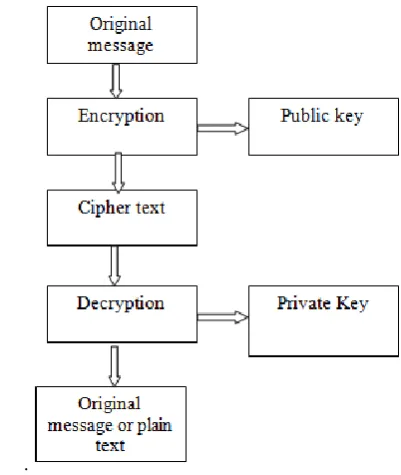
In fig. 2, Asymmetric key Cryptography is shown. Here for encryption process, plain text is converted into
cipher text, with use of public key. And at decryption time it using private key to convert cipher text into plain
text.
Asymmetric key cryptography is used two different keys: a public key and a private key for encryption and
decryption respectively. Private key is cannot be derived from public key. This scheme, provide much strength
of security.
IV. MODIFIED RSA ENCRYPTION ALGORITHM
RSA Algorithm can be summarized as follows:[3]
1. first generate keys with required digits.
2. Save and load the key, the key is saved as plain text.
3. Use specified key to encrypt any file with RSA algorithm.
4. Encrypted data can be loaded and decrypted with the specified key to restore the original data.
4.1 MREA Method
MREA is an asymmetric-key cryptosystem algorithm[5], for communication, two keys are required: a public
key and a private key. The public key is used only for encryption [6], and the private key is used only for
decryption [4]. key generation algorithm :[3]
This MREA method have removed the drawback of RSA [19] MREA Algorithm can be summarized as follows:
1. Choose four large prime numbers p, q, r and s randomly and independently of each other. All primes should
be of equivalent length.
2. Compute n = p x q, m= r x s, φ= (p-1) x (q-1) and λ=(r-1) x(s-1). 3. Choose an integer e, 1 < e < φ such that Gcd (e, φ) =1
4. Compute the secret exponent d, 1 < d < φ, such that e x d mod φ =1.
5. Select an integer g=m+1.
6. Compute the modular multiplicative inverse: μ=λ-1 mod m.
The public (encryption) key is (n, m, g, e). The private (decryption) key is (d,
,
)Encryption:Let F be a data to be encrypted where the contents of data are taken into string S. Select random
number r, where r < m. Compute cipher text as C = gs^e mod n * rm mod m2
Decryption:Compute original message: S = (((cλ mod m2 -1) / m) * μ mod m)d mod n.
V. SECURITY ANALYSISI OF ALGORITHM
For security analysis of this algorithm there are three attack approaches: Brute Force, Mathematical, and Timing
attacks
5.1 Brute Force Attack [6][7]
In this attack, attacker tries to guess the private key by all possible combinations [6]. In MREA method its
5.2 Mathematical Attack [6]
In this attack d, ,
were determined by the attacker to find the private key. This attack could be prevented byusing keys with 2048 bits size. MREA 1024 bits key size is quite enough for preventing this attack.
5.3 Timing Attack[7]
In timing attack, the private exponent was determined by the attacker by calculating the time with exploiting the
timing variation of the modular exponentiation.
Table1: Comparison between RSA and MREA method
S. No.
RSA method
MREA method
1.
Less Security
More Security
2.
More process speed
Less process speed
3.
brute force
attack
is
more
permeable
brute force
attack
is
little
permeable
4.
Use
two
prime
numbers
Use 4 large prime
nos.
VI. CONCLUSIONS
Modified RSA Encryption algorithm (MREA) is used, when data is uploaded in cloud panel and data is
downloaded from cloud to user’s system. Only authenticate user can access the file or data. This algorithm is
more secure rather than other method. This algorithm is using large prime numbers, so it will be difficult for
hackers to guess the prime numbers to find out the keys. Brute force attacker will not be crack or miss use the
data. This method will ensure security for data in cloud when data will be uploaded and downloaded.
REFERENCES
[1] Agentless Recovery. http://www.ibm.com/deceloperworks/cloud/liberary/cl-agentlessrecovery/[Accessed`;
january 2013]
[2] Amazon EC2 Service http://aws.amazon.com/ec2
[3] Rajan S Jamgekar, Geeta Shantanu Joshi, “File Encryption and Decryption using Secure RSA”,
International Journal of Emerging Science and Engineering (IJESE) ISSN: 2319–6378, Volume-1, Issue-4,
February 2013.
[4] Gaurav R. Patel, Prof. Krunal Panchal, Sarthak R. Patel, “A Comprehensive Study on Various
Modifications in RSA Algorithm”, International Journal of Engineering Development and Research.
ISSN: 2321-9939.
[5] Amare Anagaw Ayele, Dr. Vuda Sreenivasara, “A Modified RSA Encryption Technique Based on
Multiple Public keys”, International Journal of Innovative Research in Computer and Communication
[6] Faraz Fatemi Moghaddam, Omidreza Karimi, Maen T. Alrashdan, “A Comparative Study of Applying
Real-Time Encryption in Cloud Computing Environments”, IEEE 2nd International Conference on Cloud
Networking (CloudNet) 2013.
[7] Dhananjay Puglai, Harsh Chitrala, Salpesh Lunawat, P. M. Durai Raj Vincent, “An Efficient Encryption
Algorithm on Public key Cryptography”, International Journal of Engineering and Technology, Vol 5 No 3
Jun-Jul 2013.
[8] Alok Kumar Shukla, V. Kapoor “Comparison among RSA, modified RSA using Two public key and
MRSA using n prime number with n prime number”, International Journal of Engineering Sciences &
Research Technology[713-720].
[9] Sonal Sharma, Jitendra Singh Yadav, Prashant Sharma, “Modified RSA Public Key Cryptosystem Using
Short Range Natural Number Algorithm” International Journal of Advanced Research in Computer
Science and Software Engineering.
[10] Parsi kalpana, Sudha Singaraju. “Data Security in Cloud Computing Using RSA Method ”, International
Journal of Research in Computer and Communication technology, IJRCCT, ISSN 2278-5841, Vol 1, Issue
4, September 2012.
[11] Bhupesh Kumar Dewangan and Sanjay Kumar Baghel, “Survey on Ensuring Security Model of Cloud
Computing”, IJAIR, ISSN, 2278-7844.
[12] Bhupesh Kumar Dewangan and Praveen Shende, “Survey on User Behavior Trust Evaluation in Cloud
Computing”, International Journal of Science, Engineering and Technology Research (IJSETR), ISSN,
2278 – 7798 Volume 1, Issue 1, July 2012
[13] http://2012ieeetitles.blogpost.in/2012/07/a-secure-erasure-code-based-cloud.html.
[14] Jeong-Min et al, “Attribute based Proxy Re-Encryption for Data Confidentiality in Cloud Computing
Environments”, IEEE ACIS/JNU Int. Conference on Computers, Networks, Systems, and Industrial
Engineering (CNSI 2011),Korea.
[15] “NIST Cloud Computing Standards Roadmap ” NIST Special Publication 500-291, Version 2 (Supersedes
Version 1.0, July 2011) .
[16] Pratap Murukutla, K.C. Shet, “Single Sign On for Cloud .In”, International Conference on Computing
Sciences,2012 IEEE DOI 10.1109/ICCS.2012.66.
[17] Ramgovind S, Eloff MM, Smith E, “The Management of Security in Cloud Computing”,
[18] Rashmi,Dr.G.Sahoo and Dr. S. Mehfuz, “Securing Software as a Service Model of Cloud Computing:
Issues and Solutions”, International Journal on Cloud Computing: Services and Architecture (IJCCSA) ,
Vol.3, No.4, August 2013 .
About Authors
Yogita Gangboir, received B.E. (Info. Tech.) in year 2013 and pursuing M.Tech.from (Computer Sc.) From
Chhatrapati Shivaji Institute of Technology (CSIT), Durg, Chhattisgarh, India. Her interests are Programming
Languages(Java, PHP) and Cloud Computing.
Mr. Praveen Shende, received B.E. (Computer Sc.) in year 2009 and in pursuit for M.Tech. (Computer Sc.)
From Chhatrapati Shivaji Institute of Technology (CSIT), Durg, Chhattisgarh,India, His interests are
Programming Languages(Java, PHP,Zoomla), Cloud Computing and DBMS, Computer Networks, Computer