Lincoln
University
Digital
Thesis
Copyright
Statement
The
digital
copy
of
this
thesis
is
protected
by
the
Copyright
Act
1994
(New
Zealand).
This
thesis
may
be
consulted
by
you,
provided
you
comply
with
the
provisions
of
the
Act
and
the
following
conditions
of
use:
you
will
use
the
copy
only
for
the
purposes
of
research
or
private
study
you
will
recognise
the
author's
right
to
be
identified
as
the
author
of
the
thesis
and
due
acknowledgement
will
be
made
to
the
author
where
appropriate
you
will
obtain
the
author's
permission
before
publishing
any
material
from
the
thesis.
Testing alternative breeding methods in white clover
A thesis
submitted in partial fulfilment
of the requirements for the Degree of
Doctor of Philosophy
at
Lincoln University
by
Richard Mark George
ii
Abstract of a thesis submitted in partial fulfilment of the
requirements for the Degree of Doctor of Philosophy.
Testing alternative breeding methods in white clover
by
Richard Mark George
A series of experiments were conducted to estimate the genetic parameters for an elite breeding population of white clover (Trifolium repens L.) in both an irrigated and dryland environment. Data collected from two environments using spaced-planted and mini-plot trials were used to demonstrate the rationale for pursing various traditional and modern marker-assisted selection breeding methods in white clover. In addition, and under the over-arching theme of investigating breeding strategies, supplementary findings are presented regarding pollination patterns within a white clover population in isolation cages.
In an experiment designed to generate half-sib and full-sib families for progeny evaluation, pollen dispersal within isolation cages using wild bumble bees (Bombussp.) was monitored using simple sequence repeat molecular markers (SSR markers). Within bi-parental crosses, no detectable levels of self-fertilised germinated seedlings were detected, nor were there any detectable levels of foreign pollen sources. Within polycross isolations, no detectable levels of foreign pollen sources were detected, and self-fertilised rates were negligible (<1%). Outcross paternal progeny counts deviated significantly from random mating in two 20 parent
polycrosses. Siring success of paternal genotypes decayed as the distance between them and recipient maternal parents increased. Low levels of paternal pollen dispersal at increasing distances from maternal recipients within isolation cages demonstrated the requirement for randomised multi-clonal replication in white clover polycrosses, especially when being used for the generation of half-sib families for progeny evaluation.
iii
selection, the rate of expected genetic gain was doubled compared to traditional half-sib family selection alone. Supplementary phenotypic selection within molecular marker determined full-sib families further improved expected genetic gain. Discrepancies in heritabilities calculated on a half-sib family means basis and that on a single plant basis support the rationale for breeders to pursue half-sib family selection methods for low heritable traits such as clover herbage yield, whereas traits with moderate heritabilities on a single plant basis, such as leaf size, support the use of phenotypic selection methods.
In a multi-site mini-plot trial conducted in two Canterbury soils which differed in soil moisture content and irrigation application, significant genetic variation for both autumn vegetative persistence and herbage yield was observed. Utilising a North Carolina I mating design, second year autumn vegetative persistence (plot coverage) ranged among full-sib families from 15 to 100% at the irrigated site and from 10 to 70% at the dryland site, clover herbage yield from 496 to 1382 kgDM/ha at the irrigated site and 93 to 326 kgDM/ha at the dryland site, and growing point density from 356 to 3111 and 115 to 867 growing points m-2,
at the irrigated at dryland sites, respectively. Physiological measurements indicated significant soil moisture stress at the dryland site, with water potentials up to 3.5 fold lower than the irrigated site. The extent of genetic variation observed for autumn recovery supports the notion for the use of intra-population selection for the development of improved cultivars that can persist through moderate drought conditions and demonstrate improved recovery rates following rain. Similar to the spaced-planted trials, large discrepancies in heritabilities calculated on a family means basis and that on a single plant basis support the rationale for breeders to pursue family selection methods for clover herbage yield and most vegetative stolon attributes. Heritabilities for traits such as leaf size and stolon thickness support the use of phenotypic selection methods.
Partitioning of genetic variation into both additive and non-additive genetic variation was hindered by large standard errors. Inconclusive evidence for a significant proportion of non-additive genetic variation for clover herbage yield warrants further enquiry. Significant family × replicate, family × year, family × environment and family × year × environment variance components demonstrated the requirement for breeders to include multi-site and multi-year trials with adequate plot size to identify families with broad adaptation for field application.
iv
Acknowledgements
The completion of this PhD research project and thesis was made possible by the support and advice given to me by a number of people for whom I am immensely grateful for.
I was fortunate to have an outstanding advisory and supervisory team whose wealth of both academic and practical knowledge contributed to not only this thesis but also my professional development. I would like to thank my principal supervisors, Dr Rainer Hofmann (Lincoln University) and Dr Zulfi Jahufer (AgResearch) for their guidance and support throughout my project. Their humility was inspiring. I would also like to extend this gratitude to my advisors at AgResearch, Brent Barrett and Keith Widdup.
I am exceedingly grateful for the mentoring role Dr Derek Woodfield from PGG Wrightson Seeds played throughout the course of my project, his vision, and the significant personal development opportunities he has provided me with. Likewise, I would like to thank both Dr Alan Stewart and Michael Norriss from PGG Wrightson Seeds for their practical advice and discussions regarding commercial breeding programs. I also extend this gratitude to the wider PGG Wrightson Seeds team at the Kimihia Research Centre.
I thank AgResearch staff Ivan Baird, John Ford and Greig Cousins for not only their help in the field but also their invaluable wealth of practical breeding knowledge that they have shared with me. Thanks to Dr Andrew Griffiths, Craig Anderson and Dr Benjamin Franzmayr for their assistance and guidance in the molecular biology lab and Dr Alasdair Noble and Dr John Koolard for statistical advice.
A special thanks to Anouck De Bonth and Michelle Ebbett of AgResearch for the accommodation and bike loans on my visits to Palmerston North.
I thank Stephen Stilwell, Jenny Zhao, Rosy Tung, Daniel Dash, Keith Pollock and Dave Jack for their technical assistance at Lincoln University.
I thank Emma Byrne for her support and encouragement during the project.
Finally, I wish to thank my close friends, parents, brothers and partner Colette for their love and support.
v
Table of Contents
Acknowledgements ... iv
Table of Contents ... v
List of Tables ... ix
List of Figures ... x
List of Plates ... xi
Abbreviations ... xii
Chapter 1 Introduction ... 1
1.1 Background ... 1
1.2 Breeding progress in white clover ... 2
1.3 Gaps in knowledge ... 2
1.4 Objectives ... 4
1.5 Thesis structure ... 5
Chapter 2 Literature review ... 6
2.1 Origin and systematics of white clover ... 6
2.2 White clover in New Zealand ... 6
2.2.1 Agricultural importance ... 6
2.2.2 Limitations of white clover ... 8
2.3 Morphology and persistence mechanisms of white clover ... 9
2.3.1 Morphological phase I ... 9
2.3.2 Morphological phase II ... 9
2.3.3 Morphological phase III ... 10
2.3.4 Reproduction ... 10
2.3.5 Morphological features associated with water stress tolerance... 11
2.3.6 Physiological features associated with water stress tolerance... 12
2.4 Plant genetic resources ... 13
2.4.1 Germplasm associated with this thesis ... 13
2.5 Plant improvement through conventional breeding ... 14
2.5.1 Forage plant breeding methods ... 14
2.5.2 Population improvement ... 15
2.5.3 Comparing breeding methods ... 21
2.5.4 Types of cultivars ... 24
2.5.5 Current breeding methodology in white clover... 24
2.5.6 Breeding progress in white clover ... 25
2.6 Plant improvement through molecular breeding ... 27
2.6.1 Brief history and development of molecular markers ... 27
2.6.2 Application of molecular markers in forage plant breeding ... 29
2.7 Estimating genetic parameters and genetic gain computations ... 30
2.7.1 Expected gain computations ... 30
2.7.2 Mating designs ... 30
2.7.3 Genetic experiments in white clover ... 31
2.8 Summary ... 32
Chapter 3 Generation of half-sib and full-sib families ... 34
vi
3.2 Materials and methods ... 35
3.2.1 Experimental site ... 35
3.2.2 Germplasm ... 35
3.2.3 Mating designs and seed harvesting ... 36
3.2.4 Seed preparation ... 39
3.2.5 Paternity testing ... 40
3.2.6 Statistical analyses ... 40
3.3 Results ... 41
3.3.1 Polycross seed yields ... 41
3.3.2 Maternal seed yield and pollen contribution ... 43
3.3.3 Paternal outcrossing counts ... 43
3.3.4 Pollen distribution ... 44
3.3.5 Paternal contribution of half-sib families ... 48
3.3.6 Pair-cross seed yields ... 51
3.4 Discussion ... 52
3.4.1 Maternal seed yields and paternal progeny counts ... 52
3.4.2 Pollen distribution ... 54
3.4.3 Half-sib family paternal structure ... 55
3.5 Conclusions ... 58
Chapter 4 Methodology development: paternity testing in white clover ... 59
4.1 Introduction ... 59
4.2 Materials and methods ... 61
4.3 Results ... 64
4.3.1 DNA extractions ... 64
4.3.2 Genotyping of polycross parents ... 65
4.3.3 Selection of SSR markers for progeny paternity testing ... 66
4.3.4 Progeny genotyping and paternity assignment ... 69
4.3.5 Correlations ... 69
4.4 Discussion ... 70
4.4.1 DNA extraction ... 70
4.4.2 Panel of potential SSR markers... 71
4.4.3 Progeny genotyping and paternity assignment ... 72
4.4.4 Cost of implementation ... 73
4.4.5 Correlations ... 74
4.5 Conclusions ... 74
Chapter 5 Application of paternity testing in white clover ... 76
5.1 Introduction ... 76
5.2 Materials and method ... 78
5.2.1 Experimental site ... 78
5.2.2 Trial site preparation ... 78
5.2.3 Plant material ... 79
5.2.4 Experimental design ... 79
5.2.5 Trial management ... 80
5.2.6 Measurements ... 81
5.2.7 Paternity testing ... 82
5.2.8 Statistical analyses ... 82
5.2.9 Heritability ... 84
5.2.10 Predicted genetic gain simulations ... 85
5.2.11 Calculation of general combining ability (GCA) ... 86
5.3 Results ... 86
5.3.1 Calibration curves ... 88
vii
5.3.3 Across season analysis ... 91
5.3.4 Across environments and seasons analysis ... 94
5.3.5 Comparison of maternal and paternal general combining ability (GCA) ... 94
5.3.6 Simulated genetic gains using calculated genetic parameters ... 96
5.3.7 Simulated genetic gains using putative genetic parameters ... 96
5.4 Discussion ... 99
5.4.1 Calibration curves ... 99
5.4.2 Within season analyses ... 99
5.4.3 Across season analyses ... 102
5.4.4 Across seasons and environments analyses ... 104
5.4.5 Comparison of maternal and paternal GCAs ... 104
5.4.6 Simulated genetic gains ... 104
5.4.7 Trial design ... 108
5.5 Conclusions ... 109
Chapter 6 Genetic variation in a breeding population for vegetative persistence and production under summer moisture stress ... 111
6.1 Introduction ... 111
6.2 Materials and methods ... 113
6.2.1 Experimental site ... 113
6.2.2 Trial site preparation ... 113
6.2.3 Plant material ... 114
6.2.4 Experimental design ... 114
6.2.5 Morphological measurements ... 117
6.2.6 Physiological measurements ... 117
6.2.7 Soil measurements ... 119
6.2.8 Trial management ... 119
6.2.9 Statistical analyses ... 121
6.3 Results ... 126
6.3.1 Environmental measurements and plant water status ... 126
6.3.2 Biochemistry ... 131
6.3.3 Summer herbage yield ... 132
6.3.4 Autumn recovery ... 133
6.3.5 Multi seasonal analyses ... 135
6.3.6 Multi seasonal and environmental analyses ... 138
6.3.7 Pattern analysis ... 143
6.4 Discussion ... 147
6.4.1 Fixed effects ... 147
6.4.2 Variance components and heritabilities ... 153
6.4.3 Pattern analysis ... 156
6.4.4 Physiological analyses ... 156
6.5 Conclusions ... 157
Chapter 7 Estimation of additive and non-additive genetic variation for traits associated with vegetative persistence and herbage yield... 159
7.1 Introduction ... 159
7.2 Materials and methods ... 160
7.2.1 Statistical analyses ... 161
7.2.2 Variance component analysis ... 161
7.3 Results ... 164
7.3.1 Within seasons and environments ... 164
7.3.2 Across seasons but within environments ... 164
7.3.3 Across seasons and environments ... 165
viii
7.5 Conclusions ... 173
Chapter 8 General conclusions ... 175
8.1 Results and their application to plant breeders ... 175
8.1.1 Bi-parental and polycross pollination ... 175
8.1.2 Adoption of novel breeding methods ... 176
8.1.3 Effective trial designs ... 180
8.1.4 White clover vegetative persistence ... 181
8.2 Future work ... 181
References ... 183
Appendix A Generation of half-sib and full-sib families ... 197
A.1 Observed outcross progeny counts per full-sib family. ... 197
A.2 Relationship between seed yield and the number of harvested inflorescences ... 198
A.3 Relationship between the number of paternal parents ... 198
A.4 Relationship between maternal seed yield and paternal parents. ... 199
Appendix B Methodology development: paternity testing in white clover ... 200
B.1 Correlation between paternity assignment rates (%) and average LOD scores. ... 200
B.2 Correlation between average maternal half-sib family LOD scores ... 200
Appendix C Application of paternity testing in white clover ... 201
C.1 Chemical characteristics of the soil at the AgResearch and Ashley Dene sites ... 201
C.2 Physical characteristics of soil profiles at the AgResearch and Ashley Dene trial sites ... 201
C.3 AgResearch polycross nursery layout. ... 202
C.4 Ashley Dene polycross nursery layout. ... 203
Appendix D Genetic variation in a breeding population for persistence and production under summer moisture stress ... 204
D.1 Chemical characteristics of the soil at the irrigated field experiment ... 204
D.2 Chemical characteristics of the soil at the dryland field experiment ... 204
D.3 Volumetric soil water content of the 0-115cm soil profile at the irrigated site. ... 205
D.4 Volumetric soil water content of the 0-115cm soil profile at the dryland site. ... 206
D.5 Mean 13C discrimination for the irrigated and dryland sites ... 207
D.6 Correlation between carbon 13C discrimination and leaf width ... 208
D.7 P-values obtained from analyses of variances for phenolic compounds. ... 209
D.8 Mean quercetin glycoside and kaempferol glycoside accumulation in the leaves ... 210
D.9 Mean total flavonols, quercetin glycosides, kaempferol glycosides, and ratios ... 211
D.10 Pearson correlations among flavonol components ... 212
ix
List of Tables
Table 2.1 Methods of intrapopulation improvement ... 22
Table 3.1 Maternal parents from duplicate 20 parent white clover isolated polycrosses ... 42
Table 3.2 Paternal parents from duplicate 20 parent white clover isolated polycrosses... 44
Table 3.3 Attributes of ten randomly sampled bi-parental white clover progenies ... 52
Table 4.1 Seven single locus homoeologue-specific simple sequence repeat markers ... 67
Table 4.2 Parental genotypes from duplicate 20 parent isolated polycrosses ... 69
Table 5.1 Expected genetic gains per cycle for five half-sib family selection methods ... 85
Table 5.2 Correlation coefficients of white clover visual score calibration curves ... 88
Table 5.3 Seasonal herbage yield variance components for 20 white clover half-sib families ... 89
Table 5.4 Seasonal morphological trait variance components for 20 white clover half-sibs ... 91
Table 5.5 Morphological trait variance components across seasons within two environments ... 93
Table 5.6 Morphological trait variance components across environments and seasons ... 94
Table 6.1 White clover autumn herbage yield, vegetative persistence and growing point ... 134
Table 6.2 Test of fixed effects due to season, and across season morphological trait ... 137
Table 6.3 Test of fixed effects due to environment, season and environment × season ... 141
Table 6.4 Means for white clover vegetative morphological attributes. ... 142
Table 7.1 North Carolina I analysis within seasons at the irrigated site ... 166
Table 7.2 North Carolina I analysis within seasons at the dryland site ... 167
Table 7.3 North Carolina I analysis across seasons but within environments ... 168
x
List of Figures
Figure 1.1 Schematic diagram of the thesis structure ... 5
Figure 2.1 Drawing of the structure of a white clover stolon ... 10
Figure 3.1 Polycross isolation cage layout ... 37
Figure 3.2 Derivation of progenies in a North Carolina I mating design ... 38
Figure 3.3 Seed yield and number of paternal progeny counts of 20 half-sib families ... 41
Figure 3.4 Relationship between seed yield per clone and the number of progeny sired ... 43
Figure 3.5 Mean adjusted observed outcross progeny counts ... 46
Figure 3.6 Total observed outcross progeny counts per white clover full-sib family ... 47
Figure 3.7 The accumulated siring contribution of white clover paternal parents ... 48
Figure 3.8 Number of paternal parents and their contribution to recipient maternal parents. ... 49
Figure 3.9 Number of paternal parents and their contribution to recipient maternal parent seed ... 50
Figure 3.10 Paternal contributions of 20 maternal white clover half-sib families ... 51
Figure 4.1 Ethidium bromide-stained agarose gel of genomic DNA isolated ... 65
Figure 4.2 Ethidium bromide-stained agarose gel of genomic DNA isolated from modified ... 65
Figure 4.3 Electropherograms of white clover single locus homoeologue-specific alleles ... 66
Figure 4.4 Electropherograms of white clover alleles amplified using a single locus ... 67
Figure 4.5 An integrated linkage map of white clover ... 68
Figure 4.6 Correlations between paternity assignment rates (%) of maternal half-sib progeny ... 70
Figure 5.1 Monthly irrigation volumes at the AgResearch and Ashley Dene nurseries. ... 80
Figure 5.2 Mean monthly maximum and mean minimum air temperatures and rainfall ... 87
Figure 5.3 Seasonal half-sib general combining abilities (GCAs) ... 95
Figure 5.4 Simulated genetic gains for three key morphological traits... 97
Figure 5.5 Expected genetic gains (per every 3 years) simulated from half-sib family selection ... 98
Figure 6.1 Monthly irrigation volumes at the irrigated and dryland sites during the trial ... 120
Figure 6.2 Mean monthly maximum and mean minimum air temperatures and rainfall ... 128
Figure 6.3 Volumetric soil water content of the irrigated and the dryland sites ... 129
Figure 6.4 Fortnightly mean leaf water potential (MPa) of sampled white clover plants ... 130
Figure 6.5 Mean soil surface temperatures measured at the irrigated and dryland sites ... 131
Figure 6.6 Correlations among spring growing point density and autumn herbage yield ... 135
Figure 6.7 Biplots generated using adjusted means for morphological traits across seasons ... 145
Figure 6.8 Biplot generated using adjusted means for morphological traits across environments ... 146
xi
List of Plates
Plate 3.1 White clover flowering clones inside isolation cage 1 during pollination……..…...37 Plate 3.2 Pre and post scarification and incubation of white clover maternal half-sibs……...39 Plate 6.1 Soil coring and transplanting of white clover full-sib family clones at the
experimental sites in August 2012...……….……...115 Plate 6.2 Mini-plot white clover trials at the dryland and irrigated sites in December
xii
Abbreviations
HY – herbage yield LW – leaf width ST – stolon thickness NN – number of nodes
RN – number of rooted nodes BR – number of stolon branches LS – lateral spread
GPD – growing point density PER – vegetative persistence HSF – half-sib family selection
♂HS – paternal half-sib family selection
♀HS – maternal half-sib family selection PCA – principal component analysis
– heritability on a family means basis – heritability on an individual plant basis – additive genetic variance
– dominance genetic variance – genetic variance
TDR – time domain reflectometry DNA – Deoxyribonucleic acid PCR – polymerase chain reaction SSR – simple sequence repeat marker GCA – general combining ability HSPT – half-sib progeny trialling
AWF-HS – among-and-within half-sib family selection
♀+♂HS – combined known maternal and molecular marker determined paternal half-sib selection
1
Chapter 1
Introduction
1.1 Background
White clover (Trifolium repens L.) is an essential component in a vast majority of New Zealand pastures (Jahufer et al., 2002; Woodfield and Caradus, 1996), Australian temperate pastures (Ayres et al., 1992), and most other temperate pastures grazed by sheep or cattle (Abberton and Marshall, 2010). The stoloniferous growth and phenotypic plasticity of this legume species make it an ideal companion in most grazed swards (Woodfield and Caradus, 1994). In New Zealand it is key to the international competitive advantage of our pastoral industries, where it provides a reliant, cheap and high quality feed source (Caradus et al., 1996). It is estimated to contribute $3 billion to New Zealand’s annual economy through nitrogen fixation and forage yield alone (Caradus et al., 1996).
Both reliable seasonal herbage production and vegetative persistence have been identified as two important characteristics which are necessary for white clover to viably enhance pasture production (Gramshaw et al., 1989). However, poor vegetative persistence is considered to be a major limitation to the performance of white clover in many temperate regions of the world (Jahufer et al., 2013). This is further exacerbated in the context of summer moisture deficit (Knowles et al., 2003). To counter this limitation, improvement of vegetative persistence among a range of additional agronomic traits has been key objectives in many plant breeding programmes (Abberton and Marshall, 2010; Caradus and Williams, 1989; Taylor, 2008).
The rate at which these traits are improved in breeding programmes is dependent on a number of factors, one of which is the breeding strategy per se. Development of an efficient strategy hinges on the selection of an appropriate breeding method, coupled with the thoughtful allocation of resources for population development and genotype selection (Fehr, 1987). To date, the predominant breeding method in white clover has been phenotypic recurrent selection (Williams, 1987; Woodfield and Caradus, 1994). However, with both a better understanding of the quantitative genetic parameters for key white clover vegetative
persistence and production traits and complementation with modern selection technologies, perhaps the current rate of genetic gain can be improved through the use of alternative
2
1.2 Breeding progress in white clover
A significant proportion of the current economic value of white clover is due to 75 years of plant breeding. Conventional plant breeding has steadily delivered improved white clover performance in New Zealand pastoral systems (Woodfield and Easton, 2004). The
improvement of white clover performance lies between 6% to 15 % per decade, although the extent of improvement varies among white clover leaf types (Woodfield, 1999; Woodfield and Caradus, 1994).
In comparison, the reported genetic gains in other forage species including perennial ryegrass
(Lolium perenne), Italian ryegrass (Lolium multiflorum Lam) and alfalfa (Medicago sativa L.)
are similar or inferior (Hill et al., 1988; Holland and Bingham, 1994; Vanwijk and Reheul, 1991). The gains achieved in white clover are the result of accumulating genes with better yield potential as well as reducing the effects of yield limiting factors (Woodfield et al., 2001).
Progress in early white clover breeding programmes was achieved through improving performance within existing ecotypes (Woodfield and Caradus, 1994). Cultivars such as Grasslands Huia proved to be commercially successful for several decades. Superseding cultivars were the result of hybridising persistent ecotypes with more agronomic imported material. The extent of variation within a particular breeding pool has not been large enough to allow rapid gains under selection for desired improvements, and the use of exsitu genetic resources has been critical in the development of new varieties (Abberton and Thomas, 2011). The development of adapted breeding pools paved the way for phenotypic recurrent selection programmes which by in large have become the most widely adopted breeding practice (Woodfield and Caradus, 1994).
1.3 Gaps in knowledge
3
forage yield. Furthermore, in the context of white clover, there has been slow adoption of improved breeding methods that have positively influenced the rate of genetic improvement (Woodfield and Caradus, 1994).
In an era where plant breeding is being asked to deliver results more urgently than at any time previously (Parsons et al., 2011), current bottlenecks in the rate of genetic advance will need to be resolved. While features ii) & iv) above, are unlikely to change in the near future, emphasis on more efficient breeding methods and strategies which address features i) and iii) are likely to be needed if accelerated genetic gains are to be realised. Alternative breeding methods have been compared for forage species (Burton, 1992; Casler and Brummer, 2008; Haag and Hill, 1974; Ledda et al., 2000; Riday, 2011; Vogel and Pedersen, 1993), however both empirical and theoretical studies specific to white clover are limited. In order to compare breeding methods, a comprehensive understanding of the species specific quantitative genetic parameters for key traits is necessary.
Although many studies have reported genetic parameters for white clover attributes
(Annicchiarico and Piano, 1995; Annicchiarico et al., 1999; Caradus and Woodfield, 1990; Caradus and Chapman, 1996; Woodfield and Caradus, 1990), the respective studies have been conducted in single favourable environments using pot trials or mono-culture spaced-planted nurseries (Jahufer, 1998). While these studies are fundamental for providing accurate
information on the genetic control of traits, the estimates are limited to uniform environments and hence heritabilities are often near their maximum potential. Such estimates of
heritabilities and proportions of additive to non-additive genetic effects can therefore be misleading when compared to evaluation under different environmental conditions, such as mixed sward and grazed conditions (Hill, 1993; Hill and Michaelson-Yeates, 1987). To date, the lack of literature available on both empirical comparisons and estimation of relevant genetic parameters (both heritabilities and the relative importance of additive and non-additive genetic effects) of random mating white clover breeding populations evaluated in multiple target environments has limited the ability to compare alternative breeding methods (Jahufer et al., 2002). The genetic parameters estimated in the experiments reported in this thesis will provide breeders with improved understanding of heritabilities in actual farming systems. This will consequently allow breeders to critically evaluate their breeding
4
In addition, the empirical evaluation of a promising molecular marker based selection method developed in red clover (Trifolium pratense) (Riday, 2011) will provide breeders with insight into its effectiveness for white clover.
1.4 Objectives
The objectives of experiments in this thesis were to compare the efficiencies of alternative breeding methods both empirically and theoretically.
Eight objectives were identified, to;
1. Generate genetic families from a random mating white clover breeding population, for evaluation in field trials.
2. Establish a multi-site spaced-planted half-sib family nursery in white clover and utilise molecular markers to evaluate paternity testing as demonstrated by Riday (2011) in red clover.
3. Evaluate the merits of paternal-based half-sib family selection methods compared to conventional maternal based half-sib family selection.
4. Identify spatial effects of pollen distribution by bumble bees within polycross isolation crossing cages.
5. Establish a multi-site transplanted mini-plot trial with propagated stolon cuttings to assess the magnitude of genetic variation for summer moisture stress.
6. Estimate the magnitude and type of genetic variation for vegetatively
propagated white clover within and across dryland and irrigated experimental sites.
7. Characterise the magnitude and type of family × environment interaction across test environments.
5
1.5 Thesis structure
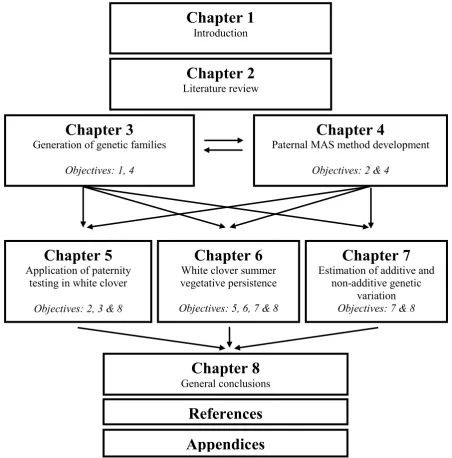
The structure of the thesis is depicted in Figure 1.1. Five experimental chapters are presented to address the objectives outlined above, commencing with the generation of genetic families (Chapter 3) for the subsequent field experiments in chapters 5, 6 and 7. Implications of each experimental chapter are addressed within, as they are kept as complete entities for individual publication. Key findings are pooled together in Chapter 8 and their overall implications to breeding strategies in white clover are discussed.
Figure 1.1 Schematic diagram of the thesis structure; depicts the relationships between thesis chapters.
Chapter 2
Literature review
Chapter 5
Application of paternity testing in white clover
Objectives: 2, 3 & 8
Chapter 8
General conclusions
References
Appendices
Chapter 3
Generation of genetic families
Objectives: 1, 4
Chapter 6
White clover summer vegetative persistence
Objectives: 5, 6, 7 & 8
Chapter 7
Estimation of additive and non-additive genetic
variation
Objectives: 7 & 8
Chapter 4
Paternal MAS method development
Objectives: 2 & 4
Chapter 1
6
Chapter 2
Literature review
2.1 Origin and systematics of white clover
White clover (Trifolium repens L.) is an allotetraploid (2n=4x=32) herbaceous perennial legume with a 1C genome size of 956 Mbp (Atwood and Hill, 1940; Williams et al., 1982a). Chromosome pairing is bivalent and inheritance is disomic (Atwood and Hill, 1940; Williams et al., 1982a). Allopolyploidy in this species is thought to have arisen from the hybridisation of two ancestral diploid species and subsequent chromosome doubling (Casey et al., 2010). Molecular phylogeny analysis has identified Trifolium occidentale and Trifolium pallescens
as probable diploid progenitors (Ellison et al., 2006).
Sexual reproduction in white clover is regulated by a highly polymorphic, gametophytic self-incompatibility system (Casey et al., 2010). The majority of individuals are self-incompatible although a small proportion of the population have been shown to be self-compatible
(Atwood, 1940; Atwood, 1941; Atwood, 1942).
The Mediterranean is considered to be the geographical centre of origin for white clover where it covers all of Europe, parts of North Africa and western Asia (Williams et al., 2010). Predominant outbreeding and disomic inheritance has resulted in white clover populations that are comprised of a heterogeneous mixture of highly heterozygous individuals. A high degree of genetic variance has been observed within and between populations in these environments (Williams et al., 2010).
2.2 White clover in New Zealand
2.2.1 Agricultural importance
7 2.2.1.1 Nitrogen fixation
Nitrogen fixation rates in New Zealand range from 17 kg N/ha/year in unimproved hill pastures to 380 kg N/ha/year in intensively managed pasture (Caradus et al., 1996). Potential nitrogen fixation rates have been illustrated to be much higher (Crush, 1987). From an economic perspective, Caradus et al.(1996) estimated the value of fixed nitrogen from white clover to be worth $1.49 billion to New Zealand’s economy.
2.2.1.2 Nutritive value
White clover provides the best quality component of grazed pastures because of its high nutritive and feeding value (Caradus et al., 1996). Compared to perennial ryegrass, the other significant species in most intensive farming swards, white clover has higher concentrations of crude protein (or total N) and readily fermentable carbohydrates, but lower concentrations of lipids, water soluble carbohydrates, lignin, cellulose and fibre (Caradus et al., 1996). Live weight gains of livestock fed white clover are consistently higher than for those fed perennial ryegrass (Ulyatt, 1981). Gross milk yield and its associated components are higher from cows fed white clover than perennial ryegrass (Thomson et al., 1985). Productive advantages can be attributed to both higher voluntary intakes and higher gross efficiency (gain per unit of intake) (Caradus et al., 1996). Cosgrove (2005) simulated that milk solids/ha continue to increase until 60% of grazing swards are comprised of white clover. Current white clover percentages in dairying pastures are less than a third of this figure in New Zealand (Harris et al., 1998), with levels even lower in sheep and beef pastures.
2.2.1.3 Morphology
The stoloniferous habit and phenotypic plasticity of white clover make it an ideal companion species in most grass swards (Woodfield and Caradus, 1994). Its ability to withstand severe defoliation can be largely mitigated by clover leaf type according to the class of stock. Within cultivars a high degree of phenotypic plasticity ensures plants can adapt to environmental changes (Caradus et al., 1993).
Leaf size is highly correlated to the size of the stolons, stolon number and plant habit (Abberton and Marshall, 2010). Small leaf cultivars are considered suitable for continuous hard sheep grazing, medium types for use under rotational grazing and large or very large types for lax cattle grazing or conservation (Abberton and Marshall, 2005).
8
have higher stolon densities and prostrate habits making them less vulnerable to frequent grazing. In contrast, large leaf types tend to be more erect with fewer larger stolons which are susceptible to continuous defoliation (Woodfield and Caradus, 1994). Grazing tolerance, plant persistence and other stress tolerance attributes are by in large tied to the effectiveness of the stolon network, which functions as a storage reserve and anchorage structure to the soil surface (Abberton and Marshall, 2010).
2.2.1.4 Complementary growth
The growth pattern of white clover complements most temperate grasses. Within New Zealand pastoral systems, white clover complements that of perennial ryegrass, as maximum growth occurs in late spring through to summer (Harris, 1987). White clover has a wider and higher optimum temperature for growth (24oC; 18-30oC) than ryegrass (20oC; 18-21oC) (Brock, 2006) which helps it to sustain herbage production after the spring peak in ryegrass. It also maintains high quality forage over summer-autumn when perennial ryegrass losses quality after flowering in the spring (Thomson, 1984).
2.2.2 Limitations of white clover
In regions on the east coast of New Zealand such as Canterbury, where the central mountain range combined with westerly air flows create a rain shadow with <800 mm of annual rainfall (Brown and Green, 2003), white clover herbage yield and persistence is often low and
variable between succeeding years (Ayres et al., 1996; Knowles et al., 2003). The low annual rainfall in these regions, combined with the exceeding summer evapotranspiration rates and variable alluvial outwash soils result in potential soil moisture deficits between 200-500mm (Salinger, 2003; Webb et al., 2000). These regions suffer from summer moisture deficits in the majority of years (Brown and Green, 2003) and poor plant survival is largely responsible for white clover herbage yield inconsistencies in these environments (Archer and Robinson, 1989).
9
Numerous field studies have shown a sharp decline in white clover persistence under water stress (Knowles et al., 2003). In many cases, this sharp decline coincides with the loss of primary tap roots when stolons become fully reliant on their adventitious roots. The limited rooting depth of white clover makes it sensitive to water deficits (Hart, 1987).
In dryland environments where annual rainfall is below 700 mm, white clover is unlikely to survive where other dryland species including lucerne (Medicago sativa) and subterranean clover (Trifolium subterraneum) have been shown to be comparatively superior (Mills and Moot, 2010). However, scope does exist for improved cultivars that can vegetatively persist in drought conditions and demonstrate improved recovery rates following rain (Knowles et al., 2003).
2.3 Morphology and persistence mechanisms of white clover
White clover development from seed has three distinct morphological phases (Brock et al., 1988; Brock et al., 2000; Thomas, 1987b; Westbrooks and Tesar, 1955):2.3.1 Morphological phase I
A rosette seedling phase lasting 1-3 months with minimal branching, no stem elongation and no nodal root formation.
2.3.2 Morphological phase II
A tap-rooted expansion phase lasting 1-2 years with rapid stolon elongation, extensive
branching and nodal root development. Internodes emerge from the axillary buds found in the axil of leaves on the orthotrophic primary stem of the seedling (Jahufer et al., 2013). Stolons (Figure 2.1) become the basic structural unit of the plant and are characterised by a number of internodes separated by nodes which form from growth at the apical bud (Thomas, 1987a). Each node bears a trifoliate leaf with an erect petiole, two root primordia, and either an axillary bud capable of growing into a lateral stolon (plants vegetative phase) or an
inflorescence (plants reproductive phase) (Thomas, 1987b). The number of lateral stolons on a plant increases with age, which in turn leads to the vegetative spread of the plant.
10
“Material removed due to copyright compliance”
Figure 2.1 Drawing of main stolon (MS) of white clover, showing axillary buds (AB), lateral branches (LB), and a lateral stolon (LS). S = stipule; Pe = petiole; RT = nodal root primordium; I = inflorescence; P = peduncle. Emerged leaves on the main stolon, and the nodes bearing them, are numbered 1 to 8 (Figure 1.1 by Thomas (1987a)).
2.3.3 Morphological phase III
A ‘mature’ clonal phase when taproots die and large plants fragment into small self-dependent daughter clones. Loss of the primary seedling taproot commences at 12 to 18 months and stolons become dependent on nodal roots to obtain both water and nutrients from the soil (Westbrooks and Tesar, 1955) .
2.3.4 Reproduction
11 2.3.4.1 Asexual reproduction
Under favourable seasonal conditions, asexual reproduction in white clover is driven by the continuous process of branching and extension of stolons at their apical ends to replace the older basal sections lost due to decay and death (Jahufer et al., 2013; Lane et al., 2000). Asexual reproduction is a feature of morphological phases II and III, where the fragmentation of large plants into smaller self-dependent daughter clones propagates original mother-plants. Grazing, plant nutrition and competition can be managed to improve the rate of stolon and nodal root formation, while moisture stress, disease and insect pests have detrimental effects on asexual reproduction (Woodfield and Caradus, 1996).
2.3.4.2 Sexual reproduction
Regeneration via seedling recruitment is an important survival strategy for white clover in unfavourable environments where reliable stolon survival is marginal (Lane et al., 2000). The regeneration of seedlings is dependent on adequate seed reserves in the soil from previous years.
Flowering is influenced by a number of factors including genotype, photoperiod, temperature, nutrition, grazing management and available soil moisture (Lane et al., 2000). Inflorescences are produced from axillary buds at nodes, each consisting of 20-150 florets. Inflorescence development is primarily influenced by day length (LDP; long day plant) in germplasm originating from high altitudes, whereas germplasm from low altitudes are more dependent on temperature (Lane et al., 2000; Thomas, 1987c).
White clover is an obligate outcrossing perennial due to its gametophytic self-incompatibility (Brewbaker, 1954), and requires cross pollination via insect mediated pollinators. The
presence of effective pollinators is essential for maximising seed yield (Lane et al., 2000). Honey bees (Apis mellifera L.) are the main pollinators of white clover, although for plant breeding purposes, breeders often use bumble bees (Bombus sp.)to facilitate pollination due to their ease of management in isolation cages (Williams, 1987).
2.3.5 Morphological features associated with water stress tolerance
Ayres (1996) proposed an ideotype for white clover cultivars in dryland environments. The attributes considered important for persistence included high nodal root frequency, tap
12
morphological characters including those key traits proposed by Ayres (1996) in dryland environments.
The development of a strong network of stolons seems to be a pre-requisite of persistence and has become the fundamental feature of white clover populations that are suitable for dryland environments. However, the negative correlation between stolon density and herbage yield complicates the concurrent improvement of both vegetative persistence and yield (Abberton and Marshall, 2010; Caradus and Williams, 1989; Jahufer et al., 1999). The basis of the correlation is unknown, but possible genetic causes include pleiotrophy or linkage. The latter can be improved through selecting recombinant genotypes, while the former is unlikely to be effected by conventional breeding (Jahufer et al., 1999).
2.3.6 Physiological features associated with water stress tolerance
Woodfield and Caradus (1987) summarised three main strategies for increasing white clover survival in drought prone areas. These included; i) drought avoidance, through re-seeding prior to the onset of moisture stress, ii) improved moisture conservation through reduced leaf size, stomatal closure and high cuticular resistance, and iii) improved moisture uptake, through a more extensive, deeper or denser root system, and an increased root to shoot ratio.
Various physiological studies have investigated strategy two (Barbour et al., 1996; Brink and Pederson, 1998; Inostroza and Acuna, 2010). Barbour (1996) reported increased water use efficiency (WUE) of white clover cultivars under increasing soil moisture deficit, but failed to find significant differences among populations within various stress levels. Their results suggest that low genetic variation for WUE exists among white clover cultivars. Similar results were obtained by Brink and Pederson (1998) when they evaluated the response of white clover cultivars to different water gradients in a mixed sward trial.
Inability to control water loss through stomatal closure and cuticular resistance has been previously reported in white clover (Hart, 1987). During dry conditions, white clover leaves rapidly wilt and die (Hart, 1987). Many other plant species reduce water loss by stomatal closure. Turner (1990a) suggested the reduced stomatal closure displayed by white clover under drought may indeed be a survival strategy whereby subsequent leaf dehydration and abscission reduces leaf area and plant transpiration.
13
clover for regeneration once water availability improves (Brink and Pederson, 1998; Knowles et al., 2003).
Contrary to both Brink and Pederson (1998) and Barbour et al. (1996), Inostroza and Acuna (2010) demonstrated significant physiological differences in the water status among white clover populations. Nine naturalised populations from southern Chile and two commercial cultivars expressed different levels of stomatal regulation, dry matter partition, transpiration rate, photosynthetic capacity and consequently WUE.
The accumulation of secondary metabolites may also influence the capacity of white clover to withstand moisture stress. Hofmann and Jahufer (2011) reported the association of
accumulated flavonoids with morphological types tolerant of stress. Further research by Ballizany et al. (2012b) supported previous findings where the increased induction of
quercetin glycosides accumulation in response to water deficit stress was related to retaining higher levels of shoot dry matter production. Ballizany et al. (2014) reported a weak negative correlation between shoot dry matter and quercetin glycoside levels, indicating that
combining high DM yield and high constitutive levels of quercetin glycosides for abiotic stress protection is possible.
2.4 Plant genetic resources
Traditionally novel material has been obtained by plant breeders through plant collection expeditions to geographical areas where germplasm with desired traits may be found
(Abberton and Marshall, 2010). In addition, hundreds of accessions with and without passport data are available throughout the world in various genebank collections.
Numerous attributes such as stolon number, stolon elongation, internode length, stolon thickness, plant spread, number of rooted nodes, number of nodes, tap root diameter, leaf width, plant habit, cyanogenesis, anthocyanin leaf markings, herbage yield and many other morphological and physiological attributes vary greatly among genotypes and populations (Annicchiarico and Piano, 1995; Caradus and Woodfield, 1990; Jahufer et al., 1995; Jahufer et al., 1997; Jahufer et al., 1999; Lee et al., 1993; Rowe and Brink, 1993; Woodfield and Caradus, 1990).
2.4.1 Germplasm associated with this thesis
The random mating population used in this thesis was developed at AgResearch, Grasslands, Palmerston North, as a breeding pool targeting broad adaptation. The pedigree of this
14
Grasslands Trophy (Ayres et al., 2007) and Grasslands Saracen, and also two ecotypes collected in the Waikato region of New Zealand.
Grasslands Tribute is a medium-large leaved white clover bred for tough drought tolerance and winter activity in Victoria, Australia (Woodfield et al., 2003). Its parentage includes elite genotypes from eleven half-sib families, half of which originated from a Syrian accession with the remainder from the cultivars Sustain and Crau, as well as Southern Europe germplasm in equal proportions.
Grasslands Trophy is a medium-large leaved cultivar which combines intermediate stolon density with intermediate stolon thickness, and shows high stolon survival and strong autumn regrowth following summer moisture stress (Ayres et al., 2007). Trophy’s parentage includes half-sib families from Portugal, Southern France, USA and the Mediterranean. It is considered suitable for temperate dryland environments with 850-1250 mm average annual rainfall.
Grasslands Saracen is yet to be formally recognised in the literature, but it has been referred to as synthetic GC 122 by Jahufer et al. (2009). Saracen is a sister line to Trophy. It is a
medium-large leaved cultivar bred from half-sib families which were derived from the best 10% of a worldwide accession breeding pool (140 world-wide accessions) after a period of 3 years of screening at Glen Innes and Armidale, NSW, Australia (Jahufer et al., 2009).
Jahufer et al. (2009) ranked all three commercial cultivars in the top performing group of a current commercial and experimental synthetics dryland trial in south-west Victoria, Australia.
2.5 Plant improvement through conventional breeding
2.5.1 Forage plant breeding methods
Plant breeding is the genetic improvement of plants through a process which is considered to be both a science and an art (Posselt, 2010). The former is a function of Mendel’s laws, and the latter is governed by the breeders eye, intuition and creativity (Posselt, 2010). Plant
breeding methods that can be used effectively to improve a species, are by in large determined by their mode of reproduction (Vogel and Pedersen, 1993). In forage species, given their relatively short period of domestication and outcrossing nature, most breeding methods have evolved from the breeding of field crops, particularly maize (Posselt, 2010).
15
performance of a population that is realised with each cycle of selection (Fehr, 1987). A cycle of selection includes the establishment of a random mating population, development and evaluation of genotypes, selection of elite genotypes, and synthesis of the selected genotypes as parents to form a new population for the next cycle of selection (Fehr, 1987). Variation in the methods used at each of these steps influence the duration of the selection cycle, so breeders often compare various methods on an annual basis to mitigate cycle length bias.
The rate of genetic gain among breeding methods and their implementation in various forage species is dependent on a number of factors. These factors include the heritability of the trait(s) of interest, the biology of the species, the length of the breeding method, the
correlation between spaced-plants and their performance in mixed species swards, as well as the available resources to the breeder. The basic equation used to interpret genetic gain, often presented in various forms and termed the breeders equation, is illustrated below;
√
where; = genetic gain or genetic advance, k = standardised selection differential, =
additive variation, c = parental control and = phenotypic variance of the parental
population.
The above equation shows that genetic gain can be improved by a number of factors, including; increasing the standardised selection differential (selection intensity), increasing the proportion of in the population, increasing the coefficient of utilised via increasing parental control or altering family structure, and finally by reducing non-genetic effects such as environmental variance which is pooled into the phenotypic variance (Bernardo, 2010).
2.5.2 Population improvement
16
Recurrent selection methods are typically used in the second phase of breeding which are designed to increase the frequency of desired alleles for quantitatively inherited traits, while maintaining genetic variability for continued genetic improvement (Hallauer et al., 2010a). Lonnquist (1952) defined recurrent selection as “a group of breeding procedures consisting of recurrent cycles of selection for outstanding genotypes with a specific purpose in a
heterozygous population and the subsequent recombination of the selected portion of the population”.
Recurrent selection within closed breeding populations (intra-population improvement) are focused towards increasing the frequency of favourable alleles within the gene pool itself (Hallauer et al., 2010a), whereas recurrent selection between populations (inter-population improvement) such as reciprocal recurrent selection, are directed at changing gene
frequencies of both populations in a complementary way so that a wide range of different types of gene action and interactions can be retained in the crossed population (Hallauer et al., 2010a). The former has been readily adopted in forage species, including white clover,
whereas the latter has had little commercial adoption, most probably due to the lack of identified heterotic groups in forage species to capture non-additive gene action.
Selection of individual genotypes as parents for the recurrent population can be evaluated according to their phenotype (phenotypic selection) or on the basis of their progeny performance (genotypic performance). The breeder’s choice between the two methods of evaluation is dependent on the trait of interest and the resources available for evaluation.
2.5.2.1 Phenotypic selection
Phenotypic selection methods are based on the performance of individual plants or on the performance of replicated clonal copies of the plant in either rows or replicates (Posselt, 2010). The phenotypes are typically evaluated using either a scored system, in which plants are denoted scores from 1-9 or 1-5 for traits of interest, or the traits are measured directly. The system allows notes to be accumulated for all individual plants, or in larger commercial breeding programmes unwanted plants can be eliminated in each round of inspection to reduce the amount of future scoring (Posselt, 2010). Various modifications to phenotypic selection are outlined below.
2.5.2.1.1 Mass selection
17
on a phenotypic basis only. Phenotypic variation among plants includes genetic variation among individuals (both additive and non-additive genetic variation) within the population, as well as all types of environmental variance within and across trial sites (Hallauer et al.,
2010a). The environmental effects act as a major limitation to the effectiveness of mass selection, as genotype × environment interactions cofound the genotypic value (Posselt, 2010). For traits with moderate to high heritabilities and insignificant genotype × environment interactions, mass selection has considerable advantages over other selection methods
including higher selection intensities, shorter breeding cycles, and a high co-efficient of additive variation (Falconer, 1961; Posselt, 2010).
√
where;
= genetic gain per cycle, k = selection intensity and parental control value
= variance; – additive, – dominance, – additive × environment, – dominance ×
environment, – within-plot, – environmental-within-plot, – plot-to-plot
2.5.2.1.2 Stratified mass selection
To help alleviate the environmental variance limitation alluded to in mass selection, Gardner (1961) proposed a stratified mass selection method where the use of a gridding system systematically partitions the field into sections. Each section becomes a separate unit, and the criterion for selection is the deviation of each individual phenotype from the mean phenotypic value of all plants within the same stratum (Hallauer et al., 2010a). The modified mass
selection method promotes differences among plants within sections to be more likely to be due to genetic differences rather than environmental effects alone (Hallauer et al., 2010a).
Notable examples of stratified mass selection in forage species have been published by Glenn Burton at Tifton, Georgia, who illustrated phenomenal gains in Pensacola bahiagrass
(Paspalum notatum Flugge var. saurae Parodi) (Burton, 1974; Burton, 1979; Burton, 1982;
Burton, 1983; Burton, 1992).
18
√
where;
= genetic gain per cycle, k = selection intensity and parental control value
= variance; – additive, – dominance, – additive × environment, – dominance ×
environment, – within-plot, – environmental-within-plot
2.5.2.2 Genotypic selection
Phenotypic or individual plant selection methods are useful when traits of interest have high heritabilities, are primarily influenced by additive genetic variation and have minimal
genotype × environment interactions. For low heritable traits (h2 < 0.20), visual differentiation
among individual plants can however become erratic and unreliable (Posselt, 2010).
Genotypic or otherwise referred to as family based selection is therefore useful when traits of interest have low heritabilities and are influenced by significant genotype × environment interactions.
The primary difference between phenotypic selection and family based selection is that family selection is based on some type of progeny test (Hallauer et al., 2010a). An important feature of family selection is that selection is based on family means, which are obtained from replicated trials, that are therefore less affected by large environmental variances than individual selections (Nguyen and Sleper, 1983). Family selection is typically conducted across a set of environments using family seed, so that genotype × environment interactions have a less pronounced effect (Hallauer et al., 2010a).
Within forage species, family selection is typically carried out using either half or full-sib families.
2.5.2.2.1 Half-sib families
Two derivatives of half-sib family selection methods include (i), half-sib family selection (HSF), whereby half-sib families are evaluated, followed by the recombination of plants from remnant seed from superior families, and (ii), half-sib progeny trialling (HSPT) where again half-sib families are evaluated, but the recombination of superior parents of the best families are used instead of remnant seed (Casler and Brummer, 2008; Fehr, 1987). HSPT is
19
recombination unit are not the same (i.e. parental control value increased from 1 to 2; for further explanation see parental control in section 2.5.3.1 below).
A third derivative of half-sib evaluation, known as among-and-within-half-sib-family selection (AWF-HS) is an extension of HSF, whereby breeders implement within family selection within the best performing families to make use of the remaining ¾ of the additive variation within half-sib families. AWF-HS is carried out in spaced-planted nurseries, so that phenotypes of individuals within families can be evaluated. Unfortunately, the within family selection component does not allow for the separation between genotypic and environmental variation, unless each progeny of each family is clonally replicated (Aastveit and Aastveit, 1990).
Half-sib families can be obtained via open pollination, polycross, topcross or diallel matings (Allard, 1960). However, methods intended to generate half-sib families for half-sib progeny trialling must be designed to disperse a similar array of tester gametes among all maternal parents, so that variation in progeny performance among the parents tested is primarily due to the genetic potential of the parents and not the genetic contribution of the pollen source (Fehr, 1987). According to selection theory, the covariance among non-inbred half-sib families is ¼ of the total additive variation ( (Fehr, 1987; Hallauer et al., 2010a).
HSF
√
AWF-HS
√
√
where;
= genetic gain per cycle, k = selection intensity and parental control value
= variance; – additive, – dominance, – additive × environment, – dominance ×
environment, – within-plot, – environmental-within-plot, – plot-to-plot
20
2.5.2.2.2 Full-sib families
Two derivatives of full-sib family selection include; i) full-sib family selection (FSF), where full-sib families are evaluated, followed by the recombination of remnant seed from superior families, and ii) among-and-within-full-sib-family selection (AWF-FS), where again full-sib families are evaluated, followed by the recombination of the best individuals within the best families.
Full-sib families are derived directly from bi-parental matings (paircrosssing). According to selection theory, the covariance among non-inbred full-sib families is ½ of the total additive variation ( and ¼ of the dominance variation ( (Fehr, 1987; Hallauer et al., 2010a). Therefore, when selecting on a family means basis, full-sib family selection (FSF) is twice as effective as half-sib family selection (Casler and Brummer, 2008). Similarly to half-sib family selection, selection within full-sib families (AWF-FS) makes use of the remaining additive variation ( ). A significant downfall of full-sib evaluation for intra-population improvement is the bias in family means if significant non-additive variation (dominance) is present in some families.
FSF
√
AWF-FS
√
√
where;
= genetic gain per cycle, k = selection intensity and parental control value
= variance; – additive, – dominance, – additive × environment, – dominance ×
environment, – within-plot, – environmental-within-plot, – plot-to-plot
21
2.5.2.2.3 Paternity aided half-sib family selection
Riday (2011) pioneered a novel concept to forage breeding that had only been previously utilised in tree breeding (Lambeth et al., 2001). The concept, which was demonstrated in red clover, extends the amount of information available to the breeder based on traditional half-sib family spaced-planted nurseries. The proposed concept utilises simple Mendelian inherited molecular markers, such as simple sequence repeat markers (SSR’s), to identify an
individual’s father at a given probability when paternal identity is unknown in maternal half-sib families (Gjertson et al., 2007; Riday, 2011). Utilising individual plant phenotypes, known maternity, and molecular marker-determined paternity, maternal and paternal breeding values are calculated, and selection on both parents is achieved (Riday, 2011). Essentially the
addition of paternity testing to traditional maternal half-sib family selection doubles the parental control value in the genetic gain formula and improves genetic gain twofold (i.e. breeders have control over both the maternal and paternal gametes for the recurrent population). Theoretically, combined maternal and molecular marker determined paternal selection is equally as effective as HSPT per cycle (Riday, 2011). However, in addition to HSPT, additional phenotypic selection within superior molecular marker determined full-sib families (hereafter referred to as among-half-sib-and-within molecular determined full-sib family selection [AWF-HS+MFS]) can be used to select parents for the recurrent population (see equation below); a process which usually adds an extra year to HSPT. Advantageously, parental plants do not have to be kept in mother nurseries for AWF-HS+MFS which can be problematic for annual species and species that cannot be clonally propagated in HSPT.
√
+
√
+
√
where:
= genetic gain per cycle
k = selection intensity; – maternal half-sib family, – paternal half-sib family, – within family
= variance; – additive, – dominance, – additive × environment, – dominance ×
environment, – within-plot, – environmental-within-plot, – plot-to-plot
r – number of reps, t – number of environments, n – number of plants per plot
2.5.3 Comparing breeding methods
22 2.5.3.1 Parental control
The parental control (c) factor determines the amount of additive variance that is captured in the recombination of selected individuals or families (Fehr, 1987) (Table 2.1). “Parental control in recurrent selection is the relationship between the plant or seed used for identifying superior genotypes (selection unit) and the plant or seed used for recombination
(recombination unit)” (Fehr, 1987). Parental control values range from 0.5 to 2, depending on the selection method and control of the parents for the recurrent population.
Parental control is set to c = 0.5 when the selection unit is the same as the recombination unit and only the female parent is selected (Fehr, 1987). This is typical for phenotypic recurrent selection when female plants are selected after pollination, and the maternal seed for the recurrent population has been pollinated by selected and unselected males in the population (i.e. control of one sex only) (Fehr, 1987).
Parental control is set to c = 1 when the selection unit is the same as the recombination unit and both parents are selected (i.e. control of both sexes) (Fehr, 1987). This is applicable to phenotypic recurrent selection when female parents are selected before pollination and moved to a separate isolation block for half-sib selection, when remnant half-sib seed is used for recombination, for full-sib family selection, and for selfed families (Fehr, 1987).
Parental control is set to c = 2 when the selection and recombination units are not the same (Fehr, 1987). This is only applicable to HSPT when clones of selected genotypes (parental unit) are used for recombination after a progeny test is carried out with their respective maternal half-sib seed.
Table 2.1 Methods of intrapopulation improvement (adapted from (Fehr, 1987; Posselt, 2010)
Method SU TU RU c
Mass Selection Plant Plant Population ½ 1 1 0 0
Mass Selection* Plant Plant Plant 1 1 1 0 0
HSF Fam Plot HSSeed 1 ¼ 0 ¾† 1†
HSPT Fam Plot HSParent 2 ¼ 0 ¾† 1†
AWF-HS Plant Plant HSPlant 1 ¼ 0 ¾ 1
AWF-HS+MFS Plant Plant HSPlant 1 ¼ + ¼ 0 ½ 1
FSF Fam Plot FSSeed 1 ½ ¼ ½† ¾†
AWF-FS Plant Plant FSPlant 1 ½ ¼ ½ ¾
SU – selection unit, TU – test/evaluation unit, RU – recombination unit, c – parental control, - genetic variability among individuals or families, - genetic variability within families,