HEAT TRANSFER ENHANCEMENT
USING LOW VOLUME
CONCENTRATIONS OF Fe
3
O
4
NANOFLUID IN CIRCULAR PIPE
BHRAMARA PANITAPUDepartment of Mechanical Engineering, JNTUH College of Engineering Hyderabad Hyderabad – 500085 INDIA
[email protected] www.jntuhceh.ac.in
KISHEN TADISINA K. REDDY Department of Mechanical Engineering JNTUH College of Engineering Hyderabad
Hyderabad – 500085 INDIA K. SHARATH REDDY
PG scholar, Department of Mechanical Engineering JNTUH College of Engineering Hyderabad
Hyderabad – 500085 INDIA
Abstract :
Nanofluids are emerging as one of the effective means of enhancing the heat transfer compared to the conventional heat transfer fluids due enhancement of thermophysical properties of base fluids due to addition of nanosized particles. Numerical experiments were conducted for heat transfer inside a circular pipe subjected to constant heat flux with water as base fluid. Heat transfer enhancement was studied by adding low volume concentrations, viz., 0.1 to 0.6 % of Fe3O4 magnetic nanoparticles of particle size 36 nm in water. The numerical
analysis of nanofluid was performed using the single phase approach for the Reynold Number of the flow ranging from 2500 – 22000. The results show that better enhancement was observed at higher Re and at higher volume fractions. The numerical results were compared with the experimental data available in the literature.
Keywords: Low volume concentration, Nanofluid, Heat transfer enhancement, circular pipe, Constant heat flux
1. Introduction
Energy efficiency of heating or cooling in an industrial process will cause a saving in energy, reduce process time, raise thermal rating and lengthen the working life of equipment. Altering the properties of the working fluid to achieve better heat transfer is one of the passive methods to improve energy efficiency. Nanofluids, nanoparticle - fluid suspensions, are a new class of heat transfer fluids. The properties of nano fluids can be engineered by dispersing nanometer-size solid particles in traditional heat transfer fluids by using different volume concentrations, different materials and different shapes.
Nanofluids are prepared by suspending nano sized particles (1-100nm) in conventional fluids and have higher thermal conductivity than the base fluids. Nanofluids exhibit better heat transfer characteristics compared to the normal solid liquid suspensions due to higher heat transfer between the particles and fluids with increased surface area of the particles and better dispersion stability with predominant Brownian motion.
2. Literature Review
Many different particle materials are used for nanofluid preparation, viz., Al
2O3, CuO, TiO2 SiC, TiC, Ag, Au,
Cu, and Fe nanoparticles are frequently used in nanofluid research. Carbon nanotubes are also utilized due to their extremely high thermal conductivity in the longitudinal (axial) direction.
Pak and Cho [1] investigated experimentally the turbulent friction and heat transfer behaviors of dispersed fluids with ultrafine metallic oxide particles, viz., γ-alumina (Al2O3) and titanium dioxide (TiO2) with mean diameters
constant average velocity, the convective heat transfer coefficient of the dispersed fluid was observed to be 12% smaller than that of pure water.
Xuan and Li [2] found that at fixed velocities, the heat transfer coefficient of nanofluids containing 2 % of copper nanoparticles by volume was improved by as much as 40% compared to that of water. Wen and Ding [3] were first to study the laminar entry flow of nanofluids in circular tubes. Their results showed a substantial increase in the heat transfer coefficient of water-based nanofluids containing γ-Al2O3 nanoparticles in the
entrance region and a longer entry length is needed for the nanofluids than that for water. They concluded that the enhancement of the convective heat transfer could not be solely attributed to the enhancement of the effective thermal conductivity. Particle migration is proposed to be a reason for the enhancement, which results a non-uniform distribution of thermal conductivity and viscosity field and reduces the thermal boundary layer thickness. Heriz et al., [4] investigated laminar flow convective heat transfer through circular tube with constant wall temperature boundary condition for nanofluids containing CuO and Al2O3 oxide nanoparticles in water as
base fluid. They concluded that heat transfer enhancement by nanofluid depends on several factors including increment of thermal conductivity, nanoparticles chaotic movements, fluctuations and interactions.
Hwang et al., [5] investigated convective heat transfer characteristics of water-based Al2O3 nanofluids flowing
through a circular tube of 1.812 mm inner diameter with the constant heat flux in fully developed laminar regime with various volume fractions ranging from 0.01% to 0.3%. They observed that the heat transfer coefficient of water-based Al2O3 nanofluids was increased by 8% at 0.3 % volume concentration under the fixed
Reynolds number compared with that of pure water and the enhancement of the heat transfer coefficient is larger than that of the effective thermal conductivity at the same volume concentration.
Fotukian and Esfahany [6] experimentally investigated the CuO/water nanofluid for convective heat transfer in turbulent regime inside a tube. They observed that heat transfer coefficients for nanofluids were greater than that of water and increasing the nanoparticle concentration showed a very weak effect on heat transfer coefficient. The heat transfer coefficient increased about 25% compared to pure water. They concluded that, increasing the concentration of nanoparticles does not show much effect on heat transfer enhancement in turbulent regime in the range of concentrations considered. Also, the ratio of convective heat transfer coefficient of nanofluid to that of pure water decreased with increasing Reynolds number. It was also reported that the wall temperature of the test tube decreased considerably when the nanofluid flowed in the tube.
Fotukian and Esfahany [7] also investigated turbulent convective heat transfer and pressure drop of γ Al2O3
/water nanofluid inside a circular tube. The volume fraction of nanoparticles in base fluid was less than 0.2%. Their results indicated that addition of small amounts of nanoparticles to the base fluid augmented heat transfer remarkably. Increasing the volume fraction of nanoparticles in the range studied did not show much effect on heat transfer enhancement. Their experimental measurements showed that pressure drop for the dilute nanofluid was much greater than that of the base fluid.
Wen and Ding [8] have conducted the experiments in the Reynolds number range of 700 and 2050 in plain tube with Al2O3 nanoparticles and found significant heat transfer enhancement. Heris et al. [10][27] under isothermal
wall boundary condition, observed that enhancement of heat transfer takes place with increase of Peclet number and volume concentration.
Maiga et al., [9] studied the hydrodynamic and thermal behavior of turbulent flow in a tube using Al2O3
nanoparticle suspension at various concentrations under the constant heat flux boundary condition. Assuming single-phase model, governing equations were solved by a numerical method of control volume. The classical
k-ε model was used for turbulence modeling and their study clearly showed that the inclusion of nanoparticles into the base fluids has produced a considerable augmentation of the heat transfer coefficient that clearly increases with an increase of the particle concentration. However, the presence of such particles has also induced drastic effects on the wall shear stress that increases appreciably with the particle loading. Among the mixtures studied, the ethylene glycol γ-Al2O3nanofluid was observed to offer a better heat transfer enhancement than water– γ
-Al2O3.
Perumal Kumar, Rajamohan Ganesan et al., [10] studied the hydrodynamic and thermal behavior of turbulent flow in a tube. They used Al2O3 nanoparticles in water of 0.02 to 6% volumetric concentration under the
is valid only for volume fractions less than 1%. So it is evident that nanofluids are useful only up till a volume fraction of 1%.
A closer look at all the experimental and numerical works reveals that most of the forced convective heat transfer studies in pipe flow have been performed with nanoparticles of Al2O3, CuO and TiO2. Both the previous
experimental values and the numerical predictions show that heat transfer enhancement increases as the volume fraction of the nanoparticles increases. Pressure drop increases dramatically for volume fraction higher than 1%. So for better thermal hydraulic effectiveness, it is important to operate at an optimum volume fraction.
3. CFD Analysis for Heat Transfer Enhancement
Earlier numerical investigations on forced convective heat transfer considered nanofluids as a homogeneous fluid and adopted a single phase approach to predict heat transfer enhancement [4,5]. More recently, the two phase approach has been used by some researchers, but the opinion about these two approaches is varied. Bianco et al [17] observed only a maximum of 11% difference between single and two phase results for the laminar regime. So they opined that single phase approach is good enough to test new nanofluids as it requires information about the particle and the base fluid with no reference to the mixture.
In the present analysis nanofluid is modeled as single phase fluid with the thermophysical properties calculated based on the models suggested in the literature.
3.1 Material Properties
Pure water is used as base working fluid and magnetic Fe3O4 is taken as nanoparticles. The density, heat
capacity and thermal conductivity of Fe3O4 are shown in Table 2 below. Table 2: Material Properties
S.no Substance Mean
Diameter
Density (kg/m3)
Thermal conductivity (W/m-k)
Specific heat (kJ/kg-k)
Kinematic Viscosity (m2/sec)
1 Fe3O4
nanoparticle
36 nm 5180 80.4 670 -
2 Water - 995.7 0.609 4.179 0.801
The thermophysical properties of Fe3O4 nanofluids (nf) such as viscosity (µ), density (ρ) and specific heat (C)
are estimated using the following empirical correlations developed by Pak and Cho [12][20] and for effective thermal conductivity (k) Wasp model is used. The particle size of the Fe3O4 nanoparticles is considered as 36
nm. The properties of nanofluid are given in Table 3 at 30oC temperature and 100 kPa pressure.
2
(1 39.11
533.9
)
nf w
(1)
3 4 3 4
3 4 3 4
2
2
2
2
Fe O w w Fe O
nf w
Fe O w w Fe O
k
k
k
k
k
k
k
k
k
k
(2)(1
)
nf p w
(3)
(1
)
nf p w
C
C
C
(4)
Table 3: Water base fluid properties with different concentration of Fe3O4 nanoparticles
Volume fraction (%) Density (kg/m3)
Specific heat (J/kg-k)
thermal
conductivity (w/m-k) Viscosity (kg/m-sec)
0.02 996.53 4312.16 0.609357 0.0008038
0.1 999.88 4844.82 0.610788 0.0008292
0.3 1008.25 6176.46 0.614374 0.0008949
3.1 Turbulence Model
The standard k −ε model is used to model single phase turbulent flow in circular pipe channel. Based on the Reynolds number, either viscous laminar model or standard k-ε model is used for laminar and turbulent flow respectively.
3.3 Governing Equations
Steady state simulations were carried out by solving mass, momentum and energy conservation equations for single phase fluid, which are expressed as:
(
)
(
)
r0
x r
u
u
u
t
X
r
r
(5)(
)
.(
. )
.( )
u
u u
g
P
t
(6)(
)
.( (
)
.(
eff.
)
E
u
E
P
K
T
t
(7)Where ρ is the density, u is the velocity, p is the pressure, τ is the viscous stress tensor, E is the energy and Keff
is the effective thermal conductivity.
Turbulent flows are characterized by fluctuating velocity fields. These fluctuations mix transported quantities such as momentum, energy, and species concentration, and cause the transported quantities to fluctuate as well. In this regard, time-averaged, ensemble-averaged instantaneous (exact) governing equations are used in a modified set of equations that are computationally less expensive to solve. However, the modified equations contain additional unknown variables, and turbulence models are needed to determine these variables in terms of known quantities.
Several turbulence models such as k- ε, k-ω, etc are available for carrying out simulation. Among these models k- ε model is widely used because of its reasonable accuracy for a wide range of turbulent condition. The standard k −ε model is used to model single phase turbulent flow in circular pipe channel. The turbulence kinetic energy, k, and its rate of dissipation, ε, are obtained solving the following transport equations:
(
)
(
)
[(
t)
i k b m k
i i k j
k
k
ku
G
G
Y
S
t
X
X
X
(8) and 21 3 2
(
)
(
)
[(
t)
(
)
i k b
i j j
u
C
G
C G
C
S
t
x
x
x
k
k
(9)In these equations, Gkrepresents the generation of turbulence kinetic energy due to the mean velocity gradients.
Gb is the generation of turbulence kinetic energy due to buoyancy. YM represents the contribution of the
fluctuating dilatation incompressible turbulence to the overall dissipation rate. C1ε. C2ε and C3ε are constants. k and ε are the turbulent Prandtl numbers for k and ε respectively. Skand Se are user-defined source terms. 3.4 Boundary Conditions
A no slip boundary condition was assigned for the non-porous wall surfaces. A constant heat flux of 13369 W/m2 is applied on the channel wall. A uniform velocity of 1.5 m/s is assigned at the channel inlet. At the exit, pressure was specified.
4. Solver Controls
5. Data Analysis
5.1 Validation of Numerical Results
Numerical results are made credible by comparing the results of water with the data from correlations available in the literature. Nusselt number for the base fluid in the turbulent regime is compared with that of Gnielinski’s correlation (Fig. 1). Similarly, Blasius correlation was used for friction factor comparison in the turbulent regime (Fig. 2). The experimental results of Sundar and Sharma [16] were also used for comparison. It can be seen from Figure 1 that Numerical Nusselt number is in very good agreement with the correlation values. Friction factor comparison is in the acceptable limit, though not as good as the heat transfer coefficient comparison. This shows that the numerical model is validated. Further analysis is carried out with the nanofluid for different volume concentration and compared with that of water for the representation of heat transfer enhancement.
Figure 1: Comparison of Nusselt number of water with Gnielinski’s Correlation and the experimental values of Sundar and Sharma [16]
Figure 2: Comparison of friction factor of water with Blasius correlation and the experimental values of Sundar and Sharma [16]
5.2 RESULTS FOR Fe3O4 NANOFLUID
Based on the validation of numerical model, simulations are performed with Fe3O4 nanofluid for volume
Figure 3: Effect of volume fraction of Fe3O4 nanofluid on Nusselt Number
The above plot shows, with the change in volume concentration of nanofluids the Reynolds number gets increased progressively. The increase in volume concentration also increases the Nusselt number. The focal point of investigation was to evaluate the effect of particle volume concentration on convective heat transfer characteristics in the developed region of the tube flow containing water-Fe3O4 nanofluid. It was observed that
0.6% of nanofluids showed highest heat transfer characteristics than that of the base fluid (water).The average heat transfer coefficient and Nusselt number increased by increasing the particle concentration and flow rate. The enhancement of heat transfer coefficient in a plain tube with 0.02% volume concentration of Fe3O4
nanofluid is 4.41% and 6.164% , with 0.1% volume concentration of Fe3O4 nanofluid is 13.04% and 16.64%,
with 0.3% volume concentration of Fe3O4 nanofluid is 20.01% and 28.272% and with .6% volume concentration
of Fe3O4 nanofluid is 28.57% and 43.51%for Reynolds number of 2500 and 22,000, respectively compared to
water.
5.2.1 Heat transfer enhancement
Figure 4 shows that the enhancement is better in the turbulent region compared to that in the laminar region for all volume fractions considered in the analysis, excepting the case of 0.02% volume concentration. On an average, enhancement of 6% from the base fluid is observed for a low volume fraction of 0.02% and a maximum of 50% of enhancement is observed for a volume fraction of 0.6% in the turbulent region. For the laminar and transition flows a maximum enhancement of 34% is observed for a volume fraction of 0.6%. For low volume fractions upto 0.1%, an enhancement of less than 20% is observed.
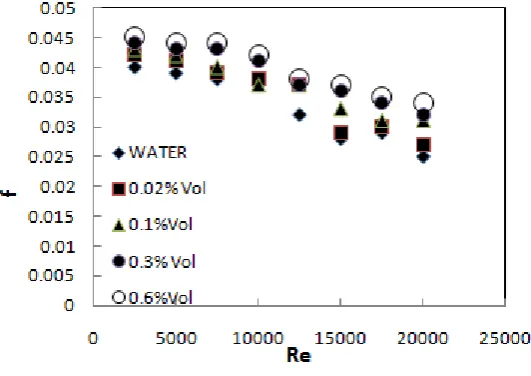
5.3 Reynolds Number Vs friction Factor graph
Figure 5. Variation of Friction Factor with Reynolds Number
The percentage enhancement of friction factor in a plain tube with 0.02% volume concentration of Fe3O4
nanofluid when compared to water is 5% and 6% for Reynolds number of 2500 and 22,000 respectively. The percentage enhancement of friction factor in a plain tube with 0.1% volume concentration of Fe3O4 nanofluid
when compared to water is 7.5% and 22%, with 0.3% volume concentration of Fe3O4 nanofluid is 10% and 24%
and with 0.6% volume concentration of Fe3O4 nanofluid, it is 12.5% and 28% for Reynolds number of 2500 and
22,000 respectively.
6. Conclusions
In this work, a steady state computational fluid dynamics (CFD) model is used for studying the hydrodynamic and thermal behavior of circular pipe with pure water and its nanofluids (Fe3O4) as working fluids. The
following are inferences from this study.
The heat transfer enhancement is observed to be better in the turbulent region compared to that in the laminar region for all volume fractions considered in the analysis.
For the laminar and transition flows a maximum enhancement of 34% is observed for a volume fraction of 0.6%. For low volume fractions upto 0.1%, an enhancement of less than 10% is observed.
The heat transfer enhancement is observed to be very less (less than 10%) or rather ineffective for low volume concentrations upto 0.1% of Fe3O4 nanofluid.
As the concentration of nanoparticle increases Nusselt number also increases with the maximum enhancement of 50% at 0.6% volume concentration of nanofluid
The enhancement factor is increased with increase of the Reynolds number, with a maximum enhancement factor of 50% is observed at a Reynolds number of 22000 at 0.6%
The friction factor is increased with the increase of volume concentration but it is observed that the friction factor enhancement is less compared to the enhancement to the heat transfer for volume fraction considered in the analysis.
7. References
[1] Pak B.C. and Cho Y.I. (1998) Hydrodynamic and heat transfer study of dispersed fluids with submicron metallic oxide particles, Experimental Heat transfer, 11, 150-170.
[2] Y. Xuan, Q. Li, Investigation on convective heat transfer and flow features of nanofluids, J. Heat Transfer 125 (2003) 151–155 [3] D. Wen, Y. Ding, Experimental investigation into convective heat transfer of nanofluid at the entrance region under laminar flow
conditions, Int. J. Heat Mass Transfer 47 (24) (2004) 5181–5188.
[4] S.Z. Heris, M.N. Esfahany, S.Gh. Etemad, Experimental investigation of convective heat transfer of Al2O3/water nanofluid in circular tube, Int. J. Heat Fluid Flow 28 (2007) 203–210.
[5] K.S.Hwang, S.K.Jang, S.U.S.Chio, Flow and convective heat transfer characteristics of water-based Al2O3 nanofluids in fully developed laminar flow regime, International Journal of Heat and Mass Transfer, 52 (2009) 193-199.
[6] S.M. Fotukian, Esfahany, Experimental study on turbulent convective heat transfer and pressure drop characteristics of CuO/ dilute water nanofluid inside a circular tube, Int. Commun. Heat Mass Transfer 37 (2010a) 214-219.
[7] S.M. Fotukian, Esfahany, Experimental investigation of turbulent convective heat transfer of dilute γ-Al2O3/water nanofluid inside a
[8] D. Wen, Y. Ding, Experimental investigation into convective heat transfer of nanofluid at the entrance region under laminar flow conditions, Int. J. Heat Mass Transfer 47 (24) (2004) 5181–5188.
[9] S. E. B. Maiga, C. T. Nguyen, N. Galanis, G. Roy, T. Maré, M. Coqueux, turbulent flow heat transfer enhancement in a tube using Al2O3 nanoparticle suspension, Int. J. Numerical Methods Heat Fluid Flow, 16 (2006) 275292 .
[10] Perumal Kumar, Rajamohan Ganesan, A CFD Study of Turbulent Convective Heat Transfer Enhancement in Circular Pipe flow,
World Academy of Science, Engineering & Technology;2012, Issue 68, p853, August 2012
[11] K.V. Sharma, L.S. Sundar, P.K. Sarma, Estimation of heat transfer coefficient and friction factor in the transition flow with low volume concentration of Al2O3 nanofluid flowing in a circular tube and with twisted tape insert, Int. Commun. Heat Mass Transfer 36 (2009) 503–507.

![Figure 1: Comparison of Nusselt number of water with Gnielinski’s Correlation and the experimental values of Sundar and Sharma [16]](https://thumb-us.123doks.com/thumbv2/123dok_us/9668420.1494735/5.595.187.407.452.632/figure-comparison-nusselt-gnielinski-correlation-experimental-sundar-sharma.webp)