INTRODUCING THE OTAM: EXPLORING USERS’ PERCEPTIONS OF THEIR
ON-GOING INTERACTION WITH ADOPTED TECHNOLOGIES
Shirlee-ann Knight
Edith Cowan UniversityJanice M. Burn
Edith Cowan UniversityABSTRACT
A common criticism directed at Davis’ (1986; 1989) Technology Acceptance Model relates to its failure to adequately frame the “experienced” user’s ongoing adoption and exploitation of information technologies. Given the pervasive nature of technology into individual users’ ongoing, everyday communication and information interactions, along with the “new adopter” becoming an increasingly rare entity, the TAM is in danger of becoming a somewhat obsolete framework for investigating user-technology interaction. Presented is critical analysis of the development and current state of the TAM, followed by a proposed addition to the existing Perceived Usefulness (PU) and Perceived Ease of Use (PEoU) TAM constructs. The paper contends that the inclusion of a third broad construct, Perception of Interaction (PoI) allows researchers to develop an investigative framework which facilitates an exploration of users’ ongoing and changing perceptions of the such things as the predictability of their technology interaction processes. The paper represents one the few inductive TAM investigations.
INTRODUCTION
Since its first introduction to Information Systems (IS) research, the Technology Acceptance Model (TAM) (Davis, 1986; 1989; Davis et al., 1989) has been explored in literally thousands [1] of research papers. Based largely on Ajzen & Fishbein’s (1980) Theory of Reasoned Action (TRA) – a social psychology model concerned with the determinants of consciously intended behaviours – the TAM postulates that two user perceptions, namely; Perceived Usefulness (PU) and Perceived Ease of Use (PEoU); shape users’ intended behaviours towards their adoption of specific technologies.
factors for user technology adoption, particularly in relation to the continued, or on-going, adoption of technologies.
It is in the context of this growing disquiet regarding the adequacy of the TAM constructs (Bagozzi, 2007; Benbasat & Barki, 2007; Straub & Burton-Jones, 2007) that the authors set out to;
1. Theoretically examine the current constructs of the TAM, in order to determine whether they are able to examine users’ ongoing adoption of technology;
2. Develop an inductive analysis of a TAM driven survey, designed to investigate a technologically experienced user-group’s attitudes and perceptions of Web-based search engine technology.
The paper discusses the theoretical inclusion of a third major construct – Perception of Interaction (PoI) – to the existing TAM, designed to measure users’ various, and evolving, perceptions of the predictability of their ongoing interactions with their adopted technologies. The evolution of the PoI construct’s inclusion into the TAM is discussed in the context of the design and analysis of user-data associated with the research project “User Perceptions of Information Quality in World Wide Web Information Retrieval Behaviour” (Knight, 2008).
THE TAM: A HISTORICAL SUMMARY (LITERATURE REVIEW)
The beginnings of the TAM
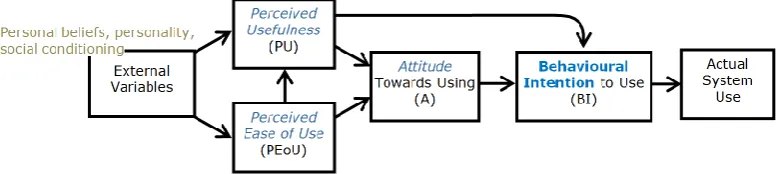
The main supposition of Davis’ (1986, 1989) model, was that PU & PEoU were the primary influencing variables in individual users’ attitudes and therefore intention to engage technologies. Davis et al., (1989) further stated that PEoU indirectly influenced Behavioural Intent (BI) through its effect on PU. Attitude – as a construct – was, by and large, bi-passed, assumed to be “positive” (i.e.; not variable-driven) in that users intention to engage technology at that time, was largely volitional.
Figure 1: Technology Acceptance Model (TAM) Davis et al 1989
Extending the TAM
Constructs for Mandated Technologies
Taylor & Todd (1995) reintroduced the TRA’s subjective norm (SN) construct to the TAM’s PU and PEoU in the context of the increasingly mandated technology-use imposed on users by business and organisations through the 1990s. The ‘early adopters’ of Davis’ original TAM, who did not need the added social influence of colleagues and other professionals had now been replaced by a typical user who felt somewhat pressured to adopt technologies. Taylor & Todd added the construct of Perceived Behavioural Control (PBC) as a means of quantifying users’ previous experiences with technologies, which by replacement, devalued the attitude construct in the TAM paradigm.
Constructs for the World Wide Web
By the time Lederer et al. (1998), Agarwal & Jayesh (1999) and Teo et al. (1999) published their TAM variations, the World Wide Web had become an established information systems environment. Once again, users were seen as having a greater degree of choice in the how, why and when of technology adoption, and the principles of TAM were found to apply relatively well to the prediction of Web-technology use. With the increasing variables between typical user characteristics however, what Davis (1989) had termed “external variables” in the original TAM began to be explored with greater vigour. Individual Differences (IDV) in users (Agarwal & Jayesh, 1999), and task variables (Lederer et al., 1998) were investigated in conjunction with TAM to examine their relationship with the PU and PEoU constructs. Teo et al. (1999) proposed a new construct, Perceived Enjoyment (PE) to investigate the ‘entertainment’ attributes of the World Wide Web.
The various extensions of the TAM, including Dishaw & Strong’s (1998) integrated TAM/TFF (Task Technology Fit) model, led to Venkatesh and Davis’ publication of TAM II (2000). This was an attempt by the authors to address the issues raised by multiple researchers during the 1990s. Seen by its authors’ as a definitive paper, Venkatesh and Davis (2000) contended that many of the additional constructs introduced to the TAM, including constructs like perceived enjoyment could easily be classified within the PU or PEoU constructs. They did, however, reinforce the inclusion of subject norm (SN) elements to explain systems usage in mandated contexts.
Despite the TAM II paper, the meteoric growth of Web usage since the late 1990s however, continued to facilitate the stream of papers perpetually adding constructs to the TAM, including;
Moon & Kim’s (2001) Perceived Playfulness (PPlay)
Chau’s (2001) Computer Attitudes (CA) – introduced specifically to test the role of prior computer experience in technology adoption; and
Liaw & Huang’s (2003) Individual Differences (IDV) and System Quality (SQ) – introduced to investigate the growing divergence in quality standards of computer technologies available on the Web.
Generally speaking, these construct additions were seen as “extensions” to the TAM model, rather than something which would fundamentally evolve the model (Straub & Burton-Jones, 2007).
Considering User Task Differences
information strategies the next time the user wishes to perform information retrieval. Although not demonstrated in Shih’s model explicitly, the model at least began to imply an iterative, cyclical process to user adoption and use of technologies. This is because successful Web searching is a strategy related task, that often requires the searcher to improvise based on the search results obtained (Quinn, 2003). Part of that improvisation is the natural flow of thoughts associated with a searcher’s own self-perceptions of the effectiveness of their strategies. This is a highly cognitive process, involving subjective variables such as; human memory (Fugmann, 1973; Cox, 1999; Quinn, 2003; Macpherson, 2004; Xu, 2007); motivation (Bilal & Kirby, 2002; Ford, 2004); attention (Vakkari,1999; Woodroof & Burg, 2003; Benoît, 2004; Anderson, 2005); concentration (Spink, 2004; Kuhlthau, 2005); anxiety (Yee, 2004); and self-efficacy (Quinn, 2003; Yee, 2004). As an efficacy related process, Web search is also easily compromised by feelings of self-doubt or negative perceptions regarding the system or results of a search (Quinn, 2003). Web search, as a task then, provided an opportunity to explore users perception and impact of interactive components of technology use. Unfortunately, this aspect of user/technology interaction was never explicitly studied in the seminal TAM papers of this period.
Considering User Individual Differences
The proliferation of home-users with access to the Web, introduced the processes of electronic informational retrieval to a population of end-users who have had little to no formal training in the use of such technologies (Wang, Berry & Yang, 2003). This is reflected in the, at times, seemingly ineffectual use of Internet search engines, despite clear help systems accompanying most search engines (Barnett, 1999). The constantly returning search engine audience, regardless of the success or non-success of user/search-engine engagement, suggests that user perceptions regarding what Shih called perceived performance, is tempered by users’ own self-perceptions of their information retrieval effectiveness. In regards to the task of Web-based IR, it would appear users are prone to attributing perceived performance as much to their own information behaviour, as to the perceived effectiveness of the search engine system (Knight, 2008).
The full effects of highly individual characteristics such as anxiety and self-efficacy on the PU and PEoU constructs of the TAM are only now beginning to be discussed within the TAM literature, particularly in relation to TAM and the World Wide Web. These are the “external variables” alluded to by Davis (1989) in the original versions of the TAM.
Considering Context
McFarland & Hamilton, (2006) contend that any reasonable investigation using the TAM should acknowledge the context specificity of the case in question, by modeling the external variables present. PU and PEoU were still seen as central to the TAM, but computer-efficacy (CE) and systems usage (SU) were included as constructs that are mediated by the various external variables previously introduced to the TAM model. There was still no explicit indication of any cyclical or feedback mechanisms in the model, which the authors’ contend remained an inherent weakness of the TAM model. Burton-Jones & Hubona (2006) also advocate the mapping of individual differences within a user-group in order to establish their impact on the TAM’s PU and PEoU constructs. The complexity of the ‘usage’ construct, i.e., technology usage, was described in terms of both IS-Usage (volume) and IS-Usage (frequency).
THE PROBLEM IS…
“the original TAM has outlived its usefulness” (Benbasat & Barki, 2007)
The extending and flexing of the TAM paradigm required to include the various individual differences of users served to highlight some of the short-falls of the model, particularly in relation to the TAM’s heavy weighting towards the new use and adoption of information technologies. It was found that the model could not fully address users’ learned or habitual behaviours. Subsequent computer-use research has indicated a strong causative relationship between such user attributes as habit, with technology usage (Verplanken, et al., 1998; Gefen, 2003; Limayem, Hirt & Cheung, 2003). This is problematic for the TAM, since habit is a condition said to bi-pass Behavioural Intention (BI), a central construct of the original linear TAM paradigm. The implication of this, is that PU and PEoU may fail to capture the true complexity of the user/system interaction taking place.
Without a strong body of literature investigating such phenomena as; (1) how users develop PU and PEoU; (2) how PU and PEoU impact behaviour beyond influencing BI; (3) how on-going BI or behavioural outcomes might impact (in a type of feedback loop) PU and PEoU; or (4) how PU and PEoU might change and evolve with on-going systems usage; two decades of TAM investigations have remained somewhat two-dimensional and, by and large, simply served to reiterate initial findings of the model; i.e., the importance of PU (Benbasat & Barki, 2007).
Some IS researchers, such as Benbasat & Barki (2007) have recently advocated abandoning TAM related research, returning instead to the roots of the TAM, the TRA (Ajzen & Fishbein, 1980) and (later) Theory of Planned Behaviour (TPB) (Ajzen, 1991); in an effort to better understand user engagement of technologies. The problem with such an approach is that both the TRA and TPB (along with the TAM) fall short of providing a framework to investigate users on-going and self-regulatory behaviours involved in their decision making processes (Bagozzi, 2007). Moreover, the pre-supposed link between each of the models’ salient belief constructs and user BI, remains central, and unquestioned, within each model. The result is three models that are unable to account for salient constructs that may bi-pass user BI.
It is the authors’ contention that human behaviour is far more complex than a linear, causal relationship between users’ salient beliefs, (which) influence behavioural intention, (which) equals behaviour. This linear-relationship approach to much IS-based research into user engagement with technologies does not lend itself to understanding the complex relationships between;
1. User beliefs and behaviour intentions;
2. Behaviour intentions and actual behaviour – particularly when intention does not lead to expectant behaviours;
3. Behaviour outcomes and evolving user beliefs;
4. Behaviours that bi-pass intentions; or
5. Behaviours that occur outside of user beliefs and/or intentions
Information System adaptations of both the TRA and TPB, like the TAM, adhere to what the authors consider is a flawed paradigm, which fails to provide a framework for investigating;
1. Non-intended (or unconscious) behaviours;
2. How previous behaviours might cause habitual behaviour;
3. How habitual behaviours might supersede salient beliefs; and
In this context, the authors propose a shift in the TAM paradigm, which will provide a more useful research framework with which to investigate the relationships between user beliefs and their decision making processes in on-going technology usage.
ADJUSTING THE PARADIGM: INTRODUCING THE OTAM
Straub & Burton-Jones (2007) describe the current state of TAM related research as a “logjam” and advocate the need to examine the constructs of the TAM more closely in order to improve the conceptual understanding of the major constructs in the model. This view is echoed by Benbasat & Barki (2007) who assert the restrictive nature of the TAM’s PU and PEoU constructs provide no mechanism for the inclusion of other user perceptions or salient beliefs. The result has been almost two decades of self-justified “extensions” of the TAM whenever researchers propose the inclusion of additional or alternative user belief constructs.
While some authors have proposed a complete shift away from the TAM (Benbasat & Barki, 2007; Bagozzi, 2007), it is the authors’ contention that PU and PEoU, if examined conceptually, are still able to provide a useful tool in examining user perceptions of the technologies with which they engage. To that end, the remainder of this paper discusses an inductive analysis of the TAM results of eighty users, who regularly engage Web-based search engines in the retrieval of high-quality information. The process of data analysis will be presented with respect to the emergence of the “OTAM” (On-going Technology Acceptance Model) as representing a more useful framework by which to investigate users’ on-going adoption of Web IR technologies.
THE RESEARCH: METHODOLOGY & RESEARCH FRAMEWORK
The Research Project
The goal of the research was to investigate users’ perceptions of Information Quality (IQ) in the context of their World Wide Web Information Search Behaviours (ISB). Of particular interest, was the sub-set of user behaviours typically associated with user search-engine interaction.
A total of four surveys were administered to a group of 100 academics from around the world over a period of approximately six months. Eighty participants completed all four surveys in the following areas:
1. Demographic – largely about academic role, discipline, and experience;
2. TAM-based – perceptions of: (a) Web search engines; and (b) Web search engine information retrieval;
3. Web-based Information Seeking Behaviours (ISB) and Information Retrieval (IR) strategies and outcomes;
4. Perceptions and value judgements in relation to the Information Quality (IQ) of the information participants encountered during IR from the WWW
Only the user data of the eighty participants who completed all surveys was used in the study. This paper covers specifically the user data from the TAM surveys.
Methodology: Inductive analysis of TAM Constructs
total of 126 questions asked of each participant. Twenty four of those questions related directly to TAM constructs, the results of which were inductively analysed in the context of a number of theoretically constructed “group-cases” developed largely from users’ non-TAM question results, including constructs such as gender; information task; cognitive expectancy; user-role; and self-efficacy, to name a few. Importantly, as part of an inductive approach to data analysis, these group-cases were not considered as mere “partitions” of the survey data. Each group-case was, in fact, chosen and analysed carefully according to existent theory of specific phenomena, in an effort to develop a rich picture of the user results. The inter-disciplinary research model proposed by Wilson (1997), and adopted as a framework for the current research, implores researchers to properly investigate the theory behind any driving constructs used to partition user data. Accordingly, this behoves the researcher to examine partitioned data more thoroughly, recognising that each cluster of data is not only an imposed construction, but part of a potentially rich data-set that provides multiple contexts from which to investigate the complexities of human/computer interaction (HCI). Essentially, this places the research analysis into an inductive, even interpretative, epistemology.
Although still numbering in the very small minority, qualitative analysis is not completely foreign to TAM studies, with researchers – particularly of late – taking this approach (Gerrard, Cunningham & Devlin, 2006; Lin, 2006) in an effort to address the large number of TAM related studies that have merely served to replicate previous studies (Lee et al., 2003; Benbasat & Barki, 2007) without producing anything significantly new (Bagozzi, 2007).
The problem with TAM, as an investigative framework, is that it has become a victim of its own success. So narrow in its methodological variance as to become its own paradigm (Straub & Burton-Jones, 2007) with few researchers venturing to investigate its constructs using different research approaches (Sharma, Yetton & Crawford, 2004). Unfortunately, the result is a model shallow in its ability to actually explore what PU and PEoU effectively mean (Bagozzi, 2007). Moreover, when the same methodology is applied to users’ complex individual behavioural differences within the context of a TAM study, nothing of any depth can be discovered or added to the model.
Bagozzi (2007) contends that almost “no research has deepened TAM in the sense of explaining PU and PEoU” (p244), going as far as to call the current extensions of the TAM as “conceptually impoverished”. The authors agree unequivocally with Bagozzi, that a significant reason for this famine in deeper understanding of the driving constructs of the TAM could well be the dearth of research approaches designed to investigate the “why” of the interaction aspects of the TAM.
The current research therefore does not take the standard statistical analysis approach usually associated with TAM, but seeks to develop theoretically sound sets of data which will allow the author to more closely examine variations in users’ results.
The TAM Surveys
The overall study associated with the current research sought to investigate user perceptions of information quality (IQ), and information seeking behaviour (ISB) in the ‘open’ information environment of the Web. The TAM component was used to examine users’ attitudes towards the Web technologies they engaged in order to search for and retrieve the high quality information associated with their work and research as ‘academics’ and ‘post-graduate’ level students. Two TAM surveys were administered, each containing twelve questions, and investigating users’ general attitudes towards;
1. Information retrieval using Web-based search engines (12 questions); and
2. Retrieving high quality information from the World Wide Web (12 questions).
then placed together, so that each of the six elements of the PU and PEoU constructs was addressed twice, the ultimate score for which was then averaged between the two results. Results were combined because the investigation sought to examine users’ perceptions and attitudes regarding the information behaviour for which they were engaging the technology, rather than simply gaining an understanding of their attitude towards Web search-engines in general.
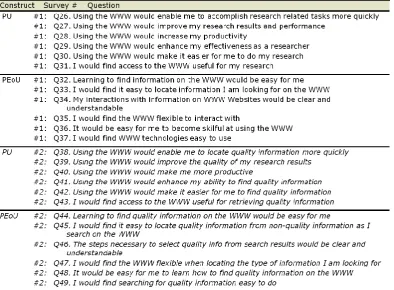
Within the PU construct, questions relating to such elements as search engine results, effectiveness, productivity and speed were addressed. Within the PEoU construct, questions relating to such elements as task ease (i.e.; find-ability and locate-ability), clarity and flexibility were addressed. Questions were all asked in the “positive”, and a standard seven-point multiple choice (highly likely through highly unlikely) applied. Table 1 presents the questions asked in the TAM surveys and the constructs those questions were designed to measure.
Table 1. TAM (PU & PEoU) Questions for the current research
The “Group-case” Constructs (Units of Analysis)
Classification of the constructed data-sets were both pre-defined (from previous literature and findings) at the survey design phase of the research; and evolutional, as some group-case characteristics became apparent after results were examined and collated. This is consistent with other examples of inductive approaches to research (McClintock et al., 1979; Eisenhardt, 1989).
User results discussed in this paper fall into the following partitioned constructs:
1. User (prior) experience (Palmquist & Kim, 2000; Hyldegaard & Seiden, 2004);
3. User motivation to use search engines (motivated, obliged or habitual) (Venkatesh, 1999; Liaw, 2002 & 2005; Chung & Tan, 2004);
4. User pre-supposed expectancy of search engine results (Zhang & von Dran, 2001);
5. User self-efficacy (Liaw, 2002; Quinn, 2003; Yee et al., 2004);
6. User task/system confidence (Liaw, 2002; Pace, 2004);
Importantly, in the context of an inductive approach to data analysis, the use of these constructed group-cases is embedded in existent theory as it is not enough to simply present the statistical variance between the clustered sub-groups of users. Each “group-case” presents a context in which to investigate complex cognitive and emotive human behaviour and its possible impact on PU and PEoU. This type of data analysis gives the researcher the opportunity to (1) examine phenomena from multiple perspectives (Stake, 1995; Dooley, 2002); (2) enable a more thorough analysis of the complex constructs chosen to partition data (Adam, Howcroft & Richardson, 2004; Eisenhardt, 1989); and (3) more closely scrutinise the possible co-relationships between the constructs and/or user results (Yin, 1994; Dooley, 2002).
Ultimately, inductive analysis of quantitative measurable data, an example of which is the current research, can provide the researcher with a desirable blend between a large data-set, bound in its collection to the validity scrutiny of quantitative research, and the opportunity to build theory through investigating phenomena from multiple perspectives.
THE INVESTIGATION: A DEEPER ANALYSIS
Mapping the Measurement: The development of the PoI construct
By taking a more inductive approach to data analysis, the authors – safe in the knowledge that data collection had closely followed an existing, valid model – were able to move out of existing TAM analysis methods, and examine the data with fresh eyes. In the first instance, the authors went back to the drawing board, so to speak, and began to scrutinise what user-driven constructs had actually been surveyed. It became apparent that elements of the PU and PEoU constructs contained their own ambiguity regarding which construct was being tested. Amongst the PU questions, for example, was the question “Using the WWW would make it easier for me to do my research”. This question was asked in the context of ‘easy accessibility to search engines’ being perceived by a user as a useful characteristic. So, although question clearly asks a direct question about PEoU, the context of the question meant the construct being measured, was PU.
This ambiguity of TAM’s constructs is both a weakness and strength of the model. There are many user attitude constructs that can, and do, exist in their own right, which can be explained or classified as PU and/or PEoU. Examples of this include the social normative element, which can be classified within the PU construct, or perceived enjoyment (PE) elements, which can be classified within the PEoU construct.
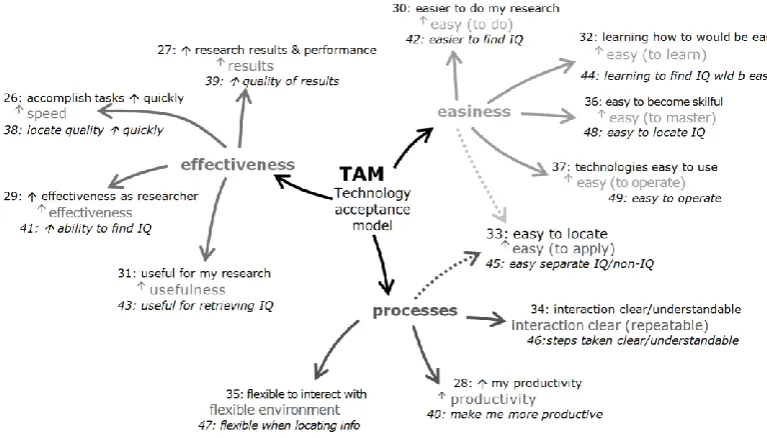
In order to determine what perceptions were actually being measured, the researcher developed a mind-map, illustrated in figure 2, of each element. PU elements became labelled as measuring a user’s perception of the “effectiveness” of an interaction, PEoU was labelled as measuring a user’s perception of the “easiness” of an interaction, and a third construct relating to “processes” was classified, which measured a user’s perception of the understandability and repeatability; or “predictability” of an interaction.
ambiguity in that some elements being tested could fall into more than one construct. For example; “easy (to apply)” could be included as either an “easiness” or a “processes” element, because it can refer to either the easiness or repeatability of an action.
Figure 2. A mind-map of the elements being measured by the TAM constructs
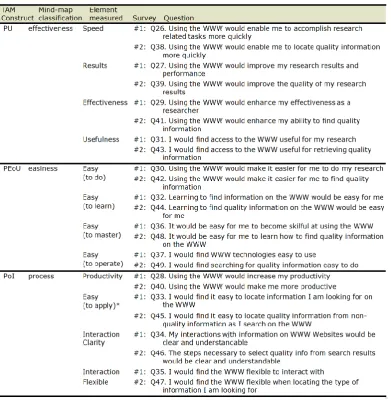
Table 2 presents the TAM questions in the context of the mind-map’s constructs and the elements determined to be being measured by each question. Effectiveness and easiness were once again classified as PU and PEoU respectively, and process related elements became classified as Perception of Interaction (PoI).
The need for an ongoing/interactive construct
Notwithstanding these issues, TAM still provides a framework to begin investigating the useful concepts associated with the model, particularly if a researcher is courageous enough to develop a deeper analysis of the constructs involved.
Table 2: TAM Constructs being measured by the current research
A “rich” investigation of the constructs of TAM
1. Provide a construct which actively seeks a feedback mechanism into the TAM, in the form of a construct which facilitates research into how (initial) resultant behaviour of PU an PEoU impacts on future use;
2. Provide a construct which allows researchers to investigate how users’ individual differences might impact PU an PEoU (as well as PoI);
3. Provide a construct which allows an investigation of user behaviour that may bi-pass the behavioural intention (BI) construct of the current TAM.
4. Provide a framework which facilitates multiple avenues of exploration in relation to data analysis.
Introducing PoI: Perception of Interaction
The OTAM proposes that a third construct, Perception of Interaction (PoI), be used in addition to PU and PEoU, to assess users’ ongoing, and changeable, perception of the predictability of their system interaction. This adds to TAM a whole realm of user/technology and user/information engagement not facilitated by the original, or subsequent, TAM frameworks.
Individual constructs have been used to extend TAM in the twenty years since Davis (1986, 1989) first proposed the model, including; user experience (Adams et al., 1992; Taylor & Todd, 1995; Liaw, 2002; Gefen, 2003); subjective norm (Taylor & Todd, 1995); motivation (Chung & Tan, 2004; Yi et al., 2006); self-efficacy (Chau, 2001; McFarland & Hamilton, 2006); perceived playfulness (Moon & Kim, 2001; Chung & Tan, 2004); computer attitude (Chau, 2001); computer enjoyment (Liaw, 2002; Teo et al., 1999; Liaw & Huang, 2003; van der Heijden, 2004); computer efficacy (Chau, 2001; McFarland & Hamilton, 2006); computer anxiety (Hackbarth, Grover & Yi, 2003; Schottenbauer et al., 2004); system quality (Liaw, 2002); perceived performance (Shih 2004); system usage (McFarland & Hamilton, 2006); IT continuance usage (Bhattacherjee, 2001; Limayem et al., 2003); habitual behaviour (Gefen, Karahanna & Straub, 2003; Limayem et al., 2003) and trust (Gefen et al., 2003). As well, individual differences, such as; age (Liu et al., 2000; Arning & Ziefle, 2007); gender (Gefen & Straub, 1997; Agarwal & Prasad, 1999; Venkatesh & Morris, 2000; Venkatesh et al., 2004); level of education (Chuang & Chuang, 2002; Burton-Jones & Hubona, 2005); cognitive style (Rapp, Taylor & Crane, 2003); and cognitive absorption (Agarwal & Karahanna 2000; Saadé & Bahli, 2005) have been used to look for variables in user results to PU & PEoU.
None of these constructs or individual differences have, however, proved to be the illusive co-construct for PU and PEoU, that would enable TAM to become an effective high-level research framework for investigating both new and ongoing adoption of information technologies. If anything, they proved to over-complicate the model, bringing the whole body of TAM literature to a somewhat confused, chaotic state (Benbasat & Barki, 2007). In effect, the plethora of extensions to TAM have lacked the high-level generic qualities of the original PU and PEoU constructs, thereby making each extension too specific to examine multiple user individual differences or co-dependent sub-constructs. They have also failed to address, what Benbasat and Barki (2007) describe as TAM’s inability as a theory “to provide a systematic means of expanding and adapting its core model ... in the constantly evolving IT adoption context” (p.212).
Of greater concern however, is that TAM, either with or without its variables and extensions, fails to really provide a great deal of value beyond confirming that users engage technologies they perceive will be “useful” (Benbasat & Zmud, 1999). The reality is, PU and PEoU as constructs themselves, require an additional construct which will allow researchers to flesh out the relationship between users’ individual differences, core salient beliefs and the central paradigms of TAM.
researchers develop ways to measure it. In other words, like PU and PEoU, how a user perceives the predictability of their systems interaction is implied by answers to questions like:
“The steps necessary to complete my assigned task would be clear enough for me to repeat” or “I would be able to find a similar website tomorrow”
What PoI adds to PU and PEoU is that it explicitly allows for a post-adoption technology investigation of user/computer interaction. It recognises that the very act of “interaction” has the capacity to impact and influence PU and PEoU as well as future interaction perceptions. It broadens the depth of TAM to facilitate a proper examination of the complex relationships between users’ individual differences and their PU and PEoU of an information system. Complex cognitive issues relating to phenomena such as users’ cognitive dissonance with a system, attribution of a successful (or non-successful) interaction or outcome, and general expectancy of a system interaction can be addressed in concrete, measurable terms to determine how PU and PEoU might influence BI.
Figure 3 presents a schematic illustration of the OTAM and it’s PU, PEoU and PoI constructs. Included are some of the relational pathways investigated as part of the current research. The “individual differences” illustrate twelve of the fourteen group-case constructs developed for the research project of which this paper was a part, six of these group-cases will now be discussed.
Figure 3. The OTAM constructs for on-going measurement of technology acceptance
Constructs for Data Analysis
Given the research’s assumption that users engage technologies at a cognitive level, user attitudes and perceptions, and their impact on PU, PEoU and PoI; results were examined in relation to multiple socio-cognitive theories, including;
1. Attribution theory (Weiner, 1974; 1980; 1986)
2. Expectancy theory (Vroom, 1964);
3. Cognitive dissonance theory (Festinger, 1957 & 1959);
4. Self-efficacy theory (Bandura, 1977 & 1982).
Prabhakar, 2004); learning (Saadé, 2007); satisfaction (McKinney, Yoon & Zahedi, 2002; Lindgaard & Dudek, 2003); persistence of engagement (Hassenplug & Harnish, 1998; Liaw, 2002); attitude (Bhattacherjee & Premkumar, 2004; Porter & Donthu, 2006); perceptions of quality (Sage, 1991; Barnes & Vidgen, 2006); trust (Gefen et al., 2003; Varlander, 2007); and decision making (Marshall, 2004). Significantly, the PoI context began to prove a rich context for investigating these socio-cognitive theories.
THE RESULTS: SOME RESEARCH FINDINGS
With the goal of the research to investigate users’ perceptions of Information Quality (IQ) in the context of their World Wide Web Information Search Behaviours (ISB), it was determined that the target user-group should be relatively intellectually sophisticated, possessing: (1) a relatively high degree of IQ perception; (2) a work-related information need which demanded a high level of quality in information typically retrieved; and (3) the ability to make (and recount) relevant quality related value-judgments of the information they encounter on the Web.
An assumption was made that such a user-group could be found amongst career academics (researchers and lecturers) and postgraduate (U.S. graduate) level students, engaging Masters, DBA and/or PhD studies. The stated criteria for inclusion in the user-group were;
1. Users who were “academics”, or “postgraduate level” students – including users who fell into both these categories;
2. Users who used the World Wide Web to retrieve information that related to their work/research as academics and/or post-graduate students.
The user-group did not necessarily have to feel ‘comfortable’ retrieving work/research related information from the Web, but needed to do so relatively regularly and be personally familiar with the process of using the Web as an information retrieval tool for the high quality content associated with their work, research, or both. Academics who engaged the Web as a means of professional networking, or even entertainment were not excluded from the target user-group, however the surveys and questionnaires they completed did not relate specifically to these interactions.
The User-Group’s General Characteristics:
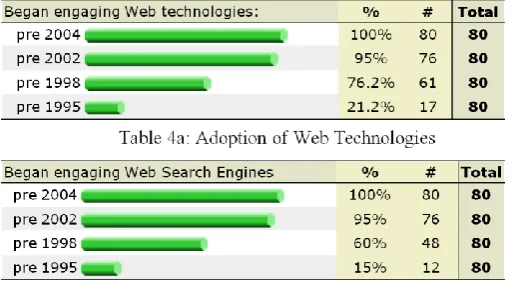
The user-group of eighty academics came from around the world (35% North America; 21.3% Europe/Africa; and 43.7% Australasia), and exhibited a number of key characteristics, including;
1.Technologically Sophisticated;
a.) Highly ‘experienced’ with both Web search engines and general web technologies;
b.) Early adopters of Web technologies;
2.Informatically sophisticated;
It should be noted, the study in no way advocates that academia holds a monopoly on intelligent individuals or high-end information users. It simply assumes that, in order to participate in post-graduate academic activities, the vast majority of users would posses above average cognitive capabilities and demand a high level of quality in their target IR.
Table 5 Users Highest Completed University Qualification
3.High Self-efficacy & Task/System Confidence;
An outstanding characteristic of this user-group was their high levels of self-efficacy and task/system confidence in their ability to search and retrieve their target information. When asked how often they expected to successfully find the information they were looking for, a staggering 88% of participants answered most or every time. In addition, this high-level of success was rarely attributed to the quality of the search engine used, but was seen by participants as a result of their own “good search strategies” and ability to engage the informatic environment of the Web.
Discussion of Some of the Findings
The following discussion presents some of the findings of the research using the modified OTAM framework, with results inductively examined in the context of; (1) the entire user-group’s results; and (2) six of the fourteen clustered data-sets (called “group cases”). For the sake of clarity and conciseness, the results discussed will focus particularly on what the proposed PoI construct revealed about user attitudes and perceptions of their search engine engagement.
Figure 4 presents the overall user-group results to the questions presented in Table 2. Results have been categorised into the PU, PEoU and PoI constructs, with each construct being used to measure four elements. Scores presented in the graph are out of 15, derived from using a simple numerical weighting formula (described in Appendix 2). The highest score an element can attain is 15, gained if 100% of the user group select “highly likely” for that element. The average score for each of the three perception constructs is also presented.
Figure 4. User Results (whole group) for PU, PEoU & PoI (OTAM)
General User Results
It was noted that user PoI elements, which relate to the predictability or repeatability of search-engine interactive outcomes, consistently produced the lowest results. Significantly, PU: expected S.E. results, which could also be seen as measuring something of the predictability of the outcome of a user’s search engine interaction, consistently scored the lowest of the PU elements. PEoU results were, by and large, the most consistent, with minimal variation between users results, regardless of which group-case of user results was being observed.
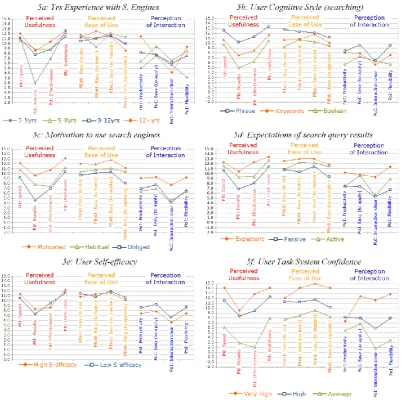
Results for six of the group-cases associated with the current paper are presented in Figure 5. In keeping with the inductive analysis, results were analysed – and are discussed – in the context of previous theory.
(1) User Experience – Fig 5a:
User Experience: Some Observations and Discussion
Overall, user-experience ranked second highest in divergence within its sub-group results, with PU and PoI showing the greatest variety of responses for this group-case. This suggests that;
User experience has a significant influence on users’ attitude towards the system.
This is consistent with previous research findings (Taylor & Todd, 1995; Agarwal & Prasad, 1999; Fusilier & Durlabhji, 2005; Lee, Qu & Kim, 2007) which contends previous exposure to a system, or relative system, is likely to have a positive influence on the constructs measured in the TAM, particularly in relation to PU (Chang et al., 2005), albeit at times, indirectly through increased user self-efficacy (McFarland & Hamilton, 2006).
Users’ level of experience has a direct effect on their perception of their potential productivity. The more experience, the greater the belief, on the part of the user, that their search engine engagement will be productive. Of interest then, is the apparent contradiction between these perceptions and experienced users’ perceptions regarding the consistency and predictability of these interactions. Apart from the “PU:results” scores (derived from questions relating to an anticipated improvement in research performance and quality), the elements of the PoI construct represent both the lowest scores and greatest divergence in sub-group results. This is consistent with the whole user-group results for PoI, which suggests that;
The greatest dissonance issue facing Web search engine users remains search engine unpredictability.
Moreover;
this issue does not seem to dissipate over time, even as the user gains more experience using the system.
(2) User Cognitive Style (query construction) – fig 5b:
Cognitive Style has been defined as a user’s preferred (sometimes habitual) approach to both organising and representing information (Frias-Martinez, Chen & Liu, 2007). Search query construction styles, such as keyword and boolean search strategies, have therefore been used previously to investigate user cognitive style (Moss & Hale, 1999; Ford, Miller & Moss, 2005). In the current research, cognitive styles were classified as (a) phrase searcher {27.5% of the user-group}; (b) keywords searcher {60%}; and (c) boolean searcher {12.5%}.
Cognitive Style: Some Observations and Discussion
The concept of users’ cognitive style has been extensively researched in various fields associated with information seeking and retrieval behaviours (Moss & Hale, 1999; Kim, 1999; Palmquist & Kim, 2000; Ford, Miller & Moss, 2002; Chen et al., 2004), and has been linked with other user characteristics, such as gender (Ford & Miller, 1996; Ong, Lai & Wang, 2006) and perceived systems performance (Workman, 2004). The intrinsic nature of the cognitive style user characteristic (Joughin, 1992), and the previously established link between system performance and perceived usefulness (Liu & Ma, 2006) lends itself to the finding that;
Cognitive style plays a significant role in search engine adoption through its impact on users’ perceptions of search engine usefulness.
that, in terms of ‘user control’, users’ cognitive styles significantly influences user/system information interaction
Figure 5. User sub-group (“group case”) results for OTAM constructs
Of particular interest is cognitive style’s impact on users’ PU, which ranks second highest (behind task/system confidence) in variation between its sub-groups. In light of previous TAM research findings that PU is the strongest precursor to technology adoption and use (Davis et al., 1989; Chau, 2001), the impact of cognitive style on user adoption attitudes towards search engines should not be understated.
(1997), occurs when a behaviour is acted or observed. If this is true, then the significant relationship between cognitive style and PU is suggestive that;
Perceived usefulness is notably influenced by users’ learned behaviours that have (in the past) produced a valued result.
This is significant because it suggests an interactive-driven construct, such as the PoI, is required as part of the TAM framework to fully investigate the complex relationship between users’ specific cognitive characteristics and their PU of a system.
(3) Motivation to use search engines – fig 5c:
Classified in the current research project as the reason for which users engage search engines, a historical review of TAM literature reveals that a major contributing factor to variations in user results can be traced to whether users make a conscious choice regarding their use of a particular technology (Rawstorne, Jayasuriya & Caputi, 2000; Brown et al., 2002). Users were identified as: (a) motivated; (b) habitual; or (c) obliged; search engine users.
Motivation: Some Observations and Discussion
As expected, motivated users – those users who engage search engines because they find them to be a highly effective information retrieval tool, returned the highest results for all the TAM constructs within this group-case. This result validates the constructed group-case itself, which overtly measures users general attitude towards search engines. Teo et al. (1999), in fact, describe extrinsic motivation and “perceived usefulness” as the same entity.
Habitual users returned higher results for the PU and PEoU constructs than obliged users, which was also to be expected. Firstly, given the previous TAM research which demonstrates users who feel obliged to use a system require positive subjective norm antecedents (Taylor & Todd, 1995; Venkatesh & Davis, 2000) in order for their PU and PEoU results to reflect a positive attitude towards that system. And secondly, given the passive role this sub-group of users perceive they play in their choice to interact with the system.
The research by Verplanken et al., (1998) into the role of habit versus planned (or intended) behaviour purports that once a behaviour is habitually strong, users rely on their habit to a greater degree than conscious choice strategies. Furthermore, from experiments conducted, the authors concluded that even when the process of choice was externally manipulated, it did not over-ride the effect of habit. Gefen’s (2003) research supports this conclusion, finding that once “specific IT behaviour become routine habit, [it] . . should become a primary predictor of use” (2003, p3).
The results for the motivation group-case support the proposition that;
Habit has a stronger influence on users attitude toward search engine use than obligation does
Interestingly, the results for the motivation group-case also provides evidence that;
the PoI construct is measuring a different type of attitudinal interaction with the system than PU and PEoU,
since the results for PoI do not simply replicate the PU and PEoU results.
Of note, is that the PoI sub-constructs tested are the only elements to return a more positive result for obliged users than habitual (also, unmotivated) users. Like Boolean searcher results, this could be indicative that;
(4) Expectations of search query results – fig 5d:
Much of the TAM research advocates that a user’s expectation of a technology has a profound impact on how they feel about, and interact with, that technology (Petersen, Madsen & Kjær, 2002; Staples, Wong & Seddon, 2002; Lindgaard & Dudek, 2003; Tesch et al., 2005). The expectancy sub-groups were classified as; (1) expectant users – who believed query results would be relevant; (2) active users – who acknowledged query results may or may not be relevant; and (3) passive users – who assumed query results may be relevant – without considering some results might be irrelevant.
Expectancy: Some Observations and Discussion
Users who had extremely high expectations of the relevance of search engine results to their queries, demonstrated some of the most positive results of the entire study for all three TAM constructs. This is consistent with DeSanctis (1983), who linked high levels of systems expectations with highly positive use of that system. In much of the TAM research, user expectancy is often measured as “perceived performance” (Bhattacherjee, 2001; D’Ambra & Wilson, 2004; Dadayan & Ferro, 2005), and ranks consistently as one of the strongest predictors of user BI (Wang, Wu & Wang, 2008).
Of interest in the context of this group-case was the results for the “active users” sub-group, who were willing to entertain the possibility that some search engine query results may include results that are not relevant to their queries. This sub-group recorded higher scores than the more passive sub-group, who stated they believed results may be relevant, without demonstrating a conscious cognition that results may also not be relevant. The implication of this is that;
a more cognitively “active” sub-group, while aware of the system’s flaws, or perhaps because of the system’s flaws, is more likely to recognise and embrace their own cognitive role in the process of web-based information retrieval, leading to a more positive attitude towards the system.
(5) User Self-efficacy – fig 5e:
Self-efficacy refers to the perception a user has of their own role in an outcome to a specific process or behaviour (Compeau, Higgins & Huff, 1999), and is considered to be an important motivational construct (Gist & Mitchell, 1992) in the adoption of specific user attitudes and behaviours. In the current research, users were classified as having high self-efficacy if they attributed a successful Web search to their own search strategies.
Self-efficacy: Some Observations and Discussion
Except for the PoI construct, the variance between the high and low self-efficacy sub-groups was relatively minimal, varying less than one point for most results. This is consistent with a number of previous studies which have generally found that users’ degree of self-efficacy has relatively little, to slightly positive, an impact on their PU or PEoU of the system with which they engage (Igbaria & Iiravi, 1995; Compeau & Higgins, 1995; Lewis, Agarwal & Sambamurthy, 2003).
Significantly, the sub-group with lower efficacy returned better results for PoI than the high self-efficacy group. PoI is designed to measure users’ ongoing perceptions of the predictability of their interactions with search engines. This could indicate that;
The higher self-efficacy sub-group have a greater recognition of the system’s flaws, and the inconsistencies of their interactions with it, resulting in a negative impact on their perceptions of the system
The PoI construct then, adds a valuable tool to the original TAM framework when investigating how high self-efficacy can return lower TAM results.
(6) User Task/System Confidence – fig 5f:
As a construct, confidence is recognised as being closely aligned with users’ self-efficacy (Igbaria & Iivari, 1995; Agarwal & Karahanna, 2000) however a number of authors have recognised the distinction between a user’s self-concept of their role and ability to perform a task, and their confidence that the system/technology is able to help them successfully complete that task.
Users’ task/system confidence was recorded by asking the user-group “How often do you expect to successfully find relevant information when utilising a Web search engine?” Conceptually, the question sought to bring together both a user’s pre-task (ex ante) expectation and post-task (ex post) evaluation. In this regard, it integrates some of the post-adoptive theory associated with the Task Technology Fit (TTF) model (Goodhue, 1995; Goodhue & Thompson, 1995; D’Ambra & Wilson, 2004), and implies a user’s level of “satisfaction” with the system (Khalifa, 2004; Tesch et al., 2005).
Task/System Confidence: Some Observations and Discussion
The task/system confidence group-case returned the largest divergence in sub-group results across all three TAM constructs. Predictably, users with the lowest (classified “average”) task/system confidence returned the lowest TAM results and users with “very high” task/system confidence returned the highest results. The user results confirm previous research findings regarding theory related to users’ perceived performance and confidence constructs – the higher a user’s confidence that they will be able to successfully complete the task for which they have engaged a system, the better their general attitudes towards that system will be (Compeau & Higgins, 1995; Hong et al., 2001)
Cross-analysing user TAM results (for task/system confidence) with their results in the non-Tam surveys, the sub-group of users with very high task/system confidence demonstrated;
higher motivation (66.7%) to use search engines (16.7% group norm)
significantly higher degree of faith (50%) that search engine returns would be relevant to their query (36.2% group norm)
equal weighting of attribution to self and system (50% each) when a search was successful. high propensity for minimal strategic change when a search query proved to be unsuccessful,
with 83.3% (36.2% group norm) stating they would simply change their keywords rather than selecting a different search-query strategy
These results are of particular interest because they strongly suggest that;
Users with very high task/system confidence, and therefore extremely high TAM results exhibit a reduced tendency to personally “own” the cognitive load of their search engine interaction,
with 0% using the more difficult boolean search tactics (12.5 group norm); 50% possessing high self-efficacy (15% group norm); and only 16.7% considering the possibility that search-engine query results might not be relevant (9.6% group norm).
This finding is supported by evidence that;
Users with relatively low task/system confidence demonstrated an increased tendency to personally own the cognitive load of their search-engine interaction;
returns may be irrelevant (5.5% high T/S confidence); and a staggering 88.9% using all the summary information associated with search engine query results to make decisions about a result’s relevancy to their information task (22.2 high T/S confidence).
This result makes a significant contribution to TAM literature, and demonstrate how the inclusion of the PoI construct can facilitate a much richer understanding of users’ cognitive processes during systems adoption. The preliminary cross analysis of the actual information seeking behaviours (survey #3) with the very high task/system confidence sub-group implies that while their attitude is towards the technology is extremely positive, actual user/information interaction may be compromised to the extent that the attitude induces a more cognitively lazy approach to information retrieval.
If this is true, then although intent to use the system is increased, effective use may not necessarily be the ultimate outcome. This conclusion is supported by the high task/system confidence sub-group’s result to the PoI productivity element, which scored relatively low.
CONTRIBUTION & AREAS FOR FUTURE RESEARCH
Contribution
The contribution of the OTAM to an already over-loaded TAM-driven body of research is twofold. Firstly, the current investigation is an example of an inductive, qualitative investigation of the TAM constructs, rather than a repeat of the common quantitative approach designed to, once again, simply support Davis’ (1986, 1989) hypothesis regarding the importance of perceived usefulness (Benbasat & Barki, 2007). Secondly, for the first time, a third dynamic construct has been added to the original TAM, which does not simply represent one or two user-driven “individual differences” or external variables of the user-group being applied to the investigation. Perception of interaction (PoI), or more pragmatically, perceived predictability of interaction, brings to the TAM, a construct allowing the model to be applied to users’ ongoing acceptance and adoption of technologies.
Pushing Research Methodology
There is a need in the field of IS literature to develop deeper analysis of the complex relationships between human behaviour and system/technology adoption. As a relatively young discipline, theory developed within IS literature is yet to experience full scrutiny from other scientific disciplines. This is however, changing, and the body of TAM literature, in particular, is being examined by researchers from multiple disciplines,[2] including Nursing Studies (Ahasan, Partanen & Keyoung, 2001; Despont-Gros et al., 2004; Ammenwerth, Iller & Mahler, 2006; Breen & Zhang, 2008); Medicine (Aguillo, 2000); Library Science (Kuhlthau & Tama, 2001; Jiao & Onwuegbuzie, 2003); Business Studies (Bruner & Kumar, 2005; Seyal & Rahman, 2007) Science & Engineering (Roco, 2005); Marketing (Gerrard et al., 2006; Jelinek et al., 2006); and Education (Ip, Jones & Jacobs, 2007). It behoves the IS discipline to broaden its investigative methods and more robustly define its conceptual terminologies, particular those which have been adopted and adapted from other disciplines, such as the Social Cognitive Theory (SCT) driven concepts of the TAM.
Significant Findings and Future Research
Expectancy & Motivation
A cross analysis between the user motivation and expectancy sub-groups reveals some interesting correlations. Motivated users are two times more likely than habitual users, and three times more likely than obliged users, to perceive a search engine will return relevant results to their queries. This is a clear confirmation of Vroom’s (1964) hypothesis that expectancy is intrinsically linked to motivation. The higher the (positive) expectancy of a behaviour, the greater is the motivation to perform that behaviour (Rappaport, 2004). Interestingly, this same sub-group of motivated users are also some 2.5 times more likely than habitual users, and two times more likely than obliged users, to not actively consider the likelihood that a search engine may return irrelevant results to their queries, making them the most “cognitively passive” group.
Expectancy, as a cognitive construct, is by and large, perceived as a positive antecedent in user adoption of technologies. The current research, however, has identified that when it comes to information search and retrieval, lower expectancy produces a more “cognitively active” searcher, who is more likely to recognise and embrace their own cognitive role in the process of web-based information retrieval and search engine interaction. This cognitively active searcher warrants further investigation, to determine the role of the “self” in OTAM related attitudes towards Web search engines.
Cognitive Dissonance
A significant finding of the current research is that;
The PoI construct, and specifically the ‘PoI: Interaction Clear’ sub-construct, provide a framework by which users’ levels of cognitive dissonance can be investigated using the OTAM.
Cognitive dissonance theory (Festinger, 1957) postulates that people adjust their internal attitudes (Whitworth et al., 2007) to overcome stimuli that does not necessarily fit-in with what they feel should be true, and therefore limit any conflict between their expectations and experiences (Brown, Venkatesh & Goyal, 2007).
Figure 6: Levels of Experience (group-case) results
12+ years experience using search engines (see also figure 5a). This sub-group of users had the highest PU scores of the “user experience” group-case, while also recording the lowest score for the PoI’s clarity of interaction.
Karahanna & Straub’s (1999) research indicated a strong relationship between higher cognitive dissonance and more positive PU results, causing the authors to contend that users attempt to stabilise any conflicting feelings associated with system interaction, by focusing on those things about the system that are useful. The current research supports Karahanna & Straub’s findings by demonstrating that;
Even long-term users experienced a degree of cognitive dissonance concerning their search engine interaction.
Significantly, that this dissonance firstly does not dissipate even for users possessing 12+ years experience, and secondly does not prevent users from repeated search engine use suggests that:
A result of greater experience with a system is a higher tolerance for any cognitive dissonance associated with that system.
Self-efficacy
Self-efficacy driven investigations in the context of the TAM have tended to return mixed results. Authors such as Venkatesh (1999) and Bhattacherjee (2001) align the TAM (in regards to self-efficacy elements) with Social Cognitive Theory’s two expectancy suppositions, suggesting that the PU construct is similar to SCT’s “outcome expectations” and PEoU encompasses similar elements as “self-efficacy”. The constructs of expectancy and self-efficacy are, at times, used inter-changeably (Bandura, 1977; Gist & Mitchell, 1992). This is particularly true in the field of IS, which has found itself adopting (and adapting) various theories originally associated with the social and psychological sciences, as a bases for investigation the human component of user technology adoption and human computer interactive processes (Chau,1996). In the current research however, a cross-analysis between the expectancy and self-efficacy sub-groups’ results confirms Stajkovic & Sommer’s (2000) finding that they are separate constructs. The former being primarily about expected outcome, the latter more about locus of control in the process of achieving an outcome. Both constructs are intrinsically linked to motivation, but not necessarily always to each other.
Of note, is that the divergence in results within the self-efficacy sub-groups (figure 5e) for the PU and PEoU constructs were negligible, however, the sub-group with lower self-efficacy returned better results for the PoI construct than the high efficacy sub-group. Chau (2001) noted that self-efficacy had a negative impact on the TAMs constructs, but explained this impact in terms of high self-efficacy still having a positive influence on users’ intended use of a system. The results for the PoI related elements sheds more light on Chau’s finding, and is suggestive that;
The lower results for the higher self-efficacy group is indicative of this sub-group’s awareness and recognition of the system flaws, and the inconsistencies of their interactions with the system.
CONCLUSION
This paper has argued for the introduction of an interactive-driven construct to be included into the original TAM in order to better investigate users’ ongoing adoption of technologies and related systems. It presents the OTAM (Ongoing Technology Acceptance Model), which employs the original TAM constructs of PU and PEoU, and the proposed PoI, as a framework useful for investigating the complex cognitive aspects of human engagement of information technologies. These include; expectancy; motivation; self-efficacy; and cognitive dissonance.
The supposition of the current research is that neither PU or PEoU adequately address the complexities associated with user cognitive behaviours employed during human computer interaction. The PoI construct has been added as a method of analysing those user results indicative of their actual, and ongoing, interactions with a technology system.
The paper has also confirmed the validity of the PoI construct through the discussion of some of the research project’s results, which have not only confirmed previous findings relating to the TAM, but have added additional understanding to those findings.
Finally, the paper has presented a combined methodological analysis of the statistical/quantitative data associated with TAM research. This proved particularly useful when cross-analysing the TAM statistical results with results to other surveys conducted during the course of the whole research project. This type of cross-analysis was presented in the Task/System Confidence - Observations and Discussion section.
Whether PoI goes on to become a fully accepted construct of a future version of the TAM remains to be seen, as the model still requires further exploration and testing beyond the scope of this research paper. The researchers acknowledge the possibility that PoI could in fact prove to become part of the existing TAM model, not as a construct, but as an over-arching framework within the model, allowing for a more useful investigation of PU and PEoU. Whichever is the case, an interaction construct is required within the TAM in order to address its “inability as a theory to provide a systematic means of expanding and adapting its core model” (Benbasat & Barki, 2007, p.212). In addition, more examples of inductive and heuristic explorations of the TAM constructs, such as the current manuscript, will add a richness to the body of TAM literature.
NOTES
[1] Google Scholar citations search figures: based on citation search of Davis’ two seminal papers (Davis, 1989; Davis et al., 1989); May 2005 = 1155 (771 & 444); May 2007 = 3398 (2116 & 1282); Jan 2008 = 5068 (3154 & 1914); Jan 2011 = 13,554 (8599 & 4955).
[2] Studies cited here are not just IS researchers’ publications in alternative disciplines, but also represent researchers from multiple disciplines using the TAM to investigate technology adoption issues within their disciplines.
ACKNOWLEDGEMENTS
REFERENCES
Adam, A., Howcroft, D., & Richardson, H. (2004). Decade of neglect: reflecting on gender and IS New Technology, Work and Employment, 19(3), 222-240.
Adams, D. A., Nelson, R. R. & Todd, P. A. (1992) Perceived Usefulness, Ease of Use, and Usage of Information Technology: A Replication". MISQ, 16, 227 - 247.
Agarwal, R. & Prasad, J. (1999) Are individual differences germane to the acceptance of new information technologies? Decision Sciences, 30, 361-382.
Agarwal, R., & Karahanna, E. (2000). Time Flies When You're Having Fun: Cognitive Absorption and Beliefs About Information Technology Usage. MIS Quarterly, 24(4).
Aguillo, I. (2000). A new generation of tools for search, recovery and quality evaluation of World Wide Web medical resources. on-line Information Review, 24(2), p138 - 143.
Ahasan, R., Partanen, T., & Keyoung, L. (2001). Global Corporate Policy for Financing Health Services in the Third World: The Structural Adjustment Crisis. International Quarterly of Community Health Education, 20(1), 3-16
Ajzen, I & Fishbein, M. (1980) Understanding Attitudes and Predicting Social Behaviour. Prentice-Hall, Englewood Cliffs, NJ, 1980
Ajzen, I. (1991). The theory of planned behavior. Organizational Behavior and Human Decision Processes, 50, 179-211.
Ammenwerth, E., Iller, C., & Mahler, C. (2006). IT-adoption and the interaction of task, technology and individuals: a fit framework and a case study. BMC Medical Informatics & Decision Making, 6(3).
Anderson, T. D. (2005) Relevance as process: judgements in the context of scholarly research. Information Research, 10, 226
Arning, K., & Ziefle, M. (2007). Understanding age differences in PDA acceptance and performance. Computers in Human Behaviour, 23(6), 2904-2927.
Bagozzi, R. P. (2007) The Legacy of the Technology Acceptance Model and a Proposal for a Paradigm Shift. Journal of the Association for Information Systems, 8, 244-254.
Bandura, A. (1977). Self-efficacy: Toward a unifying theory of behavioural change. Psychological Review, 84, 191-215.
Bandura, A. (1982). Self-Efficacy Mechanism in Human Agency. American Psychologist, 37(2), 122-147.
Barnett, A. (1999) A survey of Internet searches and their results. Reference & User Services Quarterly, 39, 177-182.
Barnes, S. J. & Vidgen, R. T. (2006) Data triangulation and web quality metrics: A case study in e-government. Information & Management 43 (2006) 767–777.
Benbasat, I. & Zmud, R. W. (1999). Empirical Research in Information Systems: The Practice of Relevance, MIS Quarterly, (23)1, 3-16.
Benbasat, I., & Zmud, R. W. (2003). The identity crisis within the IS discipline: Defining and communicating the discipline’s core properties. MIS Quarterly, 29(2), 183-194.
Benbasat, I. & Barki, H. (2007) Quo vadis, TAM? Journal of the Association of Information Systems, 8, 211-218.