Research Article
Innovative interfaces for Serious Games
J. Marco
1, E. Cerezo
1,*and S. Baldassarri
11, Advanced Computer Graphics Group (GIGA), Computer Science Department, Engineering Research Institute of Aragon (I3A),
Ed. Ada Byron. Campus Río Ebro, University of Zaragoza, C/ María de Luna n.1, 50015 Zaragoza. Spain
Abstract
The tangible interaction approach has, in recent years, become a promising alternative to tactile interaction for very young children. Children playing with Tangible User Interfaces (TUI) are motivated by the novel and digital environment and benefit from the same values as conventional physical playing. Young children build their mental image of the world through action and motor responses and, with physical handling, they become conscious of reality.
Within TUIs, digitally augmented surfaces (interactive blackboards and tabletops) are becoming popular in educative environments. Tabletop devices are horizontal surfaces capable of supporting interaction and image feedback on their surface, and are especially interesting for reinforcing face-to-face social relations and group activities. However, most of current children-oriented applications for tabletops are based on tactile interaction, thus losing the benefits of physical playing.
The paper describes our experiences building tangible tabletops, and designing tangible games and toys. In particular, we present NIKVision, a tabletop device intended to give leisure and fun while reinforcing physical manipulation and co-located gaming for 3-6 year old children. Several hybrid (physical/digital) games based on the manipulation of passive and active toys have been developed for NIKVision. From our experience several useful lessons can be extracted. Among them, the necessity of bridging the gap between designers and developers making it easier the prototyping of tabletop games stands out. To tackle this difficulty a toolkit for the prototyping of tabletop games called ToyVision has been created. The toolkit supports designers to fully explore the physical feasibilities of the manipulation of physical playing pieces, while minimizing the technical difficulties of implementing tabletop games based on physical manipulation. This way, NIKVision and ToyVision are becoming powerful tools to develop innovative serious games.
Keywords: children, framework, hybrid games, tabletop, tangible, toys.
Received on 15 September 2015, accepted on 12 October 2015, published on 05 November 2015
Copyright © 2015E. Cerezoet al., licensed to EAI. This is an open access article distributed under the terms of the Creative
Commons Attribution licence (http://creativecommons.org/licenses/by/3.0/), which permits unlimited use, distribution and reproduction in any medium so long as the original work is properly cited.
doi: 10.4108/eai.5-11-2015.150612
1. Introduction
One of the emerging research fields in Human-Computer Interaction (HCI) is concerned with innovative interaction techniques that aim to provide a more seamless bridge between the physical and digital worlds. Tangible User Interfaces (TUI) aim to give physical form to digital information by coupling physical manipulations of conventional objects with computational systems [4].
Games and entertainment computer applications are especially prolific in putting into practice the TUI paradigm,
giving rise to a new generation of hybrid games which combine traditional physical playing with the new possibilities of digitally augmenting the player’s area with computer image and audio feedback. Large horizontal interactive surfaces (or tabletop devices) are emerging as an ideal environment for these innovative hybrid games [6], [9]. Traditionally, conventional tables are popular spaces for social board-games due to their physical affordances that engage face-to-face interaction [17]. Players sit around the table and interact with the game by dragging and manipulating physical playing pieces on the table surface. Tabletop computer systems provide the possibility of
on Serious Games
digitally augmenting the game area while keeping playing pieces in the player’s physical environment, thus reinforcing the emotional impact of videogames [5], [7] and making digital technology accessible to other user profiles such as very young children [12], users with disabilities [10], and senior citizens [1].
During the last years, our group has been combining tabletop devices and tangible interaction in several experiences in nurseries, schools and special education schools. Our approach is that an adequate combination of a tabletop computer device with tangible interaction can bridge the gap between digital and physical-based playful or serious educative activities for young children and/or children with cognitive disabilities. The objective of our work is to explore the affordances of hybrid tabletop games, in terms of usability, user experience, and physical co-located playing in education environments. In this context we decided to create the NIKVision tabletop and a set of tangible games [13] designed to support co-located gaming around the table with a tangible interaction approach based on toy manipulation. The design and development of hybrid tabletop games for children involves the integration of physical, virtual, and social aspects, thus introducing new design and technical challenges during the prototyping process. The difficulties encountered in the development of our tangible games have pushed us to develop ToyVision, a software toolkit to make easy the prototyping of tangible games in visual based devices. ToyVision provides designers and developers with intuitive tools for modeling innovative tangible controls and with higher level user’s manipulation data.
The paper is organized as follows: next section describes NIKVision tabletop; section 3 describes the kind of Tangible Interaction supported by NIKVision exemplified with a set of hybrid tabletop games for NIKVision; section 4 offers designers of hybrid tabletop games some lessons derived from our experience evaluating tangible games in nurseries and schools; section 5 introduces ToyVision toolkit and, finally, in the Conclusions, the results of our work are outlined.
2. The NIKVision tabletop
The NIKVision tabletop (see Figure 1) uses well-known techniques for multitouch active surfaces, but its design is mainly focused on tangible interaction in the handling of physical objects on the table surface (see Figure 1, left, 1) [12]. A USB video camera is placed inside the table, capturing the surface from below (see fig. 1, left, 2). Visual recognition software runs in a computer station (see Figure 1, left,3) which also handles the game software and the tabletop active image provided by a video projector under the table (see Figure 1, left, 4) through a mirror inside the table (see Figure 1, left,5). The image output is also shown on a conventional computer monitor (see Figure 1, left, 6) adjacent to the table. The presence of this additional vertical monitor complementing the table surface output is a distinguishing feature of NIKVision. Visual recognition and
tracking of objects manipulated on the table are provided by the Reactivision framework [8] through fiducial markers located under each object (see Figure 1, right).
Figure 1. NIKVision sketched components.
The tangible interaction is achieved by manipulating the toys on the table surface. Both the user and the computer system are able to manipulate the toys involved in a NIKVision game. Those toys aimed to be manipulated by the user are named “passive” toys, and those aimed to be reactive (manipulated by the computer system) are named “active” toys. Next two sections describe the affordances of each kind of toy and related games developed.
3. NIKVision toys and games
3.1. Passive toys and related hybrid games
During play, children move the toys over the translucent surface of the table, putting the base of the toys in contact with the table to enable the camera to see the markers located under the base. The manipulations that visual recognition software is able to track are:
Movements over the surface: Children can grab the toys and drag them over the surface. The software tracks the position and velocity of the toy over the table.
Rotate toy: The toys can be rotated on the surface and so long as the base with the marker remains on the table the software can track their orientation. Thus, toys that have a distinguishable front and back can be oriented by the child during the game; e.g., a toy car is moved and oriented on the tabletop and a virtual 3D car on the monitor will move and orient the same way as in the game.
Manipulation of deformable materials: children often play with materials that do not have constant shape such as clay, cardboard, cloth. Thanks to the extension of the original Reactivision framework, NIKVision is also able to manage this kind of toys.
Following, several games developed for the NIKVision tabletop that make use of different passive toys are presented.
Farm Game
The farm game consists of a virtual 3D farm to be shown on the monitor and a 2D yard shown on the table surface. A set of virtual objects are placed in the 3D virtual farm scene and in the 2D table surface yard: plants, animal feeders, a nest, a barn, a bucket... and a virtual farmer character that collects the objects gathered by the animals (see Figure 2 left).
Figure 2. Farm game. Different goals of the farm game: a/ collecting strawberries. b/ laying eggs. c/
giving milk. d/ giving wool.
The farm animals are plastic animal toys with fiducials attached on their bases. Children play freely all over the meadow (tabletop) with the animals, which are represented on the screen as fully animated characters. The animals walk and make sounds when children drag (move and rotate) them around the tabletop, activating different farm activities: the pig collects strawberries hidden in the plants, the hen is used to lay eggs, the cow gives milk when manipulated on the bucked and the sheep is shear by the farmer (see Figure 2 right).
Figure 3. Three video streams synchronized for evaluation. Left, coming from a camera below the monitor for emotion analysis. Central, coming from a
camera in a corner of the test room for usability analysis. Right, coming from the graphical visualization
of the log files to be used for monitoring game events and feedback.
This game has been developed following a children-centred design methodology with the children involved for the very starting point through continuous test session in schools and nurseries [15]. Different assessment methods have been used depending on the question to be evaluated from observation notes to Wizard of Oz or video-analysis (see Figure 3).
Asteroids Game
Many conventional toys have mechanical structures that add new interactions: e.g., a space ship toy may have a button that when pressed triggers sound and light to simulate that the ship is firing. Using this concept, a space ship toy with moveable sub-pieces was designed and built for its use in the NIKVision tabletop. It has a button on the top which mechanically makes a white spot appear on its base when pressed and disappear when released. The meaning of this manipulation is that the spaceship toy will launch a virtual missile when the player presses the button (see Figure 4, right). These space ship toys are used in a hybrid game adaptation of the classic videogame “Asteroids” by Atari. Two children can collaborate to destroy all the virtual asteroids that appear on the active surface using the physical toys. Each time they press the button on their space ship toy, a missile is launched, which may fragment an asteroid on impact (see Figure4, left).
Figure 4. Asteroids game.
Drum Sequencer Game
In this game children create their own drum beats distributing plastic tokens over a graphic score shown on the surface (see Figure 5, left). On the table surface, coloured rows represent a different drum instrument. Beat is reproduced from left to right.
Besides the plastic tokens, two toys with moveable sub-pieces are used in the game:
The Speed fader is restricted to move only in a vertical axis increasing or decreasing the speed of the beat (see Figure 5, right down).
Figure 5. Drum Sequencer game. Left: tabletop overview with tokens distributed on the virtual drum score. Right: detail of the Beat Store toy (up) and the
Speed fader (down).
Paint and Bogaboo Games
The consideration of deformable playing pieces opens innovative opportunities for tabletop games making it possible to use materials and toys in which attaching a fiducial is not suitable. In particular, we have used this new kind of tokens in two simple games developed for NIKVision:
The Paint game uses conventional brushes to paint on the table (see Figure 6, left). The brush is modelled as a Deformable Token: the width of the stroke will depend on the pressure applied with the brush.
In the Bugaboo game the players use any kind of deformable material (clay, cardboard…) to build a path so that a virtual flea can jump and climb to reach the fruits (see Figure 6, right).
Figure 6. Right: The Paint game. Right: The Bugaboo game.
3.2. Active Toys: The Dragons cave hybrid
game
Hybrid games open new playful affordances by involving reactive toys: toys that can be manipulated by the computer system. A toy can be reactive in several ways: autonomous movements, vibration, colour change, sound…
Active toys required to embed electronic actuators into the objects to be able to actuate physically on the object. The computer system has to be able to send commands to the
actuators. This requires an electronic microcontroller board which mediates the computer system and the embedded actuators. NIKVision has adopted the Arduino microcontroller [16], an open-hardware platform which has become very popular for the development of tangible and ubiquitous systems since it enables a wide range of electronic components to be easily connected to a computer system via USB or wireless. In order to show the possibilities of combining passive and active toys, the following hybrid game has been designed.
The Dragon’s Cave game
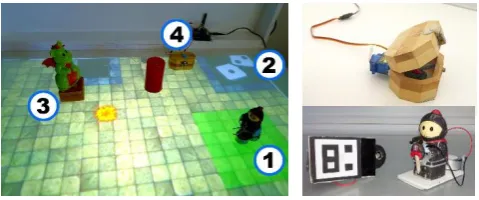
Dragon’s Cave is a hybrid board game for children based on the Dungeons & Dragons® role-playing games in which the players play the role of a hero who has to find a sword to kill a dragon that lives in a cave.
Figure 7. Dragon’s Cave game. Left: Different playing pieces. Right: Chest, Hero and Sword toys.
The game is composed of the following playing pieces:
One or more Heroes (see Figure 7, left,1). Players move their Heroes on the board in turns. A virtual dice (see Figure 7, left, 2) represents the distance the playing piece can move in any turn.
A Dragon (see Figure 7, left, 3). This active toy autonomously rotates during the game, looking for Heroes. When the Dragon looks straight at a Hero, it launches a virtual fireball and the player is removed from the game. The Dragon rotates by means of a small servo motor on the base of the toy connected to an Arduino microcontroller.
A Chest (see Figure 7, left, 4). This contains the Sword playing piece needed to kill the Dragon. The Chest automatically opens by means of a small servo motor on the back (see Figure 7, right up) when a Hero gets sufficiently close. When the Chest is open, the player can get the Sword, attach it to his/her hero playing piece, and move towards the Dragon to kill it.
means of a simple circuit composed of a reel switch and an infrared LED. When the magnetic sword is attached to the hero toy, it closes the circuit and the LED is lit, which can be tracked by NIKVision as a white spot.
4. Designing tabletop games for very
young children: lessons learned
From the experience gained during the design process, development and assessment of the NIKVision games, some lessons might be extracted that could be useful for developing future tabletop games.
There are some important considerations that must be taken into account in order to receive help from very young children during the process of creating a new technology.
The most important decision is to define, from the beginning, the role of children in the project [3]. Higher involvement children roles, like design-partners and informants, may be very useful to detect children’s needs and preferences, but are not adequate for very young children as their social and cognitive development is not enough for a natural relation with adult evaluators. In fact, our experience during the evaluation sessions with very young children shows that the more structured the session, the less useful the data obtained. One explanation would be that the great amount of instructions that is necessary to give them before they start, reduce their naturalness and spontaneity when playing, and the child may have the impression of being tested. The use of log files and video-streams allows to face the evaluation in an objective and exhaustive way.
The place chosen to carry out the evaluation sessions is also important. Nurseries and schools are very versatile environments for developing projects involving adult designers and children. Toddlers have difficulties in adapting to new environments and new people. Therefore, children may have unpredictable reactions in laboratory test sessions, added to which it is difficult to arrange frequent visits to the lab and usually only small groups of children can enter the lab at a time. On the other hand, many teachers are willing to collaborate with researchers offering their classrooms and time, and, for designers, classrooms provide a sufficient number of users for formative and summative evaluation as well as being a favourable environment for inspiration and creativity.
Psychomotor and cognitive development of children should always be considered when designing any game task. Observation of children playing with the games helps to solve this kind of questions, and with an iterative design process the game can be refined and adapted to children’s capabilities.
Finally, when planning a test session with children it is very important to consider that they will just use the application or product to have fun.
Also, some more general lessons have been learned in relation with the design of tabletop games, regardless of the children’s age.
Guidelines extracted from previous literature about videogames and children [10] may be useful, but designers should consider new ways of TUI interaction closer to non-digital toys and gaming. In other words, the potential of a tangible tabletop to promote physical playing is better exploited when the classical videogame model (with task and objectives to be sequentially achieved) is avoided, and children are left to freely explore and discover how to activate sound and animations. In this scheme, a guiding virtual character could help to engage children in the exploration of the game.
The addition of a conventional vertical monitor, complementary to the active image shown on the table surface, has positive impact in fun, as had been assessed with the analysis of video-recordings of the evaluation sessions: children expressed fun and engagement in the game while looking at the animations in the 3D scenery on the monitor. This benefit should be exploited with an adequate distribution of visual feedback between monitor and tabletop projection. While the first should be in charge of engaging children in the game, the second should give visual feedback about task completion and guide children to locate the interactive spots where toys are manipulated.
A tabletop device which supports co-located gaming does not grant this issue by itself. The design of the game tasks is decisive to engage groups of children to actively play with the toys. By giving balanced roles to each toy throughout the game, children can take any toy at any moment and start exploring its interactions in the virtual environment of the game, promoting co-located gaming.
And last, but not least, there is an important question related to the development and implementation of tabletop games.
Regarding designers’ role and despite the rich functionality afforded by tangible tabletop systems, prototyping and creating designs for conceptually complete tangible interfaces and applications remains a challenging task that requires advanced technical skills such as low level programming and to deal with electronic sensors and actuators.
the developer processed data of users’ interactions on the table, both tactile and through objects, but unfortunately, for the moment, in a very basic form: tangible interaction is described through simple events (object placed, moved or removed). This simplistic approach is constraining the designer to use playing pieces that can be just moved on the table, and therefore, this situation limits the exploration of richer tangible interaction possibilities. In order to extend the existing and “simplistic” toolkits (such as Reactivision [8] or CCV [2]), ToyVision, a toolkit for the rapid prototyping of tangible tabletop games has been recently developed.
5. The ToyVision framework
As seen in previous sections hybrid tabletop games bring new ways of gaming by taking benefit of the physical affordances of conventional objects (playing-pieces). However, the building of a functional prototype implies to tackle many technological issues. Although the tabletop hardware can be used to identify and track objects position on the table surface, other kinds of passive and active manipulations may require advanced technical skills such as electronics and hardware programming. This situation brings a breach between the design process and the corresponding implementation tasks (i.e., between designers and developers), which is hindering designers from freely explore all the Tangible Interaction feasibilities of the physical playing pieces.
To tackle the problem, we have created ToyVision, a software framework aimed to provide an easier development environment for prototyping hybrid board-games for visual based tabletop devices. It provides tools to upgrade any conventional playing piece in a control in a hybrid computer game. ToyVision supports passive playing pieces (manipulated by players) as well as active playing pieces (manipulated by the computer system) through the Arduino board.
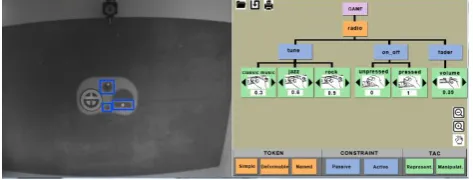
ToyVision extends the Reactivision framework, adding a Widget layer of abstraction in order to translate raw tabletop events into playing pieces status straight related to the context of the game [14]. Designers and developers can visually model all passive and active manipulations involved in their game concepts in a Graphic Assistant, and test them immediately in a tabletop device (see Figure 8).
FIGURE 8. ToyVision graphic assistant.
Any development environment (C++, AS3, Java, Processing…) can be used to code tabletop games based on the ToyVision framework. ToyVision sends text messaged through a standard TCP-IP socket to the host application. Messages coming from the ToyVision framework are coded in XML-compliant text, so, to know the status of any playing piece involved on the game, it is just needed to parse the XML.
The toolkit has been successfully checked in different contexts. Evaluation sessions with HCI students, designers and developers of interactive applications have shown that ToyVision is effectively lowering the threshold of developing tabletop applications. Coding with ToyVision has proved to be more efficient and has been perceived by users as easier than with current frameworks. Moreover, ToyVision is sufficiently expressive to support new concepts of hybrid board games ideated by participants during the workshops [16].
ToyVision is open-source software, and it is available at http://www.toyvision.org.
6. Conclusions
The combination of tabletop and manipulative toys described in this paper has revealed a notable potential for the generation of innovative entertainment and serious games that encourage collaboration and face to face social interaction. All the games designed for NIKVision enable more than one child to play at the same time and, in some games, collaboration is essential for achieving the goal. Moreover, the use of passive and active toys open new possibilities for child-computer interaction, combining conventional toys and Tangible Interaction paradigms with active surface technologies.
However, the design and development of tabletop tangible games for very young children is not an easy task. Due to the lack of verbal communication when children are very young and their necessity of having fun (even if they are testing serious games), a careful planning of every assessment session is needed. Besides, from our experience designing and prototyping hybrid games for NIKVision, we have perceived the technical difficulties TUI applications entail. Tools like ToyVision can support teams of designers and developers during iterative design processes to fully explore all the physical affordance of playing pieces in short time without requiring high technological skills.
Acknowledgements.
This work has been partly financed by the Spanish Government through the DGICYT contract TIN2011-24660.
References
[1] AL MAHMUD A., Mubin O., Shahid S., Martens J.B. (2008). Designing and Evaluating the Tabletop Game Experience for Senior Citizens. In Proceeding of the 5th Nordic conference on Human-computer interaction: building bridges
[2] CCV: Community Core Vision Web: http://nuicode.com/
[3] DRUIN, A. (2002). The role of children in the design of new technology. Behaviour and information technology, 21(1),
1-25.
[4] ISHII, H., & Ullmer, B. (1997). Tangible bits: towards seamless interfaces between people, bits and atoms. In
Proceedings of the ACM SIGCHI Conference on Human factors in computing systems. (ACM), 234-241.
[5] IWATA, T., Yamabe, T., Poloj, M., and Nakajima, T. (2010). Traditional games meet ICT: a case study on go game augmentation. In Proceedings of the fourth international conference on tangible, embedded, and embodied interaction
(TEI '10), 237-240.
[6] HEIJBOER M, and van den Hoven, E. (2008). Keeping up appearances: interpretation of tangible artifact design. In
Proceedings of the 5th Nordic conference on Human-computer interaction: building bridges (NordiCHI '08),
162-171.
[7] HINSKE, S. and Langheinrich, M. (2009). W41K: digitally augmenting traditional game environments. In Proceedings of the 3rd international Conference on tangible and Embedded interaction. (TEI '09), 99- 106.
[8] KALTENBRUNNER, M., & Bencina, R. (2007). reacTIVision: a computer-vision framework for table-based tangible interaction. In Proceedings of the 1st international conference on Tangible and Embedded Interaction. (TEI
2007, ACM), 69-74.
[9] LEITNER, J., Haller, M., Yun, K., Woo, W., Sugimoto, M., Inami, M., Cheok, A. D., and Been-Lirn, H. D. (2010). Physical interfaces for tabletop games. Comput. Entertain. 7,
4, Article 61 (January 2010), 21 pages.
[10] LI, Y., Fontijn, W., and Markopoulos, P. (2008). A Tangible Tabletop Game Supporting Therapy of Children with Cerebral Palsy. In Proceedings of the 2nd International Conference on Fun and Games. (Springer-Verlag), 182-193.
[11] MALONE, T. W., & Lepper, M. R. (1987). Making learning fun: A taxonomy of intrinsic motivations for learning. In R. E. Snow & M. J. Farr [Eds.]. Aptitude, learning and instruction.
Vol. 3. Conative and affective process analysis (Hillsdale, NJ:
Lawrence Erlbaum), 223–253.
[12] MARCO, J, Cerezo, E., Baldassarri, S. Mazzonne, E. Read, J. (2009). Bringing Tabletop Technologies to Kindergarten Children. In Proceedings of the 23rd BCS Conference on Human computer Interaction. (Cambridge University. 1-4
september 2009), 103-111. ISBN:978-1-60558-395-2. [13] MARCO, J., Cerezo, E., Baldassarri, S. (2012). Tangible
Interaction and Tabletops: New Horizons for Children’s Games. International Journal of Arts and Technology (IJART). Ed. Inderscience. Vol. 5, Nos. 2/3/4: 151-176. ISSN:
1754-8853.
[14] MARCO, J., Cerezo, E., Baldassarri, S. (2012). ToyVision: A Toolkit for Prototyping Tabletop Tangible Games. In
Proceedings of the fourth ACM SIGCHI Symposium on Engineering Interactive Computing Systems. (IT University of
Copenhagen, Denmark), June 25–28.
[15] MARCO, J., Baldassarri, S., Cerezo, E. (2013). NIKVision: Developing a Tangible Application for and with Children.
Journal of Universal Computer Science. Vol. 19, No. 15:
2266-2291.
[16] MARCO, J., Cerezo, E., Baldassarri, S. (2014). Lowering the threshold and raising the ceiling of tangible expressiveness in hybrid board-games. Multimedia Tools and Applications.
October 2014. (DOI) 10.1007/s11042-014-2298-2