http: // www.ijrsm.com (C) International Journal of Research Science & Management
[16]
IMPLEMENTATION OF ALGORITHMS FOR SOLVING ROUTING PROBLEM WITH
CONGESTION USING VHDL
Prof. Minaldevi K.Tank.1*
1*H.O.D (Industrial Electronics).Babasaheb Gawde Institute of Technology, Mumbai
*Correspondence Author: [email protected]
Keywords:Ant colony optimization, VRP, ACS, Road congestion
Abstract
The VRP (vehicle routing problem) focused on distribution of product from a depot to all customers with a limited number of vehicles. In practical scenario however we often meet with road congestion. In this paper Multi object ant colony system (MOACS) algorithm is implemented for solving VRP with Congestion, Here new parameters are added for road congestion which act as obstacle. The whole design is implemented in VHDL language using a bottom-up design and verification methodology. The algorithm is targeted for Xilinx Virtex family of FPGA. The design is optimized to meet the minimum travel time by using the MOACS algorithm The tool selected for design is Xilinx foundation series and modelsim. Xilinx tool has been chosen because it has complete flow integrated in to single tool .Also Xilinx FPGA are proven in performance and readily available. The modelsim simulator is a powerful simulator it supports VHDL and Verilog for simulation. Test benches can be written to automate and reduce the time for testing The design verification can be done in Modelsim by importing the VHDL.
Introduction
There are many problems in engineering for which there is no deterministic algorithm to find a solution. The computational methods that are simple and efficient have gained focus in the research community related to engineering, operations research and computer science. Consequently, many heuristic methods of optimization have appeared and gained widespread usage. Amongst them, there are those based on Evolutionary Computation (Backetal.2000) and Swarm Intelligence (Bonabeauetal 1999).Around a decade ago, a new heuristic method for search and optimization has emerged. This method was created by Dorigo and colleagues (Dorigo and Gambardella,1997, Dorigo and Sutzle, 2004) and is based on an analogy with the way real ants establish a trail between the nest and a food source. This method known as Ant Colony Optimization (ACO) belongs to a group of heuristic techniques collectively known as Swarm Intelligence.
ACO has been successfully applied to a number of complex real-world problems, such as: data mining(Parpinellietal,2002;Tsaietal,2004), bioinformatics (Perretto and Lopes,2005), combinatorial optimization (Buetal.,2004) and several problems in logistics (Silvaetal.,2003; Dorigo and Stutzle, 2004).One among the logistic problem is the multiple vehicle routing problem. This type of problem occurs when vehicles have a limited capacity (Tothand Vigo, 2001). Example of such problem is real-world organizations, such as goods distributors. This problem includes not only the optimization of one path, but many of them at the same time. In general, the task begins with a set of stop point that must be visited (consumers), by using some methdology such set of points is divided into subsets such that each one corresponds to a complete path. Next, the set of points for each path are ordered in such a way that the total travelled distance is minimized. The final objective is to minimize the sum of all travelled distances over all paths.
Vehicle Routing Problem was first introduced by Dantzig and Ramseris in [1] and it is a matter of research for last 10 years (VRP). It is a optimization problem which focuses on the distribution of products from a depot to a number of customers using a number of vehicles. Here each customer is visited exactly once and demand of each route is not allowed to exceed the capacity of the vehicle. Hence it is also referred as Capacitated Vehicle Routing Problem.
To be specific in CVRP a fleet of evenly capacitated vehicles have to deliver goods to geographically-distributed customers with variable demand and keeping the travelling distance least as possible. This heuristic method is inspired from the behavior of real ants in the search for food and uses two-level optimization scheme i.e global and local . A CVRP often meets with road traffic congestion, which is caused by number of vehicles because the traffic volume is increasing and it is not balanced with the capacity of existing roads. Hence we use Multi objective Ant Colony System (MOACS) algorithm based on Ant Colony System to solve this problem and implement it to solve the VRP problem by considering the level of traffic congestion as an obstacle.
Ant colony optimization
http: // www.ijrsm.com (C) International Journal of Research Science & Management
[17]
The deposit of pheromone creates a trail and serves as an indirect way of communication between ants. Such mechanism is known as stigmergy. Following ants most likely prefer those paths possessing the strongest pheromone information, thereby refreshing or further increasing the respective amounts of pheromone. Since ants on short paths are quicker, pheromone traces on these paths are increased very frequently. Over the time, pheromone information is permanently reduced by evaporation, which diminishes the influence of formerly chosen unfavorable paths. This combination focuses the search process on short, favorable paths. A short path, by comparison, gets marched over faster, and thus the pheromone density remains high as it is laid on the path as fast as it can evaporate. Pheromone evaporation has also the advantage of avoiding the convergence to a locally optimal solution. If there were no evaporation at all, the paths chosen by the first ants would tend to be excessively attractive to the following ones. In that case, the exploration of the solution space would be constrained
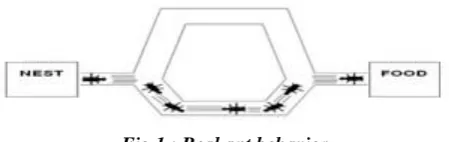
Fig 1 : Real ant behavior
To brief when one ant finds a good (i.e., short) path from the colony to a food source, other ants are more likely to follow that path, and positive feedback eventually leads all the ants following a single path as shown in fig.1.This autocatalytic phenomenon of positive feedback is the key point for establishing the shortest path from nest to food source (Beckersetal.,1992).Based on this behavioral mechanism, the ACO (Dorigo and Stutzle, 2004) was developed to solve combinatorial problems, making artificial ants search the shortest path(smaller cost) in the search space of problem’s solutions. An adaptive memory simulates the pheromone trails by means of graphs, and a fitness function measures the quality of the solutions found as an analogy to the distance between food source and nest.
Natural behavior of ants has inspired scientists to find operational methods to solve real-life complex problems. By observing ant behavior, scientists have begun to understand their means of communication. Ant-based behavioral patterns are now used to address combinatorial optimization problems. The idea of the ant colony algorithm is to mimic this behavior with "simulated ants" walking around the graph representing the problem to solve. A similar process can be put to work in a simulated world inhabited by artificial ants that try to solve the VRP problem.
Vehicle routing problem
VRP is used to distribute goods through a number of vehicle routes with minimum cost of distribution that starts from the depot and returns to the same depot [2]. The VRP is a combinatorial problem which is often expressed in a graph G(V,E).
Today, road traffic congestion becomes a major problem in big cities like Mumbai. The Congestion on a road would make a person to think to choose another route. Regarding the selection of the proper route, it would make the company save much fuel as well as the number of vehicles dispatched. If a vehicle is stuck in traffic jam, then the vehicle travel time will also increase accordingly therefore this can cause longer waiting time from the customer point of view. The authorized offices always try to solve this road congestion problem. Based on the transport analysis issued by the authorized office in Indonesia [7] every street has a lot of factors that affect the smooth flow of traffic. One of the main factors of the level of congestion of a road is the ratio between the volume of traffic and road capacity, commonly known as V/C ratio. Road capacity is defined as the ability of a road segment to accommodate vehicles per unit length of road segment. V/C value is a comparison between the existing traffic volumes on the road segment with the ability to accommodate vehicles. Value of V/C is normalized from 0 to 1. When V/C = 1, means the road is heavily congested and the vehicle speed becomes 0. The V/C ratio value is also known as congestion level, denoted as cl.
Dorronsoro Diaz [8] has identified the different type of VRP a) Capacitated VRP (CVRP) b)Multiple Depot VRP (MDVRP) c) Split Delivery VRP (SDVRP),d) VRP with Time Windows (VRPTW) e) Stochastic VRP (SVRP), f)Periodic VRP (PVRP). Our case of interest is Capacitated Vehicle Routing Problem with congestion – CVRP Which is defined as follows.
Departing from a central depot, a number of consumers must be served with different demands of a single product, by means of a fleet of vehicles of finite and equal capacity. It is aimed to find the set of tours of minimal cost (travelled distance) that satisfies demands of all customers (Toth and Vigo, 2001). The basic constraints in this problem are: A) Each customer is served only once by only one vehicle b) The total demand covered by a vehicle cannot exceed its capacity c) All individual tours begin and ends at the central point (depot) d) The total distance travelled in a tour cannot exceed the limited vehicle’s autonomy.
http: // www.ijrsm.com (C) International Journal of Research Science & Management
[18]
CVRP is NP-hard (Lenstra and Rinnooy Kan, 1981), since it contains one or more TSP( Travelling salesman problem) as sub problems. It is more difficult to solve CVRP than a TSP, because it requires a two-level solution. First, it is necessary to find which consumers will be aggregated in tours (without knowing a priori the minimum number of tours). Second, for each tour, it is necessary to find the permutation of customers that will represent the shortest path. Generally speaking, the first level can be understood as a bin packing problem, while the second, as a TSP.
Multi objective ant colony algorithm
Benjamin Baran and Matilde Schaerer introduced Multiobjective Ant Colony System (MOACS) in 2003 [3]. This algorithm used the Ant Colony System (ACO) as the basis to be implemented in Vehicle Routing Problem.
The idea of this algorithm is to construct a feasible solution using the vehicle as much as needed. In every generation, each ant k
from the set of ant in swarm m has to build a feasible solution, starting from the depot and then select the node or the next customer cj using procedure Choose-Next-Node. This procedure is to choose a node from the set of eligible nodes. A node is eligible if it has not been visited or does not violate existing constraints such as vehicle capacity. Furthermore, the selection process of the node that is declared as eligible is done in two ways: exploration and exploitation. Having obtained a feasible solution, further the algorithm performs checking the feasibility of such solutions to get into the Pareto set. If the solution is worst solution then the solution is discarded, whereas if the solution is a better solution than the new solution is inserted into the Pareto set and the old solutions is deleted. This is done repeatedly until the entire solution generated from one generation has been checked to obtain a Pareto set Solution. To determine the feasibility of Pareto solutions of a generation as compared to previous generation of Pareto set, each of new Pareto solutions is compared to the previous set. If there is a new Pareto solution more viable, then perform initial value of pheromone. If not, then do strengthen the pheromone on each route in the Pareto solution. In VRP, the criteria of route selection usually rely on the distance or travel time. Since we have determined traffic congestion problem in VRP, it may affect to the speed of a vehicle on the road.
Assume that Maximum speed of vehicle on a road without congestion can be reached is vmax.
Now suppose there is congestion such that the speed of vehicle reaches v then the relation between them is given as v = v max(1-cl),
Where cl is the level of congestion involved, Normal travel time t =sv,
where t is traveling time, s is the distance, and v is the velocity of a vehicle. Since v = vmax (1-cl)
The total traveling time t= s.v max(1-cl)
In VRP problems, suppose travel time of a path i to j is tij , the distance of a path i to j is dij, then the total travel time from i to j is expressed as tij= sij . v max(1-cl).
In MOACS, there is a probability of a path being selected and being used by ants [3].Each ant in a particular state calculates the value of probabilities. The ant will also check the current list of nodes and decide which a node are feasible to be visited and has demand that does not exceed the carrying capacity of the remaining ants. After getting the feasible nodes, the ant calculates the probability of each path from current state to reach the feasible node.
The calculation of probability of a chosen path from node ito node j is described in [3], which takes into account the pheromone Tij. The value of pheromone ij will be changed depending on the path taken by an ant. ηLij is the value of a function that takes into account travel time from i to j and it is the value of a function of time considering the waiting time and time windows. Since we consider a new parameter clij, this new parameter influences the value of ηLij and ηJij .
Where,
Jij, is the visibility from the objective function that considers the travel time. New value for Jij = 1/tij, where tij is travel time between node i to node j.
Lij is the visibility of a function that takes into account the waiting time and time windows. The derivation of ηLij is calculated and considering the various parameters needed New value obtained for ηLij is
ηLij sij -2(1 clij) 2
Thus this new value ηLij influences the computation of probability p(k)ij of a node being selected.
Why VHDL?
http: // www.ijrsm.com (C) International Journal of Research Science & Management
[19]
3. Design can be described at various levels of abstractions. 4. It provides for modular design and testing.
5. The use of VHDL has tremendously reduced the “Time to Market “for large and small design.
6. VHDL designs are portable across synthesis across synthesis and simulation tools, which adhere to the IEEE 1076 standard. 7. Using VHDL makes the design device independent.
8. The design description can be targeted to PLD, ASIC, FPGA very easily. 9. Designer has very little control at gate level.
10. The logic generated for the same description may vary from tool to tool. This may be due to algorithm used by the tools, which might be proprietary.
Result and summary
From the simulation results, it can be concluded that the higher the value of a road congestion levels, the smaller the probability of being selected road. Thus, the total travel time in MOACS that involves road congestion gives better solution to congestion. Thus MOACS provide better solution of total time travel on congested conditions than the system without involving the level of congestion. .
The level of congestion changes the probability, Greater the level of congestion on a road lesser are the chances of a road path to be selected and more is the total route time required by the vehicle
Using MOACS algorithm involving level of congestion the total time travel time is sufficiently reduced. System Results obtained are as under:
Total Travel Time:
1. without cl in System X Normal Condition 656.789 units 2. without cl in System X Congested level 1, 759.873. units 3. with cl in System X Congested level 1, 689.786 units.
This section includes the conclusion on the basis of information gathered and the test results. This project implements the MOACS with cl algorithm for solving routing problem with congestion. MOACS solves the difficult computational problems and chooses path with less congestion by changing the probability to choose the path ,thus providing solution to the problem
Test results of a FPGA XILINX VIRTEX XCV400 device implementation for the above problem have shown a considerable speedup over a software implementation, especially for a large number of ants per iteration. The users are given the flexibility to design and include their own custom hardware FPGA or ASIC based with their choice. FPGA provides superior performance to MOACS Algorithm leading to significant speedups in runtime compared to implementations in other software . The simulation was performed and report generated provides information on logic trimming, logic implementation, time constraint and I/O assignments.
References
1. M. Dorigo, luca M. G., " Ant Colony system: A Cooperative learning approach to the Travelling Salesman Problem”, IEEE transaction on evolutionary computation, Vol. 1, No. 1, 1997.
2. S. Kirkpatrick, C.D. Gelatt Jr., and M.P. Vecchi, “Optimization by Simulated Annealing”, Science, vol. 220, pp. 671-680, 1983.
3. F. Glover and M. Laguna, “Tabu Search”, Kluwer Academic Publishers, 1997.
4. H.R. Lourenco, O. Martin, and T. Stutzle, “Iterated Local Search”, in Handbook of Metaheuristics, ser. International Series in Operations Research & Management Science, F. Glover and G.Kochenberger, Eds., Kluwer Academic Publishers, vol. 57, pp. 321-353, 2002.
5. J. Holland, “Adaptation in Natural and Artificial Systems”, Ann Arbor: University of Michigan Press, 1975.
6. A. Colorni, M. Dorigo and V. Maniezzo,” Distributed optimization by ant colonies”, Proceedings of ECAL 91, European Conference on Artificial Life, Elsevier Publishing, Amsterdam,1991.
7. M. Dorigo and G. Di Caro, “The Ant Colony Optimization meta-heuristic”, in New Ideas in Optimization, D. Corne et al., Eds., McGraw Hill, London, UK, pp. 11-32, 1999.
8. M. Dorigo, G. Di Caro, and L.M. Gambardella, “Ant algorithm for discrete optimization”, Artificial Life, vol. 5, no. 2, pp. 137-172, 1999.
9. M. Dorigo, M. Birattari, and T. Stitzle, “Ant Colony Optimization: Artificial Ants as a Computational Intelligence Technique, IEEE computational intelligence magazine, November, 2006.
http: // www.ijrsm.com (C) International Journal of Research Science & Management
[20]
11. Gilmour Stephen and Mark Dras, “Understanding the pheromone system within Ant Colony Optimization”, available at http://www.ics.mq.ed.au
12. S. Lin. “Computer Solutions of the Traveling Salesman Problem”, Bell systems Journal, 44, 2245-2269, 1965.
13. E.-G. Talbi, O. Roux, C. Fonlupt, D. Robillard, Parallel ant colonies for combinatorial optimization problems, in: J.R.et al. (Eds.), Parallel and Distributed Processing, 11 IPPS/SPDP’99 Workshops, no. 1586 in LNCS, Springer-Verlag,1999, pp. 239–247.
14. S. Iredi, D. Merkle, M. Middendorf, Bi-criterion optimization with multi colony ant algorithms, in: E.Z. et al. (Eds.),Evolutionary Multi-Criterion Optimization, First InternationalConference (EMO’01), LNCS 1993, Springer-Verlag, 2001,pp. 359–372.
15. D. Merkle, M. Middendorf, Fast ant colony optimization on runtime reconfigurable processor arrays, Genet. Programming Evol. Machines 3 (4) (2002) 345–361.
16. M. Rahoual , R. Hadji, V. Bachelet, Parallel ant system for the set covering problem, in: Ant Algorithms, Proceedings of Third International Workshop ANTS 2002, LNCS 2463,Springer-Verlag, Brussels, Belgium, 2002, pp. 262–267.
17. M. Middendorf, F. Reischle, H. Schmeck, Multi colony ant algorithms, J. Heuristics 8 (3) (2002) 305–320.
18. M. Randall, A. Lewis, A parallel implementation of ant colony optimization, J. Parallel Distrib. Comput. 62 (9) (2002) 1421– 1432.
19. R. Miller, V.K. Prasanna-Kumar, D.I. Reisis, Q.F. Stout,Parallel computations on reconfigurable meshes, IEEE Trans.Comput. 42 (6) (1993) 678–692 (a preliminary version of this paper was presented at 5th MIT Conference on Advanced Research in VLSI, 1988).
20. O. Diessel, H. ElGindy, M. Middendorf, M. Guntsch, B. Scheuermann, H. Schmeck, K. So, Population based ant colony optimization on FPGA, in: IEEE International Conference on Field-Programmable Technology (FPT), 2002,pp. 125–132. 21. O. Cheung, P. Leong, Implementation of an FPGA based accelerator for virtual private networks, in: IEEE International
Conference on Field Programmable Technology (FPT), HongKong, 2002, pp. 34–43.
22. J. Gause, P. Cheung, W. Luk, Static and dynamic reconfigurable designs for a 2D shape-adaptive DCT, in:R. Hartenstein, H. Grüunbacher (Eds.), Field Programmable Logic and Applications, FPL, Springer-Verlag,2000,pp. 96–105.
23. J. Villasenor, C. Jones, B. Schoner, Video communications using rapidly reconfigurable hardware, IEEE Trans. Circuits Syst. Video Technol. (1995) 565–567.