Research Article
a
July
2018
Computer Science and Software Engineering
ISSN: 2277-128X (Volume-8, Issue-7)
Anomaly Detection in Data Mining using Fuzzy C-Means
Technique and Artificial Neural Network
Jagruti D. Parmar
M.E/ I.T, SVMIT, Bharuch, Gujarat, India
Prof. Jalpa T. Patel
CSE & IT, SVMIT, Bharuch, Gujarat, India
Abstract— Anomaly detection is the new research topic to this new generation researcher in present time. Anomaly detection is a domain i.e., the key for the upcoming data mining. The term ‘data mining’ is referred for methods and algorithms that allow extracting and analyzing data so that find rules and patterns describing the characteristic properties of the information. Techniques of data mining can be applied to any type of data to learn more about hidden structures and connections. In the present world, vast amounts of data are kept and transported from one location to another. The data when transported or kept is informed exposed to attack. Though many techniques or applications are available to secure data, ambiguities exist. As a result to analyze data and to determine different type of attack data mining techniques have occurred to make it less open to attack. Anomaly detection is used the techniques of data mining to detect the surprising or unexpected behaviour hidden within data growing the chances of being intruded or attacked. This paper work focuses on Anomaly Detection in Data mining. The main goal is to detect the anomaly in time series data using machine learning techniques.
Keywords— AnomalyDetection; Data Mining; Time Series Data; Machine Learning Techniques.
I. INTRODUCTION
The improvement of Information Technology has caused huge volume of databases and vast data in several areas. The study of datasets and information technology takes certain increase to an approach to collection and operate this valuable data for supplementary decision making.
Data Mining (DM) is formally defined as the non-trivial process of identifying valid, novel, potentially useful and ultimately understandable patterns in data [1]. From a comparatively unknown technique, adopted by some credit institutions and retailers, data mining has developed into a billion dollar business. Banks used data mining to define the credit worthiness of their applicants, retailers adopt it to choose the optimal layout for their shops and insurance companies rely on DM to recognize possible fake or fraudulent claims [1].
Anomaly detection is a main problem that has been studied in different research domains and application fields. Various techniques of anomaly detection have been definitely established for assured application areas, while others are more common [2]. Anomaly detection is defines as the problem of finding patterns in data that do not conform to expected behavior. These various patterns are normally denote to as anomalies, outliers, discordant observations, exceptions, aberrations, surprises, peculiarities, or contaminants etc., in different application areas. Of these, anomalies and outliers are two terms used most generally in the perspective of anomaly detection; sometimes interchangeably [2].
Anomaly detection find common usage in a different range of applications like fraud detection for credit cards, insurance, or health care, intrusion detection for cyber-security, fault detection in safety critical systems and military surveillance for enemy activities. The significance of anomaly detection is caused by the statement that anomalies in data decode to important and repeatedly serious, actionable information in a inclusive range of application domains [2].
ISSN(E): 2277-128X, ISSN(P): 2277-6451, pp. 79-92
Section II presents the literature review for anomaly detection in data mining. Section III proposed the new work of research in Anomaly Detection in Data Mining that is using Fuzzy C-Means clustering technique and Artificial Neural Network. Section IV includes the implementations and its results. Finally, the conclusion for this research describes.
II. LITERATURE REVIEW
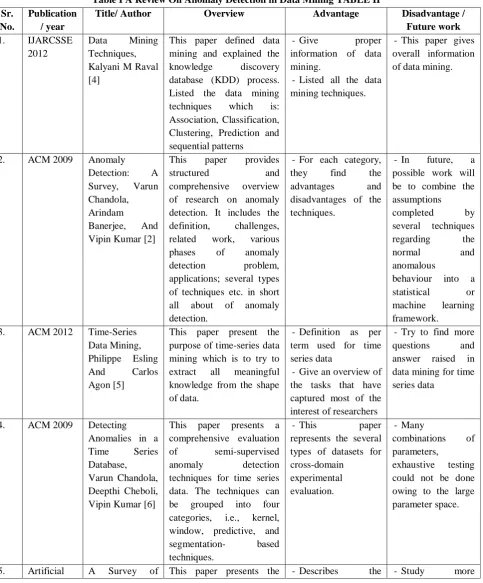
As a part of literature review study research paper is most relevant to anomaly detection in data mining. This survey gives a review on what they have used as method, database for learning and testing, and various different approaches. The review also gives advantages and disadvantages of these methods or future work.
Table I A Review On Anomaly Detection in Data Mining TABLE II Sr.
No.
Publication / year
Title/ Author Overview Advantage Disadvantage / Future work
1. IJARCSSE
2012
Data Mining
Techniques, Kalyani M Raval [4]
This paper defined data mining and explained the
knowledge discovery
database (KDD) process. Listed the data mining techniques which is: Association, Classification, Clustering, Prediction and sequential patterns
- Give proper
information of data mining.
- Listed all the data mining techniques.
-This paper gives overall information of data mining.
2. ACM 2009 Anomaly
Detection: A
Survey, Varun Chandola, Arindam
Banerjee, And Vipin Kumar [2]
This paper provides
structured and
comprehensive overview of research on anomaly detection. It includes the definition, challenges, related work, various
phases of anomaly
detection problem,
applications; several types of techniques etc. in short all about of anomaly detection.
- For each category,
they find the
advantages and
disadvantages of the techniques.
-In future, a possible work will be to combine the assumptions
completed by
several techniques
regarding the
normal and
anomalous
behaviour into a
statistical or
machine learning framework.
3. ACM 2012 Time-Series
Data Mining, Philippe Esling
And Carlos
Agon [5]
This paper present the purpose of time-series data mining which is to try to extract all meaningful knowledge from the shape of data.
- Definition as per term used for time series data
- Give an overview of the tasks that have captured most of the interest of researchers
-Try to find more
questions and
answer raised in data mining for time series data
4. ACM 2009 Detecting
Anomalies in a
Time Series
Database, Varun Chandola, Deepthi Cheboli, Vipin Kumar [6]
This paper presents a comprehensive evaluation
of semi-supervised
anomaly detection
techniques for time series data. The techniques can be grouped into four categories, i.e., kernel, window, predictive, and
segmentation- based
techniques.
- This paper
represents the several types of datasets for cross-domain
experimental evaluation.
-Many
combinations of parameters,
exhaustive testing could not be done owing to the large parameter space.
ISSN(E): 2277-128X, ISSN(P): 2277-6451, pp. 79-92 Intelligence Review 2004 Outlier Detection Methodologies,
Victoria J.
Hodge & Jim Austin [7]
methodology of the outlier detection and different approaches (supervised,
semi-supervised and
unsupervised learning) of the same.
models with their outlier detection techniques.
- Proper guidance for techniques of outlier detection.
methods
6. IEEE 2016 Anomaly
Detection In
Aircraft Data Using Recurrent Neural Networks (RNN), Anvardh
Nanduri and
Lance Sherry [8]
This paper describes the application of Recurrent Neural Networks (RNN) for effectively detecting anomalies in flight data.
- RNN based on
LSTM and GRU units do not have the limitations of MKAD or Cluster AD as
RNNs are by
definition capable of handling multivariate sequential input data
without any
modifications and treat it as time series data. RNNs are also
suitable for
implementation on the flight deck for
real-time anomaly
detection.
-to refine the RNNs architecture
and training
methodology to
detect runway
change
configuration and
abnormal pitch
anomalies.
-Experiments with varying feature combinations may be valuable in
assessing the
performance of
RNN in detecting even the subtlest anomalies in the dataset.
7. Internationa l Journal of Computer Application s 2016
Anomaly based
IDS using
Backpropagation Neural Network,
Vrushali D.
Mane and S.N. Pawar [9]
This paper presents the
Anomaly Intrusion
Detection System that can detect various network attacks. The goal is to identify those attacks with the support of supervised neural network that is. back propagation artificial neural network algorithm and make complete data safe.
- This paper included the data collection from KDD 99 dataset, data pre-processing and normalization, feature reduction, neural network - steps for implementation.
-As the growth of anomaly detection
idea through
associative analysis, the method can detect not only the problem situations, but also point out the most likely anomaly source.
8. IEEE 2011 Neural Network
Approach to
Real-Time Network Intrusion
Detection and Recognition, Pavel Kachurka
and Vladimir
Golovko [10]
This paper introduced
recirculation neural
network based approach which detects previously undetected attack types in real-time mode and to more correct recognition of these types. The tests detained on both KDD data and real network traffic data prove that this approach can be used in host-based anomaly and misuse detectors.
- Every new detector can be trained using the data samples not recognized by the operating detectors.
-Apply other
neural network
9. IEEE 2009 Host Based
Intrusion
Detection Using
This paper presents a novel approach of host based intrusion detection that
- RBFNNs provide
better detection rate and very low training
-Look to
implement this
ISSN(E): 2277-128X, ISSN(P): 2277-6451, pp. 79-92
RBF Neural
Networks,
Usman Ahmed
and Asif Masood [11]
uses Radial basis Functions
Neural Networks
(RBFNNs) as profile
containers.
time as compared to other soft computing methods.
adopting a novel activation function other then Gaussian
which would
hopefully improve
the detection
capability of the system a lot.
10. IEEE 2016 Fuzzy Logic
Inference for Unsupervised Anomaly Detection, Tetiana
Gladkykh, Taras
Hnot and
Volodymyr Solskyy [12]
This paper introduced the solution for unsupervised anomaly detection i.e., to detect unexpected activity
of user or network
equipment, based on the
analysis of mutual
dependencies of the
separate slices of network activity.
- Resulting model is an ensemble of fuzzy inference systems, which describe the dependence of the selected parameter from the set of other measured quantities values.
-As the progress of anomaly detection
idea through
associative analysis, the method can detect not only the problem situations, but also point out the most likely
source of the
anomaly.
11. IEEE 2013 Anomaly
Detection in
Time Series Data using a Fuzzy C-Means
Clustering, Hesam Izakian
and Witold
Pedrycz [13]
This paper presents
anomalies in time series which are divided into two categories: amplitude
anomalies and shape
anomalies. A unified framework sustaining the detection of both types of anomalies is introduced.
- To measure the dissimilarity of each
subsequence to
different cluster
centers, a
reconstruction criterion is used.
--For detecting
anomalies in
amplitude, the
original
representation of time series is considered, while for shape anomalies an autocorrelation representation of time series was used.
12. Proceedings
of the
Second Internationa l Symposium on Networking and Network Security (ISNNS) 2010
An Anomaly
Detection
Method Based
on Fuzzy
C-means Clustering Algorithm,
Linquan Xie,
Ying Wang,
Liping Chen, and
Guangxue Yue
[14]
This paper indicates the fuzzy C-means clustering (FCM) algorithm which
applied to detect
abnormality which based on network flow.
- It more
comprehensively analyzed the data to the clustering, not only helps to reduce the rate of the false alarm and the rate of the failing alarm, at
the same time,
combine the method with the optimized algorithm of FCM.
-Not efficient so it can further enhance
the detection
efficiency.
13. Internationa l Journal of Machine Learning and Computing 2014 Effective
Clustering of Time-Series
Data Using
FCM, Saeed
Aghabozorgi and Teh Ying Wah [15]
A large part of these successes are due to the
novel achieves in
dimensionality reduction and distance measurements of time series data. However, addressing the problem of time series
clustering through
conventional approach has
- This study indicates the method is more
efficient than
conventional
clustering algorithms computationally,
because of less
iteration in the learning phase. In
terms of being
-Needs to be done in order to evaluate
the execution
algorithm AMCT
(Accurate Multilevel
ISSN(E): 2277-128X, ISSN(P): 2277-6451, pp. 79-92
not solved the issue completely, especially when the class label of time series are vague.
accurate, this method is sufficiently accurate enough in comparison
with traditional
strategies.
different datasets
with different
dimensions to
understand its
potentials and
limitations. 14. Internationa
l Journal of Computer Science and Security 2010
Design Network Intrusion
Detection
System using
hybrid Fuzzy-Neural Network, Muna Mhammad T. Jawhar and Monica
Mehrotra [16]
This paper introduced an intrusion detection model based on hybrid fuzzy logic and neural network. The aim is to take advantage of various classification abilities of fuzzy logic and neural network for intrusion detection system.
- The main role of the present work is to
achieve a
classification model with high intrusion detection accuracy and mainly with low false negative.
-In future work apply another neural network.
15. IEEE 2004 Adaptive
Neuro-Fuzzy Intrusion Detection Systems, Sampada
Chavan, Khusbu Shah, Neha Dave and Sanghamitra Mukherjee, Ajith
Abraham and
Sugata Sanyal [17]
This paper included two machine-learning
paradigms, Artificial
Neural Networks and
Fuzzy Inference System, are used to design an
Intrusion Detection
System.
- EFuNN performed well compared to
neural networks.
Experiment results
also reveal the
importance of input variable reduction.
-The future of IDS
lies in data
correlation. The IDS of tomorrow will produce results by examining input
from several
sources.
16. Elsevier 2010
A new approach
to intrusion
detection using Artificial Neural
Networks and
fuzzy clustering,
Gang Wang,
Jinxing Hao, Jian Ma, and Lihua Huang [18]
This paper presents a new approach, FC-ANN, based
on ANN and fuzzy
clustering, to solve the problem and help IDS achieve higher detection rate, less false positive rate and stronger stability.
- Propose a new
intrusion detection approach, called FC-ANN, based on ANN and fuzzy clustering.
-In future research, how to determine the appropriate
number of
clustering remains an open problem.
17. Journal of Computer Science 2013
Hybrid of Fuzzy Clustering Neural Network over Nsl Dataset for Intrusion Detection System, Dahlia Asyiqin Ahmad Zainaddin and
Zurina Mohd
Hanapi [19]
This paper indicates test the stability of detection precision for low-frequent
attacks and weaker
detection stability using the current hybrid approach of IDS with NSL dataset instead of using standard KDD Cup 1999 dataset.
- To deal with high poor accuracy and low detection rate has been resolved by the
proposed hybrid
technique.
-Time consuming
18. IJERT 2012 Anomaly Based
Intrusion Detection
System Using
Artificial Neural
This paper work on to add restore point which allows for the rolling back of system files, registry keys, installed programs and the
- The complexity of each sub training set is
reduced and
consequently the
detection performance
ISSN(E): 2277-128X, ISSN(P): 2277-6451, pp. 79-92
Network and
Fuzzy
Clustering, Prof. D.P. Gaikwad, Sonali Jagtap, Kunal Thakare
and Vaishali
Budhawant [20]
project data base is increased.
19. European
Journal of Advances in Engineering and
Technology 2016
A Hybrid
Approach of
Intrusion
Detection using ANN and FCM, Swain Sunita,
Badajena J
Chandrakanta
and Rout
Chinmayee [21]
This paper introduced an off-line intrusion detection system is implemented
using Multi-Layer
Perceptron (MLP) artificial neural network.
- KDD Data set is used for the training and evaluation of the ANN classifier.
-Future work will be use the center values and index values obtained to represent the data pattern and train the system in less iteration.
20. Internationa l Journal of Innovative Research in Computer and Communica tion Engineering 2016
Hybrid
Approach for
Classification using Multilevel Fuzzy Min-Max Neural Network,
Bhavana Jain
and Vaishali
Kolhe [22]
This paper proposes the hybrid approach in which pruning strategy has been used to reduce number of hyper boxes and hence accuracy is improved. Various datasets are used for testing purpose.
- The proposed
method uses
multilevel based
FMM technique
which gives better accuracy with less
number of hyper
boxes using pruning strategy.
-This work can be used further for speech classification
and text
classification.
However, the main drawbacks of ANN-based IDS exist in two aspects: (1) lower detection precision, especially for low-frequent attacks, e.g., Remote to Local (R2L), User to Root (U2R), and (2) weaker detection stability. For the above two as-pects, the main reason is that the distribution of different types of attacks is imbalanced. For low-frequent attacks, the leaning sample size is too small compared to high-frequent attacks. It makes ANN not easy to learn the characters of these attacks and therefore detection precision is much lower. In practice, low-frequent at-tacks do not mean they are unimportant. Instead, serious conse-quence will be caused if these attacks succeeded. For example, if the U2R attacks succeeded, the attacker can get the authority of root user and do everything he likes to the targeted computer systems or network device. Furthermore in IDS the low-frequent attacks are often outliers. Thus ANN is unstable as it often con-verges to the local minimum. Although prior re-search has proposed some approaches, when encountering large datasets, these approaches become not effective.
III. PROPOSED APPROACH
This section describes the anomaly detection in data mining using machine learning method. This chapter consists of discussions about problems that were analyzed during literature survey. It was found that there are some limitations in the existing model so there is a need to improve that limitations. First of all, time series data is applying as the input data. Then, features are extracted with the help of certain techniques and then the machine learning techniques are applied. Based on literature survey analysis, number of methods and algorithms will developed to identify anomaly detection. But still some issue related to accuracy, time, data-set limitation, detection capacity, shape anomaly so using proposed flow try to solve issue like time, dataset, detection capacity.
A. Problem Formulation
ISSN(E): 2277-128X, ISSN(P): 2277-6451, pp. 79-92
Anomaly detection can prevent the system from any kind of new or Zero-day attack. Anomalies are detected on the basis of user behavior. There are so many data mining techniques to classify the normal or abnormal behavior of the user. But these data mining techniques have some limitation so the main objective of the thesis is to reduce these limitations and improve the accuracy. Existing techniques having following problems:
- Noisy, meaningless, unrelated or corrupt data is present in a dataset while data collection. Due to the presence of this kind of data classification is never done accurately.
- Overfitting of model due to its excessive parameter comparison to its number of observation creates excessively complex behavior to classify.
- Missing values or missing data have a significant effect on the result while classification. These missing values are extremely important for feature selection while classification. Because of this missing data, conclusions that could be drawn from the data are not accurate.
- Real-time traffic analysis is one of the major concerns that are being faced now-a-days. If detection of real-time traffic is not accurate, then it leads to compromising the system. So there is a need for the classifiers which are more accurate in detecting intrusion.
- Due to big dataset it becomes difficult to train the classifier which has a direct effect on the accuracy of classifiers.
B. Fuzzy C- Means Clustering Algorithm
Fuzzy C-means (FCM) technique is a clustering method that awards one piece of data to belong to two or more clusters. It was produced by Dunn and enhanced later by Bezdek; it is utilized as a part of utilizations for which hard order of information is not important or hard to accomplish (e.g., pattern recognition) [27]. C-means algorithm is similar to K-Means however with the each point’s membership is characterized in light of a fuzzy function and all the points give to a cluster centroid for replacement in view of their fuzzy membership to that cluster [27].
Fuzzy C-Means clustering is used for these following statements [27]:
• K-Means clustering brings about decadence and is not appropriate for big data. Y-Means is eliminating empty clusters i.e., an upgrade over K-means.
• Fuzzy C-Means depends on the fuzzy logic that enables a thing to have a place with more than one cluster and focuses on the minimization of the objective function that analyzes the nature of partitioning.
• The techniques are concentrated past obscure huge connections and patterns from vast databases. The extracted patterns are then utilized as a premise to recognize new attacks.
• Three clustering algorithms to be specific K-means, Y-means and Fuzzy C-means have been discussed. Result obtained by discussion state that FCM is better than among.
• The primary preferred standpoint of Fuzzy C-Means clustering for anomaly/intrusion detection is the high detection rate and lower false positive rate that it offers. Although it is a productive method however it is tedious.
• The execution of anomaly/intrusion detection systems can be yet enhanced by joining the features of Fuzzy C- Means clustering technique with some other technique so that it reduces the time required by Fuzzy C-Means for the clustering process and also increases the detection rate and decreases the false positive rate thereby making the intrusion detection system more exact and powerful.
C. Artificial Neural Network
• A feed forward neural network is a biologically inspired classification algorithm. It comprises of a (possibly large) number of simple neuron like processing units, organized in layers [28]. Each unit in a layer is connected with all the units in the previous layer. These networks are not all equivalent: each connection or network may have a different strength or weight. The weights on these connections encode the knowledge of a network. Frequently the units in a neural network are also termed nodes. Data enters at the inputs and passes through the network, layer by layer, until it arrives at the outputs. All through ordinary operation i.e., when it acts as a classifier, there is no feedback between layers. This is why they are called feed forward neural networks [28]. Feed forward networks have the following characteristics [29]:
1. Perceptrons are organized in layers, with the main layer taking in data sources and the last layer delivering yields. The center layers have no association with the outside world and hence called hidden layers.
2. Each perceptron in one layer is associated with each perceptron on the following layer. Subsequently data is consistently 'fed forward' starting with one layer then onto the next and portrays why these systems are called feed forward networks.
ISSN(E): 2277-128X, ISSN(P): 2277-6451, pp. 79-92 D. Block Diagram Phases
FC-ANN firstly divides the training data into several subsets using fuzzy clustering technique. Subsequently, it trains the different ANN using different subsets. Then it determines membership grades of these subsets and combines them via a new ANN to get final results. The whole framework of FC-ANN is illustrated in Fig. . As typical machine learning framework, FC-ANN incorporates both the training phase and testing phase. The training phase includes the following three major phases:
Phase I: For an arbitrary data set DS, it is firstly divided into training set TR and testing set TS. Then the different training subsets TR1; TR2; . . . ; TRk are created from TR with fuzzy clustering module.
Phase II: For each training subset TRi ði ¼ 1; 2; . . . ; kÞ, the ANN model, ANNi, (i ¼ 1; 2; . . . ; k) is training by the specific learning algorithm to formulate k different base ANN models.
Phase III: In order to reduce the error for every ANNi, we simulate the ANNi using the whole training set TR and get the results. Then we use the membership grades, which were generated by fuzzy clustering module, to combine the results. Subsequently, we train another new ANN using the combined results.
• In the testing phase, we directly input the testing set data into the k different ANNi and get outputs. Based on these outputs, the final results can then be achieved by the last fuzzy aggregation module.
• The three stages of FC-ANN framework raise three important is-sues: (1) how to create k different training subsets from the original training dataset TR; (2) how to create different base model ANNi with different training subsets; (3) how to aggregate the different results produced by different base model ANNi. These issues will be addressed by the following sections, respectively.
Fig. 1 Block Diagram of Proposed Scheme
Input Dataset
Data Normalization
Fuzzy C-Means Clustering Algorithm
TR1
TR2
TRn
Testing
Dataset
Number of clusters x
Training Dataset (TR)
…………
………
ANN1
ANN2
ANNn
Fuzzy Aggregation
Result
P
ha
se
III
P
ha
se
II
P
ha
se
ISSN(E): 2277-128X, ISSN(P): 2277-6451, pp. 79-92 IV. IMPLEMENTATIONANDRESULTDETAILS
This chapter discusses about the proposed work, dataset description, implementation and result of the proposed hybrid model. Here the discussion is about the architecture of the proposed model and different components used during the implementation. This chapter present the implementation work up to import dataset to fuzzy c means algorithm (phase I) in MATLAB 2014b.
A. Implementation Tool
MathWorks is the main engineer of mathematical computing software. MATLAB is the language of technical computing which is a programming domain for algorithm advancement, data analysis, visualization, and numeric computation. Simulink is a graphical situation for reproduction and Model-Based Design for multi domain dynamic and embedded systems. MATLAB founded in 1984[30].
Matlab version MATLAB R2014b (8.4.0.150421) includes new Characteristics [30]:
1) New MATLAB graphics system
2) Date and time information sorts with time zone and show alternatives
3) Git and Subversion source control combination and access to projects on GitHub from File Exchange
4) MATLAB toolbox packaging as single, installable records for simple sharing and downloading of user-developed tools
5) Arduino and Andriod equipment bolster for cooperating with engines and actuators and for getting to sensor information
6) MATLAB MapReduce™ data analysis that scales Hadoop for big data.
B. Experimental results
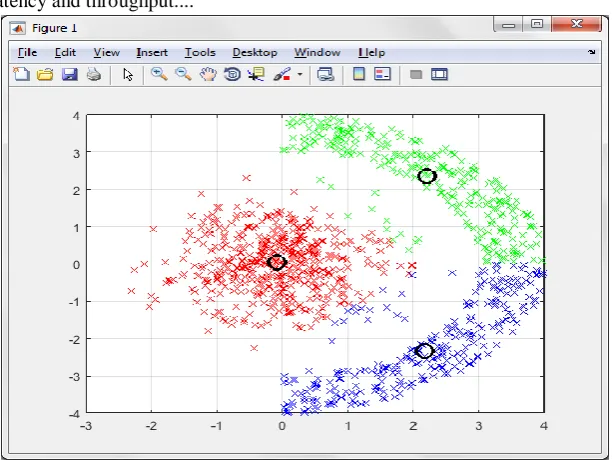
When we start the MATLAB R20014b and run the system, the system should be want the user id and the password to run and analysed the dataset.If the system allows the authorized person than the data loaded and the plotting diagram of clusters is show by the iteration.
The following steps are running in the MATLAB for our proposed approach:
1) When we start the MATLAB R20014b and run the program, the program should be want your user id and the password to run and analysed the dataset.
2) If the system allows the authorized person than the data loaded and the plotting diagram of clusters is show by the iteration.
3) If your id is correct it gives u password and if it correct than you can enter in system and again same step 1) and 2)\
4) Normalise data
5) Clustering using fuzzy logic 6) Create group of same data
7) Count iteration and plot result using MATLAB plot 8) Choose best cluster and create group
9) Count time, latency and throughput....
ISSN(E): 2277-128X, ISSN(P): 2277-6451, pp. 79-92
Fig. 3 Basic Neural Network frame as output
Fig. 4 Confusing matrixes to indicate the anomalies
ISSN(E): 2277-128X, ISSN(P): 2277-6451, pp. 79-92
Fig. 6 Iteration count for choose cluster and group for membership
Fig. 7 Final output for time latency and throughput
ISSN(E): 2277-128X, ISSN(P): 2277-6451, pp. 79-92 Table 5.1 Complexity of time
Time Latency Throughput
19.1 155 0.055
9.3285 245 0.0101
9.7946 452 0.0058
9.3531 271 0.0088
Fig. 8 Final result
V. CONCLUSIONS
According to literature review, mostly researcher research on the Anomaly Detection by using data mining and machine leaning techniques or combined both. As par the anomaly detection application it detects. In this hybrid approach, the intrusion detection system made to detect the anomaly in different datasets using data mining technique. Fuzzy C- means clustering technique used in intrusion detection system for low false alarm rate. Neural network algorithm is used to classification in proper class – normal and anomaly. This combine method overcomes the limitation of a single neural network.
We look forward to achieve good result and detect anomaly in an open problem in the future research.
REFERENCES
[1] J. Huysmans, B. Baesens, D. Martens, K. Denys And J. Vanthienen, “New Trends in Data Mining”, Tijdschrift voor Economie en Management, Vol. L, 4, 2005: 1-14.
[2] Varun Chandola, Arindam Banerjee and Vipin Kumar, “Anomaly Detection: A Survey”, ACM Computing Surveys, Vol. 41, No. 3, Article 15, 2009: 1-58.
[3] Animesh Patcha, Jung-Min Park, “An overview of anomaly detection techniques: Existing solutions and latest technological trends”, ScienceDirect 2007.
[4] H. Debar, M. Dacier, and A. Wespi, “A revised taxonomy for intrusion-detection systems,” In Annales des telecommunications, Springer-Verlag, vol. 55, no. 7-8, pp. 361-378, 2000.
[5] A.S. Ashoor and S. Gore, “Importance of Intrusion Detection system (IDS),” International Journal of Scientific and Engineering Research, vol. 2, no. 1, pp. 1-4, 2011.
[6] Kalyani M Raval, “Data Mining Techniques”, International Journal of Advanced Research in Computer Science and Software Engineering (IJARCSSE) Volume 2, Issue 10, 2012: 439-442.
[7] P.G. Majeed and S. Kumar, “Genetic algorithms in intrusion detection systems: A survey,” International Journal of Innovation and Applied Studies, vol. 5, no. 3, pp. 233-236, 2014.
[8] F. Alserhani, M. Akhlaq, I. U. Awan, A. J. Cullen, J. Mellor, and P. Mirchandani, “Snort Performance Evaluation,” In Proceedings of Twenty Fifth UK Performance Engineering Workshop (UKPEW 2009), Leeds, UK, 2009.
[9] Philippe Esling and Carlos Agon, ”Time-Series Data Mining”, ACM Computing Surveys, Volume 45, No. 1, Article 12 (2012),: 1- 34.
ISSN(E): 2277-128X, ISSN(P): 2277-6451, pp. 79-92
[11] Victoria J. Hodge & Jim Austin,” A Survey of Outlier Detection Methodologies “, Artificial Intelligence Review 22 (2004): 85–126.
[12] Anvardh Nanduri and Lance Sherry, “Anomaly Detection In Aircraft Data Using Recurrent Neural Networks (RNN)”, IEEE Integrated Communications Navigation and Surveillance (ICNS) Conference, 5C2-8(2016):19-21.
[13] Vrushali D. Mane and S.N. Pawar,” Anomaly based IDS using Backpropagation Neural Network”, International Journal of Computer Applications (0975 – 8887) Volume 136 – No.10 (2016):29-34.
[14] Pavel Kachurka and Vladimir Golovko, “Neural Network Approach to Real-Time Network Intrusion Detection and Recognition”, The 6th IEEE International Conference on Intelligent Data Acquisition and Advanced Computing Systems: Technology and Applications 15-17 (2011): 393-397.
[15] Usman Ahmed and Asif Masood, “Host Based Intrusion Detection Using RBF Neural Networks”, IEEE 2009 International Conference on Emerging Technologies (2009): 48-51.
[16] Tetiana Gladkykh, Taras Hnot and Volodymyr Solskyy, “Fuzzy Logic Inference for Unsupervised Anomaly Detection”, IEEE First International Conference on Data Stream Mining & Processing 23-27 (2016): 42-47. [17] Hesam Izakian and Witold Pedrycz, “Anomaly Detection in Time Series Data using a Fuzzy C-Means
Clustering”, IEEE (2013): 1513-1518.
[18] Linquan Xie, Ying Wang, Liping Chen, and Guangxue Yue,” An Anomaly Detection Method Based on Fuzzy C-means Clustering Algorithm”, Proceedings of the Second International Symposium on Networking and Network Security (ISNNS ’10), Academy Publisher, 2-4 (2010): 089-092.
[19] Saeed Aghabozorgi and The Ying Wah, “Effective Clustering of Time-Series Data Using FCM”, International Journal of Machine Learning and Computing, Vol. 4, No. 2, (2014): 170-176.
[20] Muna Mhammad T. Jawhar and Monica Mehrotra, “Design Network Intrusion Detection System using hybrid Fuzzy-Neural Network”, International Journal of Computer Science and Security, Volume 4, Issue 3(2010): 285-294.
[21] Sampada Chavan, Khusbu Shah, Neha Dave and Sanghamitra Mukherjee, Ajith Abraham and Sugata Sanyal,” Adaptive Neuro-Fuzzy Intrusion Detection Systems”, IEEE Computer Society Proceedings of the International Conference on Information Technology: Coding and Computing (ITCC’04) (2004).
[22] Gang Wang, Jinxing Hao, Jian Ma, and Lihua Huang,” A new approach to intrusion detection using Artificial Neural Networks and fuzzy clustering”, Elsevier Expert Systems with Applications 37 (2010): 6225–6232. [23] Dahlia Asyiqin Ahmad Zainaddin and Zurina Mohd Hanapi,” Hybrid of Fuzzy Clustering Neural Network over
Nsl Dataset for Intrusion Detection System”, Journal of Computer Science, Volume 9, No. 3 (2013): 391-403. [24] Prof. D.P. Gaikwad, Sonali Jagtap, Kunal Thakare and Vaishali Budhawant, “Anomaly Based Intrusion
Detection System Using Artificial Neural Network and Fuzzy Clustering”, International Journal of Engineering Research & Technology (IJERT) Vol. 1 Issue 9 (2012): 1-6.
[25] Swain Sunita, Badajena J Chandrakanta and Rout Chinmayee, “A Hybrid Approach of Intrusion Detection using ANN and FCM”, European Journal of Advances in Engineering and Technology, 3(2), (2016): 6-14.
[26] Bhavana Jain and Vaishali Kolhe, “Hybrid Approach for Classification using Multilevel Fuzzy Min-Max Neural Network”, International Journal of Innovative Research in Computer and Communication Engineering ,Volume 4, Issue 5 (2016): 8636-8640.
[27] Tejwant Singh, Mr. Manish Mahajan, “Performance Comparison of Fuzzy C Means with Respect to Other Clustering Algorithm”, International Journal of Advanced Research in Computer Science and Software Engineering, Volume 4, Issue 5, May 2014: PP. 89-93.
[28] “Feedforward neural networks 1. What is a feedforward neural network?”,accessed on 3 March 2017http://www.fon.hum.uva.nl/praat/manual/Feedforward_neural_networks_1__What_is_a_feedforward_ne.ht ml.
[29] Accessed on 3rd March, 2017
http://cs.stanford.edu/people/eroberts/courses/soco/projects/neuralnetworks/Architecture/feedforward.html
[30] Loren Shure, ”MATLAB R2014b Graphics”, accessed on 6th March, 2017
https://blogs.mathworks.com/loren/2014/10/03/matlab-r2014b-graphics-part-1-features-of-the-new-graphics-system/
[31] I. Levin, “KDD-99 classifier learning contest LLSoft's results overview”, ACM SIGKDD Explorations Newsletter, vol. 1, no. 2, (2000): 67-75.
ISSN(E): 2277-128X, ISSN(P): 2277-6451, pp. 79-92
[33] P.G. Jeya, M. Ravichandran, and C. S. Ravichandran, “Efficient Classifier for R 2 L and U 2 R Attacks” , International Journal of Computer Applications, vol. 45, no. 21, (2012).
[34] S.Paliwal and Ravindra Gupta, “Denial-of-Service, Probing & Remote to User (R2L) Attack Detection using Genetic Algorithm”, International Journal of Computer Applications, vol. 60, no. 19, (2012).