An Empirical Study on the Influence of PBL
Teaching Model on the Critical Thinking Ability
of Non-English Majors
Jinzhu Zhang
School of Foreign Languages, Tianjin Polytechnic University, Tianjin, China
Hongquan Lin
Personnel Section, Tianjin Polytechnic University, Tianjin, China
Abstract—This study combines the PBL teaching model based on cooperative learning autonomous learning and inquiry learning with the intensive reading course of college English with the aim to test whether this model is conducive to promoting the critical thinking ability of students. Ability of second language acquisition (L2) is measured by language test and questionnaire survey among 95 subjects. The results show that the teaching model of PBL has a positive effect on improving students' critical thinking ability and second language acquisition ability.
Index Terms—critical thinking ability; problem-based learning; language ability
I. INTRODUCTION
A. Critical Thinking
Facione (1992) defines critical thinking (CT) as an ability “to be purposeful, self-regulatory judgment which results in interpretation, analysis, evaluation, and inference, as well as explanation of the evidential, conceptual, methodological, criteriological, or contextual considerations upon which that judgment is based.” The cultivation of critical thinking ability is not only the foundation of information processing ability and autonomous learning ability, but also the precondition of innovative thinking. Therefore, presently, the cultivation of students’ critical thinking ability has become an important goal of teaching.
B. PBL Teaching Model
PBL (Problem-Based Learning) is a teaching strategy, originated from School of Medicine at McMaster University in Canada in the middle of 1960s, was firstly intended to improve the teaching quality by replacing the traditional teaching model. Since then, it has been widely extended to the fields of engineering, construction, business education and social work. Up till now, there is still no widely accepted definition of PBL teaching strategy, but all researchers agree that PBL is a student-based teaching conception, which provides real problem situations and allows students to solve problems and construct knowledge in a learning environment that is both autonomous and cooperative. Nelson (2008) puts forward a more comprehensive definition: PBL is a teaching strategy, which begins with a question to students, asks students to work in groups to solve a complex and chaotic problem that may be encountered in real society; the process of problem solving allows students to actively participate in the analysis of the problems, to review the knowledge they have acquired, and to identify the relevant facts, finally new knowledge is constructed On the basis of learning activities above. Students collectively decide which problems need to be discussed jointly by the group, and which problems can be carried out by the individuals. At the same time, they may design plans to solve the problems. In terms of cultivation of critical thinking, Almost all the studies have shown that the teaching of critical thinking should be based on problem-solving strategies, and the ultimate purpose of problem-solving is considered to be the core of PBL learning model. In PBL teaching model, learners can produce critical thinking and creative thinking by coping with various difficult problems. ZhiYongbi (2014) defines PBL teaching model as an excellent container for promoting thinking.
C. Effects of PBL Teaching Model on SLA
The problem-based PBL teaching model enables students to transfer from passive learning to a positive discovery learning model, thus enhancing their learning interests and motivation. Therefore, PBL teaching model provides a new platform for the improvement of second language acquisition ability.
D. Literature Review
In the past 10 years, the research on critical thinking has been paid more attention by domestic researchers. There have been numerous related works in the field of second language acquisition and educational psychology. on the CNKI(Chinese National knowledge Internet), the biggest and the most popular research and paper database in China, The author searches the papers with the key words "critical thinking ability/speculative ability" and "English Teaching", 370 papers are found, with 79 in key journals and 58 theses for mater’ degree, which indicates that the cultivation of critical thinking with the aid of foreign language teaching has been paid more and more attention to in recent years, especially in the teaching of college English reading and writing. This study attempts to explore the effects of PBL on critical thinking and second language acquisition by constructing a curriculum model of combining PBL teaching model with intensive reading course.
II. RESEARCH METHODOLOGY
A. Research Questions
1) Is the PBL teaching model helpful to improve the critical thinking ability of learners? 2) Is PBL teaching model helpful to improve learners' language competence?
B. Subjects
This study was conducted in two English classes randomly selected from Tianjin Polytechnic University in 2017, one of class with 48 students was used as the experimental group; The other class with 47, was taken as the control group, each class had an average age of 18.2 and 18.5 respectively. And the average scores of college entrance examination English were 112.6 and 110.9 respectively. The two groups had the same teaching hours for 16 teaching weeks, offering the same college English courses, enjoying the same learning and living environment in the teaching experiment. The experimental group adopted the PBL teaching model, the control group adopted the traditional teaching model. As a whole, there was no significant difference in language proficiency between the two groups, and the experimental environment was similar. the basic conditions to carry out the comparative teaching experimental research were fully equipped.
III. RESEARCH PROCEDURES
A. Preparation Stage
The preparation process of the experiment included grouping, role assignment, group leader selection,and establishment of assessment system
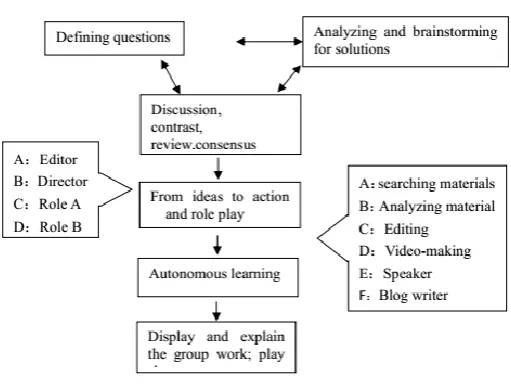
Grouping in the experimental group was in accordance with the voluntary principle, and a harmonious community was established to provide a good basis of cooperative learning for members in the group. Members in each group were assigned to six characters respectively: data searchers, material analyzers, translators, proofreaders of the translated materials, multimedia producers, team spokesmen and leaders who were responsible for the overall planning of tasks. They were encouraged to choose the roles based on their strengths, and to take turns to assume different roles.
TABLE I.
THE PROCESS OF DEVELOPING A COOPERATIVE MODEL
Stages Measures Efficiency Evaluation strategy
Beginning
In order to cultivate students' cooperative mind, some simple classroom cooperative tasks, such as mutual evaluation of composition, and cooperative dictation, are assigned to students at the beginning.
Reinforcement of Group leader's sense of responsibility:
Organization of group activities; supervision of other members to learn and give help to other students; shift from self-centered learning model to focus on group members and group honor;
Formative evaluation of students' group activities in class, emphasis on the basis of group activities, and leading students into the track of cooperative learning gradually.
Forming
Strengthening self-evaluation in the implementation of PBL model
Cooperation on track:
with the development of the PBL model, problems arise and continue to be solved. The team members constantly understand and adapt to each other's characteristics in the process of cooperation. The team leaders will also develop a mechanism for team cooperation according to the characteristics of the team members, avoid conflicts effectively and maximize cooperation
Reflection from group leaders: When, where and how to start a panel discussion? How do you describe the characteristics of your team?
How do you handle conflicts in cooperation? How to strengthen group cohesion? Team reflection program: How do you benefit from PBL model? How do you break through yourself in this new model? What will you do to make sure the team can work together?
After a period of training, students have gradually developed the cooperation model as is shown in figure 1:
Figure 1: The cooperation model of students
B. Implementation of the Research
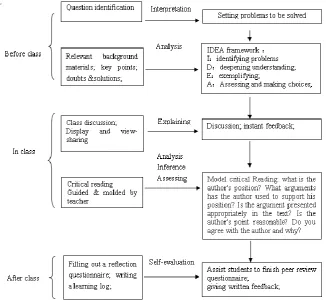
Figure 2. The process of experiments
In the phase of group pre-class activities, the teacher firstly sets up a real-life problem for students that is relevant to the topic of the unit they are going to learn, but the problems are unstructured without a fixed solution. They are intended to arouse students' interests and to form a multifaceted solution through discussion. Besides, students are provided with a framework for measuring critical thinking skills to guide and test whether or not they have applied critical thinking to the problem-solving (Facione, 2013). When students are faced with complex problems, they can use the skills of classification, identification, clarification, differentiation, interpretation and other critical thinking to sort out the context of the problem in a relaxed and orderly manner, consider the various restrictive factors comprehensively and finally find the best solution by measuring all kinds of solutions.
In class activities, teachers are supposed to provide students with the time and stage to display the results of group activities in the classroom. At the same time, teachers should provide targeted and individualized feedback to each group of students after students’ report. In addition to measuring the fluency of the students' language expression, Teachers can adopt the comprehensive evaluation of critical thinking skills and temperament of students in the process of solving problems. It is suggested that teachers adopt the criteria provided by Wen Qiufang, etc in the theoretical models of critical thinking ability. Besides offering time and stage for students to display, In order to improve students' critical reading ability and the effect of extra-curricular reading, teachers need to demonstrate the process of critical reading to students in the classroom based on textbooks. By asking questions step by step, the teacher leads students to understand the theme of the article, analyze and evaluate the logical thinking of the author, and then help students to gradually understand and master the concept and skills of critical thinking in the interpretation of an article.
It is usually possible to use the question strategy shown in figure 2 (Payne, 2006) to ask students to conduct a self-evaluation in the reflection and self-evaluation stage after class to test whether they have applied critical thinking skills to the process of problem-solving or not. Meanwhile, teachers should also evaluate whether students have displayed the temperament of critical thinking and ask students what problems have been encountered in the process of solving problems and acquiring new knowledge, whether they have actively faced and sought solutions to problems by building an environment of questioning and inquiring. Students can use logical ideas and reflect on the whole process of thinking, they are becoming more and more willing to reflect and modify their thinking.
IV. RESEARCH TOOLS &DATA COLLECTION
A. Research Tools
The present study employs both quantitative and qualitative approaches. The quantitative approach is designed to investigate the critical thinking skills and tendencies of students and to check whether there are significant differences in their second language acquisition abilities before and after the experiment. To investigate the attitudes of teachers and students towards the PBL teaching model, the main research tools are questionnaires and language tests. The test designed is based on the National College English Test 4 of 2016 (CET-4), covering the examination of listening, reading,writing and translating. The questionnaire includes questions on critical thinking skills and students’ disposition. The questionnaire employs the professor Wen Qiufang’s adapted version based on the California Critical Thinking Disposition Inventory(CCTDI) (Facione, 1992), which Includes eight dimensions: analysis, truth-seeking, curiosity, self-confidence, tenacity, openness, maturity, and fairness, were reduced from 75 to 54 items, and the dimensions of fairness are tested. The total reliability of the questionnaire is 0. 810, and the reliability of each dimension is between 0.51 (justice) and 0.73 (tenacity), so the reliability of the questionnaire is much higher than the acceptable value of 0.4.
and validity. The total reliability of the scale was 0.913, and the reliability of each dimension was between 0.496 (analysis) and 0.791 (self-regulation). The results of KMO and Bartlette's tests showed that KMO = 0.864 > 0.5, which indicates that the validity of the questionnaire is good.
B. Data Collection
The experiment includes pre-test and post-test. Two groups of students are tested by language tests and questionnaires before the beginning of PBL teaching model. By the end of PBL teaching model, two groups of students are also given language tests and questionnaires as the basis of the post-test. 180 questionnaires were sent out by the teacher in the beginning and the final period. The recovery rate is 100%, and then the language test data and the questionnaire data were entered into SPSS 17.7 to analyze. An interview for students is also carried out.
V. RESULTS AND DISCUSSION
A. Analysis on the Results of Questionnaire of the Critical Thinking Disposition
In order to compare whether there were significant differences in the use of critical thinking tendency and critical skills between the two groups after one semester’s training and study, we use an independent sample T test in pre-test and post-test. At the same time, in order to verify that each group of students have made significant differences in their own learning, paired samples are used to test the results of T test, such as Table 2 and Table 3.
TABLE II.
AVERAGE SCORES OF PRE-TEST AND POST-TEST IN EACH DIMENSION OF CRITICAL THINKING TENDENCY QUESTIONNAIRE OF EXPERIMENTAL
GROUP
Items Average scores of pre-test Average scores of post-test P values
Analysis 38. 62 40. 13 . 002
Curiosity 45. 13 45. 60 . 411
Tenacity 34. 56 35. 17 . 319
Confidence 38. 82 41. 13 . 008
Truth 37. 46 40. 07 . 028
Maturity 38. 57 40. 33 . 011
Openness 39. 89 42. 07 . 024
Justice 38. 65 43. 64 . 000
TABLE III.
INDEPENDENT SAMPLE T-TEST OF PRE-TEST AND POST-TEST RESULTS IN CRITICAL THINKING TENDENCY QUESTIONNAIRE
Items Pre-test Post-test
T values P values T values P values
Analysis .038 .970 2.641 .010
Curiosity 1.104 .272 1.957 .053
Tenacity .947 .346 1.676 .096
Confidence .362 .718 2.425 .017
Truth-seeking .667 .507 2.283 .024
Maturity .149 .882 2.150 .034
Openness 1.079 .284 2.187 .031
Justice 1.162 .248 4.341 .000
In the questionnaire of critical thinking, the scores for each dimension ranged from 10 to 60, 40 or more is with a positive tendency; 30 or below is with a negative tendency; scores between 31and 39 is with a swaying tendency. as it can be seen from Table 2, before participating in the PBL teaching experiment, the students in the experimental group have shown a positive tendency of curiosity. Although the other dimensions are not negative, they still did not reach the ideal state of positive tendency, among which, the tenacity was the least ideal.
in Table 3. The P values of critical thinking tendency in each dimension are 0.970, 0.272, 0.346, 0.718, 0.507, 0.882, 0.284, 0.248, 0.05 respectively, which indicates that there is no significant difference in critical thinking tendency between the experimental group and the control group before and after the experiment. The P values of analysis, confidence, truth-seeking, maturity, openness and justice are 0.010, 0.017, 0.024, 0.024, 0.034, 0.031, 0.000, p<0 05 respectively, which indicates that there are significant differences between the two groups in the dimensions above. but in dimensions of curiosity and tenacity, there are significant differences between the two groups. P values are 0.053 and 0.096 respectively, indicating that there is no significant difference between the two groups in the two dimensions. The results show that PBL teaching methods have a positive effect on the development of critical thinking of students. Compared with traditional teaching, PBL teaching model is more helpful to promote students' ability to solve problems and develop critical thinking.
self-confidence in the first stage of the study. However, in the third stage of the experiment, there is significant difference in the dimension of tenacity. Therefore, in this experiment, the tenacity tendency of the experimental group needs a longer experimental period to make a significant difference. Besides, there is no significant change in the dimension of curiosity. But before the experiment, the students have shown a strong positive tendency, so we believe that it is difficult to change significantly when the subjects reach a positive tendency.
B. Analysis on the Results of Questionnaires about Critical Thinking Ability
TABLE IV.
INDEPENDENT SAMPLE T-TEST OF PRE-TEST AND POST-TEST RESULTS IN CRITICAL THINKING SKILLS QUESTIONNAIRE BETWEEN TWO GROUPS
Items Pre-test Post-test
T values P values T values P values
Interpretation .723 .457 2.140 .038
Analysis .037 .967 2.150 .034
Evaluation .074 .947 2.666 .009
Reasoning 1.420 .133 .425 .671
Explanation .324 .436 2.592 .011
Self regulation .165 .566 .652 .516
TABLE V.
PAIRED SAMPLE T-TEST OF PRE-TEST AND POST-TEST IN CRITICAL THINKING ABILITY QUESTIONNAIRES BETWEEN TWO GROUPS
Items Experimental group Control group
T values P values T values P values
Interpretation 8.504 .020 .580 .566
Analysis 9.356 .002 .425 .671
Evaluation 9.478 .000 .652 .516
Reasoning 4.853 .321 .822 .312
Explanation 7.584 .026 .764 .436
Self regulation 3.760 .483 .712 .467
In the T test of independent samples of pre-test, The P values of the two groups of students in the dimensions of interpretation, analysis, evaluation, reasoning, explanation and self-regulation are 0.457, 0.967, 0.947, 0.133, 0.436, 0.566 respectively, (p>0. 05), indicating that there is no significant difference between two groups of subjects in the dimensions above. In the post-test, the P values of each dimension were. 0.038 0.034 0.009 0.671 0.011 0.516, which indicated that the two groups showed significant differences in interpretation analysis, evaluation and interpretation (p<0. 05). However, there was no significant difference between the two groups in the dimension of reasoning and self-regulation (p>0.05). in the following paired sample T-test, The P values in each dimension of the experimental group are 0.020 0.0020 0.0020 0.000 0.000 0.321 0.026 0.483 respectively, which indicates that the students in experimental group have made a significant change in interpretation, analysis, evaluation and the use of explanation skills after one term of study (p<0.05). However, there is no significant change in the dimension of reasoning and self-regulation (p>0.05). The results of paired sample t-test show that the P value of each dimension is greater than 0. 05, indicating that the traditional teaching does not have a significant impact on students’ critical thinking ability. in comparison, the PBL teaching model has provided students with abundant pre-class and after-class activities, which have offered students a wide range of space to develop and use their critical thinking ability through defining problems, analyzing materials, demonstrating programs, presenting results, self-evaluating and peer evaluating. The research result is very similar to the conclusion of Albanese Mitchell (2009) that the introduction of PBL teaching model has a significant effect on the improvement of students' meta-cognitive ability with manifestation in the improvement of students' ability to understand concepts and apply knowledge.
C. Analysis of Language Test Results
TABLE VI.
TWO SETS OF INDEPENDENT SAMPLE T-TESTS IN LANGUAGE TESTING
Pre-test of listening 11. 0000 2. 18143 10. 4667 2. 01260 0. 5333 . 984 . 329 Post-test of listening 13. 7000 2. 84241 11. 5667 2. 22344 2. 1333 3. 238 . 002 Pre-test of reading 26. 3333 3. 15500 25. 6000 3. 27225 0. 7333 1. 018 . 313 Post-test of reading 30. 000 2. 97113 26. 333 1. 94641 3. 667 5. 695 . 000 Pre-test of writing 9. 4000 1. 27577 9. 0000 1. 25945 0. 4000 1. 222 . 227 Post-test of writing 11. 4667 1. 19578 10. 0333 1. 32570 1. 43333 4. 397 . 000
promote the improvement of students' language ability. Through interviews, teachers and most of the students agree that the PBL model plays a positive role in English learning. In addition to developing the habit of finding evidence on the basis of research and increasing the sense of teamwork. From activities before class and in class, students have made full use of the platform to train their language ability. the forms of language output, such as oral reports and performance, have strengthened students' phonetic correction, and indirectly have promoted the level of listening comprehension. in terms of reading skills, Students are required to do critical reading based on textbooks, and problem-solving is considered as the core to constantly stimulate them to find answers in extracurricular reading. In terms of writing, high-quality oral reports come from high-quality written output. Classroom presentations in each unit give them plenty of opportunities to write, thereby helping students to activate their reserves of vocabulary and grammar, and to constantly revise and improve their ability to make sentences and form discourses. A large number of exercises over time have reduced students' fear of English learning and have gradually formed the habit of expressing in English. Therefore, in the PBL teaching model, the students' language ability has been comprehensively improved.
VI. CONCLUSION
The research indicates that PBL teaching model can promote the development of students' critical thinking ability and improve their second language acquisition ability compared with the traditional teaching, so that students can autonomously construct the new knowledge while achieving the development of the ability at the same time. But the experiment has also faced with unprecedented challenges, it is fundamental to the success of the experiment that teachers can actively and effectively change students from traditional passive knowledge receivers to active knowledge builders. The systematic and strict examination system is the guarantee of the experiment. The evaluation standard of critical thinking ability is the main criteria to examine the students' learning achievement. Some students have not fully adapted to the new learning model because of the short period of the experiment. Therefore, the development of some critical thinking ability and disposition requires a longer period in research and teaching practice. In addition, the limitations of measuring tools have also led to the inability of the experimental data to fully reflect the development of the subjects' abilities. Therefore, a variety of evaluation and testing methods should be applied in future research.
ACKNOWLEDGEMENTS
The research in this paper was supported by Tianjin Municipal Education Commission "the 13th 5-Year" Planning Project: Research on the Assessment Standards of Teachers' Professional Developments in Higher Institutions (NO. HE1003)
REFERENCES
[1] Albanese, M. A & S. Mitchell. (2009). Problem-based learning: A review of literature on its outcomes and implementation issues. Academic Medicine 68.1, 52– 81.
[2] Boud, D. J & G. Feletti. (1997). The Challenge of Problem-based Learning. London: Kogan-Page.
[3] Burris, S & B. L. Garton. (2007). Effect of instructional strategy on critical thinking and content knowledge: Using problem-based learning in the secondary classroom. Journal of Agricultural Education.48.2, 106-116.
[4] Dochy, F, et al. (2003). Effects of problem-based learning: A meta-analysis. Learning and Instruction.13. 5, 533-568. [5] Facione, P. (1992). The California Critical Thinking Disposition Inventory.CA: The California Academic press.
[6] Facione, P & C. A Gittens. (2013). Think Critically [Z/OL] [2013.06.09]. http://wps.Pearsoncustom.com/wps/media/objects/14127/14466175/HUM180_Ch03.pdf.
[7] Nelson, E. T. (2008). Effects of Online Problem-based Learning on Teachers' Technology Integration Perceptions and Planning. Retrieved from ProQuest Digital Dissertations.AAT 3290657.
[8] Payne, E & L. Whittaker. (2006). Developing Essential Study Skills. Harlow. England: Pearson Education Limited.
[9] Tiwari, A, et al. (2012). A comparison of the effects of problem-based learning and lecturing on the development of students' critical thinking. Medical Education. 40. 6, 547-554.
[10] Tiwari, A, et al. (1999). Enhancing students' critical thinking through problem-based learning. Marsh. Implementing Problem Based Learning Project: Proceedings of the First Asia Pacific Conference on Problem Based Learning. Hong Kong: The University Grants Committee of HongKong, Teaching Development Project. 75-86.
[11] Wen Qiufang, etc. (2009). The theoretical framework for the construction of foreign language students' speculative ability measuring tools in China. Foreign Language World 46.1, 37–43.
[12] Zhao Fei, Zou Weicheng. (2015). The theoretical Construction of interaction hypothesis: meaning, dilemma and solutions.
Foreign language Teaching Theory and Practice 68.2, 78–86.
[13] Zhi Yongbi. (2014). Application of PBL in foreign language education in China. Foreign language and Foreign language Teaching 83,7. 33–37.