Cloud Assessment Workshop
Rob Roebeling
Weather Research
Thanks to:
Hartwig Deneke, Bastiaan Jonkheid, Wouter Greuell , Jan Fokke Meirink and Erwin Wolters (KNMI)
MSG-SEVIRI
Introduction
Motivation
Retrieval of cloud and precipitation properties
Validation and inter-comparison studies
Model evaluation
Motivation
Trend studies (
annual, seasonal
and diurnal)
Evaluation of model parameterisations
Studies of feedback mechanism
Studies of aerosols indirect effects
Retrieval: Cloud Physical Properties
Algorithm
Satellites
: MSG
(SEVIRI),
NOAA
(AVHRR),
Terra & Aqua
(MODIS)
Channels
:
VIS (
0.63
m)
and
NIR
(
1.6
m
) and IR (10.8
m)
Products CM-SAF :
CPH, COT, LWP, IWP
Products KNMI
: CFC, CTT, REF, Precip, SSI, DCLD, DnDv
Models
Doubling Adding KNMI model (DAK) & SHDOM
Auxiliary
Surface reflectance(MODIS white sky albedo)
Product Overview
Product Unit Note
CFC Cloud Fraction [%]
COT Cloud Optical Thickness [-]
REFF Particle size [m]
CPH Cloud Thermodynamic Phase [-] CTT Cloud Top Temperature [K]
CTH Cloud Top Height [hPa]
LWP Liquid Water Path [g m-2]
IWP Ice Water Path [g m-2]
CGT Geometrical Depth [m] Water clouds only CDNC Droplet Number Concentration [cm-3] Water clouds only
IRR Surface Solar Irradiance [W m-2]
Example: Cloud Phase and Cloud Optical Thickness
Cloud Thermodynamic Phase Water Ice Clear
Validation
&
Cabauw
Paris Chilbolton
Validation: Overview
Validation activities
Comparison against ground-based
observations;
Comparison against retrievals of other
providers;
Comparison against other A-Train
instruments (Cloudsat, Calipso, AMSU)
Validation Overview
Product Unit Acc. Prec. Ref
Cloud Optical Thickness [-] ~15% ~25%
Particle size (Water (ice)) [m] 2 (10) 5 (30)
Cloud Thermodynamic Phase [%] 5 15 Wolters et al. (2008), JAMC
Cloud Top Temperature [K] 5 10 Feijt et al. (1999),Phys. Chem.of the Earth
Liquid Water Path [g m-2] 5 25 Roebeling et al. (2008), JAMC
Greuell and Roebeling (2009), JAMC Schutgens and Roebeling (2009), JTECH
Geometrical Depth (water cloud) [m] 50 120 Roebeling et al. (2008), GRL
Droplet nr. Conc. (water cloud) [cm-3] - - Roebeling et al. (2008), GRL
Surface Solar Irradiance [W m-2] 5 20 Deneke et al. (2008), RSE
Rain Occurrence [%] 1 10 Roebeling and Holleman (2009), JGR
Rain Rate [mm hr-1] 0.1 1.0 Roebeling and Holleman (2009), JGR
EUMETSAT algorithm inter-comparison activity
Objective
To quantify the differences between cloud properties algorithms to for passive
imagers (e.g. SEVIRI, MODIS, AVHRR)
Method
•
To inter-compare SEVIRI cloud properties retrievals of different algorithms;
•
To inter-compare cloud properties retrievals from different satellites;
•
To compare passive imager cloud properties to independent measurements.
Response
•
About
50
participants from research groups in Europe and North America
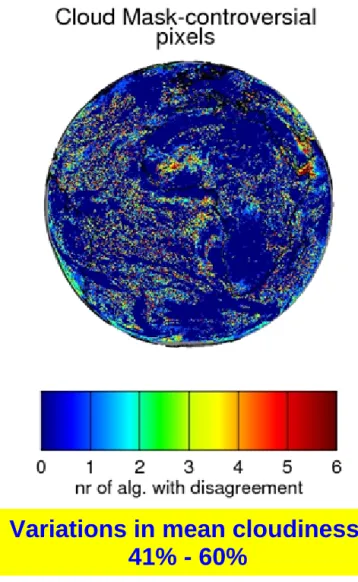
Example: inter-comparison cloud masks
Fig. : Cloud masks of 12 MSG algorithms
Variations in mean cloudiness
41% - 60%
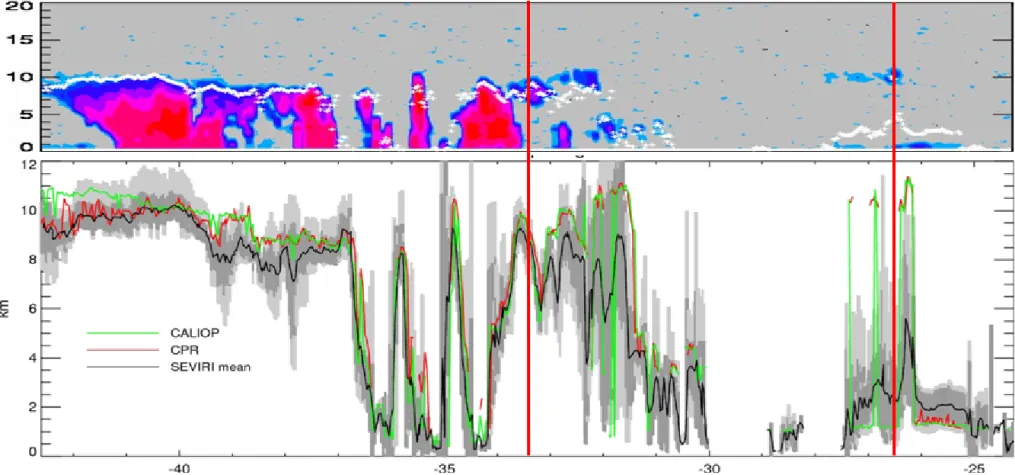
SEVIRI–CTH vs. Calipso/Cloudsat-CTH
Taylor diagrams Cloud Top Height
Level 2 vs. Level 3
Satellite data
Model simulation
Model - satellite
TOA albedo
Cloud cover
RACMO evaluation using
Satellite data
Model simulation
Model - satellite
Condensed Water Path
Effect of model modifications
Fig. : Cloud cover along track through
stratocumulus field
Fig. : Condensed water path along track
Evaluation: RACMO seasonal means
SEVIRI
SEVIRI
RACMO
RACMO
SEVIRI
RACMO
Diurnal cycle over land and ocean
MED SAO
Seasonal cycle
land 2 land 1
Diurnal cycle
land 2 land 1
land 2 land 1
Conclusions
Very accurate calibration is required for generating climatologies;
Validation against independent observations confirm accurate and
precise radiation, cloud and precipitation properties retrievals;
SEVIRI derived cloud information is valuable for evaluating
spatial
diurnal
and
seasonal
variations weather and climate models;
Differences in Level3 data partly result from cloud masking, the
treatment of cloud free pixels and differences in averaging methods;