THE GENERATION GAP BETWEEN GROUP AFFILIATION AND POLITICS: HOW AGE INFLUENCES THE POLITICAL IMPACT OF RELIGIOUS COMMITMENT
AMONGST EVANGELICALS
Kristin N. Garrett
A thesis submitted to the faculty of the University of North Carolina at Chapel Hill in partial fulfillment of the requirements for the degree of Master of Arts in the Department of Political Science (American Politics).
Chapel Hill 2013
ABSTRACT
KRISTIN N. GARRETT: The Generation Gap Between Group Affiliation and Politics: How Age Influences the Political Impact of Religious Commitment Amongst Evangelicals
(Under the direction of Thomas M. Carsey.)
ACKNOWLEDGMENTS
TABLE OF CONTENTS
LIST OF TABLES . . . v
LIST OF FIGURES . . . vi
Introduction . . . 1
Theory . . . 2
Social Groups, Socializing Environments, and Political Behavior . . . 2
Evangelical Affiliation . . . 6
Age Cohort Socialization . . . 8
Contextual Complexity for Young and Older Evangelicals . . . 9
Hypothesis . . . 11
Data and Methods . . . 11
Analysis . . . 13
Results . . . 13
Discussion . . . 17
Conclusion . . . 20
APPENDIX . . . 21
Section A . . . 21
Section B . . . 22
Section C . . . 23
LIST OF TABLES
Table
LIST OF FIGURES
Figure
1 Estimated Marginal Effect of Religious Commitment on Evangelicals’ Party Iden-tification . . . 15 2 Estimated Marginal Effect of Religious Commitment on Evangelicals’ Political
Ideology . . . 16 3 Estimated Marginal Effect of Religious Commitment on Evangelicals’ Presidential
Introduction
Since the classic Columbia voting studies (Berelson, Lazarsfeld and McPhee 1954; Lazarsfeld, Berelson and Gaudet 1944), scholars of American political behavior have presented persuasive evidence that social groups influence members’ political actions and affiliations (e.g., Cohen 2003; Conover 1988; Manza and Brooks 1991; Leege et al. 2002). Contextual effects scholarship, which builds on the Columbia tradition, has also suggested that social environments shape individuals’ political choices (Huckfeldt and Sprague 1993; Huckfeldt 1986; Sprague 1982). Up to this point, however, the majority of work on the political importance of group affiliations has focused on the straightforward connection between people’s group behavior and their political behavior, largely overlooking the influence of socializing environments on this connection. Consequently, earlier studies have laid the foundation for us to advance scholarship on the political relevance of social groups by investigating the mediating impact of socializing contexts. I build on this foundation by examining how the unique environment in which people come of age politically affects the translation of their religious affiliation to their politics.
Decades of research have established that individuals live in multiple, overlapping contexts of social experience, including workplaces, geographic areas, social groups, and historical settings, which influence their partisanship, issue attitudes, and voting behavior (e.g., Huckfeldt, Plutzer and Sprague 1993; Huckfeldt et al. 1995; McClurg 2006; Segal and Meyer 1974; Wald, Owen and Hill 1988). Based on the political messages and social norms they convey, these intersecting environments can either strengthen the connection people feel to a particular political candidate or party or they can pull people in different directions, placing cross–pressure on their politi-cal decisions (Berelson, Lazarsfeld and McPhee 1954; Huckfeldt and Sprague 1993; Lazarsfeld, Berelson and Gaudet 1944). While scholars have applied this insight in the context of polit-ical participation, they have rarely examined how the reinforcing or conflicting pressures that result from different socializing environments influence the translation of group affiliations to partisanship, ideology, and voting decisions.
over-lapping values, group membership alone is enough to shape their political behavior. In contrast, when people face high contextual complexity, meaning their cultural settings and social groups communicate conflicting political messages and generate cross–pressures, membership in a group is no longer sufficient to predict their political positions. Rather, personal commitment to the group becomes more important in shaping how the group’s norms translate to members’ politics. I apply this theory to examine how age mediates the connection between the religious and political behavior of evangelical Protestants. I examine age because it serves as a proxy for having been socialized into politics under distinct environmental circumstances, and I argue that differences in the generational period in which members of a group are introduced to politics will influence how these members translate group norms into political actions and affiliations. More specifically, I hypothesize that the political effect of religious commitment will be greater amongst young evangelicals, who are pulled between the political cues of their religious group and socializing environment, than amongst older evangelicals, who established their political views in a social setting that largely reinforced their religious tradition’s political message.
To test this argument, I utilize 2008 American National Election Studies (ANES) data, and I limit analysis to self–identified evangelical respondents. The findings of this study lend support to my hypothesis: religious commitment is more politically important for young evangelicals— the age cohort of “believers” who have experienced greater contextual complexity as they have been socialized into politics.
Theory
Social Groups, Socializing Environments, and Political Behavior
Huckfeldt and Sprague (1993, 281) write that mass politics is best understood as “the end product of [the] intersections between groups and individuals within a particular time period and a particular place.” This quote illustrates two important points. First, group affiliations affect individuals’ politics. Second, specific social environments influence how overlapping group dynamics and personal factors translate to political behavior. These insights from the contextual approach outline the subsequent discussion.
their values. In other words, social groups communicate shared patterns of thoughts, feelings, symbols, and standards, which influence affiliates’ perspectives on aspects of everyday reality, including political events, parties, issues, and candidates (Leege et al. 2002; Wuthnow 1987). By conveying specific messages, cultivating common experiences, and facilitating distinct styles of learning, groups encourage individuals to link cultural, religious, moral, and political values in a particular way (Sprague 1982; Sapiro 2004). Groups also reinforce certain political perspectives by encouraging social cohesion. When group members recurrently interact, they strengthen each other’s commitment to shared norms. Consequently, individuals who spend a lot of time with a group are more likely to display political attitudes consistent with the group’s values (Wald, Owen and Hill 1990; Wald, Kellstedt and Leege 1993). Whether people are aware of it or not, their social affiliations influence their political behavior (Cohen 2003).
To the second point, cultural contexts also affect people’s politics. Social environments, including those related to a particular time, region, association, or demographic, influence polit-ical actions and affiliations by shaping the circumstances under which individuals adopt politpolit-ical commitments. More specifically, social settings circumscribe the relational interactions that impact one’s political evaluations, filter the information that shapes one’s political reality, and generate pressure for one to conform with collectively held political views (Huckfeldt 1986; Huck-feldt and Sprague 1993, 1995; HuckHuck-feldt, Johnson and Sprague 2002; MacKuen and Brown 1987; McClurg 2006; Sprague 1982). Consequently, environmental contexts, like group associations, help to socialize people into politics, particularly when these contexts are experienced during the early “impressionable years” when individuals are first introduced to politics (Hyman 1959; Pacheco 2008; Sapiro 2004; Sears and Levy 2003).1 In fact, group affiliations serve as an impor-tant context of social and political influence because they facilitate ongoing personal contacts, communicate particular norms, and reinforce political perspectives.
one’s aggregate social context shapes how exposure to political disagreement in one’s immediate relationships affects political participation.
The literature on cross–cutting cleavages and cross–pressures suggests that overlapping per-sonal interactions, group affiliations, and social environments can either pull people in divergent political directions, placing cross–pressure on their political decisions, or they can mutually re-inforce people’s political commitments (e.g., Berelson, Lazarsfeld and McPhee 1954; Lazarsfeld, Berelson and Gaudet 1944; Lipset and Rokkan 1967; Powell 1976; Simmel 1955). For the pur-pose of this study, it is important to note that the social and political values associated with the larger cultural environment in which a person is socialized into politics can either contradict or complement the social and political norms espoused by a particular community. Throughout this article, I will use the termcontextual complexity to signifying the extent to which messages, values, and norms from one’s aggregate social environment and individual group affiliation either conflict or overlap when shaping one’s political positions. People face high contextual complexity when their larger cultural and smaller community environments place cross–pressure on their political decisions, and they face low contextual complexity when these social settings encourage complementing political perspectives.
The concept of contextual complexity challenges simplistic notions regarding the direct im-pact of group affiliations on individuals’ voting decisions, ideology, and partisanship. Rather than a straightforward translation of group values to members’ political behavior, the effect of one’s group affiliation on one’s politics likely depends on the extent of overlap between the norms espoused by one’s group and by one’s broader socializing environment. Consequently, high and low contextual complexity are expected to influence the political impact of individuals’ group behavior in distinct ways. This raises the central question of concern: how does contextual complexity—reflecting either reinforcing– or cross–pressures from the cultural environment in which people are socialized into politics—affect the political impact of people’s group affilia-tions? As I explain below, I posit that greater contextual complexity heightens the effect of group commitment on the translation of group norms to individuals’ politics.
become more politically relevant in situations where they face cross–pressure from divergent af-filiations, environments, or values. More specifically, individuals who are pulled away from their ingroup’s norms by pressures from their larger socializing context are more likely to adjust or discount these norms unless countervailing forces keep them from doing so. Thus, when group members face cross–pressure from the aggregate environment, the factors that influence them to hold tightly to their community’s values will matter more in the translation of the community’s norms to their political behavior. Lending evidence to this theory, McClurg (2006) finds that the larger social and political context in which personal interactions take place influences the effect of these interactions on political participation. He reports that, in comparison to indi-viduals who hold the same political positions as the majority of their neighborhood, personal exchanges with immediate friends and family have a bigger effect on the political participation of individuals who hold less popular opinions in their district. When facing cross–pressure from the aggregate social environment, it appears that support from one’s immediate social network exerts more influence on one’s political involvement. In extension, when contextual complexity is high, factors that reinforce commitment to group norms will likely become more relevant in the translation of group values to individual voting behavior, partisanship, and ideology. For this reason, we need to consider what dynamics strengthen people’s dedication to ingroup norms.
of social settings (Huckfeldt and Sprague 1993; MacKuen and Brown 1987). People are more influenced by the political views of friends with whom they actively participate as members of a community than they are by the abstract values of a group with which they casually associate. To summarize these insights, group behaviors that inculcate and reinforce group norms influ-ence how tightly individuals hold to group values, as well as how likely these values are to shape individuals’ political actions and affiliations. For the sake of simplicity, I utilize the termgroup commitment to reference one’s involvement with a group, self-reported relevance of a group, and frequency of interaction with other group members. In summary, therefore, when people face socializing circumstances that pull them away from an ingroup’s prevailing political posi-tions, group commitment will play a heightened role in the translation of the ingroup’s values to individuals’ politics. Applying this insight to the research question at hand, level of group commitment will have a greater impact on the political relevance of group associations amongst people who are introduced to politics in complex, cross–pressured contexts.
In contrast, when contextual complexity is low, the relative political effect of a person’s in-volvement with a community will decrease. People do not need extra incentive to act according to an ingroup’s social and political values when the larger cultural environment already reinforces the ingroup’s dominant views. As I referenced above, McClurg (2006) finds that personal network interactions have little effect on the political participation of people who side with the neigh-borhood majority on politics because the aggregate social environment already supports their political perspective. It appears that citizens need less immediate support to maintain political positions that pervade the cultural context in which they come of age politically. Consequently, I expect that group commitment will matter less to the political behavior of individuals who are socialized into politics in an environment that largely reinforces their group’s prevalent norms.
Evangelical Affiliation
Shafer 1991). Furthermore, Layman and Carmines (1997) report that the cultural division be-tween religious traditionalists and religious liberals and secularists has surpassed Inglehart’s Materialist–Postmaterialist division as the cultural cleavage most relevant to American politics. More specifically, evangelicalism has played a central role in linking religious affiliates to pol-itics since the 1970s and 1980s, when the Moral Majority and Religious Right burst on the political scene (Green, Rozell and Wilcox 2003, 2006; Kellstedt, Green, Smidt and Guth 1996; Layman 2001). Therefore, if socializing environments influence how evangelical religious com-mitment translates to politics, this effect is particularly consequential for how we think about mass political behavior in the U.S.
Second, I focus on evangelical Protestants because this group poses a “hard case” for my theory that different socializing contexts distinctly shape the political impact of group commit-ment. The strong link between evangelicals’ religious beliefs and their political behavior should be difficult for forces in the aggregate social environment to shift. Historically, religious groups provide members an identity and meaning, encourage social interactions, maintain group bound-aries, convey norms of behavior, and shape perceptions of reality (Layman 2001; Leege, Lieske and Wald 1991; Leege and Kellstedt 1993). Through these processes, religious affiliations help to produce and maintain common political perspectives (Kellstedt, Green, Guth and Smidt 1996; Leege et al. 2002; Layman and Green 2006). Consequently, religious traditions tend to have a powerful effect on members’ political actions and affiliations (Kellstedt and Green 1993; Wald, Owen and Hill 1988; Wilcox, Jelen and Leege 1993).
Evangelical communities, in particular, have encouraged notably strong links between their affiliates’ religious beliefs and political behavior since the 1970s, leading scholars of religion and politics to emphasize the tight connection between evangelicals and the Republican Party (e.g., Green 2007; Layman 2001; Kohut et al. 2000; Putnam and Campbell 2010; Wald and Calhoun-Brown 2007). The bond between evangelical Protestants and conservative politics is so firmly established that evangelicals are often uniformly lumped into the “Religious Right” or the “Christian Right” category. Any shift in the translation of evangelicals’ religious values to their politics has to overcome this link. Therefore, the threshold is high for different socializing contexts to influence changes in the political relevance of religious commitment.
Fourth, I examine evangelicalism because the social and political environment under which this group’s members have been socialized into politics has shifted in the last decade, allowing me to compare the political effect of religious commitment in socializing contexts of low versus high contextual complexity. The older respondents in my ANES data have, by and large, received clear and consistent cues over the years that have reinforced the tight connection between their religious identity and the Republican Party. Only recently have evangelicals who are coming of age politically experienced substantial cross–pressure from the cultural environment, which challenges their religious community’s political influence. I present my full argument for this proposition in a subsequent section.
Age Cohort Socialization
I include age in this study as a proxy for having been socialized into politics under different eras. Decades of research have shown that age is a key variable that influences electoral politics (e.g., Braungart and Braungart 1986; Campbell et al. 1960; Eisenstadt 1956; Fisher 2008, 2010). More importantly, age cohort socialization facilitates the development of distinct political values and affiliations amongst different generations (Beck and Jennings 1991; Cain 1964; Foner 1974). Each birth cohort grows up in a unique historical environment, where different political issues, material realities, social concerns, and cultural values are salient. Consequently, generations tend to develop distinct political norms, attitudes, and behaviors (Mannheim 1952; Ryder 1965). Ac-cording to the persistence and impressionable years models, the political commitments that develop early in life persist throughout later stages of life (Sears and Levy 2003). As such, the generational politics literature argues that birth cohorts share lasting political identities (Braun-gart and Braun(Braun-gart 1986; Eisenstadt 1956; Mannheim 1952; Ryder 1965). Scholars also report that “generational effects” have contributed to party realignment along age lines in response to key issues and events throughout American history (e.g., Campbell 2002; Foner 1974; Greene and Saunders 2011; Sears and Levy 2003). Based on her findings, Pacheco (2008, 416) writes that “contexts experienced during political development are as important to understanding political behavior as contemporaneous political contexts.”
compare how reinforcing or cross–cutting forces from different socializing environments mediate the translation of group affiliations to politics.3
In this analysis, I focus on a dichotomous comparison between older adults and the highly publicized Millennial generation. Sociologists suggest that substantial differences separate this new category of emerging adults from older age groups (e.g., Arnett 2004; Howe and Strauss 2000; Twenge 2006; Zukin et al. 2006). Whether labeled “Millennials,” “DotNets,” “Generation Next,” or “Generation Me,” 18– to 29–year–old Americans have been socialized in a vastly different social, technological, economic, and political environment than previous generations. In comparison to older cohorts, Millennials tend to marry and have children later, to pursue more education, to have more diverse friends, to put off long–term commitments, to question institutional authority, and to experiment with a wide range of life experiences (Smith and Snell 2009; Smith et al. 2011; Wuthnow 2007). More importantly, as the subsequent discussion will expound, the social and political factors that influence the Millennial generation tend to complicate the historical connection between evangelicals and right–wing politics. Consequently, generational differences between young and older evangelicals provide an excellent opportunity to test the theory that individuals’ religious commitment becomes more politically important in the context of cross–cutting social pressures.
Contextual Complexity for Young and Older Evangelicals
In order to predict how different generational contexts and levels of religious commitment intersect to influence political actions and affiliations, it is important to understand how the socializing environments experienced by different generations of evangelicals reinforce or contra-dict the values communicated by their religious tradition. As I allude to above and explain more fully below, several factors have influenced distinct levels of contextual complexity for Millennial and older evangelicals.
over evangelicals. He reports that in the 1970s, GOP activists strategically seized issues like abortion, school prayer, and women’s rights as an opportunity to gain political ground. Since that time, Republican candidates have actively courted evangelical leaders and voters with their culturally conservative issue agenda.
Second, older evangelicals have received internal cues from pastors, religious leaders, and other congregants encouraging them to support the Republican Party. Evangelical clergy have historically urged members to adopt conservative political positions (Guth 1983; Guth et al. 1997; Welch et al. 1993). Church members have also influenced their peers to shift towards the political right (Wald, Owen and Hill 1988, 1990). Finally, national evangelical leaders and organizations, including Jerry Falwell, Pat Robertson, Gary Bauer, the Moral Majority, and the Christian Coalition, have worked to rally support for the Republican Party over the years (Green, Rozell and Wilcox 2003; Green 2007).
Third, when it comes to values, evangelical congregations have historically espoused conserva-tive theological positions, which often translate to conservaconserva-tive political attitudes. Consequently, evangelics have generally embraced traditional positions on abortion, same–sex marriage, racial issues, social welfare, defense spending, the environment, and government involvement (Layman and Green 2006; Putnam and Campbell 2010). In previous generations, evangelicals did not receive as much cultural push-back for their conservative stances. All of these factors suggest that the social and political environment in which older evangelicals were introduced to politics helped to strengthen the connection between their religious affiliation and conservative politics. These socializing circumstances are likely to have produced lasting effects that continue to influ-ence older evangelicals’ political positions into the present (Beck and Jennings 1991; Campbell et al. 1960).
While many of the same internal signals and religious values are expressed in the context of evangelical churches today, competing cultural cues and norms also vie for young evangelicals’ attention. First, Millennial evangelicals have grown up in a different political environment than older evangelicals. While older believers were energized by Ronald Reagan’s time in office, young evangelicals were largely alienated by George W. Bush’s presidency and inspired by Barack Obama’s campaigns. Furthermore, Democratic party leaders have actively appealed to Christian constituents over the last ten years (Smidt et al. 2010). Democratic candidates have successfully connected with Millennial evangelicals on an expanded range of moral value issues: poverty reform, universal health care, environmental protection, racial equality, and same–sex marriage (Putnam and Campbell 2010).
which likely contradict the messages communicated in conservative evangelical congregations. National religious leaders like Jim Wallis and Donald Miller, who encourage and defend lib-eral issue attitudes with religious rationales, have become increasingly popular amongst young evangelicals. Also, Christian organizations like Sojourners, Call to Renewal, and RELEVANT Magazine urge young believers to translate their religious beliefs into liberal political positions (Smidt et al. 2010).
Finally, young evangelicals have grown up with more religiously, sexually, and racially diverse friends who encourage them to celebrate a variety of social values and personal choices, as well as to push back on conventional notions of biblical literalism and absolute morality (Arnett 2004; Smith and Snell 2009; Smith et al. 2011; Zukin et al. 2006). This environment of increased open– mindedness contradicts many of the conservative political cues sent to Millennial evangelicals by their parents and pastors. As a result, young evangelicals have been socialized into politics in a cultural context that pushes them in a different political direction than their religious affiliation.
Hypothesis
I have already presented my case that group membership alone is enough to predict political behavior and identities when contextual complexity is low, while group commitment becomes more politically important when contextual complexity is high. Applying this theoretical frame-work to different generations of evangelicals, I expect that one’s level of commitment to one’s evangelical community will matter more for the translation of evangelical norms to personal poli-tics when one’s socializing environment and religious group generate cross–pressure. In contrast, when the cultural context in which one comes of age politically reinforces—or, at minimum, does not weaken—the predominant political influences of one’s evangelical association, I expect that the evangelical label is largely enough to predict one’s political behavior, regardless of religious commitment. Based on the lower contextual complexity experienced by older evangelicals and the higher complexity faced by young evangelicals, I hypothesize:
The influence of religious commitment on voting behavior, partisanship, and ideology
is greater amongst Millennial evangelicals than amongst older evangelicals.
Data and Methods
denomi-national traditions.4 Among evangelicals, African Americans and whites differ substantially in their political behavior (see McDaniel and Ellison 2008; Steensland et al. 2000), but there are not enough African American evangelicals in the ANES sample to analyze this group separately. Therefore, I limit my analysis to white evangelicals. Finally, I utilize multiple imputation to replace missing data.5
The key explanatory variables in this analysis are age, religious commitment, and an in-teraction term consisting of age multiplied by religious commitment.6 In order to test the mediating effect of young and older evangelicals’ different socializing environments, I codeage as a dichotomous variable where zero indicates respondents who are 30 and older and one indicates respondents who are 18 to 29.7 In order to operationalizereligious commitment, I use principal components factor analysis to combine the standard indicators that are available in the 2008 NES study: religious salience (guidance), frequency of worship attendance, and frequency of prayer (Green 2007; Layman 2001; Leege and Kellstedt 1993).8 All three items load strongly on a single factor, and I use this factor score to indicate religious commitment.9 Control variables include income, education, gender, union membership, region of residence (South vs. non-South), and race and ethnicity.10
The dependent variables in this analysis are party identification, ideology, and presidential 4While other methods of coding evangelicals are available (Hackett and Lindsay 2008), these methods typically utilize questions related to religious beliefs and commitments, posing a problem for this study, which uses mea-sures of commitment as an explanatory variable. Other meamea-sures rely on survey respondents’ self-identification as evangelical—an indicator the 2008 ANES does not include. For these reasons, Steensland et al.’s (2000) “RELTRAD” measure is optimal for this study. See Section A of the Appendix for the complete coding scheme.
5Multiple imputation has been shown to be an unbiased, efficient method of dealing with missing data, which produces better inference than standard pairwise or listwise deletion (Little and Rubin 2002; Rubin 1987; Schafer 1997). Based on Little and Rubin’s (2002) suggestion that 5-10 imputations produce unbiased estimates, I create 10 replicate data sets to use in my analysis. See Section C of the Appendix for more information on multiple imputation.
6The religion and politics literature typically considers religious commitment and orthodoxy to be distinct predictors of political behavior and includes both of these indicators in all analyses (see Green et al. 1996; Green 2007; Layman 1997, 2001; Leege and Kellstedt 1993). I agree that these unique dimensions of religious affiliation are both important predictors, but in keeping with my theory, I focus my analysis on religious commitment and exclude doctrinal orthodoxy. Looking at the ANES questions used to measure religious orthodoxy (namely a respondent’s view of Scripture and identification as a born–again believer), this variable largely captures how respondents define their faith. It does not reflect religious importance or participation. While I do not include religious orthodoxy in my primary analysis, I do run models including both religious orthodoxy and commitment. Despite high levels of multicollinearity between these variables, the results from the orthodoxy and commitment models are similar to the findings I present for the religious commitment models (Table 2). Also, I follow the religion and politics literature in separating religious orthodoxy and commitment into two distinct variables, but I do run models combining the indicators for these variables into one measure of religiosity. The results from these religiosity models, which can be viewed in Section B of the Appendix, mirror the results from the religious commitment models (Table 2).
7I follow Arnett (2000, 2004), who indicates that the age range 18–29 best captures the unique life–stage of emerging adulthood. While scholars disagree about which dates define the Emerging Adult cohort, they largely agree that Millennials are born somewhere between 1978 and 2000 (Twenge 2006; Zukin et al. 2006). Therefore, the 18–29 age range captures the Millennial Generation arguably well.
8See Section A of the Appendix for the 2008 NES question wording for this indicator.
9This factor has an eigenvalue of 2.11 and explains 70% of the total variance in the three indicators. The factor loadings range from .81 to .87.
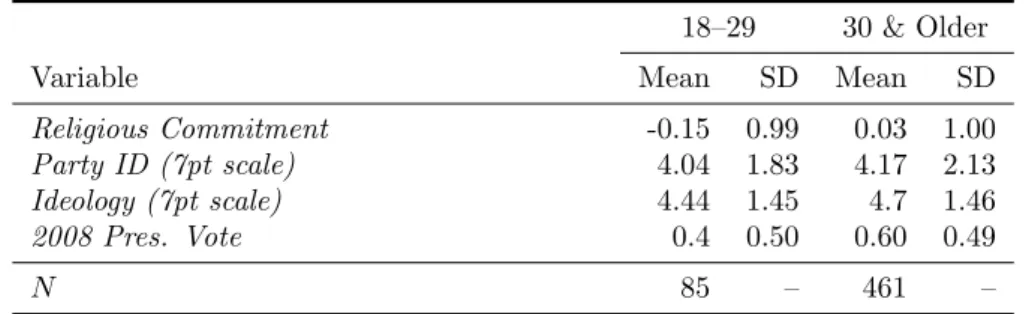
vote choice. Party identification andideology are coded as a 7–point scale, respectively ranging from Strong Democrat to Strong Republican and from Strong Liberal to Strong Conservative. Presidential vote choiceis coded zero for the Democratic candidate, Barack Obama, and one for the Republican candidate, John McCain. Table 1 provides an overview of the key independent and dependent variables included in this analysis, broken down between Millennial and older evangelicals.
Table 1: Variable Overview: Means and Standard Deviations
18–29 30 & Older
Variable Mean SD Mean SD
Religious Commitment -0.15 0.99 0.03 1.00
Party ID (7pt scale) 4.04 1.83 4.17 2.13
Ideology (7pt scale) 4.44 1.45 4.7 1.46
2008 Pres. Vote 0.4 0.50 0.60 0.49
N 85 – 461 –
Note: With imputed data, all of the differences
in means are significant atp <0.05
Analysis
In order to test the marginal effect of age and religious commitment on politics, I utilize linear regression to model party identification and ideology and logitistic regression to model presidential vote choice. I regress all three political variables on age, religious commitment, the interaction term, and the demographic controls, modeling the following equation:
DVi=β0+β1M illennialsi+β2Commitmenti+β3(M illennialsi∗Commitmenti)+β4Controlsi+ei
After running models for each response variable, I utilize Rubin’s combination rules to pool the results from the 10 imputed data sets (Little and Rubin 2002; Rubin 1987). This means that I include both between and within imputation variance when calculating standard errors, and I adjust the degrees of freedom to account for imputation uncertainty.11
Results
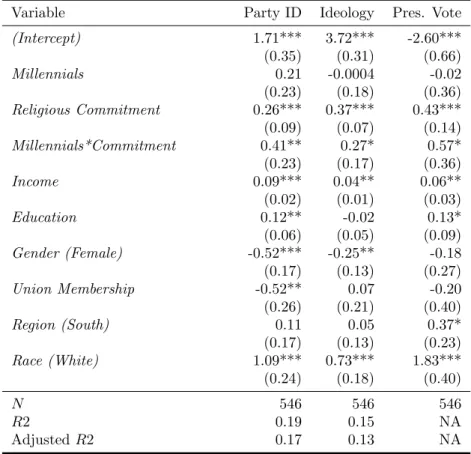
Table 2 presents the parameter estimates that result from the models for party identification, ideology, and presidential vote. The coefficients on religious commitment capture the marginal effect of this variable on the political regressands for older evangelicals. In all three cases, this
effect is positive and significant at the 0.01 level, which indicates that commitment to one’s religious group does matter, even among those who face lower contextual complexity. More importantly, the coefficients on the interaction terms between religious commitment and age are also positive and significant at the 0.10 level. This indicates that the marginal effect of religious commitment on party identification, ideology, and presidential vote choice is in the same direction, but significantly larger, for Millennial evangelicals compared to older evangelicals. For every one unit increase in religious commitment, we expect a marginal increase of .41 in party identification, of .27 in ideology, and of .57 in the log odds of voting for McCain amongst young evangelicals, relative to the change we expect amongst older evangelicals. These results support my hypothesis that religious commitment influences political behavior and identity to a greater extent amongst young evangelicals than it does amongst older evangelicals.
Table 2: Parameter Estimates from Religious Commitment Models
Variable Party ID Ideology Pres. Vote
(Intercept) 1.71*** 3.72*** -2.60***
(0.35) (0.31) (0.66)
Millennials 0.21 -0.0004 -0.02
(0.23) (0.18) (0.36)
Religious Commitment 0.26*** 0.37*** 0.43***
(0.09) (0.07) (0.14)
Millennials*Commitment 0.41** 0.27* 0.57*
(0.23) (0.17) (0.36)
Income 0.09*** 0.04** 0.06**
(0.02) (0.01) (0.03)
Education 0.12** -0.02 0.13*
(0.06) (0.05) (0.09)
Gender (Female) -0.52*** -0.25** -0.18
(0.17) (0.13) (0.27)
Union Membership -0.52** 0.07 -0.20
(0.26) (0.21) (0.40)
Region (South) 0.11 0.05 0.37*
(0.17) (0.13) (0.23)
Race (White) 1.09*** 0.73*** 1.83***
(0.24) (0.18) (0.40)
N 546 546 546
R2 0.19 0.15 NA
AdjustedR2 0.17 0.13 NA
One-tailed tests.
*p <0.10. **p <0.05. ***p <0.01.
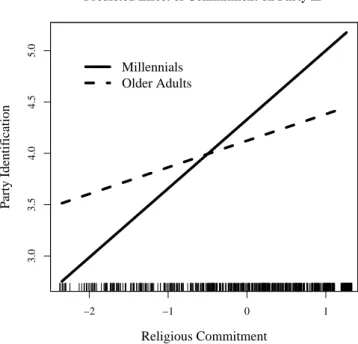
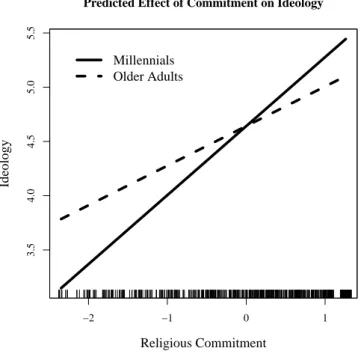
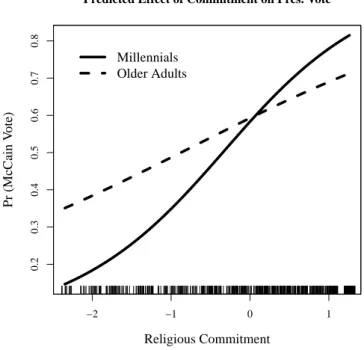
graph, I plot the marginal effects of religious commitment on political behavior and identity for both young (solid line) and older evangelicals (dashed line). Also, there is a rug plot on the X-axis of each figure with tick marks showing how the observations are distributed.
Figure 1 illustrates the estimated effect of religious commitment on party identification for Millennial and older evangelicals, holding all control variables constant at their means. This graph shows that the slope of the line representing the predicted impact of religious commitment on partisanship is steeper for young evangelicals than for older evangelicals. On average, moving from the lowest to the highest level of religious commitment shifts older evangelicals less than one point on the 7–point party identification scale, while it shifts Millennial evangelicals up two and a half points.
−2 −1 0 1
3.0
3.5
4.0
4.5
5.0
Predicted Effect of Commitment on Party ID
Religious Commitment
P
arty Identif
ication
Millennials Older Adults
Fig. 1: Estimated Marginal Effect of Religious Commitment on Evangelicals’ Party Identification
−2 −1 0 1
3.5
4.0
4.5
5.0
5.5
Predicted Effect of Commitment on Ideology
Religious Commitment
Ideology
Millennials Older Adults
Fig. 2: Estimated Marginal Effect of Religious Commitment on Evangelicals’ Political Ideology
−2 −1 0 1
0.2
0.3
0.4
0.5
0.6
0.7
0.8
Predicted Effect of Commitment on Pres. Vote
Religious Commitment
Pr (McCain V
ote)
Millennials Older Adults
Fig. 3: Estimated Marginal Effect of Religious Commitment on Evangelicals’ Presidential Vote Choice
In summary, older evangelicals tend to express more stable political orientations than young evangelicals across the range of religious commitment. Conversely, young evangelicals reflect greater variability in partisanship, ideology, and voting behavior based on their level of religious commitment. In short, all three figures illustrate that religious commitment matters more in predicting the political behavior and political affiliations of young versus older evangelicals.
Discussion
The main question raised at the start of this paper was how different socializing contexts influence the political relevance of group behavior. The results of this analysis suggest that the answer depends, in part, on whether or not the aggregate environment in which people come of age politically communicates norms and produces pressures that reinforce or contradict the prevalent political values and positions endorsed by a particular social community.
those who develop their political views in less complex contexts. Once these political positions are adopted, they are likely to persist through shifts in the social environment over time (Camp-bell et al. 1960; Mannheim 1952; Pacheco 2008; Ryder 1965). Older evangelicals appear to fit this pattern.
On the other hand, socializing environments that increase contextual complexity heighten the political impact of group commitment. When one’s broader cultural environment and immediate group affiliation communicate conflicting messages and pressure one in opposite directions, one has to prioritize between competing values. Under these circumstances, people need additional support from their community to maintain the community’s values, and group commitment, which represents this reinforcement, becomes more important in swaying individuals to espouse their ingroup’s political positions. The increased political effect of religious commitment amongst young evangelicals evidences this premise.
Based on the research findings, this study makes three contributions to the extant literature. First, it suggests that the connection between groups and politics is mediated by the broader cultural environment. Previous research has established that group behavior influences individual political behavior. The results of this study, however, indicate that the political effect of group commitment is mediated by the aggregate social environments in which people come of age politically. Consequently, these findings contribute to a more nuanced understanding of the contingent way in which group behavior influences individual political actions and affiliations. We know that groups matter to politics, and this study suggests that how much they matter depends on broader social norms and pressures.
segment of the “Religious Right” is important for our understanding of the translation of group behavior to individual politics.
Second, this study provides evidence that various levels of aggregate and interpersonal social contexts intersect to influence political actions and affiliations. Several authors have admitted the challenge of trying to measure the political effect of multiple, overlapping environments (e.g., Huckfeldt and Sprague 1993; Huckfeldt, Plutzer and Sprague 1993; Pacheco 2008). Also, many of the studies that examine the impact of two contexts on political participation and preferences are susceptible to the criticism of self–selection bias, whether the interaction of concern is between neighborhood and smaller network settings or between social network environments and dyadic interactions (Huckfeldt, Johnson and Sprague 2002; McClurg 2006). Johnson, Shively and Stein (2002) point out that contextual effects research faces the challenge of demonstrating that ag-gregate social contexts are exogenous, rather than correlated with the response variable. What appear to be aggregate efects on individual behavior might be the result of similar individuals choosing to live in the same neighborhood or district, to work at the same company, to attend the same church, or to send their kids to the same school. By examining the interaction effect between age and religious commitment, however, I address the problem of self–selection bias. Individuals do not pick the generation in which they are born based on traits that might influence their political behavior. Therefore, by using age as a proxy for having been socialized into pol-itics in different historical environments, I can be relatively certain that aggregate, age–related factors have an exogenous effect on the political impact of individuals’ group commitment. As a result, my finding that broad socializing environments and specific group dynamics interact to shape people’s political perspectives lends stronger support to the notion that different types of social and political contexts intersect to influence politics.
Conclusion
Ultimately, these findings advance scholarship on the political effect of group behavior by modeling the mediating impact of socializing contexts. This study demonstrates that even strong connections between groups and politics are influenced by the environment in which people come of age politically. More specifically, greater contextual complexity heightens the effect of group commitment on the translation of group norms to individuals’ political behavior.
While this analysis focuses on the impact of age cohort socialization on the political effect of group behavior, the unique patterns of political learning that result from other contexts, such as geographic regions or social classes, are expected to exert a similar influence. Across different environments, the fundamental factor defining the mediating impact of socializing contexts on the political relevance of group commitment is whether these contexts reinforce or counter a group’s political norms. Furthermore, if social settings can weaken even the tight connection between people’s evangelical commitment and their political behavior, they can likely modify the political relevance of other group affiliations as well.
APPENDIX
Section A
Evangelical Protestants
Denominations coded as evangelical: Seventh-Day Adventist, American Baptist Association, Baptist Bible Fellowship, Baptist General Conference, Baptist Missionary Association of Amer-ica, Conservative Baptist Association of AmerAmer-ica, General Association of Regular Baptist Churches, National Association of Free Will Baptists, Primitive Baptists, Reformed Baptists, Southern Baptist Convention, Mennonite Church, Evangelical Covenant Church, Evangelical Free Church, Congregational Christian, Brethren in Christ, Mennonite Brethren, Christian and Missionary Alliance, Church of God (Anderson, Ind.), Church of the Nazarene, Free Methodist Church, Salvation Army, Wesleyan Church, Church of God of Findlay, Ohio, Plymouth Brethren, Independent Fundamentalist Churches of America, Lutheran Church-Missouri Synod, Wiscon-sin Evangelical Lutheran Synod, Congregational Methodist, Assemblies of God, Church of God (Cleveland, Tenn.), Church of God (Huntsville, AL), International Church of the Four Square Gospel, Pentecostal Church of God, Pentecostal Holiness Church, Church of God of the Apostolic Faith, Church of God of Prophecy, Apostolic Pentecostal, Cumberland Presbyterian Church, Presbyterian Church in America, Evangelical Presbyterian, Christian Reformed Church. Respondents selecting “No Denomination,” “Nondenominational,” “Protestant,” and “Just Christian” were coded as evangelicals if they attend church at least once a month.
Religious Commitment
Church Attendance: Do you go to religious services every week, almost every week, once or twice a month, a few times a year, or never?
1 = Never
2 = A few times a year 3 = Once or twice a month 4 = Almost every week 5 = Once a week
6 = More than once a week
Religious Salience: Would you say your religion provides some guidance in your day-to-day living, quite a bit of guidance, or a great deal of guidance in your day-to-day life?
1 = None 2 = Some 3 = Quite a bit 4 = A great deal
Prayer: Do you pray several times a day, once a day, a few times a week, once a week or less, or never?
1 = Never 2 = Once a week 3 = A few times a week 4 = Once a day
Section B
Religious Orthodoxy
Scriptural Authority: Which of these statements comes closest to describing your feelings about the Bible?
1 = The Bible is a book written by men and is not the Word of God.
2 = The Bible is the Word of God but not everything in it should be taken literally, word for word.
3 = The Bible is the actual Word of God and is to be taken literally, word for word.
Born-Again Christian: Would you call yourself a born-again Christian, that is, have you per-sonally had a conversion experience related to Jesus Christ?
0 = No 1 = Yes Religiosity
In order to operationalizereligiosity, I use principal components factor analysis to combine the three indicators for religious commitment and the two indicators for religious orthodoxy. All five items load strongly on a single factor, and I use this factor score to indicate religiosity.12
Table 3: Parameter Estimates from Religiosity Models
Variable Party ID Ideology Pres. Vote
(Intercept) 1.70*** 3.71*** -2.66***
(0.35) (0.31) (0.68)
Millennials 0.23 0.03 0.02
(0.23) (0.18) (0.37)
Religiosity 0.28*** 0.42*** 0.48***
(0.09) (0.07) (0.14)
Millennials*Religiosity 0.37* 0.24* 0.57*
(0.23) (0.18) (0.37)
Income 0.09*** 0.04** 0.06**
(0.02) (0.01) (0.03)
Education 0.14** -0.01 0.15*
(0.06) (0.05) (0.09)
Gender (Female) -0.52*** -0.26** -0.19
(0.17) (0.13) (0.27)
Union Membership -0.51** 0.08 -0.18
(0.26) (0.21) (0.40)
Region (South) 0.10 0.03 0.36*
(0.17) (0.13) (0.23)
Race (White) 1.07*** 0.71*** 1.83***
(0.24) (0.18) (0.41)
N 546 546 546
R2 0.19 0.17 NA
AdjustedR2 0.18 0.15 NA
One-tailed tests.
*p <0.10. **p <0.05. ***p <0.01.
Section C
Multiple Imputation
I used the Multivariate Imputation by Chained Equation (MICE) package in R to fill in missing data with plausible values. MICE applies a fully conditional specification method, which means that it specifies an imputation model for each variable with missing values and then iterates over these conditionally specified models, sequentially imputing missing values. These plausible values reflect uncertainty about the nonresponse model.
In applying MICE to this project, I generated imputations of the missing data 10 different times, producing 10 replicate datasets—each with somewhat different values filled in for the missing data. I chose this number based on the accepted guideline that only 5 to 10 imputations are necessary for efficient results (Little and Rubin 2002). I ran my models on each of the 10 dataset and then averaged the results from each analysis to get a single estimate for each parameter.
In order to get accurate standard error estimates, I had to account for the variance within each dataset and the variance between the datasets, which multiple imputation produces. To do this, I calculated the within imputation variance, which is simply the mean of the individual variances from each imputation, and the between imputation variance, which is the mean of the squared differences between individual parameter estimates and the average, overall parameter estimate. I combined the within and the between imputation variance to get the total variance. Then I took the square root of the total variance to get accurate standard errors. I also had to ac-count for the multiple imputation datasets by adjusting the degrees of freedom for the t–statistic. Average Estimates
¯
θM =
1 M
M X
m=1 (bθm)
Within lmputation Variance ¯
WM =
1 M M X m=1 Σm
Between Imputation Variance
BM =
1
M−1
M X
m=1
(bθm−θ¯M)2
Total Variance
TM = ¯WM + (1 + 1
M)BM
Adjusting the Degrees of Freedom
(M −1)(1 + ( 1
M+ 1)(
¯
WM
BM
))2
REFERENCES
Allinsmith, Wesley and Beverly Allinsmith. 1948. “Religious Affiliations and Politico-Economic Attitude: A Study of Eight Major U.S. Religious Groups.” The Public Opinion Quarterly 12(3):377–89.
Arnett, Jeffrey J. 2000. “Emerging Adulthood: A Theory of Development from the Late Teens through the Twenties.”American Psychologist55(5):469–80.
Arnett, Jeffrey J. 2004. Emerging Adulthood: The Winding Road From the Late Teens Through the Twenties. Oxford: Oxford University Press.
Beck, Paul Allen and Edward T. Jennings. 1991. “Family Traditions, Political Periods, and the Development of Partisan Orientations.”Journal of Politics53(4):742–63.
Berelson, Bernard R., Paul F. Lazarsfeld and William N. McPhee. 1954. Voting: A Study of Opinion Formation in a Presidential Campaign. Chicago: University of Chicago Press.
Braungart, Richard G. and Margaret M. Braungart. 1986. “Life-Course and Generational Poli-tics.”Annual Review of Sociology12:205–31.
Cain, Leonard D., Jr. 1964. Life Course and Social Structure. InHandbook of Modern Sociology, ed. Robert E. L. Faris. Chicago, IL: Rand McNally pp. 272–309.
Campbell, Angus, Philip E. Converse, Warren E. Miller and Donald E. Stokes. 1960. The American Voter. New York: Wiley.
Campbell, David E. 2002. “The Young and the Realigning: A Test of the Socialization Theory of Realignment.”The Public Opinion Quarterly66(2):209–34.
Cohen, Geoffrey L. 2003. “Party over Policy: The Dominating Impact of Group Influence on Political Beliefs.”Journal of Personality and Social Psychology85(5):808–22.
Conover, Pamela J. 1988. “The Role of Social Groups in Political Thinking.”British Journal of Political Science18(1):51–76.
Eisenstadt, Shmuel N. 1956. From Generation to Generation: Age Groups and Social Structure. New York: Free Press.
Fisher, Patrick. 2008. “Is There an Emerging Age Gap in US Politics?” Society45(6):504–11.
Fisher, Patrick. 2010. “The Age Gap in the 2008 Presidential Election.”Society47(4):295–300.
Review39:187–96.
Gosselin, Tania and Gabor Toka. 2008. The Impact of Cleavages on Political Participation and Electoral Volatility. In Annual Meeting of the Canadian Political Science Association. pp. 1–40.
Green, John C. 2007.The Faith Factor: How Religion Influences American Elections. Westport, CT: Praeger Publishers.
Green, John C., James L. Guth, Corwin E. Smidt and Lyman A. Kellstedt, eds. 1996. Reli-gion and the Culture Wars: Dispatches from the Front. New York: Rowman and Littlefield Publishers.
Green, John C., Mark J. Rozell and Clyde Wilcox, eds. 2003. The Christian Right in American Politics: Marching to the Millennium. Washington, DC: Georgetown University Press.
Green, John C., Mark J. Rozell and Clyde Wilcox, eds. 2006. The Values Campaign: The Christian Right and the 2004 Elections. Washington, DC: Georgetown University Press.
Greene, Steven H. and Kyle L. Saunders. 2011. The New Generation Gap: The Changing Bases of Voting Behavior among Younger and Older Voters in the 2008 Presidential Election Cycle. InAnnual National Conference of the Midwest Political Science Association. pp. 1–30.
Guth, James L. 1983. Southern Baptist Clergy: Vanguard of the Christian Right. InThe New Christian Right: Mobilization and Legitimation, ed. Robert C. Liebman and Robert Wuthnow. New York: Aldine Publishing Company pp. 117–30.
Guth, James L., John C. Green, Corwin E. Smidt, Lyman A. Kellstedt and Margaret M. Poloma. 1997. The Bully Pulpit: The Politics of Protestant Clergy. Lawrence, KS: University Press of Kansas.
Hackett, Conrad and D. Michael Lindsay. 2008. “Measuring Evangelicalism: Consequences of Different Operationalization Strategies.”Journal for the Scientific Study of Religion47(3):499– 514.
Howe, Neil and William Strauss. 2000. Millennials Rising: The Next Great Generation. New York: Vintage Books.
Huckfeldt, Robert. 1986.Politics in Context: Assimilation and Conflict in Urban Neighborhoods. New York: Agathon Press.
Huckfeldt, Robert, Eric Plutzer and John Sprague. 1993. “Alternative Contexts of Political Behavior: Churches, Neighborhoods, and Individuals.”The Journal of Politics55(2):365–81.
The State of the Discipline, ed. Ada W. Finifter. Vol. 2 Washington, DC: American Political Science Association pp. 281–303.
Huckfeldt, Robert and John Sprague. 1995. Citizens, Politics, and Social Communication: In-formation and Influence in an Election Campaign. Cambridge: Cambridge University Press.
Huckfeldt, Robert, Paul Allen Beck, Russel J. Dalton and Jeffrey Levine. 1995. “Political En-vironments, Cohesive Social Groups, and the Communication of Public Opinion.” American Journal of Political Science39(4):1025–54.
Huckfeldt, Robert, Paul E. Johnson and John Sprague. 2002. “Political Environments, Political Dynamics, and the Survival of Disagreement.”Journal of Politics64(1):1–21.
Hyman, Harvey. 1959. Political Socialization: A Study in the Psychology of Political Behavior. Glencoe, IL: Free Press.
Johnson, Martin, W. Phillips Shively and Robert M. Stein. 2002. “Contextual Data and the Study of Elections and Voting Behavior: Connecting Individuals to Environments.”Electoral Studies21(2):219–233.
Kellstedt, Lyman A. and John C. Green. 1993. Knowing God’s Many People: Denominational Preference and Political Behavior. InRediscovering the Religious Factor in American Politics, ed. David C. Leege and Lyman A. Kellstedt. Armonk, NY: M.E. Sharpe pp. 53–71.
Kellstedt, Lyman A., John C. Green, Corwin E. Smidt and James L. Guth. 1996. The Puzzle of Evangelical Protestantism: Core, Periphery, and Political Behavior. In Religion and the Culture Wars, ed. John C. Green, James L. Guth, Corwin E. Smidt and Lyman A. Kellstedt. Washington, DC: Rowman and Littlefield Publishers pp. 240–66.
Kellstedt, Lyman A., John C. Green, James L. Guth and Corwin E. Smidt. 1996. Grasping the Essentials: The Social Embodiment of Religion and Political Behavior. In Religion and the Culture Wars, ed. John C. Green, James L. Guth, Corwin E. Smidt and Lyman A. Kellstedt. Washington, DC: Rowman and Littlefield Publishers pp. 174–92.
Kohut, Andrew, John C. Green, Scott Keeter and Robert C. Toth. 2000.The Diminishing Divide: Religion’s Changing Role in American Politics. Washington, DC: Brookings Institution Press.
Layman, Geoffrey C. 1997. “Religion and Political Behavior in the United States: The Impact of Beliefs, Affiliations, and Commitment from 1980 to 1994.”The Public Opinion Quarterly 61(2):288–316.
Layman, Geoffrey C. 2001.The Great Divide: Religious and Cultural Conflict in American Party Politics. New York: Columbia University Press.
Politics59(3):751–77.
Layman, Geoffrey C. and John C. Green. 2006. “Wars and Rumours of Wars: The Contexts of Cultural Conflict in American Political Behaviour.” British Journal of Political Science 36(1):61–89.
Lazarsfeld, Paul F., Bernard Berelson and Hazel Gaudet. 1944. The People’s Choice; How the Voter Makes up his Mind in a Presidential Campaign. New York: Duell Sloan and Pearce.
Leege, David C. 1988. “Catholics and the Civic Order: Parish Participation, Politics, and Civic Participation.”Review of Politics50:704–37.
Leege, David C., Joel A. Lieske and Kenneth D. Wald. 1991. Toward Cultural Theories of Ameri-can Political Behavior: Religion, Ethnicity, and Race, and Class Outlook. InPolitical Science: Looking to the Future, ed. William Crotty. Vol. 3 Evanston, IL: Northwestern University Press pp. 193–238.
Leege, David C., Kenneth D. Wald, Brian S. Krueger and Paul D. Mueller. 2002.The Politics of Cultural Differences: Social Change and Voter Mobilization Strategies in the Post-New Deal Period. Princeton, NJ: Princeton University Press.
Leege, David C. and Lyman A. Kellstedt. 1993. Rediscovering the Religious Factor in American Politics. Armonk, NY: M.E. Sharpe.
Lipset, Seymour Martin and Stein Rokkan. 1967. Party Systems and Voter Alignments: Cross-national Perspectives. Vol. 7 New York: Free press.
Little, Roderick J.A. and Donald B. Rubin. 2002. Statistical Analysis with Missing Data. Second ed. Hoboken, NJ: Wiley-InterScience.
MacKuen, Michael and Courtney Brown. 1987. “Political Context and Attitude Change.” Amer-ican Political Science Review81(2):471–90.
Mannheim, Karl. 1952. The Problem of Generations. In Essays on the Sociology of Knowledge, ed. P. Kecskemeti. London: Routledge and Kegan Paul pp. 276–320.
Manza, Jeff and Clem Brooks. 1991. Social Cleavages and Political Change: Voter Alignments and U.S. Party Coalitions. New York: Oxford University Press.
McClosky, Herbert and Harold E. Dahlgren. 1959. “Primary Group Influence on Party Loyalty.” The American Political Science Review53(3):757–76.
McDaniel, Eric L. and Christopher G. Ellison. 2008. “God’s Party? Race, Religion, and Parti-sanship over Time.”Political Research Quarterly61(2):180–91.
Miller, Arthur H., Patricia Gurin, Gerald Gurin and Oksana Malanchuk. 1981. “Group Con-sciousness and Political Participation.”American Journal of Political Sciencepp. 494–511.
Mutz, Diana C. 2002. “The Consequences of Cross-Cutting Networks for Political Participation.” American Journal of Political Science46(4):838–55.
Pacheco, Julianna Sandell. 2008. “Political Socialization in Context: The Effect of Political Competition on Youth Voter Turnout.”Political Behavior30(4):415–36.
Powell, G. Bingham, Jr. 1976. “Political Cleavage Structure, Cross-Pressure Processes, and Partisanship: An Empirical Test of the Theory.”American Journal of Political Science20(1).
Putnam, Robert D. and David E. Campbell. 2010. American Grace: How Religion Divides and Unites Us. New York: Simon and Schuster.
Rubin, Donald. 1987. Multiple Imputation for Nonresponse in Surveys. New York: John Wiley and Sons.
Ryder, Norman B. 1965. “The Cohort as a Concept in the Study of Social Change.”American Sociological Review30(6):843–61.
Sapiro, Virginia. 2004. “Not Your Parents’ Political Socialization: Introduction for a New Gen-eration.”Annual Review of Political Science 7:1–23.
Schafer, J.L. 1997. Analysis of Incomplete Multivariate Data. London: Chapman and Hall.
Sears, David O. and Sheri Levy. 2003. Childhood and Adult Political Development. InOxford Handbook of Political Psychology, ed. David O. Sears, Leonie Huddy and Robert Jervis. First ed. New York: Oxford University Press pp. 60–109.
Segal, David R. and Marshall W. Meyer. 1974. The Social Context of Political Partisanship. In Social Ecology, ed. Mattei Dogan and Stein Rokkan. Cambridge, MA: M.I.T. Press pp. 217–32.
Shafer, Byron E. 1991. The End of Realignment?: Interpreting American Electoral Eras. Madi-son, WI: University of Wisconsin Press.
Simmel, Georg. 1955. Conflict and the Web of Group Affiliations. New York: Free Press.
Smith, Christian, Kari Christoffersen, Hilary Davidson and Patricia Snell Herzog. 2011. Lost in Transition: The Dark Side of Emerging Adulthood. Oxford: Oxford University Press.
Smith, Christian and Patricia Snell. 2009.Souls in Transition: The Religious and Spiritual Lives of Emerging Adults. Oxford: Oxford University Press.
Sprague, John. 1982. Is There a Micro Theory Consistent with Contextual Analysis? InStrategies of Political Inquiry, ed. Elinor Ostrom. Beverly Hill, CA: Sage Publications pp. 99–121.
Steensland, Brian, Jerry Z. Park, Mark D. Regnerus, Lynn D. Robinson, Bradford W. Wilcox and Robert D. Woodberry. 2000. “The Measure of American Religion: Toward Improving the State of the Art.”Social Forces 79(1):291–318.
Terry, Deborah J. and Michael A. Hogg. 2001. Attitudes, Behavior, and Social Context: The Role of Norms and Group Membership in Social Influence Processes. In Social Influence: Direct and Indirect Processes, ed. Joseph P. Forgas and Kipling D. Williams. Philadelphia, PA: Psychology Press p. 25370.
Toka, Gabor. 2003. The Impact of Cross-Cutting Cleavages on Citizens’ Political Involvement. InAnnual Meeting of the American Political Science Association. pp. 1–50.
Twenge, Jean M. 2006. Generation Me: Why Today’s Young Americans are More Confident, Assertive, Entitled–And More Miserable than Ever Before. New York: Free Press.
Wald, Kenneth D. and Allison Calhoun-Brown. 2007.Religion and Politics in the United States. Lanham, MD: Rowman and Littlefield Publishers.
Wald, Kenneth D., Dennis E. Owen and Samuel S. Hill. 1988. “Churches as Political Communi-ties.”The American Political Science Review82(2):531–48.
Wald, Kenneth D., Dennis E. Owen and Samuel S. Hill. 1990. “Political Cohesion in Churches.” Journal of Politics52(1):197–215.
Wald, Kenneth D., Lyman A. Kellstedt and David C. Leege. 1993. The Public Dimension of Private Devotionalism. In Rediscovering the Religious Factor in American Politics, ed. David C. Leege and Lyman A. Kellstedt. Armonk, NY: M.E. Sharpe pp. 139–156.
Welch, Michael R., David C. Leege, Kenneth D. Wald and Lyman A. Kellstedt. 1993. Are the Sheep Hearing the Shepherds? Cue Perceptions, Congregational Responses, and Political Communication Processes. In Rediscovering the Religious Factor in American Politics, ed. David C. Leege and Lyman A. Kellstedt. Armonk, NY: M.E. Sharpe pp. 235–54.
Wuthnow, Robert. 1987.Meaning and Moral Order: Explorations in Cultural Analysis. Berkeley, CA: University of California Press.
Wuthnow, Robert. 2007. After the Baby Boomers: How Twenty- and Thirty-Somethings Are Shaping the Future of American Religion. Princeton: Princeton University Press.