Recreational Drug Use among Chinese MSM
and Transgender Individuals: Results from a
National Online Cross-Sectional Study
Peizhen Zhao1, Songyuan Tang2,3,4, Cheng Wang1, Ye Zhang1,2,3, John Best5, Thitikarn May Tangthanasup2,3, Shujie Huang1, Bin Yang1, Chongyi Wei5, Joseph D. Tucker2,3,6, Weiming Tang1,2,3,6*
1 Guangdong Center for Skin Diseases and STI Control, Guangzhou, China, 2 University of North Carolina
at Chapel Hill Project-China, Guangzhou, China, 3 SESH study group of University of North Carolina at Chapel Hill, Guangzhou, China, 4 Kunming Medical University, Kunming, China, 5 School of Medicine, University of California, San Francisco, San Francisco, United States of America, 6 School of Medicine of University of North Carolina at Chapel Hill, Chapel Hill, United States of America
Abstract
Background
Recreational drug use has increased considerably among Chinese men who have sex with men (MSM). The phenomenon has the potentially to increase HIV transmission among Chi-nese MSM. The aims of this study were: 1) to investigate the prevalence of recreational drug use among Chinese MSM, and 2) to explore the correlation between gay smartphone based sex-seeking applications (gay apps), HIV/STIs testing, group sex, commercial sex, sexual roles and poppers use among Chinese MSM.
Methods
MSM who were born biologically male, were at least 16 years of age and had engaged in anal sex with a man at least once were recruited through a nation-wide online survey in 2014. Information regarding socio-demographics, risk behaviors, recreational drug use, HIV and other STIs testing history and gay app use were collected. Univariate and multivariate analysis were used to determine factors associated with recreational drug use among Chi-nese MSM.
Results
Among 1424 participating MSM, 1100 (77.3%) reported ever using recreational drugs in their lifetime. In the last 12 months, 303 (21.3%) used poppers, 34 (2.4%) used crystal meth and 15 (1.0%) used ecstasy. The mean age of respondents was 25.6±6.8 years, 72.9% identified as gay, 41.3% were students, and 83.8% had never been married. Multiple logistic regression models revealed that compared with non-popper users, popper users were more likely to have been tested for HIV (adjusted OR (aOR) = 1.50, 95% CI: 1.15–1.96) and other STIs (aOR = 1.65, 95% CI: 1.26–2.17). In addition, popper users were more likely to engage a1111111111
a1111111111 a1111111111 a1111111111 a1111111111
OPEN ACCESS
Citation: Zhao P, Tang S, Wang C, Zhang Y, Best J,
Tangthanasup TM, et al. (2017) Recreational Drug Use among Chinese MSM and Transgender Individuals: Results from a National Online Cross-Sectional Study. PLoS ONE 12(1): e0170024. doi:10.1371/journal.pone.0170024
Editor: Zhefeng Meng, Fudan University, CHINA
Received: September 26, 2016
Accepted: December 26, 2016
Published: January 20, 2017
Copyright:©2017 Zhao et al. This is an open access article distributed under the terms of the
Creative Commons Attribution License, which permits unrestricted use, distribution, and reproduction in any medium, provided the original author and source are credited.
Data Availability Statement: All relevant data are
within the paper and its Supporting Information files.
Funding: This work was supported by the National
in group sex (aOR = 2.63, 95% CI:1.80–3.86), commercial sex (aOR = 1.86, 95% CI:1.13– 3.06) and used gay mobile apps to seek sexual partners (aOR = 2.10, 95% CI:1.58–2.80).
Conclusion
Chinese MSM has a high rate of recreational drug use, including poppers. Public health pro-grams serving MSM may consider integrating intervention propro-grams to decrease recrea-tional drug use related harms.
Introduction
Recreational drug use is long being considered to a major global driving force for HIV trans-mission[1]. With the implementation of harm reduction programs, however, HIV incidence rates have decreased among people who inject drugs around the world[2–4]. Despite these achievements in HIV transmission prevention among people who inject drugs, many chal-lenges still remain [5]. In addition, new challenges have emerged in the last decade due to increasing prevalence of recreational drug use among men who have sex with men (MSM) and transgender individuals [6].
Recreational drug use is not uncommon among MSM, and may be associated with risk of HIV and sexually transmitted infections[7]. Recreational drug use and subsequent states of intoxication may influence sexual risk behavior among MSM [6]. Recreational drug use affects HIV transmission via several mechanisms, including physiological responses, routes of admin-istration, venues at which drugs are used, incidence of HIV infection in specific drug-using populations, and cognitive effects on decision making [8]. Under the effect of recreational drugs, MSM may to have multiple sexual partnerships [9], participate in group sex[10], engage in condomless anal intercourse [11] and experience moreintimate partner violence[12], which may further facilitate HIV transmission.
Although a number of studies have examined the association between recreational drug use and risk behaviors for HIV transmission, its association with HIV and other STIs testing his-tory, smartphone-based sex-seeking applications (gay apps) use, and sexual role during sex have not been well documented. China presents a unique opportunity to examine these corre-lations. In China, recreational drug use has increased considerably among MSM in recent years [13], and an alarmingly high rate of recreational drug use has been observed among Chi-nese MSM[14]. In addition, gay app use has been relatively widespread [15] and rapidly adopted [16] among Chinese MSM. Smartphone use may foster virtual risk environments for HIV transmission among Chinese MSM, as the gay app use has the potential to facilitate the organization of private sex parties involving recreational drug use[17].
The main aim of this study was to characterize the proportion of different types of recrea-tional drug use among MSM in China at a narecrea-tional level. In addition, we aimed to explore the association between popper (the most common recreational drug in China) use and other novel influencing factors (HIV and other STIs testing history, gay apps use, and sexual role during sex among Chinese MSM).
Methods
Study design and sampling methods
A cross-sectional nation-wide online survey was conducted between September and October of 2014.
Institute of Allergy and Infectious Diseases P30 AI027763 to CWei]; National Institute of Mental Health [R00MH093201 ]; the UNC Chapel Hill, Johns Hopkins University, Morehead School of Medicine and Tulane University (UJMT) Fogarty Fellowship [FIC R25TW0093]; and the Doris Duke International Clinical Research Fellowship .This publication was also supported by Grant Number UL1TR001111 from the National Center for Advancing Translational Sciences (NCATS) at the National Institutes of Health.
Competing Interests: The authors have declared
In the survey, MSM across China were recruited through three gay web portals: Northern China (http://www.danlan.org), Southern China (http://www.yntz.net), and Eastern China (http://www.jstz.org). Web portals serve as an especially common online entry points for a number of different services, such as exchanging news, social networking, finding sex partners, and advertising gay specific products and research. Detailed description of sampling strategy and recruitment has been reported elsewhere [18]. We followed a checklist for reporting results of Internet e-surveys (CHERRIES) throughout the process to improve the quality and reporting of our web survey[19].
In order to recruit participants, the banner links of the survey were displayed on the home-pages of the aforementioned web portals. In addition, we also sent a survey introduction with a survey link to registered users of the three web portals. After clicking the banner links, inter-ested participants were directed to the online survey. To be eligible, participants must meet the following criteria: being born as male, at least 16 years old, had ever engaged in anal sex with another man, willing to provide their cell phone number (for other follow- up purposes) and agreed to an informed consent.
Measures
After meeting criteria and signing the consent form, participants provided socio-demographic information: age (continuous, and was further categorized into three groups: less than 20, 20– 29, or 30 and above), occupation (student or not), marital status (never married or ever mar-ried, including widowed or divorced), education (senior high school or below, college/bache-lors, or masters or PhD), and annual income (less than 3000 USD, 3000–6000 USD, 3001– 9600 USD, 9601–15000 USD or above 15000USD). In addition, we also collected information on their sexual orientation (gay or bisexual) and their current self-identified gender (male or transgender). We also collected information behaviors such as HIV and other STIs testing his-tory (yes or no), whether or not participants currently have a main partner (yes or no), their preferred sexual role during anal sex (insertive, receptive or no preference), history of vaginal or oral sex with women (yes or no), whether or not they had condomless sex with female part-ners in the last three months (yes or no), whether or not they had condomless sex with male partners in the last three months (yes or no), ever drunk alcohol during or prior sex in the last three months (yes or no), whether or not they had participated in group sex in the last 12 months (yes or no), engaged in commercial sex in the last 12 months, and whether or not they had used smartphone-based sex-seeking applications (gay apps) in the last six months.
Every participant was also asked whether or not they had used any of the listed recreational drugs [poppers, ecstasy, crystal meth, or others] prior to sex in the last 12 months.
Statistical analysis
Descriptive analysis was performed to describe socio-demographics, risk behaviors, and recre-ational drug use among participants who used poppers in the last 12 months compared to those and who did not. Univariate and multivariate logistic regressions were used to evaluate factors associated with poppers use (the most popular recreational drug) among Chinese MSM. In this study, demographic characteristics, including age, residence, education, marital status, and income were adjusted for in the multivariate logistic regression models. All data were analyzed by using SAS 9.4 (SAS int. Cary, NC, USA).
Ethical statement
Carolina at Chapel Hill and the University of California, San Francisco (14–1865)). The study protocol as well as the inform consent were all approved by the ethics committees. All pants agreed to an informed consent. Written consent from was obtained from each partici-pant prior to the survey, while informed consents from the next of kin, caretakers, or
guardians on behalf of the minors/children enrolled in the study was not obtained. The anony-mous data (S1 Dataset) and written inform consents were kept electrically and confidential.
Results
Socio-demographic characteristics and behaviors
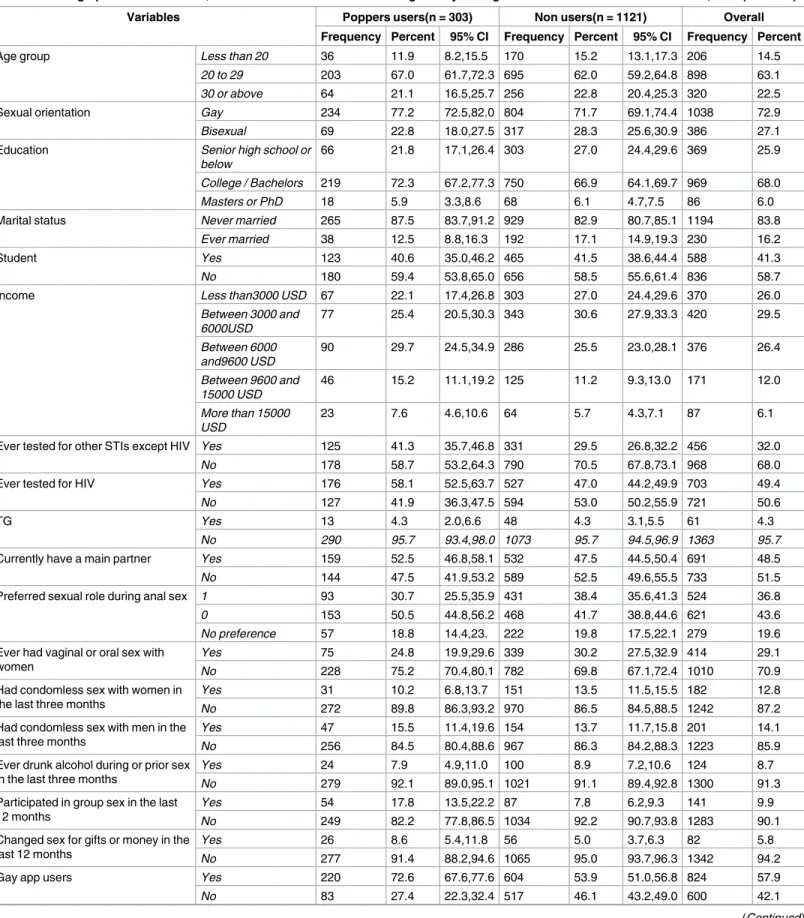
Altogether 1424 participants were recruited in this cross-sectional survey. The mean age of participants was 25.6±6.8 years. About 63.1% of the participants were aged between 20 and 29 years old, 72.9% of them identified themselves as gay, 68.0% have a college/bachelor and above degree, 41.3% were students, 83.8% had never been married, and 26.0% had annual income less than 3000 USD.
Among 1424 participating MSM, 1100 (77.3%) reported using any recreational drugs in their lifetime. In the last 12 months, 303(21.3%) used poppers, 34(2.4%) used crystal meth and 15(1.0%) used ecstasy.
In our study, a total of 703(49.4%) participants reported that they have been tested for HIV before, 456(32.0%) have been tested for other STIs except HIV, 61(4.3%) were trans-gender individuals, 691 (48.5%) currently have a main partner, 414(29.1%) of participants reported that they ever had vaginal or oral sex with women. In the last three months, 182 (12.8%) of participants had condomless sex with women, 201(14.1%) of them had condom-less sex with men and 124 (8.7%) of them had ever drunk alcohol prior to sex. In the last 12 months, 141(9.9%) of participants engaged in group sex, 82(5.8%)of them engaged in com-mercial sex.
In our study, 824 (57.9%) participants used gay apps for partner seeking in the last six months. About 72.6% of the poppers users and 53.9% of the non-poppers users used gay apps for partner seeking in the last six months, respectively.
Detailed information regarding socio-demographics, behaviors for both poppers users and non- poppers users are also presented inTable 1.
Correlates of recreational drug use
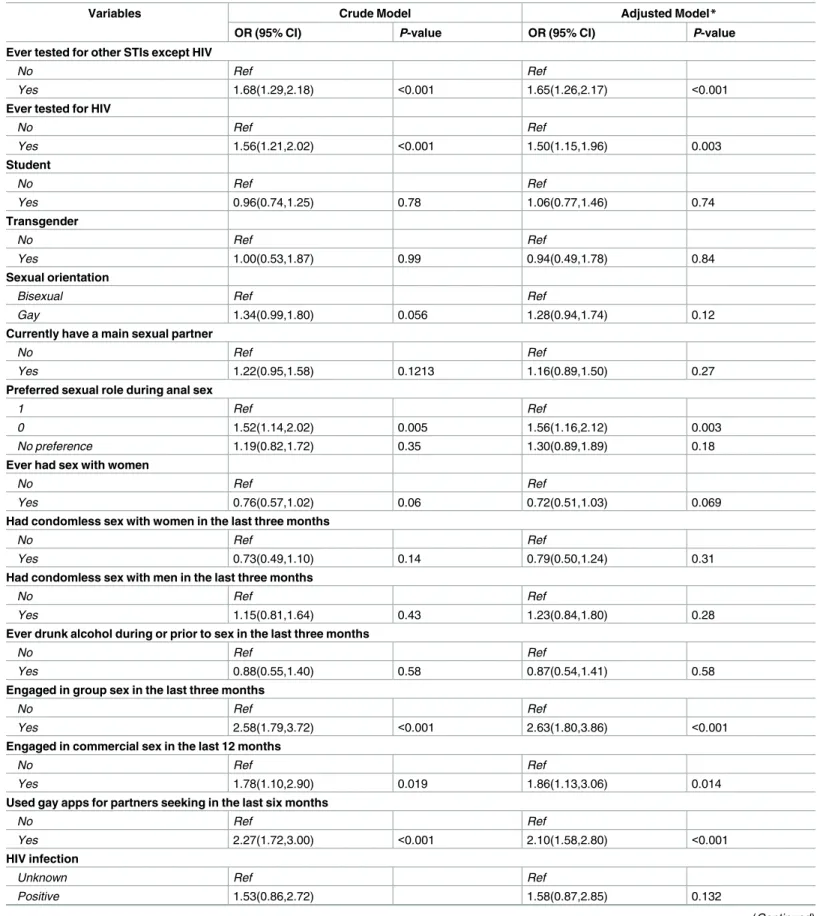
Univariate analysis indicated that compared to non-users, poppers users were more likely to have been tested for HIV or other STIs except HIV, with crude OR (cOR) of 1.56 (95% CI:1.21–2.02) and 1.68 (95% CI:1.29–2.18), respectively.
Compared to non-users, poppers users were more likely to engage in group sex in the last three months (cOR = 2.58,95% CI:1.79–3.72) and were also more likely engage in commercial sex in the last 12 months (cOR = 1.78, 95% CI:1.10–2.90). Univariate analysis also suggests that poppers users were more likely to use gay apps for partner seeking in the last six months (cOR = 2.27, 95% CI:1.73–3.00).
Table 1. Demographic characteristics, behaviors and HIV/other STIs testing history among men who have sex with men in China, 2014 (N = 1424).
Variables Poppers users(n = 303) Non users(n = 1121) Overall
Frequency Percent 95% CI Frequency Percent 95% CI Frequency Percent
Age group Less than 20 36 11.9 8.2,15.5 170 15.2 13.1,17.3 206 14.5
20 to 29 203 67.0 61.7,72.3 695 62.0 59.2,64.8 898 63.1
30 or above 64 21.1 16.5,25.7 256 22.8 20.4,25.3 320 22.5
Sexual orientation Gay 234 77.2 72.5,82.0 804 71.7 69.1,74.4 1038 72.9
Bisexual 69 22.8 18.0,27.5 317 28.3 25.6,30.9 386 27.1
Education Senior high school or
below
66 21.8 17.1,26.4 303 27.0 24.4,29.6 369 25.9
College / Bachelors 219 72.3 67.2,77.3 750 66.9 64.1,69.7 969 68.0
Masters or PhD 18 5.9 3.3,8.6 68 6.1 4.7,7.5 86 6.0
Marital status Never married 265 87.5 83.7,91.2 929 82.9 80.7,85.1 1194 83.8
Ever married 38 12.5 8.8,16.3 192 17.1 14.9,19.3 230 16.2
Student Yes 123 40.6 35.0,46.2 465 41.5 38.6,44.4 588 41.3
No 180 59.4 53.8,65.0 656 58.5 55.6,61.4 836 58.7
Income Less than3000 USD 67 22.1 17.4,26.8 303 27.0 24.4,29.6 370 26.0
Between 3000 and 6000USD
77 25.4 20.5,30.3 343 30.6 27.9,33.3 420 29.5
Between 6000 and9600 USD
90 29.7 24.5,34.9 286 25.5 23.0,28.1 376 26.4
Between 9600 and 15000 USD
46 15.2 11.1,19.2 125 11.2 9.3,13.0 171 12.0
More than 15000 USD
23 7.6 4.6,10.6 64 5.7 4.3,7.1 87 6.1
Ever tested for other STIs except HIV Yes 125 41.3 35.7,46.8 331 29.5 26.8,32.2 456 32.0
No 178 58.7 53.2,64.3 790 70.5 67.8,73.1 968 68.0
Ever tested for HIV Yes 176 58.1 52.5,63.7 527 47.0 44.2,49.9 703 49.4
No 127 41.9 36.3,47.5 594 53.0 50.2,55.9 721 50.6
TG Yes 13 4.3 2.0,6.6 48 4.3 3.1,5.5 61 4.3
No 290 95.7 93.4,98.0 1073 95.7 94.5,96.9 1363 95.7
Currently have a main partner Yes 159 52.5 46.8,58.1 532 47.5 44.5,50.4 691 48.5
No 144 47.5 41.9,53.2 589 52.5 49.6,55.5 733 51.5
Preferred sexual role during anal sex 1 93 30.7 25.5,35.9 431 38.4 35.6,41.3 524 36.8
0 153 50.5 44.8,56.2 468 41.7 38.8,44.6 621 43.6
No preference 57 18.8 14.4,23. 222 19.8 17.5,22.1 279 19.6 Ever had vaginal or oral sex with
women
Yes 75 24.8 19.9,29.6 339 30.2 27.5,32.9 414 29.1
No 228 75.2 70.4,80.1 782 69.8 67.1,72.4 1010 70.9
Had condomless sex with women in the last three months
Yes 31 10.2 6.8,13.7 151 13.5 11.5,15.5 182 12.8
No 272 89.8 86.3,93.2 970 86.5 84.5,88.5 1242 87.2
Had condomless sex with men in the last three months
Yes 47 15.5 11.4,19.6 154 13.7 11.7,15.8 201 14.1
No 256 84.5 80.4,88.6 967 86.3 84.2,88.3 1223 85.9
Ever drunk alcohol during or prior sex in the last three months
Yes 24 7.9 4.9,11.0 100 8.9 7.2,10.6 124 8.7
No 279 92.1 89.0,95.1 1021 91.1 89.4,92.8 1300 91.3
Participated in group sex in the last 12 months
Yes 54 17.8 13.5,22.2 87 7.8 6.2,9.3 141 9.9
No 249 82.2 77.8,86.5 1034 92.2 90.7,93.8 1283 90.1
Changed sex for gifts or money in the last 12 months
Yes 26 8.6 5.4,11.8 56 5.0 3.7,6.3 82 5.8
No 277 91.4 88.2,94.6 1065 95.0 93.7,96.3 1342 94.2
Gay app users Yes 220 72.6 67.6,77.6 604 53.9 51.0,56.8 824 57.9
No 83 27.4 22.3,32.4 517 46.1 43.2,49.0 600 42.1
Discussion
The increasing use of recreational drug among Chinese MSM may facilitate high-risk behav-iors for HIV transmission among Chinese MSM[7]. Previous studies have shown that individ-uals who used recreational drug had a 2–4 times greater risk of acquiring HIV than those who did not use drugs [11,20]. Most of the literature about recreational drug use among MSM has focused on high-income contexts and its association with risk behaviors. Our study adds to the literature by recruiting participants from multiple cities throughout China, utilizing an online countrywide survery, and demonstrating the association with HIV/ STIs testing and gay apps use. Our findings indicate that individuals who use recreational drugs have a higher prevalence of risk behaviors and tend to use gay apps to find sexual partners, which has the potential to worsen the epidemic of HIV and other STIs among MSM. In addition, recreational drug users are more likely to have HIV/STI testing experience than non-users.
In the present study, even though popper use is illegal in China, approximately one-fifth of participants used poppers in the last 12 months, which is higher than the lifetime poppers use among MSM recruited in Chongqing 11.3%, Kunming 3.2%, Shenyang 1.8%, and Heilong-jiang 0.3% in a 2013 study[11]. These differences may be due to the increasing use of poppers among Chinese MSM in recent years, as global data indicated that popper has become more and more population among MSM in recent years [11,14,21–23]. However, the usage rate of popper among Chinese MSM is much lower than the findings of two UK studies (53.3% in Brighton, [21], and 64.9% in London 64.9%[24]), which may be due to the fact that are legal in sex shops, clubs and bars in these cities.
Our results indicated that that poppers use was associated with using gay apps for partner seeking in the last 6 months. Gay apps utilize geospatial technology that facilitates rapid sexual partner identification and networking unbound by the constraints of time or location. [25–27] In addition, as popper uses tend to have more sexual partners[11], gay apps could facilitate the organization of private sex parties involving recreational drug use.[17] The combined use of poppers and gay apps may create a virtual risk environment for HIV transmission among Chi-nese MSM.
In our study, poppers users were more likely to have been tested for STIs and HIV com-pared with non-users, suggesting that poppers users may utilize sexual health resources at a higher rate than non- poppers users. One potential reason for this phenomenon is that after engaging in popper use and other high- risk behaviors, the popper users are more worried about their risk of HIV and other STIs infection, which linked them to HIV and other STIs testing[28–30]. Even though popper users have higher HIV and other STIs testing rates than non-users, the HIV testing rate among poppers users is still far from international guideline goals [31]. Strategies that can further promote HIV and other STIs testing are needed.
Consistent with previous literature, our study also found that recreational drug use is asso-ciated with commercial sex and group sex[23]. Unlike traditionally studied illicit drugs (e.g. heroin and marijuana), recreational drugs such as poppers can enhance sexual desire and Table 1. (Continued)
Variables Poppers users(n = 303) Non users(n = 1121) Overall
Frequency Percent 95% CI Frequency Percent 95% CI Frequency Percent
HIV infection Positive 17 5.6 3.0,8.2 51 4.5 3.3,5.8 68 4.8
Negative 145 47.9 42.2,53.5 424 37.8 35.0,40.7 569 40.0
Unknown 141 46.6 40.9,52,2 646 57.6 54.7,60.5 787 55.2
Table 2. Factors associated with Poppers use among Chinese MSM, 2014 (N = 1424).
Variables Crude Model Adjusted Model*
OR (95% CI) P-value OR (95% CI) P-value
Ever tested for other STIs except HIV
No Ref Ref
Yes 1.68(1.29,2.18) <0.001 1.65(1.26,2.17) <0.001
Ever tested for HIV
No Ref Ref
Yes 1.56(1.21,2.02) <0.001 1.50(1.15,1.96) 0.003
Student
No Ref Ref
Yes 0.96(0.74,1.25) 0.78 1.06(0.77,1.46) 0.74
Transgender
No Ref Ref
Yes 1.00(0.53,1.87) 0.99 0.94(0.49,1.78) 0.84
Sexual orientation
Bisexual Ref Ref
Gay 1.34(0.99,1.80) 0.056 1.28(0.94,1.74) 0.12
Currently have a main sexual partner
No Ref Ref
Yes 1.22(0.95,1.58) 0.1213 1.16(0.89,1.50) 0.27
Preferred sexual role during anal sex
1 Ref Ref
0 1.52(1.14,2.02) 0.005 1.56(1.16,2.12) 0.003
No preference 1.19(0.82,1.72) 0.35 1.30(0.89,1.89) 0.18
Ever had sex with women
No Ref Ref
Yes 0.76(0.57,1.02) 0.06 0.72(0.51,1.03) 0.069
Had condomless sex with women in the last three months
No Ref Ref
Yes 0.73(0.49,1.10) 0.14 0.79(0.50,1.24) 0.31
Had condomless sex with men in the last three months
No Ref Ref
Yes 1.15(0.81,1.64) 0.43 1.23(0.84,1.80) 0.28
Ever drunk alcohol during or prior to sex in the last three months
No Ref Ref
Yes 0.88(0.55,1.40) 0.58 0.87(0.54,1.41) 0.58
Engaged in group sex in the last three months
No Ref Ref
Yes 2.58(1.79,3.72) <0.001 2.63(1.80,3.86) <0.001
Engaged in commercial sex in the last 12 months
No Ref Ref
Yes 1.78(1.10,2.90) 0.019 1.86(1.13,3.06) 0.014
Used gay apps for partners seeking in the last six months
No Ref Ref
Yes 2.27(1.72,3.00) <0.001 2.10(1.58,2.80) <0.001
HIV infection
Unknown Ref Ref
Positive 1.53(0.86,2.72) 1.58(0.87,2.85) 0.132
make users have enhanced feelings of stamina and intoxicating highs[11], which may increased the likability for popper user to engage in commercial sex, group sex and having condomless anal intercourse [11,20]. Group sex often co-occurs with other high-risk behaviors that together create an environment conducive to disease transmission[32]. Previous studies showed that HIV positive MSM were more likely to have group sex and condomless anal inter-course when under the influence of recreational drugs [33,34].
This survey has several limitations. First, the MSM sample was only recruited online. Thus, the sample may fail to truly represent the actual general population. However, previous studies have confirmed the similar risk profile among online and non-online Chinese MSM based on the high Internet popularity among Chinese MSM[26]. Second, as the data was collected through self-reporting, there might be possible social desirability bias, for instance, poppers users might be reluctant to admit having used poppers, which in turn leads to underreporting [33,35]. Third, like all cross-sectional studies, selection bias due to non-response or withdraw during the study might exist in our studies [35].
Despite the above limitations, our results show that the proportion of recreational drug use, including poppers use among MSM in China is high, which has the potential to further the spread of HIV. The findings of our study stressed the need to better understand the specific characteristics of MSM who tend to use poppers and to design intervention programs target-ing them. HIV interventions among MSM should not only target injecttarget-ing drug use, but also reduce sexual risk behaviors. Although the Chinese government has carried out many anti-drug programs, for example, methadone maintenance treatment, these programs only target injecting drug users, and programs for MSM are limited. Chinese harm reduction programs should address the challenge of recreational drug use among MSM. HIV voluntary counseling & testing(VCT), 100% condom use program and specialist support services can be also used in Chinese MSM. Longer follow-up time for intervention to help promote behavior self-manage-ment skills may be effective for MSM risk reduction. MSM are still a hidden population in many countries, thus, new interventions methodologies (i.e. intervention delivery through social media, including gay apps) are needed.
Supporting Information
S1 Dataset.
(SAV)
Acknowledgments
We thank all the study participants and staff members at SESH Global, Danlan, and the Guangdong Provincial Center for Skin Diseases and STI Control who contributed. Table 2. (Continued)
Variables Crude Model Adjusted Model*
OR (95% CI) P-value OR (95% CI) P-value
Negative 1.57(1.21,2.04) 1.60(1.14,1.96) 0.003
Note
*Model adjusted for age (Continuous), residence (Urban or rural), education level (High school or below, college or bachelors, or masters or PhD) and monthly income (less than $250 USD, $250-300USD, $301-800USD, $801-1200USD, or more than $1200USD)
Author Contributions
Conceptualization: ST WT JT BY SH CW C. Wei.
Data curation: PZ.
Formal analysis: PZ WT.
Funding acquisition: JT.
Investigation: JB.
Methodology: PZ ST CW C. Wang WT.
Project administration: YZ.
Resources: JT.
Software: PZ.
Supervision: JT, WT.
Validation: PZ ST CW C. Wang YZ JB TT SH BY CW JT WT.
Visualization: PZ ST CW C. Wang YZ JB TT SH BY CW C. Wei JT WT.
Writing – original draft: PZ WT.
Writing – review & editing: PZ ST CW C. Wang YZ JB TT SH BY CW C. Wei JT WT.
References
1. Mathers BM, Degenhardt L, Phillips B, Wiessing L, Hickman M, Strathdee SA, et al. Global epidemiol-ogy of injecting drug use and HIV among people who inject drugs: A systematic review. LANCET 2008; 372:1733–1745. doi:10.1016/S0140-6736(08)61311-2PMID:18817968
2. UNAIDS: Global Report. UNAIDS report on the global AIDS epidemic 2013, 2013,
3. Ruan Y, Liang S, Zhu J, Li X, Pan SW, Liu Q, et al. Evaluation of harm reduction programs on seroinci-dence of HIV, hepatitis B and C, and syphilis among intravenous drug users in southwest China. SEX TRANSM DIS 2013; 40:323–328. doi:10.1097/OLQ.0b013e31827fd4d4PMID:23486498
4. MacArthur GJ, Minozzi S, Martin N, Vickerman P, Deren S, Bruneau J, et al. Opiate substitution treat-ment and HIV transmission in people who inject drugs: Systematic review and meta-analysis. BMJ 2012; 345:e5945. doi:10.1136/bmj.e5945PMID:23038795
5. UNAIDS. UNAIDS Gap report, 2014,
6. Darrow WW. Risky sexual behaviors associated with recreational drug use among men who have sex with men in an international resort area: Challenges and opportunities. Journal of Urban Health: Bulletin of the New York Academy of Medicine 2005; 82:601–609.
7. Daskalopoulou M, Rodger A, Phillips AN, Sherr L, Speakman A, Collins S, Elford J, et al. Recreational drug use, polydrug use, and sexual behaviour in HIV-diagnosed men who have sex with men in the UK: Results from the cross-sectional ASTRA study. Lancet HIV 2014; 1:e22–e31. doi:10.1016/S2352-3018 (14)70001-3PMID:26423813
8. Zuckerman MD, Boyer EW.HIV and club drugs in emerging adulthood. CURR OPIN PEDIATR 2012; 24:219–224. doi:10.1097/MOP.0b013e32834faa9bPMID:22227785
9. Breyer BN, Vittinghoff E, Van Den Eeden SK, Erickson BA, Shindel AW.Effect of sexually transmitted infections, lifetime sexual partner count, and recreational drug use on lower urinary tract symptoms in men who have sex with men. UROLOGY 2012; 79:188–193. doi:10.1016/j.urology.2011.07.1412 PMID:21962880
10. Ward C, Lee V.Should we offer routine hepatitis C antibody testing in men who have sex with men? J INT AIDS SOC 2014; 17:19591. doi:10.7448/IAS.17.4.19591PMID:25394096
12. Li Y, Baker JJ, Korostyshevskiy VR, Slack RS, Plankey MW. The association of intimate partner vio-lence, recreational drug use with HIV seroprevalence among MSM. AIDS Behav 2012; 16:491–498. doi:10.1007/s10461-012-0157-6PMID:22327371
13. Jia Y, Aliyu MH, Jennifer Huang Z. Dynamics of the HIV epidemic in MSM. BIOMED RES INT 2014; 2014:1–3.
14. Xu JJ, Zhang C, Hu QH, Chu ZX, Zhang J, Li YZ, et al. Recreational drug use and risks of HIV and sexu-ally transmitted infections among Chinese men who have sex with men: Mediation through multiple sex-ual partnerships. BMC INFECT DIS 2014; 14:642. doi:10.1186/s12879-014-0642-9PMID:25443542
15. Bien CH, Best JM, Muessig KE, Wei C, Han L, Tucker JD. Gay apps for seeking sex partners in china: Implications for MSM sexual health. AIDS and Behavior 2015; 19:941–946. doi: 10.1007/s10461-014-0994-6PMID:25572834
16. Parra LWAA. Chinese gay dating app grows to 15 million users, US NEWs, 2014,
17. Stockholm. Understanding the impact of smartphone applications on STI/HIV prevention among men who have sex with men in the EU/EEA, European Centre for Disease Prevention and Control, 2015,
18. Juan S.Young male students hit hard by HIV/AIDS, China Daily USA, 2015,
19. Eysenbach G. Improving the quality of Web surveys: The Checklist for Reporting Results of Internet E-Surveys (CHERRIES). J MED INTERNET RES 2004; 6:e34. doi:10.2196/jmir.6.3.e34PMID: 15471760
20. Plankey MW, Ostrow DG, Stall R, Cox C, Li X, Peck JA, Jacobson LP. The relationship between meth-amphetamine and popper use and risk of HIV seroconversion in the multicenter AIDS cohort study. JAIDS Journal of Acquired Immune Deficiency Syndromes 2007; 45:85–92. doi:10.1097/QAI. 0b013e3180417c99PMID:17325605
21. Kurka T, Soni S, Richardson D. High rates of recreational drug use in men who have sex with men. SEX TRANSM INFECT 2015; 91:394. doi:10.1136/sextrans-2015-052218PMID:26294692
22. Hunter LJ, Dargan PI, Benzie A, White JA, Wood DM. Recreational drug use in men who have sex with men (MSM) attending UK sexual health services is significantly higher than in non-MSM. POSTGRAD MED J 2014; 90:133–138. doi:10.1136/postgradmedj-2012-131428PMID:24390619
23. Daskalopoulou M, Rodger A, Phillips AN, Sherr L, Speakman A, Collins S, et al. Recreational drug use, polydrug use, and sexual behaviour in HIV-diagnosed men who have sex with men in the UK: Results from the cross-sectional ASTRA study. Lancet HIV 2014; 1:e22–e31. doi:10.1016/S2352-3018(14) 70001-3PMID:26423813
24. Thurtle N, Dargan PI, Hunter LJ, Lovett C, White JA, Wood DM.A comparison of recreational drug use amongst sexual health clinic users in London with existing prevalence data. INT J STD AIDS 2015
25. Hull P, Mao L, Prestage G, Zablotska I, de Wit J, Holt M. The use of mobile phone apps by Australian gay and bisexual men to meet sex partners: An analysis of sex-seeking repertoires and risks for HIV and STIs using behavioural surveillance data. SEX TRANSM INFECT 2016:2015–52325.
26. Bien CH, Best JM, Muessig KE, Wei C, Han L, Tucker JD. Gay apps for seeking sex partners in china: Implications for MSM sexual health. AIDS and Behavior 2015; 19:941–946. doi: 10.1007/s10461-014-0994-6PMID:25572834
27. Holloway IW. Substance use homophily among geosocial networking application using gay, bisexual, and other men who have sex with men. Archives of Sexual Behavior 2015; 44:1799–1811. doi:10. 1007/s10508-015-0581-6PMID:26216146
28. Saw YM, Yasuoka J, Saw TN, Poudel KC, Tun S, Jimba M. What are the factors associated with HIV testing among male injecting and non-injecting drug users in Lashio, Myanmar: A cross-sectional study. BMJ OPEN 2013; 3:e2747.
29. Chua AC, Chen MI, Cavailler P, Jiang L, Abdullah MR, Ng OT, et al. Challenges of respondent driven sampling to assess sexual behaviour and estimate the prevalence of human immunodeficiency virus (HIV) and syphilis in men who have sex with men (MSM) in Singapore. Ann Acad Med Singapore 2013; 42:350–353. PMID:23949264
30. Pattanasin S, Wimonsate W, Chonwattana W, Tongtoyai J, Chaikummao S, Sriporn A, et al. Loss to fol-low-up and bias assessment among a cohort of Thai men who have sex with men in Bangkok, Thailand. INT J STD AIDS 2016; 27:196–206. doi:10.1177/0956462415578954PMID:25792548
31. WHO: 90–90–90—an ambitious treatment target to help end the AIDS epidemic, 2014,
32. Rice CE, Lynch CD, Norris AH, Davis JA, Fields KS, Ervin M, et al. Group sex and prevalent sexually transmitted infections among men who have sex with men. Archives of Sexual Behavior 2016; 45:1411–1419. doi:10.1007/s10508-015-0554-9PMID:26392187
34. Buttram ME, Kurtz SP. Characteristics associated with group sex participation among men and women in the club drug scene. SEX HEALTH 2015; 12:560. doi:10.1071/SH15071PMID:26342286