PTB 311E – Manual 3-in-1 Tablet Testing Instrument
The manual tablet testing instrument PTB 311E is a dual force mode hardness test apparatus as it can be used for either linear force or linear speed increase while tablet hardness is tested. It offers a multiple point validation procedure for the built-in digital load cell.
The instrument is made in strict compliance with the EP <2.9.8> and USP <1217> Pharmacopoeia. Enter the nominal test information for thickness, diameter or length and hardness as well as a batch number via the PTB 311E keyboard. Select the units to measure, mm - Inch, KP (Kilopond), N (Newton) or Sc (Strong Cobb). Now place the sample onto the sample upright in to the Thickness Jaw and start the test. The driven jaw will run forward, touch and force the tablet at its highest point to measure the thickness, thereafter it reverses back so that the sample falls into horizontal position to test its diameter (length) and immediately its hardness (tablet breaking force).
The 3 result are immediately displayed and printed to a connected dot-matrix or suitable PCL5 type laser- or Deskjet printer. Repeat this until your series has been tested, get a full print-out including each individual result, date, time, serial number of the instrument, batch number of the product tested, mean value and deviations of the test series.
In case you need to test hardness “only”, no problem; zero Thickness and Diameter station and perform hardness tests only. This flexibility and the reproducibility of the results have made the PTB311E series to become one of the most sold hardness testers.
The flexibility and the reproducibility of the results have made this and other models, like the PTB 111E/111EP series to become one of the most sold tablet hardness testing instruments worldwide.
Operating Principle
Even in the existing USP and EP monographs there is no standard force setting or force increase mode established, but it is recommended to use a linear force increase rate of 20N/s. Different force settings usually cause problems when comparing results received by different supplier's instruments when testing the same tablet. The hardness result is directly influenced by the contact speed and force increase rate. Faster operated test jaw means lower reproducibility and often higher results. In order to offer the possibility to select an operating mode which will offer you similar results as the instruments you may already use, select the force mode, linear force increase or linear speed increase and select the same or similar rate. Also touch and detection force may be altered to suit the sample design specification. When the sample is touched the instrument switches to the selected mode and linear increasing rate.
Which Force Mode Should Be Selected?
For more than 18 years all Pharma Test hardness testing instruments offer the possibility to select either linear force or linear speed increase. Linear force increase is the recommended setting as it offers the most accurate control, as the rate of increase is directly controlled by the electronic load cell used to read the force. Also it is quite simple to validate the correct and linear operation as a tablet having a hardness of 100 Newton will be broken within 5 seconds if 20N/s had been set as force increase rate. The test of "soft" tablets often requires an increase of the standard force setting, otherwise the sample gets deformed only but does not break.
Linear speed increase can also be used. Here the driving speed of the motor is kept linear. Actually if the touching force is kept low there is not too much difference in results between the two systems but it is very difficult to validate the linearity of the drive speed.
Calibration and Validation
The current USP Pharmacopeia requires the force sensor of a tablet hardness testing
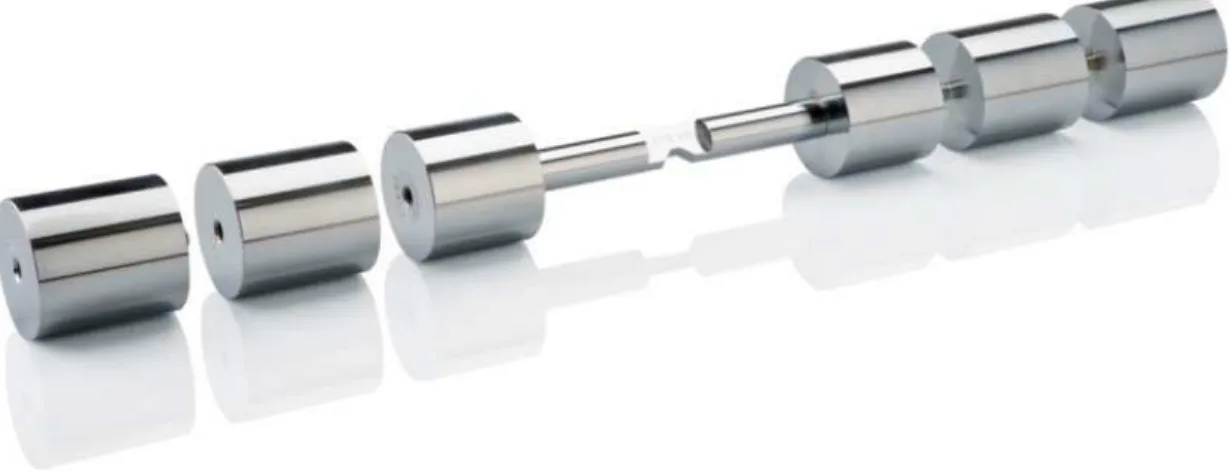
Pharma Test offers the PT-MT3 magnetic tablets to calibrate the breakpoint detection of the whole tablet hardness testing instrument (force sensor and mechanics of the instrument). All Pharma Test tablet hardness testing instruments are fully compliant to the requirements of the current USP Pharmacopeia.
The PTB 311E offers a built-in calibration and validation program for the hardness test station. To validate the hardness test station the PT-MT3 magnetic tablet or different certified weights are used. Use the PT-MT3 to qualify the correct breakpoint detection, the PT-MT3 instrument works like a tablet, it withstands force and after “breaks”.
For the two point adjustment (zero and reference) of the load cell inside the hardness station a certified reference weight of 10 kg is used. For validation purposes the use 5 up to 30kg certified weights is recommended. All adjustment and calibration results can be printed and countersigned. To prove the linearity of the instrument, the operator can program a print-out of the force curve recorded during a test. This will show the linear increase of the adjusted force mode. Also different weights, like the PTB-CAL15 and PTB-CAL30 weight sets which include 5, 10, 15kg and 30kg (PTB-CAL30) using two additional 10kg weights for total 50kg, may be placed onto the load cell or the PT-MT and can be used to validate the linearity. Using the parallel port a Matrix or PCL5 printer can be added and using the RS232 COM port, all results can be transmitted to software running on a computer system.
Advantages
Some of the highlights the PTB 311E offers are:
Select either linear force or linear speed increase (dual mode selection) Steppless adjustment of the force or speed increasing rate
Entry of time and date Enter a 12 digit batch number
Automatic re-start facility to speed up the testing sequence
Documentation of all results using a separate Dot-Matrix or PCL5 printer Validation and calibration program for the measurement station
Force curve print-out
Dual point adjustment of the load cell for the hardness test station Multiple point validation (calibration) up to 30 or 50kg
Programmable print-out of force increase curve Data transfer via RS-232 interface
Hardness testing in compliance with the EP <2.9.8> and USP <1217> Pharmacopoeia Test program for soft gelatine capsule testing by setting up a testing distance
Features
The main features of the PTB 311E are:
Fully USP <1217> and EP <2.9.8> compliant
Dual force mode instrument with linear speed increase and linear force increase modes Multiple point validation procedure built-in
Programmable print-out of force increase curve
Set to test tension strength of oblongs and caplets available
Standard Scope of Supply
The PTB 311E comes ready to use with the following standard scope of supply: Standard Jaw set to allow hardness test of all size and shape samples Broken Sample collector
Comprehensive documentation folder including: User manual
QC/DQ testing certificate IQ documentation OQ documentation
Options
In addition to the standard scope of supply Pharma Test offers a broad range of accessories and options including:
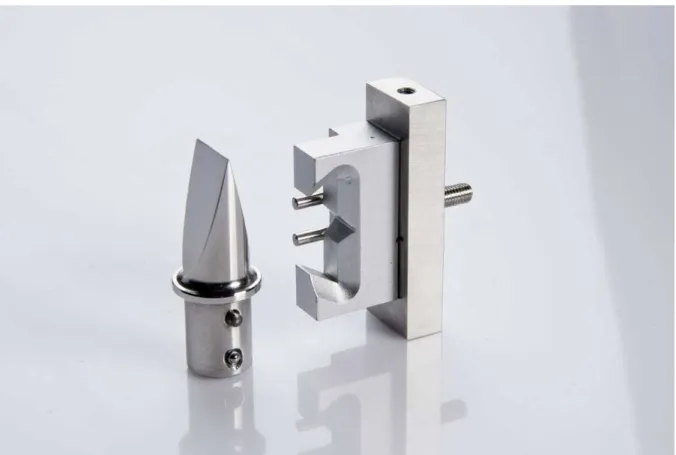
Tension test set to test break line force of shaped tablets 500N (PTB 511E) extended force range
Recommended spare part set
Full range of certified validation tools available
Technical Data
Parameter Specification
Display LED Display showing number of tests and results Data Entry Numerical and Functional keys
Standard Force Range 5.0 to approximately 300N
Accuracy < 1N
Resolution 0.074N (300N model) - 0.1482N (500N model) Force Settings Linear speed or linear force increase
Selectable Range 5.0 - 200 N/Second or Millimeter/Minute Accuracy < 2% force or < 0.1% speed
Maximum Sample Size 45 mm
Diameter Range 2.0 - 45.0mm
Height/Thickness Range 2.0 - 45.0mm (requires different thickness jaws) Accuracy < 0.05 mm (typically 0.02mm)
Resolution 0.0015 mm
Printer Interface to connect Dot-Matrix or PCL 5 Printer
Interface RS232 COM port
Calibration Guidance Built-in calibration procedures the digital load cell Adjustments Two point adjustment - zero and 10kg
Calibrations Multiple point for load cell precision using certified weights (CAL15/30/50)
Force Detection Reproducibility
PT-MT3 Magnetic Tablet
Instrument Housing Stainless Steel to meet GLP requirements
Bench Space Requirement L 48cm x W 24cm x H 26cm (without external printer ) Certification All components certified to USP / EP requirements CE / EMC Certification All CE / EMC Certification provided