‘‘Forward-Thinking’’ in U.S. Biobanking
R. Jean Cadigan,1Teresa P. Edwards,2Dragana Lassiter,3 Arlene M. Davis,4and Gail E. Henderson1
Aims:
Do biobanks enact policies and plans that allow them to anticipate and respond to potential challenges? If
a biobank has one such policy or plan, is it likely to have more? Using survey data from 456 U.S. biobanks, we
assess four possible indicators of such ‘‘forward-thinking.’’
Methods:
We present response frequencies and cross-tabulations regarding policies for return of results and
ownership of specimens, and for having a formal business plan and a plan for what happens to specimens if the
biobank closes. We analyze the relationships among these indicators, using chi-square for tests of statistical
significance.
Results:
Policies—Sixty-two percent of biobanks have a policy about returning individual research results; 70%
have a policy designating ownership of specimens and/or technology. Having these two policies is significantly
related (
p
<
0.001).
Plans—34% of biobanks have a formal business plan; 26% have a written plan for what will
happen to the specimens if the biobank closes. Having these two plans is significantly related (p
<
0.001).
Relationships among indicators—only 7% of biobanks are forward-thinking across all four indicators; 12% are
forward-thinking across none.
Discussion:
The two policies we examined tend to occur together, as do the two plans. These policies and plans
seem to tap different aspects of accountability and responsiveness. Specifically, the policies reflect issues most
commonly raised in the ethical and legal literature on biobanking, while the plans are indicators of
sustain-ability, a separate area of concern in biobanking.
Keywords:
biobanks, policy, return of results, ownership, termination plan, business plan
Introduction
B
iobanks are extremely heterogeneous institutions(Gibbons, 2009; Hendersonet al., 2013a). They vary in multiple ways, including size, purpose, types of specimens collected, affiliations with larger organizations, and sources of funding (Hendersonet al., 2013a). While biobanks have been in existence for decades, only recently has there been a ‘‘boom’’ in the industry (Tupasela and Stephens, 2013), generating increased interest in the ethical, legal, and social issues (ELSI) associated with biobanks, as well as their long-term sustainability. The ELSI literature on biobanking has focused on issues such as informed consent, data sharing, privacy, identifiability, public trust, and approaches to gov-ernance (e.g., Haga and Beskow, 2008; Hansson, 2009).
The biobanking industry has been described as ‘‘highly dy-namic’’ (O’Dohertyet al., 2011) and ‘‘precarious’’ (Stephens
and Dimond, 2015a). This, coupled with the tremendous growth of the industry, has necessitated that responsible biobanks reflect upon and address the implications of relevant challenges, in-cluding potential identifiability of specimen donors, government requirements for data sharing, and other developments in tech-nology, regulation, and funding. The literature on biobanking has suggested that biobanks continuously evaluate how they are meeting their goals, anticipating and planning for challenges rather than simply responding to problems when they arise (Laurieet al., 2011; O’Dohertyet al., 2011).
The need for biobank policies and plans to facilitate such analysis and foresight is frequently addressed in the ELSI literature (e.g., O’Dohertyet al., 2011; Laurie et al., 2012; Stephens and Dimond, 2015b) and the literature on sustain-ability (e.g., Albertet al., 2014; Simeon-Dubach and Hen-derson, 2014). In this article, we use data from our U.S. Biobank Survey to examine whether biobanks have policies
1Department of Social Medicine, CB 7240, University of North Carolina at Chapel Hill, Chapel Hill, North Carolina. 2
HW Odum Institute for Research in Social Science, CB 3355, University of North Carolina at Chapel Hill, Chapel Hill, North Carolina. 3
Department of Anthropology, CB 3115, University of North Carolina at Chapel Hill, Chapel Hill, North Carolina. 4
Center for Bioethics, Department of Social Medicine, CB 7240, University of North Carolina at Chapel Hill, Chapel Hill, North Carolina.
ªMary Ann Liebert, Inc.
Pp. 148–154
DOI: 10.1089/gtmb.2016.0393
and plans that allow them to anticipate and be responsive to potential challenges. Specifically, we look at ways biobanks deliberately address potential challenges, and we call these indicators of ‘‘forward-thinking’’ biobanks.
We use the following as indicators of forward-thinking biobanks: having a policy on ownership of specimens or rights to technologies developed from research uses of the specimens, having a policy on return of individual results derived from use of specimens, having a formal business plan, and having a plan for termination. Each feature is dis-cussed in the Background section.
Background
Elsewhere, we have reported on biobank practices, de-tailing how biobanks steward specimens from collection through storage and use by researchers (Henderson et al., 2013b). In this article, we turn to biobank policies and formal plans, arguing that they represent ways that biobanks antic-ipate and address potential future challenges, or exhibit thinking. Furthermore, we explore whether forward-thinking in one such policy or plan is associated with forward-thinking in others.
Policies on return of individual research results and on designation of ownership rights have long been foci of debate among ELSI scholars (e.g., Dressler, 2007; Rao, 2007; de Faria, 2009; Wolfet al., 2012; Jarviket al., 2014). Biobank best practice guidelines acknowledge the need for biobanks to address them, yet no specific strategies are described (NCI, 2011; ISBER, 2012). In contrast, creating a business plan and a plan for termination are both strongly recommended within practice guidelines (OECD, 2009; NCI, 2011; ISBER, 2012) and are familiar generally in the world of business, but are largely ignored by ELSI scholars (Cadiganet al., 2013).
Return of individual results policy. With few exceptions
( Johnsonet al., 2012), little is known about biobanks’ poli-cies regarding returning individual research results [else-where we describe biobanks’ reportedpracticesregarding the return of research results (Henderson et al., 2013b)]. The question of whether or not biobanks have a responsibility to return individual research results to participants is deliber-ated by those interested in the ethical and legal concerns regarding biobanking (Wolfet al., 2012). The International Society for Biological and Environmental Repositories (ISBER) acknowledges that return of results is a complex and important ethical issue that should be discussed with an ethics review board before repositories are established (ISBER, 2012). Similarly, National Cancer Institute (NCI) guidelines state that biobank governance plans should outline protocols for handling research results (NCI, 2011).
Dressler (2009:94) notes that while international guide-lines related to biobanking often support an ethical duty to disclose research results, ‘‘There are no consistent criteria to aid a biobanker or researcher in determining when and if a research result may be of benefit to an individual participant. Therefore, the practical interpretation and application of these guidelines, on a daily basis, is still a challenge.’’ Other researchers have argued that if a biobank fails to address the issue of return of individual results, it could undermine its relationship with existing and future specimen contributors, and the resulting ‘‘lack of trust could lead to operational
unsustainability’’ (Simeon-Dubach and Henderson, 2014:288). Consequently, we regard having a policy on return of indi-vidual results as an indicator of a biobank’s consideration of this contentious issue; so for our analyses, a biobank is forward-thinking if it has such a policy.
Policy on designation of ownership rights. Collecting and
storing specimens for long periods of time for future research raises questions about ownership. To date, there is little federal law addressing ownership of specimens in biobanks or rights to technologies developed from research use of the specimens. Given that uncertainty, best practice guidelines largely side-step ownership of specimens or technology altogether, or-ienting their guidance toward authority to control the use and storage of specimens, such as references to biobanks as ‘‘custodians’’ of specimens (NCI, 2011; ISBER, 2012). Thus, neither policy nor practice regarding ownership of specimens and/or related technologies is well-developed. Common law has offered some guidance, although incomplete.
Rights to the physical property of human specimens have been litigated in the United States (Moore v. Regents of the University of California, Washington University v. Catalona, Greenberg v. Miami Children’s Hospital) and more recently before an Ontario, Canada, superior court (Piljak Estate v. Abraham, 2014). Some cases, like Moore and Greenberg, address relevant related technologies as well (Lepsch, 2012; Ormond and Cho, 2014). However, the numerous ownership disputes that are not litigated remind us that courts of law do not remedy all ownership issues (e.g., De Souza and Green-span, 2013; Ormond and Cho, 2014). Furthermore, high profile cases brought to public attention through the publication of a book detailing the story of Henrietta Lacks and the HeLA cell line (Skloot, 2010) or by the media’s portrayal of the plight of the Havasupai Native Americans in a legal battle over the extent of research uses of their specimens (Havasupai Tribe v. Arizona Board of Regents; Mello and Wolf, 2010), highlight how contentious perceptions of ownership can become.
Consequently, we view having a policy about ownership of specimens and/or rights to technologies developed from the use of specimens to be evidence of a forward-thinking bio-bank because it displays consideration of the complexities of the rights associated with ownership and anticipates chal-lenges that could ensue from it.
Formal business plan. Best practice guidelines for
bio-banks recommend that biobio-banks create a business plan to formalize their operations and account for their operational costs (NCI, 2011; Vaughtet al., 2011b; ISBER, 2012). Other guidelines recommend that a biobank should be ‘‘explicit and transparent about the nature and source of its financing/ funding’’ (OECD, 2009:4). These recommendations hinge on the need for long-term funding to build and sustain a biobank. Others have argued that a biobank must communicate its commitment to fundamental business practices and its un-derstanding of the costs of conducting business to persuade potential funders (Vaughtet al., 2011a).
Funding for biobanking is notoriously insecure (Vaught
70% of our survey respondents said that they had major or moderate concerns about their biobank running out of funding (Hendersonet al., 2013a).
While having a business plan does not necessarily indicate increased financial security for a biobank, accounting for business costs, customer needs, and areas of growth required when creating a business plan can lead to future stability (Simeon-Dubach and Henderson, 2014). In addition, a busi-ness plan is an expression of accountability to others inter-ested in the legitimacy of the biobank. These parties include not only potential funders but also the researchers who serve as their customers and the individuals who contribute spec-imens. Consequently, we view having a business plan as an indication of forward-thinking.
Plan for termination. Biobanks may be terminated, often
due to lack of funding (Zawatiet al., 2011; Cadiganet al., 2013; Tupasela and Stephens, 2013; Stephens and Dimond, 2015a, 2015b). Best practice guidelines for biobanks rec-ommend creating plans for termination and that any transfer of specimens or data to third parties upon termination should be consistent with the informed consent under which speci-mens or data were obtained (OECD, 2009; NCI, 2011; ISBER, 2012). Plans for termination, also called legacy plans, can address the uncertainty arising from the potential mismatch between the original purpose of collection and subsequent use of specimens (Matzkeet al., 2016).
Some have argued that termination plans that promote the use of the biobank’s resources in accordance with its original purposes can promote public trust (Laurie, 2011). Recent data reveal that potential specimen contributors think it is very important to be informed, before joining the biobank, of the contingency plan for specimens and data in the event of clo-sure (Longet al., 2015). Ensuring that future use of specimens is in line with what contributors expect is an important issue to consider if biobanks’ collections are to be transferred to new owners and/or combined with other collections.
In other businesses, plans for termination (or other con-tingency plans), may be set forth in statutory requirements, such as provisions for corporate dissolution. Such plans for corporations contemplate disposition of assets and property, accounting for liabilities and proper notice provisions to parties who may have outstanding claims (see e.g., NCGS 55-14-01 et seq). These existing models, and an appreciation that biobanks have failed in the past (by disappearing, bank-ruptcy, or acquisition), are convincing reasons for forward-thinking biobanks to create plans for termination.
Methods
Detailed information about our 2012 national survey of biobanks, including our recruitment methods, is provided elsewhere (Hendersonet al., 2013a). We employed a multi-faceted search strategy to create a list of U.S. biobanks, which we defined as ‘‘organizations that acquire and store human specimens and associated data for future research use’’ (Boyer et al., 2012). For each biobank on our list, we re-cruited the director (or other knowledgeable representative) to complete the survey. We asked that the representative be thoroughly knowledgeable about the policies and practices of the biobank and encouraged the representative to confer with others in the biobank, if necessary, to answer the survey
questions accurately. We also instructed representatives that if they could not find the answer to a survey question, to please skip it (see Cadiganet al., 2013 for more information). Representatives were sent an invitation letter, followed by an email with a link to the 30-min online survey, which was preceded by an informed consent statement. Of 636 eligible biobanks, representatives of 456 (72%) completed the sur-vey. For the analyses presented in this study, we exclude 27 biobanks that store specimens for researchers who collected and deposited them, but do not share with other researchers. The University of North Carolina IRB approved this study. Survey data were collected using Illume software version 4.7 (Datstat, Inc., Seattle, WA).
Data were analyzed in SAS version 9.2 (SAS Institute, Inc., Cary, NC). We present response frequencies and cross-tabulations, with percentages where appropriate. Where percentages do not add to 100, it is due to rounding. In ex-amining bivariate relationships, we use chi-square to test the null hypothesis that the variables are independent.
Results
Below, we report results for each of our forward-thinking indicators and then discuss relationships among them.
Return of individual results
To be eligible to answer our questions about return of results, we first asked respondents whether their biobank has access to identifying information for any of their specimen contribu-tors because we reasoned that without access to identifying information, a biobank could not return results. Three hundred twenty-seven (77% of the total sample) indicated they had access to identifying information. We asked these survey re-spondents whether their biobank has a policy about returning individual results to specimen contributors (or to their surro-gates, in the case of pediatric or postmortem specimens). Sixty-two percent of these 327 survey respondents said that the biobank does have a policy, 28% reported that it does not, and 10% said they were not sure. For the 62% with a policy, we asked what the policy specifies—whether results will be re-turned always, under certain conditions, or never. For the ma-jority, 57%, the policy states that results will never be returned, for 38% results will be returned under certain conditions, and results will always be returned for only 5%.
For those biobanks that do have a policy on return of indi-vidual results, we also asked whether the policy addresses the issue of incidental findings, which we defined as ‘‘findings beyond the initial aims of the research.’’ Fifty-two percent of respondents indicated that the policy also addresses this issue. These respondents were then asked whether the incidental findings policy states that they will be returned always, under certain conditions, or never. Just over half (51%) responded that incidental findings are returned under certain conditions, while 42% responded that they are never returned, and 7% indicated that they are always returned. For this article, a bio-bank is forward-thinking if they have a return of results policy, regardless of whether the policy includes incidental findings.
Policy on designation of ownership rights
percent responded ‘‘yes,’’ 16% said ‘‘no,’’ and 22% said they were ‘‘not sure.’’ We also asked respondents whether the biobank has a policy that designates who owns the rights to technologies developed from research done with the speci-mens. Forty-four percent of respondents said their biobank has a policy designating ownership of these rights, 19% said the biobank does not, and 15% said they were not sure. An addi-tional 21% indicated that the question was ‘‘not applicable’’ because no technologies are developed. Fewer respondents indicated their biobank has a policy about ownership rights to technologies developed from research with the specimens than ownership of the specimens themselves. One hundred seventy-three respondents said the biobank has a specimen ownership policy and also answered the question regarding ownership rights to technologies with a ‘‘yes’’ or ‘‘no’’ (i.e., they did not respond ‘‘not sure or ‘‘not applicable’’). Of these 173 respon-dents, 132 (76%) indicated that the biobank does have a policy regarding ownership of rights to technologies. Only 14 re-spondents indicated that their biobank has a policy regarding ownership of rights to technologies, but not a policy on own-ership of specimens. For this article, we label a biobank as forward-thinking if it has either a policy on ownership of specimens or on ownership of technologies developed from research use of the specimens.
Formal business plan
In our survey, we asked all respondents, ‘‘Does [biobank] have a formal business plan?’’ Thirty-four percent reported that they do, while 66% said they do not.
Plan for termination
We asked survey respondents, ‘‘Does [biobank] have a written plan for what will happen to the specimens should the biobank be terminated for any reason?’’ Twenty-six percent reported that the biobank does have a plan for termination, 51% reported that it does not, and 24% said they were not sure whether the biobank has a termination plan.
Bivariate relationships among the forward-thinking variables
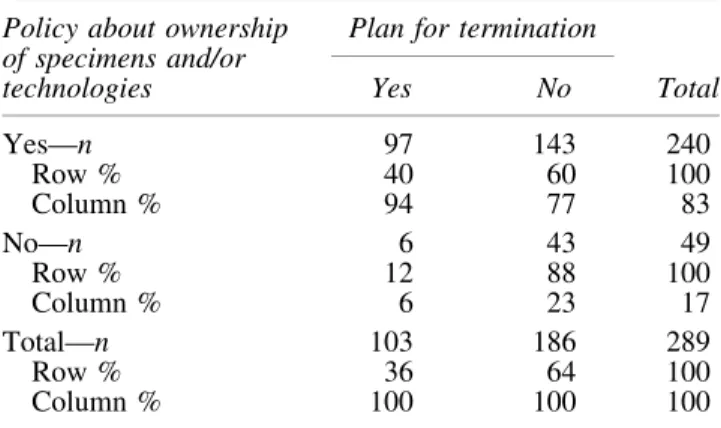
We investigated whether and how these four variables are related because we hypothesized that if a biobank was forward-thinking in one area, it was more likely to be forward-forward-thinking in others. Thus, we examined cross-tabulations between each pair of variables. Three relationships are statistically significant (depicted in Tables 1–3): having a policy about ownership of specimens and/or technology is associated with having a policy about return of individual results (w213.30,p<0.001; Table 1).
Having a policy about ownership of specimens and/or tech-nology is associated with having a plan for termination (w2
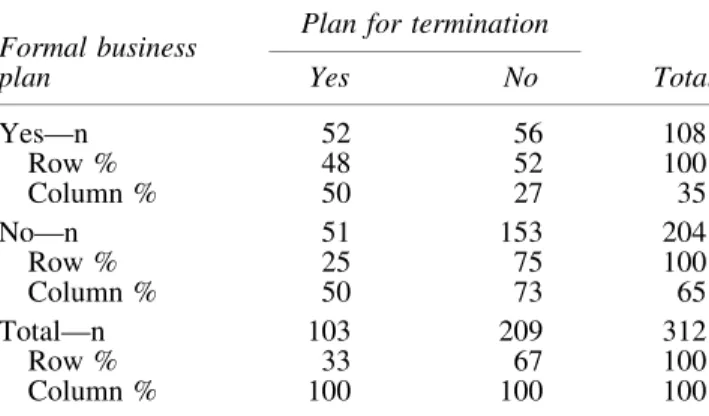
14.08, p<0.001; Table 2). Having a plan for termination is associated with having a formal business plan (w2 17.11,
p<0.001; Table 3). Because we have no causal hypotheses about the relationships, we include row and column percent-ages in Tables 1–3.
Patterns of forward-thinking variables
To further explore relationships between the indicators of forward-thinking biobanks, we examined our four variables in combination. In this way, we could examine the proportion of biobanks that may be forward-thinking in only one or two ways and those that are forward-thinking along all four vari-ables.1Biobanks were excluded from these analyses if they were not asked or chose not to answer any of the related survey questions. A total of 312 biobanks are included in this analysis. We analyzed all possible combinations of the four forward-thinking indicators. The results are shown in Table 4. We observed patterns among the 312 biobanks that an-swered questions about all four forward-thinking variables. One-fifth of these biobanks (n=62) have policies on return of results and ownership, but no business plan or plan for
Table1. Ownership and Return of Results
Policy about
ownership of specimens and/or technologies
Policy about return of individual resultsa
Total Yes No
Yes—n 157 56 213
Row % 73 27 100
Column % 89 70 84
No—n 19 23 42
Row % 45 55 100
Column % 11 30 16
Total—n 176 79 255
Row % 69 31 100
Column % 100 100 100
w2=13.30,p<0.001.
Seventy-eight additional respondents answered one or both of the questions with ‘‘Not Sure’’ or left it blank and are therefore omitted from this table.
a
Ninety-six respondents were not asked this question because their biobank does not have identifying information for any of its specimens and therefore could never return results.
Table2. Ownership and Plan for Termination
Policy about ownership of specimens and/or technologies
Plan for termination
Total Yes No
Yes—n 97 143 240
Row % 40 60 100
Column % 94 77 83
No—n 6 43 49
Row % 12 88 100
Column % 6 23 17
Total—n 103 186 289
Row % 36 64 100
Column % 100 100 100
w2=14.08,p<0.001.
One hundred forty respondents answered one or both questions with ‘‘Not Sure’’ or left one/both blank and are therefore omitted from this table.
termination (row 4). Fourteen percent (n=45) have a return of results policy, but are not forward-thinking in any other variables (row 2). Twelve percent (n=38) are not forward-thinking for any variable (row 1). Eleven percent (n=34) have only ownership policies (row 3). Finally, only 7% of these biobanks (N=23) are forward-thinking across all four variables (row 16).
Discussion
Biobanking is an evolving field. What began as small collections, often based at academic medical centers and focused on fulfilling the needs of specific studies, have grown into an emerging industry (De Souza and Greenspan, 2013; Hendersonet al., 2013a). This is evident in publications of guidelines for best practices in biobanking (OECD, 2009; NCI, 2011; ISBER, 2012) as well as the development of an
extensive accreditation program for biobanks (College of American Pathologists). These efforts may help to improve the quality and consistency of biobank collections. They may also help to increase public trust and confidence from research users and funders by, among other things, providing evidence of professionalism, adaptability, and foresight (O’Dohertyet al., 2011; Laurie et al., 2012; Simeon-Dubach and Henderson, 2014). Commentators suggest that biobanks have been guided mainly by the ‘‘quest for research’’ rather than by the standard conventions of business practice, where examination of supply and demand, and the application of basic business principles would guide the creation and maintenance of a successful business (Vaughtet al., 2011a).
We argue that forward-thinking policies and plans are other indicators of anticipatory planning. In this article, we use four variables from our survey of U.S. biobanks. The variables we highlight as indicators of forward-thinking biobanks are just some that could be examined. For example, elsewhere, we report on biobanks’ ‘‘reach through’’ practices after distrib-uting specimens or data to researchers (Henderson et al., 2013b). We defined ‘‘reach through’’ as the extent to which biobanks retain or relinquish control of the specimens or data after sharing them. We could have argued here, for instance, that forward-thinking biobanks are those that require re-searchers to return aggregate results to the biobank from the studies using its specimens (Hendersonet al., 2013a). Alter-natively, we could have examined the presence or absence of oversight committees (Hendersonet al., 2013a).
However, for this article, we chose our variables of interest because they reflect two different kinds of anticipatory plan-ning that are frequently discussed in the literature on bio-banking, but usually not together: ethical and legal issues and sustainability of the biobank. Policies on return of individual research results and incidental findings, as well as policies on ownership of specimens and technologies, reflect planning related to contentious ethical and legal issues. Debate over the ethical issues raised by return of research results is commonly found in the bioethics literature, while ownership issues have
Table3. Formal Business Plan and Plan for Termination
Formal business plan
Plan for termination
Total Yes No
Yes—n 52 56 108
Row % 48 52 100
Column % 50 27 35
No—n 51 153 204
Row % 25 75 100
Column % 50 73 65
Total—n 103 209 312
Row % 33 67 100
Column % 100 100 100
w2=17.11,p<0.001.
One hundred seventeen respondents answered one or both questions with ‘‘Not Sure’’ or left one/both blank and are therefore omitted from this table.
Table4. Patterns of Forward-Thinking Variables
Row no.
Formal business plan
Plan for termination
Ownership policya
Return of
results policy Frequency Percentage
1 N N N N 38 12
2 N N N Y 45 14
3 N N Y N 34 11
4 N N Y Y 62 20
5 N Y N N 3 1
6 N Y N Y 3 1
7 N Y Y N 5 2
8 N Y Y Y 28 9
9 Y N N N 13 4
10 Y N N Y 10 3
11 Y N Y N 18 6
12 Y N Y Y 22 7
13 Y Y N N 2 1
14 Y Y N Y 2 1
15 Y Y Y N 4 1
16 Y Y Y Y 23 7
Total 312 100
been debated in courts and in the media. Having a business plan and a plan for termination of the biobank reflect formal planning related to sustainability, which we have argued elsewhere is also an ethical issue (Cadiganet al., 2013).
In our survey, 62% of biobanks that have access to identi-fying information report they have a return of individual results policy. Interestingly, although international guidance on bio-banking leans toward returning individual results to contribu-tors, for the majority of biobanks in our study with a policy (57%), the policy states that results will never be returned. Seventy percent of the biobanks in our survey report having a policy on ownership of specimens and/or technology. Biobanks were far less likely to have plans related to sustainability (34% have a business plan and 26% have a termination plan). When we examined patterns among biobanks that provided answers to all four variables, we discovered that only 7% were thinking across all four variables, and 12% were not forward-thinking for any of the variables.
Having a return of results policy and an ownership policy were significantly related, as were having a business plan and termination plan. Interestingly, we also found a significant relationship between biobanks having an ownership policy and a plan for termination. This may indicate that biobanks that find it important to formally designate ownership are also more mindful of the need to develop legacy plans for the specimens and data should the biobank close. In fact, one best practice guideline recommends, regarding ‘‘business risks,’’ that biobanks ‘‘provide [specimen contributors] information that ownership could change and explain the uncertainties associated with the establishment and operation of the [bio-bank]’’ (OECD, 2009:24).
Our study of biobanks has limitations. It is not a longitu-dinal study, so we cannot examine whether biobanks’ poli-cies have changed over time, which might further indicate their ability to be adaptive (O’Dohertyet al., 2011). In ad-dition, our survey did not ask respondents about the return of individual results if they reported that their biobank does not have access to identifying information for any of its specimen contributors. We could have labeled these biobanks as not forward-thinking for our analyses in this study, arguing that biobanks with specimens and data that are linked to indi-viduals are forward-thinking by anticipating that the value of the collection is increased with such linkages. However, we chose not to do so because we lack data onwhy these biobanks do not have access to identifying information. It is possible, for instance, that an honest broker has access, but the biobank itself does not (Boydet al., 2007). Therefore, we did not feel comfortable labeling them as not forward-thinking. Further research should be done to understand the different circumstances under which biobanks do not retain identifying information.
We argue that given the uncertainties of biobanking, it is critical to develop policies and plans such as those we ex-amine in this report. Furthermore, in the new era of ‘‘preci-sion medicine,’’ which hopes to capitalize on specimens and data already collected and stored for large-scale research projects (Collins and Varmus, 2015), it is increasingly im-portant that biobanks evidence professionalism and ac-countability. For any organization to be sustainable, certain levels of planning must be met. Forward-thinking in bio-banking means anticipating future challenges and creating both policies and procedures to address them.
Acknowledgments
We wish to thank the people who kindly participated in our survey and members of our biobank survey research team, including Ian Conlon, Bryan Weiner, and Cathy Zimmer. Funding for this research was provided by several grants: 1R01HG005227-01A1 (G. Henderson, principal investiga-tor, ‘‘From Specimen to Biobank: Using An Organizational Perspective to Study ELSI Issues’’) from the National Human Genome Research Institute; 5UL1RR025747-04S1, a sup-plement to the UNC CTSA U54RR024382-01A1 ( M. Runge, principal investigator, ‘‘Enhancing Biobank Capa-cities Across CTSAs’’), and the UNC Center for Genomics and Society, P50 HG004488 (G. Henderson, principal in-vestigator), from the National Human Genome Research Institute. The content of this article does not necessarily reflect the views or policies of the funding agencies.
Author Disclosure Statement
No competing financial interests exist.
References
Albert M, Bartlett J, Johnston RN, et al. (2014) Biobank
bootstrapping: is biobank sustainability possible through cost recovery? Biopreserv Biobank 12:374–380.
Boyd AD, Hosner C, Hunscher DA,et al.(2007) An ‘Honest
Broker’ mechanism to maintain privacy for patient care and academic medical research. Int J Med Inform 76:407–11.
Boyer GJ, Whipple W, Cadigan RJ,et al.(2012) Biobanks in
the United States: how to identify an undefined and rapidly evolving population. Biopreserv Biobank 10:511–517.
Cadigan RJ, Lassiter D, Haldeman K, et al.(2013) Neglected
ethical issues in biobank management: results from a US study. Life Sci Soc Policy 9:1.
College of American Pathologists. Biorepository accreditation program. Available at: www.cap.org/web/oracle/webcenter/ portalapp/pagehierarchy/biorepository_accreditation_program .jspx?_afrLoop=459142652236798#%40%3F_afrLoop%3D4
59142652236798%26_adf.ctrl-state%3Dbuzdluha1_51
Ac-cessed November 15, 2015.
Collins FS, Varmus H (2015) A new initiative on precision medicine. N Engl J Med 372:793–795.
de Faria PL (2009) Ownership rights in research biobanks: do we need a new kind of ‘‘biological property’’? In: Solbakk DJH, Holm DS, Hofmann DB (eds) The Ethics of Research Biobanking. Dordrecht: Springer, pp 263–276.
De Souza YG, Greenspan JS (2013) Biobanking past, present and future: responsibilities and benefits. AIDS 27:303–312. Dressler LG (2007) Biospecimen ‘‘ownership’’: counterpoint.
Cancer Epidemiol Biomarkers Prev 16:190–191.
Dressler LG (2009) Biobanking and disclosure of research re-sults: addressing the tension between professional boundaries and moral intuition. In: Solbakk DJH, Holm DS, Hofmann DB (eds) The Ethics of Research Biobanking. Dordrecht: Springer, pp 85–99.
Gibbons SMC (2009) Regulating biobanks: a twelve-point ty-pological tool. Med Law Rev 17:313–346.
Greenberg v. Miami Children’s Hospital Research Institute, 264 F.Supp.2d 1064 (S.D. Fla. 2003).
Haga SB, Beskow LM (2008) Ethical, legal, and social impli-cations of biobanks for genetics research. Adv Genet 60: 505–544.
Havasupai Tribe v. Arizona Board of Regents, 204 P.3d 1063 (Ariz. Ct. App. 2008).
Henderson GE, Cadigan RJ, Edwards TP,et al.(2013a)
Char-acterizing biobank organizations in the US: results from a national survey. Genome Med 5:1–12.
Henderson GE, Edwards TP, Cadigan RJ, et al. (2013b)
Stewardship practices of US biobanks. Sci Transl Med 5: 215cm7.
International Society for Biological and Environmental Re-positories (ISBER) (2012) Best practices for reRe-positories: collection, storage, retrieval, and distribution of biological materials for research. Biopreserv Biobank 10:79–161.
Jarvik GP, Amendola LM, Berg JS, et al. (2014) Return of
genomic results to research participants: the floor, the ceiling, and the choices in between. Am J Hum Genet 94:818–826. Johnson G, Lawrenz F, Thao M (2012) An empirical
exami-nation of the management of return of individual research results and incidental findings in genomic biobanks. Genet Med 14:444–450.
Laurie G (2011) Reflexive governance in biobanking: on the value of policy led approaches and the need to recognise the limits of law. Hum Genet 130:347–356.
Laurie G, Harmon SHE, Arzuaga F (2012) Foresighting futures: law, new technologies, and the challenges of regulating for uncertainty. Law Innov Technol 4:1–33.
Lepsch AC (2012) Greenberg v. Miami Children’s Hospital Research Institute. Grove City CJL Pub Pol’y 3:145–155.
Long MD, Cadigan RJ, Cook SF,et al.(2015) Perceptions of
patients with inflammatory bowel diseases on biobanking. Inflamm Bowel Dis 21:132–138.
Matzke LAM, Fombonne B, Watson PH,et al.(2016)
Funda-mental considerations for biobank legacy planning. Biopre-serv Biobank 14:99–106.
Mello MM, Wolf LE (2010) The Havasupai Indian tribe case— lessons for research involving stored biologic samples. N Engl J Med 363:204–207.
Moore v. Regents of the University of California, 793 P.2d 479 (Cal. 1990).
NCI Office of Biorepositories and Biospecimen Research (2011) NCI best practices for biospecimen resources. Avail-able at: http://biospecimens.cancer.gov/practices Accessed November 23, 2015.
O’Doherty KC, Burgess MM, Edwards K, et al.(2011) From
consent to institutions: designing adaptive governance for genomic biobanks. Soc Sci Med 73:367–374.
OECD (2009) OECD Guidelines on human biobanks and ge-netic research databases. Available at: www.oecd.org/sti/ biotechnology/hbgrd Accessed November 23, 2015.
Ormond KE, Cho MK (2014) Translating personalized medi-cine using new genetic technologies in clinical practice: the ethical issues. Per Med 11:211–222.
Piljak Estate v. Abraham [2014] Ont.S.C. 2893 (Can.). Rao R (2007) Genes and spleens: property, contract, or privacy
rights in the human body? J Law Med Ethics 35:371–382. Simeon-Dubach D, Henderson MK (2014) Sustainability in
biobanking. Biopreserv Biobank 12:287–291.
Skloot R (2010) The Immortal Life of Henrietta Lacks. Crown, New York.
Stephens N, Dimond R (2015a) Unexpected tissue and the biobank that closed: an exploration of value and the mo-mentariness of bio-objectification processes. Life Sci Soc Policy 11:1–15.
Stephens N, Dimond R (2015b) Closure of a human tissue biobank: individual, institutional, and field expectations dur-ing cycles of promise and disappointment. New Genet Soc 34:417–436.
Tupasela A, Stephens N (2013) The boom and bust cycle of biobanking–thinking through the life cycle of biobanks. Croat Med J 54:501–503.
Vaught J, Rogers J, Carolin T,et al.(2011a) Biobankonomics:
developing a sustainable business model approach for the formation of a human tissue biobank. J. Natl Cancer Inst Monogr 2011:24–31.
Vaught J, Rogers J, Myers K,et al.(2011b) An NCI perspective on creating sustainable biospecimen resources. J Natl Cancer Inst Monogr 2011:1–7.
Washington Univ. v. Catalona, 437 F.Supp.2d 985 (E.D. Mis-souri 2006).
Wolf SM, Crock BN, Van Ness B, et al. (2012) Managing
incidental findings and research results in genomic research involving biobanks and archived data sets. Genet Med 14: 361–384.
Zawati MH, Borry P, Howard HC (2011) Closure of population biobanks and direct-to-consumer genetic testing companies. Hum Genet 130:425–432.
Address correspondence to: