DRINKING-WATER, SANITATION, AND HYGIENE BEYOND THE HOUSEHOLD: A GLOBAL REVIEW AND A SITUATIONAL ASSESSMENT OF GHANA
Ryan D. Cronk
A thesis submitted to the faculty of the University of North Carolina at Chapel Hill in partial fulfillment of the requirements for the degree of Masters of Science in the Department of
Environmental Sciences and Engineering.
Chapel Hill 2013
Approved by:
Dr. Jamie Bartram
Dr. Jacqueline MacDonald-Gibson
ii
ABSTRACT
RYAN CRONK: Drinking-Water, Sanitation, and Hygiene Beyond the Household: A Global Review and Situational Assessment of Ghana
(Under the direction of Jamie Bartram)
Extra-household settings are in consideration for drinking-water, sanitation, and
hygiene (WaSH) targets in the post-2015 development agenda but evidence gaps impair
monitoring, policy, and practice. We systematically reviewed literature to develop a
typology, evaluate standards, identify actors, assess evidence, and catalog monitoring
initiatives. A situational assessment of Ghana identified specific national challenges. Schools
and health facilities have the most support from actors, evidence for benefits, and standards
defined. From available data in developing countries, we estimate that WaSH monitoring
initiatives for schools exist in approximately 70 countries, 30 countries for health facilities,
and fewer than 20 countries for all other settings combined. We found limited evidence
describing benefits of WaSH or the impact of poor WaSH conditions in most settings. While
not all countries conduct extra-household monitoring, examples are available on most
iii
ACKNOWLEDGEMENTS
I would like to thank my advisor, Dr. Jamie Bartram who provided strategic vision,
feedback, and guidance on the development of these papers and members of my committee,
Dr. Jackie MacDonald-Gibson, and Dr. Pete Kolsky for their feedback and advice. Tom
Slaymaker, chair of Joint Monitoring Program post-2015 Water Working Group, provided
valuable feedback on the initial drafts of both papers.
I would like to thank Jonny Crocker of the Water Institute at UNC for collecting
hard-to-find Ghanaian policy documentation and monitoring reports that helped shape the
situational assessment. World Vision Ghana staff were instrumental in coordinating logistics
and helping arrange interviews. Murat Sahin of UNICEF also helped to arrange interviews
and provided feedback on an early draft.
This project was commissioned and partially funded by WaterAid on behalf of the
WHO/UNICEF Joint Monitoring Programme post-2015 working groups. Additional funding
was provided from a fellowship in Public Health Informatics supported by the Office of
National Coordinators (ONC). World Vision Ghana and a Department of Environmental
iv
TABLE OF CONTENTS
LIST OF TABLES ...v
ABBREVIATIONS ... vii
CHAPTER I: INTRODUCTION ...1
CHAPTER II: A REVIEW OF DRINKING-WATER, SANITATION, AND HYGIENE BEYOND THE HOUSEHOLD: SETTINGS, MONITORING AND POLICY IMPLICATIONS ...3
INTRODUCTION ...3
METHODS ...4
RESULTS ...7
DISCUSSION ...22
CONCLUSION ...27
CHAPTER III: DRINKING-WATER, SANITATION, AND HYGIENE BEYOND THE HOUSEHOLD: A SITUATIONAL ASSESSMENT OF GHANA ON MONITORING, POLICY, AND PRACTICE ...28
INTRODUCTION ...28
METHODS ...29
RESULTS ...31
DISCUSSION ...39
CONCLUSIONS AND RECOMMENDATIONS ...44
CHAPTER IV: CONCLUSION ...47
v
LIST OF TABLES
1. Search terms used to review extra-household literature ...5
2. Descriptive evidence for evaluating extra-household settings ...6
3. Descriptive evidence for evaluating monitoring initiatives for extra-household settings ...6
4. Results of review of extra-household settings (part 1 of 2) ...8
5. Results of review of extra-household settings (part 2 of 2) ...9
6. Extra-household settings typology ...11
7. Extra-household monitoring initiatives at the global, national, and local levels ...12
8. Proposed aggregate WaSH indicators for schools and health facilities ...19
9. Proposed indicators for basic levels of service for schools and health facilities ...20
10. Proposed indicators for intermediate levels of service for schools and health facilities ...21
11. Proposed indicators for high levels of service for schools and health facilities ...21
12. WaSH monitoring initiatives available for extra-household settings ...25
13. Typology of Extra-household settings ...30
14. Extra-Household WaSH data availability from WaSH monitoring actors ...31
15. School evaluation units used in Ghana ...36
16. Input indicators for schools in Ghana ...36
17. Enabling environment indicators for schools in Ghana ...36
18. Basic level indicators for schools in Ghana ...37
vi
20. Input indicators for health facilities in Ghana ...38
21. Enabling environment indicators for health facilities in Ghana ...38
22. Basic level indicators for health facilities in Ghana ...39
23. School water and sanitation coverage in Ghana ...41
vii
LIST OF ABBREVIATIONS
CSO Country Status Overview
CWSA Community Water and Sanitation Agency
DA District Assembly
DESSAP District Environmental Sanitation Strategy and Action Plan
DHS Demographic and Health Survey
EHO Environmental Health Officer
EHSD Environmental Health and Sanitation Directorate
EMIS Educational Management Information System
GSS Ghana Statistical Service
HMIS Health Management Information System
IRC International Water and Sanitation Centre
JMP Joint Monitoring Programme for water supply and sanitation of the World Health Organization and UNICEF
LSMS Living Standards Measurement Survey
MICS Multiple Indicator Cluster Surveys
MoE Ministry of Education
MoH Ministry of Health
NESSAP National Environmental Sanitation Strategy and Action Plan (Ghana)
NGO Non-Governmental Organization
SAM Service Availability Mapping
SARA Service Availability and Readiness Assessment
viii
SMS Short Message Service
SPA Service Provision Assessment
UN United Nations
UNICEF United Nations Children's Fund
USAID US Agency for International Development
VCT Voluntary Counseling and Testing
WaSH Water, Sanitation, and Hygiene
WEDC Water, Engineering and Development Centre of Loughborough University, Leicestershire, UK
WHO World Health Organization
WSMIS Water Sector Management Information System
CHAPTER I: INTRODUCTION
The Joint Monitoring Programme (JMP) of the World Health Organization (WHO)
and the United Nations Children’s Fund (UNICEF) has been the agency responsible for
monitoring progress on drinking-water and sanitation coverage worldwide since 1990. Since
the establishment of the Millennium Development Goals (MDGs), the JMP has a mandate for
monitoring worldwide progress against the MDG target for drinking-water and sanitation.
JMP monitoring has provided value to efforts towards capacity development, advocacy, and
informing investments. The JMP recognizes that new, ambitious targets and indicators for
monitoring could contribute to more rapid achievement of drinking-water and sanitation
coverage worldwide (WHO/UNICEF JMP, 2012).
With the impending construction of the post-2015 development agenda and
associated monitoring framework, the JMP assembled four expert working groups on
drinking-water, sanitation, hygiene, and a cross-cutting group on equity and
non-discrimination to develop a package of goals, targets, and indicators for WaSH beyond the
MDGs. These working groups operated under the following assumptions and principles
(WHO/UNICEF JMP, 2012):
1. “The targets should be formulated in the context of a simple, inspirational vision, articulated around universal use of water, sanitation and hygiene
2. “Targets should focus primarily on outcomes
3. “Targets should reflect the human rights to water and sanitation, and the concept of progressive realization of the rights
4. “The targets should reflect the aspiration of both an increase in the number of people using water, sanitation, and hygiene, and improvements in their level of service, and both are considered progressive realization
2
6. “Targets should look beyond the home to schools and health centres 7. “There must be a focus on the poor, disadvantaged and excluded
8. “There must be a focus on the elimination of inequalities and inequities” (WHO/UNICEF JMP, 2012, p. 2-3).
Point six, focused on WaSH in extra-household settings, is the genesis of this article
compilation thesis. Prior to this review and situational assessment, little had been
documented on WaSH in extra-household settings. Gaining a broader understanding of
WaSH in the extra-household environment through a desk-based global review and a
situational assessment of how these topics play out in practice in a specific country context
has implications for the formation of international development policy and the post-2015
development agenda.
In section II, I review WaSH beyond the household through the development of a
typology of settings, cataloging monitoring initiatives, and developing a set of indicators for
monitoring. In section III, I report a situational assessment of the extra-household monitoring
environment in Ghana to provide a contextual assessment of monitoring, policy, and practice.
This research contributes to the broader understanding of these non-household environments
by documenting gaps in evidence, monitoring, and practice to inform policy and the future
3
CHAPTER II: A REVIEW OF DRINKING-WATER, SANITATION, AND HYGIENE BEYOND THE HOUSEHOLD: SETTINGS, MONITORING, AND POLICY
IMPLICATIONS
INTRODUCTION
With the approaching expiration of the Millennium Development Goals (MDGs),
attention is shifting to the assembly of the post-2015 development agenda. An aim of the
agenda is to create a framework of Sustainable Development Goals (SDGs) that build on the
MDGs. For drinking-water, sanitation, and hygiene (WaSH), settings beyond the household,
such as schools, health facilities, and markets are being considered in addition to households,
which were the only setting monitored for the drinking-water and sanitation target of the
MDGs (WHO/UNICEF JMP, 2012).
In general, the lack of WaSH access in extra-household settings disproportionately
affects certain household members in different ways. For example, inadequate sanitation
facilities for menstrual hygiene management (MHM) have been associated with poor school
attendance by adolescent girls (Abrahams, 2006). The elderly face substantial challenges if
WaSH facilities are not suited to their needs (Harris, 2012). Disabled persons make up 15%
of the global population and include individuals living with physical, intellectual, sensory
(e.g. blindness, deafness) or mental health impairments (WHO, 2011). They face technical
and social barriers related to WaSH preventing them from attending school, seeking jobs, and
4
take jobs, it places an additional economic burden on their families and compounds
inequality (Groce, 2011).
Monitoring access to extra-household WaSH is important for purposes of informing
investment in resources, supporting benchmarking and reporting, and measuring progress. A
component of effective monitoring is a framework for data collection using a set of
indicators. Examples of WaSH monitoring frameworks include the Human Right to Water
(HRTW), the United Nations (UN) Water Global Analysis and Assessment of Sanitation and
Drinking-Water (GLAAS), and the World Health Organization (WHO)/United Nations
Children’s Fund (UNICEF) Joint Monitoring Programme (JMP) which collects data used to
track progress for the MDG target on drinking-water and sanitation. Despite the availability
of multiple frameworks, none of them provide globally harmonized indicators or guidance
for extra-household WaSH monitoring. Therefore, a new framework is required to monitor
these settings.
This review summarizes the current state of WaSH in extra-household settings. We
develop a typology to categorize extra-household settings. We catalog international
standards, actors, and the current status of evidence about WaSH in these settings to identify
literature gaps. We describe available monitoring initiatives that collect extra-household data
and review other monitoring initiatives that could incorporate extra-household indicators in
the future. Finally, we present a framework of extra-household indicators for monitoring in
5
METHODS
Literature search strategy
We systematically reviewed PubMed, Web of Science, and Google Scholar, using
each of the terms “drinking-water,” “sanitation,” and ‘hygiene” in combination with terms
associated with extra-household settings as described in Table 1 and terms related to
monitoring, evaluation, policy, guidelines, and standards. The list of search terms in Table 1
was generated iteratively through web searches, literature searches, and consultation with the
post-2015 WaSH working groups. Using the same set of terms, we searched for and reviewed
gray literature publications from United Nations (UN) agencies, bilateral and multilateral
organizations, non-governmental organizations (NGOs), national governments, and research
institutions.
Table 1. Search terms used to review extra-household literature
Setting PubMed MeSH
term Associated search terms
Schools School primary OR secondary OR boarding OR day AND school, nursery, daycare, university, kindergarten
Health facilities Health facilities
Hospital, health center, clinic, asylum, dental surgery, general practitioner facility, maternities, nursing home, psychiatric hospital, voluntary counseling and testing (VCT) facility
Workplaces Workplace Farm, military base, municipal building, office, office park, factory, agriculture
Service settings Food services,
Restaurants
Accommodation, accommodation types, hotel, inn, motel, cafeteria, canteen, fast food, restaurant, bakery
Transit hubs None available Rail, bus, train, ship port, station, lorry park, bus stop, railway
Markets None available Food market, grocery
Places of worship None available Church, mosque, synagogue, temple, chapel, masjid, musjid, shrine, tabernacle
Public WaSH
facilities None available
Public toilet, pay-and-use toilet, community toilet, drinking-water fountain
Mass gatherings None available
Mobile food vendors, Hajj, Olympic (Athens, London, Beijing), World Cup, soccer, football, State events (e.g. funeral, inauguration), festival, temporary event
Internally displaced persons camps
None available IDP, emergency, disaster, disaster-response
Refugee camps Refugees Refugee, shelter, refugee community
Prisons Prisons Detention, penal, reformatory, penitentiary, incarceration, jail
6 Document screening and categorization
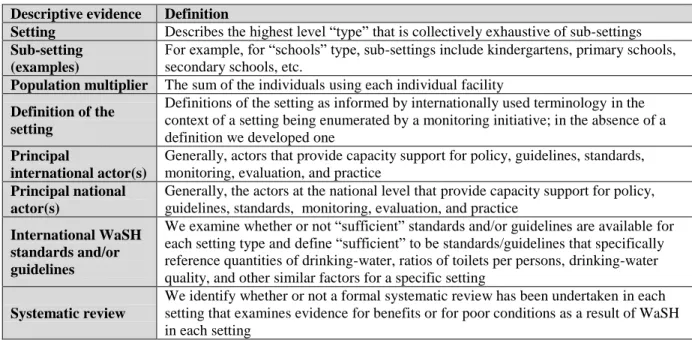
We describe settings using the available evidence and definitions listed in Table 2. We
describe monitoring initiatives using the available evidence and definitions listed in Table 3.
Table 2. Descriptive evidence for evaluating extra-household settings
Descriptive evidence Definition
Setting Describes the highest level “type” that is collectively exhaustive of sub-settings
Sub-setting (examples)
For example, for “schools” type, sub-settings include kindergartens, primary schools, secondary schools, etc.
Population multiplier The sum of the individuals using each individual facility
Definition of the setting
Definitions of the setting as informed by internationally used terminology in the context of a setting being enumerated by a monitoring initiative; in the absence of a definition we developed one
Principal
international actor(s)
Generally, actors that provide capacity support for policy, guidelines, standards, monitoring, evaluation, and practice
Principal national actor(s)
Generally, the actors at the national level that provide capacity support for policy, guidelines, standards, monitoring, evaluation, and practice
International WaSH standards and/or guidelines
We examine whether or not “sufficient” standards and/or guidelines are available for each setting type and define “sufficient” to be standards/guidelines that specifically reference quantities of drinking-water, ratios of toilets per persons, drinking-water quality, and other similar factors for a specific setting
Systematic review
We identify whether or not a formal systematic review has been undertaken in each setting that examines evidence for benefits or for poor conditions as a result of WaSH in each setting
Table 3. Descriptive evidence for evaluating monitoring initiatives for extra-household settings
Descriptive evidence Definition
Monitoring initiative Description of the initiative by which monitoring data on extra-household
settings are collected
Examples in practice Examples of monitoring initiative(s) in practice in countries
Applicable settings For which settings is the monitoring initiative applicable
Institutional data coordinator
Actor responsible for managing, coordinating, and aggregating the monitoring data
Typical area of indicators
included Input, output, outcome, and impact indicators Sampling approach E.g. random sample, complete enumeration
Estimated number of data sets
Number of publicly available data sets that were identified through the course of this review
Frequency of reporting E.g. monthly, annually, every five years
Data provider/ collector The individual who is providing the status of the facility or setting of interest
(e.g. school principal, health care worker)
Typology Development
Based on attributes of settings identified through the literature search, we develop a
7
The typology was constructed using methods described in Bailey (1994). Bailey describes
typologies to be collectively exhaustive, where all settings are assigned a type. Types are also
mutually exclusive, where each setting is only part of one type. The settings are conceptually
grouped based on multidimensional attributes and characteristics described by the
descriptions in Tables 2 and 3.
RESULTS
Settings
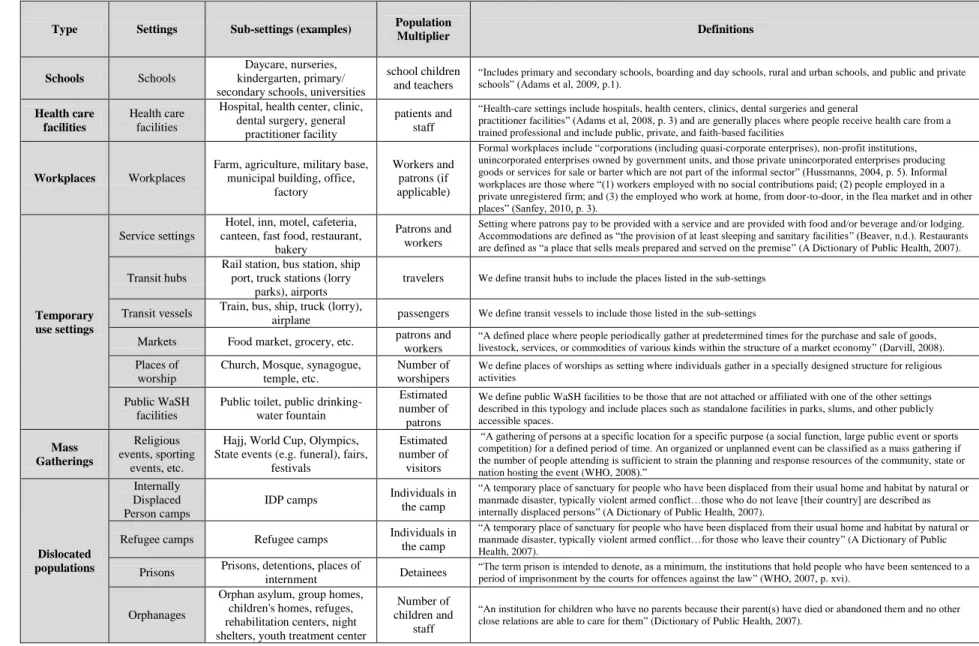
Findings on settings are described in Tables 4 and 5. By type, Table 4 describes the
settings (e.g. transit hub), examples of associated sub-settings (e.g. rail station, bus station),
the population multiplier, and definitions. Table 5 describes, for each setting, the principal
international actor(s), principal national actor(s), available international standards and/or
Table 4. Results of review of extra-household settings (part 1 of 2)
Type Settings Sub-settings (examples) Population
Multiplier Definitions
Schools Schools
Daycare, nurseries, kindergarten, primary/ secondary schools, universities
school children and teachers
“Includes primary and secondary schools, boarding and day schools, rural and urban schools, and public and private schools” (Adams et al, 2009, p.1).
Health care facilities
Health care facilities
Hospital, health center, clinic, dental surgery, general
practitioner facility
patients and staff
“Health-care settings include hospitals, health centers, clinics, dental surgeries and general
practitioner facilities” (Adams et al, 2008, p. 3) and are generally places where people receive health care from a trained professional and include public, private, and faith-based facilities
Workplaces Workplaces
Farm, agriculture, military base, municipal building, office,
factory
Workers and patrons (if applicable)
Formal workplaces include “corporations (including quasi-corporate enterprises), non-profit institutions, unincorporated enterprises owned by government units, and those private unincorporated enterprises producing goods or services for sale or barter which are not part of the informal sector” (Hussmanns, 2004, p. 5). Informal workplaces are those where “(1) workers employed with no social contributions paid; (2) people employed in a private unregistered firm; and (3) the employed who work at home, from door-to-door, in the flea market and in other places” (Sanfey, 2010, p. 3).
Temporary use settings
Service settings
Hotel, inn, motel, cafeteria, canteen, fast food, restaurant,
bakery
Patrons and workers
Setting where patrons pay to be provided with a service and are provided with food and/or beverage and/or lodging. Accommodations are defined as “the provision of at least sleeping and sanitary facilities” (Beaver, n.d.). Restaurants are defined as “a place that sells meals prepared and served on the premise” (A Dictionary of Public Health, 2007).
Transit hubs
Rail station, bus station, ship port, truck stations (lorry
parks), airports
travelers We define transit hubs to include the places listed in the sub-settings
Transit vessels Train, bus, ship, truck (lorry),
airplane passengers We define transit vessels to include those listed in the sub-settings
Markets Food market, grocery, etc. patrons and
workers
“A defined place where people periodically gather at predetermined times for the purchase and sale of goods, livestock, services, or commodities of various kinds within the structure of a market economy” (Darvill, 2008). Places of
worship
Church, Mosque, synagogue, temple, etc.
Number of worshipers
We define places of worships as setting where individuals gather in a specially designed structure for religious activities
Public WaSH facilities
Public toilet, public drinking-water fountain
Estimated number of patrons
We define public WaSH facilities to be those that are not attached or affiliated with one of the other settings described in this typology and include places such as standalone facilities in parks, slums, and other publicly accessible spaces. Mass Gatherings Religious events, sporting events, etc.
Hajj, World Cup, Olympics, State events (e.g. funeral), fairs,
festivals
Estimated number of visitors
“A gathering of persons at a specific location for a specific purpose (a social function, large public event or sports competition) for a defined period of time. An organized or unplanned event can be classified as a mass gathering if the number of people attending is sufficient to strain the planning and response resources of the community, state or nation hosting the event (WHO, 2008).”
Dislocated populations
Internally Displaced Person camps
IDP camps Individuals in
the camp
“A temporary place of sanctuary for people who have been displaced from their usual home and habitat by natural or manmade disaster, typically violent armed conflict…those who do not leave [their country] are described as internally displaced persons” (A Dictionary of Public Health, 2007).
Refugee camps Refugee camps Individuals in
the camp
“A temporary place of sanctuary for people who have been displaced from their usual home and habitat by natural or manmade disaster, typically violent armed conflict…for those who leave their country” (A Dictionary of Public Health, 2007).
Prisons Prisons, detentions, places of
internment Detainees
“The term prison is intended to denote, as a minimum, the institutions that hold people who have been sentenced to a period of imprisonment by the courts for offences against the law” (WHO, 2007, p. xvi).
Orphanages
Orphan asylum, group homes, children's homes, refuges, rehabilitation centers, night shelters, youth treatment center
Number of children and
staff
“An institution for children who have no parents because their parent(s) have died or abandoned them and no other close relations are able to care for them” (Dictionary of Public Health, 2007).
Table 5. Results of review of extra-household settings (part 2 of 2)
Type Settings Principal International Actor(s) Principle National Actor(s) International standards and/or guidelines Systematic review?
Schools Schools
United Nations Educational, Scientific and Cultural Organization (UNESCO),
UNICEF, WHO
Ministry of Education
UNICEF, WHO, The Sphere Project - Humanitarian Charter and Minimum Standards
in Humanitarian Response (Sphere)
Yes; Jasper et al 2012
Health care
facilities Health care facilities
WHO, MEASURE Evaluation, International Health Facility Assessment Network (IHFAN)
Ministry of Health WHO, Sphere No
Workplaces Workplaces International Labor Organization (ILO) Ministry of Labor
None sufficient; general guidance by Work Improvement in Small Enterprises (WISE+)
(ILO, 2009)
No
Service settings None identified Ministry of Health and/or
Environmental Health None identified No
Temporary use settings
Transit hubs Local Governments for Sustainability (ICLEI)
Municipal authorities, private companies, mayor
associations
None sufficient; General guidance on environmental health in bus and rail stations
(WHO, n.d.)
No
Transit vessels None identified Municipal authorities;
private companies
WHO guide to ship sanitation (WHO, 2011); none sufficient for other vessels
Rooney et al, 2004 (ships only)
Markets WHO (though limited) Municipal authorities None sufficient though some guidance in
Healthy Food Marketplaces (WHO, 2006) No
Places of worship Global governing body of the religious institution
National governing body of
the religious institution None identified No
Public WaSH facilities None; generally managed locally Ministry of Works; Water
and Sanitation None identified No
Mass Gatherings
Religious events, sporting events,
etc. WHO
Context specific; often
Ministry of Health None identified No
Dislocated populations
IDP camps Commissioner for Refugees (UNHCR) The Office of the United Nations High None identified Sphere No
Refugee camps UNHCR None identified Sphere Yes; Cronin,
2011
Prisons International Committee of the Red
Cross (ICRC) National prison agency ICRC, WHO No
Orphanages Non-governmental organizations
(NGOs) None identified None identified No
10 Typology for settings
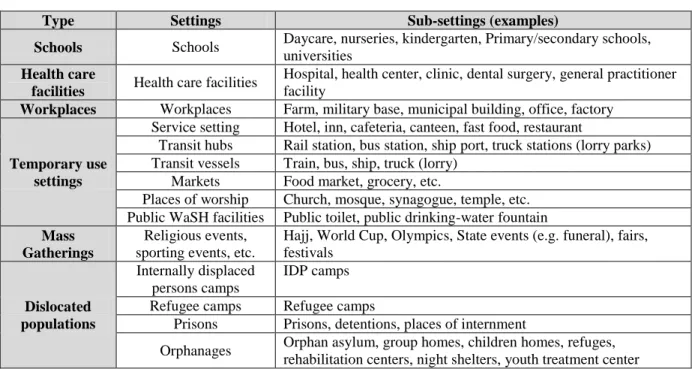
For settings, seven types are identified based on the literature review and denoted in
Table 6: schools, health care facilities, workplaces, temporary use settings, mass gatherings,
and dislocated populations. The typology was constructed based on common characteristics
of the populations who use the settings (e.g. children, sick people, working adults), length of
exposure to inadequate WaSH while in the setting (e.g. temporary use throughout a lifetime),
and additional factors that are unique to each setting (e.g. large temporary gathering,
involuntarily relocated to the setting). Schools, workplaces, and health facilities include
settings described in the definitions informed by literature. Temporary use settings, which
include service settings (e.g. hotel, restaurant), transit hubs (e.g. bus station), means of transit
(e.g. bus), markets, and public WaSH facilities (e.g. public toilet) are settings where
individuals are temporary users. Mass gatherings include religious events, sporting events,
and large state events, among others, where large groups of people gather temporarily and
place a strain on local resources (WHO, 2008). Dislocated populations include internally
displaced persons (IDP) camps, refugee camps, prisons, and orphanages and are settings
where individuals are involuntarily relocated, are dependent on third parties for sustenance,
11
Table 6. Extra-household settings typology
Type Settings Sub-settings (examples)
Schools Schools Daycare, nurseries, kindergarten, Primary/secondary schools, universities
Health care
facilities Health care facilities
Hospital, health center, clinic, dental surgery, general practitioner facility
Workplaces Workplaces Farm, military base, municipal building, office, factory
Temporary use settings
Service setting Hotel, inn, cafeteria, canteen, fast food, restaurant
Transit hubs Rail station, bus station, ship port, truck stations (lorry parks) Transit vessels Train, bus, ship, truck (lorry)
Markets Food market, grocery, etc.
Places of worship Church, mosque, synagogue, temple, etc. Public WaSH facilities Public toilet, public drinking-water fountain
Mass Gatherings
Religious events, sporting events, etc.
Hajj, World Cup, Olympics, State events (e.g. funeral), fairs, festivals
Dislocated populations
Internally displaced persons camps
IDP camps
Refugee camps Refugee camps
Prisons Prisons, detentions, places of internment
Orphanages Orphan asylum, group homes, children homes, refuges, rehabilitation centers, night shelters, youth treatment center
Monitoring Initiatives
Findings on established monitoring initiatives are described in Table 7 and grouped at
three levels: global, national, and local. Local initiatives include district monitoring in
addition to program and project monitoring. Initiatives that currently do not contain
Table 7. Extra-household monitoring initiatives at the global, national, and local levels
Monitoring level
Monitoring
Initiative Examples in practice
Applicable settings Institutional data coordinator Sampling approach Estimated data sets available Frequency of reporting Data provider/ collector
Global GLAAS GLAAS as conducted biennially
Schools, health
facilities WHO
Survey to
country ministers Two Two years Mixed
National
Educational Management Information System
(EMIS)
Ghana EMIS, India District Information System for Education (DISE), Bolivia EMIS
Schools Ministry of
Education
Complete enumeration in
country
30 Annually
School teachers or headmaster Health Management Information System (HMIS) Ethiopia, Myanmar,
Timor-Leste Health facilities Ministry of Health
Complete enumeration in
country
10+ Quarterly,
annually Health facility employee Water Sector Management Information System (WSMIS)
Directorate of Water Development Management Information
System (Uganda)
All settings (most focus on schools
and health facilities)
National government ministry (e.g. water,
environment)
Complete enumeration in
country
Unknown Annually Water sector
professional
Service Provision Assessment (SPA)
Bangladesh, Egypt,
Guyana, Kenya Health facilities
MEASURE Evaluation
Cluster random sample
14 countries, 19 data sets
Every three to five years Trained enumerator Service Availability and Readiness Assessment (SARA)
Sierra Leone, Tanzania,
Zambia Health facilities WHO
Cluster random
sample Four
Every three to five years
Trained enumerator
Facility surveys Iraq schools, Tajikistan health facilities
All settings (most are schools and health facilities)
UNICEF, WHO, USAID
Generally, a random sample
30 schools, 5+ health facilities One-off studies; often baseline surveys Trained enumerator Local Program/ Project
USAID Ghana, NGO reports, impact assessments, journal
publications
All settings (most are schools and health facilities) Context specific Random sample or complete enumeration Many, though not many are
publicly available
Generally one-off studies, length of project
Trained enumerator
District Ghana EHSD All settings District agency
Generally complete enumeration
Many, though not many are
publicly available
annually District
employee
13 Globally Conducted Monitoring Initiatives
The only global monitoring initiative that contains information on extra-household
settings is the Global Analysis and Assessment of Sanitation and Drinking-Water (GLAAS).
GLAAS is a UN-Water initiative implemented by the WHO. Information for GLAAS are
compiled from surveys completed by national ministers. This report provides policy makers
with global information for decision making. Amongst the responses are data on
drinking-water and sanitation in schools and health facilities. Survey respondents indicate that the
school and health facility data are compiled from national monitoring sources (GLAAS,
2012).
Nationally Conducted Monitoring Initiatives
For school monitoring, national Ministries of Education frequently use the open
source Educational Management Information System (EMIS). UNESCO, which is a UN
agency that contributes resource capacity for education and other initiatives, designed these
generic systems. EMIS are customizable and operated at the national level by the Ministry of
Education. To collect information for the EMIS, a national Ministry of Education distributes
a census annually to all schools, generally both public and private, primary through
secondary, and in some instances, tertiary facilities such as universities. A principal, head
teacher, or district official completes the census for each school and these data are aggregated
nationally in a database for evaluation by the Ministry of Education (UNESCO, 2009).
The primary focus of the EMIS is not WaSH and national survey instruments
generally contains few WaSH indicators. The survey typically includes indicators on the ratio
of toilets per student, existence of separate sanitation facilities for boys and girls, and an
14
often reported annually and it is estimated that there are at least 30 publicly available data
sets from developing countries. Because the survey instrument and indicators are designed
nationally, the data from these systems are not necessarily comparable between countries
(UNICEF, 2011).
For national health facility monitoring, Health Management Information Systems
(HMISs), are routine health facility reporting systems that generate service data at the facility
level for all facility types and often allow for aggregation at the national level. HMISs collect
a range of health related indicators (e.g. malaria prevalence, number of beds available per
hospital) and some of these systems include indicators on infrastructure such as
drinking-water and sanitation (WHO, 2010).
Other health facility monitoring initiatives include Service Provision Assessments
(SPAs) and Service Availability and Readiness Assessments (SARAs) which examine the
status of health service delivery in a country. These initiatives replace several precursor tools
including Service Availability Mapping (SAM) and the Facility Audit of Service Quality
(FASQ). Infrastructure status is collected in this survey process including drinking-water
and sanitation. SPAs were designed by USAID and SARAs by the WHO to be used globally
but they are conducted in country by national ministries (usually the ministry of health and
national statistical office). They sample from all facilities and facility types using
government and NGO coordination lists including facilities managed by the government
(public sector) and by NGOs, faith-based organizations, and private for-profit groups. They
do not include a population multiplier (e.g. number of patients and staff). Both SPA and
SARA include indicators for WaSH. They are conducted similarly to survey approaches such
15
household survey that is conducted in individual countries and is comparable between
countries. For SPA and SARA, enumerators sample facilities from a stratified cluster and
collect interview and observational response data. Because of the global coordination of the
survey instruments by WHO and USAID, the survey indicator data on WaSH are comparable
between countries (Alva et al, 2009; WHO, 2013; MEASURE DHS, 2013).
There are other facility surveys that can be used to capture data on any facility type.
These initiatives are most frequently conducted by multilateral agencies, such as UNICEF
and WHO, at the national level. Only surveys for schools and health facilities were found
through the course of the review but the general methodology could be applied to any other
setting. An example facility survey includes the 2009 Djibouti School Hygiene and
Sanitation Survey (SHSS) which was a simple random sample of schools in the country in
which enumerators collected data from students and teachers (El-Zanty & Associates, 2009).
UNICEF have conducted national baseline assessments of WaSH in schools in Malawi, the
Philippines, Timor-Leste, and Uganda among others (Freeman et al, 2013). India conducts
annual health facility surveys that are released annually online (NUEPA, 2012). A WHO
survey from 2009 indicated that more than 50% of health facilities in Tajikistan do not have
access to safe drinking-water in sufficient quantity or quality (WHO-Europe, 2010).
Locally conducted monitoring initiatives
Local monitoring initiatives include district, project, and program monitoring.
Extra-household WaSH monitoring are often collected by local governments but are infrequently
aggregated at a higher level and are often not publicly or digitally available. For example, the
Ghana DESSAP includes data on sanitation facilitates in many extra-household settings such
16
stored in hard copy, and not available outside district offices (Ministry of Local Government,
2007).
Other sources of monitoring data from settings such as markets and workplaces were
identified in literature but the primary sources could not be found, such as those in a World
Bank report on the economic impacts of sanitation in Southeast Asia (Hutton et al, 2008) and
case study examples from the GLAAS report (GLAAS, 2012).
Some facility surveys are used to fulfill a specific purpose such as targeting
vulnerable populations or specific districts or regions. For example, a survey in Kyrgyzstan
examined WaSH access in schools and health facilities in targeted regions of the country
(UNICEF, 2011). In Ghana, a USAID project conducted health facilities surveys in targeted
regions of the country where maternal and child health was a focus (Quality Health Partners,
2009).
Possible future options for extra-household monitoring
In addition to established methods for monitoring extra-household settings, there are
other initiatives and emerging tools that could include extra-household monitoring indicators.
Nationally representative household surveys include the Demographic and Health Survey
(DHS), Multiple Indicator Cluster Survey (MICS), Living Standards Measurement Study
(LSMS), World Health Survey (WHS), Core Welfare Indicator Questionnaire (CWIQ)
national censuses, and other similar national household surveys that provide data for a wide
range of indicators. These surveys are conducted by national statistics offices often with
technical assistance from an outside agency or development partner. These cross-sectional
surveys are generally conducted every few years and the data are made publicly available
17
reports. Censuses conducted by national governments are generally a complete enumeration
while the other survey types are frequently a two stage probability sample which provide
nationally representative statistical data on a given country. The surveys collect data on a
variety of demographic, health, and economic indicators and include harmonized household
drinking-water and sanitation indicators which allow for global comparison across time
(K4Health, 2013).
Extra-household modules have been incorporated in household surveys. LSMS
surveys have included community modules to show both the supply side and demand side of
services within countries. A review of the World Bank survey database indicates that no
community modules have been applied to the LSMS since 1997. Two LSMSs, in the Côte
d'Ivoire and Jamaica, surveyed both schools and health facilities. These facility assessments
were linked with household survey response data and did not provide statistical
representation of the population of facilities nor populations in each country (World Bank,
2013). Similar methods have been conducted to link the DHS with SPA surveys with an
example being Egypt in 2004 (Ministry of Health and Population et al, 2005).
MEASURE Evaluation, an organization that provides support for global population
and health monitoring and evaluation, produced a guideline on how to conduct nationally
representative health facility assessments within a household survey design scheme.
Statistically, once the clusters have been selected for the household surveys, a “ring” of
surrounding clusters are added and all the facilities within the new larger cluster are
surveyed. Depending on the country and the amount of stratification desired a complete
enumeration of larger facilities and certain types of facilities might need to be completed
18
Other future monitoring options include mapping tools and information and
communication technologies (ICTs). Examples include tools developed by the
non-governmental organizations (NGOs) Akvo and WaterAid. Both of these tools monitor
community drinking-water sources (e.g. water taps and boreholes). Akvo FLOW is a
smartphone application that uses open-source Android technology. FLOW has even been
adopted at a national level by Liberia as their primary drinking-water monitoring tool (Akvo,
2013). The WaterAid Water Point mapper monitors drinking-water sources in rural and
urban areas. WaterAid claims that this tool can help service sustainability issues, equity and
transparency, access levels, financing needs, planning needs, water quality, and monitoring
and evaluation trends (WaterAid, 2010).
The Waterpoint Data Transmitter developed at Oxford University in the UK is
capable of measuring and transmitting handpump data via mobile phone networks. This tool
is capable of modeling the frequency of handpump usage (e.g. number of pumps per day) and
provides immediate feedback when a system becomes non-functioning (Thomson et al,
2012).
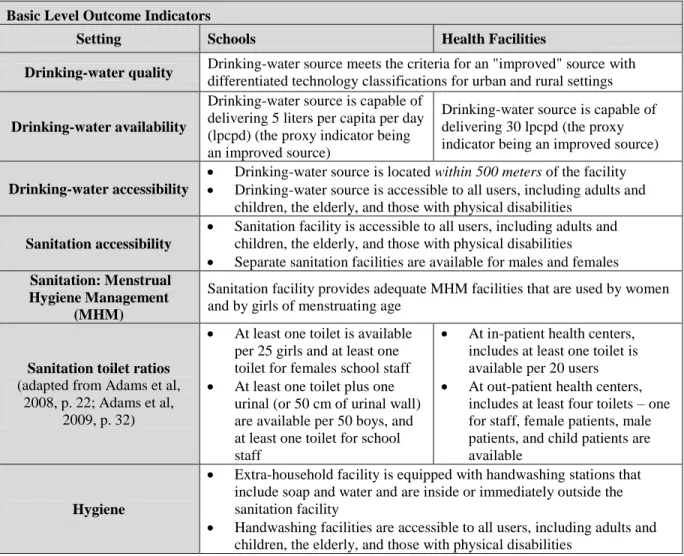
Indicators for monitoring extra-household settings
Indicators for schools and health facilities are presented in Tables 8 through 11. These
are the two settings with the most global institutional support, existing monitoring systems in
place, and represent an example on how indicators for other settings may look. Indicators are
organized using a service level approach. Service levels are a mechanism by which to
describe and differentiate between qualities of service or “ladders.” (Kayser et al, in draft).
Indicators organized by basic, intermediate, and high levels of service are described for three
19
Sanitation: quality, availability and accessibility (Roaf et al, 2005). Indicators in Tables 8
through 11 were derived from several sources including WHO guidelines (Adams et al, 2008;
Adams et al, 2009) and expert elicitation from experts on the post-2015 WaSH working
groups (WHO/UNICEF JMP, 2012).
Table 8. Proposed aggregate WaSH indicators for schools and health facilities (WHO/UNICEF JMP, 2012)
Aggregate Indicators
Setting Schools Health Facilities
Drinking-water
Percent of school children and teachers with access to a drinking-water source at school that is accessible to all
Percent of patients and staff at health facilities with access to a drinking-water source that is accessible to all
Sanitation
Percent of school children and teachers with access to gender-segregated sanitation facilities and adequate facilities for women and girls for menstrual hygiene that are accessible to all
Percent of patients and staff at health facilities with access gender-segregated to sanitation facilities and adequate facilities for women and girls for menstrual hygiene that are accessible to all
Hygiene
Percent of school children and teachers with access to handwashing stations with soap near the sanitation facility that are accessible to all
20
Table 9. Proposed indicators for basic levels of service for schools and health facilities (WHO/UNICEF JMP, 2012)
Basic Level Outcome Indicators
Setting Schools Health Facilities
Drinking-water quality Drinking-water source meets the criteria for an "improved" source with
differentiated technology classifications for urban and rural settings
Drinking-water availability
Drinking-water source is capable of delivering 5 liters per capita per day (lpcpd) (the proxy indicator being an improved source)
Drinking-water source is capable of delivering 30 lpcpd (the proxy indicator being an improved source)
Drinking-water accessibility
Drinking-water source is located within 500 meters of the facility
Drinking-water source is accessible to all users, including adults and children, the elderly, and those with physical disabilities
Sanitation accessibility
Sanitation facility is accessible to all users, including adults and children, the elderly, and those with physical disabilities
Separate sanitation facilities are available for males and females
Sanitation: Menstrual Hygiene Management
(MHM)
Sanitation facility provides adequate MHM facilities that are used by women and by girls of menstruating age
Sanitation toilet ratios
(adapted from Adams et al, 2008, p. 22; Adams et al,
2009, p. 32)
At least one toilet is available per 25 girls and at least one toilet for females school staff
At least one toilet plus one urinal (or 50 cm of urinal wall) are available per 50 boys, and at least one toilet for school staff
At in-patient health centers, includes at least one toilet is available per 20 users
At out-patient health centers, includes at least four toilets – one for staff, female patients, male patients, and child patients are available
Hygiene
Extra-household facility is equipped with handwashing stations that include soap and water and are inside or immediately outside the sanitation facility
21
Table 10. Proposed indicators for intermediate levels of service for schools and health facilities (WHO/UNICEF JMP, 2012)
Intermediate Level extra-household WaSH Indicators
Setting Schools Health facilities
Drinking-water
quality Drinking-water source has <1 E. coli colony forming units (CFU) per 100 ml sample Drinking-water
availability Drinking-water service discontinuity is less than 2 days in 2 weeks
Drinking-water access
Drinking-water source is on the facility premises
Drinking-water source is capable of delivering a minimum of 50 lpcpd (proxy indicator being drinking-water source is on the facility premises and service discontinuity is less than 2 days in 2 weeks)
Drinking-water source is accessible to all users including adults and children, the elderly, and those with physical disabilities
Sanitation accessibility
“Safe management of excreta” (containment, extraction, and transport to a
designated disposal or treatment site, safe reuse at the facility level) (WHO/UNICEF JMP, 2012)
Sanitation is accessible to all users, including adults and children, the elderly, and those with physical disabilities
Separate sanitation facilities are available for males and females
Sanitation:
MHM Same indicators as basic level Hygiene Same indicators as basic level
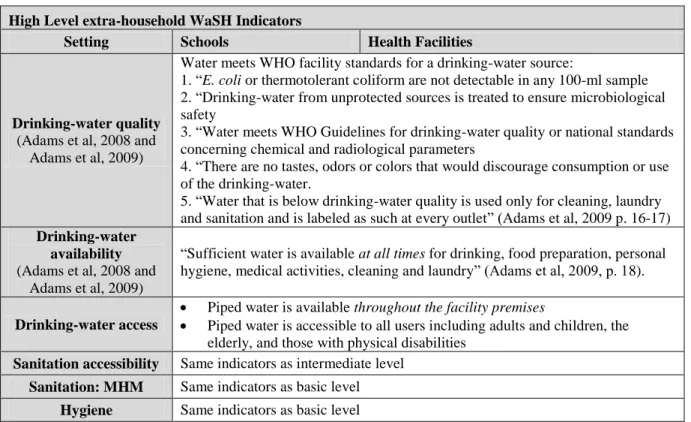
Table 11. Proposed indicators for high levels of service for schools and health facilities (WHO/UNICEF JMP, 2012)
High Level extra-household WaSH Indicators
Setting Schools Health Facilities
Drinking-water quality
(Adams et al, 2008 and Adams et al, 2009)
Water meets WHO facility standards for a drinking-water source:
1. “E. coli or thermotolerant coliform are not detectable in any 100-ml sample 2. “Drinking-water from unprotected sources is treated to ensure microbiological safety
3. “Water meets WHO Guidelines for drinking-water quality or national standards concerning chemical and radiological parameters
4. “There are no tastes, odors or colors that would discourage consumption or use of the drinking-water.
5. “Water that is below drinking-water quality is used only for cleaning, laundry and sanitation and is labeled as such at every outlet” (Adams et al, 2009 p. 16-17)
Drinking-water availability
(Adams et al, 2008 and Adams et al, 2009)
“Sufficient water is available at all times for drinking, food preparation, personal hygiene, medical activities, cleaning and laundry” (Adams et al, 2009, p. 18).
Drinking-water access
Piped water is available throughout the facility premises
Piped water is accessible to all users including adults and children, the elderly, and those with physical disabilities
Sanitation accessibility Same indicators as intermediate level
Sanitation: MHM Same indicators as basic level
22
DISCUSSION
A typology for extra-household settings and monitoring initiatives was developed to
categorize settings. A typology is useful because it helps systematically group setting types
that have similar characteristics or common traits which helps to organize the state of
knowledge. This is important from a monitoring perspective because it can contribute to the
reduction of data costs, identifies duplications in monitoring efforts, and ensures all relevant
settings are considered and enumerated. No other settings-based typology was discovered
through the process of conducting this review.
Within the typology, however, there are caveats and challenges. For example,
boarding schools may be considered long-term residences while agriculture is a very
different workplace than an office building. Workplaces may benefit from further
sub-categorization that group sub-settings into types with common risk factors such factories
(sanitary conditions from production, heat, and intensive labor) and agricultural work settings
(outdoors, changing environmental conditions, often spread out over large spaces).
Regardless, each type provides commonalities where efficiencies can be gained. For
example, while each mass gathering event is often quite different (e.g. a sporting event
compared to a religious event), there may often be indirect transferability between settings
(e.g. standards on portable toilet provision, deployment of handwashing stations, and
strategic positioning of drinking-water stations).
For the purposes of enumerating facilities for monitoring, some settings are better
defined than others. Schools, for example, are relatively straightforward and include settings
for early age children (daycares and kindergartens) to primary and secondary schools, and
23
to the diverse nature of the sub-setting types which range from agriculture to office buildings.
Further challenges arise from informal workplaces. The ILO has attempted to define and
identify informal work settings for the purposes of measuring economic impact yet
characterizing, identifying, and enumerating all these settings is a persistent challenge
(Hussmanns, 2004).
Health, economic, environmental, and educational benefits from WaSH in most
extra-household settings are also limited. Three settings, schools, refugee camps, and ships, have
had systematic reviews conducted that catalog WaSH evidence. These reviews include
studies that show benefits from WaSH interventions in these settings and also include studies
that identify the impact of poor conditions (Jasper et al, 2012; Cronin, 2011; Rooney et al,
2004). For the settings without systematic reviews, studies that examined extra-household
evidence tend to focus on drinking-water quality issues and there were few studies identified
that examined health impacts from WaSH provision. The lack of studies suggests that
extra-household settings have not been prioritized within the WaSH sector research agenda.
There is no current international actor responsible for aggregating extra-household
data to form global data sets. No consolidated global extra-household monitoring database
was identified through this review. Schools and health facilities garner the most international
attention and more data sets are publicly available for these settings from individual
countries. These data sets are not necessarily comparable between countries due to
differences in the indicators used to measure WaSH coverage and differences in
methodological approaches. Table 12 describes tools, indicators and data sets available to
24
At present, there is no systematic way to collect extra-household monitoring data sets.
Not all reports and data sets are publicly available from national governments. Other data
sets may exist but the institutional owners of the data may not recognize the value of the data
they have or collect it in a representative manner. Two sources of data that likely exist but are
frequently not publicly available are local monitoring initiatives and drinking-water quality
regulator data. Unlocking these data could provide an enormous amount of WaSH access
statistics for settings for which little publicly available data exists such as workplaces and
markets. Because of these limitations, a systematic process could not be applied through this
review to identify the number of existing global data sets for extra-household settings.
With mobile phone coverage and wireless broadband access expanding rapidly,
including 79% penetration in the developing world and 5.9 billion subscriptions worldwide,
it is important to consider data collected through mobile technology, smart phone
applications (‘apps’), and other “bottom up” collection methods as potential sources of
monitoring data in the future (ICT, 2011). As these devices have become more ubiquitous,
they become cost-effective tools for data collection if harnessed properly.
User reported data could be a source of data to build the evidence base on WaSH
coverage in extra-household settings. For example, if a country uses a random sample facility
survey, it is difficult to determine which facilities in any given region or district do not have
access to WaSH facilities. User reported data can provide additional texture to these baseline
facility surveys by identifying which systems are functional and document aspects of
Table 12. WaSH monitoring initiatives available for extra-household settings
Setting Type Settings Monitoring Initiatives including WaSH
indicators Level
Estimated number of publicly available country data sets
Schools Schools GLAAS, EMIS, facility surveys,
project/program monitoring
Global,
National, Local 60+
Health care
facilities Health care facilities
GLAAS, HMIS, SPA, SARA, facility surveys, project/program, district
Global,
National, Local 30+
Workplaces Workplaces District Local < 5
Temporary use settings
Service settings Sometimes local monitoring Local < 5
Transit hubs Sometimes local monitoring Local < 5
Transit vessels Sometimes local monitoring Local < 5
Markets Sometimes local monitoring Local < 5
Places of worship Sometimes local monitoring Local < 5
Public WaSH facilities Sometimes local monitoring Local < 5
Mass gatherings Religious events,
sporting events, etc. None identified None identified None publicly available
Dislocated populations
Internally Displaced
Persons Camps UNHCR monitoring Global None publicly available
Refugees UNHCR monitoring Global None publicly available
Prisons None identified None identified None publicly available
Orphanages None identified None identified None publicly available
26
The importance of user reported data, such as “crowdsourced” SMS from cell phones,
should not be discounted despite their current inability to collate nationally representative
extra-household data. While the data quality and coverage is currently not viable for use by a
global monitoring actor such as the Joint Monitoring Programme, these sources serve as a
critical supplementary data layer. A protocol could be developed to set data quality standards
to allow these data streams to feed into a global monitoring system which would provide a
richer picture of WaSH coverage in certain sub-regions. As quality of these data streams
continue to improve over time heading to 2030, these tools should be reexamined on how
they can contribute to global monitoring.
Nationally representative household surveys are another initiative that could be
leveraged to provide extra-household data. Extra-household facilities could be sampled
within cluster randomized household survey designs. After clusters are selected, enumerators
create a household listing by developing a complete numbered list of every household or
dwelling within the cluster. Enumerators could map extra-household facilities during this
process. In fact, many extra-household facilities are already documented as landmarks on
household listing maps. Oversampling of settings would likely need to be conducted to
capture a statistically valid national sample of facilities. The challenge with this approach,
however, is that it results in a facility-based estimate rather than population-based estimate.
A facility based approach heavily weights small facilities while a population based estimate
27
CONCLUSION
Examples of successful monitoring systems exist in different world regions but not all
countries are monitoring. At the global level, more capacity support from international
actors, such as UNESCO, UNICEF, and WHO, are necessary to help ensure that monitoring
initiatives are effective. National initiatives will benefit from clearly defined and robust
indicators, the adoption or adaptation of internationally vetted standards and guidelines, and
technical assistance for management and implementation of information systems and
nationally representative surveys.
Much like existing JMP household data aggregation, a global extra-household
monitoring system should interface and harmonize with national monitoring information
systems, survey data, and other data streams. Collecting WaSH monitoring data from
different sources poses challenges in terms of coordination and reconciling multiple data
sources to generate globally comparable data. A global system will require that these data
sources are representative, collected regularly, and validated.
International monitoring systems for extra-household settings require fewer but
simple and robust indicators many of which are already included within existing data
collection mechanisms. These mechanisms should include core, harmonized indicators
proposed in this review for aggregation to international monitoring systems. Prioritizing
monitoring and investing resources into capacity building for initiatives will help to improve
28
CHAPTER III: DRINKING WATER, SANITATION, AND HYGIENE BEYOND THE HOUSEHOLD: A SITUATIONAL ASSESSMENT OF GHANA ON
MONITORING, POLICY, AND PRACTICE
INTRODUCTION
Extra-household settings (e.g. schools, health facilities, refugee camps) are being
considered for drinking-water, sanitation, and hygiene (WaSH) targets in the post-2015
development agenda. The proposal by the High Level Panel of eminent persons on the
post-2015 agenda have recommended that three of the four targets for WaSH include monitoring
access in schools, health facilities, workplaces, and refugee camps (UN, 2013).
Cronk (2013) conducted a global review of extra-household settings and generated a
typology, evaluated guidelines and standards, identified actors, assessed available evidence
by setting, and generated a catalog of monitoring initiatives. Less is known about monitoring,
policy, and practice at the national, regional, and district level within a country. This paper is
a situational assessment of Ghana that examines how the concepts described in the global
review occur in practice.
The burden of disease due to diarrhea in Ghana is estimated to be 20,300 deaths per
year or 18 disability adjusted life years (DALYs) per 1000 capita per year (WHO, 2009). The
World Bank estimates that Ghana loses 420 million cedis (US$290 million) annually due to
poor sanitation which is equivalent to US$12 per person in Ghana per year or 1.6% of the
29
and extra-household settings will contribute to improving health, educational, environmental,
and economic outcomes in Ghana.
This situational assessment identifies WaSH monitoring actors, describes their roles
and responsibilities, and describes how the actors conduct extra-household monitoring. For
each setting, policies, standards, and monitoring systems are described. Finally, the proposed
post-2015 extra-household indicators are compared to those existing in Ghana and
recommendations for future improvements to Ghanaian monitoring systems are described.
METHODS
Literature search strategy
This situational assessment used a mixed methods approach to evaluate
extra-household settings and monitoring in Ghana through a desk based literature review and field
interviews with relevant monitoring staff. We reviewed PubMed, Web of Science, and
Google Scholar, using the terms “Ghana,” “drinking-water,”“sanitation,” and ‘hygiene” in
combination with terms associated with extra-household settings as described in Table 13
from Cronk (2013), terms related to monitoring and evaluation, and names of cities and
towns in Ghana. We used the same set of terms on gray literature websites including the
International Water and Sanitation Centre (IRC) knowledge base, the Water, Engineering and
Development Centre (WEDC) knowledge base, and other online WaSH knowledge
repositories. National ministry websites were searched for relevant policy documents.
30
Table 13. Typology of Extra-household settings (from Cronk, 2013)
Type Settings Sub-settings (examples)
Schools Schools Daycare, nurseries, kindergarten, Primary/secondary schools, universities
Health care
facilities Health care facilities
Hospital, health center, clinic, dental surgery, general practitioner facility
Workplaces Workplaces Farm, military base, municipal building, office, factory
Temporary use settings
Service setting Hotel, inn, cafeteria, canteen, fast food, restaurant
Transit hubs Rail station, bus station, ship port, truck stations (lorry parks) Transit vessels Train, bus, ship, truck (lorry)
Markets Food market, grocery, etc.
Places of worship Church, mosque, synagogue, temple, etc. Public WaSH facilities Public toilet, public drinking-water fountain
Mass Gatherings
Religious events, sporting events, etc.
Hajj, World Cup, Olympics, State events (e.g. funeral), fairs, festivals
Dislocated populations
Internally Displaced Persons camps
IDP camps
Refugee camps Refugee camps
Prisons Prisons, detentions, places of internment
Orphanages Orphan asylum, group homes, children's homes, refuges, rehabilitation centers, night shelters, youth treatment center
Interviews
Interviews were conducted with WaSH monitoring experts and staff at the district,
regional, and national level in Ghana. Approval was provided by the University of North
Carolina at Chapel Hill Institutional Review Board (#110226). Snowball sampling, which is
a sampling procedure where interviewees recruit additional interviewees from among their
colleagues, was employed to help validate the desk based literature review. The interview
questions asked respondents to highlight the challenges faced in reality versus what is written
in policy and guidelines, and also provide a snapshot of the current status of extra-household
31
RESULTS
Actors Involved in WaSH Monitoring
Organizations and institutions that conduct WaSH monitoring were examined for
their ability to provide data on WaSH in extra-household settings. Table 14 describes
agencies that conduct extra-household monitoring.
Table 14. Extra-Household WaSH data availability from WaSH monitoring actors
Actor Setting data
collected Levels of aggregation Frequency of collection/ reporting Reporting format Publicly Available? Ghana Statistical Services (GSS) Health facilities National coordination Baseline in 2002 Service Provision Assessment (SPA) Yes Environmental Health and Sanitation Directorate (EHSD) All extra-household sanitation National
coordination Annual NESSAP No
Ministry of Education, Sports, and Science (MoESS)
School water & sanitation
National
coordination Annual
EMIS, Education sector performance reports No Environmental Health Officers (EHOs) All extra-household sanitation District collection and coordination
Annual DESSAP No
The Ghana Statistical Service (GSS) is responsible for administering most nationally
conducted surveys such as the Demographic and Health Survey (DHS), Service Provision
Assessment (SPA), and the national census. Interviewees confirmed that the GSS has no
involvement in validating the quality of any extra-household WaSH data sources (e.g. such
as the Educational Management Information System) with the exception being the Service
Provision Assessment (SPA) which collects data on health facilities (GSS, 2003).
The Environmental Health and Sanitation Directorate (EHSD) is responsible for
national coordination of the activities involved in the sanitation sector. National policy,
established through the National Environmental Sanitation Strategy and Action Plan