87
CHEMICAL EVALUATION OF AUTOCHTHONOUS VARIETY 'PROKUPAC'
RED WINE WITH THE ADDITION OF SELECTED AROMATIC HERBS
LAKIĆEVIĆ, S.,1 POPOVIĆ, T.,2 MATIJAŠEVIĆ, S.,3, ĆIRKOVIĆ, B.,4 LAZIĆ, M.,5
POPOVIĆ-ĐORĐEVIĆ, J.3A
1College of Agriculture and Food Technology, Prokuplje, Serbia 2University of Montenegro, Faculty of Biotechnology, Podgorica, Montenegro; 3Belgrade University,Faculty of Agriculture, Department for horticulture, Belgrade,Serbia;
3a Corresponding authors:e-mail: [email protected] 4University of Prishtina, Faculty of Agriculture, Lešak, Serbia
5University of Niš, Faculty of Technology, Leskovac, Serbia
ABSTRACT
The quality parameters and chemical composition (total phenolics, total flavonoids and total anthocyanins) of the red wine obtained from the autochthonous variety 'Prokupac' (Vitis vinifera L.) with the addition of the selected aromatic herbs (Pimpinella anisum L., Cinnamomum zeylanicum, Artemisia absinthium and Glycyrrhiza glabra) were examined in two consequtive vintages (2013-2014). The differences in contents of total extract, reducing sugars and ash between the studied samples were observed, but with no statistical significance between both examined years and analyzed wines. 'Prokupac' red wines with the addition of aromatic herbs stood out with significantly higher contents of total phenolics (371.4-594.3 mg GAE L-1) and total flavonoids (136.2-243.2 mg CTE L-1) while lower total anthocyanins content was noticed, when compared to 'Prokupac' red wine used as control (p<0.05). The unfavourable weather conditions in the vintages 2013 and 2014, reflected notably on the quality of the obtained wine. To analyze the correlations between wine quality parameters and the similarity of individual wine samples, Principal Component Analysis (PCA) was used.
Keywords: wine quality, chemical composition, cinnamon, polyphenols, PCA
INTRODUCTION
Vitis vinifera L. is one of the oldest agricultural cultures. It encompasses a large number of varieties of different use. Only a few hundred varieties are used for commercial wine production (Pelsy et al., 2010). Wine represents a complex mixture of natural organic compounds belonging to different structural classes that synergistically affect the quality of the wine. Wine quality attributes depend on many factors including grape composition, grape variety, soil and microclimatic conditions, viticultural practices and applied winemaking techniques (Popović-Djordjević et al.,
2017). Due to its rich history and tradition it has been the subject of diverse studies. The 'Prokupac' autochthonous variety comes from the Toplica vineyard (Republic of Serbia). It is adaptable to the climatic conditions of the Republic of Serbia and is grown on significant winegrowing surfaces (Žunić and Garić, 2010).
88 processes in the human body. In that respect, wines are recommended for moderate consumption as an alcoholic beverage as some health benefits are observed in the epidemiological study which constitutes the so-called "French Paradox" (Pantelić et al., 2016, Renaud and de Lorgeril, 1992). Many researches have been conducted in respect to the phenolic constituents in wines, which usefulness as antioxidants is more pronounced in red wines as these wines have a higher phenolic content than white wines (Zhu et al., 2012., Bisson et al., 2002). Polyphenols are the main contributors for certain organoleptic characteristics of wines, such as astringency and bitterness. The concentration of phenolic compounds in wine is influenced by numerous factors such as variety, climate, soil, wine-making techniques, as well as aging and storage conditions (Ivanova-Petropulos et al., 2015). The anthocyanins are the source of red, blue and pink pigments of berries and have the greatest significance in the history of wine-making (Strommer et al., 2003 ). They are directly related to a major quality attribute of wine - red wine color, due to their complex interactions with other phenolic compounds, as well as with proteins and polysaccharides (Fournier-Level et al., 2011, Giovinazzo and Grieco, 2015).
Aromatic plants, in addition to its importance for the pharmaceutical industry, are widely used in the food industry (Sarikurkcu et al., 2018, Božović and Ragno, 2017). They are a source of aroma for the flavoring of strong alcoholic beverages and in the production of aromatized wines (vermouth, bermet) (Tonutti and Liddle, 2010, Egea et al., 2016 ). Some herbs such as anise and wormwood are widely used for making making various liqueurs. In most Mediterranean countries (Spain, Italy, Portugal, Turkey, Greece, Lebanon, Cyprus, Israel, and France) Anisette, Ouzo, Anise and Raki are well recognized
liqueurs with anise, whereas wormwood is used as an ingredient in beverages such as absinthe, bitter, vermouth, pelinkovac and some wines (Karabegović et al., 2012).
This work aimed to evaluate the quality attributes and chemical composition (total contents of phenolics, flavonoids andanthocyanins) of red wine, obtained from the 'Prokupac' autochthonous variety, with the addition of selected aromatic herbs namely, aniseed (Pimpinella anisum), cinnamon (Cinnamomum zeylanicum), wormwood (Artemisia absinthium) and liquorice (Glycyrrhiza glabra).
MATERIALS AND METHODS
Plant material and
microvinification
For this study grapes of autochthonous grapevine variety 'Prokupac' (Vitis vinifera L.) grown in Jug Bogdan vineyards located in Toplica region (coordinates 43° 13' N/21° 42' E, 250-400 m above sea level) in two consecutive vintages (2013 and 2014) were used.
89 stems). The must was supplemented with 120 mg kg-1 of SO2 and 5% (m/v) of potassium metabisulfite. Alcoholic fermentation was performed by Saccharomyces cerevisiae Lalvin V1116 yeast (0.3 g L-1 of must) (Lallemand Inc. Canada). Fermentation took place in 5 L glass bottles at 22 °C. Immediately before the start of alcohol fermentation, finely grinded aromatic herbs were added to the must in an amount of 1%. Wines were labeled as follows: PAW - 'Prokupac' wine with anis; PCW - 'Prokupac' wine with cinnamon; PWW - 'Prokupac' wine with wormwood; PLW - 'Prokupac' wine with liquorice and control 'Prokupac' red wine (PW). Upon completion of the fermentation, wines were decanted from the lees, bottled and stored at 5-6 °C. After six months of bottle aging wines were subjected to chemical analyzes.
Climatic conditions
Air temperature (at a height of 1.5 m above the ground), rainfall and sunshine duration were monitored at the automatic weather station Niš (Republic Hydrometeorological Institute, Serbia) located less than 1.5 km from the experimental site.
Wine quality parameters and chemical analyses
The relevant enological parameters of the wines were determined following literature methods (Popović-Djordjević et al., 2017).The concentration of total phenolics (TPC) was determined using Folin-Ciocalteu method as described in literature (Popović-Djordjević et al., 2017). The concentration of total flavonoids was determined by spectrophotometric method with aluminum trichloride (Kim et al., 2003). The content of total anthocyanins was determined by a spectrophotometric method based on the ability of free anthocyanins to increase the absorbance on 520 nm (at pH 1), and to discolour with SO2 (which is released from sodium
metabisulphite) (Ribéreau-Gayon and Stonestreet, 1965). All assays were carried out in triplicate.
Chemicals and reagents
Folin-Ciocalteu reagent and standards (galic acid, catechin and malvidin-3-glukozid) were purchased from Merck (Darmstadt, Germany). Ultrapure water (TKA Germany MicroPure water purification system, 0.055 μS cm-1) was used to prepare all standard solutions and dilutions. All other reagents were of analytical grade.
Statistical analysis
90 RESULTS AND DISCUSION
Climate conditions
Climate changes are noticed in many regions world-wide. Factors such as increasing temperatures, water deficit, shifting of ripening phase period, and flooding (as an extreme weather condition) have a great implications on wine quality, which may vary from one year to the other (Van Leeuwen and
Darriet, 2016). Weather conditions during
the examined period (years 2013 and 2014) were very heterogenic (Figure 1 a-c). During 2013, average annual temperature was 12.84 oC, average precipitation 50.92 L m-2, and average sunshine duration 175.75 hours. Values of the same parameters for the vegetation period were: average temperature 18.3
oC, precipitation 46.48 L m-2, and sunshine duration 246.15 hours. During the second year of study (2014) average annual temperature was 12.88 oC, average precipitation 82.6 L m-2, and sunshine duration 160.29 hours. The same parameters in the vegetation period (April–October) had the following average values: temperature 17.48 oC, precipitation 107.84 L m-2 and sunshine duration 201.77 hours. By comparing the analyzed parameters, it could be noticed that during 2014, as opposed to 2013, in the vegetation period (April–October), the average temperature was lower, precipitation significantly higher and sunshine duration notably shorter. These extreme weather conditions reflected greatly on the quality of the wine
.
Figure 1. Weather conditions for the vegetation period in 2013 and 2014; average temperature (a), precipitation (b) and sunshine duration (c).
Wine quality parameters
The results of the basic wine quality parameters in the examined period are presented in Table 1. The content of alcohol in all studied wines varied in the range of 10.15 vol % (PCW) to 10.49 vol % (PWW). Total acids content expressed as tartaric was in range from 5.54 g L-1 to 6.86 g L-1 in wine samples PCW and PW (control), respectively. The content of total extract was the lowest in control wine (PW-16.90/17.25 g L-1), whereas wine with the addition of liquorice (PLW) had the highest content of total extract (19.75/19.50 g L-1), in both vintages. The content of reducing sugars was within the limits of 0.81–2.07 g L-1. The values of
91 grapes and in the same manner the quality of the corresponding wine.
Slight differences in the content of total extract, reducing sugars and the content of ash, between the wines with the addition of aromatic herbs (PAW, PCW, PWW and PLW) and the control one (PW) were observed, but with no statistical significance between both examined years and analyzed wine samples. This assertion was confirmed by the correlations among certain components of the chemical characteristics of the wine (data not
shown). Namely, there was a distinct correlation in the control wine (PW) between the content of alcohol on one side and total extract, reducing sugars and ash on the other. Furthermore, positive correlation was also observed between the content of total extract and reducing sugars and ash. The same tendency was noticeable in wine samples with the addition of aromatic herbs (PAW, PCW, PWW and PLW), but the correlation was more emphasized.
Quality parameters of 'Prokupac' red wine samples
Table 1.
Parameter Vintage PAW† PCW PWW PLW PW
Alcohol ( vol %) 2013 10.23±0.13 10.15±0.13 10.36±0.25 10.36±0.17 10.36±0.08
2014 10.40±0.12 10.31±0.12 10.49±0.21 10.44±0.17 10.45±0.09
Titriable acids*
(gL-1)
2013 6.15±1.10 6.09±0.09 6.64±0.93 6.20±0.13 5.90±0.25
2014 6.04±0.33 5.54±0.38 5.78±0.17 6.26±0.11 6.86±0.41
Volatile acids**
(g L-1)
2013 0.39±0.01 0.41±0.01 0.41±0.03 0.46±0.02 0.37±0.01
2014 0.37±0.01 0.39±0.03 0.47±0.04 0.43±0.03 0.36±0.01
Total extracts (g L-1)
2013 17.45±0.45 19.60±1.00 18.10±0.35 19.75±1.65 16.90±0.20
2014 17.35±0.75 18.60±2.46 18.35±0.45 19.50±1.00 17.25±0.45
Reducing
sugars (g L-1)
2013 1.01±0.16 1.17±0.47 1.15±0.40 1.02±0.38 0.81±0.12
2014 1.61±0.99 2.07±1.03 1.05±0.33 1.96±1.19 1.67±0.90
Ash (g L-1) 2013 2.59±0.24 3.07±0.15 2.73±0.15 2.89±0.19 2.13±0.07
2014 2.14±0.24 2.97±0.02 2.49±0.24 2.51±0.37 1.91±0.18
Results are presented as mean±standard deviation (SD); †PAW, PCW, PWW and PLW -
'Prokupac' wines with the addition of anis, cinnamon, wormwood and liquorice, respectively; PW -
control. *as tartaric acid; **as acetic acid
Content of total phenolics, flavonoids and anthocyanins in 'Prokupac' wine
samples
The polyphenolic compounds have a great impact on the quality of red wines, especially anthocyanins and tannins as they contribute to the wine colour, mouthfeel and color stability (Vujovic et al., 2016). Composition and the content of phenolic compounds in wine may depend on a number of factors. Phenolic content of wine is mostly atributted to grape variety and vintage and may vary from 160 to 3200 mg of gallic acid per liter
92
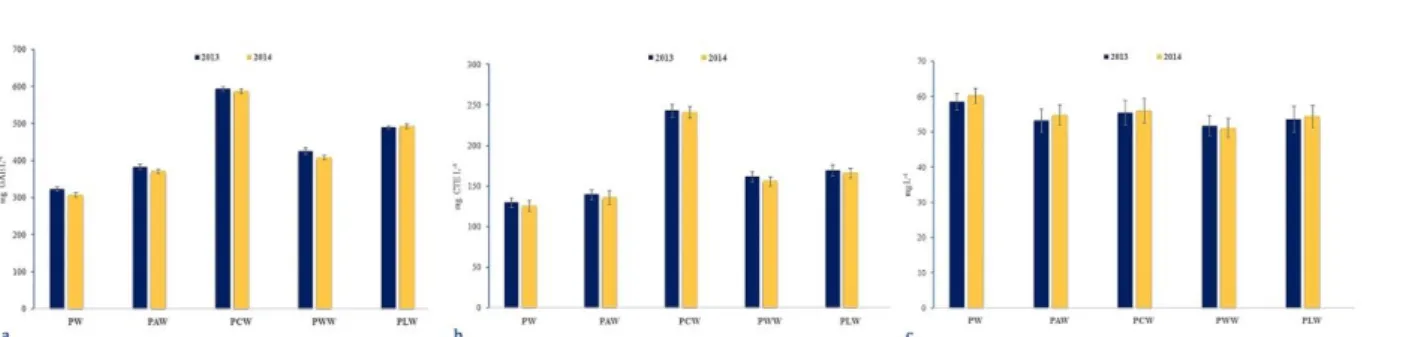
Figure 2. Content of (a) total phenolics (mg GAE L-1), (b) total flavonoids (mg CTE L-1) and (c) total anthocyanins (mg L-1) in 'Prokupac' red wine samples (vintages 2013–2014); PAW–
'Prokupac' wine with anis, PCW–'Prokupac' wine with cinnamon, PWW–'Prokupac' wine with wormwood, PLW–'Prokupac' wine with liquorice and PW–'Prokupac' wine (control).
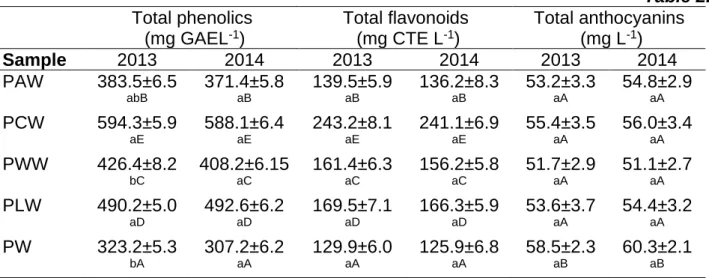
According to the results for TPC, significant differences were observed between wine samples in both vintages (p<0.05, Table 2). The lowest TPC (expressed as mg GAE L-1) was found in 'Prokupac' red wine (PW) 323.2/307.2 mg GAE L-1, whereas the highest TPC was detected in 'Prokupac' wine with added cinnamon (PCW) 594.3/588.1 mg GAE L -1, in vintages 2013 and 2014, respectively (Figure 2a). The content of total phenolics in wines with addition of wormwood and the control one was statistically different between the vintages (p<0.05, Table 2). For other studied wines (PAW, PCW and PLW) significant diferences were not observed for TPC. In all wine samples the higher TPC were recorded in the vintage 2014. The obtained results for TPC are in line with the findings for Merlot and Cabernet Sauvignon wines from China (Zhu et al., 2012).On the other hand, for 'Prokupac' wine from Grocka vineyards (Central Serbia) about four-fold higher TPC in comparison to the studied 'Prokupac' wines were reported (Pantelić et al., 2018).
In both vintages, the significant differences in the content of total flavonoids among the relevant 'Prokupac'
wine samples were noticed (p<0.05, Table 2). Nontheless, TFC was not significantly different between the vintages, as the highest/lowest TFC was observed in samples PCW (239.93±7.1 mg CTE L-1) and PW (125.9±6.22 mg CTE L-1), respectively, both in the vintage 2014.
The content of total anthocyanins varied between studied wine samples, as well as between the vintages (Figure 2c). Statisticaly significant differences were observed between wines with the addition of aromatic herbs and the control one (p<0.05, Table 2); 'Prokupac' wine (PW) was the richest in TAC compared to wines with the addition of aromatic herbs (PAW, PCW, PWW and PLW). Overal results for TAC indicated that addition of aromatic herbs affected their content in wine samples PAW, PCW, PWW and PLW, resulted in the decrease of the content of free anthocyanins. These observation are in line with literature as the content of anthocyanins could be reduced due to polymerization, interaction with other phenolic compounds, absorption by yeast cell walls, oxidation, etc. as reported in literature (Ricardo da Silva, 1997).
The correlation coefficients for the wine quality parameters of the samples were also studied (Table 3). In the first year of the study (2013) positive highly significant correlations were observed between TPC and TFC (0.96, p<0.01), and between ash and total extracts,
93
Statistical data for 'Prokupac' red wine samples
Table 2.
Total phenolics (mg GAEL-1)
Total flavonoids (mg CTE L-1)
Total anthocyanins (mg L-1)
Sample 2013 2014 2013 2014 2013 2014
PAW 383.5±6.5 abB
371.4±5.8 aB
139.5±5.9 aB
136.2±8.3 aB
53.2±3.3 aA
54.8±2.9 aA PCW 594.3±5.9
aE
588.1±6.4 aE
243.2±8.1 aE
241.1±6.9 aE
55.4±3.5 aA
56.0±3.4 aA PWW 426.4±8.2
bC
408.2±6.15 aC
161.4±6.3 aC
156.2±5.8 aC
51.7±2.9 aA
51.1±2.7 aA PLW 490.2±5.0
aD
492.6±6.2 aD
169.5±7.1 aD
166.3±5.9 aD
53.6±3.7 aA
54.4±3.2 aA
PW 323.2±5.3
bA
307.2±6.2 aA
129.9±6.0 aA
125.9±6.8 aA
58.5±2.3 aB
60.3±2.1 aB
PAW–Prokupac wine with anis, PCW–Prokupac wine with cinnamon, PWW– Prokupac wine with wormwood, PLW–Prokupac wine with liquorice and PW–Prokupac wine (control).
Results are presented as mean±standard deviation (SD); Small letters denote a significant difference between vintages, and capital letters denote a significant difference among wine samples according to Duncan's test, p < 0.05.
Correlation matrix of wine quality parameters in vintages 2013-2014.
Table 3.
2013 Alcohol TA VA TE RS Ash TPC TFC TAC Alcohol 1.00 0.27 0.15 -0.29 -0.47 -0.50 -0.59 -0.68 -0.03 TA 0.27 1.00 0.35 0.17 0.66 0.38 0.13 0.03 -0.87 VA 0.15 0.35 1.00 0.86 0.45 0.72 0.60 0.36 -0.51 TE -0.29 0.17 0.86 1.00 0.64 0.91* 0.92* 0.79 -0.31 RS -0.47 0.66 0.45 0.64 1.00 0.88* 0.77 0.73 -0.70 Ash -0.50 0.38 0.72 0.91* 0.88* 1.00 0.94* 0.83 -0.55 TPC -0.59 0.13 0.60 0.92* 0.77 0.94* 1.00 0.96** -0.24 TFC -0.68 0.03 0.36 0.79 0.73 0.83 0.96** 1.00 -0.07 TAC -0.03 -0.87 -0.51 -0.31 -0.70 -0.55 -0.24 -0.07 1.00
2014 Alcohol TA VA TE RS Ash TPC TFC TAC
Alcohol 1.00 0.48 0.48 -0.07 -0.74 -0.58 -0.67 -0.77 -0.25 TA 0.48 1.00 -0.44 -0.39 0.03 -0.84 -0.73 -0.74 0.69 VA 0.48 -0.44 1.00 0.64 -0.51 0.42 0.27 0.13 -0.85 TE -0.07 -0.39 0.64 1.00 0.33 0.71 0.75 0.54 -0.47 RS -0.74 0.03 -0.51 0.33 1.00 0.34 0.57 0.53 0.50 Ash -0.58 -0.84 0.42 0.71 0.34 1.00 0.96** 0.95* -0.45 TPC -0.67 -0.73 0.27 0.75 0.57 0.96** 1.00 0.95* -0.30 TFC -0.77 -0.74 0.13 0.54 0.53 0.95* 0.95* 1.00 -0.15 TAC -0.25 0.69 -0.85 -0.47 0.50 -0.45 -0.30 -0.15 1.00
TA -Titriable acids; VA - Volatile acids; TE- Total extracts; RS - Reducing sugars; TPC - Total
phenolic content; TFC - Total flavonoid content; TAC - Total anthocyanin content
94 Principal component analysis (PCA) and hierarchical cluster analysis (HCA)
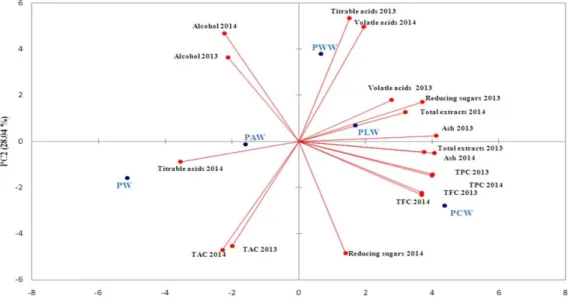
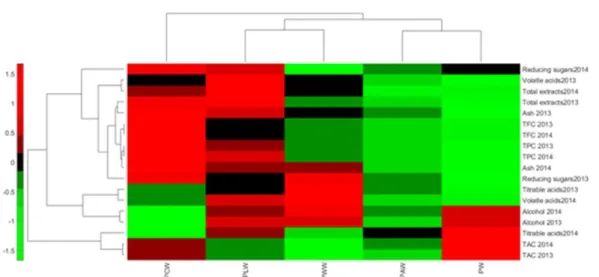
In addition to the correlation of the studied parameters, separation of wines based on their chemical composition could be seen by analyzing biplot (Figure 3) and clustergram (Figure 4). In Figure 3, a positive correlation between titratable acids in 2013 and volatile acids in 2014 as well as, between TFC in both year of the study (2013 and 2014) could be observed. It is interesting that there was no correlation between reducing sugars in 2013 and reducing sugars in 2014. The
position of 'Prokupac' wine with the addition of cinnamon (PCW) indicates that this wine had the highest values of TFC, TPC, ash (in both years of study) as well as total extracts in 2013 and reducing sugars in 2014. The 'Prokupac' wine with the addition of wormwood (PWW) wine had the highest values of alcohol in both years, as well as titriable acids in 2013 and volatile acids in 2014. 'Prokupac' wine with the addition liquorice (PLW) had the average values or values slightly above the average for TFC and total extracts, respectively (in both years).
Figure 3. PCA biplot showing separation of wines based on their chemical composition
PAW treatment had the average values of titriable acids, and values of all other parameters were belowe the average. 'Prokupac' wine (PW, control) was separated from wines with the addition of aromatic herbs by the highest values of titratable acids 2014, as well as alcohol and TAC in both years of the study (Figure 4).
CONCLUSION
The obtained results indicated that a slight increase of the examined wine
95
Figure 4. Clastergram of the analysed parameters in 2013 and 2014
ACKNOWLEDGEMENTS
This work was supported by the Ministry of Education, Science and Technological
Development of the Republic of Serbia (Research grant No. 172047).
BIBLIOGRAPHY
1. Bisson LF, Waterhouse A L, Ebeler SE, Walker M A, Lapsley JT., 2002. The present and future of the international wine industry. Nature. 418: 696.
2. Bešlić Z, Todić S, Matijašević S, Novaković M, Kuljančić I., 2011. Effect of early basal leaf removal on grape structure and quality of Prokupac (Vitis vinifera L.). In: Proceedings 46th Croatian and 6th International Symposium on Agriculture. February 14 - 18, Opatija. Croatia.
3. Božović M. and Ragno R., 2017. Calamintha nepeta (L.) Savi and its main essential oil constituent pulegone: biological activities and chemistry. Molecules. 22:290.
4. Coldea TE. and Mudura E., 2015. Valorisation of aromatic plants in beverage industry. Hop and Medicinal Plants. 1-2: 25.
5. Egea T, Adele Signorini M, Ongaro L, Rivera D, Obón de Castro C, Bruschi P., 2016. Traditional alcoholic beverages and their value in
the local culture of the Alta Valle del Reno, a mountain borderland between Tuscany and Emilia-Romagna. J. Ethnobiol. Ethnomed. 12: 12-27. 6. Fournier-Level A, Hugueney P,
Verriès C, This P, Ageorges A., 2011.Genetic mechanisms underlying the methylation level of anthocyanins in grape (Vitis vinifera L.). BMC Plant Biol. 11. 179.
7. Giovinazzo G. and Grieco F., 2015. Functional Properties of Grape and Wine Polyphenols. Plant. Foods Hum. Nutr. 70: 454.
8. Greenacre M. Biplots in Practice, 2010; Fundación BBVA, Madrid, Spain
9. Gris EF, Mattivi F, Ferreira E A ,Vrhovsek U, Filho D W, Pedrosa R C. Bordignon-Luiz M.T., 2013. Phenolic profile and effect of regular consumption of Brazilian red wines on in vivo antioxidant activity. J Food Compos Anal. 31: 31–40.
96 vinifera L. red grape varieties in danger of extinction. Eur. Food Res. Technol.; 236: 647-658.
11. Ivanova-Petropulos V, Hermosín-Gutiérrez I, Boros B, Stefova M, Stafilov T, Vojnoski B, Dörnyei A, Kilár F., 2015. Phenolic compounds and antioxidant activity of Macedonian red wines J. Food Compos. Anal. 41: 1.
12. Karabegović IT, Vukosavljević PV, Novaković MM, Gorjanović SŽ, Džamić AM, Lazić ML., 2012. Influence of the storage on bioactive compounds and sensory attributes of herbal liqueur. Dig. J. Nanomater. Biostruct. 7: 1587–1598 .
13. Kim D, Chun O, Kim Y, Moon H, Lee C., 2003. Quantification of Polyphenolics and Their Antioxidant Capacityin Fresh Plums J. Agric. Food Chem. 51: 6509−6515
14. Marković N, Pržić Z, Rakonjac V, Todić S, Ranković-Vasić Z, Matijašević S, Bešlić Z., 2017. Ampelographic characterization of Vitis cv “Prokupac” clones by
multivariate analysis.
Rom.Biotech.Lett.;Vol.22:No.5:12868– 12875.
15. Pantelić M, Dabić Zagorac D, Gašić U, Jović S, Bešlić Z, Todić S, Natić M., 2018. Phenolic profiles of Serbian autochthonous variety 'Prokupac' and monovarietal international wines from the Central Serbia wine region. Nat. Prod. Res. 32: (19) 2356-2359.
16. Pantelić M, Dabić Zagorac D, Natić M, Gašić U, Davidović S, Vujović D, Popović-Djordjević J., 2016. Impact of clonal variability on phenolics and radical scavenging activity of grapes and wines: a study on the recently developed Merlot and Cabernet Franc clones (Vitis vinifera L.) PLoS One.; 11(10):
17. Pelsy F, Hocquigny S, Moncada X, Barbeau G, Forget D, Hinrichsen P, Merdinoglu D., 2010. An extensive
study of the genetic diversity within seven French wine grape variety collections. Theor. Appl. Genet.; 120 (6):1219-1231.
18. Pejin B, Stanimirovic B, Vujovic D, Popovic-Djordjevic J, Velickovic M, Tesevic V., 2016. The natural product content of the selected Cabernet Franc wine samples originating from Serbia: a case study of phenolics. Nat. Prod. Res. 30: 1762.
19. Popović-Djordjević J, Pejin B, Dramićanin A, Jović S, Vujović D, Žunić D, Ristić R., 2017. Wine chemical composition and radical scavenging activity of some Cabernet Franc clones. Curr. Pharm. Biotechnol. ; 18: 343
20. Renaud S. and de Lorgeril M., 1992. Wine, alcohol, platelets, and the French paradox for coronary heart disease. Lancet. 339: 1523.
21. Ribéreau-Gayon P. and Stonestreet E., 1965. Determination of anthocyanins in red wine. Bull. Soc. Chim. Fr. 9: 2649 -2652.
22. Ricardo da Silva JM., 1997. Anthocyanins and proanthcyanidins in grape and wines. Their primordial role in enology, In: Proceedings of the First Symposium in Vino Analytica Scientia, Bordeaux, France, 101.
23. Sarikurkcu C, Ozer MS, Calli N, Popović-Djordjević J., 2018. Essential oil composition and antioxidant activity of endemic Marrubium parviflorum subsp oligodon. Ind. Crop. Prod. 119: 209. 24. Strommer J, Coventry J, Ali A,
Metcalf D, Fischer H., 2003. Regulation of anthocyanin and stilbene production in vitis. Acta Hort. 603: 361.
25. Tonutti I. and Liddle P., 2010. Aromatic plants in alcoholic beverages. Flavour Fragr. J. 25: 341. 26. Van Leeuw R, Kevers C,
97 phenolic composition of red wines from various grape varieties: specificity of Pinot Noir. J. Food Compos. Anal. 36: 40-50.
27. Van Leeuwen C. and Philippe
Darriet P., 2016. The impact of
climate change on viticulture and wine quality, Journal of Wine Economics. 11, 150–167.
28. Vujovic D, Pejin B, Popovic-Djordjevic J, Veličkovic M, Teševic V., 2016. Phenolic natural products of the wines obtained from three new Merlot clone candidates. Nat. Prod. Res. 30: 987.
29. Zhu L, Zhang Y, Deng J, Li H, Lu J., 2012. Phenolic concentrations and antioxidant properties of wines made from north american grapes grown in china Molecules.; 17: 3304.