27
EFFICIENT NODE AUTHENTICATION USING INSENS PROTOCOL
FOR MANET NETWORK
1Priyanka.M, 2P.Chandrasekar
M.E.(Communication System),
1
PG Scholar, Professor,
Department of Communication Systems,
RVS College Of Engineering and Technology,
Abstract-
Mobile Ad-Hoc Networks (MANETs) have been used in wide range of applications such
as disaster management, emergency and rescue operations where it is not possible to have well defined
infrastructure. In MANETs, the topology is highly dynamic as nodes frequently join or leave the network,
and roam in the network. Though MANETs are dynamic in nature, security services need to be provided in
mobile nodes as they move from one place to another. Unlike fixed wired networks, mobile wireless adhoc
networks need more security mechanisms as attackers may intrude into the network through subverted nodes.
Therefore, a powerful security solution is required to identify and isolate malicious nodes in the network. In
addition to protecting the network from intruders, the security solution should also protect each node in the
network. The security scheme adopted by each node in MANET has to work within its own resource
limitations in terms of energy supply, communication capacity, and memory and computation capability. In
this Project Intrusion-Tolerant Routing protocol for Manet (INSENS) protocol &Small Minimum-Energy
communication Network (SMECN) is used to focus on a Malicious control by identity the characteristics, to
improve an energy and avoid Malicious. This property implies that for any pair of sensors in a graph
associated with a network, there is a minimum energy-efficient path between them that is, a path that has the
smallest cost in terms of energy consumption over all possible paths between this pair of sensors.
Keywords-Sensor Networks, Network Protocols, Fault Tolerance, Security.
Introduction
Mobile Ad-hoc Networks consist of a multitude of tiny
sensor nodes capable for wireless communications and a
few powerful base stations. The sensor nodes usually
perform some monitoring task (e.g., measure various
environmental parameters). The base stations collect
sensor readings and forward them for further processing
to a service center.
Based on how the sensor readings reach the base
stations, we can distinguish synchronous
And asynchronous sensor networks. In the synchronous
case, the sensor readings are sent to the base stations in
real-time using multi-hop wireless communications,
where the sensor nodes cooperatively forward data
pack-
ets on behalf of other sensor nodes towards the base
stations. In the asynchronous case, the sensor readings
are fetched by the base stations after some delay (e.g.,
28
are often mobile, and they physically approach the
sensors in order to fetch their data through a single
wireless hop. Examples of synchronous sensor network
applications include forest fire alarm systems and
building automation systems where real-time operation
is indispensable. Examples of asynchronous
applications include habitat monitoring systems and
agricultural applications such as vineyard monitoring
where real-time operation is not an issue. As sensor
nodes are often severely resource constrained, various
techniques have been proposed to ensure the efficient
operation of sensor networks. One of these techniques
is called aggregation or in-network processing. The idea
is that instead of forwarding (in case of synchronous
applications) or storing (in case of asynchronous
applications) raw sensor readings, data can be first
processed, combined, and compressed by some
distinguished sensor nodes, called aggregators.
While aggregation increases the overall efficiency of the
sensor network, the aggregator nodes them elves use
more resources than the regular sensor nodes. For this
reason, it is desirable to change the aggregators from
time to time, and thereby, to better balance the load on
the sensor nodes. For this purpose, aggregator node
election protocols can be used in the sensor network that
allow dynamic re-assignment of the aggregator role.
MOBILE ad hoc networks (MANETs) are originally
designed for military tactic environments.
Communication anonymity is a critical issue in
MANETs, which generally consists of the following
aspects: 1) Source/
destination anonymity—it is difficult to identify the
sources or the destinations of the network flows. 2)
End-to-end relationship anonymity—it is difficult to identify
the end to-end communication relations. To achieve
anonymous MANET communications, anonymous
routing protocols have been proposed.
Though a variety of anonymity enhancing techniques
like onion routing [9] and mix-net [10] are utilized,
these protocols mostly rely on packet encryption to hide
sensitive information (e.g., nodes’ identities and routing
information)from the adversaries. However, passive
signal detectors can still eavesdrop on the wireless
channels, intercept the transmissions, and then perform
traffic analysis attacks. Over the past few decades,
traffic analysis models have been widely investigated
for static wired networks (e.g., [9],[10], [11], [12], [13]).
For example, the simplest approach to track a message
is to enumerate all possible links a message could
traverse, namely, the brute force approach
[11].Recently, statistical traffic analysis attacks have
attracted broad interests due to their passive nature, i.e.,
attackers only need to collect information and perform
analysis quietly without changing the network behavior
(such as injecting or modifying packets). The
predecessor attacks [14], [15], [16]and disclosure
attacks [17], [18], [19], [20] are two representatives.
However, all these previous approaches do not work
well to analyze MANET traffic because of the following
three natures of MANETs: 1) The broadcasting nature:
In wired networks, a point-to-point message
transmission usually has only one possible receiver.
While in wireless networks, a message is broadcasted,
which can have multiple possible receivers and so incurs
additional uncertainty. 2) The ad hoc nature: MANETs
lack network infrastructure, and each mobile node can
serve as both a host and a router. Thus, it is difficult to
determine the role of a mobile node to be a source, a
destination, or just a relay. 3) The mobile nature: Most
of existing traffic analysis models do not take into
29
which make the communication relations among mobile
nodes more complex. In [21], Huang devised an
evidence-based statistical traffic analysis model
specially for MANETs. In this model, every captured
packet is treated as an evidence supporting a
point-to-point (one-hop) transmission between the sender and the
receiver. A sequence of point-to-point traffic
matrices is created, and then they are used to derive
end-to-end (multi hop) relations. This approach provides a
practical attacking framework against MANETs but still
leaves substantial information about the communication
patterns undiscovered. First, the scheme fails to address
several important constrains (e.g., maximum hop-count
of a packet) when deriving the end-to-end traffic from
the one hope evidences. Second, it does not provide a
method to identify the actual source and destination
nodes (or to calculate the source/destination probability
distribution).
Moreover, it only uses a native accumulative traffic
ratio to infer the end-to-end communication relations
(e.g., the probability for node j to be the intended
destination of
node i is computed as the ratio of the traffic from i to j
to all traffic coming out from node i), which incurs a lot
of in accuracy in the derived probability distributions.
2. Related Work
Traffic analysis attacks against the static wired
networks(e.g., Internet) have been well investigated.
The brute forceattack proposed in [11] tries to track a
message byenumerating all possible links a message
could traverse. In
node flushing attacks (a.k.a blending attacks, n _ 1
attacks)[10], the attacker sends a large quantity of
messages to thetargeted anonymous system (which is
called a mix-net).
Since most of the messages modified and reordered by
the system are generated by the attacker, the attacker
can track the rest a few (normal) messages. The timing
attacks as proposed in [9] focus on the delay on each
communication path. If the attacker can monitor the
latency of each path, he can correlate the messages
coming in and out of the system by analyzing their
transmission latencies. The message tagging attacks
(e.g., [12]) require attackers to occupy at least one node
that works as a router in the communication path so that
they can tag some of the forwarded messages for traffic
analysis. By recognizing the tags in latter transmission
hops, attackers can track the traffic flow. The
Water marking attacks are actually variants of the
message tagging attacks. They reveal the end-to-end
communication relations by purposely introducing
latency to selected packets. Different from the attacks
mentioned above, statistical traffic analysis intends to
discover sensitive information from the statistical
characteristics of the network traffic, for example, the
traffic volume. The adversaries usually do not change
the network behavior (such as injecting or modifying
packets). The only thing they do is to quietly collect
traffic information and perform statistical calculations.
The predecessor attacks are first pointed out by Reiter
and Rubin [14].
Later works such as [15] and [16] extend them to all
kinds of anonymous communication systems including
onion-routing[9], mix-net [10], and DC-net [22]. In a
typical predecessor attack, the attackers act exactly as
legitimate nodes in the network communications. They
collectively maintain a single predecessor counter for
each legitimate node in the system. When an attacker
finds himself to be on an anonymous path to the targeted
30
predecessor node in this path. The counters are then
used for the attackers to infer the possible
source nodes of the given destination. Obviously, to
launch such an attack, a large number of legitimate
nodes must first be compromised and controlled by the
attackers. This is usually not achievable in MANETs.
Moreover, in a MANET protected by anonymity
enhancing techniques, it is a difficult task itself to
identify an actual destination node as the target due to
the ad hoc nature. That is, destinations are
indistinguishable from other nodes (e.g., relays) in a
MANET. In fact, they usually act as relay nodes as well,
forwarding traffic for others. The adversaries are not
able to determine whether a particular node is a
destination depending on whether the node sends out
traffic. This is totally different from the situation in
traditional infrastructural networks where the role of
every node is determined. The statistical disclosure
attacks as mentioned in [17], [18], [19], and [20] are
similar. A statistical disclosure attack often targets a
particular given source node and intends to expose its
corresponding destinations. It is assumed that the
packets initiated by the source are sent to several
destinations with certain probability distribution. The
background (covering) traffic also has certain
probability distribution (usually assumed to be
uniformly distributed). After a large number of
observations, the attackers are able to figure out the
possible destinations of the given source. Nonetheless,
the statistical disclosure attacks cannot be applied to
MANETs either, because the attackers cannot easily
identify the actual source nodes in MANETs. Even if a
source node is identified, the attacks can only be
performed when the attackers know for sure when the
targeted source is originating traffic and can observe the
network behavior in the absence of the source.
However, the attackers are prevented from being able to
do so by the ad hoc nature of MANETs, i.e., they cannot
tell if the source is originating traffic or just forwarding
traffic as a relay.
Due to the unique characteristics of MANETs, very
limited investigation has been conducted on traffic
analysis in the context of MANETs. He et al. proposed a
timing-based approach in [23] to trace down the
potential destinations given a known source. In this
approach, assuming the transmission delays are bounded
at each relay node, they estimate the flow rates of
communication paths using packet matching. Then
based on the estimated flow rates, a set of nodes that
partition the network into two parts, one part to which
the source can communicate in sufficient rate and the
other to which it cannot, are identified to estimate the
potential destinations. In [24], Liu et al. designed a
traffic inference algorithm (TIA) for MANETs based on
the assumption that the difference between data frames,
routing frames, and MAC control frames is visible to the
passive adversaries, so that they can recognize the
point-to-point traffic using the MAC control frames, identify
the end-to-end flows by tracing the routing frames, and
then infer the actual traffic pattern using the data frames.
The TIA achieves good accuracy in traffic inference,
while the mechanism is tightly tied to particular
anonymous routing protocols but not a general
approach. Both [23] and [24] are analytical strategies
which heavily rely on the deterministic network
behaviors.
3. Proposed model – INSENS
Our Assumption
Traffic analysis models have been widely investigated
for static wired networks. The simplest approach to
31
message could traverse, namely, the brute force
approach. Recently, statistical traffic analysis attacks
have attracted broad interests due to their passive nature,
i.e., attackers only need to collect information and
perform analysis quietly without changing the network
behavior (such as injecting or modifying packets). Many
anonymity enhancing techniques have been proposed
based on packet encryption to protect the
communication anonymity of mobile ad hoc networks
(MANETs).
Statistical traffic pattern discovery system, To disclose
the hidden traffic patterns in a MANET communication
system, INSENS&SMECNS includes two major steps.
First, it uses the captured traffic to construct a sequence
of point-to-point traffic matrices and then derives the
end-to-end traffic matrix. Second, further analyzing the
end-to-end traffic matrix, it calculates the probability for
each node to be a source/destination (the
source/destination probability distribution) and that for
each pair of node to be an end-to-end communication
link (the end-to-end link probability distribution). traffic
analysis models have been widely investigated for static
wired networks . For example, the simplest approach to
track a message is to enumerate all possible links a
message could traverse, namely, the brute force
approach .Recently, statistical traffic analysis attacks
have attracted broad interests due to their passive nature,
i.e., attackers only need to collect information and
perform analysis quietly without changing the network
behavior (such as injecting or modifying packets).
INSENS&SMECNS is basically an attacking
system, which only needs to capture the raw traffic from
the PHY/MAC layer without looking into the contents
of the intercepted packets. From the captured packets,
INSENS&SMECNS constructs a sequence of
point-to-point traffic matrices to derive the end-to-end traffic
matrix, and then uses a heuristic data processing model
to reveal the hidden traffic patterns from the end-to end
matrix. Our empirical study demonstrates that the
existing MANET systems can achieve very restricted
communication anonymity under the attack of
INSENS&SMECNS. The probability distributions
produced by INSENS&SMECNS are good indicators of
the actual traffic patterns, i.e., actual sources,
destinations, and end-to-end links. Different strategies
can be used to speculate the actual traffic patterns from
the probability distributions. To discover the
communication patterns without decrypting the
capturedpackets, we present a novel statistical traffic
pattern discovery system (INSENS&SMECNS).
INSENS&SMECNS works passively to perform traffic
analysisbased on statistical characteristics of captured
raw traffic. INSENS&SMECNS is capable of
discovering the sources, the destinations, and
theend-to-end communication relations. Empirical studies
demonstrate that INSENS&SMECNS achieves good
accuracy in disclosing the hiddentraffic patterns.
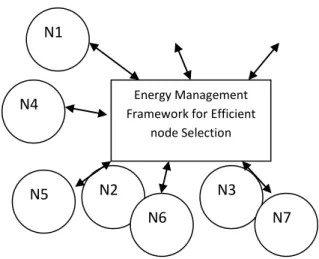
Figure 1: Energy Management of the Wireless Sensor Network
N1
N2 N4
N3
N7 N5
N6
Energy Management Framework for Efficient
32 We further assume the communication time
between the sink and sensor nodes is negligible, as
compared with the sink node’s travelling time.
Similarly, the delay due to multi hop communications
including transmission, propagation, and queuing delays
is negligible with respect to the travelling time of the
mobile sink in a given round. Each RP node has
sufficient storage to buffer all sensed data. The mobile
sink is aware of the location of each RP. All nodes are
connected, and there are no isolated sensor nodes.
Sensor nodes have a fixed data transmission range.
Definition 1 (Delay of data). The delay of data is
defined as the time spent by the mobile sink moving
from one sink site to the next sink site.
Definition 2 (Network lifetime (T)). The network
lifetime (T) is defined as the elapsed time since the
launch of this network till the instant that the first node
dies.
Network Model and Assumption
The MANET has been modeled using a
distributed routing protocol utilizing the diverse traffic
handling by nodes through aware of their positions.
Each node is supposed to be aware of its current node
state and forwarding node state in order to route the
data to the destination. Wireless Sensor Network does a
packetization to transmit the data to a destination node
through intermediate nodes.
3.1 SYSTEM ARCHITECTURE DESIGN
The architecture diagram clearly explains
hop
by
hop
authentication
features
and
functionalities. The fig 4.2 describe about the
system architecture for the proposed system.
Fig 3.1 System Architecture
Data are communicated from one node to
another node in the above process. First the source
node will send the data it is passed into the
automatic key generator here a secrete key will be
generated automatically for the source node. After
the key is generated data is passed into the network
with key value in the data.
Above process is made for each and every
node in the network by generating its own key until
it reaches the destination.
When the data reach its destination it will
check for the key of destination node, once
validated data is delivered.
3.2 ARCHITERCTURE DIAGRAM
33
Fig. 3.2Architecture Diagram
When the data is transmitted from source to
destination, Communication will be established in 2
ways either hop by hop or multi hop. The
intermediate nodes are taken as load node. When
there is energy drain in load nodes, alternative node
can be replaced. This protocol is named as active
protocol. Here Multicasting is also applied, so
every node will easily knows the maximum energy
level of other nodes.
4. MODULE
DESCRIPTION
4.1 NODE FORMATION MODULE
This module is formation of nodes what all
needed for sending and receiving information.
One node is assumed as sender node and another
node is assumed as receiver node. And some nodes
are assumed as information passing nodes.
4.2 DATA TRANSMISSION MODULE
The sender node sends the information to
the receiver node through this module. These
modules have an option for sending the file from
one location to the other location. Each node has an
identity using the IP address.
4.3 DATA RECEIVING AND VERIFICATION
MODULE
This
module
is
for
receiving
the
information. It checks whether the information is
coming from secure sender and from the correct
path. After authentication, the receiver receives the
information through the secure nodes.
4.4 EXPERIMENTAL RESULTS
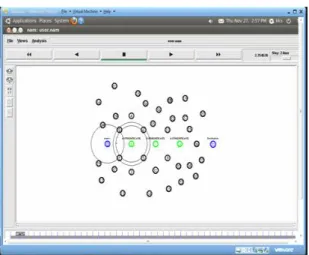
The below screenshots will describe how
the proposed system for identifying the adjacent
nodes in the network.
Fig 4.1 Viewing Adjacent Nodes
34
Fig 4.2Authenticating Each Node while sending
data
In order to transfer data between nodes,
one node will be selected as source node another
will be destination node. Before sending data to the
destination node first we have to broadcast node.
By broadcasting a shortest path is identify for
transferring data which is shown in the Fig 5.2
while
visiting
each
node
automatic
key
authentication is made on that node.
While
transferring data from one node to another node
there is a possible for data loss, above Fig 5.3
shows the data loss in node.
Fig 4.3 Finding Unauthenticated Node
Once data loss is occur it seems that the
original data doesn’t reach the destination. The
above Fig 5.4 check for unauthenticated node in
that path.
After identifying alternate node, those nodes are
placed in the appropriate location. Now the source
node will retransmit the data to the destination
node. Finally data is reached in the destination node
without data loss.
Fig 4.4 Removing the Unauthenticated Node
In Fig 5.55 the red color node in the pathindicates the unauthenticated node. Once the nodes are
identified those nodes are removed from the path. After
the nodes are removed, the destination node will find the
alternate node and placed in that path.
5. CONCLUSION
MOBILE ad hoc networks (MANETs) are
originally designed for military tactic environments.
MANET communications, many anonymous routing
protocols such as ANODR , MASK , and OLAR have
been proposed. Though a variety of anonymity
enhancing techniques like onion routing and mix-net
are utilized, these protocols mostly rely on packet
encryption to hide sensitive information (e.g., nodes’
35
However, passive signal detectors can still eavesdrop on
the wireless channels, intercept the transmissions, and
then perform traffic analysis attacks. To demonstrate
how to discover the communication patterns without
decrypting the captured packets, we present a novel
statistical traffic pattern discovery system
(INSENS&SMECNS). INSENS&SMECNS works
passively to perform traffic analysis based on statistical
characteristics of captured raw traffic.
INSENS&SMECNS is capable of discovering the
sources, the destinations, and the end-to-end
communication relations.
6. FUTURE ENHANCEMENT
The implemented work has been tested for
density upto 50nodes and it can be tested for high
density of nodes having bigger mix of wired nodes and
ireless nodes. The high density networks shall cause the
high values of reliability and having nodes with almost
equal reliability value will increase the competition
among the nodes. In future, this work can also be
enhanced to test on the protocols. The mechanism can
also be tested for other output parameters such as end to
end delay, packet delivery ratio etc.
Reference
[1] J. Kong, X. Hong, and M. Gerla, “An Identity-Free
and On-Demand Routing Scheme against Anonymity
Threats in Mobile
Ad Hoc Networks,” IEEE Trans. Mobile Computing,
vol. 6, no. 8,pp. 888-902, Aug. 2007.
[2] Y. Zhang, W. Liu, W. Lou, and Y. Fang, “MASK:
Anonymous On-Demand Routing in Mobile Ad Hoc
Networks,” IEEE Trans. Wireless Comm., vol. 5, no. 9,
pp. 2376-2385, Sept. 2006.
[3] Y. Qin and D. Huang, “OLAR: On-Demand Light
weight Anonymous Routing in MANETs,” Proc. Fourth
Int’l Conf. Mobile
Computing and Ubiquitous Networking (ICMU ’08),
pp. 72-79, 2008.
[4] M. Blaze, J. Ioannidis, A. Keromytis, T. Malkin, and
A. Rubin,“WAR: Wireless Anonymous Routing,” Proc. Int’l Conf. Security Protocols, pp. 218-232, 2005.
[5] A. Boukerche, K. El-Khatib, L. Xu, and L. Korba,
“SDAR: A Secure Distributed Anonymous Routing
Protocol for Wireless and Mobile Ad Hoc Networks,”
Proc. IEEE 29th Ann. Int’l Conf. Local Computer Networks (LCN ’04), pp. 618-624, 2004.
[6] S. Seys and B. Preneel, “ARM: Anonymous Routing
Protocol for Mobile Ad Hoc Networks,” Proc. IEEE
20th Int’l Conf. Advanced Information Networking and
Applications Workshops (AINA Workshops
’06), pp. 133-137, 2006.
[7] R. Shokri, M. Yabandeh, and N. Yazdani,
“Anonymous Routing in MANET Using Random
Identifiers,” Proc. Sixth Int’l Conf.
Networking (ICN ’07), p. 2, 2007.
[8] R. Song, L. Korba, and G. Yee, “AnonDSR:
Efficient Anonymous Dynamic Source Routing for
Mobile Ad-Hoc Networks,” Proc.Third ACM Workshop
Security of Ad Hoc and Sensor Networks(SASN ’05),
pp. 33-42, 2005.
[9] M. Reed, P. Syverson, and D. Goldschlag,
“Anonymous Connections and Onion Routing,” IEEE J.
Selected Areas in Comm., vol. 16,no. 4, pp. 482-494,
May 2002.
[10] D. Chaum, “Untraceable Electronic Mail, Return
Addresses, and Digital Pseudonyms,” Comm. ACM,
vol. 24, no. 2, pp. 84-88, 1981.
[11] J. Raymond, “Traffic Analysis: Protocols, Attacks,
36
Workshop Designing Privacy Enhancing Technologies:
Design Issues in Anonymity and Un observability, pp.
10-29, 2001.
[12] W. Dai, “Two Attacks against a PipeNet-Like
Protocol Once Used by the Freedom Service,”
http://weidai.com/freedomattacks.
txt, 2013.
[13] X. Wang, S. Chen, and S. Jajodia, “Network Flow
Watermarking Attack on Low-Latency Anonymous
Communication Systems,”Proc. IEEE Symp. Security
and Privacy, pp. 116-130, 2007.
[14] M. Reiter and A. Rubin, “Crowds: Anonymity for Web Transactions,” ACM Trans. Information and
System Security, vol. 1, no. 1,pp. 66-92, 1998.
[15] M. Wright, M. Adler, B. Levine, and C. Shields,
“The Predecessor Attack: An Analysis of a Threat to
Anonymous Communications
Systems,” ACM Trans. Information and System
Security, vol. 7, no. 4,pp. 489-522, 2004.QIN ET AL.:
STARS: A STATISTICAL TRAFFIC PATTERN
DISCOVERY SYSTEM FOR MANETS 191
Fig. 6. Evaluation results.
[16] D. Figueiredo, P. Nain, and D. Towsley, “On the
Analysis of the Predecessor Attack on Anonymity
Systems,” technical report, Computer Science, pp.
04-65, 2004.
[17] G. Danezis, “Statistical Disclosure Attacks: Traffic
Confirmation in Open Environments,” Proc. Security
and Privacy in the Age of Uncertainty (SEC ’03), vol.
122, pp. 421-426, 2003.
[18] G. Danezis and A. Serjantov, “Statistical
Disclosure or Intersection Attacks on Anonymity
Systems,” Proc. Sixth Information Hiding Workshop (IH ’04), pp. 293-308, 2004.
[19] G. Danezis, C. Diaz, and C. Troncoso, “Two-Sided
Statistical Disclosure Attack,” Proc. Seventh Int’l Conf.
Privacy Enhancing
Technologies, pp. 30-44, 2007.
[20] C. Troncoso, B. Gierlichs, B. Preneel, and I.
Verbauwhede, “Perfect Matching Disclosure Attacks,”
Proc. Eighth Int’l Symp. Privacy
Enhancing Technologies, pp. 2-23, 2008.
[21] D. Huang, “Unlink ability Measure for IEEE
802.11 Based MANETs,” IEEE Trans. Wireless
Comm., vol. 7, no. 3, pp. 1025-
1034, Mar. 2008.
[22] D. Chaum, “The Dining Cryptographers Problem:
Un conditional Sender and Recipient Un traceability,” J.
Cryptology, vol. 1, no. 1,
pp. 65-75, 1988.
[23] T. He, H. Wong, and K. Lee, “Traffic Analysis in
Anonymous MANETs,” Proc. Military Comm. Conf.
(MILCOM ’08), pp. 1-7,2008.
[24] Y. Liu, R. Zhang, J. Shi, and Y. Zhang, “Traffic
Inference in Anonymous MANETs,” Proc. IEEE
Seventh Ann. Comm. Soc. Conf.
Sensor Mesh and Ad Hoc Comm. and Networks
(SECON ’10), pp. 1-9,2010.
[25] J. Wexler, “All About Wi-Fi Location Tracking,”
Network
World,http://features.techworld.com/mobile-wireless/2374/all-aboutwi-i-location-tracking/, 2004.