SOME RECENT DEVELOPMENTS IN THE DESIGN OF ADAPTIVE CLINICAL TRIALS
A. Baldi Antognini, A. Giovagnoli, M. Zagoraiou
1. INTRODUCTION
Most clinical trials are carried out to compare different drugs or therapies. Pharmaceutical industries in particular invest very large budgets for research and development of new drugs but recently the increased spending in biomedical re-search has not reflected in a corresponding increase in benefits. Furthermore, in a clinical trial the ethical concern of assigning treatments to patients so as to care for each of them individually often conflicts with the experimental demands. To overcome this impasse, the FDA Critical Path initiative of 2004 supports and en-courages innovative approaches in the design of the trial, in particular the use of adaptive designs. Adaptive designs are sequential procedures that use the available information at each stage to modify aspects of the trial without undermining its validity and integrity. Special cases are
i) group sequential designs for early termination of the trial due to efficacy or futility through interim analyses;
ii) sample size re-estimation designs;
iii) adaptive dose-finding designs to minimize toxicity while acquiring informa-tion on the maximum tolerated dose;
iv) covariate-adjusted designs;
v) adaptive randomization designs for treatment comparison with the ethical aim of skewing allocations towards the best treatment or dropping the less suc-cessful treatment arms.
The past decade has witnessed an outburst of books and papers on the topic of adaptive designs in clinical trials, see for instance Chow and Chang (2007), which pertain mainly to the medical and pharmaceutical literature. At the same time, the topic has aroused a wide interest among statisticians with a more atten-tive eye to the methodological implications, see for instance the book by Hu and Rosenberger (2006).
op-timization of specific compromise criteria given by a weighted average of a design optimality measure and a measure of the subjects’ risk. The relative weights in the compound criterion have been allowed to depend on the true state of nature, since it is reasonable to suppose that the more the effects of the treatments differ, the more important for the patients are the chances of receiving the best treat-ment. The purpose of the present paper is to extend the theoretical results ob-tained in Baldi Antognini and Giovagnoli (2010) and Baldi Antognini and Zagoraiou (2010) and enhance their applicability by including some numerical ex-amples. For simplicity we consider just two treatments, as is usually the case in Phase III trials, where the aim may be either to estimate the treatment effects separately or, more commonly, to estimate or test their difference.
We shall first of all find the target allocation that optimizes a given compound criterion for different response models and different choices of the optimality measures. This target in general depends on the unknown parameters, and we will present adaptive randomization methods that make the experiment converge to the desired target, whatever the true value of the parameters, extending the dou-bly-adaptive biased coin design of Hu and Zhang (2004). The last part of the pa-per discusses a special case of adaptive randomization when one categorical co-variate is also observed.
We end this introduction by pointing out that for binary responses, a popular design with an ethical slant is the so-called Play-the-Winner proposed by Zelen (1969) and later extended to include randomization (Ivanova, 2003; Wei and Durham, 1978). Play-the-Winner is a sequential experiment in which the treat-ment allocation is repeated for the next patient in case of success, or switched to the other arm in case of failure. It is widely believed to be “an optimal model that minimizes the number of failures” (Chow and Chang, 2007), but this claim is not justified by the theory. It can be shown however that when the number of obser-vations goes to infinity the limit allocation of each treatment is inversely propor-tional to the treatment risk, which clearly always favours the better treatment.
2. THE COMPOUND CRITERION AND THE OPTIMAL ALLOCATION 2.1. The model
Given two treatments T1 and T2, with n subjects recruited into the trial, let
ik
Y be the response of patient (i i1,..., )n to treatment Tk (k1, 2).
Condi-tionally on the treatment assignment, the responses are usually taken to be inde-pendent. Put
2
E(Yik)k, Var(Yik)k (1)
and assume a “the-larger-the--the better scenario”. Special cases are 1) homoscedastic responses, i.e. 2 2
1 2
2) when the responses are binary, with p1, p2 being the respective success probabilities:
E(Yik) Pr( Yik 1) pk, Var(Yik) p qk k (2)
and qk 1 pk.
We may further assume the dependence of pk or k on some patient-related
covariates.
After n1 subjects are assigned to T1 and n2 n n1 to T2, let and 1 be the proportions of allocations to T1 and T2 respectively. The ML estimators of
1
and 2 in general are the sample means and their variance-covariance matrix (exact or asymptotic) is proportional to
2 1
2 2 0
. 0
1 V
2.2. The treatment allocation
We shall refer to all the desirable treatment allocations as “targets”. In Optimal Design Theory, the design problem consists in minimizing a suitably chosen op-timality criterion I, which measures the loss of potential information ensuing from the experimental design. In particular, the D-optimality criterion det( )V measures the global variance and the trace criterion tr( )V measures the variance of the estimated difference 12; under suitable assumptions it also measures the power of Wald’s test of the equality of treatment effects. In this setting, popu-lar treatment allocation schemes are the balanced one, B 1/2, which mini-mizes det( )V , and the well-known Neyman allocation
1 1 2
,
N
(3)
which minimizes tr( )V .
From an ethical viewpoint one possible “optimality criterion” is the proportion
W
of patients who receive the worse treatment,
1 2 1 1
(1 2 )sgn( )
2 2
W
which would be minimized, trivially, by assigning all the patients to the better treatment, if we knew which one this is. This choice however would make the treatment comparison impossible.
In practice, we would most likely wish to simultaneously minimize both the ethical cost and the inferential loss. Note that both are functions of . A possi-bility is to measure the trade-off by means of some compromise function, such as a weighted average of I and W , suitably standardized to make them
compa-rable (see for instance Baldi Antognini and Giovagnoli, 2010). One way is to set
min ( ) 1
( )
I I
I
so that both functionals W and I range in [0,1) , with 0 being their best
value.
We can look at the combination
(1 )
W I
(4)
as the compound criterion to be minimized. We can attempt to find the optimum allocation arg min by differentiation of wrt , i.e. look for a
solu-tion in (0,1) of
1 2
sgn( ) 1
0
(1 ) I I
(5)
where I minI. The target will in general depend on the following:
the inferential criterion I. As already pointed out, either D-optimality or trace-optimality will in general be chosen as I;
the weight chosen by the experimenter, with 0 1. It may be fixed or function of some or all the unknown parameters. The choice of the best weight function ( ) in a given applied context is open to discussion, but here are some general remarks:
1) the function should deal with T1 and T2 symmetrically;
2) should be non-decreasing in the absolute difference of the treatment ef-fects, to make the ethical impact more crucial the more the effects differ, whereas, on the other hand, a small difference is more difficult to detect correctly, so more emphasis is needed on precision (i.e. small )
3. OPTIMAL TARGETS
3.1. The compound target when I is D-optimality
We assume model (1) and I det( )V . Equation (5) becomes
1 2
2 2 2 2
1 2 1 2
sgn( ) (1 )
(1 ) 4
(6)
and
1 2
1 1 1
sgn( )min , .
2 8 1 2
(7)
is the optimum target. The expression for is independent of ( 12, 22). If 4/5
then
1 2
1 1
sgn( ) (0,1);
2 8 1
(8)
otherwise, if 4/5, will assign all the subjects to the better treatment.
For binary responses, the optimum target will clearly be
1 2
1 1 1
sgn( )min , .
2 p p 8 1 2
It is evident that the target allocation (7) will always assign more than half the subjects to the better treatment.
3.1.1 The choice of the weights
We can define the “ethical gain” in terms of relative percentage of fewer sub-jects assigned by to the worse treatment than by the balanced design, namely
when 0. Assuming (wlog) 12, it is easy to find the expression of the ethical gain:
1 8 1( )
(1 ) (1 ) 1
.
1/ 2 4 1
1
B B
(9)
We can measure the inferential loss by 2 min det( ) 1
1 .
det( ) 16 1
D
V V
The ethical gain and the inferential loss for the optimal compound target defined in (8) are compared in Table 1.
The percentual ethical gain of the compound target is always greater than the percentual inferential loss, with maximum difference at 1/2.
Another possibility is to let the weight depend on the parameters.
Example 1(Normal case)For normal responses we could choose
1 2 2 2 1 2 4
1 ,
5 e
(11)
so that (0,1) is satisfied. Letting 12 (wlog), Table 2 shows possible values of
2 2
1 2 1 2
( )/ and the corresponding values of the compound target:
TABLE 1
The relative ethical gain and the relative inferential loss for target
in (8) as ω varies when μ 1>μ2
ω % ethical gain 4(1 )
% inferential loss
2 4(1 )
0.00 0.50 0.00 0.00 0.10 0.51 2.78 0.08 0.20 0.53 6.25 0.39 0.30 0.55 10.71 1.15 0.40 0.58 16.67 2.78 0.50 0.63 25.00 6.25
0.60 0.69 37.50 14.06
0.70 0.79 58.33 30.03
0.75 0.88 75.00 56.26
TABLE 2
Values of the optimum compound target allocation
in (8) with ethical weight
1 2 2 2 1 2
4 1
5 e
1 2 2 2 1 2
ω
→ 0 → 0 0.500
0.25 0.18 0.527
0.50 0.31 0.557
0.75 0.42 0.591
1.00 0.51 0.628
1.50 0.62 0.705
3.00 0.76 0.896
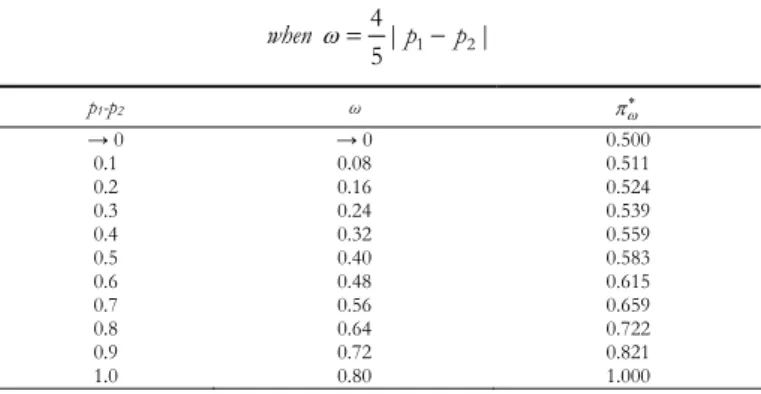
Example 2 (Binary case) For binary responses a possible choice of the weight function is the one suggested in Baldi Antognini and Giovagnoli (2010), namely
2
1 2 1 2
( ,p p ) {(p p ) 1}/ 2
, but the condition 4/5 is not always satisfied.
An-other choice is
1 2 1 2
4
( , ) | |.
5
p p p p
(12)
Table 3 gives the target allocation to the better treatment as a function of the difference in success probabilities.
TABLE 3
Values of the target as a function of the difference in success probabilities
when 4| 1 2|
5 p p
p1-p2 ω
→ 0 → 0 0.500
0.1 0.08 0.511 0.2 0.16 0.524 0.3 0.24 0.539 0.4 0.32 0.559 0.5 0.40 0.583 0.6 0.48 0.615 0.7 0.56 0.659 0.8 0.64 0.722 0.9 0.72 0.821 1.0 0.80 1.000
3.2. The compound target when I is trace-optimality
Since 2 2
1 2
tr( )V / /(1) and 2
1 2
min tr( ) (V ) , equation (5) becomes
1 2
2 2 2
1 2 2 1
sgn( ) (1 )
0.
1 ( ) ( ) 1
(13)
When 2 2
1 2
, equation (13) is identical to (6), so that all the results of Sub-section 3.1 apply. Let now 2 2
1 2
; (13) can be rewritten as a quadratic equation in :
2 2 2
1 2 2 1
2 2 2 2 2 2
1 2 2 1 1 1
sgn( )[( ) 1]
1
( ) [( ) 2 ] 0.
(14)
2
2 2 1
2
1 2 1
2 1 1 2 1
1 1
1 sgn( ) 1
(15)
lies in (0,1) , it will give the optimum allocation to T1 as a function of , 2/ 1 and sgn(12). The LHS of (14) is monotonic in [0,1], so the existence of a unique solution in (0,1) is ensured if the LHS is negative at 0 and positive at 1 namely if
2 2
1 2
1 2
2 1
1 sgn( ) 1 ,
1
which holds if and only if 2 1 2
2 2 1 2
( ) .
1 max( , )
(16)
We may be able to use some previous knowledge on 2 1
and 2 2
in order to choose a weight function that satisfies (16). Since 1 2
1 2 max( , )
1 2, again 4/5 will have to hold true. The condition 1/2, which means that the ethical im-pact should not prevail over the inferential goal, is enough to guarantee (16) for all 2
1
and 2 2
, but at times may be too restrictive.
Table 4 shows the optimal targets given by (15) for different values of the
ratio 2/ 1 and different choices of /(1 ), compared with the Neyman al-location.
The top and the bottom parts of Table 4 show the unfavourable cases, i.e. 1 2
with 12 or 12 with 12, in which Neyman’s allocation is unethical, namely it assigns more patients to the worse treatment. The optimal compound target counteracts this effect, especially with a large . This points to the need for adaptive weights, for instance by choosing (11) as the weight func-tion. However, Table 4 seems to suggest that the weight perhaps should de-pend also on 2/ 1.
RemarkIn this case, whether or not the optimal compound target assigns more than half the subjects to the better treatment depends on the weights and the true values of the parameters. However, there is always an ethical gain, in terms of more subjects assigned by the target to
TABLE 4
Optimal target for different values of 2/1 and ω/(1-ω) when ΨI is the trace, compared with Neyman’s N
1 2 1
0.20 0.33 0.50 1.00 1.50 2.00 3.00 * N
μ1> μ2 5.00 0.18 0.19 0.21 0.32 1.00 1.00 1.00 0.17
4.00 0.22 0.23 0.25 0.35 0.78 1.00 1.00 0.20 2.00 0.36 0.37 0.40 0.48 0.61 0.82 1.00 0.33 1.50 0.42 0.44 0.46 0.54 0.63 0.75 1.00 0.40 1.33 0.45 0.47 0.49 0.57 0.65 0.74 0.98 0.43 1.00 0.52 0.54 0.56 0.63 0.69 0.75 0.88 0.50 0.80 0.58 0.60 0.61 0.67 0.72 0.77 0.85 0.56 0.50 0.69 0.70 0.72 0.76 0.79 0.82 0.86 0.67 0.33 0.79 0.80 0.81 0.83 0.85 0.87 0.90 0.77 0.25 0.81 0.82 0.83 0.86 0.87 0.89 0.91 0.80 0.20 0.85 0.85 0.86 0.88 0.89 0.91 0.92 0.83 μ1< μ2 5.00 0.15 0.15 0.14 0.12 0.11 0.09 0.08 0.17
4.00 0.19 0.18 0.17 0.14 0.13 0.11 0.09 0.20 2.00 0.31 0.30 0.28 0.24 0.21 0.18 0.14 0.33 1.50 0.38 0.36 0.34 0.30 0.25 0.21 0.15 0.40 1.33 0.41 0.39 0.37 0.32 0.27 0.23 0.15 0.43 1.00 0.48 0.46 0.44 0.37 0.31 0.25 0.12 0.50 0.80 0.53 0.51 0.49 0.42 0.34 0.26 0.06 0.56 0.50 0.64 0.63 0.60 0.52 0.39 0.18 0.00 0.67 0.33 0.75 0.74 0.71 0.61 0.35 0.00 0.00 0.77 0.25 0.78 0.77 0.75 0.65 0.22 0.00 0.00 0.80 0.20 0.82 0.81 0.79 0.68 0.00 0.00 0.00 0.83
Assuming 12 (wlog), the ethical gain is given by
1 N N
and the loss of efficiency is
2
tr 1 2 2 2 2
2 1 1
(1 )
min tr( )
1 1 ( ) .
tr( ) ( )
V V
For the binary model (2), equation (14) becomes 2 2 2 1 2 1 1 2 2
2 2 2 2
1 1 1 1
sgn( ) 1 1
1
1 1 2 1 0
p q
p p
p q
p q p q
p q p q
(17)
and condition (16) translates to 2 1 1 2 2
1 1 2 2
( )
.
1 max( , )
p q p q
p q p q
When p1p2, the unfavourable case occurs if p q1 1 p q2 2. In Table 5 we show the optimum compound targets that correspond to different choices of the weight ratio /(1 ) and different values of p1, p2, and compare them with the Neyman allocation N and the Play-the-Winner target PW 2
1 2 . q
q q
TABLE 5
Optimal target for different values of p1,p2 and ω/(1-ω) when ΨI is the trace, compared with Neyman’s N
and the Play-the-Winner target pW
ω/(1-ω)
p1 p2 0.05 0.11 0.25 1.00 1.50 2.00 2.50 3.00 *N *pW 0.10 0.05 0.586 0.593 0.609 0.688 0.735 0.777 0.816 0.851 0.579 0.514 0.20 0.05 0.653 0.660 0.674 0.741 0.777 0.808 0.834 0.858 0.647 0.543 0.20 0.10 0.578 0.585 0.601 0.682 0.730 0.774 0.814 0.851 0.571 0.529 0.40 0.05 0.698 0.704 0.717 0.775 0.805 0.830 0.851 0.869 0.692 0.613 0.40 0.20 0.557 0.564 0.581 0.666 0.717 0.766 0.811 0.854 0.551 0.571 0.40 0.35 0.513 0.521 0.538 0.630 0.691 0.752 0.812 0.871 0.507 0.520 0.65 0.40 0.500 0.507 0.525 0.620 0.684 0.748 0.814 0.880 0.493 0.632 0.65 0.60 0.500 0.507 0.525 0.620 0.684 0.748 0.814 0.880 0.493 0.533 0.95 0.65 0.319 0.326 0.343 0.465 0.606 0.881 1.000 1.000 0.314 0.875 0.95 0.85 0.385 0.392 0.410 0.524 0.625 0.760 0.954 1.000 0.379 0.750
Although PW always assigns more than half the subjects to the better
treat-ment, the PW target assignment would perform poorly for inference.
4. DIFFERENT CRITERIA FOR THE BINARY MODEL
4.1. Changing the measure of ethical loss
For binary responses, another possible measure of ethical loss is the expected proportion of failures:
1 2 1 1 2 2
( , ) ,
F
E q q
which is related to W by a linear transformation:
min 1 1 1 2 min
max min 1 2
1 1 2
(1 )
| |
1 1 sgn( ) .
2 2
F
W
E q q q q
q q p p
p p
If we minimize the compound criterion ( 1)
(1 ) ,
F I
E
this is equivalent to minimizing criterion (4) with different weights. More pre-cisely,
[ 0,1] [ 0,1]
1 2 1 2
arg min [ (1 ) ] arg min [ (1 ) ]
| |
where
| | 1
F I W I
E p p p p
Basically, we are re-scaling the weight ratio, namely 1|p1p2|1 . The results of Sections 3.1 and 3.2 can be applied after suitable changes. In particular,
for the determinant: the choice 4/5 ensures 4/5 and in this case the optimal target is
1 2
1 1
( ) ;
2 p p 8 1
(19)
for the trace: replace 1 by 1|p1 p2| in equation (14) and replace condition (18) by
2 1 1 2 2 1 2
1 1 2 2
( )
| |
.
1 max( , )
p q p q
p p
p q p q
4.2. Changing the compound criterion
Now we want to deal with an altogether different compound criterion, the one that was assumed in Baldi Antognini and Giovagnoli (2010), namely:
( 2 )
1 2 1 2
1 2
( , ) ( , )
( , ) (1 ) .
min min F I F I E E
(20)
Since the minimum value of EF is simply qmin, by differentiation the defining equation of this new compound target is
1 2 min
( ) 1
(1 ) I 0.
I p p q
(21)
4.3. The targets wrt criterion (20)
If I D-optimality, equation (21) becomes
1 2 1 1 2 2
1 1 2 2 min
4 0,
1 (1 )
p p p q p q
i.e.
1 2
2 2
min
4( ) 2 1
0,
1 (1 )
p p
q
(22)
and the optimal target is obtained by solving (22) in (0,1) . Since the LHS of (22) is monotonic and as 0 and 1, the limits are and , respectively, there is a unique solution in (0,1) . The important difference from considering criterion (4) is that in this case the optimal solution depends on the actual values of p p1, 2 and not just on the sign of their difference.
RemarkIt is evident from (22) that this target will always assign more than half the subjects to the better treatment, since sgn(2 1) sgn(p1 p2).
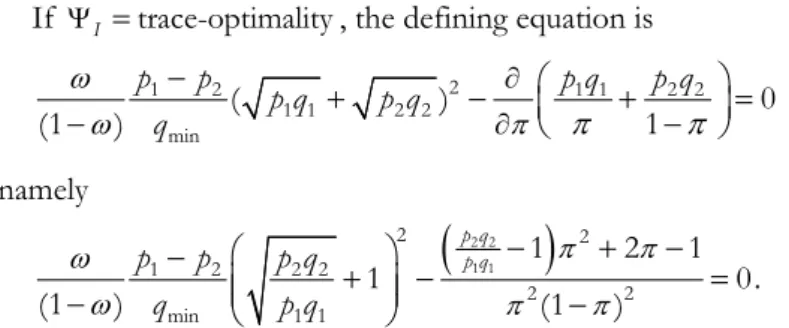
If I trace-optimality, the defining equation is
2
1 2 1 1 2 2
1 1 2 2 min
( ) 0
(1 ) 1
p p p q p q
p q p q
q
namely
2 2
1 1
2 2
1 2 2 2
2 2
min 1 1
1 2 1
1 0.
(1 ) (1 )
p q p q
p p p q
q p q
(23)
RemarkIt is shown in Baldi Antognini and Giovagnoli (2010), that with this target alloca-tion, the majority of subjects will receive the better treatment if the weight function is chosen so that ( , ) 1/2x y when x y 1.
Table 6 shows the values of the compound targets that solve (22) and (23), corresponding to fixed weight 1/2 (1/2 and 1/2, respectively) and to
1 2
( p p 1)/2
(p and p
, respectively) for several choices of p1 and
2 p .
TABLE 6
Values of the compound targets for D- and trace-optimality, corresponding to ω=1/2 and ωp=(|p1-p2|+1)/2,
for different choices of p1 and p2
D-optimality trace-optimality
p1 p2 1/ 2 p
**
1/ 2
**p N pW
The targets 1/2 and p
assign more patients to the better treatment, whereas the bottom part of Table 6 (outlined) shows the values of ( ,p p1 2) for which the Neyman target penalizes the better treatment. Clearly the values of
1/2
and p, and of 1/2 and p are very close when |p1 p2| is small.
5. CONVERGENCE TO THE OPTIMAL ALLOCATION: RESPONSE-ADAPTIVE EXPERIMENTS
As shown previously, the target allocation depends in general on some or all the unknown parameters of the model, e.g. ( ) with { , 1 12; ,2 22}, and when this function is continuous response-adaptive procedures may be called for. These designs, also called response-driven or data-dependent, use the observed responses as well as past allocations to modify the experiment as we go along in order to gradually approach the desired target allocation.
Now we briefly describe the general framework of these sequential methods. Starting with n0 observations on each treatment, usually assigned by using re-stricted randomization, e.g. permuted block designs, an initial non-trivial parame-ter estimation ˆ0 is derived. Then, at each step n (n2 )n0 let ˆ( )n be a consis-tent parameter estimator of based on the first n observations, so that the op-timal target will be estimated by all the data up to that step. Let ˆ( )n ( ( ))ˆ n . Moreover, let N n1( ) and N n2( ) be the number of patients assigned to T1 and
2
T , respectively, with N n1( )N n2( )n; additionally, ( )n n N n1 1( ) is the random proportion of allocation to T1 and, symmetrically, 1( )n to T2. When patient (n1) is ready to be randomized, s/he will be assigned to T1 with prob-ability Pn1 (consequently, to T2 with probability 1Pn1) and the problem con-sists in choosing the allocation probabilities { ,P nn 1} so that, as n tends to in-finity, ( ) n converges to ( ) in some sense.
One of the most effective family of randomization procedures is the Doubly Adaptive Biased Coin Design (D-BCD) analyzed by Hu and Zhang (2004) (see also references therein). The rationale behind this procedure consists in favouring the allocation of a given treatment, the more so the more its current allocation proportion is smaller than the current estimate of the target. The D-BCD consists in assigning treatment T1 to subject (n1) with probability
1 ( ( ); ˆ ( ))
n
i) g x y( ; ) is continuous on (0,1)2; ii) g x x( ; )x;
iii) g x y( ; ) is decreasing in x and increasing in y; iv) g x y( ; ) 1 g(1x;1 y) for all x, y (0,1)2
Observe that the D-BCD will force the allocation proportion to the target, since from conditions ii) and iii), when x y then ( ; )g x y < y, whereas if x y, then ( ; )g x y >y. However, condition i) is quite restrictive since it does not include several widely-known procedures based on discontinuous allocation functions such as Efron’s Biased coin design and its extensions (Hu et al. 2009), while con-dition iv) simply guarantees that T1 and T2 are treated symmetrically.
The following result ensures the convergence of the D-BCD to the chosen compound optimal target allocation ( ) (see for instance Hu and Zhang, 2004):
Proposition If the compound optimal target ( ) (0,1) and is continuous in , adopting the D-BCD
ˆ
lim ( ) ( ) and lim ( ) . .
n n n n a s
Now we give some examples belonging to the D-BCD family:
Method 1. The most “intuitive” allocation rule consists in letting g x y( ; ) y; this means that treatment T1 will be assigned to subject n1 with probability
1 ˆ ( ).
n
P n (24)
When estimation is made by ML, this procedure is called the Sequential Maxi-mum Likelihood (SML) or recursive MaxiMaxi-mum Likelihood design. See Baldi An-tognini and Giovagnoli (2005) and references therein.
Method 2. Hu and Zhang (2004) suggest the following family of allocation func-tions
( / )
( ; ) ,
( / ) (1 )[(1 )/(1 )]
y y x g x y
y y x y y x
(25)
Method 3. A new proposal of allocation function is:
1
1 1
( )
( ; ) ,
1
( ) 1 (1 )
y
F G x F y
g x y
y y
F G x F y F G x F y
(26)
where F z G z R( ), ( ) : R are continuous and increasing functions with (1) 1
G and F invertible. Note that if F z( )z and ( )G z z one obtains ( ; )
g x y in (25).
Example 3Set G z( )z. We let
1
1 1
( )
( ; ) ,
1
( ) 1 (1 )
y
F x F y
g x y
y y
F x F y F xF y
(27)
where ( ) 2 0 2
z t
F z e dt
(this F is called the error function).
Figure 1 shows the behaviour of the function g in (27).
Fig. 1 – Plots of ( ; )g x y as x varies in (0,1). The values of y from the bottom curve to the top curve are: 0.2, 0.4, 0.6 and 0.8, respectively.
The SML design (Method 1) is not affected by the current allocation propor-tions but depends only on the current estimate of the target. As an example, when y0.7 the SML design favours the allocation of T1 by assigning T1 with probability 0.7 , both in case of x0.05 and x0.8. Method 2, however, strongly depends on the current allocation proportion. Indeed, the top part of Table 7 shows that if treatment T1 has (almost) never been assigned, then it will be allocated with probability 1 even if the target allocation is extremely small (e.g.
0.1
y or y0.3). Furthermore, starting from 2 Method 2 tends to be highly deterministic. On the contrary, the proposed g in (27) has an interesting behaviour as regards the drawbacks of Methods 1 and 2, since it forces the alloca-tion decisively onto the target, when needed, guaranteeing at the same time a suit-able degree of randomness.
TABLE 7
Values of the randomization function g in (25) with =0, namely the SML design, =1, =2 and g in (27)
x y g0(SML) g1 g2 g
→ 0 0.1 0.1 1.000 1.000 0.537
→ 0 0.3 0.3 1.000 1.000 0.653
→ 0 0.5 0.5 1.000 1.000 0.792
→ 0 0.7 0.7 1.000 1.000 0.916
→ 0 0.9 0.9 1.000 1.000 0.990
0.2 0.1 0.1 0.047 0.022 0.051
0.2 0.3 0.3 0.424 0.557 0.407
0.2 0.5 0.5 0.800 0.941 0.735
0.2 0.7 0.7 0.956 0.995 0.897
0.2 0.9 0.9 0.997 0.999 0.988
0.4 0.1 0.1 0.018 0.003 0.025
0.4 0.3 0.3 0.216 0.151 0.227
0.4 0.5 0.5 0.600 0.692 0.585
0.4 0.7 0.7 0.891 0.966 0.859
0.4 0.9 0.9 0.992 0.999 0.984
0.6 0.1 0.1 0.008 0.001 0.016
0.6 0.3 0.3 0.109 0.034 0.141
0.6 0.5 0.5 0.400 0.308 0.415
0.6 0.7 0.7 0.784 0.850 0.773
0.6 0.9 0.9 0.982 0.997 0.975
0.8 0.1 0.1 0.003 0 0.012
0.8 0.3 0.3 0.044 0.005 0.103
0.8 0.5 0.5 0.200 0.059 0.265
0.8 0.7 0.7 0.577 0.443 0.593
0.8 0.9 0.9 0.953 0.979 0.949
6. THE HOMOSCEDASTIC MODEL WITH ONE CATEGORICAL COVARIATE We now further specify (1) as follows
2
( ik) k it , ( )i 1, 2,...,
E Y z V Y i n (28)
case was dealt with in Baldi Antognini and Zagoraiou (2010). The covariate dis-tribution in the population is assumed to be known: j Pr(Z z j) for
1,...,
j J; is the vector of block effects and zi is the indicator function of
the block for the i th observation. Conditionally on the covariate and the treat-ment allocations, patients’ responses are assumed to be independent. In the statis-tical literature (28) is described as a 2-factor mixed model without treatment-block interaction; in other words, the superiority of one treatment over the other (meaning 12 or vice-versa) is uniformly constant over the blocks. The inferen-tial interest typically lies in testing or estimating the difference 12 as precisely as possible and is usually a nuisance parameter.
Let Nj ( j 1,...,J) with Jj1Nj n be the random size of block j after n
observations and let ( ,...,1 J)t denote the vector of allocation proportions
to T1 in each block. Let Z( ,...,Z1 Zn)t be the vector of covariates for the n
subjects.
Then we obtain
1
2 2
1 2
1
ˆ ˆ
( | ) (2 1) ,
J
j j
j
Var n N
Z
so the inferential loss depends on the design through the allocation vector and the block sizes. The loss is a minimum if the treatments are equally replicated within each block (for a recent discussion see Baldi Antognini and Zagoraiou, 2011). The loss is random, since it depends on the block sizes which are not un-der the experimental control, therefore one must average over the covariate dis-tribution. After some suitable simplifications and approximations we can let our criterion be
1 2 2
1 1
( ) J (2 1) J (2 1)
I j j j j
j j
E n N
Z (29)
ranging in [0,1].
The percentage of patients assigned to the worse treatment is
1 2 1
1 1
( ) sgn( ).
2 2
J
W j j
j
(30)
We choose the compound criterion of Section 2, i.e.
( ) W( ) (1 ) ( ).I
Setting the partial derivatives with respect to j equal to 0 we find the set of
equations
1 2
sgn( ) 4(1 )(2 j 1) 0 for all j 1,..., .J
Thus the same result as (7) applies to each block so that the optimal target 1
( ,..., )t J
is given by
1 2
1 1 1
sgn( )min , for all 1,..., .
2 8 1 2
j j J
(32)
Observe that the optimal compound target does not depend on the covariate probabilities j’s and if the weight function is chosen so that 4/5, then
πωj* (0,1). When J 1 (no covariates), then 1 2 12 and (32) reduces to expression (7).
Remark This allocation is always “ethical”, i.e. more subjects are assigned to the better treat-ment, whatever their covariate value. Since the compound optimal allocations in all the blocks are the same as (7), there is no need for further examples.
The optimum can be targeted by a suitable implementation of the above
mentioned sequential methods adjusted for covariates by applying the same ran-domization function for each block. However, in Baldi Antognini and Zagoraiou (2010) a different method was employed namely the randomization function
( / ) ( ; )
( / ) (1 )[(1 )/(1 )]
j
j j
j
y y x g x y
y y x y y x
with 1
j j
for all j 1,...,J , so the allocations for the profiles which may be
potentially under-represented will be forced towards the optimal target.
ACKNOWLEDGEMENTS
This research was partly supported by the Italian Ministry for Education, Uni-versity, and Research protocol 2007AYHZWC Statistical methods for learning in clinical research.
Department of Statistical Sciences ALESSANDRO BALDI ANTOGNINI
University of Bologna ALESSANDRA GIOVAGNOLI
REFERENCES
A. BALDI ANTOGNINI, A. GIOVAGNOLI (2005), On the large sample optimality of sequential designs for comparing two or more treatments, “Sequential Analysis”, 24, pp. 205-217.
A. BALDI ANTOGNINI, A. GIOVAGNOLI (2010), Compound optimal allocation for individual and collec-tive ethics in binary clinical trials, “Biometrika”, 97, pp. 935-946.
A. BALDI ANTOGNINI, M. ZAGORAIOU (2010), Covariate adjusted designs for combining efficiency, ethics and randomness in normal response trials, in A. GIOVAGNOLI, A.C. ATKINSON, B. TORSNEY(eds.)
and C. MAY (co-ed.), mODa 9 - Advances in Model Oriented Design and Analysis, Springer-Verlag, Heidelberg.
A. BALDI ANTOGNINI, M. ZAGORAIOU (2011), The Covariate-adaptive biased coin design for balancing clinical trials in the presence of prognostic factors, “Biometrika”, 98, pp. 519-535.
S. C. CHOW, M. CHANG (2007), Adaptive Design Methods in Clinical Trials, Chapman and Hall/
CRC.
FDA U.S DEPARTMENT OF HEALTH AND HUMAN SERVICES (2004), Challenge and Opportunity on the Critical Path to New Medicinal Products, available at: www.fda.gov/downloads/Science Research/SpecialTopics/CriticalPathInitiative/CriticalPathOpportunitiesReports/ucm 113411.pdf
F. HU, L.X. ZHANG (2004), Asymptotic properties of doubly adaptive biased coin designs for multi treat-ment clinical trials, “The Annals of Statistics”, 32, pp. 268-301.
F. HU, L.X. ZHANG, X. HE (2009), Efficient randomized-adaptive designs, “The Annals of Statistics”,
37, pp. 2543-2560.
F. HU, W.F. ROSENBERGER (2006), The Theory of Response-Adaptive Randomization in Clinical Trials, Wiley & Sons, New York.
A. IVANOVA (2003), A play-the-winner type urn model with reduced variability, “Metrika”, 58, pp.
1-13.
L.J. WEI, S. DURHAM (1978), The randomized play-the-winner rule in medical trials, “Journal of the
American Statistical Association”, 73, pp. 840-843.
M. ZELEN (1969), Play-the-winner rule and the controlled clinical trials, “Journal of the American
Statistical Association”, 64, pp. 131-146.
SUMMARY
Some recent developments in the design of adaptive clinical trials