Sharif University of Technology
Scientia IranicaTransactions D: Computer Science & Engineering and Electrical Engineering http://scientiairanica.sharif.edu
An attribute-based anonymous broadcast encryption
scheme with adaptive security in the standard model
R. Rabaninejad
a, M.H. Ameri
b, M. Delavar
b, and J. Mohajeri
b;a. Department of Electrical Engineering, K. N. Toosi University of Technology, Tehran, Iran. b. Electronics Research Institute, Sharif University of Technology, Tehran, Iran.
Received 10 December 2016; received in revised form 4 September 2017; accepted 2 October 2017
KEYWORDS Broadcast encryption; Ciphertext-Policy Attribute-Based Encryption (CP-ABE);
Access structure; Anonymity; Provable security; Attack.
Abstract.In broadcast encryption schemes, a distribution center broadcasts an encrypted message to a subset chosen from a universe of receivers, and only the intended users are able to decrypt the message. Most broadcast encryption schemes do not provide anonymity, and the identities of target receivers are sent in plaintext. However, in several applications, the authorized users' identities have the same sensitivity as the broadcasted messages. Yu, Ren, and Lou (YRL) [Yu, S., Ren, K., and Lou, W. \Attribute-based on-demand multicast group setup with membership anonymity", Computer Networks, 54(3), pp. 377-386 (2010).] considered this issue and introduced an ecient anonymous attribute-based broadcast encryption scheme. This paper rst proposed an attack on the YRL scheme, and showed that the unauthorized receivers could also decrypt the broadcasted message. Next, we proposed the Improved-YRL scheme and proved that it achieved anonymity and semantic security under adaptive corruptions in the chosen ciphertext setting. The proof is provided by the dual system encryption technique and is based on three complexity assumptions in composite order bilinear maps. The Improved-YRL scheme is a step forward in solving the long-standing problem of secure and low overhead anonymous broadcast encryption.
© 2019 Sharif University of Technology. All rights reserved.
1. Introduction
Broadcast Encryption. The concept of Broadcast Encryption (BE) [1] is used when a sender wants to send a message to an arbitrary subset chosen from a universe of receivers via an insecure broadcast chan-nel. In this scenario, the distribution center chooses an arbitrary subgroup of receivers, S, encrypts the message due to set S, and broadcasts the ciphertext through the channel. In a secure broadcast encryption
*. Corresponding author.
E-mail addresses: [email protected]. (R.
Rabaninejad); ameri [email protected] (M.H. Ameri); [email protected] (M. Delavar);
[email protected]. (J. Mohajeri) doi: 10.24200/sci.2017.4517
scheme, only the legitimate receivers, which belong to set S, can decrypt the received message, while the unauthorized users obtain no information about the message even if they collude. The broadcast encryption schemes are helpful in several applications including TV subscription and electronic learning services [2] in which only the subscribed users who have made a payment to a certain channel or paid to a virtual course could be able to receive the service. Broadcast encryption schemes can also be used for providing access control in encrypted le systems where a le is encrypted so that only users who have access to the le can decrypt it. Copyrighted content protection and group key distribution are also some other potential applications of the broadcast encryption schemes [3]. Attribute-Based Broadcast Encryption. Since
the introduction of broadcast encryption in 1993 by Fiat and Naor [1], many broadcast encryption schemes have been proposed (see e.g., [4-11]). In these schemes, the broadcaster species the legitimate receivers indi-vidually, while, in real applications, broadcasters often address groups of receivers with the same characteris-tics. In these scenarios, especially when the number of receivers is large, identifying each individual receiver is impractical. By using Attribute-Based Broadcast Encryption (ABBE), a broadcaster can encrypt a message under a specied attribute policy, and only the receivers who own the intended attributes can decrypt the message. In other words, in an ABBE scheme, the target set of receivers S is specied by the attributes of its members stated as an access policy. Therefore, the broadcaster has the exibility to encrypt the message, either with or without the identity information of each individual receiver. Several ABBE schemes have been proposed in the literature among which we can refer to [3,12-15].
Anonymous Broadcast Encryption. In the pre-vious broadcast encryption schemes, the authorized receiver needs information about the intended set of receivers S in order to decrypt the ciphertext correctly. Therefore, set S must be transmitted as part of the ciphertext. Hence, all users including the authorized and unauthorized ones will be aware of the authorized set of receivers. This causes important privacy issues; for example, in group key distribution, everyone will know which users and how many of them are involved in a task. In addition, in applications like television broadcasting, the user who has paid a subscription to a certain channel will know who else has paid for that subscription and the user's privacy is violated. To solve this issue, Barth et al. [16] proposed the rst anony-mous broadcast encryption scheme. Their scheme protects receivers' identities; however, the number of receivers is leaked by the ciphertext length. In addi-tion, the computation and communication overheads are linear in the number of users. Libert et al. [17] suggested another anonymous broadcast encryption scheme in the standard model with overhead linear in the number of receivers. Schemes [16] and [17] provide full anonymity, meaning that any user, whether he is in set S or not, is unable to obtain information about intended receivers. Outsider anonymity [18] is another denition that only guarantees the anonymity of intended receivers from the view of users outside of set S. However, users in S can still learn the identities of other legal receivers. Fazio and Perea [18] proposed an outsider-anonymous broadcast encryption scheme with sublinear overheads. The attribute-based anonymous multicast scheme presented by Yu et al. [3], which we call it the YRL scheme in this paper, suggests a stronger denition of full anonymity; the scheme
not only hides the identities of receivers but also protects the number of intended users. In addition, communication and computation overheads are linear in the number of attributes and are independent of the number of receivers; therefore, the scheme provides high eciency because of its attribute-based structure. The scheme relies on the notion of Ciphertext-Policy Attribute-Based Encryption (CP-ABE) and aims to solve the group key distribution problem. Therefore, instead of broadcasting a message M, a group key GK is emitted.
Our contributions. In this paper, we have made the following three main contributions:
We propose an attack on the YRL scheme. This
attack shows that all users, including the authorized and unauthorized ones, can decrypt the broadcasted message. Therefore, the YRL scheme is not secure and does not provide the main requirement of broad-cast encryption schemes that only the authorized users should be able to decrypt the broadcasted message [19];
We develop an enhanced scheme in composite order bilinear groups, called the improved-YRL scheme, which is secure against the proposed attack. We also prove the security of the improved-YRL scheme in the standard model using dual system encryption technique [20]. Our proof is based on the security model for adaptive CCA adversaries proposed in [17] which considers anonymity and indistinguishability in one security game, simultaneously;
We demonstrate that the new scheme retains low
overhead and high-performance property of the ba-sic YRL scheme, which means that computation and communication overheads are linear in the number of attributes independent of the number of receivers. Boneh et al. [6] proposed that \it is a long-standing open problem to build a low-overhead anony-mous broadcast encryption system"; therefore, pre-senting the improved-YRL scheme as an anonymous broadcast encryption scheme with adaptive security and overhead proportional to the number of attributes is an eort toward solving this open problem.
The paper is organized as follows. Section 2 is dedicated to the background on bilinear groups and state the access policy used in the YRL scheme. Section 3 concerns the YRL scheme. Section 4 proposes the attack on the YRL scheme. In Sections 5 and 6, we describe our improved-YRL scheme and prove its security, respectively. Section 7 gives the performance evaluation; nally, Section 8 concludes the paper.
2. Preliminaries 2.1. Bilinear maps
The YRL scheme is based on bilinear maps. Let G and GT be two multiplicative cyclic groups of prime order
p. Let g be a generator of G and e be a bilinear map, e : G G ! GT. The bilinear map e is a function with
the following properties:
1. Bilinearity: for all u; v 2 G and a; b 2 Zp, e(ua;
vb) = e(u; v)ab;
2. Non-degeneracy: e(g; g) 6= 1, where 1 denotes the identity element of GT;
3. Computability: There is an ecient algorithm to
compute e(u; v) for u; v 2 G.
2.2. Composite order bilinear maps
Composite order bilinear maps were rst introduced in [21]. Let G be a group generator algorithm. It takes as input a security parameter, , and outputs a tuple (N = p1p2p3; G; GT; e), where p1; p2; p3 are
distinct prime numbers, G and GT are multiplicative
cyclic groups of composite order N = p1p2p3 and
e : G G ! GT is a composite order bilinear map.
For each pi; i 2 f1; 2; 3g, let Gpi be a subgroup of G
of order pi with a generator named as gi. Each T 2 G
can be represented as T = X1X2X3 where Xi2 Gpi is
referred to as the \Gpi component of G". In addition,
for all x; y; z 2 f1; p1; p2; p3g, Gxyz denotes a subgroup
of order xyz in G. To generate a random element r 2 Gpi, one can set r = gi where is a random
element in Zpi.
The main property of composite order bilinear maps is that subgroups Gp1; Gp2; Gp3 are orthogonal
under the bilinear map e, meaning that if h 2 Gpi
and u 2 Gpj for i 6= j, then e(h; u) = 1. The
other properties of composite order bilinear maps are the same as prime order bilinear maps described in Subsection 2.1.
2.3. Access policy
Herein, the access policy used in the YRL scheme is reviewed to specify the intended group of receivers [3]. Let n denote the total number of attributes. Each user is assigned an n-element string fAtti;bj 8i 2 Zn; b = 0
or 1g such that Atti;0and Atti;1show the negative and
positive incidents of the i-th attribute, respectively. In other words, the binary sequence Xn 1Xn 2:::X0 can
be used to demonstrate the attribute set of each user. In this sequence, the bit `0' implies that the user does not have the corresponding attribute, and the bit `1' shows that the user owns that attribute.
The access policy is demonstrated using AND logic. For example, (Att3;1^ Att1;0) or X3X1 is used
for showing the access policy for the users with the 3rd attribute and do not possess the 1st attribute. Here,
X2 is don't-care, i.e., for this access policy, it is not
important what the value of X2is.
3. The YRL Scheme
The YRL scheme [3] relies on the notion of Ciphertext-Policy Attribute-Based Encryption (CP-ABE) in which the intended subset of users, S, is specied with the access policy, T . In the YRL scheme, access policy T is not broadcasted along with the ciphertext, and the authorized users can decrypt the received messages without knowing the access structure. In this way, the scheme can provide the anonymity of users. The scheme consists of four algorithms: Setup, KeyGen, Encryption, and Decryption. The scheme is reviewed in the following.
Setup (; Xn 1Xn 2:::X0) ! (P P; MK): The input
parameters of the setup algorithm include security parameter, , and the attribute set of each user, Xn 1Xn 2:::X0, and the outputs include public
pa-rameters, P P , and Master Key, MK, generated as follows. Due to security parameter, , the algorithm chooses a group, G, of prime order, p, with generator, g. Each attribute in vector Xn 1Xn 2:::X0is mapped
to one of the members of G. Consider that attribute Atti;b is mapped to hi;b as a member of G. The Setup
algorithm randomly selects (ai; bi) 2 Zp and sets the
values of hi;0and hi;1equal to gai and gbi, respectively
and sets i = ai+ bi. Finally, this algorithm outputs
P P = (p; g; G) as the public parameters and master key, MK = (; ; fai; big8i2Zn), where ; 2RZN.
MK is only held by the broadcaster.
KeyGen (MK; Xn 1Xn 2:::X0) ! SK: The
in-put parameters of the KeyGen algorithm include master key, MK, and the attribute set of each user, Xn 1Xn 2:::X0, and its output is the tuple
(D; ^D; D; fDig8i2Zn) as the secret key of the user which
is generated through Eq. (1):
SK = (D = g(+r)=; ^D = gr; D = gr;
fDi = hri; Xig8i2Zn): (1)
The parameters (g; ; ; hi; Xi) are dened in the setup algorithm, above. In addition, r is a random element chosen from Zp.
Encryption (GK; T; MK) ! CT : In order to distribute the group key GK, the broadcaster rst
encrypts GK using this algorithm. The input
parameters of the Encryption algorithm include GK, access policy T , and master key, MK = (; ; fai; big8i2Zn); the output is the ciphertext CT =
CT is in the form of ~C = (GK k MAC):X, where X is a blinding factor to hide the value (GK k MAC). The other three components of the ciphertext are used to construct X and obtain GK. In the last component, each Ci is generated corresponding to the i-th bit of
the attribute set, Xn 1Xn 2:::X0, through steps 1 to
4:
1. The random values, s0; s1; sn 1; k0; k1 2R Zp, are
chosen and is set equal to Pn 1i=0 isi; where i
has been determined in the Setup algorithm.
2. Ci is equal to the tuple (gsi; Ci;0; Ci;1) where Ci;0
and Ci;1 are the members of G. If Xi 2 T , the
i-th attribute is an intended attribute in i-the access policy. Then a random value, ti 2R Zp, is chosen,
and the values Ci;Xi = hsi;Xi+tii and Ci;1 Xi =
hsi
i;1 Xi are computed. Otherwise, Ci;0and Ci;1are
set equal to hsi
i;0and hsi;1i, respectively.
3. The broadcaster sets gs0
= Qn 1i=0 Ci;0Ci;1 = g+x
where has been dened in step 1 and x 2 Zp
satises the equation gx = Q
8j;Xj2Th
tj
j;Xj. Then,
the second term of the ciphertext is calculated as
C = gs0
, and the values of Ci;0 and Ci;1 are
updated as follows:
Ci;0= gk0Ci;0; Ci;1= gk1Ci;1: (2)
4. Finally, the ciphertext is generated through Eq. (3): CT =( ~C = (GK k MAC)e(g; g)s0
;
C = gs0
; f ^Cj= gkj=gj=0;1; fCig8i2Zn);
(3) where MAC = H(GK) (H(:) is a cryptographic hash function).
Decryption (CT; Xn 1Xn 2:::X0; SK) ! (GK or?):
Each authorized group member, GM, runs this algo-rithm to obtain the group key GK. The inputs of this algorithm include the ciphertext, the attribute set, Xn 1Xn 2:::X0, and the secret key of the GM. The
output is GK or ? depending on whether the attribute set of the GM satises the access structure or not. The decryption procedure is as follows:
1. For j = 0; 1; Bj = e( ^Cj; D) = e(gkj=; gr) =
e(g; g)rkj is calculated. Then, for each bit Xi of
the user's attribute set, Xn 1Xn 2:::X0, the value
Fi corresponding to Xi is computed using Ci =
(gsi; C
i;0; Ci;1) through Eq. (4).
Fi= e(Di; gsi)e(Ci;Xi; ^D)=BXi
= e(hr i; Xi; g
si)e(gkXihsi+ti
i;Xi ; g
r)=B Xi
= e(g; g)risie(g; h
i;Xi)rti: (4)
In Eq. (4), if Xi2 T , ti6= 0; otherwise, ti= 0.
2. F is computed by multiplying the values of Fi:
F =n 1Y
i=0
Fi= n 1Y
i=0
e(g; g)risie(g; h
i;Xi)rti
= e(g; g)re(g; g)rx0
; (5)
where x02 Zp is dened in Eq. (6):
gx0
=n 1Y
i=0
hti
i;Xi; (ti= 0 if Xi =2 T ): (6)
Therefore, according to the properties of bilinear maps, we will have:
n 1Y i=0
e(g; hi;Xi)rti = e(g; g)rx 0
: (7)
Eq. (7) is used to calculate the value of F in Eq. (5). If the GM's attributes satisfy the access policy, x0 will be equal to x. Otherwise, the probability of
x0 being equal to x will be negligible (note that x
has been dened in the Encryption algorithm as gx=Q
8j;Xj2Th
tj
j;Xj).
3. Finally, each group member of GM computes M0
and recovers the Group Key, GK, using Eq. (8):
M0= C~
e( C; D)=F =
(GK k MAC)e(g; g)s0
e(g; g)s0+rs0=e(g; g)r(+x0)
= (GK k MAC)e(g; g)r(x0 x)
: (8)
Then, the user checks whether the hash value of the rst part of M0 is equal to its second part or not.
If the user is a member of the target subset, x0 will
be equal to x; as a result, the hash value of the rst part will be equal to the second part. Thus, the user obtains the correct GK. Otherwise, the user is unauthorized and cannot obtain GK.
As can be seen, in the YRL scheme, access structure, T , is not sent along with the ciphertext and the authorized users are able to decrypt the received message without knowing the access structure. As a result, the authorized user, after decryption, does not know which attributes or how many of them make the message accessible to him. In addition, he is not aware of the membership of other users in the subset or even the number of authorized users. Therefore, not only the unauthorized users but also the authorized ones are not able to obtain any information about the access structure, and the YRL scheme provides the anonymity property.
Yu et al. [3] also claimed that their introduced scheme was secure. It means that a user can obtain the
correct GK i his attributes satisfy the access policy. However, no proof is provided for neither anonymity nor security in their paper. In the next section, we propose an attack, which violates the security of the YRL scheme.
4. Attack on the YRL scheme
Herein, we demonstrate that the claim that a user can obtain GK i he holds all the attributes required by the access policy, is not true; further to that, all of the users, including authorized and unauthorized ones, can decrypt the received message. Assume that user u with secret key SKu has received a broadcasted ciphertext
CT . As mentioned in Section 3, the secret key SKu
and the ciphertext CT are computed as follows: SKu= (D = g(+r)=; ^D = gr; D
= gr; fD
i= hri; Xig8i2Zn); (9)
CT = ( ~C = (GK k MAC)e(g; g)s0
; C = gs0
; f ^Cj = gkj=gj=0;1; fCig8i2Zn): (10)
Now, user u can decrypt the ciphertext using his secret key through the following procedure:
1. Computes:
e(D; C) = e(g(+r)=; gs0
) = e(g; g)(+r)s0
:
2. Calculates e(g; g)rs0
: As mentioned in the Decryp-tion algorithm, s0 satises the equation:
gs0
=n 1Y
i=0
Ci;0Ci;1;
however, after that, Ci;0 and Ci;1 were updated to
new values, Ci;0 = gk0Ci;0; and Ci;1 = gk1Ci;1.
Since Ci = (gsi; Ci;0; Ci;1), user u can compute
Qn 1
i=0 Ci;0Ci;1 by using Cis:
Ci;0= gk0Ci;0; Ci;1= gk1Ci;1 n 1Y
i=0
Ci;0Ci;1= n 1Y
i=0
gk0C
i;0:gk1Ci;1= gn(k0+k1)gs0:
(11) Therefore:
e(gn(k0+k1)gs0; ^D) = e(gn(k0+k1)gs0; gr)
= e(gs0
; gr)e(gn(k0+k1); gr)
= e(g; g)rs0
e(g; g)rn(k0+k1):
(12)
Furthermore, we have:
Bj= e( ^Cj; D) = e(gkj=; gr) = e(g; g)rkj;
j = 0; 1 ! B0:B1= e(g; g)r(k0+k1): (13)
Thus, using Eqs. (12) and (13), the user u can obtain e(g; g)rs0
as follows: (12)
(13)n =
e(g; g)rs0
e(g; g)rn(k0+k1)
(e(g; g)r(k0+k1))n = e(g; g)
rs0
: (14)
3. Computes e(g; g)s0
by dividing the result of the rst step of the attack, e(g; g)(+r)s0
, by the result of the second step, e(g; g)rs0
. e(g; g)(+r)s0
e(g; g)rs0 = e(g; g)s 0
: (15)
4. Finally, user u can obtain GK as follows: ~
C e(g; g)s0 =
(GK k MAC)e(g; g)s0
e(g; g)s0
= (GK k MAC): (16)
Therefore, this user, regardless of what his set of attributes is, can obtain GK. This shows that the YRL scheme is not secure and does not provide the main requirement of a broadcast encryption scheme that only the intended users should be able to decrypt the broadcasted message.
5. Improved-YRL scheme
In this section, we improve the YRL scheme in order to remove its weakness and make it secure against the proposed attack in Section 4. The update procedure of Ci;0 and Ci;1 is the vulnerability point of the YRL
scheme. As mentioned before, for all i 2 Zn, the
broadcaster uses xed values k0; and k1 for updating
Ci;0 and Ci;1 to new values Ci;0 = gk0Ci;0; and
Ci;1 = gk1Ci;1. Therefore, e(Qn 1i=0 Ci;0Ci;1; ^D) has a
xed term e(g; g)rn(k0+k1)which can be omitted using
the term ^Cj in the ciphertext. As a result, e(g; g)rs0
and e(g; g)s0
are obtained which help the attacker to obtain GK. Hence, in order to x this weakness, we randomize the update process and eliminate the third term in both the ciphertext and secret key. In addition, in order to propose a security proof, the Improved-YRL scheme is based on composite order bilinear maps. In what follows, the improved-YRL scheme is describe in detail:
Setup (; Xn 1Xn 2:::X0) ! (P P; MK): The input
parameter, , and the attribute set of each user, Xn 1Xn 2:::X0, and the outputs are public
parame-ters, P P , and master key, MK, which are generated as follows. Due to security parameter, , the algorithm selects a cyclic group, G, of composite order, N = p1p2p3. Let Gp1; Gp2, and Gp3 be three subgroups
of G with orders p1; p2; p3 and generators g1; g2; g3,
respectively. Then, the same as before, each of
attributes, Atti;b, is mapped to hi;b. hi;0 and hi;1 are
set equal to gai
1 R3;0 and g1biR3;1, respectively, where
ai and bi are randomly selected forms of Zp1 and
i = ai+ bi. The only dierence here is that hi;0 and
hi;1 have additional factors R3;0 and R3;1 which are
randomly chosen from Gp3. Hence hi;bis an element of
subgroup Gp1p3. The algorithm outputs, P P = (N =
p1p2p3; G), as the public parameters and master key,
MK = (; ; fai; big8i2Zn), where ; 2RZN and MK
is only held by the broadcaster as before.
KeyGen (MK; Xn 1Xn 2:::X0) ! SK: This
algo-rithm takes the master key, MK, the attribute set of a user, Xn 1Xn 2: : : X0, chooses random r 2RZp1 and
outputs (D; ^D; fDig8i2Zn) as the secret key of the user
through Eq. (17):
SK =(D = g1(+r)=; ^D =gr
1; fDi= hri; Xig8i2Zn): (17)
The parameters (g1; ; ; hi; Xi) are dened in the setup
algorithm above. Therefore, it is the same as the YRL's KeyGen algorithm except that the third term D = gr
is omitted and Dis are the members of Gp1p3.
Encryption (GK; T; MK) ! CT : As before, The inputs are group key, GK, access policy, T , and master key, MK; the output is the ciphertext CT . However, this algorithm has some dierences with the YRL's Encryption algorithm. The rst dierence is the procedure for updating the values of Ci;0and Ci;1,
and the second one omit the term f ^Cj = gkj=gj=0;1
from the ciphertext because the decryption successfully works without it. In addition, g is turned into g1;
therefore, the rst term in Ci is gs1i 2 Gp1; because
hi;Xi is an element of Gp1p3 as stated in the setup
algorithm, Ci;0 and Ci;1 are elements of Gp1p3, too.
Therefore, the ciphertext: CT =( ~C; C; fCig8i2Zn)
is generated as follows:
1. The values s0; s1; sn 1 2R Zp1 are randomly
se-lected and is set equal toPn 1i=0 isi.
2. 8i 2 Zn : Ci = (g1si; Ci;0; Ci;1), where Ci;0 and
Ci;1 belong to the group Gp1p3. If Xi 2 T (the
i-th attribute is an intended attribute in the access policy), then a random value ti 2R Zp1 is selected
and the values of Ci;Xi and Ci;1 Xi are set equal
to hsi+ti
i;Xi and h
si
i;1 Xi, respectively. Otherwise,
Ci;0= hsi;0i and Ci;1= hsi;1i.
3. The term gs0
1 is computed through Eq. (18): n 1Y
i=0
Ci;0Ci;1= g1s0R3= g1+xR3; (18)
where R3 is the product of all elements in Gp3. In
addition, x 2 Zp1is such that g1x=
Q
8j;Xj2Th
tj
j;Xj,
where only Gp1 part of hj;Xj is considered. Then
the value of C is set equal to (gs0
1R3) = gs
0
1 R032
Gp1p3. In other words, C has an extra R03 term in
comparison to the basic YRL scheme.
4. Ci;0and Ci;1are updated as follows: If Xi2 T , the
random value ki2 Zp1 is selected and:
Ci;Xi = Ci;Xi; Ci;1 Xi = gk1iCi;1 Xi:
In this way, only Ci;1 Xi, which is not intended
in the access policy, is updated; Ci;Xi, which is
intended in the access policy does not change. Otherwise, if Xi =2 T or Xi is don't-care, Ci;0 and
Ci;1remain unchanged. For example, if we have an
access policy with n = 4 and T = X3X2X0, only
the values of C0;0, C2;0, and C3;1 are updated and
the other values do not change.
5. Finally, the ciphertext is computed as: CT = ( ~C = (GK k MAC)e(g1; g1)s0;
C = g1s0R0
3; fCig8i2Zn);
where e(g1; g1)s0 is computed as:
e(n 1Y
i=0
Ci;0Ci;1; g1) = e(gs
0
1R3; g1) = e(g1; g1)s0:
The last equality holds due to the orthogonality property of composite order bilinear maps.
Decryption (CT; Xn 1Xn 2:::X0; SK) ! (GK or?):
The inputs of this algorithm include the ciphertext, the attribute set Xn 1Xn 2:::X0, and the private key of a
GM; in addition, its output is GK or ? depending on whether the GM's attribute set satises the access structure or not.
In this algorithm, the rst step of the basic YRL's Decryption algorithm for calculating Bj is omitted. In
addition, Fis are computed in a simpler way:
1. For each bit, Xi, of the GM's attribute set,
Xn 1Xn 2:::X0, Fi is computed through Eq. (19):
Fi = e(Di; g1si)e(Ci;Xi; ^D)
= e(hr i; Xi; g
si
1)e(gk1ihsi;Xi+tii; g
r 1)
It can be easily veried that the elements of Gp3
are omitted due to the orthogonality property of composite order bilinear maps. In addition, values of parameters ti and ki change due to the following
conditions:
Xi2 T; ti6= 0 and ki= 0;
Xi2 T; ti= 0 and ki6= 0;
Xi =2 T; ti= 0 and ki= 0.
2. The GM calculates F by multiplying the values of Fis obtained in the previous step:
F=n 1Y
i=0
Fi= n 1Y
i=0
e(g1; g1)risie(g1; hi;Xi)rtie(g1; g1)kir
= e(g1; g1)re(g1; g1)rx0e(g1; g1)kr: (20)
x0 satises Eq. (21) where only Gp
1 part of hj;Xj
is considered: gx0
1 = n 1Y i=0
hti
i;Xi; (ti= 0 if Xi =2 T ): (21)
If the GM's attributes satisfy the access policy, then we will have:
x0= x;
8i; ki= 0 ! k = 0.
Otherwise, the probability of x0= x or k = 0
will be negligible.
3. Each user calculates M0 corresponding to his
at-tributes through Eq. (22) to obtain GK:
M0= C~
e( C; D)=F
= (GK k MAC)e(g1; g1)s
0
e(g1; g1)s0+rs0=e(g1; g1)r(+x0+k)
= (GK k MAC)e(g1; g1)r(k+x0 x): (22)
Then, each user veries whether the hash value of the rst part of M0 is equal to its second part or
not. If the user is a member of the target group, this equality will be obtained because x = x0 and
k = 0. Otherwise, the user is unauthorized and cannot obtain the correct value of GK.
In the next section, we will analyze the security of the proposed scheme, and prove that it achieves both indistinguishability and anonymity in the standard model.
6. Security analysis
This section begins by explaining why the proposed
attack in Section 4 would not succeed on the Improved-YRL construction. Then, in order to prove the security of the proposed scheme, we will formally dene the exact security denition in Subsection 6.1. Next, we state the complexity assumptions in composite order bilinear groups and present the proof in Subsections 6.2 and 6.3, respectively.
Lemma 1. The Improved-YRL scheme is secure against the proposed attack in Section 4.
Proof. The attack process involves computing the equation ofQn 1i=0 Ci;0Ci;1= gk1r:gs
0
1R3, where kris the
sum of all ki values used for updating Ci;0 and Ci;1in
the update phase of the improved-YRL scheme. kr is
completely random and unpredictable because there is no term in the ciphertext containing information about it. Therefore, the attacker will not be able to obtain e(g1; g1)rs0, and the blinding factor, e(g1; g1)s0, and
the attack will not work. 6.1. Security denitions
In this section, a model is dened for the anonymous broadcast encryption with CCA security against adap-tive adversaries. This model is a modication of the security model dened in [17].
Denition 1. ANO-IND-CCA security game for a broadcast encryption scheme, BE, is as follows. Setup. Challenger C runs Setup algorithm to generate master key MK.
Phase 1. Adversary A issues queries for secret keys corresponding to the set of attributes Att1;
Att2; : : : ; Attq0. Challenger C runs KeyGen
al-gorithm and returns the corresponding secret keys SK1; SK2; : : : ; SKq0 to A. A can also make
decryp-tion queries (CT; Atti), meaning that decryption of
ciphertext CT for user i with attribute set Atti, and
challenger C will return the decrypted message or ? using Decryption algorithm.
Challenge. A submits two equal length group keys GK0 and GK1 and two access policies T0 and T1.
The submitted access policies T
0 and T1 should
be such that none of the queried attribute sets Att1; Att2; : : : ; Attq0in Phase 1 satisfy them. Then, the
challenger chooses a random bit b 2 f0; 1g and encrypts GKbunder Tbusing Encryption algorithm and returns
CT to A.
Phase 2. A continues querying secret keys correspond-ing to the set of attributes Attq0+1, Attq0+2; : : : ; Attq,
none of which satises T
0 or T1 and receives
addition, A continues making decryption queries (CT; Atti) with the restriction that if CT = CT, then
Atti should not satisfy any of T0 or T1.
Guess. A outputs b0 as its guess for b and wins the
game if b = b0. The advantage of A in this game is
dened as AdvA;BEANO IND CCA() = jP r[b = b0] 1=2j.
Denition 2. A broadcast encryption scheme, BE, is said to be anonymous and indistinguishable against CCA adversaries or is ANO-IND-CCA secure if any PPT adaptive CCA adversary has at most a negligible advantage in the above security game.
6.2. Complexity assumptions
In what follows, we state three complexity assumptions in composite order bilinear groups which we will rely on to prove the security of the improved-YRL scheme. Rao and Dutta [22] closely followed [23] to show that Assumptions 1, 2, and 3 hold in the generic group model under the assumption that nding a non-trivial factor of N, where N = p1p2p3, is hard.
Assumption 1. Let G be a group generator and ~y = (N = p1p2p3; G; GT; e) G(). Choose g1, and
g3randomly from Gp1 and Gp3, respectively. Then, for
each PPT adversary A which is given D = (~y; g1; g3),
A's advantage of distinguishing T0 2 G from T1 2
Gp1p3 is negligible, where T0 and T1 are randomly
chosen from the corresponding groups. In other words, for any PPT algorithm A, we have:
Adv1
A= jP r[A(D; T0) = 1] P r[A(D; T1) = 1]j
negl(); (23)
where negl(:) is a negligible function.
Assumption 2. Let G be a group generator and ~y = (N = p1p2p3; G; GT; e) G(). Choose random
elements g1 2 Gp1; g3 2 Gp3; X1X2X3 2 G, Y1Y2 2
Gp1p2. Then, for each PPT adversary A which is
given D = (~y; g1; g3; X1X2X3; Y1Y2), A's advantage
of distinguishing T0 2 Gp1 from T1 2 Gp1p2, is
negligible, where T0 and T1 are randomly chosen from
the corresponding groups. In other words, for any PPT algorithm A, we have:
Adv2
A= jP r[A(D; T0) = 1] P r[A(D; T1) = 1]j
negl(); (24)
where negl(:) is a negligible function.
Assumption 3. Let G be a group generator and ~y = (N = p1p2p3; G; GT; e) G(). Choose random
elements ; & 2 ZN; g1 2 Gp1; X2; Y2 2 Gp2; X3; Y3 2
Gp3. Then, for each PPT adversary A which is
given D = (~y; g1; g1X2; X3; g&1Y2Y3), A's advantage of
distinguishing T0 = e(g1; g1)& from T1 as a random
element in GT is negligible. In other words, for any
PPT algorithm A, we have: Adv3
A= jP r[A(D; T0) = 1] P r[A(D; T1) = 1]j
negl(); (25)
where negl(:) is a negligible function. 6.3. Security proof
Here we use a technique called dual system encryp-tion [20] to prove the security of improved-YRL scheme in the ANO-IND-CCA security game described in Subsection 6.1. In a dual system, ciphertexts and secret keys can be either normal or semi-functional. Semi-functional terms are not part of the real system; however, they are only used in the security proof. A normal secret key, can decrypt both normal and semi-functional ciphertexts; however, a semi-semi-functional se-cret key can only decrypt normal ciphertexts. In other words, one would fail to decrypt a semi-functional ci-phertext using a functional secret key. The semi-functional ciphertexts and secret keys for improved-YRL are dened as below.
Semi-functional ciphertext. To obtain a semi-functional ciphertext, rst, Encryption algorithm is run to obtain a normal ciphertext CT = ( ~C; C; fCig8i2Zn),
where Ci = (gsi; Ci;0; Ci;1) for all i 2 Zn. Then, the
semi-functional ciphertext CT0 = ( ~C0; C0; fC
i0g8i2Zn)
is computed as follows: ~
C0= ~C; C0= C g
2; Ci0= Ci g2=n; (26)
where is chosen randomly from ZN and in Ci0 =
Ci g2=n, only the terms Ci;0; and Ci;1are multiplied
by g2=n. In addition, n is the number of attributes,
and is a part of master key as stated before.
Semi-functional secret key. To compute a semi-functional secret key for a user with the attribute set Xn 1Xn 2:::X0, we rst run the algorithm KeyGen to
obtain a normal secret key, SK = (D; ^D; fDig8i2Zn),
where Di = hri; xi for all i 2 Zn. The semi-functional
secret key SK0 = (D0; ^D0; fD
i0g8i2Zn) is computed as
follows:
D0=D g
2=; D^0= ^D g2; Di0=Di g2ei;
(27) where is a random element in ZN and ei = ai if
hi; xi = ga1iX3and ei= bi if hi; xi= g1biX3.
Security is proved using a sequence of games, which are proven to be indistinguishable under as-sumptions given in Section 6.2. Considering q as the
maximum number of secret key queries an adversary can make, the sequence of games is as follows:
GameANO IND CCA: In this game as described
in Section 6.1, all ciphertexts and secret keys are normal;
Game0: Herein, the challenge ciphertext is
semi-functional; however, all secret keys are normal;
Gamek(1 k q): In this game, in addition to
the challenge ciphertext, the rst k queried secret keys are semi functional, and the rest of them are normal. Therefore, in Gameq, all the secret keys
would be semi-functional;
Gamefinal: This game is the same as Gameq except
that the ciphertext is randomized. Therefore, the challenge ciphertext is independent of the group keys and access policies given by the adversary in the challenge step.
The sequence of hybrid games in the proof are related as follows:
GameANO IND CCA, Game0, Game1:::
, Gameq 1 , Gameq , Gamefinal;
where the notation \," means that the two games are computationally indistinguishable. Now, the above relations are shown through the following lemmas. Lemma 2. Suppose that there exists a polynomial time algorithm A such that:
AdvGameANO IND CCA
A AdvGameA 0 = ":
Then, we can build a PPT algorithm B with advantage " in breaking Assumption 1.
Proof. B is given (~y; g1; g3; T ). It will simulate
GameANO IND CCA or Game0 for A depending on
whether T is an element of G or it is an element of Gp1p3. We now describe how B interacts with A to
break Assumption 1.
Setup. B chooses random elements ; 2 ZN, and
for each element of the attribute set, it chooses ai; and
bi randomly from Zp1 and keeps master key, MK =
(; ; fai; big8i2Zn).
Phase 1 and Phase 2. B generates normal secret keys SK = (D; ^D; fDig8i2Zn) in response to A's
secret key queries using the KeyGen algorithm. This is possible since B possess master key, MK, and g1; g3. As mentioned in the ANO-IND-CCA security
game, none of the attribute sets queried in secret key requests should satisfy the access policies given by A
in the challenge phase. In addition, in response to A's decryption requests (CT; Atti), B generates the
secret key corresponding to Atti, and decrypts CT
using Decryption algorithm.
Challenge. A sends B two equal length group keys GK0 and GK1 and two access policies T0 and T1.
B chooses a random bit b and performs the nor-mal encryption of GKb under Tb to obtain CTb =
( ~C; C; fCig8i2Zn). Next, in order to generate the
challenge ciphertext CT = ( ~C0; C0; fC
i0g8i2Zn), B
performs the following calculations: ~
C0 = ~C e(g 1; T );
C0 = C T;
C0
i0;1= Ci0;1 T1=n: (28)
Guess. A outputs a bit b0 as its guess of b and
wins if b = b0. It can be seen that if T 2 Gp
1p3,
CT is a properly distributed normal ciphertext and
GameANO IND CCA is simulated. Else, if T 2 G,
CT is a properly distributed semi-functional
cipher-text and we have Game0. In addition, if is a
non-negligible function, B can use the output of A to distinguish between two values of T and break Assumption 1.
Lemma 3. Suppose that there exists a polynomial time algorithm A such that:
AdvGamek 1
A AdvAGamek = ";
where 1 k q and q is the maximum secret key queries that A can make. Then we can build a PPT algorithm B that has advantage " in breaking Assumption 2.
Proof. B is given (~y; g1; g3; X1X2X3; Y1Y2; T ). It will
simulate Gamek 1 or Gamek depending on whether
T is an element of Gp1 or is an element of Gp1p2.
We now describe how B interacts with A to break Assumption 2.
Setup. B chooses random elements ; 2 ZN; for
each element of the attribute set, it chooses ai, and
bi randomly from Zp1 and keeps master key, MK =
(; ; fai; big8i2Zn).
Phase 1 and Phase 2. Herein, B responds to secret keys queries from A in three ways
depend-ing on the query number. For the rst k 1
queries, B generates semi-functional secret keys. For this purpose, B rst computes a normal secret key (D; ^D; fDig8i2Zn) using the KeyGen algorithm. Then
SKj = (D0; ^D0; fDi0g8i2Zn) for 1 j k 1 is
computed as below: rj2RZN;
D0= D (Y
1Y2)rj=;
^
D0= ^D (Y 1Y2)rj;
Di0 = Di (Y1Y2)rjei; (29)
where ei can take two values: ei = ai if hi; xi = g1aiX3
and ei= bi if hi; xi = gb1iX3.
For query k, B rst generates a normal secret key (D; ^D; fDig8i2Zn) and sets SKk as follows:
D0= D T1=;
^
D0= ^D T;
Di0 = Di Tei; (30)
where ei is as dened above. It can be seen that if
T 2 Gp1, SKk is a normal secret key; if T 2 Gp1p2,
SKk is a semi-functional secret key.
Finally, for SKj; k+1 j q, B simply generates
a normal secret key.
In addition, in response to A's decryption requests (CT; Atti), B generates the normal secret key
corre-sponding to Atti, and decrypts CT using Decryption
algorithm.
Challenge. A sends B two equal length group keys and two access policies T
0 and T1. B chooses a random
bit b and performs the normal encryption of GKb
under T
b to obtain CTb = ( ~C; C; fCig8i2Zn). Next,
in order to generate the semi-functional ciphertext CT = ( ~C0; C0; fC
i0g8i2Zn), B performs the following
calculations: ~
C0= ~C e(g
1; (X1X2X3));
C0= C (X
1X2X3); (31)
C0
i0;1= Ci0;1 (X1X2X3)1=n:
CTis sent back to A.
Guess. A outputs a bit b0 as its guess of b and wins if
b = b0. It can be seen that if T 2 G
p1, B has interaction
with A in Gamek 1. Else, if T 2 Gp1p2, Gamek is
simulated. So B can use the output of A to distinguish between two values of T and break Assumption 2. Lemma 4. Suppose that there exists a polynomial
time algorithm A such that: AdvGameq
A AdvAGamefinal= ":
Then, a PPT algorithm B can be built that has advantage " in breaking Assumption 3.
Proof. B is given (~y; g1; g1X2; X3; g&1Y2Y3; T ). It will
simulate Gameq or Gamefinal depending on whether
T = e(g1; g1)& or it is a random element of GT.
We now describe how B interacts with A to break Assumption 3.
Setup. B chooses random 2 ZN, and for each
element of the attribute set, it chooses ai; and bi
randomly from Zp1 and keeps master key, MK =
(; fai; big8i2Zn). Herein, B cannot choose parameter
himself, because this parameter is given to him via the term g
1X2. However, it can be easily shown that
normal ciphertext and secret keys can be generated using the term g
1X2, without having directly.
Phase 1 and Phase 2. Herein, all the queried secret keys are semi functional. In response to A's secret key queries, B rst generates a normal secret key (D; ^D; fDig8i2Zn) using the KeyGen algorithm,
g1; X3; g1X2, and MK. Then, semi-functional secret
key SKj = (D0; ^D0; fDi0g8i2Zn) for 1 j q is
computed below: rj2RZN;
D0= D (g
1X2)rj=;
^
D0= ^D (g 1X2)rj;
Di0 = Di (g1X2)rjei; (32)
where ei is as dened in Lemma 3.
In addition, in response to A's decryption re-quests (CT; Atti), B generates the normal secret key
corresponding to Atti, and decrypts CT using the
Decryption algorithm.
Challenge. A sends B two equal length group keys and two access policies T
0 and T1. B chooses a random
bit b and performs the normal encryption of GKbunder
T
b to obtain:
CTb = ( ~C; C; fCig8i2Zn):
Next, the challenge ciphertext: CT= ( ~C0; C0; fC
i0g8i2Zn);
~
C0 = ~C T;
C0 = C (g&
1Y2Y3); (33)
Ci0;10= Ci0;1 (g1&Y2Y3)1=n;
CT is sent back to A.
Guess. A outputs a bit b0 as its guess of b and wins
if b = b0. It can be seen that if T = e(g
1; g1)&, B
has interaction with A in Gameq. Else, if T 2R GT,
the challenge ciphertext is randomized and Gamefinal
is simulated. Therefore, B can use the output of A to distinguish between two values of T and break Assumption 3.
Theorem 1. If Assumptions 1, 2, and 3 hold, then Improved-YRL is an anonymous adaptive CCA secure broadcast encryption scheme.
Proof. We have shown in the previous lemmas
that GameANO IND CCA is indistinguishable from
Gamefinal. In Gamefinal, the adversary receives no
information about b information theoretically and the chance of any adversary in guessing the true b is exactly
1=2. Therefore, this is true in GameANO IND CCA
and the adversary cannot guess which GK is encrypted and also cannot obtain any information about access structure from the ciphertext with a probability greater than 1=2. Therefore, the improved-YRL scheme has both indistinguishability and anonymity and the proof is completed.
7. Performance evaluation 7.1. Overhead analysis
This subsection analyzes the performance of the pro-posed scheme. For this aim, the computation, com-munication, and storage overheads are calculated in terms of the total number of attributes in the network,
which is denoted by n. Modular multiplications,
exponentiations, and pairings over composite orders
are denoted by Mul:cmp, Exp:cmp, and P air:cmp, respectively.
7.1.1. Computation Overhead.
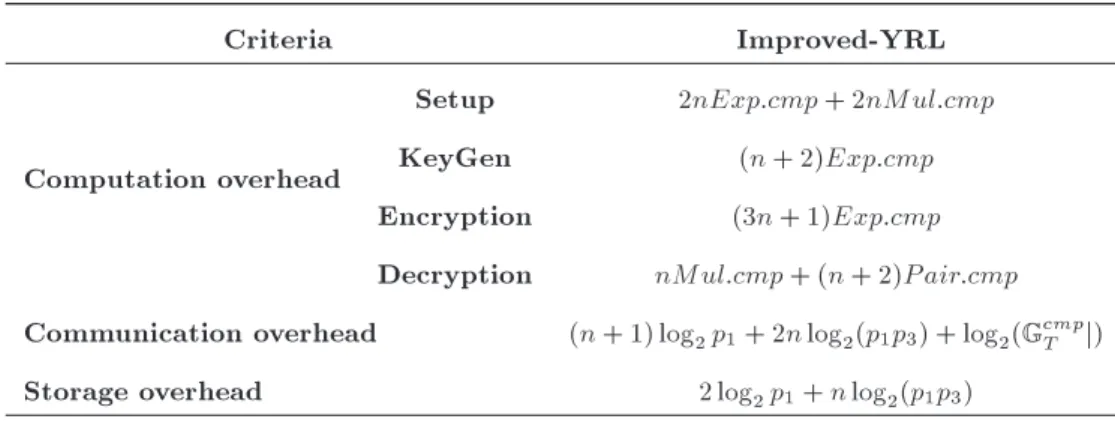
Herein, we investigate the computation load of the Setup, KeyGen and Encryption algorithms of improved-YRL executed by the broadcaster and De-cryption algorithm executed by the receivers. Similar to the YRL's setup overhead [3], improved-YRL's setup has a term 2nExp:cmp. In addition, as in the improved-YRL's setup, some elements of subgroup G1
are multiplied by some elements of subgroup G3, and
then the extra term 2nMul:cmp is added. Therefore, the total overhead of the improved-YRL's setup is 2nExp:cmp + 2nMul:cmp. In the KeyGen algorithm, the term gris eliminated in comparison with KeyGen
algorithm of the YRL scheme. Therefore, the com-putation overhead of the KeyGen algorithm is (n + 2)Exp:cmp. In the Encryption algorithm, the terms gk0 and gk1 are eliminated. Therefore, in comparison
with the Encryption algorithm of the YRL scheme, two Exp computations are omitted and the resulting computation overhead is reduced to (3n + 1)Exp:cmp. In the Decryption algorithm, there is no need to
compute fBj = e(g
kj
; gr)gj2f0;1g; consequently, the
total number of pairing computations is reduced by two units. Therefore, the total computation overhead of Decryption algorithm becomes nMul:cmp + (n + 2)P air:cmp. These results are summarized in Table 1. 7.1.2. Communication Overhead.
The total communication overhead of the proposed scheme is (n + 1) log2p1+ 2n log2(p1p3) + log2jGcmpT j,
as presented in Table 1. 7.1.3. Storage Overhead.
The main storage load for users comes from the secret key SK. The storage load of the YRL scheme is (n + 3) log2p [3]; in addition, as in the Improved-YRL scheme, gr is omitted from the secret key, and each
user needs 2 log2p1+n log2(p1p3) bits to store his secret
key. These results are illustrated in Table 1.
Table 1. A summary of overhead analysis of our proposed scheme.
Criteria Improved-YRL
Computation overhead
Setup 2nExp:cmp + 2nMul:cmp
KeyGen (n + 2)Exp:cmp
Encryption (3n + 1)Exp:cmp Decryption nMul:cmp + (n + 2)P air:cmp Communication overhead (n + 1) log2p1+ 2n log2(p1p3) + log2(GcmpT j) Storage overhead 2 log2p1+ n log2(p1p3)
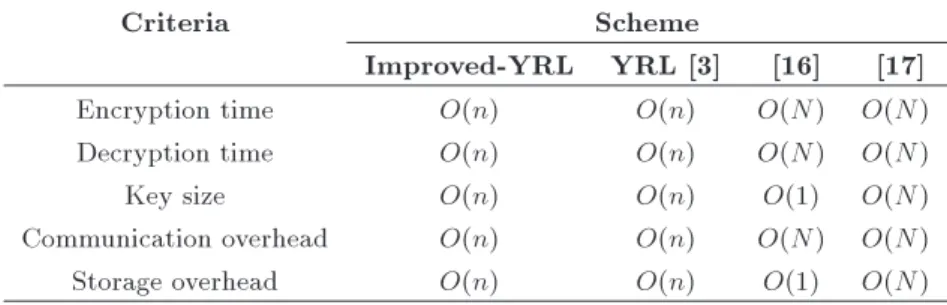
Table 2. A comparison of anonymous broadcast encryption schemes; n denotes the number of attributes and N the number of the intended receivers.
Criteria Scheme
Improved-YRL YRL [3] [16] [17]
Encryption time O(n) O(n) O(N) O(N)
Decryption time O(n) O(n) O(N) O(N)
Key size O(n) O(n) O(1) O(N)
Communication overhead O(n) O(n) O(N) O(N)
Storage overhead O(n) O(n) O(1) O(N)
7.2. Discussion and comparison
Table 2 compares the overheads of our scheme with the basic YRL scheme [3] and two other anonymous broadcast encryption schemes [16,17], as discussed in the Introduction Section. In this table, parameters n and N denote the number of the attributes and number of the intended receivers, respectively. As in Table 2, the computation, communication, and storage overheads of the improved-YRL scheme, the same as the basic YRL scheme, are linear in the number of attributes, and independent of the number of receivers. Therefore, improved-YRL not only enjoys enhanced and provable security in comparison to basic YRL [3] and resists the proposed attack in this paper, but also preserves low overhead and high-performance properties of the basic YRL scheme.
Furthermore, a comparison between the proposed scheme and two selected anonymous broadcast encryp-tion schemes [16,17] demonstrates that our scheme is much more ecient. That is, as can be seen in Table 2, the computation (encryption and decryption time) and communication overheads of both [16] and [17] grow linearly with regard to the number of the intended receivers. In this case, if 1024 bit RSA algorithm for encryption is used, then the ciphertext size will be 1024N, where N is the total number of receivers. This implies a huge computation and communication overhead in the large-scale systems. Since the attributes are usually shared by the unlimited number of group members, it can be seen that in the case of large-scale applications, the computation and communication overheads of the improved YRL scheme, which are linear in the number of attributes, can be well controlled. In fact, in systems with large-scale structures, the number of the required attributes in comparison to the total number of users could be signicantly small. In addition to better eciency, the proposed scheme suggests stronger anonymity, that is, our scheme not only hides the identities of receivers, but also protects the number of intended receivers. In [16] and [17], the number of intended receivers is not protected.
Besides, according to [3], in order to minimize the communication overhead in a limited bandwidth
environment such as wireless networks, or to minimize the computation overhead in resource-constrained re-ceivers, there are dierent implementations of bilinear pairings. Depending on the application, the appropri-ate implementation should be chosen for minimizing the communication/computation overhead in practice. 8. Conclusion and future work
In this study, we investigated an anonymous broadcast encryption scheme, called YRL scheme and showed its vulnerability. Our investigation demonstrated that all of the users in this scheme, including authorized and unauthorized ones, could decrypt the received message. Thus, the YRL scheme did not provide the main requirement of the broadcast encryption schemes. Since the introduction of an anonymous, ecient and provably secure broadcast encryption scheme is one of the most important open problems in this eld, the YRL scheme in composite order bilinear groups was improved, making it secure against the proposed
attack. We also proved anonymity and semantic
security of the improved-YRL scheme under adaptive corruptions in the chosen ciphertext setting.
The same as the basic YRL, the computation and communication overheads of the improved-YRL scheme, as illustrated in Table 1, are O(n), where n is the number of attributes and independent of the number of receivers. Since the attributes are usually shared by the unlimited number of group members, the scheme is more ecient than the anonymous broadcast encryption schemes with overheads related to the number of receivers [17].
Furthermore, presenting a real-world application of the proposed scheme, e.g., secure and scalable e-health architectures and secure cloud storage systems, can be considered as an interesting future work. Acknowledgement
This research is research is partially supported by Center of Excellence in Cryptography and Information Security, Sharif University of Technology.
References
1. Fiat, A. and Naor, M. \Broadcast encryption", in Annual International Cryptology Conference, pp. 480-491, Springer (1993).
2. Aljawarneh, S. \A web engineering security method-ology for e-learning systems", Network Security, 2011(3), pp. 12-15 (2011).
3. Yu, S., Ren, K., and Lou, W. \Attribute-based on-demand multicast group setup with membership anonymity", Computer Networks, 54(3), pp. 377-386 (2010).
4. Boneh, D., Gentry, C., and Waters, B. \Collusion resistant broadcast encryption with short ciphertexts and private keys", in Annual International Cryptology Conference, pp. 258-275, Springer (2005).
5. Boneh, D. and Waters, B. \A fully collusion resistant broadcast, trace, and revoke system", in Proceedings of the 13th ACM Conference on Computer and Com-munications Security, pp. 211-220, ACM (2006).
6. Boneh, D., Waters, B., and Zhandry, M. \Low over-head broadcast encryption from multilinear maps", in International Cryptology Conference, pp. 206-223, Springer (2014).
7. Guo, D., Wen, Q., Li, W., Zhang, H., and Jin, Z. \Adaptively secure broadcast encryption with con-stant ciphertexts", IEEE Transactions on Broadcast-ing, 62(3), pp. 709-715 (2016).
8. Wu, Q., Qin, B., Zhang, L., Domingo-Ferrer, J., Farras, O., and Manjon, J.A. \Contributory broadcast encryption with ecient encryption and short cipher-texts", IEEE Transactions on Computers, 65(2), pp. 466-479 (2016).
9. Yang, Y., Yang, S.-L., Wang, F.-H., and Sun, J. \Post-quantum secure public key broadcast encryption with keyword search", Journal of Information Science & Engineering, 33(2), pp. 485-497 (2017).
10. Sun, M., Ge, C., Fang, L., and Wang, J. \A proxy broadcast re-encryption for cloud data sharing", Mul-timedia Tools and Applications, pp. 1-15 (2017).
11. Aljawarneh, S., Yassein, M.B., et al. \A resource-ecient encryption algorithm for multimedia big data", Multimedia Tools and Applications, 76(21), pp. 1-22 (2017).
12. Lubicz, D. and Sirvent, T. \Attribute-based broadcast encryption scheme made ecient", in International Conference on Cryptology in Africa, pp. 325-342, Springer (2008).
13. Zhou, Z. and Huang, D. \On ecient ciphertext-policy aribute based encryption and broadcast encryp-tion", in Proceedings of the 17th ACM Conference on Computer and Communications Security, pp. 753-755, ACM (2010).
14. Aljawarneh, S.A., Alawneh, A., and Jaradat, R. \Cloud security engineering: Early stages of sdlc", Future Generation Computer Systems, 74, pp. 385-392 (2017).
15. Wesolowski, B. and Junod, P. \Ciphertext-policy attribute-based broadcast encryption with small keys", in International Conference on Information Security and Cryptology, pp. 53-68, Springer (2015).
16. Barth, A., Boneh, D., and Waters, B. \Privacy in encrypted content distribution using private broadcast encryption", in International Conference on Financial Cryptography and Data Security, pp. 52-64, Springer (2006).
17. Libert, B., Paterson, K.G., and Quaglia, E.A. \Anony-mous broadcast encryption: Adaptive security and ef-cient constructions in the standard model", in Public Key Cryptography-PKC 2012, pp. 206-224, Springer (2012).
18. Fazio, N. and Perera, I.M. \Outsider-anonymous broadcast encryption with sublinear ciphertexts", in International Workshop on Public Key Cryptography, pp. 225-242, Springer (2012).
19. Rabaninejad, R., Delavar, M., Ameri, M.H., and Mohajeri, J. \On the security of YRL, an anonymous broadcast encryption scheme", in Telecommunications, IST 2016, International Symposium on. IEEE (2016).
20. Waters, B. \Dual system encryption: Realizing fully secure ibe and hibe under simple assumptions", in Advances in Cryptology-CRYPTO, 2009, pp. 619-636, Springer (2009).
21. Boneh, D., Goh, E.-J., and Nissim, K. \Evaluating 2-dnf formulas on ciphertexts", in Theory of Cryptog-raphy Conference, pp. 325-341, Springer (2005).
22. Sreenivasa Rao, Y. and Dutta, R. \Fully se-cure bandwidth-ecient anonymous ciphertext-policy attribute-based encryption", Security and Communi-cation Networks, 8(18), pp. 4157-4176 (2015).
23. Lewko, A., Okamoto, T., Sahai, A., Takashima, K., and Waters, B. \Fully secure functional encryp-tion: Attribute-based encryption and (hierarchical) inner product encryption", in Advances in Cryptology-EUROCRYPT 2010, pp. 62-91, Springer (2010). Biographies
Reyhaneh Rabaninejad is currently a third year PhD student at the Electrical Engineering Department at K. N. Toosi University of Technology, Tehran, Iran. She received both her BSc and MSc degrees in Electri-cal Engineering from Sharif University of Technology in 2012 and 2014, respectively. Her research interests include network security and applied cryptography. Her current research area focuses on secure cloud storage and search mechanisms on encrypted data. Mohammad Hassan Ameri received his BS degree in Electrical Engineering from Shahid Bahonar Univer-sity, Kerman, Iran in 2013 with the honor of the rst ranked student among electrical engineering students of the same entrance, and his MS degree in Electrical En-gineering from Sharif University of Technology, Tehran,
Iran in 2015. Currently, he is working as a researcher in Electronic Research Institute at Sharif University of Technology. His major research interests include cloud security, searchable encryption, provable security, information-theoretic security, network security, design and cryptanalysis of cryptographic protocols.
Mahshid Delavar received the BSc degree from the Amirkabir University of Technology, Tehran, Iran in 2006, the MSc degree from Islamic Azad University, South Tehran Branch, Tehran, Iran in 2009, and the PhD degree from Iran University of Science and Technology, Tehran, Iran in 2016, all in Electronics
Engineering. Her current research interests include hardware security and cryptographic protocols. Javad Mohajeri is an Assistant Professor in Elec-tronics Research Institute and an Adjunct Assistant Professor at the Electrical Engineering Department at Sharif University of Technology, Tehran, Iran. His research interests include design and cryptanalysis of cryptographic algorithms, and protocols and data security. He is the author/co-author of about 100 research articles in refereed journals/conferences and is one of the founding members of Iranian Society of Cryptology.