IC, 2016 – 12(2): 591-618 – Online ISSN: 1697-9818 – Print ISSN: 2014-3214 http://dx.doi.org/10.3926/ic.727
Marketing assets: Relating brand equity
and customer equity
Jaime Romero , María J. Yagüe Universidad Autónoma de Madrid (Spain)
[email protected], [email protected]
Received October, 2015 Accepted January, 2016
Abstract
Purpose: Brand equity and customer equity are inextricably linked. Some authors propose that marketing activities build these intangible assets simultaneously. In contrast, others suggest that brand equity is an antecedent of customer equity. In this research, we aim to shed light about the relationship between brand equity and customer equity, by empirically testing these two alternative explanations.
Design/methodology: We propose four research models that reflect these two alternatives explanations regarding the link between brand equity and customer equity. In order to estimate these models we employ Structural Equations Modelling. We measure model variables using data collected through a survey to marketing managers of services companies that operate in Spain. We compare these four research models in terms of explanatory power and goodness of fit.
Research limitations/implications: Our results recommend caution when interpreting previous research about the effects of brand (customer) equity, as they might indeed correspond to customer (brand) management. Similarly, future research focusing on customer and brand management need to take into account both managerial areas in their studies.
Practical implications: From a practitioners’ point of view, our findings suggest adopting a brand-customer portfolio approach to enhance company profitability. Similarly, we derive implications for firm valuation processes, which incorporate brand equity and customer equity in their calculations.
Originality/value: We empirically study the relationship between brand equity and customer equity, while previous research has analyzed this topic only at a theoretical level. Clarifying this link enriches our comprehension about how companies build these marketing intangible assets and increases the accuracy of firm valuation processes.
Keywords: Brand equity, Customer equity
Jel Codes: M31
1. Introduction
Research efforts involving BE and CE have generally constituted well-differentiated lines of research. On the one hand, BE studies spread in the early 1990s and tend to concentrate on its conceptualization and measurement (Aaker, 1991; Keller, 1993; Netemeyer, Krishnan, Pullig, Wang, Yagci, Dean, Ricks & Wirth, 2004; Wang, Hsu & Fang, 2009; Christodoulides & de Chernatony, 2010). On the other hand, the concept of CE has become popular over the past ten years and its research focuses on its measurement and optimization (e.g.: Berger & Nasr, 1998; Allenby, Leone & Jen, 1999; Gupta, Lehmann & Stuart, 2004; Venkatesan & Kumar, 2004; Fader, Hardie & Lee 2005a, 2005b; Wiesel, Skiera & Villanueva, 2008).
Hence, there is some parallel development of the research into BE and CE, and these concepts are intimately related (Leone, Rao, Keller, Luo, Mcalister & Srivastava, 2006; Spyropoulou, Skarmeas & Katsikeas, 2011; Luo, Lehmann & Neslin, 2015). Building BE modifies customer choices and brand sales, producing cash flows from the customer to the company (Srivastava, Shervani & Fahey, 1998; Kim, Kim Woo & An Jeong, 2003; Rao, Agarwal & Dahlhoff, 2004; Johansson, Dimofte & Mazvancheryl, 2012), in short BE. Similarly, CE increases BE through several ways, “including: social influence, market presence, customer satisfaction, advocacy and network externalities” (Luo et al., 2015). Furthermore, building BE and CE requires having the similar marketing capabilities (marketing capabilities understood as the ability of a firm to efficiently deploy and manage its marketing resources; Porter, 1985, 1991). Both BE and CE are related with specific outputs - competitive advantages, namely customers’ loyalty and their willingness to pay price premiums (Lassar, Mittal & Sharma, 1995; Taylor, Celuch & Goodwin, 2004; Del Río, Vázquez & Iglesias, 2001; Faircloth, Capella & Alford, 2001; Alawadi, Lehmann, and Neslin 2003; Kim & Kim Woo, 2005; Rust, Lemon et al., 2004).
by these customers during their lifetimes. More specifically, BE influences acquisition and retention rates and profit margins, which are three key components of CE (Stahl, Heitmann, Lehmann & Neslin, 2012). Under this perspective, brand management is a tool for customer management.
These two conflicting points of view have important theoretical and practical implications. Clarifying if BE and CE are assets that either are built simultaneously or an antecedent and its consequence constitutes, for instance, a strong base for linking the separated research streams on BE and CE. Similarly, research about marketing profitability formation – an important topic that is generating a growing interest among academics and practitioners (Rust, Ambler, Carpenter, Kumar & Srivastava, 2004) – requires accurately identifying how marketing activities (brand management and customer management) contribute through customers’ loyalty or margins to company returns and, ultimately, to firm value. From a practitioners point of point of view, understanding the bond between BE and CE has a direct application in terms of marketing decisions aiming to enhance the long-term value of a company (Kumar, Lemon & Parasuraman, 2006). The assessment of firm value also requires a complete comprehension of the connection between BE and CE, given that both are intangible assets that affect firm valuation. Nevertheless, despite its theoretical and practical implications, up to our knowledge there are not studies that directly compare both views in the same research. The link between BE and CE remains obscure.
In this research we fill this gap by proposing four alternative research models that follow the two competing perspectives regarding the connection between BE and CE. We depart from the resource-based view theory to propose these models. They posit that marketing capabilities produce marketing assets (BE and CE); and that such marketing assets provide competitive advantages (customers’ loyalty and price premiums) to companies. We validate these models using survey data from a sample of marketing managers, grounding our findings on managerial practice. We examine our estimation results in the light of the competing perspectives and compare them in terms of their explanatory power and goodness of fit. Thus, we contribute to current knowledge about the connection between BE and CE by empirically testing the existing alternative explanations of such link.
current separation. Marketing profitability research and management require adopting a joint perspective of these assets. The BE-CE connection is the key for building stronger brands and increasing the customer base of a firm (Kumar, Lemon & Parasuraman, 2006; Luo et al., 2015) in order to ensure sustainable competitive advantages. According to our results a growth in BE and CE leads both to a greater customer willingness to pay premiums and to a higher loyalty among customers, respectively (and not indistinctly, as in previous studies). Finally, our results recommend moving to a brand-customer portfolio approach for managing marketing activities and a careful assessment of BE and CE when valuing firms, in order to avoid inflating firm value when taking into account both assets in firm valuation processes.
The remainder of this paper is organized as follows. In the second section we briefly introduce our theoretical framework, presenting a review of the relationship between BE and CE. Next, we formulate our research models. The third section provides details of the method followed for gathering and processing the information, and for measuring the latent variables included in the models via the development of scales. Subsequently, we analyze the results obtained from the estimation of the models in terms of goodness of fit and model relationships. Finally, we present our principal conclusions, and suggest future lines of research, aimed at overcoming some of the limitations of this work.
2. Theoretical models
2.1. Marketing capabilities, assets and competitive advantage
Ailawadi, Lehmann & Neslin, 2003). Second, a stable and sustained purchase level over time is more likely (Gupta & Lehmann, 2003).
Traditionally, literature on the resource-based view has treated marketing capabilities as an aggregate (Vorhies & Morgan, 2005) or as a concept consisting of two types of components: those associated with marketing mix capabilities and those of the strategic marketing process (Morgan, Vorhies & Mason, 2009). Recently, some academics have grouped the former (that is, marketing mix capabilities) in accordance with the type of market-based assets they develop (Srivastava et al., 1998). Thus, marketing mix capabilities involve capabilities developed by the company in order to create and manage stronger and closer relations with its customers (Rust, Zeithaml & Lemon, 2004), as well as others that are associated with the processes and activities that help the company to develop, support and maintain strong brands (Aaker, 1991; Hulland, Wade & Antia, 2007).
Investing in brand capabilities constitutes an outstanding tool for improving the results of an organization (Keller, 1993; Kerin & Sethuraman, 1998; Ambler, 2003; Raggio & Leone, 2007). The greater the value of an organization’s brands, the greater its competitive differentiation advantages (Aaker, 1991; Nurittamont & Ussahawanitchakit, 2008; Lassar et al., 1995), the better the results it achieves (Aaker, 1991, 1996; Keller, 1993; Park & Srinivasan, 1994; Nurittamont & Ussahawanitchakit, 2008) and the higher its market value (Simon and Sullivan, 1993; Kerin & Sethuraman, 1998). Studies in Customer Relationship Management and CE (Gupta et al., 2004; Rust, Lemon et al., 2004; Bauer & Hammerschmidt, 2005) likewise conclude that companies that strengthen customer capabilities (by applying Customer Relationship Management techniques) improve their value via future profits generated by the accumulation of CE.
as a common benefit derived from the construction of these market assets. The price premium associated with BE and CE comes from an inelasticity in the demand of loyal customers (Rao & Monroe, 1996).
In summary, previous research indicates that
• brand and customer capabilities increase BE and CE, and that
• BE and CE are positively related with gaining competitive advantages, namely customer loyalty and customer willingness to pay a premium price (Srivastava et al., 1998).
These findings are compatible with the competing explanations that researchers have proposed regarding the link between BE and CE, which we explain next.
2.2. Linking BE and CE
Given that BE and CE provide companies with present and future cash flows, it is reasonable to assume that BE and CE are highly correlated, if not equivalent (Ambler et al., 2002). However, some authors indicate that although built simultaneously there are relevant differences between them, representing specific contributions to company cash flows (Leone et al., 2006). For example, strong brands attract and retain not only consumers, but also more highly qualified employees; and they facilitate relations within distribution channels, presenting opportunities for growth via product line extensions, licenses and franchises (Jones, 2005; Chernatony, McDonald & Wallace, 2010). In turn, customers can generate value for the company beyond their purchases by word-of-mouth or co-creation (van Doorn, Lemon, Mittal, Nass, Pick, Pirner & Verhoef, 2010; Kumar, Aksoy, Donkers, Venkatesan, Wiesel & Tillmanns, 2010). These effects and, therefore, the contribution of BE and CE to firm results might vary across industries (Bick, 2009), thus supporting the notion of BE as CE as separated assets.
antecedents is strong, the correlation of BE and CE could be low. In line with this pers pective, Stahl et al. (2012) find that marketing activities grow CE not only through BE but also directly.
These two alternative explanations about the interdependence between BE and CE are compatible with the findings of studies that indicate that
• marketing capabilities increase BE and CE, and that
• BE and CE are positively related with customer loyalty and price premiums (Srivastava et al., 1998).
These studies do not incorporate simultaneously BE and CE and, therefore, the effect of marketing capabilities on them and their effects on competitive advantages could have been confounded (wrongly attributed, due to a potential correlation between BE and CE, arising from their simultaneity or from BE being an antecedent of CE).
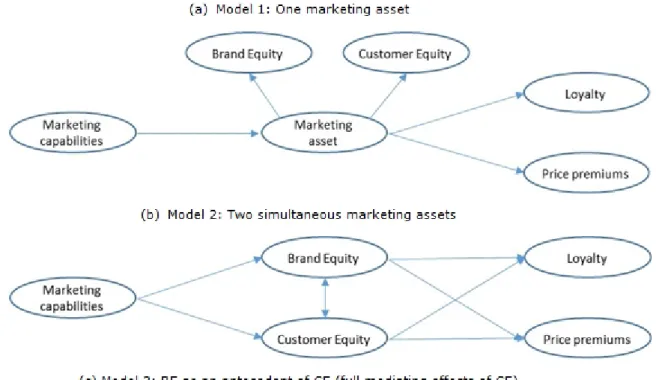
Thus, in this study we propose two research models that
• reflect the two perspectives regarding the link between BE and CE and
• shed light about previous results about the role of marketing capabilities on BE and CE and the impact of these assets on loyalty and price premiums.
Our first research model (Figure 1a) establishes that BE and CE are two different views of the same marketing asset (Ambler et al., 2002). In this model, marketing capabilities positively influence a more general marketing asset, which increases loyalty and price premiums, (Srivastava et al., 1998; Srivastava et al., 2001). Following this view, we measure the marketing asset of our first model as a second order construct that is reflected by BE and CE. Assuming that this research model is true, the results of previous studies that include either BE or CE and find that they influence loyalty and price premiums could be due to the fact that these studies are indeed capturing the impact of a more general marketing asset (measured just either through BE or through CE).
Figure 1. Research Models
• that support that that marketing capabilities increase customer equity (that indeed omit the full or partial mediation of BE in this effect);
• and that indicate that BE produces loyalty and allows charging price premiums (despite not taking into account the mediating effect of CE on the relationship between BE and these competitive advantages).
3. Method
To test our four research models we employ Structural Equation Modelling. This tool can simultaneously estimate all the relationships included in complex models in which constructs are interrelated. In order to measure the variables of our model, we collected data from a survey of marketing managers working for service companies in Spain. Hence, our results are grounded on managerial practice. Managerial samples have a long tradition in management research (e.g. Greenley, 1998; Jantan, Honeycutt, Thelen & Attia, 2004; Narasimhan, 1990; Pehrsson, 2006) and usually allow reaching similar results than other sources of data (Venkatraman & Ramanujam, 1987; Reinartz, Krafft & Hoyer, 2004).
A market research institute carried out the fieldwork via telephone surveys, using the CATI system, in November 2011. The sample (201 managers) was randomly taken from the 5,745 service companies registered in the database SABI (which contains the financial records of more than one million companies operating in Spain), ensuring an acceptable representativeness of the population. The sample proceeds from the following service industries: accommodation and food service activities; administrative and support service activities; arts, entertainment and recreation; education; financial and insurance activities; information and communication; professional, scientific and technical activities; real estate activities; retail trade, except of motor vehicles and motorcycles; supplies, sewerage, waste management and remediation activities; transportation and storage; and other services.
the services provided by your brands are: Over 20% lower; Between 11% and 20% lower; Up to 10% lower; Similar; Up to 10% higher; Between 11% and 20% higher; Over 20% higher”). For customer loyalty, we devised a weighted average of five levels of loyalty multiplied by the estimated percentage of customers that fall within each level (“Distribute your current customer portfolio in accordance with the degree of loyalty shown towards your company when they have to buy a service in this category: between 90% and 100% of their purchases; between 70% and 89%; between 50% and 69%; between 30% and 49%; less than 30% of the times“).
4. Analysis and results
We applied a structural equations model estimated by maximum likelihood using the SPSS Amos 19 software program. As in any structural equations model, the analysis was implemented in two phases. First, we evaluated the psychometric properties of the measurement scales proposed for the latent variables of the model using both exploratory and confirmatory analysis techniques. Next, we assessed the goodness-of-fit of our models, which is particularly relevant for model comparisons, and evaluated their estimates.
4.1. Validation of scales
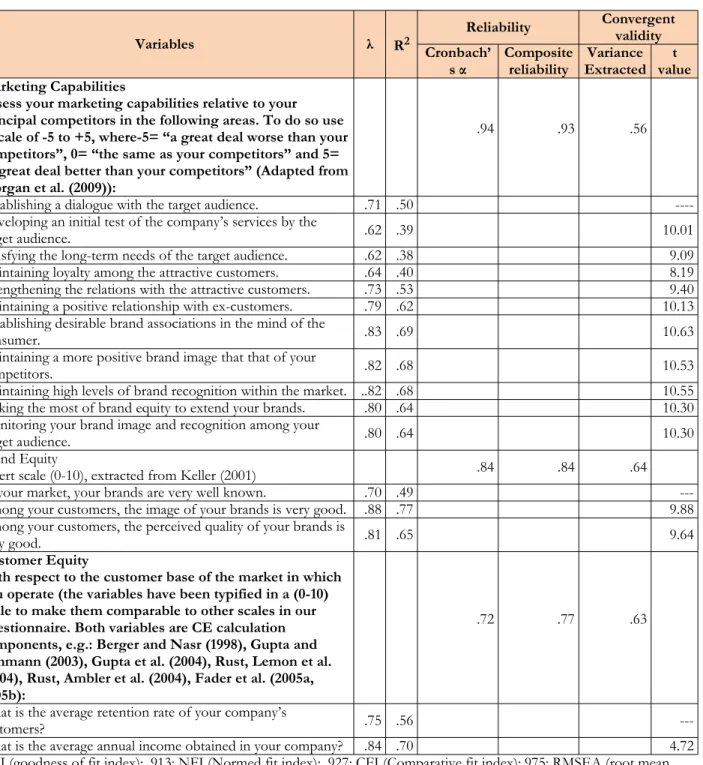
We initially applied an exploratory factor analysis and a reliability analysis to the items that define the scales of the latent variables of our model. After this initial filter, we dropped to two items from the original scale of marketing capabilities, due to incorrectly loadings in other variable. Hence, the marketing capabilities scale maintained eleven out of thirteen indicators. For the remaining variables, BE and CE, every item loads on its corresponding latent variable. Subsequently, the analysis of the psychometric properties of our latent variables supports the validation of the scales finally used in this study (Table 1). Following Hair, Black, Babin, Anderson and Tatham (2006), the model presents a good global fit. Furthermore, all the indicators present standardized lambda coefficients that are both significant and greater than 0.5 (they vary between 0.62 and 0.88). Likewise, all the indicators have a clear relationship with each of the underlying factors they measure (R2>0.3). Convergence validity of
of 0.7 (Nunnally, 1978; Norusis, 1993). Additionally, the t-values of each indicator show that they are significant (Fornell & Larcker, 1981).
With regard to discriminant validity, none of the confidence intervals of the estimated correlation between every pair of constructs contains 1. Secondly, we tested a restricted model whose correlations estimates between latent variables are constrained to one towards our (unrestricted) model. The
restricted model showed a significantly worse overall fit 2 = 141.84; ∆2 = 5.41. Finally, the square
root of the AVE of each latent variable is higher than the correlations of that variable with any other construct (Table 2). All together, these tests support the discriminant validity of the latent variables of our study.
To check for potential common method bias, we applied Harman’s single-factor test with a confirmatory factor analysis (e.g., Podsakoff, Mackenzie, Jeong-Yeon Lee & Podsakoff, 2003). This test incorporates a single latent common factor in the model under study; subsequently it evaluates whether this factor can explain the majority of the model variance using a chi-square difference test. In our case, we implemented the test with regard to our basic measurement model with the three factors. The chi-square value of the single-factor model was 175.67 (d.f.=94), significantly worse than our basic
measurement model with the three factors:.∆2 = 39.23, ∆d.f. = 1 p< 0.001. This provides evidences
that the measurement model of our study is robust to common method bias.
4.2. Model comparison
Variables λ R2
Reliability Convergentvalidity Cronbach’
s α Compositereliability ExtractedVariance valuet Marketing Capabilities
Assess your marketing capabilities relative to your principal competitors in the following areas. To do so use a scale of -5 to +5, where-5= “a great deal worse than your competitors”, 0= “the same as your competitors” and 5= “a great deal better than your competitors” (Adapted from Morgan et al. (2009)):
.94 .93 .56
Establishing a dialogue with the target audience. .71 .50
----Developing an initial test of the company’s services by the
target audience. .62 .39 10.01
Satisfying the long-term needs of the target audience. .62 .38 9.09
Maintaining loyalty among the attractive customers. .64 .40 8.19
Strengthening the relations with the attractive customers. .73 .53 9.40
Maintaining a positive relationship with ex-customers. .79 .62 10.13
Establishing desirable brand associations in the mind of the
consumer. .83 .69 10.63
Maintaining a more positive brand image that that of your
competitors. .82 .68 10.53
Maintaining high levels of brand recognition within the market. ..82 .68 10.55
Making the most of brand equity to extend your brands. .80 .64 10.30
Monitoring your brand image and recognition among your
target audience. .80 .64 10.30
Brand Equity
Likert scale (0-10), extracted from Keller (2001) .84 .84 .64
In your market, your brands are very well known. .70 .49
---Among your customers, the image of your brands is very good. .88 .77 9.88 Among your customers, the perceived quality of your brands is
very good. .81 .65 9.64
Customer Equity
With respect to the customer base of the market in which you operate (the variables have been typified in a (0-10) scale to make them comparable to other scales in our questionnaire. Both variables are CE calculation components, e.g.: Berger and Nasr (1998), Gupta and Lehmann (2003), Gupta et al. (2004), Rust, Lemon et al. (2004), Rust, Ambler et al. (2004), Fader et al. (2005a, 2005b):
.72 .77 .63
What is the average retention rate of your company’s
customers? .75 .56
---What is the average annual income obtained in your company? .84 .70 4.72 GFI (goodness of fit index): .913; NFI (Normed fit index): .927; CFI (Comparative fit index):.975; RMSEA (root mean square error of approximation): .051; S-Bχ2=136.43 (d.f. 93, p=0.002); χ2 /d.f.=1.46
Table 1. Reliability and Convergent Validity of Model Variables
Latent variables Mean Standard Error (1) (2) (3)
Marketing capabilities (1) 7.82 1.29 0.75
Brand equity (2) 7.67 1.19 0.52 0.80
Customer equity (3) 2.87 1.88 0.30 0.41 0.79
Figures in the principal diagonal (in bold) correspond to the square root of the AVE of each latent variable; figures below the principal diagonal are the correlations between constructs.
Model 1 Model 2 Model 3 Model 4 Model 2 (restricted)
χ2 169.63 169.28 265.70 183.34 170.91
d.f. 125 123 126 125 125
χ2/d.f. 1.36 1.38 2.10 1.47 1.37
p 0.005 0.004 0.000 0.001 0.004
GFI 0.90 0.90 0.86 0.90 0.90
CFI 0.97 0.97 0.92 0.97 0.97
NFI 0.91 0.91 0.87 0.90 0.91
RMSEA 0.044 0.045 0.078 0.051 0.045
Dχ2 (p-values) 0.35 (0.55) - 96.42 (<0.01) 14.06 (<0.01) 1.63 (0.20) Table 3. Goodness of Fit of the Four Research Models
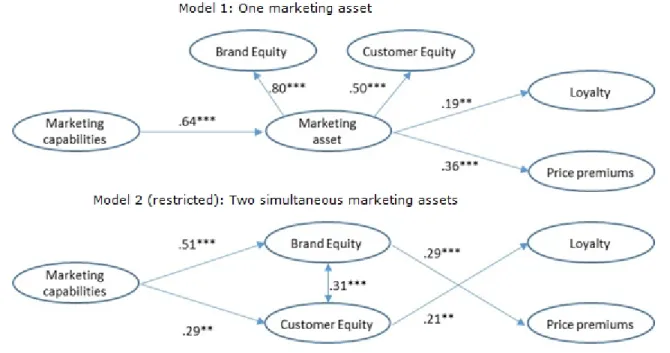
Figure 2 shows the estimation results for models 1 and 2. Model 1 proposes that marketing capabilities build an overall marketing asset that is positively related with loyalty and customer willingness to pay price premiums. All the paths in model 1 are significant. Model 2 proposes that marketing capabilities build BE and CE and that both assets positively influence loyalty and customer willingness to pay price premiums. However, in this model our results indicate that BE does not affect customer loyalty and that CE has no impact on price premiums. Given these results, we have estimated a restricted version of model 2, where the non-significant coefficients are set to zero. Next, we have compared it to the “full” version of model 2. The difference in the fit of these two versions of model 2 is not significant (χ2 test; Table 3). Moreover, the values of the restricted for the RMSEA, GFI, NFI and CFI are
virtually identical to those of the original model. Thus, we present model 1 as-is in Figure 2 but, for parsimony, our subsequent analyses of model 2 (including Figure 2) will make reference to its restricted version.
There is not a significant difference between the overall fit of the models 1 and 2 (χ2 incremental test).
Hence, our models support Leone et al. (2006) perspective. Marketing activities affect the elements that grow BE and CE. This provokes a significant degree of simultaneity and overlapping between both assets, against the antecedent-consequent (BE-CE) relationship proposed by Rust, Zeithaml et al. (2004). The results of our estimations of model 1 suggest that BE and CE are first order constructs that reflect a broader marketing asset construct. Consistently, our results regarding model 2 indicate that there is a positive and significant correlation of .31 between BE and CE. The sign and significance of the estimated coefficients in both models provide an extra evidence of Leone et al. (2006) perspective.
Figure 2. Estimation results
5. Managerial implications
propose supporting this view have a higher goodness of fit that the other models that support that BE is an antecedent of CE. The goodness of fit of the former models is indeed quite similar, thus impeding to establish the superiority of one of them. This similar performance recommends caution when interpreting their results and analyzing their managerial implications.
Research model 1 proposes that BE and CE are two indicators of a broader marketing asset. Research model 2 separates BE and CE, but admits that both assets are highly correlated. Consistent with research model 1, the results of research model 2 confirm this significant correlation, which is .31 in our study. With regard to the impact of BE and CE on customers’ loyalty and their willingness to pay premiums prices, the models offer different insights. Our first model indicates that the marketing asset has a positive influence on both loyalty and price premiums. Nevertheless, when separating BE and CE, BE only influences directly price premiums, while CE only has a direct influence on loyalty (.05 of confidence level). A potential explanation for this apparent divergence of results might be the existence of synergies between BE and CE. When separating BE and CE, their impact on competitive advantages appears more attenuated than when incorporating them in a model through a broader marketing asset. We observed differences between models 1 and 2 regarding the magnitude of the total effects of marketing capabilities on loyalty and price premiums (.03 and .06, respectively). Model 1 indicates that these effects are .12 and .23, respectively, while in model 2 these are .09 and .17. The results of model 2 indicate that BE and CE are correlated. Consequently, BE also indirectly influences average loyalty via CE. Similarly, CE has an indirect impact on price premiums. Hence, the indirect effect of BE on loyalty is .065, while the indirect effect of CE on price premiums is .09.
management, in contrast to Ambler and colleagues indications. Thus, our results recommend being cautious with their division of brand and customer management areas.
In any case, it is clear that brand and customer management cannot be separated. The managers in our sample indicate that BE and CE are built simultaneously, regardless they are the different indicators of a broader marketing construct or two different (but correlated) assets. Creating a solid base of marketing capabilities leads to gaining competitive advantages via these marketing assets. Both BE and CE are necessary to generate value for companies, given that they allow creating loyal customers who are willing to pay higher prices for firm products. Combining these two competitive advantages allows obtaining profits both in the short and in the long term. But how to integrate brand and customer management? Leone et al. (2006) recommend conceiving brand and customer management as a matrix where company brands are rows and customers (or segments) are the columns, thus taking into account both the rows and columns in order to arrive to optimal product solutions. However, implementing this recommendation can be quite challenging in practice.
Managing brands and customers portfolios together implies somehow moving to a management of brand-customer portfolios. The idea of brand-customer portfolios is appealing, but putting it in practice is only straightforward if there are not overlaps between the brands and the customers of the brand-customer portfolios identified by companies. In the simplest case, each brand of the company targets a single segment. Nevertheless, this is situation does not usually occur in practice.
Figure 3 illustrates two situations in which this condition does not hold, for a hypothetical firm selling five brands to four customer segments. Figure 3a shows a business setting where one segment purchases three company brands (segment A, brands 1,2 and 3), two segments are served by the same brand (segments B and C, brand 4) and one segment acquires only one brand (segment D, brand 5). This business setting is not problematic for adopting a brand-customer portfolio approach, as there are not overlaps between brands and customers. Here, the most natural solution is dividing the brand-customer matrix in three brand-brand-customer portfolios: a multi-brand portfolio, a multi-segment portfolio and a single brand-customer portfolio, corresponding to the three aforementioned combinations of brands and customers. All the three portfolios require an adequate management of customer acquisition and retention, together with brand or brands with a high awareness and an appropriate image. Additionally, for the first portfolio, promoting cross-selling can be key to improve profitability. Similarly, the second portfolio requires an appropriate policy to increase up-selling and customer referrals, as well as a precise segmentation to achieve high retention rates in each segment.
Figure 3b shows a business setting where the separation of brands and customers in independent brand-customer portfolios is not possible. In effect, every brand-customer combination in Figure 3b connects with another brand or customer segment. In this situation, companies might be forced to organize their business around brands or customers, and not around brand-customer portfolios, in order to manage efficiently their business.
apply BE measurement methods (Yoo & Donthu, 2001; Christodoulides & de Chernatony, 2010) and, subsequently value the profits derived from customer management that not spill directly over customers’ purchases. According to Kumar et al. (2010) these profits include customer referral value (the value provided by customers by recommending company brands in exchange of some incentives) and customer knowledge value (the value provided by customers by sharing their knowledge about brands to companies, thus facilitating product improvement, new product development, etc.).
6. Conclusions and future lines of research
This work provides new evidence regarding the relationship between BE and CE. We have studied this relationship within the resource-based view framework. To do so, we test two alternative approaches about the link between BE and CE. The first approach suggest that both assets are built simultaneously, while the second one suggests that BE is an antecedent of CE. Our results support that BE and CE are built simultaneously. Moreover, they could be two indicators of a broader marketing asset. Our results also indicate that BE allows companies to charge price premiums and that CE is positively related with loyalty, in contrast to previous research that attributes these competitive advantages to both BE and CE. From a theoretical point of view our results recommend devoting efforts to integrate brand and customer management research. For instance, the role of brands on customer referrals or on enhancing customers sharing their knowledge about the product with companies could be fruitful research directions. Similarly, studying the role of customer management on brand image, brand awareness, etc. would help academics and practitioners obtaining a deeper comprehension regarding marketing profitability formation. From a managerial perspective, our results point out the relevance of clarifying how brands and customers contribute to value creation. Our findings also recommend moving from a brand portfolio or customer portfolio management to a brand-customer portfolio management when possible. Finally, our results indicate that the simultaneity of BE and CE must be taken into account when performing firm valuation processes.
finding a scale for measuring CE that reflects the main financial components of the concept deserves special attention: the scale used consists of two indicators whose measurement is different from that of the rest of the variables; this fact hinders a direct comparison of the average BE and CE levels achieved by the companies in our sample. Moreover, this may affect the magnitudes of some of the coefficients estimates. Secondly, the fact that our analysis was carried out on different service sectors prevents us from knowing the stability of the models if they were to be applied to other industries, as suggested by Bick (2009). Enriching our sample could help to assess a potential generalization of our results and to detect whether the effects of BE and CE upon competitive advantages are similar or different according to the type of industry. Finally, we have focused on two main outputs provided by brand and customer management. However, other outputs could have been included in our work, thus expanding the scope and measurement of competitive advantages that affect economic results in terms of profit margins and sales growth.
Acknowledgements
Funded by Ministerio de Economía y Competitividad (ECO2012-31517)
References
Aaker, D.A. (1991). Managing Brand Equity. New York: Free Press.
Aaker, D.A. (1996). Building Strong Brands. New York: Free Press.
Aaker, D.A. (2012). Win the Brand Relevance Battle and then Build Competitor Barriers. California Management Review, 54(2), 43-57. http://dx.doi.org/10.1525/cmr.2012.54.2.43
Ailawadi, K.L., Lehmann, D.R., & Neslin, S.A. (2003). Revenue Premium as an Outcome Measure of Brand Equity. Journal of Marketing, 67(4), 1-17. http://dx.doi.org/10.1509/jmkg.67.4.1.18688
Allaway, A.W., Huddleston, P., Whipple, J. & Ellinger, A.E. (2011). Customer-based Brand Equity, Equity Drivers, and Customer Loyalty in the Supermarket Industry. Journal of Product and Brand Management, 20(3), 190-204. http://dx.doi.org/10.1108/10610421111134923
Allenby, G.M., Leone, R.P., & Jen, L. (1999). A Dynamic Model of Purchase Timing with Application to Direct Marketing. Journal of the American Statistical Association, 94(446), 365-374.
Ambler, T. (2003). Marketing: The Trouble with Finance. Business Strategy Review, 14(3), 54-62.
http://dx.doi.org/10.1111/1467-8616.00274
Ambler, T., Bhattacharya, C.B., Edell, J., Keller, K.L., Lemon, K.N., & Mittal, V. (2002). Relating Brand and Customer Perspectives on Marketing Management. Journal of Service Research, 5(1), 13-25.
http://dx.doi.org/10.1177/1094670502005001003
Bauer, H.H., & Hammerschmidt, M. (2005). Customer-based Corporate Valuation. Management Decision, 43(3), 331-348. http://dx.doi.org/10.1108/00251740510589733
Berger, P.D., & Nasr, N.I. (1998). Customer Lifetime Value: Marketing Models and Applications. Journal of Interactive Marketing, 12(1), 17-30.
http://dx.doi.org/10.1002/(SICI)1520-6653(199824)12:1<17::AID-DIR3>3.0.CO;2-K
Bick, G.N.C. (2009). Increasing Shareholder Value through Building Customer and Brand Equity. Journal of Marketing Management, 25(1), 117-141. http://dx.doi.org/10.1362/026725709X410061
Chen, C., & Myagmarsuren, O. (2011). Brand equity, Relationship Quality, Relationship Value, and Customer Loyalty: Evidence from the telecommunications services. Total Quality Management and Business Excellence, 22(9), 957-974. http://dx.doi.org/10.1080/14783363.2011.593872
Chernatony, L., Mcdonald, M., & Wallace, E. (2010). Creating Powerful Brands. UK: HB (Elsevier).
Christodoulides, G., & De Chernatony, L. (2010). Consumer-based Brand Equity Conceptualisation and Measurement. International Journal of Market Research, 52(1), 43-66.
http://dx.doi.org/10.2501/S1470785310201053
Del Río, A., Vázquez, R., & Iglesias, V. (2001). The Effects of Brand Associations on Consumer Response. Journal of Consumer Marketing, 18(5), 410-425. http://dx.doi.org/10.1108/07363760110398808
Den Hertog, P., Van Der Aa, W., & De Jong, M.W. (2010). Capabilities for Managing Service Innovation: towards a Conceptual Framework. Journal of Service Management, 21(4), 490-514.
http://dx.doi.org/10.1108/09564231011066123
Fader, P.S., Hardie, B.G.S., & Lee, K.L. (2005a). “Counting your Customers" the Easy Way: An Alternative to the Pareto/NBD Model. Marketing Science, 24(2), 275-284.
http://dx.doi.org/10.1287/mksc.1040.0098
Faircloth, J.B., Capella, L.M., & Alford, B.L. (2001). The Effect of Brand Attitude and Brand Image on Brand Equity. Journal of Marketing Theory and Practice, 9(3), 61-75.
http://dx.doi.org/10.1080/10696679.2001.11501897
Fornell, C., & Larcker, D.F. (1981). Evaluating Structural Equation Models with Unobservable Variables and Measurement Error. Journal of Marketing Research, 18(1), 39-50.
http://dx.doi.org/10.2307/3151312
Geigenmüller, A., & Bettis-Outland, H. (2012). Brand Equity in B2B Services and Consequences for the Trade Show Industry. Journal of Business and Industrial Marketing, 27(6), 428-435.
http://dx.doi.org/10.1108/08858621211251433
Greenley, G.E. (1988). Managerial Perceptions of Marketing Planning. Journal of Management Studies, 25(6), 575-601. http://dx.doi.org/10.1111/j.1467-6486.1988.tb00048.x
Gupta, S., & Lehmann, D.R. (2003). Customers as Assets. Journal of Interactive Marketing, 17(1), 9-24.
http://dx.doi.org/10.1002/dir.10045
Gupta, S., Lehmann, D.R., & Stuart, J.A. (2004). Valuing Customers. Journal of Marketing Research, 41(1), 7-18. http://dx.doi.org/10.1509/jmkr.41.1.7.25084
Hair, J.F., Black, B., Babin, B., Anderson, R.E., & Tatham, R.L. (2006). Multivariate Data Analysis (6th ed.). Upper Saddle River (NJ): Prentice Hall.
Hao, Z., Ko, E., & Taylor, C.R. (2010). Advertising Appeals Strategy: Moderating Effect on the Relationship between Innovation and Customer Equity. Advances in International Marketing, 9(21), 111-136.
Hogan, J.E., Lemon, K.N., & Rust, R.T. (2002). Customer Equity Management: Charting New Directions for the Future of Marketing. Journal of Service Research, 5(1), 4-12.
http://dx.doi.org/10.1177/1094670502005001002
Holehonnur, A., Raymond, M.A., Hopkins, C.D., & Fine, A.C. (2009). Examining the Customer Equity Framework from a Consumer Perspective. Journal of Brand Management, 17(3), 165-180.
http://dx.doi.org/10.1057/bm.2009.21
Jantan, M.A., Honeycutt, E.D., Thelen, S.T., & Attia, A.M. (2004). Managerial perceptions of sales training and performance. Industrial Marketing Management, 33(7), 667-673.
http://dx.doi.org/10.1016/j.indmarman.2003.09.003
Jobber, D., & Shipley, D. (2012). Marketing-orientated Pricing: Understanding and Applying Factors that Discriminate between Successful High and Low Price Strategies. European Journal of Marketing, 46(11/12), 1647-1670. http://dx.doi.org/10.1108/03090561211260022
Johansson, J.K., Dimofte, C.V., & Mazvancheryl, S.K. (2012). The Performance of Global Brands in the 2008 Financial Crisis: a Test of Two Brand Value Measures. International Journal of Research in Marketing, 29(3), 235-245. http://dx.doi.org/10.1016/j.ijresmar.2012.01.002
Jones, R. (2005). Finding Sources of Brand Value: Developing a Stakeholder Model of Brand Equity. Journal of Brand Management, 13(10), 10-32. http://dx.doi.org/10.1057/palgrave.bm.2540243
Juntunen, M., Juntunen, J., & Juga, J. (2011). Corporate Brand Equity and Loyalty in B2B Markets: A Study among Logistics Service Purchasers. Journal of Brand Management, 18(4/5), 300-311.
http://dx.doi.org/10.1057/bm.2010.43
Keller, K.L. (1993). Conceptualizing, Measuring, Managing Customer-based Brand Equity. Journal of Marketing, 57(1), 1-22. http://dx.doi.org/10.2307/1252054
Keller, K.L. (2001). Building Customer-based Brand Equity: a Blueprint for Creating Strong Brands (Working Papers Series, 01-107): Cambridge, MA: Marketing Science Institute.
Keller, K.L. (2008). Strategic Brand Management: Building, Measuring, and Managing Brand Equity (3rd ed.). Upper Saddle River (NJ): Prentice Hall.
Kerin, R.A., & Sethuraman, R. (1998). Exploring the Brand Value-Shareholder Value Nexus for Consumer Goods Companies. Journal of the Academy of Marketing Science, 26(4), 260-273.
http://dx.doi.org/10.1177/0092070398264001
Kim, H.-B., & Kim Woo, G. (2005). The Relationship between Brand Equity and Firms’ Performance in Luxury Hotels and Chain Restaurants. Tourism Management, 26(4), 549-560.
http://dx.doi.org/10.1016/j.tourman.2004.03.010
Kim, H.-B., Kim Woo, G., & An Jeong, A. (2003). The Effect of Consumer-based Brand Equity on Firms' Financial Performance. Journal of Consumer Marketing, 20(4), 335-351.
Kumar, V., Lemon, K.N., & Parasuraman, A. (2006). Managing Customers for Value: An Overview and Research Agenda. Journal of Service Research, 9(2), 87-94. http://dx.doi.org/10.1177/1094670506293558
Kumar, V., Aksoy, L., Donkers, B., Venkatesan, R., Wiesel, T., & Tillmanns, S. (2010). Undervalued or Overvalued Customers: Capturing Total Customer Engagement Value. Journal of Service Research, 13(3), 297-310. http://dx.doi.org/10.1177/1094670510375602
Lassar, W., Mittal, B., & Sharma, A. (1995). Measuring Customer-based Brand Equity. Journal of Consumer Marketing, 12(4), 11-19. http://dx.doi.org/10.1108/07363769510095270
Leone, R.P., Rao, V.R., Keller, K.L., Luo, A.M., Mcalister, L., & Srivastava, R.K. (2006). Linking Brand Equity to Customer Equity. Journal of Service Research, 9(2), 125-138.
http://dx.doi.org/10.1177/1094670506293563
Luo, A., Lehmann, D.R., & Neslin, S.A. (2015). Co-managing Brand Equity and Customer Equity. In V. Kumar & Denish Shah (Eds), Handbook of Research on Customer Equity in Marketing (pp. 363-381). Cheltenham, UK: Edward Elgar Publishing Ltd. http://dx.doi.org/10.4337/9781781004982.00024
Morgan, N.A., Slotegraaf, R.J., & Vorhies, D.W. (2009). Linking Marketing Capabilities with Profit Growth. International Journal of Research in Marketing, 26(4), 284-293.
http://dx.doi.org/10.1016/j.ijresmar.2009.06.005
Morgan, N.A., Vorhies, D.W., & Mason, C.H. (2009). Market Orientation, Marketing Capabilities, and Firm Performance. Strategic Management Journal, 30(8), 909-920. http://dx.doi.org/10.1002/smj.764
Narasimhan, C. (1990). Managerial Perspectives on Trade and Consumer Promotions. Marketing Letters, 1(3), 239-251. http://dx.doi.org/10.1007/BF00640801
Netemeyer, R.G., Krishnan, B., Pullig, C., Wang, G., Yagci, M., Dean, D., Ricks, J., & Wirth, F. (2004). Developing and Validating Measures of Facets of Customer-based Brand Equity. Journal of Business Research, 57(2), 209-224. http://dx.doi.org/10.1016/S0148-2963(01)00303-4
Norusis, M.J. (1993). SPSS. Statistical Data Analysis. Chicago: SPSS Inc.
Nunnally, J.C. (1978). Psychometric Theory (2nd ed.). New York: McGraw-Hill.
Park, C.S., & Srinivasan, V. (1994). A Survey-based Method for Measuring and Understanding Brand Equity and its Extendibility. Journal of Marketing Research, 31(2), 271-288.
http://dx.doi.org/10.2307/3152199
Pehrsson, A. (2006). Business Relatedness and Performance: a Study of Managerial Perceptions. Strategic Management Journal, 27(3), 265-282. http://dx.doi.org/10.1002/smj.516
Podsakoff, P.M., Mackenzie, S.B., Jeong-Yeon Lee, & Podsakoff, N.P. (2003). Common Method Biases in Behavioral Research: A Critical Review of the Literature and Recommended Remedies. Journal of Applied Psychology, 88(5), 879-903. http://dx.doi.org/10.1037/0021-9010.88.5.879
Porter, M.E. (1980). Competitive Strategy: Techniques for Analyzing Industries and Competitors. New York: Free Press.
Porter, M.E. (1985). Competitive Advantage. Creating and Sustaining Superior Performance. New York: Free Press.
Porter, M.E. (1991). Towards a Dynamic Theory of Strategy. Strategic Management Journal, 12(4), 95-117.
http://dx.doi.org/10.1002/smj.4250121008
Prajogo, D.I. (2007). The Relationship between Competitive Strategies and Product Quality. Industrial Management and Data Systems, 107(1), 69-83. http://dx.doi.org/10.1108/02635570710719061
Raggio, R.D., & Leone, R.P. (2007). The Theoretical Separation of Brand Equity and Brand Value: Managerial Implications for Strategic Planning. Journal of Brand Management, 14(5), 380-395.
http://dx.doi.org/10.1057/palgrave.bm.2550078
Ramaseshan, B., Rabbanee, F.K., & Hui, L.T.H. (2013). Effects of Customer Equity Drivers on Customer Loyalty in B2B Context. Journal of Business and Industrial Marketing, 28(4), 335-346.
http://dx.doi.org/10.1108/08858621311313929
Rao, A.R., & Monroe, K.B. (1996). Causes and Consequences of Price Premiums. Journal of Business, 69(4), 511-535. http://dx.doi.org/10.1086/209703
Rao, V.R., Agarwal, M.K., & Dahlhoff, D. (2004). How is Manifest Branding Strategy Related to Intangible Value of a Corporation?. Journal of Marketing, 68(4), 126-141.
http://dx.doi.org/10.1509/jmkg.68.4.126.42735
Reinartz, W., Krafft, M., & Hoyer, W.D. (2004). The Customer Relationship Management Process: Its Measurement and Impact on Performance. Journal of Marketing Research, 41(3), 293-305.
Romero, J., & Yagüe, M. (2015). Relating brand equity and customer equity An exploratory study. International journal of Market Research, 57(4), 631-651. http://dx.doi.org/10.2501/IJMR-2015-050
Rust, R.T., Ambler, T., Carpenter, G.S., Kumar, V., & Srivastava, R.K. (2004). Measuring Marketing Productivity: Current Knowledge and Future Directions. Journal of Marketing, 68(4), 76-89.
http://dx.doi.org/10.1509/jmkg.68.4.76.42721
Rust, R.T., Lemon, K.N., & Zeithaml, V.A. (2004). Return on Marketing: Using Customer Equity to Focus Marketing Strategy. Journal of Marketing, 68(1), 109-127.
http://dx.doi.org/10.1509/jmkg.68.1.109.24030
Rust, R.T., Zeithaml, V.A., & Lemon, K.N. (2000). Driving Customer Equity: How Customer Lifetime Value is Reshaping Corporate Strategy. New York: Free Press.
Rust, R.T., Zeithaml, V.A., & Lemon, K.N. (2004). Customer-centered Brand Management. Harvard Business Review, 82(9), 110-118.
Simon, C.J., & Sullivan, M.W. (1993). The measurement and determinants of brand equity: A financial approach. Marketing Science, 12(1), 28-52. http://dx.doi.org/10.1287/mksc.12.1.28
Spyropoulou, S., Skarmeas, D., & Katsikeas, C.S. (2011). An Examination of Branding Advantage in
Export Ventures. European Journal of Marketing, 45(6), 910-935.
http://dx.doi.org/10.1108/03090561111119967
Srivastava, R.K., Fahey, L., & Christensen, H.K. (2001). The Resource-based View and Marketing: The Role of Market-based Assets in Gaining Competitive Advantage. Journal of Management, 27(6), 777-802. http://dx.doi.org/10.1177/014920630102700610
Srivastava, R.K., Shervani, T.A., & Fahey, L. (1998). Market-based Assets and Shareholder Value: A Framework for Analysis. Journal of Marketing, 62(1), 2-18. http://dx.doi.org/10.2307/1251799
Srivastava, R.K., Shervani, T.A., & Fahey, L. (1999). Marketing, Business Processes, and Shareholder value: An Organizationally Embedded View of Marketing Activities and the Discipline of Marketing. Journal of Marketing, 63(4), 168-179. http://dx.doi.org/10.2307/1252110
Stahl, F., Heitmann, M., Lehmann, D.R., & Neslin, S.A. (2012). The Impact of Brand Equity on Customer Acquisition, Retention, and Profit Margin. Journal of Marketing, 76(4), 44-63.
http://dx.doi.org/10.1509/jm.10.0522
Taylor, S.A., Hunter, G.L., & Lindberg, D.L. (2007). Understanding (Customer-based) Brand Equity in Financial Services. The Journal of Services Marketing, 21(4), 241-252.
http://dx.doi.org/10.1108/08876040710758540
Teece, D.J., & Pisano, G. (1994). The Dynamic Capabilities of Firms: An Introduction. Industrial and Corporate Change, 3(3), 537-556. http://dx.doi.org/10.1093/icc/3.3.537-a
Teece, D.J., Pisano, G., & Shuen, A. (1997). Dynamic Capabilities and Strategic Management. Strategic Management Journal, 18(7), 509-533.
http://dx.doi.org/10.1002/(SICI)1097-0266(199708)18:7<509::AID-SMJ882>3.0.CO;2-Z
Van Doorn, J., Lemon, K.N., Mittal, V., Nass, S., Pick, D., Pirner, P., & Verhoef, P.C. (2010). Customer Engagement Behavior: Theoretical Foundations and Research Directions. Journal of Service Research, 13(3), 253-266. http://dx.doi.org/10.1177/1094670510375599
Venkatesan, R., & Kumar, V. (2004). A Customer Lifetime Value Framework for Customer Selection and Resource Allocation Strategy. Journal of Marketing, 68(4), 106-125.
http://dx.doi.org/10.1509/jmkg.68.4.106.42728
Venkatraman, N., & Ramanujam, V. (1987). Measurement of Business Economic Performance: An Examination of Method Convergence. Journal of Management, 13(1), 109-122.
http://dx.doi.org/10.1177/014920638701300109
Villanueva, J., & Hanssens, D.M. (2007). Customer Equity: Measurement, Management and Research Opportunities. Foundations and Trends in Marketing, 1(1),1-95. http://dx.doi.org/10.1561/1700000002
Villanueva, J., Yoo, S., & Hanssens, D.M. (2008). The Impact of Marketing-induced Versus Word-of-mouth Customer Acquisition on Customer Equity Growth. Journal of Marketing Research, 45(1), 48-59.
http://dx.doi.org/10.1509/jmkr.45.1.48
Vorhies, D.W., & Morgan, N.A. (2005). Benchmarking Marketing Capabilities for Sustainable Competitive Advantage. Journal of Marketing, 69(1), 80-94. http://dx.doi.org/10.1509/jmkg.69.1.80.55505
Wang, C., Hsu, L., & Fang, S. (2009). Constructing a Relationship-based Brand Equity Model. Service Business, 3(3), 275-292. http://dx.doi.org/10.1007/s11628-008-0062-2
Wiesel, T., Skiera, B., & Villanueva, J. (2008). Customer Equity: An Integral Part of Financial Reporting. Journal of Marketing, 72(2), 1-14. http://dx.doi.org/10.1509/jmkg.72.2.1
Yoo, B., & Donthu, N. (2001). Developing and Validating a Multidimensional Consumer-based Brand Equity Scale. Journal of Business Research, 52(1), 1-14. http://dx.doi.org/10.1016/S0148-2963(99)00098-3
Yoo, B., Donthu, N., & Lee, S. (2000). An Examination of Selected Marketing Mix Elements and Brand Equity. Journal of the Academy of Marketing Science, 28(2), 195-211.
http://dx.doi.org/10.1177/0092070300282002
Intangible Capital, 2016 (www.intangiblecapital.org)
Article's contents are provided on an Attribution-Non Commercial 3.0 Creative commons license. Readers are allowed to copy, distribute and communicate article's contents, provided the author's and Intangible Capital's names are included. It must not be used for